A comparative study on chemiluminescence
propperties of some inorganic systems
Marian Elbanowski, Krzysztof Staninski,
Małgorzata Kaczmarek, and Stefan Lis
Department of Rare Earths, Faculty of Chemistry, Adam Mickiewicz University,
Grunwaldzka 6, Pozna´n, 60-780, Poland
Abstract. Chemiluminescence (CL) of selected inorganic reaction systems, generating ultraweak photon emission, has been studied. The kinetics of the systems and their emission spectra have been characterised by measurements with the use of the stationary and the flow methods of CL recording. The systems studied contained cations at different oxidation degree such as Fe2+\3+, Cu+\2+, Co2+\3+, Eu2+\3+, CLO−anions and hydrogen peroxide without organic sensitisers. On the basis of the analysis of the spectra, in partic-ular systems emitters have been identified and mechanisms of the reactions have been proposed. The ef-fect of carbonate and azide ions and propylene carbonate on the yield of CL and spectral characterisation of the systems studied has been evidenced and discussed. A possibility of the application of the systems Eu3+\N−3\H2O2and Co2+\propylene carbonate\H2O2for analytical purposes has been considered.
1. INTRODUCTION
Chemiluminescence accompanying certain reactions al-most always occurs in the presence of oxygen or oxygen-rich compounds, e.g. hydrogen peroxide. In wa-ter solutions containing metal ions the kinetics of cat-alytic decomposition of H2O2is complex and strongly
depends on the reaction conditions [1]. This reaction leads to formation of a transient peroxo-metal complex decomposing with liberation of oxygen often accompa-nied by weak emission of light [2]. As these reactions most often take place in oxidised solutions, the sion from these systems is often accompanied by emis-sion from dimers of singlet oxygen [3]. The aim of the study was to analyse the kinetic CL curves and determi-nation of the mechanism of the processes taking place in the systems studied. We have also proposed two new systems, which can be used in analytical applications of the lanthanide ions (Eu3+\N−
3\H2O2) and d—electron
cations (Co2+\propylene carbonate\H2O2).
2. EXPERIMENTAL
The study was performed for the following metal salts: FeCl2, CoCl2, CuCl, EuCl2and EuCl3, Aldrich, (analytical
grade), NaN3, H2O2, Na2CO3and propylene carbonate
(PC), Fluka (analytical grade). The reagents were used to study the following systems:
(I) Fe2+\H2O2,
(II) Co2+\H
2O2,
(III) Cu+\H2O2,
(IV) Eu2+\H2O2,
(V) Eu3+\N−
3\H2O2,
(VI) Co2+\PC\H2O2.
The CL spectra were obtained with the use of a flow measurement system shown in Figure 1 applying the cut-off filters method.
8
1 2
6 7
3
4
5
Figure 1. Chemiluminescence flow measurement
sys-tem: 1- photomultiplier tube Hamamatsu R 636P with
cooler C659-72, 2- flow cell, 3- peristaltic pump Ismatec
MS 2/8-160,4- cut-off filters, 5- high voltage power
sup-ply unit HamamatsuC4710,6- high speed amplifier
Hama-matsuC5594-34,7- automatic signal counterC570,8-
com-puter.
The flow rate of the reagents was set in the range 1.6–15 ml/min so that to ensure the maximum signal to noise ratio. The decay of CL in time was recorded using the measuring system for stationary measure-ments with an injection cell. The reaction was initi-ated by a solution of hydrogen peroxide injected to the solution containing the other reagents at a given pH. The concentrations of substrates in the systems stud-ied were optimised in order to obtain the maximum efficiency of chemiluminescence. The following concen-trations were used: Co2+—10−5–10−8mol/l, Fe2+, Cu+, Eu2+—0.05 mol/l, Eu3+—10−4mol/l, N−
240 Marian Elbanowskiet al. Vol. 05
ClO−—0.2 mol/l, CO23−—0.1–0.5 mol/l, propylene
car-bonate—2 ml/8 ml ethanol/water solution at v/v=1 : 1. In order to obtain a homogeneous (single phase) system ethyl alcohol was added to a solution containing Co2+ ions and propylene carbonate. All solutions were made using redistilled water.
3. RESULTS
The kinetic curves of chemiluminescence recorded for systemsI–VIare shown in Figure 2.
1 2 3 4 5
1- Co2+/H2O2and Cu+/H2O2
2- Fe2+/H2O2
3- Eu2+/H2O2
4- Co2+/propylene carbonate/H2O2
5- Eu2+/N−3/H2O2
2800 2600 2400 2200 2000 1800 1600 1400 1200 1000 800 600 400 200 0 −200
CL
intensity
0 100 200 300 400 500 600 700
[image:2.600.314.519.77.284.2]time [s]
Figure 2.Kinetic curves of systemsI–VI.
The curves obtained for systemsI–V(curves 1–4 in Figure 2), indicate a similar exponential decay of CL emission. The duration of CL in these systems varies from a few tens to a few hundred seconds. The emission observed from the systemVI(curve 5 in Figure 2) was different and characterised by long duration and high intensity of CL. As indicated by earlier results [4–6], the responsibility for the increase in the emission duration and intensity rests with the complex(EuN3)2+, form-ing in the system containform-ing Eu3+ and N−
3 ions in the
pH range 5.0–8.5. The final excited products of the re-action are identified on the basis of the CL spectrum. The CL spectra for systemsI–VIare shown in Figure 3.
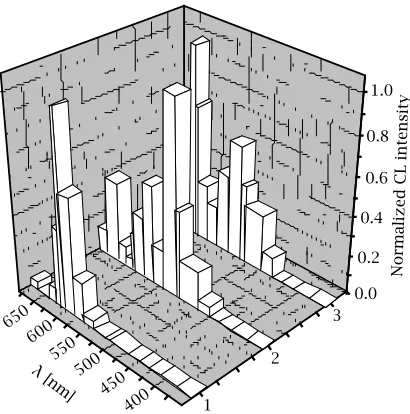
In the spectra of systemsIVandV(spectrum 1, Fig-ure 3) the dominant band with a maximum at∼600 nm is a result of the radiative transitions 5D
0→7F1and
5D
0→7F2in the Eu3+ ion. It means that in these
sys-tems the energy coming from decomposition of hydro-gen peroxide is accepted by the europium ions being simultaneously emitters [7, 8]. The azide ions present in systemVeffectively (by about three orders of magni-tude) increase both the duration and yield of CL of the system.
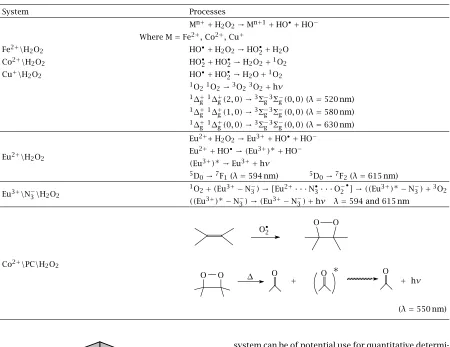
The emission spectrum of systemI—the so-called Fenton system (spectrum 2, Figure 3) shows the emis-sion bands at about 520, 580 and 630 nm. Results of the hitherto studies of the system have shown the oc-currence of the radical processes of hydrogen peroxide
1
2 3
0.0 0.2 0.4 0.6 0.8 1.0
Normalized CL intensity
650 600
550 500
450 400
λ
[nm]
Figure 3.Spectral distribution of systems: 1-Eu2+\H2O2
and Eu3+\N−
3\H2O2, 2- Fe2+\H2O2, 3- Co2+\H2O2 and
Cu+\H2O2.
decomposition leading to the formation of singlet oxy-gen dimols [9, 10]. The spectrum 3 in Figure 3, charac-teristic of systemsIIandIII, containing the cations Cu+ and Co2+is similar to that systemI(Fenton), however, the maximum emission in these systems is at∼630 nm, which indicates a different dominant emitter than in systemI.
In the inorganic systems containing metal ions and hydrogen peroxide CL is usually of very low intensity. Components very often added to such inorganic sys-tems are sodium or potassium carbonates or hydrocar-bonates [11, 12]. Their addition implies the adequate adjustment of pH of the reaction environment: neutral or basic. In this study we report the effect of addition of sodium carbonate on the CL of systemsI–V. For sys-temsI–IVthe emission intensity increased as a result of sodium carbonate addition and the CL decay kinet-ics was similar as in the system without this addition. In system Va decrease in the emission intensity was observed with increasing concentration of carbonates.
A characteristic feature of the systems contain-ing carbonates is the emission band with a maximum at ∼ 420 nm (spectrum 1, Figure 4). The hitherto ob-tained results [12] indicate that the radical processes taking place in this system lead to decomposition of carbonates and the energetic effect of such reactions (∼ 305 kJ/mol) is high enough to generate radiation with a maximum at 420 nm (spectrum 2, Figure 4).
[image:2.600.71.287.210.377.2]Table 1.Chemiluminescence radical processes in studied systems containing hydrogen peroxide.
System Processes
Mn++H2O2→Mn+1+HO•+HO− Where M=Fe2+,Co2+,Cu+
Fe2+\H2O2 HO•+H2O2→HO•2+H2O
Co2+\H2O2 HO•
2+HO•2→H2O2+1O2
Cu+\H2O2 HO•+HO•2→H2O+1O2
1O
21O2→3O23O2+hν
1∆+
g 1∆+g(2,0)→3Σg−3Σ−g(0,0)(λ=520 nm)
1∆+
g 1∆+g(1,0)→3Σg−3Σ−g(0,0)(λ=580 nm) 1∆+g 1∆+g(0,0)→3Σ−g3Σ−g(0,0)(λ=630 nm)
Eu2+\H2O2
Eu2++ H2O2→Eu3++HO•+HO− Eu2++HO•→(Eu3+)∗+HO−
(Eu3+)∗→Eu3++hν
5D
0→7F1(λ=594 nm) 5D0→7F2(λ=615 nm)
Eu3+\N3−\H2O2
1O
2+(Eu3+−N−3)→[Eu2+· · ·N•3· · ·O−2•]→((Eu3+)∗−N−3)+3O2
((Eu3+)∗−N−
3)→(Eu3+−N−3)+hν λ=594 and 615 nm
Co2+\PC\H2O2
O•2 O O
O O ∆ O
+ O
∗ O
+ hν
(λ=550 nm)
650 600
550 500
450 400
λ
[nm]
1
2 0.0
0.2 0.4 0.6
0.8 1.0
[image:3.600.80.287.425.632.2]Normalized CL intensity
Figure 4.Spectral distribution of systems:1-Co2+\
propy-lene carbonate\H2O2,2-Co2+\HCO−3\H2O2.
carbonate. The kinetics of CL decay in this system is the same as in systemII, but the intensity of emission is by one order of magnitude higher. For this reason the
system can be of potential use for quantitative determi-nation of Co2+ions (below 10−9mol/l), analogously to
the system Co2+\HCO3−\H2O2. The emission spectrum
of systemVIis shown in Figure 4, spectrum 1. The spectrum reveals a broad band with a max-imum at ∼ 550 nm, which indicates that system VI
generates a different type emitter than the system Co2+\HCO3−\H
2O2, and this different emitter is
formed in a process whose yield is similar to that of a radical decomposition of carbonates. The double bond in the propylene carbonate molecule and the presence of oxygen radicals in the systems with hydrogen perox-ide suggests that the process of CL in systemVIoccurs according to the McCapra mechanism [13] (Table 1).
The system that deserves particular attention is systemV(Eu3+\N−
3\H2O2). From among the members
of the lanthanide series only europium together with azide ions and hydrogen peroxide forms a CL emitting system. No effect of the other f-electron ions on the ki-netics and yield of CL in this system was found. The high yield of CL and the characteristic emission band of this system make it also attractive from the point of view of analytical applications. A characteristic feature of system Vis that with the progress of the reaction it undergoes gelation. This phenomenon is observed for the reagents concentrations (Eu3+, N−
242 Marian Elbanowskiet al. Vol. 05
higher than 0.15 mol/l. The gel forming in the system is colourless, water soluble and stable at 100◦C. Most probably the phenomenon of gelation occurs as a re-sults of the radical reactions leading to the formation of the N−OH bonds in the reaction products and then condensation of the reaction products. In the systems type metal ion\N−3\H2O2, the process of gelation has
been noted only in the presence of europium ions.
4. Conclusions
The processes of emission accompanying the decompo-sition of hydrogen peroxide in the systems containing the ions catalysing this decomposition such as (Fe2+\3+, Co2+\3+, Cu+\2+) take place with the involvement of sin-glet oxygen. The low yield of CL in these systems im-plies the need to use activators. One of a few inorganic activators is the complex(Eu−N3)2+, which effectively increases the yield of CL in solutions containing active oxygen species. A similar effect has been observed in the systems with propylene carbonate. In the latter sys-tems the energy from H2O2decomposition is captured
by the excited carbonyl reaction products, according to the mechanism proposed by Mc Capra [13] (Table 1). The yield of CL in the systems type: metal ion\PC\H2O2
is additionally enhanced by addition of ethanol.
ACKNOWLEDGMENT
This work was supported by the Polish State Committee for Scientific Research, Grant No 3 T09A 105 19.
REFERENCES
[1] H. A. Mottola and D. Perez-Bendito, Anal. Chem.66
(1994), 131R.
[2] K. Hayakawa and S. Nakamura, Bull. Chem. Soc. Jpn.47(1974), 1162.
[3] A. Singh, Photochem. Photobiol.28(1978), 429. [4] K. Staninski, M. Kaczmarek, and M. Elbanowski, J.
All. Comp.341(2002), 294.
[5] M. Elbanowski, K. Staninski, M. Kaczmarek, and S. Lis, J. All. Comp.323–324(2001), 670.
[6] K. Staninski, M. Kaczmarek, S. Lis, and M. El-banowski, Int. J. Photoen.3(2001), 201.
[7] M. Elbanowski, K. Staninski, and M. Kaczmarek, Spectrochim. Acta Part A54(1998), 2223. [8] M. Elbanowski, B. Makowska, K. Staninski, and M.
Kaczmarek, J. Photochem. Photobiol. A: Chem.130
(2000), 75.
[9] H. Inaba, Y. Shimizu, Y. Tsuji, and A. Yamagishi, Photochem. Photobiol.30(1979), 169.
[10] A. Singh, Can. J. Physiol. Pharmacol. 60 (1982), 1330.
[11] Z. Fan and L. Qingxiong, Talanta40(1993), 1557. [12] J.-M. Lin and T. Hobo, Anal. Chim. Acta323(1996),
69.
[13] F. McCapra and A. Burford, J. Chem. Soc. Chem. Commun. (1976), 607.
Submit your manuscripts at
http://www.hindawi.com
Hindawi Publishing Corporation
http://www.hindawi.com Volume 2014
Inorganic Chemistry
International Journal ofHindawi Publishing Corporation
http://www.hindawi.com Volume 2014
Photoenergy
Hindawi Publishing Corporation
http://www.hindawi.com Volume 2014
Carbohydrate
Chemistry
International Journal ofHindawi Publishing Corporation
http://www.hindawi.com Volume 2014 Journal of
Chemistry
Hindawi Publishing Corporation
http://www.hindawi.com Volume 2014
Physical Chemistry
Hindawi Publishing Corporation http://www.hindawi.com
Analytical Methods
in Chemistry
Journal of
Volume 2014
Bioinorganic Chemistry and Applications Hindawi Publishing Corporation
http://www.hindawi.com Volume 2014
Spectroscopy
International Journal of Hindawi Publishing Corporationhttp://www.hindawi.com Volume 2014
The Scientific
World Journal
Hindawi Publishing Corporationhttp://www.hindawi.com Volume 2014
Medicinal Chemistry
Hindawi Publishing Corporation
http://www.hindawi.com Volume 2014
Chromatography
Research International
Hindawi Publishing Corporationhttp://www.hindawi.com Volume 2014
Applied Chemistry
Journal ofHindawi Publishing Corporation
http://www.hindawi.com Volume 2014
Hindawi Publishing Corporation
http://www.hindawi.com Volume 2014
Theoretical Chemistry
Journal of Hindawi Publishing Corporation
http://www.hindawi.com Volume 2014 Journal of
Spectroscopy
Analytical Chemistry
Hindawi Publishing Corporation
http://www.hindawi.com Volume 2014
Journal of
Hindawi Publishing Corporation
http://www.hindawi.com Volume 2014
Quantum Chemistry
Hindawi Publishing Corporation
http://www.hindawi.com Volume 2014
International
Electrochemistry
International Journal ofHindawi Publishing Corporation
http://www.hindawi.com Volume 2014
Hindawi Publishing Corporation
http://www.hindawi.com Volume 2014