odern control systems must meet in-creasingly demanding requirements stemming from the need to cope with significant degrees of uncertainty, as
well as with more dynamic environments, and to provide greater flexibility. This, in turn, means that
con-trol systems software is highly complex in that it invariably has a large number of interacting parts [20]. This complexity requires that state-of-the-art software engineering methods and techniques be employed. In this article, we will argue that analyzing, designing, and implementing such complex
soft-ware systems as a collection of interacting, autonomous, flexi-ble components (i.e., as agents) affords software engineers several significant advantages over contemporary methods.
In seeking to demonstrate the efficacy of the agent-ori-ented software engineering approach [11], the most compelling argument would be to show quantitatively how its adoption improved the develop-ment process in a range of (control system) projects. Al-though several applications have been deployed (see [15] and [19] for overviews), such data are simply not available (as is the case for other contemporary software engineering approaches such as patterns, application frameworks, and
By Nicholas R. Jennings
and Stefan Bussmann
Jennings ([email protected]) and Bussmann are with the Department of Electronics and Computer Science, University of Southampton, Southampton SO17 1BJ, U.K. Bussmann is also with DaimlerChrysler AG, Alt-Moabit 96a, 10559 Berlin, Germany.
component-ware). Given this fact, the best that can be achieved is a qualitative justification for why agent-oriented approaches are well suited to engineering complex control systems. This general premise is then supported with two specific case studies in the domains of industrial process control (in particular, electricity transportation manage-ment) and manufacturing control (in particular, manufac-turing line control), where the experiences of using an agent-based approach are assessed.
Before making the general case for agent-oriented software engineering, however, we first discuss the characteristics of complex software systems (of which control systems are natu-rally an instance). We then discuss the methods that software engineers have developed to help manage this complexity.
The role of any new software engineering paradigm is to provide structures and techniques that make complexity eas-ier to handle. Fortunately for designers, this complexity ex-hibits several important regularities [20]. First, complexity frequently takes the form of a hierarchy; that is, a system composed of interrelated subsystems, each of which is in turn hierarchic in structure, until the lowest level of elemen-tary subsystem is reached. The precise nature of these orga-nizational relationships varies between subsystems; however, some generic forms (such as client-server, peer, etc.) can be identified. These relationships are not static; they often vary over time. Second, the choice of which com-ponents in the system are primitive is relatively arbitrary and is defined by the observer’s aims and objectives. Third, hier-archical systems evolve more quickly than nonhierhier-archical ones of comparable size (i.e., complex systems will evolve from simple systems more rapidly if there are clearly identifi-able stidentifi-able intermediate forms than if there are not). Fourth, it is possible to distinguish between the interactions among subsystems and those within subsystems. The latter are both more frequent (typically by at least an order of magni-tude) and more predictable than the former. This gives rise to the view that complex systems are nearly decomposable: subsystems can be treated almost as if they are independent,
but not quite, since there are some interactions between them. Moreover, although many of these interactions can be predicted at design time, some cannot.
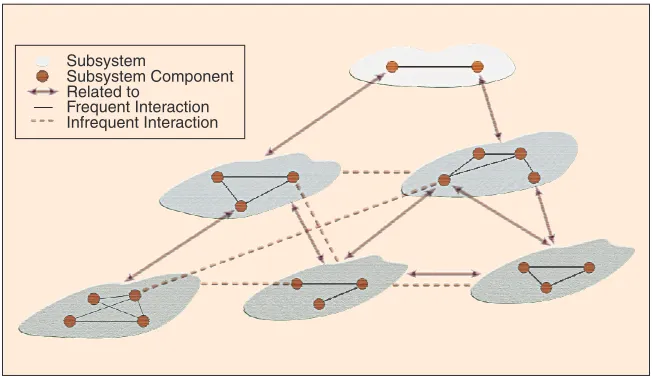
Drawing these insights together, a canonical view of a complex system (Figure 1) can be defined. The system’s hi-erarchical nature is expressed through the “related to” links; components within a subsystem are connected through “frequent interaction” links, and interactions be-tween components are expressed through “infrequent inter-action” links.
Given these observations, software engineers have de-vised several fundamental tools of the trade to help manage this complexity [2], [3].
• Decomposition:The most basic technique for tackling large problems is to divide them into smaller, more man-ageable chunks, each of which can then be addressed in relative isolation (note the nearly decomposable sub-systems in Figure 1). Decomposition helps tackle com-plexity because it limits the designer’s scope.
• Abstraction: The process of defining a simplified model of the system that emphasizes some of the de-tails or properties while suppressing others. Again, this works because it limits the designer’s scope of in-terest at a given time.
• Organization:The process of defining and managing the interrelationships among the various problem-solving components (note the subsystem and interaction links of Figure 1). This covers phenomena such as inheritance (in object-oriented systems) and subroutines (in proce-dural languages). The ability to specify and enact orga-nizational relationships helps designers tackle complexity by enabling a number of basic components to be grouped together and treated as a higher-level unit of analysis and by providing a means of describing the high-level relationships among various units.
Having characterized complex software systems and identified the fundamental software engineering ap-proaches that help manage this complexity, the case for agent-oriented software engineering can now be made.
The Case for
Agent-Oriented
Software Engineering
The first step in arguing for an agent-ori-ented approach to software engineer-ing involves identifyengineer-ing the key concepts of agent-based computing. The first such concept is that of an agent: “An agent is an encapsulated computer system that is situated in some environment and can act flexibly and autonomously in that environment to meet its design objectives” [22].Several points about this definition require elaboration. Agents are i) Subsystem
Subsystem Component Related to
[image:2.612.59.385.532.720.2]Frequent Interaction Infrequent Interaction
clearly identifiable problem-solving entities with well-defined boundaries and interfaces; ii) situated (embedded) in a par-ticular environment over which they have partial control and observability—they receive inputs related to the state of their environment through sensors and they act on the envi-ronment through effectors; iii) designed to fulfill a specific role—they have particular objectives to achieve; iv) autono-mous—they have control over both their internal state and their own behavior; v) capable of exhibiting flexible prob-lem-solving behavior in pursuit of their design objectives, be-ing both reactive (able to respond in a timely fashion to changes that occur in their environment) and proactive (able to opportunistically adopt goals and take the initiative) [24].
When adopting an agent-oriented view, it soon becomes apparent that most problems require or involve multiple agents: to represent the decentralized nature of the prob-lem, the multiple loci of control, the multiple perspectives, or the competing interests [1]. Moreover, the agents will need to interact with one another, either to achieve their in-dividual objectives or to manage the dependencies that en-sue from being situated in a common environment. These interactions can vary from simple semantic interoperation (information passing), through traditional client-server-type interactions, to rich social interactions (the ability to cooperate [12], coordinate [10], and negotiate [13] about a course of action). Whatever the nature of the social process, however, two points qualitatively differentiate agent inter-actions from those that occur in other software engineering paradigms. First, agent-oriented interactions generally oc-cur through a high-level (declarative) agent communication language (often based on speech act theory [17]). Conse-quently, interactions are conducted at the knowledge level [16]: in terms of which goals should be followed, at what time, and by whom (compare method invocation or func-tion calls that operate at a purely syntactic level). Second, as agents are flexible problem solvers, operating in an envi-ronment over which they have only partial control and observability, interactions need to be handled in a similarly flexible manner. Thus, agents need the ability to make con-text-dependent decisions about the nature and scope of their interactions and to initiate (and respond to) interac-tions that were not foreseen at design time.
In the majority of cases, agents act either on behalf of in-dividuals/companies or as part of some wider initiative. Thus, there is typically some underpinning organizational context to the agents’ interactions. This context defines the nature of the relationship between the agents and the rules that must be adhered to during the interaction. For exam-ple, the agents may be peers working together in a team, or one may be the manager of the others, or the agents must negotiate according to the rules of a particular auction house. To capture such links, agent systems have explicit constructs for modeling organizational relationships (e.g., manager, team member, auctioneer). In many cases, these relationships are subject to ongoing change: social
interac-tion means existing relainterac-tionships evolve (e.g., a team of peers may elect a leader) and new relationships are created (e.g., a number of unrelated agents band together to deliver a service that no one individual can offer). The temporal ex-tent of these relationships can also vary enormously: from providing a service as a one-off to a permanent bond. To cope with this variety and dynamism, agent researchers have devised protocols that enable organizational group-ings to be formed and disbanded [6], specified mechanisms to ensure that groupings act together in a coherent fashion [12], [10], and developed structures to characterize the macro behavior of collectives [15], [24].
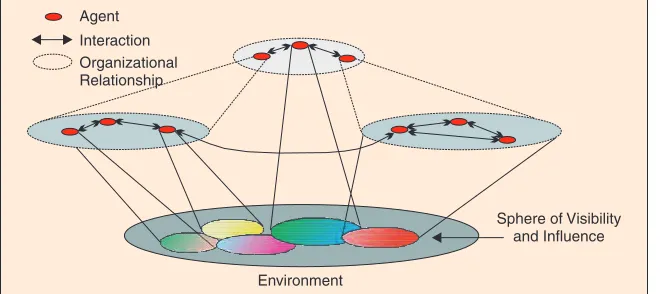
Drawing these points together (Figure 2), it can be seen that i) adopting an agent-oriented approach to software en-gineering means decomposing the problem into multiple au-tonomous components that can act and interact in flexible
Agents Versus Objects
ways to achieve their set objectives; ii) the key abstraction models that define the agent-oriented mindset are agents, interactions, and organizations; and iii) explicit structures and mechanisms are often used to describe and manage the complex and changing web of organizational relationships that exist among the agents.
From a control perspective, this view of software tems has several similarities to work on heterarchical sys-tems in distributed control [8]. The work of [9], for example, avoids the drawbacks of hierarchical control by distributing the decision making into intelligent parts. However, the work on heterarchical control tends to concentrate on the distributed systems nature of these control systems and, to a certain extent, on the autonomy of the individual components, rather than on the flexible, high-level nature of the interactions and the explicit representation of the or-ganizational context.
The Software Engineering Credentials
of the Agent-Oriented Approach
Here the argument in favor of an agent-oriented approach to software engineering is composed of the following steps: i) show that agent-oriented decompositions are an effective way of partitioning the problem space of a complex system, ii) show that the key abstractions of the agent-oriented mindset are a natural means of modeling complex systems, and iii) show that the agent-oriented philosophy for model-ing and managmodel-ing organizational relationships is appropriate for dealing with the dependencies and interactions that exist in complex systems. When taken together, these steps form a complete mapping (cross product) between the characteris-tics of a complex system and the key software engineering ab-stractions for handling complexity as they apply to agent-based systems. Each step is now discussed in turn.
The Merits of Agent-Oriented Decompositions Complex systems consist of a number of related subsys-tems organized in a hierarchical fashion (Figure 1). At any given level, subsystems work together to achieve the func-tionality of their parent system. Moreover, within a
subsys-tem, the constituent components work together to deliver the overall functionality. Thus, the same basic model of in-teracting components, working together to achieve particu-lar objectives, occurs throughout the system. Given this fact, it is entirely natural to modularize the components in terms of the objectives they achieve. (Indeed, the view that decompositions based on functions/actions/processes are more intuitive and easier to produce than those based on data/objects is even acknowledged within the object-ori-ented community (see [18, p. 44])). In other words, each component can be thought of as achieving one or more ob-jectives. A second important observation is that complex systems have multiple loci of control: “real systems have no top” [18, p. 43]. Applying this philosophy to objective-achieving decompositions means the individual compo-nents should localize and encapsulate their own control. Thus, entities should have their own thread of control (i.e., they should be active), and they should have control over their own actions (i.e., they should be autonomous).
For the active and autonomous components to fulfill both their individual and collective objectives, they need to interact (recall that complex systems are only nearly de-composable). However, the system’s inherent complexity means it is impossible to a priori know about all potential links: interactions will occur at unpredictable times, for un-predictable reasons, between unun-predictable components. For this reason, it is futile to try to predict or analyze all the possibilities at design time. It is more realistic to endow the components with the ability to make decisions about the na-ture and scope of their interactions at runtime. From this, it follows that components need the ability to initiate (and re-spond to) interactions in a flexible manner.
The policy of deferring to runtime decisions about compo-nent interactions facilitates the engineering of complex sys-tems in two ways. First, problems associated with the coupling of components are significantly reduced (by dealing with them in a flexible and declarative manner). Components are specifically designed to respond to unanticipated re-quests and can spontaneously generate rere-quests for assis-tance if they find themselves in difficulty. Moreover, because these interactions are enacted through a high-level agent communication lan-guage, coupling becomes a knowl-edge-level issue. This removes syntactic concerns from the types of er-rors caused by unexpected interac-tions. Second, the problem of managing control relationships among the soft-ware components (a task that bedevils traditional objective-based decomposi-tions) is significantly reduced. All agents are continuously active, and any coordination or synchronization that is required is handled bottom-up through interagent interaction.
Agent Interaction Organizational Relationship
Environment
[image:4.612.60.390.559.706.2]Sphere of Visibility and Influence
From this discussion, it is apparent that the natural way to modularize a complex system is in terms of multiple autono-mous components that act and interact in flexible ways to achieve their objectives. Given this, the agent-oriented ap-proach is simply the best fit.
The Suitability of Agent-Oriented Abstractions
A significant part of the design process is finding the right models for viewing the problem. Typically, there will be mul-tiple candidates, and the difficult task is choosing the most appropriate one. When designing software, the most power-ful abstractions are those that minimize the semantic gap between the units of analysis that are intuitively used to conceptualize the problem and the constructs present in the solution paradigm. In the case of complex systems, the problem to be characterized consists of subsystems, sub-system components, interactions, and organizational rela-tionships.
• Subsystems naturally correspond to agent organiza-tions. They involve several constituent components that act and interact according to their role within the larger enterprise.
• The case for viewing subsystem components as agents has been made above.
• The interplay between the subsystems and between their constituent components is most naturally viewed in terms of high-level social interactions: “In a complex system at any given level of abstraction, we find meaningful collections of objects that collaborate to achieve some higher level view” [2, p. 34]. This view accords precisely with the knowledge-level treatment of interaction afforded by the agent-oriented ap-proach. Agent systems are invariably described in terms of “cooperating to achieve common objec-tives,” “coordinating their actions,” or “negotiating to resolve conflicts.”
• Complex systems involve changing webs of relation-ships among their various components. They also re-quire collections of components to be treated as a single conceptual unit when viewed from a different level of abstraction. Here again, the agent-oriented mindset provides suitable abstractions. A rich set of structures is available for explicitly representing orga-nizational relationships [6]. Interaction protocols ex-ist for forming new groupings and disbanding unwanted ones. Finally, structures are available for modeling collectives [12]. The latter point is espe-cially useful in relation to representing subsystems, as they are nothing more than a team of components working together to achieve a collective goal.
The Need for Flexible Management of Changing Organizational Structures
Organizational constructs are first-class entities (in the pro-gramming language sense) in agent systems—explicit
rep-resentations are made of organizational relationships and structures. Moreover, agent-oriented systems have the con-comitant computational mechanisms for flexibly forming, maintaining, and disbanding organizations. This represen-tational power enables agent systems to exploit two facets of the nature of complex systems. First, the notion of a primi-tive component can be varied according to the needs of the observer. Thus, at one level, entire subsystems can be viewed as singletons or collections of agents can be viewed as primitive components, and so on, until the system even-tually bottoms out. Second, such structures provide the sta-ble intermediate forms that are essential for the rapid development of complex systems. Their availability means that individual agents or organizational groupings can be developed in relative isolation and then added into the sys-tem in an incremental manner. This, in turn, ensures a smooth growth in functionality.
Will Agent-Oriented Techniques
Be Widely Adopted?
Two key pragmatic issues will determine whether agent-oriented approaches catch on as a software engineering paradigm: the degree to which agents represent a radical departure from current software engineering thinking and the degree to which existing software can be integrated with agents.
been used in a wide variety of applications, including air traf-fic control, process control, fault diagnosis, and transporta-tion [15], [19]. In the latter case, flexible patterns of interaction such as the contract net protocol [21] (an agent with a task to complete advertises this fact to others that it believes are capable of performing it; these agents may sub-mit a bid to perform the task if they are interested, and the originator then delegates the task to the agent that makes the best bid) and various forms of resource-allocation auction
(e.g., English, Dutch, first- and second-price sealed bid [25]) have been reused in numerous applications (see the manu-facturing line control scenario). In short, agent-oriented tech-niques represent a natural progression of current software engineering thinking, and, for this reason, the main concepts and tenets of the approach should be readily acceptable to software engineering practitioners.
The second factor in favor of a widespread use of agents is that their adoption does not require a revolution in terms of an organization’s existing software systems. Agent-oriented systems are evolutionary and incremental, as legacy (nonagent) software can be incorporated in a rel-atively straightforward manner (see the electricity trans-portation case study). The technique used is to place wrapping software around the legacy code to serve as an agent interface to the other software components. Thus, from the outside, the wrapper looks like any other agent; on the inside, it performs a two-way translation function: taking external requests from other agents and mapping them into calls in the legacy code and taking the legacy code’s external requests and mapping them into the appro-priate set of agent communication commands. This ability to wrap legacy systems means agents may initially be used as an integration technology. As new requirements are placed on the system, however, bespoke agents may be de-veloped and added. This feature enables a complex system to grow in an evolutionary fashion (based on stable inter-mediate forms) while continually maintaining a working version of the system.
Case Studies
Having discussed the potential benefits of agent-based sys-tems for complex syssys-tems in general, we now present two specific agent-based control system applications. The goal in presenting these case studies is twofold: i) to ground the ab-stract concepts of agent-based computing in specific
applica-tion contexts and ii) to highlight the practical advantages that can accrue from an agent-based solution. Moreover, the scope and applicability of agent-based solutions is empha-sized by discussing two examples that are at fundamentally different levels of the control spectrum: control of an entire network and control of an individual production line.
Electricity Transportation Management
This application was developed and deployed by the Spanish electric utility Iberdrola (more details of the underpinning agent technology can be found in [14], and more details of its application in this domain can be found in [7]). Generally, energy management is the process of moni-toring and controlling the cycle of generating, transporting, and distrib-uting electrical energy to industrial and domestic customers. Generation transforms raw energy (hydraulic, thermal, nuclear, and solar) into a more accessible form that then needs to be transported from its generation site to the consumer. To minimize losses during transportation, the electrical voltage is made high (132 kV or above) before it is placed on a transport network and sent over many hundreds of kilometers. Finally, the voltage is lowered and electricity is delivered to consumers using a distribution network involv-ing many kilometers (all below 132 kV) spread over a much smaller area.
To ensure that the transportation network remains within the desired safety and economical constraints, it is equipped with a sophisticated data acquisition system (SCADA) and several conventional application programs that help the operator (a control engineer) analyze it (these programs are primarily designed for normal operating con-ditions). The network’s operation is monitored from a dis-patching control room (DCR), and whenever an unexpected event occurs, hundreds of alarms are automatically sent to it by the SCADA system. Under these circumstances, the op-erator must rely on experiential knowledge to analyze the information, diagnose the situation, and take appropriate remedial actions to return the network to a safe state. To re-duce the operators’ cognitive load in such circumstances and to help them make better decisions faster, Iberdrola first developed several (stand-alone) decision support sys-tems (e.g., a real-time database that stores information about the state of the network and an alarm analysis expert system that diagnoses faults produced in the network based on the alarm messages received at the DCR). To improve this support, Iberdrola decided that these systems should interoperate to produce a coherent view and that new func-tionality should be added (to enable the control engineer to actually perform and dynamically monitor the service res-toration process and also to exploit the new data sources, such as chronological information and faster rate snap-shots, which became available as the SCADA system was
im-“An agent is an encapsulated computer
system that is situated in some
environment and can act flexibly
proved). What follows is a description of how these goals were achieved using agent technology.
Why Use Agent Techniques for This Application? This application required the tried and tested decision sup-port tools to be integrated and extended with new function-ality. Two means of realizing this system upgrade strategy were considered: extend the existing systems to cover the new features or follow a distributed approach and allow the new functionality to be expressed as distinct computational entities that can interact with the existing systems through a common distribution platform. The second option was chosen because it was considered the most effective means of the following:
• Permitting reasoning based on information of different granularity.Two types of alarms, nonchronological and chronological, need to be dealt with. In the former case, the time stamped is coincident with the time of acquisition by the control system (consequently, it is conditioned by the control system’s polling mecha-nism), whereas in the latter case, the time stamped is coincident with the actual occurrence of the event. As chronological alarms represent a more accurate pic-ture of events in the network, they generally lead to a swifter diagnosis; however, they have the disadvan-tage that chronological information has a low priority in Iberdrola’s communication channels. Thus, when the channels are saturated (as often happens during a disturbance), their time of arrival is unpredictable. For these reasons, a new alarm analysis expert system was built that utilized chronological information and could subsequently integrate its results with those of the pre-existing system, rather than constructing a monolithic system that received both types of data and had to em-body both types of diagnostic knowledge.
A similar situation occurs when considering ser-vice restoration. Two types of information are rele-vant to this activity: snapshots (which provide a comprehensive picture of the current state of all the network’s components) and alarm messages (which show how the state of the components has changed over time). The former can be produced relatively quickly and give a complete picture of the system’s state, whereas the latter may take several minutes for a large disturbance but are needed to indicate the type of fault from which the system must be restored. Rather than trying to place both types of information and reasoning in a single system, it seemed more natu-ral to develop a service restoration subsystem that dealt mainly with snapshots and received the neces-sary high-level information about the equipment at fault from a diagnosis subsystem (rather than trying to deal with the raw alarm messages themselves). • Allowing the inclusion of different network models
within the same system.Some of the problem solvers
need to work on the SCADA model of the network, while others need the applications network model (a model that permits differential equations to be solved and takes into account the physical characteristics of all its components). Rather than trying to combine and harmonize these complex and disparate models at design time, it was decided that each subsystem should work on whichever model was most appropri-ate for its task. Then the various components can in-teract at runtime to resolve any inconsistencies that arise from their use of different network models. • Enabling the use of several different problem-solving
paradigms.The diverse range of activities that need to be performed means there is no universally best prob-lem-solving paradigm; procedural techniques are re-quired for algorithmic calculations such as connectivity (to know which component is connected to which other) and load-flow analysis (solution of the differential equations), whereas symbolic reasoning based on heuristic search is best for diagnosis. A dis-tributed approach enabled each component to be en-coded in the most appropriate method.
• Meeting the application’s performance criteria. Trans-portation management is a time-critical application, and as many different types of information can be pro-cessed in parallel, with only a small synchronization overhead, the response time of the overall system can be improved through the use of several intercon-nected machines.
Having decided on a distributed approach, a choice had to be made between using more conventional distributed processing techniques or agent-based techniques. Here the latter was adopted for the following reasons:
• Robustness:As the subsystems have overlapping do-mains of expertise, the failure of one of them to pro-duce an answer does not necessarily mean that no solution will be forthcoming (because one of the other systems may be able to produce at least a partial solu-tion). However, to achieve this backup functionality flexibly, the different problem-solving components need to be intelligently coordinated in a context-sensi-tive manner (see the cooperacontext-sensi-tive scenario for more details), a task beyond present-generation distributed processing systems.
• Reliability:The solutions of the overlapping systems can be cross referenced so as to present the operator with more reliable information. Again, however, this cross-referencing functionality needs to be properly managed according to the prevailing circumstances and thus requires dynamic and flexible reasoning to take place.
restoration, another tries to diagnose the problem based on different sources of information, and so on—and they communicate relevant information to one another to ensure they are following a coherent course of action toward the overall objective of re-storing the service.
Specification of the Agents
During normal working conditions, management of the net-work by the operator in the DCR consists mainly of routine and simple tasks. However, during emergency situations, management becomes considerably more difficult because of the large number of constraints that must be taken into con-sideration and the insufficient quality of the information available to make these decisions. Emergency situations typi-cally originate from a short circuit in a line, bus bar, or trans-former. They can be exacerbated by equipment mal-functioning (e.g., a breaker failing to open) or subsequent overloads (a domino effect can cause one line to fail because of an overload, which in turn increases the load on neighbor-ing lines so they become overloaded and subsequently fail, and so on). The situation can become even worse if power stations become disconnected, as this will cause an imbal-ance in the network’s power. Consequently, actions to restore service must be taken rapidly and accurately so that what starts as a relatively minor problem does not escalate into a major disaster. In these circumstances, the actions the opera-tor can perform consist mainly of breaker operations, topol-ogy changes, and activation/deactivation of automatisms and protective relays. For larger disturbances, however, ac-tions on power plants may also be required. From this de-scription of the control engineer’s job, a top-down analysis determined that a comprehensive decision support system should cover the following activities:
• detect the existence of disturbances; sometimes the operation of protective relays and breakers can be caused by routine maintenance, and this should not be confused with genuine disturbances
• determine the cause, location, and type of the distur-bance, including identifying if any equipment is per-manently damaged
• analyze the situation of the network once it arrives at a steady state
• prepare a restoration plan to return the network to its original operational state.
Allying this top-down analysis with the bottom-up per-spective of examining the extant systems, we decided to en-capsulate the following preexisting systems as agents: the alarm analysis expert system and the interface to the con-trol system. As discussed earlier, the availability of chrono-logical alarm messages necessitated a new diagnosis system, which we decided to make available as an agent. Fi-nally, it was always known that information about the initial area out of service (the blackout area) could help constrain the search for the faulty equipment; however, developing a
dedicated stand-alone system for this purpose was never deemed cost-effective since the original alarm analysis ex-pert system’s performance was considered satisfactory (if somewhat slow). However, through the use of agent tech-nology, much of the basic infrastructure to implement this functionality was now available from other agents, so devel-oping a system capable of producing this information was considered economically viable.
In more detail, the operational system consists of seven agents running on five different machines (Figure 3). This figure shows a small portion of the Iberdrola network, which contains four substations (Sestao, Sodupe, Erandio, and Achuri). Each of these substations has a corresponding re-mote transmission unit (RTU) that sends information to the DCR in Bilbao about the status of its bus bars, breakers, and other electrical components. In the DCR, this information is collected by the front-end computer and made available to the cooperating agents through the control system’s inter-face functions.
• BRS (breakers and relays supervisor):The new alarm analysis expert system detects the occurrence of a dis-turbance, determines the type of fault and its extent, generates an ordered list of fault hypotheses, validates hypotheses, and identifies malfunctioning equipment. To perform its analysis, it takes two types of inputs: chronological alarm messages and snapshots of the net-work that give the status of every breaker and switch. • AAA (preexisting, nonchronological alarm analysis agent
expert system):This agent pursues similar goals to the BRS, but the quality of information it receives is inferior to that of the BRS. Although the alarm messages re-ceived by both systems relate to the same physical op-erations, those received by the AAA represent ±5 s accuracy, whereas those received by the BRS are pre-cise. This means that if the data are error free, then the BRS performs a better diagnosis than the AAA. However, if some of the chronological information is lost (a dis-tinct possibility when the SCADA system is busy), the BRS may perform worse than the AAA. Therefore, when-ever incomplete or erroneous information exists, which is true in most interesting cases, there is a need for coop-eration between the two systems to make the overall system more robust and reliable (see below).
• SRA (service restoration agent):This agent devises a ser-vice restoration plan to return the network to a steady state after a blackout has occurred. To do so, it takes into account the constraints imposed by the damaged equipment as identified by the diagnosis agents. • UIA (user interface agent):This agent implements the
simulated environment to see its predicted effect, and request the development of a new restoration plan that takes into account the actions that are deemed pertinent. Through the use of a distributed window-ing system, the UIA presents the appropriate informa-tion on the consoles of the various control engineers who are working on the system (Figure 3 shows two such control engineers, one working on restoration activities and one on diagnosis activities).
• BAI (blackout area identifier):When a fault occurs, the network’s protective relays and breakers automatically try to isolate the minimum amount of equipment possi-ble; in an ideal case, only the element at fault would be isolated. The BAI’s objective is to identify which ele-ments of the network are initially out of service, as the actual element at fault must be within this region. It uses nonchronological alarm messages as its information source and cooperates with the BRS and the AAA to in-crease the efficiency of the overall diagnosis process. • CSI (preexisting control system interface):The CSI acts as
the front end to the control system computers. Its objec-tives are to acquire and distribute network data to the other agents, to interface with the conventional man-agement system application programs, and to monitor the restoration process to detect unexpected devia-tions. It is split into two physical agents: CSI-D, which de-tects the occurrence of disturbances and preprocesses the chronological and nonchronological alarm mes-sages that are used by the AAA, BAI, and BRS agents; and CSI-R, which detects and corrects inconsistencies in the snapshot data file of the network, calculates the power flowing through it, and makes this information available to the SRA and the UIA.
This system design ensures that all the tasks identified by the top-down analysis are
per-formed by at least one agent. Robustness is achieved by having multiple agents that are able to provide the same (or at least some) overlapping re-sults. Efficiency is obtained by the parallel activation of tasks. Reliability is increased be-cause even if one of the agents breaks down, the rest of the agents can often produce a re-sult that, although not as good as the one provided by the complete system, is still of use to the operator.
Cooperative Diagnosis and Restoration
An important example of co-operation in this system
in-volves the information interchange between the AAA, BRS, and BAI agents. The AAA and BRS produce the same result from different information sources, whereas BAI applies dif-ferent knowledge to produce a result that should be coher-ent with that of the AAA and BRS.
Assume a block of nonchronological alarm messages has been provided by the SCADA system, and these alarm mes-sages have been identified as related to a disturbance by the CSI. Using its model of the other agents, the CSI will realize the alarms are relevant to the AAA and BAI and will volun-tarily send them out as unsolicited data. Some time later, the same process will be repeated, and the BRS will receive the corresponding chronological alarm messages. At this point, the AAA, BAI, and BRS are all operating in parallel.
When the AAA receives the alarm messages, it starts its diagnosis process, and a preliminary set of hypotheses is produced. During this time, the BAI would also have re-ceived the alarm messages and would have started trying to identify the initial blackout area. Again based on its models of the other agents, the BAI sends this information to the AAA. After a certain delay, the BRS agent starts working on the analysis of the chronological alarm messages. This will also result in a list of initial hypotheses being produced. The BRS checks whether any agents are interested in this infor-mation—again the AAA is noted and the hypotheses sent to it. The BRS then continues with its diagnosis to try and vali-date the cause of the fault.
After producing its tentative list of hypotheses, the AAA proceeds with a detailed analysis to try to ascertain the pre-cise cause of the fault. The following situations may then oc-cur: i) the initial blackout area is available to the AAA, triggering a refinement behavior that may reduce the number of hypotheses to be validated because the BAI has given a fo-cused view of the situation; ii) the initial hypotheses
pro-Bus Bar RTU
Substation
Front-End Computer
Achuri Line Breaker
Erandio
Sestao
Sodupe
BAI, CSI-D
AAA, BRS
CSI-R UIA
Diagnosis Restoration SRA
vided by the BRS are available to the AAA, triggering another refinement behavior and obtaining a better reordering of the hypotheses to be validated and a benefit in finding the ele-ment at fault; iii) the validated hypotheses provided by the BRS are available to the AAA, triggering yet another refine-ment behavior that has the same functionality as the previ-ous one, but the reordering is based on validated hypotheses that are more accurate; iv) if no information is available from the BAI or BRS, the AAA proceeds with its hypothesis valida-tion as a stand-alone agent. Therefore, if the other agents are down or are too slow to provide the information, the AAA will continue and find a faulty element, although its diagnosis will be less reliable and will take longer.
The restoration process is activated whenever a distur-bance is detected. Once the disturdistur-bance is identified, the disturbance identifier is sent to the CSI-R, which acquires the snapshot of the network, corrects any inconsistencies that have arisen in its representation, and calculates the power flow solution of the current state. This information is then passed on to the SRA so that it can prepare for its resto-ration planning. The SRA waits until the diagnosis agents have informed it of the element suspected of being at fault and then proceeds to prepare a restoration plan. If, during this plan preparation, the SRA is informed that the equip-ment at fault is different from that originally indicated by ei-ther the AAA or the BRS, then it replans the restoration taking this information into account.
The UIA is the interface through which the user accesses the results produced by the agent community. During the di-agnosis phase, the user is presented with both the tentative (early) list of suspected hypotheses and the final (validated) list. During the restoration phase, the UIA supports a more participatory interaction between the user and the teams of agents. The user is presented with the restoration plan and can then decide to modify it, run a detailed simulation to see the effects of the plan, or specify new constraints and ask for a new plan to be devised taking them into account.
Observations and Reflections
This application afforded several benefits. First, the agent system gives better results than its stand-alone counterparts because it takes into account multiple types of knowledge and data and then integrates them in a consistent manner. Second, the agent system is more robust because there are overlapping functionalities, meaning partial results can be produced in the case of component (agent) failure. Third, some results can be provided more quickly because coopera-tion provides a shortcut. Fourth, the funccoopera-tionalities of the dif-ferent domain systems can be increased independently, which makes them easier to maintain (see, for example, the argument for developing the BAI and the general point about stable intermediate forms). Fifth, the control engineer is pro-vided with an integrated view of the results of interest. Fi-nally, the system has been designed to be open so that new agents can be added in an incremental manner.
One of the key features of this multiagent system is the way it handles fault diagnosis by using two different types of data (the nonchronological alarms used by the AAA and the chronological alarms used by the BRS) and two different points of view (the typical diagnosis approach of hypothesis generation and validation used by the AAA and BRS and the BAI’s monitoring approach, which provides a high-level view of the status of the net-work). With this setup, the solution method that is best suited to the current situation can be dynamically se-lected. For example, if the BRS is operational but the AAA is not, the solution provided to the control engineer is the one created by the BRS; but if both the BRS and the AAA are running, the solution provided is the one that is mutu-ally agreed on between them. Also, the fact that multiple agents are trying to generate the same results can be ex-ploited to avoid repetition of certain tasks if deemed de-sirable in a particular context. For example, both the AAA and the BRS can provide initial hypotheses; conse-quently, if these hypotheses are provided by the BRS and made available to the AAA before it starts its own genera-tion task, then this task need not be executed and the hy-potheses provided by the BRS can be used instead. This ability to flexibly manage, at runtime, multiple sources of data and multiple problem-solving perspectives provides enormous robustness to the overall system because if one of the agents crashes, the others will still be able to provide some form of solution.
Manufacturing Line Control
This application was developed by a DaimlerChrysler-led industrial consortium and was deployed on one of DaimlerChrysler’s production lines in Stuttgart, Germany (more details can be found in [5]). The overall aim of the sys-tem is to provide a flexible and robust syssys-tem for controlling a manufacturing line. This process has several basic parts (workpieces) that have various operations performed on them by various machines.
Why Use Agent Techniques for This Application?
To overcome the aforementioned problems, the control system must be made responsive to the prevailing sit-uation of the manufacturing process. In this domain, a centralized control-ler is not a viable option—it would be too time consuming to construct and maintain an up-to-date representation of what is going on in the whole sys-tem, it would be a severe bottleneck in
the system’s performance, and it would represent a single point of failure (meaning the system would not be robust).
Given the requirements for decentralization, responsive-ness, and flexible contingency handling, an agent- based ap-proach was adopted. In this system, each manufactured part is represented by an autonomous agent that has the objec-tive of getting itself to the end of the manufacturing line after a specified set of operations has been performed on it. Each machine is also represented by an agent. Such agents have the objective of maximizing their throughput, and they do this by deciding what parts will be accepted in what order and what operations will be performed at what time. Thus, for a given part to have an operation performed on it, its agent must negotiate with a machine agent capable of per-forming that operation. In short, resources are allocated dy-namically on a just-in-time basis through a continuous coordination process among the relevant agents.
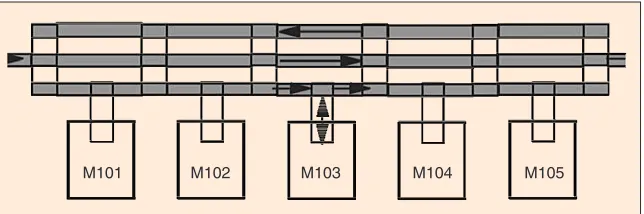
Specification of the Agents and Their Interactions To achieve robustness and flexibility, the machines must have overlapping capacities. This means that there must always be more than one machine that can perform every manufacturing step. Thus, when machine breakdowns occur, the redundancy gives the system the flexibility of diverting the part to another machine. Diverting a part, however, is not possible without the ability to bypass a machine (or machines). To this end, the concept of a modular manufacturing system was developed (Figure 4) in which the entire manufacturing system is com-posed of standard modules. Each module consists of a ma-chine, three one-way conveyors, and two transportation switches (Figure 5). Every switch can move a part from any of its entry points to any of its exits. In Figure 4, each of the inter-mediary switches has two entries and one exit on the left-hand side and two exits and only one entry on the right-hand side. An arrangement of standard modules, as in Figure 4, means a part can either enter a machine through the lower-most conveyor or bypass the machine through the middle one. After bypassing a machine, a part has two options: it can either proceed in a forward direction to a subsequent machine or move backward using the topmost conveyor. If, for instance, the lowermost conveyor is already occupied, preventing a part from entering the target machine, then the part can move backward and forward in a circle until the
lowermost conveyor is available again. In this way, the en-tire transportation system serves as a flexible buffer.
To control this flexible manufacturing system in a decen-tralized manner, a specific agent is associated with each workpiece, machine, and switch. A workpiece agent manages the state (which operations need to be performed and which operations have already been performed) of the workpiece attached. A machine agent controls the overall material flow through a machine, not just the work in progress. To this end, every machine agent manages what we call a virtual buffer. This buffer includes not only the machine’s current work in progress, but also the outgoing flow of material; that is, all those workpieces that have already been processed by the machine but are not yet able to find an appropriate new ma-chine. The switch agent controls a particular switch, decid-ing which entry to serve first and where to move a part.
All these agents constitute parallel processes. These pro-cesses, of course, are not independent; they have to be coor-dinated. Here coordination is achieved by a negotiation procedure, which also takes place simultaneously. A single workpiece negotiates with the machines about which of them should process it next. In particular, the workpiece auctions off its current due operations by inviting machines to bid for these tasks. Every machine bid includes informa-tion about the current state of the machine’s virtual buffer. If a workpiece awards one or more operations to a specific ma-chine, then getting to this machine becomes the next goal of the workpiece. The routing of a workpiece is also organized through a sequence of bilateral communications, in each case, between the workpiece and the next switch that the workpiece approaches. This continues until the workpiece eventually reaches its goal.
[image:11.612.231.553.64.171.2]M101 M102 M103 M104 M105
Figure 4. A flexible manufacturing system.
M101
[image:11.612.311.553.604.722.2]In more detail, the allocation of workpiece operations to machines is carried out by a first-price, sealed auction (the organizational structure). Each round involves three steps.
Step 1:The protocol is always initiated by a workpiece agent; in particular, whenever a workpiece first enters the manufacturing system and, thereafter, immediately after it leaves a machine. In any case, the workpiece determines its current task (next and subsequent operations to be per-formed on it) and all forward successors of the machine it has just left. The system is more efficient if parts move forward (left to right in Figure 4). However, this is not always possible (e.g., due to disturbances), and if workpieces do move back-ward, an assignment must be enforced to avoid deadlocks (see [5] for more details). The workpiece then sends an invitation to all these machines to bid for its current task.
Step 2:If a machine receives an invitation to bid for a cur-rent task, it checks whether it is able to perform it. If it can, it issues a bid; otherwise, it simply ignores the call. Short-term disturbances of some of the machine’s operations are ig-nored here. This is because the subject of the negotiation is a future allocation of a subtask, and the current situation ob-viously does not tell us much about a machine’s state when the workpiece enters the machine. The machine agent is-sues no bids without making sure that it is actually ready to accept a new workpiece; it therefore checks the capacity of its virtual buffer. If it does not have capacity, it does not an-swer the call. If the agent does make a bid, it includes the current size of its virtual buffer and the maximum number of the desired operations it is able to perform.
Step 3:The workpiece agent collects all the bids for a spe-cific call. If there are no bids, it issues another invitation to bid, continuing with step 1; otherwise the workpiece selects the best bid. This selection is based on both components (a) and (b) of a bid, with (a) having a higher priority. In this case, the
lower the current size of the virtual buffer, the better. The more operations the maximal subtask (b) contains, the better. The chosen machine agent is then informed, and it then includes the relevant workpiece in its (virtual) input buffer.
Once a workpiece agent has selected its next target ma-chine, the workpiece must be moved to its new goal. In a lay-out like the one depicted in Figure 4, there is usually a vast number of different paths ultimately leading to the same goal. Of course, shorter paths are preferred, but even more important than optimizing the routing is the avoidance of any congestion (since this can have disastrous conse-quences on the overall system performance). In an unpre-dictable environment such as a manufacturing system, jams can only be avoided by strictly separating the actual routing from the goal itself. In this system, such dynamic routing is ensured through a sequence of bilateral communications, each time between the workpiece and the next switch it ap-proaches. A switch always tries to move a workpiece di-rectly to its goal, thus trying to optimize the routing. If an exit is not available, then an alternative route is taken. In this case, however, the priority of the workpiece is incremented. These priorities are used to decide which workpiece to pre-fer if a switch has more than one possibility: the workpiece with the highest priority is always served first so as to avoid indefinitely routing a workpiece along a cycle rather than to its actual goal.
Observations and Reflections
To evaluate the system, DaimlerChrysler conducted a series of simulations, all of which are based on authentic product types and cycle times. The disturbance characteristics have been taken from existing machines. A typical configuration consists of four blocks of identical machines. The number of machines in a block ranges from 5 to 11, with 36 machines in total. The simulations have shown that the agent-based mechanism is ex-tremely robust against disturbances of machines as well as failures of control units. Moreover, its performance is nearly optimal, achieving about 99.7% of the theoretical optimum.
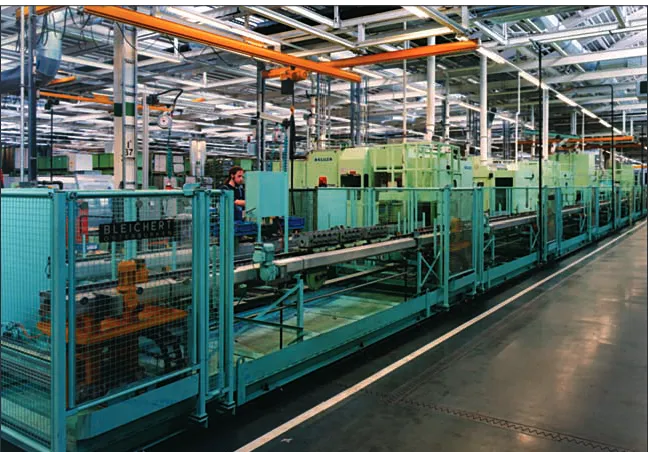
[image:12.612.60.385.482.708.2]In addition to this simulation work, the control system has been installed as a bypass to an existing large-series manufacturing line for cylinder heads. The bypass, located in a plant in Stuttgart-Untertürkheim, Germany, is shown in Figure 6. The bypass has un-dergone a series of performance tests which showed that the results of the simulations are valid under real manu-facturing conditions. Moreover, the sys-tem has now been in routine operation for more than two years and has con-firmed its robustness in day-to-day pro-duction situations.
The success of the system, in terms of both increased throughput and greater robustness to failure, can be attrib-uted to several points. First, representing the components and the machines as agents means the decision making is much more localized. It can therefore be more responsive to prevailing circumstances. If unexpected events occur, agents have the autonomy and proactiveness to try alterna-tives. Second, because the schedules are built up dynami-cally through flexible interactions, they can readily be altered in the event of delays or unexpected contingencies.
Conclusions
This article has sought to justify precisely why agent-ori-ented approaches are well suited to developing complex software systems in general and control systems in partic-ular. These general points are then made concrete by showing how they apply in two very different agent-based control systems: Iberdrola’s electricity transportation management system and DaimlerChrysler’s manufactur-ing line control system. In makmanufactur-ing these arguments, propo-nents of other software engineering paradigms can claim that the key concepts of agent-oriented computing can be reproduced using their technique. This is undoubtedly true. Agent-oriented systems are, after all, computer pro-grams, and all programs have the same set of computable functions. However, this misses the point. The value of a paradigm is the mindset and the techniques it provides to software engineers. In this respect, agent-oriented con-cepts and techniques are both well suited to developing complex, distributed systems and an extension of those currently available in other paradigms.
We believe that agent-based systems provide several ad-vantages to the next generation of control systems. They provide a decentralized solution based on local decision making that gives the system a high degree of flexibility and robustness. The downside of devolving the decision making to autonomous components, however, is that it is corre-spondingly more difficult to predict overall system behav-ior. To this end, work is progressing on agent-oriented methodologies specifically for control applications [4]. In the systems described here, the agents are under the con-trol of a single organization, which makes it easier to tailor their behavior so that desirable system properties emerge from their interplay. In the more general case of multiple or-ganizations, however, producing predictable system-wide behavior is still an area of active research.
References
[1] A.H. Bond and L. Gasser, Eds., Readings in Distributed Artificial Intelli-gence. New York: Morgan Kaufmann, 1988.
[2] G. Booch,Object-Oriented Analysis and Design with Applications. Reading, MA: Addison Wesley, 1994.
[3] F.P. Brooks,The Mythical Man-Month. Reading, MA: Addison Wesley, 1995.
[4] S. Bussmann, N.R. Jennings, and M. Wooldridge, “Re-use of interaction protocols for decision-oriented applications,” in Proc. 3rd Int. Workshop Agent-Oriented Software Engineering, Bologna, Italy, pp. 51-62.
[5] S. Bussmann and K. Schild, “Self-organising manufacturing control: An in-dustrial application of agent technology,” inProc. 4th Int. Conf. Multi-Agent Sys-tems, Boston, MA, 2000, pp. 87-94.
[6] K.M. Carley and L. Gasser, “Computational organization theory,” in Multiagent Systems, G. Weiss, Ed. Cambridge, MA: MIT Press, 1999, pp. 229-330. [7] J.M. Corera, I. Laresgoiti, and N.R. Jennings, “Using ARCHON, Part 2: Elec-tricity transportation management,”IEEE Expert,vol. 11, pp. 71-79, 1996. [8] D.M. Dilts, N.P. Boyd, and H.H. Whorms, “The evolution of control architec-tures for automated manufacturing systems,”J. Manufact. Syst., vol. 10, no. 1, pp. 79-93, 1991.
[9] N. A. Duffie and R.S. Piper, “Non-hierarchical control of a flexible manufac-turing cell,”Robot. Comput. Integrat. Manufact., vol. 3, no. 2, pp. 175-179, 1987. [10] E.H. Durfee, “Practically coordinating,”AI Mag., vol. 20, no. 1, pp. 99-116, 1999.
[11] N.R. Jennings, “On agent-based software engineering,”Artific. Intell., vol. 117, no. 2, pp. 277-296, 2000.
[12] N.R. Jennings, “Controlling cooperative problem solving in industrial multi-agent systems using joint intentions,”Artif. Intell., vol. 75, no. 2, pp. 195-240, 1995.
[13] N.R. Jennings, P. Faratin, A.R. Lomuscio, S. Parsons, C. Sierra, and M. Wooldridge, “Automated negotiation: Prospects, methods and challenges,” Int. J. Group Decision and Negotiation, vol. 10, no. 2, pp. 199-215, 2001. [14] N.R. Jennings, E. Mamdani, J. Corera, I. Laresgoiti, F. Perriolat, P. Skarek, and L.Z. Varga, “Using ARCHON to develop real-world DAI applications Part 1,”IEEE Expert, vol. 11, pp. 64-70, 1996.
[15] N.R. Jennings and M. Wooldridge, Eds.,Agent Technology: Foundations, Applications and Markets. New York: Springer-Verlag, 1998.
[16] A. Newell, “The knowledge level,”Artif. Intell., vol. 18, pp. 87-127, 1982. [17] J. Mayfield, Y. Labrou, and T. Finin, “Evaluating KQML as an agent commu-nication language,” inIntelligent Agents II,M. Wooldridge, J.P. Müller, and M. Tambe, Eds. New York: Springer, 1995, pp. 347-360.
[18] B. Meyer,Object-Oriented Software Construction. Englewood Cliffs, NJ: Prentice-Hall, 1988.
[19] H.V.D. Parunak, “Industrial and practical applications of distributed AI,” in Multi-Agent Systems, G. Weiss, Ed. Cambridge, MA: MIT Press, 1999, pp. 377-421. [20] H.A. Simon,The Sciences of the Artificial. Cambridge, MA: MIT Press, 1996. [21] R.G. Smith and R. Davis, “Frameworks for cooperation in distributed problem solving,”IEEE Trans. Syst., Man, Cybern., vol. 11, pp. 61-70, 1981. [22] M. Wooldridge, “Agent-based software engineering,”Proc. Inst. Elec. Eng., vol. 144, pp. 26-37, 1997.
[23] M. Wooldridge,Reasoning About Rational Agents. Cambridge, MA: MIT Press, 2000.
[24] M. Wooldridge and N.R. Jennings, “Intelligent agents: Theory and prac-tice,”Knowledge Eng. Rev., vol. 10, no. 2, pp. 115-152, 1995.
[25] P.R. Wurman, “Dynamic pricing in the virtual marketplace,”IEEE Internet Computing, vol. 5, pp. 36-42, Mar./Apr. 2001.
Nicholas R. Jenningsis a professor of computer science in the Department of Electronics and Computer Science at Southampton University, where he carries out basic and ap-plied research in agent-based computing. He has published some 150 articles on various facets of agent-based comput-ing. He was the recipient of the Computers and Thought Award in 1999 for his contributions to multi-agent systems, the recipient of an IEE Achievement Medal in 2000 for his work on agent-based computing, and the recipient of the ACM Autonomous Agents Research award in 2003.