Original Article
Effect of comprehensive nursing intervention on
negative emotion, quality of life and renal
function of hemodialysis patients
Baodan Liao1, Linlin Zhao2, Yiti Peng1, Jing Chen4, Wen Chen3, Xiujiao Wang1
Departments of 1Blood Purification Room, 2Outpatient, 3Nephrology, The Second Affiliated Hospital of Hainan Medical University, Haikou, Hainan Province, China; 4Department of Nephrology, The First Affiliated Hospital of Hainan Medical College, Haikou, Hainan Province, China
Received August 28, 2019; Accepted January 7, 2020; Epub February 15, 2020; Published February 28, 2020
Abstract: Objective: To explore the effects of comprehensive nursing intervention on negative emotion, quality of life and renal function of hemodialysis patients. Methods: A total of 128 patients with chronic renal failure or end-stage renal disease who underwent hemodialysis were randomly divided into conventional care group and comprehen-sive nursing group according to the nursing care methods. The comprehencomprehen-sive nursing group received cognitive behavioral therapy and extended care in addition to conventional care. The changes of self-rating anxiety scale (SAS) scores, self-rating depression scale (SDS) scores, quality of life (the Kidney Disease Quality of Life-36 ques-tionnaire, KDQOL-36TM) scores at admission and three months after discharge, as well as changes in creatinine clearance rates (Ccr) and effective urea clearance volume of distribution of urea/effective dialysis time (KT/V) were recorded and compared between the two groups. Results: The differences of Ccr and KT/V before and after inter-vention between the comprehensive nursing group and the coninter-ventional care group were 3.96±4.78 mL/min/1.73 m2, 2.32±2.89 mL/min/1.73 m2 and 0.41±0.62 mL/min/1.73 m2, 0.18±0.29 mL/min/1.73 m2 respectively. The difference values of the comprehensive nursing group were significantly higher than those in the conventional care group (all P<0.05). In addition, the comprehensive nursing group also had significantly higher difference values in SAS, SDS and quality of life (QOL) scores compared to the conventional care group (all P<0.05). Conclusion: Comprehensive nursing interventions can effectively alleviate anxiety and depression of hemodialysis patients and improve their quality of life and renal function.
Keywords: Hemodialysis, care intervention, depression, anxiety, quality of life, renal function
Introduction
With the rapid development of economy, ch- ange of lifestyle and increasingly aging of the population, the morbidity of diabetes, hyper-tension, obesity and other chronic diseases are getting higher in China. Accordingly, the in- cidence of chronic kidney disease (CKD) is also on the rise [1]. In 2010, a multi-center cross-sectional study in China showed that taking the
reduced glomerular filtration rate or proteinuria
as criteria, the prevalence of chronic kidney disease in China was 10.8% and the number of affected patients was nearly 120 million [2]. As a result, some patients with CKD may develop chronic renal failure or end-stage renal disease, so they need renal replacement therapy by
means of hemodialysis or peritoneal dialysis [3]. Hemodialysis is the most common al- ternative therapy for chronic renal failure and end-stage renal disease, as the therapy can replace partial renal function and survive the patients. In 2015, approximately 553,000 patients in China were treated with hemo- dialysis, and the number was much greater than that of patients undergoing peritoneal dialysis [4]. The incidence of depression and anxiety in patients with hemodialysis is si-
gnificantly higher than that in the normal people
gative emotions can further adversely affect prognosis and quality of life of patients [7, 8]. Multiple studies have demonstrated that nursing care interventions alleviate negative emotions (such as depression and anxiety) and improve quality of life and renal function of patients undergoing hemodialysis. However, the results of the studies are inconsistent due to the differences in study design and ev- aluation indicators [9-11]. Results from two meta-analyses showed that psychological in- tervention could effectively improve quality of life or negative emotions of patients undergo- ing hemodialysis [9, 10]. Nevertheless,
accord-ing to the findaccord-ing of a study, care interventions
could not improve quality of life of patients [11]. In addition, a study also showed that continu- ing care interventions helped alleviate negative emotions of chronic renal failure patients who received hemodialysis, improved their self-management and treatment compliance, and reduced the incidence of complications [12].
Comprehensive nursing intervention is
defin-ed as adoption of various nursing regimens to deal with different aspects of a problem or many problems concerned [13]. Frequently used nursing care including psychological in- terventions and continuing care, and they can improve negative emotions, quality of life and prognosis of patients when used in the care of a variety of diseases including kidney diseases [14, 15].
Therefore, the purpose of this study was to evaluate the role of comprehensive nursing interventions based on health education, co- gnitive behavioral psychology and continuing nursing in the care of patients undergoing hemodialysis, and to know its effects on negative emotions (anxiety and depression), quality of life and renal function, providing
scientific evidence for improving the care
effects of post-hemodialysis patients. Materials and methods
Study subjects
A total of 128 patients undergoing mainte- nance hemodialysis in the Department of
Nephrology of The Second Affiliated Hospital
of Hainan Medical University between January 2017 and December 2017 were selected as subjects in this study. The inclusion criteria
included: patients with an age of 18 years or older; need of maintenance hemodialysis for chronic renal failure or end-stage renal disease, and the dialysis duration no less than 3 mon- ths; sober mind and normal intelligence, with-out cognitive impairment; signed informed con-sent. The exclusion criteria included: patients with other concurrent serious disease; cogni-tive impairment, mental illness, or inability to communicate verbally; previous other dialysis or kidney transplantation. This study was ap- proved by the Ethics Committee of The Second
Affiliated Hospital of Hainan Medical University.
Grouping and intervention
tivate their subjective initiatives, correct mis- takes with reasonable cognition, reestablish cognitive structure, and challenge, debate and change their own irrational beliefs by continu- ous questioning. In this way, they could learn and gradually master methods of debating irra-tional beliefs. (3) Patients were instructed to do trainings on progressive relaxation, which included making slow and deep breathes ac- cording to the directions of the investigator and relaxing the muscles of the whole body. Efforts were also made to eliminate psychologi-cal symptoms of anxiety, depression and ten-sion of patients. (4) Extended care, after dis-charge, patients continued to receive care interventions by telephone, WeChat or other means of communication on the internet, and nursing care and rehabilitation guidance, in- cluding self-management, nutritional guidance and relaxation trainings. In this study, the nurs-ing care program started from admission and lasted until 3 months after discharge. The care-givers who provided psychological intervention had received trainings related to psychological intervention.
Observation measures
Renal function: For the two groups of patients, changes in creatinine and urea in blood, urine and dialysates were detected before and after
intervention, and the ultrafiltration volume in
peritoneal dialysis and urine volume were re- corded. The Ccr and KT/V were calculated. Depression and anxiety: The SDS and SAS we- re utilized to evaluate depression and anxiety states of patients at admission and completion of care interventions, respectively [17, 18]. The SDS scores lower than 50 indicate no de- pression, 50-69 are mild depression, 60-69 are moderate depression, 70 or higher are severe depression. The SAS scores lower than 50 points indicate normal state, 50-59 are mild anxiety, 60-69 are moderate anxiety, and 70 or higher are severe anxiety.
Quality of life: The quality of life of patients was assessed by the Kidney Disease Quality of Life-36 (KDQOL-36TM) questionnaire at ad- mission and 3 months after discharge [19]. The questionnaire consists of 36 items, they were used to evaluate quality of life of patients fr-
om five dimensions, including physical activity,
mental state, burden of kidney disease, symp-toms of kidney disease and effects of kidney
disease. The KDQOL-SF-36TM version 1.3 was used to record data, automatically convert the score of each item and calculate the total scores of each dimension, the higher the scores, the better quality of life of patients. Statistical analysis
Measurement data were expressed as mean ± standard deviation. Comparison of the means of measurement data between the two groups were made with the use of an independent-samples t test. Categorical variables were expressed by constituent ratio, and the be- tween-group differences were compared using two-sided x2 test. The changes in scores of renal function, depression, anxiety and quality of life between the two groups were compared before and after intervention by paired t-test. An independent sample t test was used to compare the differences in changes of renal function, depression, anxiety and quality of life
scores. The significance level was set as two-sided α=0.05. Statistical analysis was
con-ducted on the data with the use of the SPSS software, version 20.0.
Results
Basic information of patients
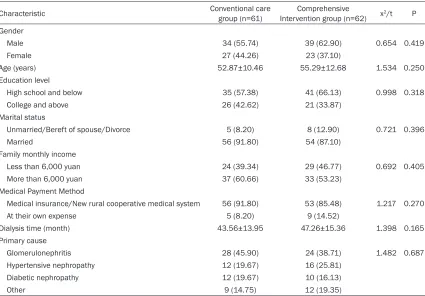
A total of 128 patients were randomly allocat- ed to the conventional care group and com- prehensive nursing group, with 64 cases in each group. During the intervention period, two patients were lost to follow up and one dropped out in the conventional care group; one patient was lost to follow up and one dropped out in the comprehensive nursing group. Hence, the patients enrolled in the con-ventional care group and the comprehensive nursing group were 61 and 62 respectively (Figure 1). The baseline and clinical character-istics of both groups were presented in Table 1.
There were no significant differences in age,
sex, education, marital status, family income, ways of medical payment, dialysis time and pri-mary disease between the two groups, so the baseline data were similar (all P>0.05).
Renal functions of patients before and after
intervention
CCR and KT/V scores of the comprehensive nursing group at admission were 55.67±18.46 mL/min/1.73 m2 and 1.88±1.09 mL/min/1.73 m2 respectively; the corresponding scores of the conventional care group were 59.25± 19.38 mL/min/1.73 m2 and 2.12±1.23 mL/ min/1.73 m2 respectively. There were no signi-
ficant differences between the two groups (all
P>0.05). The CCR and KT/V of both groups improved at 3-month follow-up after discharge (paired t-test before and after intervention, all P<0.001). The differences of CCR and KT/V scores before and after intervention in the comprehensive nursing group were higher than those of the conventional care group (all P< 0.05).
Comparison of improvements in anxiety and depression before and after intervention
Before intervention, the depression scores of the comprehensive nursing group and the conventional care group were 64.02±28.58 and 64.15±30.44 respectively, with no signi-
ficant difference. At completion of intervention,
the scores of depression and anxiety in both
groups dropped significantly (all P<0.01), but
the improvements in depression and anxiety
scores were significantly greater in the
com-prehensive nursing group than in the con- ventional care group, with P values of 0.041 and 0.029 respectively (Table 3).
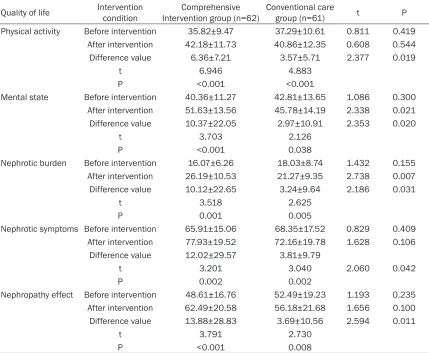
Comparison of improvements in quality of life before and after intervention
Table 4 shows no differences in the scores of each item of the KDQOL-36TM between the two
groups at admission (all P> 0.05), but the scores of both groups were improved at 3 months after discharge (paired t test, before and after in- tervention, all P<0.001). The improvements in physical ac- tivity, mental state, burden of kidney disease, symptoms of kidney disease and effects of kidney disease of the com- prehensive nursing group was greater than those of the conventional care group (all P<0.05).
Discussion
[image:4.612.90.377.71.249.2]In the past decade, CKD has become one of the major global public health concerns. The CKD inpatients accounted for 4.8% of all hospi-talized patients in China in 2015, and the per-centage was higher than that of patients wi- th other chronic non- infectious diseases. The age-adjusted incidence of end-stage renal dis-ease patients undergoing hemodialysis was 122.19 cases per million patients, and it was higher than the previous value and higher than that of peritoneal dialysis [4, 20]. Due to the irreversible disease course of hemodialysis patients, treatment constraints to their lives and economic pressure, patients are inclined to develop negative emotions including an- xiety and depression, which affect their quality of life [21, 22]. Therefore, how to avoid or reduce negative emotions and improve quality of life of hemodialysis patients has become a focus for research on post-hemodialysis care [23, 24].
To improve the care effect of hemodialysis patients, many intervention regimens have been used for hemodialysis patients, such as education, psychology, and continuing care. The content of assessments includes negative emotions, quality of life and some other clinical indicators [25-27]. Cognitive behavioral inter- vention is a widely used psychotherapy among psychological care interventions. It can change poor cognition by changing thoughts or beliefs and behavior of patients to eliminate their bad mood and behavior. It has already been used for nursing care of hemodialysis patients [28, 29]. Some randomized controlled studies have
indicated that cognitive behavioral interven- tion significantly improves quality of life of
[image:5.612.94.519.95.391.2]end-stage renal disease patients undergoing hemodialysis, alleviate their depression and promote treatment compliance [29]. Continu- ing care refers to the care provided to ensure patients to receive continuing care in different health care locations (generally from the hos- pital to the community), including development
Table 1. Single-factor analysis of enumeration data between comprehensive intervention group and conventional care group
Characteristic Conventional care group (n=61) Intervention group (n=62)Comprehensive x2/t P
Gender
Male 34 (55.74) 39 (62.90) 0.654 0.419
Female 27 (44.26) 23 (37.10)
Age (years) 52.87±10.46 55.29±12.68 1.534 0.250
Education level
High school and below 35 (57.38) 41 (66.13) 0.998 0.318
College and above 26 (42.62) 21 (33.87)
Marital status
Unmarried/Bereft of spouse/Divorce 5 (8.20) 8 (12.90) 0.721 0.396
Married 56 (91.80) 54 (87.10)
Family monthly income
Less than 6,000 yuan 24 (39.34) 29 (46.77) 0.692 0.405
More than 6,000 yuan 37 (60.66) 33 (53.23)
Medical Payment Method
Medical insurance/New rural cooperative medical system 56 (91.80) 53 (85.48) 1.217 0.270
At their own expense 5 (8.20) 9 (14.52)
Dialysis time (month) 43.56±13.95 47.26±15.36 1.398 0.165
Primary cause
Glomerulonephritis 28 (45.90) 24 (38.71) 1.482 0.687
Hypertensive nephropathy 12 (19.67) 16 (25.81)
Diabetic nephropathy 12 (19.67) 10 (16.13)
Other 9 (14.75) 12 (19.35)
Table 2. Improvement of renal functions in comprehensive intervention group and conventional care group
Measurements Intervention condition Conventional care group (n=61) Intervention group (n=62)Comprehensive t P CCR (mL/min/1.73 m2) Before intervention 59.25±19.38 55.67±18.46 1.049 0.960
After intervention 61.57±21.34 59.63±20.19 0.518 0.605 Difference value 2.32±2.89 3.96±4.78 2.298 0.023
t 6.270 6.523
p <0.001 <0.001
KT/V (mL/min/1.73 m2) Before intervention 2.12±1.23 1.88±1.09 1.457 0.254 After intervention 2.30±1.67 2.21±1.89 0.397 0.691 Difference value 0.18±0.29 0.41±0.62 2.628 0.010
t 4.848 5.207
p <0.001 <0.001
of discharge programs, family visits and guid-ance [30]. A randomized controlled trial show- ed that continuing care intervention based on
telephone follow-ups could significantly reduce
[image:5.612.91.521.436.592.2]owed significantly greater improvements in
depression, anxiety and quality of life than those in the conventional care group during hospitalization and after discharge, similar to
the findings of other studies [27, 32]. However,
the effects of care interventions in
[image:6.612.94.523.85.241.2]hemodialy-sis patients are not completely conhemodialy-sistent. For example, in a meta-analysis evaluating the impacts of care interventions on quality of life of patients with CKD, the comprehensive nurs-ing intervention regimen includnurs-ing multiple activities had substantial impacts on only the Table 3. Depression improvement in comprehensive intervention group and conventional care group
Measurements Intervention condition Intervention group (n=62)Comprehensive Conventional care group (n=61) t p
SDS Before intervention 60.83±22.67 64.02±28.58 0.686 0.494
After intervention 51.02±20.59 60.06±28.91 2.000 0.048 Difference value 9.81±19.32 3.96±10.79 2.069 0.041
t 3.998 2.866
p <0.001 0.006
SAS Before intervention 61.54±25.47 64.15±30.44 0.516 0.607
After intervention 52.67±23.85 61.20±28.73 6.799 <0.001
Difference value 8.87±19.11 2.95±8.49 2.214 0.029
t 3.655 2.714
p 0.001 0.009
Table 4. Quality of life in comprehensive intervention group and conventional care group
Quality of life Intervention condition Intervention group (n=62)Comprehensive Conventional care group (n=61) t P Physical activity Before intervention 35.82±9.47 37.29±10.61 0.811 0.419
After intervention 42.18±11.73 40.86±12.35 0.608 0.544 Difference value 6.36±7.21 3.57±5.71 2.377 0.019
t 6.946 4.883
P <0.001 <0.001
Mental state Before intervention 40.36±11.27 42.81±13.65 1.086 0.300 After intervention 51.63±13.56 45.78±14.19 2.338 0.021 Difference value 10.37±22.05 2.97±10.91 2.353 0.020
t 3.703 2.126
P <0.001 0.038
Nephrotic burden Before intervention 16.07±6.26 18.03±8.74 1.432 0.155 After intervention 26.19±10.53 21.27±9.35 2.738 0.007 Difference value 10.12±22.65 3.24±9.64 2.186 0.031
t 3.518 2.625
P 0.001 0.005
Nephrotic symptoms Before intervention 65.91±15.06 68.35±17.52 0.829 0.409 After intervention 77.93±19.52 72.16±19.78 1.628 0.106
Difference value 12.02±29.57 3.81±9.79
t 3.201 3.040 2.060 0.042
P 0.002 0.002
Nephropathy effect Before intervention 48.61±16.76 52.49±19.23 1.193 0.235 After intervention 62.49±20.58 56.18±21.68 1.656 0.100 Difference value 13.88±28.83 3.69±10.56 2.594 0.011
t 3.791 2.730
[image:6.612.92.521.276.629.2]dimensions of quality of life which covered symptoms, sleep, dialysis and encouragement,
but it had no significant impacts on the
di-mensions of effects of kidney disease and bur-den of kidney disease. The results were cons- istent in subgroup analysis of hemodialysis patients [25]. However, the author also pointed out that the results of this meta-analysis were highly heterogeneous and should be explained with caution. The effect of care interventions on negative emotions and quality of life of he- modialysis patient needs further evaluation due to the different intervention methods, pa- tient characteristics and evaluation indicators. Lower quality of life score is often associated with poor outcomes in hemodialysis patients [33]. Results of two randomized controlled studies indicate that compared with conven-tional care, cognitive behavioral care interven-tion improved the hemodialysis compliance rate of chronic renal failure patients undergo-
ing hemodialysis, and significantly reduced the
level of renal function indicators [34, 35]. In the current study, the renal function indicators
of patients in both groups were significantly
improved after intervention, but the
compre-hensive nursing group got significantly greater
improvements than the conventional care gr- oup. This may be attributable to the fact that care interventions are helpful to enhance
patients’ confidence in treatment and increase
their treatment compliance, leading to better
efficacy.
An advantage of the present study is adoption of randomization; because of that, the two groups were well-balanced and comparable in baseline characteristics. However, there are still some limitations, such as lack of blind design and failure to avoid the impacts of so- me biases. In future research, intervention ran- domized controlled trials with large sample
size and definite evaluation indicators are
needed to evaluate the effects of comprehen-sive nursing interventions on improving nega-tive emotions, quality of life and renal function of hemodialysis patients. In this way, more po- werful evidence can be obtained for effective-ness of comprehensive nursing interventions in hemodialysis patients.
Acknowledgements
This work was supported by the Standardized
Promotion of Blood Purification Technology in
County Hospitals of Hainan Province (ZDXM- 2015085).
Disclosure of conflict of interest
None.
Address correspondence to: Xiujiao Wang, Depart- ment of Blood Purification Room, The Second Affiliated Hospital of Hainan Medical University, No.48 Baishuitang Road, Haikou 570311, Hainan Province, China. Tel: +86-0898-66808115; Fax: +86-0898-66808115; E-mail: wangxiujiaortfg55@ 163.com
References
[1] Zhang L, Long J, Jiang W, Shi Y, He X, Zhou Z, Li Y, Yeung RO, Wang J, Matsushita K, Coresh J, Zhao MH and Wang H. Trends in chronic kidney disease in China. N Engl J Med 2016; 375: 905-6.
[2] Zhang L, Wang F, Wang L, Wang W, Liu B, Liu J, Chen M, He Q, Liao Y, Yu X, Chen N, Zhang JE, Hu Z, Liu F, Hong D, Ma L, Liu H, Zhou X, Chen J, Pan L, Chen W, Wang W, Li X and Wang H. Prevalence of chronic kidney disease in China: a cross-sectional survey. Lancet 2012; 379: 815-822.
[3] China is facing a rapidly growing burden of end-stage renal disease treatment. China Blood Purification 2010; 1: 47-49.
[4] Wang F, Yang C, Long J, et al. Executive sum-mary for the 2015 Annual Data Report of the China Kidney Disease Network (CK-NET). Kidney Int 2019; 95: 501-505.
[5] Liu X, Yang X, Yao L, Zhang Q, Sun D, Zhu X, Xu T, Liu Q and Wang L. Prevalence and related factors of depressive symptoms in hemo- dialysis patients in northern China. BMC Psychiatry 2017; 17: 128.
[6] Kimmel PL and Cukor D. Anxiety symptoms in patients treated with hemodialysis: me- asurement and meaning. Am J Kidney Dis 2019; 74: 145-147.
[7] Schouten RW, Haverkamp GL, Loosman WL, Chandie Shaw PK, van Ittersum FJ, Smets YFC, Vleming LJ, Dekker FW, Honig A and Siegert CEH. Anxiety symptoms, mortality, and hos- pitalization in patients receiving maintenance dialysis: a cohort study. Am J Kidney Dis 2019; 74: 158-166.
[8] Rebollo Rubio A, Morales Asencio JM and Eugenia Pons Raventos M. Depression, anxiety and health-related quality of life amongst pa-tients who are starting dialysis treatment. J Ren Care 2017; 43: 73-82.
the quality of life of hemodialysis patients. Qilu J Nur 2017; 9: 4-7.
[10] Xing L, Chen R, Diao Y, Qian J, You C and Jiang X. Do psychological interventions reduce depression in hemodialysis patients? A me- ta-analysis of randomized controlled trials fol-lowing PRISMA. Medicine (Baltimore) 2016; 95: e4675.
[11] van Zuilen AD, Bots ML, Dulger A, van der Tweel I, van Buren M, Ten Dam MA, Kaasjager KA, Ligtenberg G, Sijpkens YW, Sluiter HE, van de Ven PJ, Vervoort G, Vleming LJ, Blankestijn PJ and Wetzels JF. Multifactorial intervention with nurse practitioners does not change cardiovascular outcomes in patients with chronic kidney disease. Kidney Int 2012; 82: 710-7.
[12] Liu T, Li JR, Song WW and Wang Y. The influen-ce of continuous nursing intervention on nega-tive emotion and self-management ability of hemodialysis patients with chronic renal fai- lure. International Journal of Psychiatry 2017; 2: 374-378.
[13] Cope DG. Nursing intervention research. Oncol Nurs Forum 2015; 42: 409-11.
[14] Connolly SB, Kotseva K, Jennings C, Atrey A, Jones J, Brown A, Bassett P and Wood DA. Outcomes of an integrated community-based nurse-led cardiovascular disease prevention programme. Heart 2017; 103: 840-847. [15] Ma R, Song Y, Zhao N, Zhang NN and Shen HY.
Meta-analysis of the effect of comprehensive nursing intervention on anxiety and depression in maintenance hemodialysis patients. Journal of Shenyang Medical College 2018; 3: 240-243.
[16] Lerma A, Perez-Grovas H, Bermudez L, Peralta-Pedrero ML, Robles-Garcia R and Lerma C. Brief cognitive behavioural intervention for depression and anxiety symptoms improves quality of life in chronic haemodialysis patients. Psychol Psychother 2017; 90: 105-123. [17] Zung WW. A self-rating depression scale. Arch
Gen Psychiatry 1965; 12: 63-70.
[18] Zung WW. A rating instrument for anxiety disorders. Psychosomatics 1971; 12: 371-9. [19] Tao X, Chow SK and Wong FK. Determining the
validity and reliability of the Chinese version of the Kidney Disease Quality of Life Questionnaire (KDQOL-36). BMC Nephrol 2014; 15: 115. [20] Zhang L and Zuo L. Current burden of
end-stage kidney disease and its future trend in China. Clin Nephrol 2016; 86 (2016): 27-28. [21] Cohen SD, Cukor D and Kimmel PL. Anxiety in
patients treated with hemodialysis. Clin J Am Soc Nephrol 2016; 11: 2250-2255.
[22] Ganu VJ, Boima V, Adjei DN, Yendork JS, Dey ID, Yorke E, Mate-Kole CC and Mate-Kole MO. Depression and quality of life in patients on long term hemodialysis at a nationalhospital in
Ghana: a cross-sectional study. Ghana Med J 2018; 52: 22-28.
[23] Burrai F, Lupi R, Luppi M, Micheluzzi V, Donati G, Lamanna G and Raghavan R. Effects of lis-tening to live singing in patients undergoing hemodialysis: a randomized controlled cross- over study. Biol Res Nurs 2019; 21: 30-38. [24] Guan Y and He YX. Effect of advanced care
on psychological condition in patients with chronic renal failure undergoing hemodialysis: a protocol of a systematic review. Medicine (Baltimore) 2019; 98: e14738.
[25] Chen CC, Chen Y, Liu X, Wen Y, Ma DY, Huang YY, Pu L, Diao YS and Yang K. The efficacy of a nurse-led disease management program in im-proving the quality of life for patients with chronic kidney disease: a meta-analysis. PLoS One 2016; 11: e0155890.
[26] Wu XY, Bai Y, Li YJ, Wei XY and Wang J. Effect of cognitive behavioral nursing intervention on renal function and quality of life in patients with chronic renal failure undergoing hemo- dialysis. Hainan Medicine 2017; 06: 1023-1025.
[27] Huang JP. Analysis of the effect of continuous nursing on quality of life and curative effect of hemodialysis patients with renal failure. China Rural Health 2017; 25: 58-59.
[28] Shirazian S, Smaldone A, Rao MK, Silberzweig J, Jacobson AM, Fazzari M and Weinger K. A protocol for a pilot randomized controlled trial to assess the feasibility and effect of a cogni-tive behavioral intervention on quality of life for patients on hemodialysis. Contemp Clin Trials 2018; 73: 51-60.
[29] Cukor D, Ver Halen N, Asher DR, Coplan JD, Weedon J, Wyka KE, Saggi SJ and Kimmel PL. Psychosocial intervention improves depr- ession, quality of life, and fluid adherence in hemodialysis. J Am Soc Nephrol 2014; 25: 196-206.
[30] Coffey A, Mulcahy H, Savage E, Fitzgerald S, Bradley C, Benefield L and Leahy-Warren P. Transitional care interventions: Relevance for nursing in the community. Public Health Nurs 2017; 34: 454-460.
[31] Kargar Jahromi M, Javadpour S, Taheri L and Poorgholami F. Effect of nurse-led telephone follow ups (tele-nursing) on depression, anxiety and stress in hemodialysis patients. Glob J Health Sci 2015; 8: 168-73.
[32] Long Y, Zhou XJ, Liu Y and Wang AJ. Meta-analysis of the effect of continuous nursing on the quality of life of hemodialysis patients. Laboratory Medicine and Clinic 2019; 4: 482-486+489.
[34] Zhou GF. The influence of cognitive behavioral nursing intervention on renal function, anxiety and depression and quality of life in patients with chronic renal failure undergoing hemo- dialysis. China Modern Medicine 2018; 35: 203-205.