FIELD MANUAL
No. 7-85 DEPARTMENT OF THE ARMYHEADQUARTERS
Washington, DC, 9 June 1987
FM 7-85
TABLE OF CONTENTS
Preface
CHAPTER 1.
Introduction
1-1. 1-2. 1-3. 1-4. 1-5. 1-6. 1-7.
Mission
Purpose and Function
Fundamentals of Ranger Operations Capabilities and Limitations
Employment Considerations Command and Control Communications
CHAPTER 2.
Organization and Equipment
2-1. 2-2. 2-3. 2-4. 2-5.
Headquarters and Headquarters Company Regimental Headquarters
Regimental Headquarters Company Ranger Battalion
Special Teams and Elements
CHAPTER 3.
Deployment
3-1. 3-2. 3-3. 3-4. 3-5. 3-6. 3-7. 3-8.
Readiness
Ranger Ready Force N-Hour Sequence
Intelligence and Security Operations
Logistics
Communications-Electronics
Remote Marshalling Base and Intermediate Staging Base
CHAPTER 4.
Insertion, Extraction, Escape, and Evasion
4-2. 4-3. 4-4. 4-5. 4-6. 4-7. 4-8. 4-9. 4-10. 4-11. 4-12. 4-13. 4-14. 4-15. 4-16. 4-17. 4-18. 4-19. 4-20. Deception
Speed and Mobility Stealth
Suppression Security
Night Vision and Electronics Devices Rehearsals
Sand Tables and Terrain Models Communications
Planning Insertions Air Insertion Airborne Insertion
Air-Land Insertion (Fixed-Wing) Air Assault Insertion
Amphibious Insertion Land Infiltration
Stay-Behind Techniques Extraction
Escape and Evasion
CHAPTER 5.
Strike Operations
5-1. 5-2. 5-3. 5-4. Application Raid Operations Interdiction Operations
Personnel and Equipment Recovery Operations
CHAPTER 6.
Special Light Infantry Operations
6-1. 6-2. 6-3. 6-4. 6-5. 6-6. 6-7. 6-8. 6-9. 6-10. 6-11. Movement Ambush Operations Antiarmor Operations
Military Operations on Urbanized Terrain Perimeter Defense
Breakout from Encirclement Linkup Operations
Passage of Lines
Reconnaissance Platoon Operations Reconnaissance Planning
Execution of Insertion
7-1. 7-2. 7-3. 7-4. 7-5. 7-6.
Intelligence Support
Electronic Warfare Support Communications Support Fire Support
Aviation Support Engineer Support
CHAPTER 8.
Combat Service Support
8-1. 8-2. 8-3. 8-4. 8-5. 8-6.
Ranger Support Element Logistics and Personnel Resupply
Military Police Counterintelligence Personnel Service Support
APPENDIX A.
Organization and Equipment of the
Ranger Regiment
APPENDIX B.
Composition and Equipment of Ranger
Regiment Liaison Teams
APPENDIX C.
Equipment Density
C-1. C-2.
Communication Equipment
Weapons and Equipment Each Battalion
APPENDIX D.
Standing Orders, Rogers' Rangers
APPENDIX E.
The Ranger Creed
APPENDIX F.
Ranger History
C-1. C-2. C-3. C-4. C-5. C-6. C-7. C-8. C-9. C-10. C-11. C-12. C-13.
Application and Guidance Philosophy
Mission Analysis Unit Training Individual Training Collective Training
Performance-Oriented Training Evaluation
Field Training
Professional Development Physical Training
Environmental and Specialized Training Ranger Indoctrination Program
Glossary
References
Authorization
PREFACE
This publication contains doctrinal guidelines for the employment and training of ranger units. The intended audience is intermediate and higher level commanders, staffs of those headquarters, and newly assigned officers and NCOs of the ranger regiment. It is to be used with all other published US doctrine concerning NBC operations and the climatic or geographic influences on combat. The fundamentals apply to the employment of ranger units on worldwide operations and across the spectrum of conflict from low to high intensity warfare. This includes all aspects of the integrated battlefield: nuclear, biological, and chemical. It is not intended to apply to the employment of long-range reconnaissance patrol (LRRP) companies, even though such units carry the designation "ranger." These LRRP companies, as well as the long-range surveillance company (LRSC) (corps level) and the long-range surveillance detachment (LRSD) (division level), are organized, trained, and equipped for long-range reconnaissance in enemy territory.
The scope of this publication addresses the mission, organization, equipment,
perform the mission. Once in combat, the ranger regiment maneuvers to accomplish the mission in the manner of other light infantry units. Ranger units make full use of
published light infantry doctrinal guidance. This manual will repeat procedures or techniques contained in other publications only if necessary for understanding or continuity.
This publication does not contain everything the ranger needs to know to successfully execute a unit mission. Rather, it supplements unit training and the ranger unit
commander's guidance; it does not supersede it.
The proponent of this publication is HQ, TRADOC. Submit changes for improving this publication on DA Form 2028 (Recommended Changes to Publications and Blank Forms) and forward it to Commandant, US Army Infantry School, ATTN: ATSH-B-ID, Fort Benning, GA 31905.
Unless otherwise stated, whenever the masculine gender is used, both men and women are included.
CHAPTER 1
Introduction
The ranger regiment is a major component of the US Army's special operations forces. It is a unique light infantry unit tasked to conduct special military operations in support of national policies and objectives. These operations require highly trained, well-disciplined units capable of employment in any environment, either alone or in concert with other military forces. Within this publication, the term ranger force describes any size force consisting mainly of members of the ranger regiment and led by a member of the ranger regiment's chain of command. A ranger force may be a TOE unit or it may be a specially organized task force for a specific mission.
1-1. Mission.
Figure 1-1. Spectrum of conflict.
b. Special military operations conducted by the ranger regiment include strike operations, usually deep penetration, and special light infantry operations. Strike operations include raids, interdiction, and recovery operations. Special light infantry operations include many of the light infantry missions assigned to
airborne, air assault, or light infantry battalions and brigades. These operations are conducted in support of the AirLand Battle at all levels of intensity.
1-2. Purpose and function.
The ranger regiment provides the national command authority (NCA) the ability to move a credible military force quickly to any region in the world. The regiment uses the entire spectrum of intelligence support, from national systems to organic assets. Ranger units maintain a readiness posture that supports their immediate commitment to battle once deployed. They are often tailored for specific missions and may require augmentation from external sources. Tactical mobility may be augmented by USAF or Army special operations aviation (SOA) aircraft.
a. The ranger regiment conducts light infantry operations on the integrated battlefield as well as in low intensity conflicts. Special light infantry operations are conducted to accomplish certain contingency missions during peacetime or as part of the echelons above corps (EAC) battle.
b. The regiment conducts both strategic and operational missions. Its efforts are combined into an overall plan to destroy, delay, and disorganize the enemy, or to cause him to divert his attention and combat forces to rear area security. The limited number of ranger units and the diverse targets dictate a careful assignment of missions.
The ranger regiment or separate ranger battalions are normally assigned to the headquarters whose area of responsibility includes the regiment's operational area(s). The strategic or operational value of potential targets means that ranger units are normally employed at no lower than corps level. Employment at EAC is routine. The EAC headquarters employing ranger units could be the commander in chief's (CINC's) special operations command or field army. The controlling headquarters could also be that of a joint task force (JTF) or the Army component command (ARFOR) of a JTF. The ranger regiment's organization,
communications equipment density, and training programs do not support operational level reconnaissance missions.
d. Ranger battalions are not oriented to a specific theater. Current force structure, contingency plans, and training needs (see Appendix G) preclude committing battalions to one region.
1-3. Fundamentals of ranger operations.
a. The success of an operation by a ranger unit depends on the observance of the fundamentals of the US Army's AirLand Battle doctrine (see FM 100-5). The ranger regiment fights the enemy as a light infantry force. It follows infantry doctrine and observes all the basic rules of infantry operations.
b. Along with initiative, depth, agility, and synchronization, ranger operations
require--(1) Detailed planning and coordination that allow the ranger unit to discern and exploit the enemy's weaknesses while avoiding his strength. Both permit the evaluation and use of information gathered from all sources. Detailed coordination integrates all supporting units and services. During planning, the ranger unit conducts pre-mission training, briefings, and rehearsals for all personnel. The use of special mission equipment is practiced and perfected.
(2) Decentralized execution IAW mission orders and the commander's intent. Special operations forces must use individual and unit initiative. Mission-type orders give the ranger force commander the flexibility to take advantage of opportunities on the battlefield.
(3) Surprise, achieved through the ranger unit's ability to move by uncommon means, along unexpected routes, and over rough terrain. Ranger units normally conduct operations during poor weather and reduced visibility, aided by night vision devices. This adds to the attainment of surprise.
(4) Survivability, achieved by using the classic infantry combat techniques of stealth and concealment. The ranger unit engages the enemy at the time and place of its own choosing. It takes full advantage of terrain, and
accomplishment and a prompt departure from the objective area.
(5) Mobility, speed, and violence of execution that allow the ranger unit it to close quickly on the objective area and complete the mission before the enemy can react. The speed at which events take place confuses and deceives the enemy as to the intent of the ranger unit. This forces the enemy to react rather than to take the initiative. Tactical mobility lets the ranger unit break contact and withdraw from the objective area.
(6) Shock effect, which is a psychological advantage achieved by the combining of speed and violence with the precision of the ranger attack. The ranger unit strives to apply its full combat power at the decisive time and place, and at the point of the greatest enemy weakness. The ranger unit strives to achieve maximum physical and psychological effect on the enemy by exhibiting aggressiveness and reasoned audacity.
(7) Multiple methods of insertion and attack, trying not to repeat
operations thus decreasing the chance the enemy will detect a pattern. This is achieved through imaginative training and planning.
(8) Deception, practiced by the ranger unit during all phases of its
operations, from deployment through the insertion phase, to the actions in the objective area and extraction. The enemy is kept unaware of the ranger unit's intentions, is fed conflicting and wrong information, and is kept from knowing the size or mission of the ranger force. The ranger force
commander makes full use of ruses, feints, false insertions, electronic countermeasures, and dummy transmissions. Concurrent military operations by US or allied forces may be used as cover for ranger operations. Ranger units are careful to hide every possible aspect of an operation and to disguise those that cannot be hidden. While in the operational area, or when departing any location, ranger units ensure that no material is left that could provide the enemy with information
concerning the ranger force.
(9) Audacity, achieved by a willingness to accept risk. The ranger force commander considers what the enemy expects the unit to do and the actual ranger abilities, He then chooses a course of action that may confuse the enemy, while remaining within the capability of the ranger unit. This fundamental is combined with deception and surprise to disrupt the enemy command and control.
c. Detailed planning and coordination finds the enemy. Surprise, mobility and speed, variety, deception, and audacity combine to shock and disorient the enemy, fixing him in place. The violence and precision of the ranger attack finishes the enemy while ensuring the ranger force survives.
1-4. Capabilities and limitations.
(1) Deploying quickly to conduct operations on all types of terrain and in all kinds of weather.
(2) Establishing a credible American presence in any part of the world to show US interest or resolve.
(3) Infiltrating and exfiltrating an area of operations, and assaulting an objective by land, sea, or air.
(4) Conducting strike operations to include raids, personnel and equipment recovery operations, and interdiction of key areas.
(5) Conducting special light infantry operations to include seizing and securing airfields, communications centers, command and control facilities, and key bridges; and other special light infantry operations. (6) Performing short-duration reconnaissance of assigned ranger objectives for the ranger force commander.
(7) Operating for up to three days without resupply, and for longer periods when provided with accompanying or airdropped supplies.
(8) Providing liaison, communication, and coordination personnel and equipment to integrate the deployed ranger force into the logistical, intelligence, and operational system of the theater or joint task force (JTF) commander.
(9) Assuming operational control, for a limited time, of other US military forces such as engineers or infantry, airborne, or air assault battalions. (10) Providing the focal point for all-source intelligence support to attached and assigned units of the regimental task force.
(11) Conducting limited combat operations under conditions of chemical, nuclear, or biological contamination.
b. The ranger regiment has the following limitations:
(1) Limited capability against armored or motorized units in open terrain. (2) No organic transportation.
(3) Limited sustained combat capability due to the shortage of organic combat support and combat service support elements.
(4) Limited organic air defense weapons. (5) Limited organic indirect fire support. (6) No casualty evacuation capability.
(7) Reconstitution and retraining needed to replace combat losses.
1-5. Employment considerations.
individual skill of their members. This produces units with superb collective abilities, able to adapt well to changing, complex situations.
b. Ranger units can conduct either deliberate or quick-response operations. (1) Deliberate operations rely on careful planning, reconnaissance and surveillance of the target area, deception, secrecy, thorough preparation and rehearsals, and violent execution. A deliberate operation aims to complete the mission even though the enemy may have heavy forces on or near the objective area. Deliberate operations allow for detailed planning, evaluation, rehearsal, and coordination before insertion. A deliberate operation is likely to succeed against targets that the enemy has protected in depth, that have strong natural defenses, or that need a detailed and long insertion process.
(2) Quick-response operations rely on the high level of training and
readiness of the ranger regiment to execute a mission before the enemy can react. These operations are conducted when there is little time for long, detailed planning. They rely on set procedures set forth by the ranger regiment and its supporting elements. A quick-response operation aims to complete the mission before an enemy can react. This type of operation may be chosen due to the time-sensitive nature of the target, political or military goals, the time frame of other operations, or the increased chance of enemy detection.
(3) Whether an operation is to be deliberate or quick response is often a difficult and time-sensitive decision by a high-level command authority. Decision-makers must consider the enemy's strength in the area, his intentions, his ability either to reinforce or to alter the target area, and the consequences of success or failure of diplomatic or military initiatives in related areas. The ranger unit commander tries to use the existing time, manpower, and resources to complete a detailed and coordinated plan. He refines that plan up to the insertion into the objective area.
c. Ranger units train to operate in any environment or weather condition. They regularly perform operations during periods of limited visibility. Ranger units maintain a high state of physical fitness and often train in close quarters combatives. In addition to completing advanced
marksmanship training with standard US weapons, each member of a ranger unit trains with many foreign weapons. Ranger units are trained to operate on urbanized terrain, becoming specialists in entry and clearing techniques and quick-fire methods, especially during periods of limited visibility.
d. Because ranger units have limited vehicles, logistics operations capability, indirect fire support, and heavy weapons systems, they are not designed for continuous operations. During all phases of operations and training, ranger units need responsive external support.
need their unique skills. Although targeting priority is set by the overall
commander, ranger units are not normally assigned missions that can be done by conventional aerial bombardment or by other units.
f. Ranger units are oriented toward offensive operations. They are not normally employed as a rear area protection force. Although the ranger regiment has a small reconnaissance unit, ranger units do not normally conduct long-range reconnaissance missions. The structure, communications, and training of the ranger unit do not prepare it for LRRP missions. Ranger units engaged in strike and special light infantry operations have a secondary mission to collect and report combat information.
g. Ranger units can be deployed worldwide when US military presence or participation with a host national military activity would serve US interests. This deployment shows a readiness to commit forces into a threatened area or proves US national resolve. After the deployment, other activities include staging operations, rehearsing combat operations, securing base areas for use and deployment of other forces, and so on that provide a clear signal of US intent. Ranger units are not trained or organized to provide mobile training teams (MTT) to train indigenous forces. The US Special Forces or other special operation forces are trained to conduct such security assistance operations.
h. Ranger units can serve as an example to a host country and provide limited military advice and training. They will normally be augmented with linguists and technicians to increase their abilities. The regiment would normally still function as a unit. Most of its assistance would be through short-term, high-impact, unit-oriented operations. They would not be long-term individual efforts associated with advisory-type activities.
i. Ranger units may be deployed to engage in combined training exercises with allies. This enhances US national image by demonstrating the outstanding abilities of the American ranger. These activities may include ranger, light infantry,
airborne, air assault, or amphibious operations.
j. Ranger units use standard US nuclear, biological, chemical (NBC) warning; detection; protection; and decontamination equipment and doctrine when operating on the integrated battlefield.
1-6. Command and control.
a. External.
(1) The ranger regiment is a key component of the US Army's special operations forces. The other elements of special operations forces are special forces (SF), psychological operations (PSYOP), civil affairs (CA), and special operations aviation.
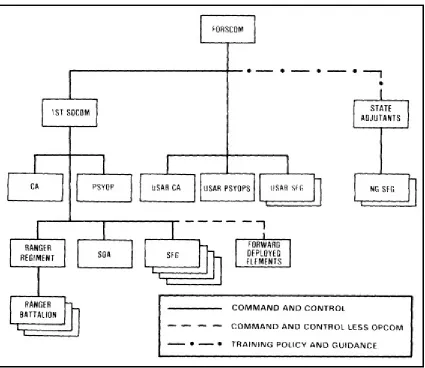
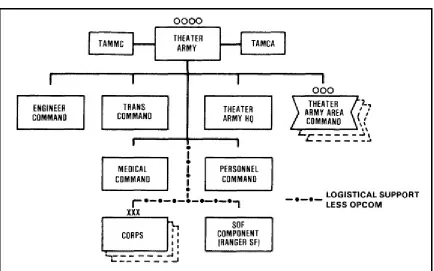
and control of all assigned special operations forces, less operational command (OPCOM) of special operations forces units forward deployed. (See Figure 1-2.) The ranger regiment, while based in the continental United States (CONUS), is under the control of 1st SOCOM. During peacetime, the OPCOM of deployed ranger units is through channels chosen by the NCA through the Joint Chiefs of Staff (JCS) to the unified command.
Figure 1-2. Command and control of Army Special operations forces during peacetime.
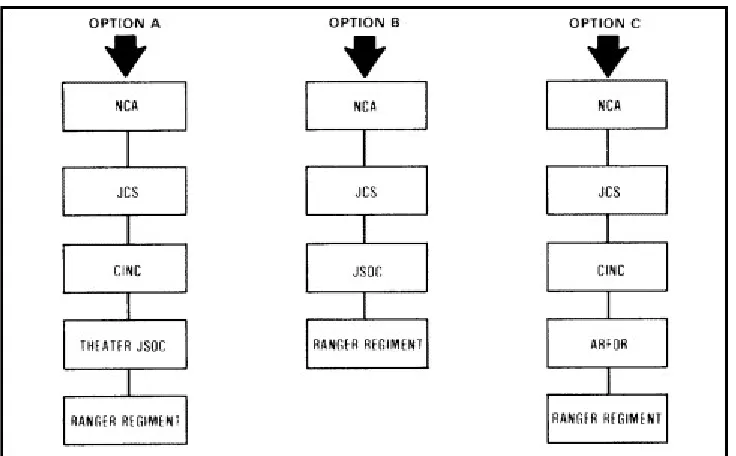
the highest level of command responsible for the operation. This command may be the unified command responsible for the contingency area (Option A), or a JTF designated by the NCA through the JCS (Option B). If no SOTF is formed, the ranger regiment could be OPCOM to the Army component commander (Option C). The ranger regiment or its battalions are not normally placed OPCOM to a division. A division's area of influence rarely contains appropriate targets. The division also lacks the assets to adequately support ranger operations. Employment of a ranger unit by a corps-level command is normally on a case-by-case basis. The theater or JTF commander retains centralized control over the mission assigned to the ranger unit.
Figure 1-3. Command and control of Army Special operations forces during contingency operations.
(4) The 1st SOCOM is responsible for the deployment of the ranger force to the theater area. The headquarters having OPCOM provides the all-source intelligence, secure communications, insertion and extraction assets, and logistical support needed. The responsible commander in chief, through the Army component commander, provides support during the contingency operation.
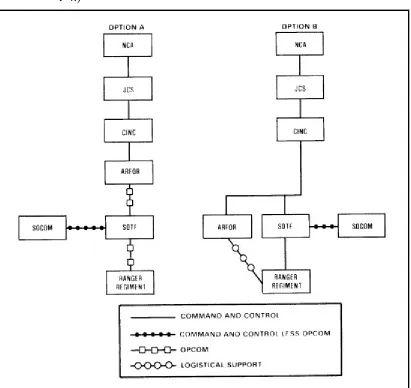
(5) During wartime, ranger units are deployed as strategic assets to the theater of operations. Strategic mission support is provided to the unified commander (CINC) from the NCA through the Joint Chiefs of Staff. It may involve the execution of sensitive operations. The employment of ranger units is controlled at the highest level of command directly
control of these units conforms to the provisions of JCS Pub 2. (See Figure 1-4.)
Figure 1-4. Command and control of Army Special operations forces during wartime.
(a) A theater joint special operations command (JSOC) is
subordinate to the unified command to supervise the command and control, employment, and support of all US and allied special operations forces. The JSOC is a key element in the command and control of ranger units performing strike missions or special light infantry operations (Option A).
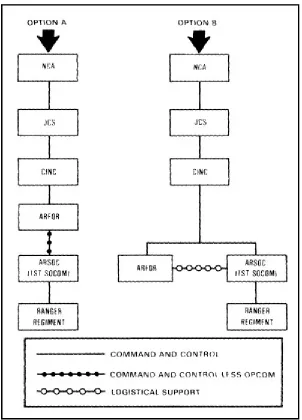
(c) Under the Army special operations command (ARSOC) concept, 1st SOCOM deploys as a command and control
[image:16.612.156.458.129.549.2]headquarters within the theater. When this occurs, the command relationships will be as shown in Figure 1-5.
Figure 1-5. Command and control of Army Special operations forces under the ARSOC concept.
(d) Recently passed legislation will modify existing high level SOF command and control arrangements. All US Army, USN, and USAF special operations forces will be consolidated into joint commands at both national and theater level. The ranger regiment will continue to operate under the command of the 1st SOCOM, while increasing its ability to conduct joint operations.
planning and targeting for ranger missions.
(7) Requests for ranger units, from either US or allied commands, go through normal command channels to the CINC. The CINC, through the JSOC, is responsible for the employment of all special operations forces, including ranger units. This provides flexible response to JCS-directed missions, ensures quick response to the CINC's needs, enhances the joint employment of special operations forces, and lessens the chance of overcommitting and degrading the ranger force.
(8) Command and control of the ranger regiment and its battalions is IAW AirLand Battle doctrine. Before commitment to a mission, command and control is kept at a level where the unit's unique skills can be applied worldwide. Once committed, the ranger unit is placed under the operational control of the command that is responsible for the mission. This normally corresponds to the command whose area of influence includes the target area. Ranger task forces may operate directly under the authority of the senior American representative in the country. Command and control arrangements may vary according to the theater involved and METT-T considerations.
(9) The command and control of special operations is centralized and begins at the highest level of the military and civilian decision-making process. The specific command relationships are normally based on the mission.
b. Internal.
(1) The ranger regimental headquarters is organized to operate like that of a brigade headquarters. In addition to commanding and controlling all three ranger battalions, the regimental headquarters can assume
operational control (OPCON) of conventional combat and combat support units, and other special operations forces for limited periods. It provides the regimental commander with a well-balanced responsive staff. It is structured as an operational headquarters that can deploy to the mission area and act as the ground tactical headquarters.
(a) The regimental headquarters prepares for combat by forming two small command and control groups. Each of these can deploy to an objective area and control combat operations. Other elements of the staff operate the tactical operations center (TOC) and the logistical operations center (LOC). These may be collocated depending on the situation. The TOC and LOC are normally located well behind the FEBA, at the REMAB or at the
intermediate staging base (ISB). The ranger regiment also has two small liaison teams consisting of LNOS, staff representatives, and communications elements. (See Appendix B.)
A liaison and communications team is detached from the
regimental headquarters to augment the ranger battalion. This team is attached to the deployed battalion until the end of the mission. (c) If two or more ranger battalions are used in a single operation, the regimental commander normally deploys both command and control groups. He commands from the objective area, The use of two small, mobile control elements makes up for the possible loss of the regimental commander and the primary control element. (d) Whenever the regimental commander is controlling an operation from the REMAB or the objective area, he normally provides a liaison team with a communications element to the higher headquarters exercising operational control. This cell can provide ranger representation to the controlling staff, operations interface, logistics interface, fire support planning and
coordination, intelligence analysis and dissemination, and communications between the higher headquarters and the ranger battalion.
(2) The ranger regimental headquarters can serve as a ranger or special operations force task force headquarters. With augmentation, it can function as the Army special operations force command element. The regimental headquarters can also function as the Army component command of a JTF.
1-7. Communications.
a. Ranger missions need unique and dedicated communication support assets. Along with the ranger regiment's organic communications means,
communications support assets are organized within the 1st SOCOM that-can deploy in support of the ranger regiment. This ensures that there are reliable communications to all elements of the SOTF. A special operations
communications battalion (SOCB), deployed by the 1st SOCOM, provides more communications systems to support the special operations plan. The SOCB does not replace or duplicate existing in-theater communications. It augments the CINC's communications with the US Army's portion of the critical special
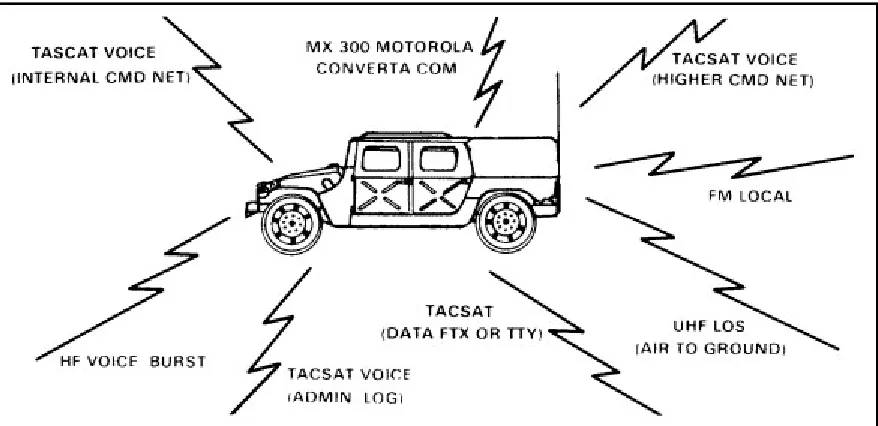
operations force command, control, and communications link unique to the SOTF. b. The ranger regiment's communication platoon can provide secure, long-range communication links from the CINC to a deployed ranger force. It can also enter the SOCB and the joint communications support element (JCSE) nets to provide a direct link with the NCA. Its equipment consists of four light vehicles equipped with various multiple communications systems. The two regimental liaison teams use one of these vehicles each. The TOC and LOC each use one.
regimental commander has two light vehicles equipped with multiple
communications systems. One of these is used to support each of the two mobile command and control elements of the regimental headquarters. Some of the radio systems can be dismounted and man-packed.
d. The ranger regimental headquarters has both man-packed and vehicular tactical satellite communication systems. Each of the ranger battalions has one base station and three man-packed systems.
(1) The man-packed radio is battery-operated. It provides two-way communications in both line-of-sight (mobile) and satellite (at-halt) modes. The digital message device group (DMDG) is the input and output device for data transmission. Secure voice communications is achieved using various encryption devices.
(2) The vehicular net control station uses the basic receiver/ transmitter unit installed on a vehicle. Each can serve up to 15 terminals in a communications net.
e. The reconnaissance platoon is equipped with multiple, man-packed communications systems. These let its teams operate in most of the
[image:19.612.92.531.363.576.2]communications nets within the regiment. Each five-man reconnaissance team has this communications ability, as does the platoon headquarters.
CHAPTER 2
Organization and Equipment
The ranger regiment is a specially organized and trained light infantry force consisting of about 2,000 personnel. It includes a regimental headquarters and headquarters company and three ranger battalions. (See Appendix A.) The regiment can operate as a single unit, separate battalions, or separate companies on specific missions. Independent missions are not normally assigned to ranger platoons.
2-1. Headquarters and headquarters company.
The HHC of the ranger regiment consists of 130 personnel, the majority being senior noncommissioned officers, commissioned officers, or soldiers with special skills to support the operations of the ranger battalions. (See Appendix A.) The HHC consists of two elements: the regimental headquarters and the headquarters company (minus).
2-2. Regimental headquarters.
a. The regimental headquarters consists of the regimental commander and his staff. The primary staff is composed of five sections: personnel (S1), intelligence (S2), operations and training (S3), supply (S4), and civil affairs (S5). These staff sections perform the standard functions and are supervised by the executive officer (XO). The regimental commander has a deputy commander and a special staff consisting of a communications officer, fire support officer, surgeon, and staff judge advocate. The S2 officer has a large intelligence analysis and
counterintelligence section. The S3 section has extra liaison officers and assistant operations officers to coordinate the widespread and complex ranger missions. A United States Air Force (USAF) staff weather officer and a tactical air control party (TACP) are permanently attached.
b. The regimental headquarters:
Analyzes assigned missions.
Plans, coordinates, and controls training and operations.
Coordinates the infiltration, resupply, exfiltration, and debriefing of the
reconnaissance teams.
Provides liaison support.
Provides administrative, medical, NBC, and logistical planning and
coordination support to the committed ranger battalions.
Coordinates special support requirements (rigger, transportation,
2-3. Regimental headquarters company.
The regimental headquarters company (minus) consists of the company commander and his administrative personnel, plus the limited combat support (CS) and combat service support (CSS) elements assigned to the regiment. These are the fire support element, the communications platoon, the reconnaissance platoon, and the medical treatment team.
a. The company headquarters:
(1) Provides command and control of assigned elements.
(2) Provides administrative, personnel, logistical, and maintenance support to the assigned elements.
b. The fire support element:
(1) Plans fires to support the commander's ground tactical plan.
(2) Coordinates the integration of all available fire support means (mortars, artillery, armed helicopters, close air support, naval gunfire) to support mission execution.
c. The communications platoon (see Appendix A):
(1) Provides secure SATCOM teletype (TTY) and facsimile transmissions (FAX) abilities at the remote marshalling base or intermediate staging base (REMAB or ISB).
(2) Provides secure SATCOM, TTY, and FAX to the regimental headquarters and ranger battalions in the objective area.
(3) Provides cryptographic support to the regimental headquarters. (4) Provides limited repair of radio and cryptographic equipment. d. The reconnaissance platoon (see Appendix A):
(1) Trains, equips, and controls the employment of three reconnaissance teams.
(2) Infiltrates the objective area by parachute (high-altitude, low-opening [HALO]; high-altitude, high-opening [HAHO]; static line), helicopter, fixed-wing aircraft, self-contained underwater breathing apparatus (SCUBA), small boat, or other means.
(3) Remains undetected in the objective area for up to five days. (4) Performs reconnaissance.
(5) Performs demolition target analysis. (6) Uses small boats and inflatable rafts.
(7) Emplaces and monitors unattended ground sensors. (8) Uses night image enhancement devices.
(10) Emplaces electronic target acquisition and designation devices. (11) Collects specific combat information to satisfy priority intelligence requirements (PIR).
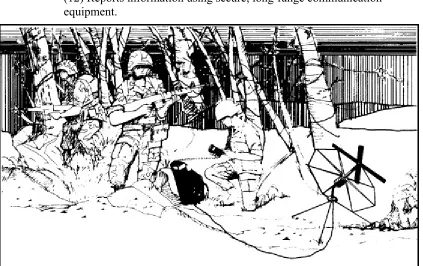
[image:22.612.97.520.135.401.2](12) Reports information using secure, long-range communication equipment.
Figure 2-1. Reconnaissance platoon communications.
(13) Performs drop zone (DZ) and landing zone (LZ) selection, marking, and reception duties.
(14) Escapes and evades enemy areas.
(15) Performs limited attacks or ambushes when tasked by the regimental commander.
(16) Reports weather in the objective area. e. The medical treatment team:
(1) Provides medical support to the regimental headquarters. (2) Coordinates required medical support and evacuation.
2-4. Ranger battalion.
a. The ranger battalion is organized and equipped to conduct both special and conventional combat operations. It contains organic combat, CS, and limited CSS elements. It consists of a battalion headquarters, a headquarters company, and three ranger rifle companies. (See Appendix A.)
conduct independent combat operations or subdivide into its separate ranger rifle companies and their subordinate elements who can conduct semi-independent operations.
c. The ranger battalion headquarters and headquarters company (see Appendix A) includes:
(1) Battalion headquarters. The battalion headquarters consists of the commander; the executive officer; the command sergeant major; the S1, S2, S3, S4, and S5 officers; the chaplain; the communications officer; the fire support officer; and two radio operators.
(2) Battalion headquarters section. The battalion headquarters section consists of the S3 air and assistant S8, an assistant S2, an intelligence sergeant and a senior intelligence analyst, two operations sergeants and an operations assistant, a personnel staff noncommissioned officer (PSNCO), the chaplain's assistant, two clerk typists, two radio operators, a chemical officer and NCO, a personnel administration center (PAC) NCO, three PAC clerks, and a legal specialist. There is a USAF tactical air control party permanently attached.
(3) Communications section. The communications section consists of one telecommunications technician, one tactical communications chief, two combat signal radio team chiefs, one tactical communications systems supervisor, three radio operators, one switchboard operator, one single channel radio operator, and two equipment mechanics. The section provides communications support and associated maintenance.
(4) Battalion medical section. The battalion medical section consists of one general medical officer, one physician's assistant, two medical specialists, and twelve aidmen. The section provides unit-level medical support and trains selected members of the battalion in advanced medical procedures.
(5) Battalion support platoon. The battalion support platoon consists of a battalion support platoon leader, an ammunition NCO, and a food service section. The platoon provides limited CSS for assigned and attached units. This platoon does not have organic transportation. The battalion food service section consists of a food service sergeant (E7), a first cook (E6), and eight cooks.
(6) Fire support team headquarters. The fire support team (FIST) headquarters is supervised by the battalion fire support officer. It consists of the fire support sergeant and two fire support specialists. The
headquarters controls three 9-man fire support teams. These teams are normally with the ranger rifle companies in a habitual support relationship. When operations are conducted near water, the fire support team
headquarters may be augmented by spotter teams from the naval shore fire control party.
a commanding officer, an executive officer, a first sergeant, a supply sergeant, and an armorer.
d. The ranger rifle company (see Appendix A) includes a company headquarters, three rifle platoons, and a weapons platoon. Each company can conduct semi-independent operations for a short time when augmented by assets from the ranger battalion headquarters company.
(1) Ranger rifle company headquarters. The ranger rifle company headquarters consists of a commanding officer, an executive officer, a first sergeant, a supply sergeant, a tactical communications chief, two
radiotelephone operators, an armorer, and an NBC NCO. It also has a two-man sniper team equipped with a sniper weapon. It normally has one of the 9-man FISTs attached from the ranger battalion headquarters company. Elements of this FIST may be further attached to the ranger rifle platoons. (2) Ranger rifle platoon. The ranger rifle platoon consists of a
headquarters section, three rifle squads, and a machine gun squad. The headquarters section personnel include a platoon leader, a platoon sergeant, and a radiotelephone operator. Each rifle squad consists of a squad leader and two balanced fire teams of four men each. The machine gun squad consists of a squad leader and three M60 machine gun crews of three men each. The machine gun squad is normally employed as a single element to provide quick, accurate, long-range supporting fire. One or more crews may be attached to other squads within the platoon.
(3) Ranger weapons platoon. The ranger weapons platoon consists of a headquarters section, a mortar section, and an antiarmor section. The headquarters section consists of a platoon leader, a platoon sergeant, and a radiotelephone operator. The mortar section has two 3-man 60-mm mortar squads. The mortar squads are normally employed as a section. They may be attached by section or squad to other platoons. The antitank section normally consists of a section sergeant and three 3-man 90-mm recoilless rifle or Dragon missile teams. They are normally employed as a section. The antiarmor section may also be attached by section or team to other platoons.
2-5. Special teams and elements.
The ranger regiment forms special teams to do critical tasks. These teams are made up of members of the unit and are used when needed. Examples of these special teams and elements
are--a. SCUBA teams whose members are graduates of the Special Forces Underwater Operations School. They conduct special insertion and reconnaissance duties. b. HALO teams whose members are graduates of the Special Forces Freefall School and who conduct high-altitude, low-opening parachute operations.
School and who conduct high-altitude, high-opening parachute operations, allowing offset parachute insertions.
d. Scout swimmer teams whose members are specially trained by the Landing Force Training Command (United States Marine Corps [USMC]) to conduct operations along coastlines, waterways, and inland waters. These teams conduct special insertion, reconnaissance, and security tasks often in support of
amphibious operations.
e. Sniper teams, whose members are authorized by the table of organization and equipment (TOE), are used for both conventional and special operations. Along with the two-man sniper teams in the rifle company headquarters, each rifle platoon has two trained snipers.
f Demolition teams whose members are trained in advanced demolition and incendiary techniques and the use of special explosives,
g. Air defense teams trained in the use of man-portable air defense system
(MANPADS) weapons. Such teams give the ranger battalion limited self-defense against air attack.
Figure 2-2. HALO and HALO parachute operations.
i. The ranger support element (RSE).
(1) The RSE is a special support element provided by host installation commanders at CONUS posts. It consists of elements and teams from either TOE units stationed at the installation or from the table of
distribution and allowances (TDA) organizations under the command of the installation commander.
(2) The RSE provides the necessary support to ensure a timely and
responsible for initial deployment and continuing support until the deploying ranger force is OPCON to the supported unified command or JTF. The responsible theater commander assumes support of the ranger battalion at the REMAB or the ISB if outside continental United States (OCONUS). On deployments that require the ranger battalion to move directly to the objective area from CONUS, the RSE continues support of the ranger battalion until released, and is prepared to accept considerable augmentation assets. The RSE provides the following support:
(a) Furnishing meals that are either served by a supporting unit in an established facility or taken to the ranger battalion at an isolated location.
(b) Issuing supplies from existing stocks, or from contingency items stored for use by the ranger battalion.
(c) Transporting supplies, food, personnel, and equipment. (d) Palletizing equipment and ammunition for air movement and airdrop.
(e) Rigging vehicles and equipment for airdrop. (f) Refueling vehicles and equipment.
(g) Issuing barrier and construction material for building of rehearsal sites.
(h) Helping in the construction of rehearsal sites and targets. (i) Securing, storing, moving, and issuing ammunition and other Class V items.
(j) Maintaining ranger weapons and equipment, to include
communications equipment. This is normally done by maintenance contact teams.
(k) Setting up and operating the RSE emergency operations center. (l) Securing the REMAB if it is in CONUS.
CHAPTER 3
Deployment
3-1. Readiness.
One ranger battalion is always in an advanced readiness condition as the Ranger Ready Force (RRF) available for immediate worldwide deployment. A second battalion is prepared to deploy later and a third battalion to follow. The regimental headquarters maintains command and control, liaison, communications, and reconnaissance elements immediately available for deployment. Higher status of readiness in response to specific world situations can be achieved.
3-2. Ranger ready force.
In order to maintain advanced readiness conditions, ranger battalions are rotated as the RRF.
a. Before taking over the duties of the RRF, battalions must do the following: (1) Complete preparation for oversea movement (POM) qualification, to include an individual records check and required inoculations.
(2) Test fire all weapons, confirm battlesight settings, and repair or replace faulty weapons.
(3) Assemble and load on pallets the unit basic load (Classes I and V) and other supplies and equipment.
(4) Check unit-derived packing list components for accountability and serviceability.
(5) Prepare special operations troop listings. b. During an RRF period, ranger units:
(1) Have a positive recall system for all personnel.
(2) Store enough air items for a battalion-size parachute assault. (3) Conduct no off-post exercises, unless approved by the regimental commander.
c. Each unit keeps an alert roster and a telephone notification system for recalling personnel. The rosters ensure that the duty officer and the unit charge of quarters make a minimum number of calls. Each commander briefs personnel assigned to his unit on the recall system and tests it often.
d. Ranger units can maintain an increased readiness condition for long periods, but they should not be kept in that condition longer than needed. The effort to maintain this level of readiness will degrade the unit's training and effectiveness. If the needs of the operations dictate long periods at the highest readiness
condition, provisions must be made for sustainment training. Also, added support will be required from the RSE.
command is responsible for family support.
3-3. N-hour sequence.
The N-hour sequence is a departure time sequence designed to help the ranger force complete all required deployment actions within a certain time. The length of the N-hour sequence depends on the readiness condition of the battalion before deployment. The N-hour sequence begins when the battalion is alerted and ends when the first elements depart. The N-hour sequence does not include travel time to the objective area.
3-4. Intelligence and security.
a. Essential elements of friendly information. Items of sensitive information and subject areas, if not secured, can be collectively analyzed by a hostile force. This analysis can reveal the intentions of a unit or compromise a mission. These items of information are designated as essential elements of friendly information (EEFI). They are never transmitted without encryption. The EEFI associated with a ranger unit alert normally are the mission, the use of staging bases, nature of the target, special terrain or weather conditions, and time limits. The ranger force commander must ensure that EEFI are not discussed outside of secure areas or made available to personnel without a security clearance and a need to know. b. Security plans. Security plans for billets, marshalling areas, and out-loading areas must remain flexible to adapt to any situation. Certain items are always addressed in security plans. These are access control and physical security.
(1) Access control. Ranger units control access to their respective areas by allowing only authorized personnel to enter or leave. All entrances are secured and an armed guard with the access roster is posted. Access to telephones is restricted.
(2) Physical security.
(a) Equipment is open to theft and sabotage during the early phases of deployment. Units must provide guards to secure all unit and personal equipment.
(b) Weapons, ammunition, and sensitive items must be stored in a restricted area and guarded.
(c) Classified documents are open to compromise during
deployment. Steps must be set up for maintenance, transportation, turn-in, and destruction of classified material. The most secure facility available must be used.
d. Tactical operations center security. Only personnel listed on TOC access rosters are allowed free entry into the TOC area. Personnel wanting to enter the TOC, who are not listed on the access rosters, are detained until their identity and purpose are proven. Such personnel are escorted at all times while within the TOC area.
e. Marshalling and out-loading area security. The ranger unit normally
marshalls its personnel and equipment in the unit area, providing its own security force. The USAF security police provide this support at the departure airfield. On Army airfields, Army military police provide security. En route security is
provided by the RSE.
f. Personnel and unit equipment sanitization.
(1) Before deployment, personnel are relieved of non-mission-essential material having intelligence value. This reduces the intelligence available to hostile forces if they capture a ranger force member.
(2) The ranger force commander sets the degree of sanitization IAW mission requirements.
(3) If strict sanitization is imposed, guidelines are issued as follows: (a) The only personal items retained are identification card and tags.
(b) Unit insignia and markings are removed from uniforms and equipment.
(c) Personal items, such as wallets and photographs, are secured by the rear detachment commander.
(d) Personnel are briefed on how to compose and retain combat diaries. No personal diaries are allowed.
(4) The commander decides how much US currency is to be taken with the unit. '
g. Area sanitization. To avoid the compromise of classified or sensitive mission-related material, searches are conducted before and after leaving the host
3-5. Operations.
a. Actions upon receipt of the OPORD.
(1) Task-organize and equip units for special mission(s) IAW the warning order.
(2) Allocate/reallocate mission-essential equipment. (3) Distribute augmentee personnel.
(4) Redistribute key personnel,
(5) Prepare a deployment time sequence. (6) Prepare a movement plan.
(7) Prepare and maintain a current operation estimate.
b. Advance elements. A planning element is normally deployed to the
REMAB/ISB or JTF headquarters in advance of the main body if the ranger force does not deploy directly to the objective area.
c. Emergency operations center. An EOC is setup by the ranger battalion headquarters. The EOC is responsible for relaying all reports to higher headquarters. It remains operational until ordered to cease.
d. Air movement. The ranger force always deploys by USAF aircraft. This is normally an administrative air movement to a REMAB or ISB. It may be followed by tactical air deployment from there. For some missions, tactical deployment begins at the unit's home station. Even if the movement is administrative, key personnel are cross-loaded. This is done under the direction of the operations section air officer based on aircraft allocations and load plans.
3-6. Logistics.
The following describes logistics readiness needs and steps for deployment. a. Supply.
(1) Class I.
(a) Combat rations are normally palletized when the unit is RRF. These rations are to be used during the tactical operation. If the mission calls for deployment directly into the objective area, the palletized stock of rations is off-loaded in the unit area and issued as needed.
(b) Each ranger deploys with emergency combat rations. (2) Classes II and IV.
(a) Individual clothing and equipment.
Individual A bags are packed IAW a predetermined packing
departure airfield by the RSE, and loaded IAW the air movement plan.
Individual B bags are packed, assembled, and forwarded on
order by the rear detachment.
Individual environmental equipment is issued. Equipment
shortages are replenished out of stocks maintained by the RSE.
(b) Air items.
While the unit is on RRF, a contingency load of main and
reserve parachutes is maintained by the RSE.
Individual and unit air items are palletized by the RSE and
shipped in bulk to the REMAB or ISB.
For direct-deployment missions, air items and packing
material are taken to the unit by the RSE.
(c) General supplies. The RSE maintains pallets of common contingency items and special equipment. Pallets are picked up by the out-loading support unit and moved to the unit area for issue or moved with the other pallets to the departure airfield.
(d) Bulk supplies. Barrier material is identified, relocated, palletized, and out-loaded IAW the air movement plan. (3) Class V.
(a) The unit basic load of ammunition is secured, palletized, and loaded by the RSE IAW the air movement plan.
(b) For direct deployment missions, selected pallets are taken to the unit area and ammunition is issued. The convoy route is
coordinated through the post EOC, and secured by the RSE. (c) Designated items are rigged by the RSE for airdrop, if enough time exists before movement to the REMAB or ISB begins. (4) Class VI. Personnel deploy with comfort items as needed. (5) Class VII.
(a) All weapons and sensitive items not deployed are assembled and secured by the rear detachment personnel. (b) Unit vehicles are prepared for airland or airdrop. (c) Inoperable mission-essential equipment is repaired or replaced.
(d) Special equipment requests are forwarded to the logistics section as they are identified.
(6) Class VIII.
items.
(b) Unit medics deploy with modified aidbags.
(c) Controlled medical items (less drugs) are palletized and deployed with section supplies. Controlled drugs are secured and issued to unit aidmen on order.
(d) Medical supply chests are maintained in the unit aid station.
(7) Class IX.
(a) Units deploy with initial prescribed load list (PLL) items.
(b) Critical PLL shortages are identified to the RSE for follow-on issue.
b. Maintenance.
(1) Upon alert, priority maintenance or replacement of key items of equipment is coordinated by the logistics officer. Only minimum mission-essential equipment is replaced.
(2) Items to be returned from supporting maintenance activities are identified, and pickup is coordinated by the property book officer. c. Out-loading coordination and support.
(1) Upon alert, the RSE provides a liaison officer to the ranger logistics section.
(2) The support platoon leader (SPI,) attends the air movement conference and coordinates the following:
(a) Movement times (for both troops and equipment) to the departure airfield.
(b) Steps for weighing and joint inspection of the pallets and vehicles upon arrival at the departure airfield control group (DACG).
(c) Limitations on the pallet height and weight due to aircraft type, allowable cargo load (ACL), and availability.
(d) Changes in the planned number of pallets due to the mission requirements or airframe availability.
(e) Rigging and loading of the heavy drop and supply bundles. (3) Empty pallets are placed in position for loading by the RSE in coordination with the SPL.
(a) Companies and staff sections prepare pallets.
site. The SPL and the officer in charge of the rigger detachment coordinate for a rigging site and the delivery of the required air items to that location. Rigging is done by the RSE, and supervised by a member of the ranger unit. Loading aboard the aircraft is IAW the air movement plan and supervised by RSE and USAF aerial port personnel.
(4) The DACG is provided by the host installation. Upon arrival at the DACG area, unit personnel and equipment are under the control of the DACG. As the deployment begins, a member of the ranger unit is present at the DACG to ensure an orderly loading of personnel and equipment. (5) The DACG plans for troop-holding areas in the event of delayed or aborted aircraft.
(6) Unit movement data are maintained by the air officer in the operations section.
3-7. Communications-electronics.
a. Alert notification communications. Alert notification of the ranger battalions by the regiment is done by secure communications means. Units in local training areas are informed by radio or through their assigned range field telephone. Units operating out of normal FM radio range during RRF periods set up a high
frequency net, or other communications, to their higher headquarters.
b. Telephone service. Strict control is maintained over key telephones being used during unit alert. Care is taken to ensure that COMSEC and OPSEC violations do not occur. All telephones are assumed to be monitored; classified, sensitive, or official information is not discussed.
c. Radio communications.
(1) Voice communications.
(a) A secure radio net is set up early in the deployment. The ranger unit EOC, the installation EOC, and the RSE EOC operate in this net. A liaison officer from the ranger unit is placed at the
installation EOC.
(b) The ranger support element liaison officer, attached to the logistics section, operates a secure voice station on a separate logistics net to the RSE EOC and the RSE commander.
(2) Cryptographic material. During RRF, COMSEC codes and enabling equipment are kept available to set up the secure voice net.
3-8. Remote marshalling base and intermediate staging base.
REMAB or an ISB before insertion into the area of operations. (See Figure 3-1.)
Figure 3-1. Deploying ranger units.
b. The REMAB is a secure base to which the entire ranger unit, including organic and attached support elements, deploys and where mission planning continues. The REMAB is normally within the geographical area encompassed by the command authority of the theater or JTF commander. This ensures that the CSS elements providing support to the ranger unit are operating within their normal area. It prevents or lessens out-of-sector support requirements for CSS elements. c. The REMAB also provides a secure location for the ranger unit to conduct detailed planning and coordination with the controlling headquarters staff. In the REMAB, the ranger force commander conducts rehearsals, refines and modifies plans, determines PIR, and coordinates with the proper intelligence source to receive that information. It is in the REMAB that specialist augmentees to the ranger force are integrated into the unit, if they have not already joined. Specially trained supporting units, such as aviation and communications elements, also join the ranger force at the REMAB. The REMAB must
provide--(1) Access to the controlling headquarters staff.
(2) Physical security of billeting, planning, maintenance, and communications areas.
(3) Mess, billeting, latrine, and shower facilities for the ranger force and its supporting elements.
(4) Access to a C-141 or C-130 capable airfield, possibly with all-weather operations.
(6) Access to rehearsal areas where sites can be built and live-fire rehearsals can be conducted.
(7) Access to the unit locations of major supporting elements, such as naval landing craft or Army aviation units.
(8) An external security force and an active counterintelligence agency. (9) Vehicular transport for troop lift, equipment transfer, and
administrative use.
(10) Access to maintenance support facilities.
(11) Medical support facilities to augment the ranger force medical personnel.
(12) Covered area to allow for packing of parachutes and rigging of airdrop loads.
d. The ISB is a more austere location. Elements of the ranger force deploy to an ISB to perform final planning, coordination, and task organization. The unit's organization and composition are finalized for movement to the objective area. The ISB is normally not occupied for long periods. Ranger units may deploy to the ISB from the REMAB or CONUS. Deployment to the ISB is more common when terrain or distance precludes insertion to the objective area directly from the REMAB or CONUS. Quick-reaction missions often involve the use of an ISB. Facilities needed at the ISB are limited to the following:
(1) Austere messing arrangements for the combat elements of the ranger force and its attachments.
(2) Austere billets or rest areas. (3) Water point.
(4) Fuel for aircraft and vehicles. (5) Areas for test firing of weapons.
(6) Covered and concealed areas for assembly of the ranger force and rigging of parachutes and door bundles.
(7) Austere airfield support facilities, possibly capable of all-weather operations.
(8) Remote location far away from civilians or traffic routes. (9) Security and counterintelligence elements.
(10) Secure communications.
base. Not enough acclimatization means that the ranger force could be less efficient, especially when the objective area is hot, dry, or at a great altitude.
CHAPTER 4
Insertion, Extraction, Escape, and Evasion
Insertion is the entrance of a ranger force into a hostile area to execute a particular mission. It is the first critical phase of a ranger operation. These operations often involve deep penetrations of enemy territory by air, water, or land. This chapter emphasizes fundamentals and techniques employed by ranger units when their mission requires insertion and extraction. Extraction is conducted quickly after the mission to avoid casualties.
4-1. Intelligence.
a. Insertion plans are based on timely and accurate intelligence. The headquarters directing the operation must provide current intelligence information to the ranger force. The ranger regiment normally takes action to solicit required information from the controlling headquarters and from other agencies, if security permits. The type of intelligence needed varies depending on the specific mission, but normally includes the following:
(1) Current photographs from aerial or overhead reconnaissance. (2) Detailed maps.
(3) Data on the population, terrain, and weather from area studies. (4) Current enemy order of battle, enemy troop locations, and enemy capabilities.
(5) Details on the target area and infiltration routes.
b. To meet its need for current intelligence, the ranger force also relies on aerial reconnaissance and surveillance of the terrain over which it will move. Emphasis is on getting information on the enemy's ability to detect and engage the inserting forces. The location and abilities of air defense radar and weapons systems are critical. Terrain analysis is detailed and focuses on areas suitable for the insertion. Weather information must be detailed and current.
c. In getting information and intelligence data, OPSEC measures are stringent and must be enforced. Coordination with other agencies is kept within security
4-2. Deception.
There are always plans to deny the enemy knowledge of the ranger unit's insertion, or to deceive him as to the location or intent of the operation. Feints, false insertions, and other deception operations all add to ranger deception plans. Selection of unexpected means, time, place, and routes of insertion, as well as use of speed and mobility, give less reaction time to the enemy. Planning may include the use of diversionary fires to direct the enemy's attention away from the inserting unit. Deception techniques that may be used
include--a. Multiple airdrops, water landings, or both. This precludes the entire force from becoming engaged at the same time and place, if detected.
b. Dispersion of insertion craft (air or water) both in time and location.
c, Landing a force in an area closer to other potential targets than to the actual targets.
d. Leaks of false information and false messages.
e. False insertions or radio traffic to disguise actual insertions.
f. Diversionary actions such as airstrikes in other than the target areas.
g. Increased reconnaissance flights, either by manned aircraft or remotely piloted vehicles, over false targets.
4-3. Speed and Mobility.
a. Speed of action must be emphasized when the enemy can react quickly to the ranger force presence or when there are limited means of withdrawal. The
operation must be conducted swiftly, allowing the ranger force to withdraw before the enemy can react.
b. Major problems facing ranger units are the need for speed and mobility, and the heavy loads carried by soldiers for sustained operations. Ranger units are required to be flexible and to be able to react to any problem within the objective area. However, if equipment is carried to cover every encounter, the load will become too heavy. This will reduce the speed and mobility of the ranger unit. The ranger force commander must always have a balance between the equipment carried and the mobility of his unit. He does this by making three different types of loads: fighting, mission, and existence. He decides what items will make up these loads, where they are carried, and what will be done with them upon contact with the enemy.
(1) The fighting load consists of those items of equipment, weapons, ammunition, food, and water that are common to all soldiers and are necessary for immediate use in combat. These items are normally carried and are retained at all times while in contact with the enemy.
in a unit. The load may include spare batteries, demolitions, radios, antitank weapons, or mines. This load is normally spread out among members of the unit and is rotated often. It may be dropped upon enemy contact, but is normally carried to the objective and either used or emplaced there.
(3) The existence load consists of any items designed to provide protection from the elements: sleeping gear, changes of clothes, spare rations, or tentage. This load may or may not be brought into the objective area, depending on the tactical situation. If it is brought, it is normally dropped upon enemy contact or left in an assembly area and retrieved later.
4-4. Stealth.
Methods and steps chosen for insertion must emphasize stealth and try to avoid detection by the enemy. Multiple routes or methods of insertion may be used to preserve the ranger force if some soldiers or units are seen.
4-5. Suppression.
Effort must be made to suppress enemy detection devices, weapons systems, and command and control facilities. This may include electronic countermeasures or direct attack. This helps prevent the enemy from finding and engaging the ranger force en route to the objective area. Deception tactics add to suppression activities. If the ranger force is inserting by infiltration, suppression must not disclose friendly activities.
4-6. Security.
Emphasis on OPSEC prevents compromise of an impending operation. The operation must not be disclosed by overt rehearsals or training activities, the open use or
procurement of special items of equipment, or the location of the marshalling area. Several measures can help in maintaining security:
a. Guarded and secure facilities for the headquarters and staff during planning. b. Issue of operation orders only after units are moved to secure marshalling areas. c. Alerts, rehearsals, and training to get the local people used to conditions that will exist during actual marshalling.
d. A secure facility set up to isolate units selected for an impending operation.
4-7. Night vision and electronic devices.
a. Rangers use night vision devices to detect and avoid the enemy's forces and his detection devices. These devices also assist in controlling and speeding movement and allow units to traverse almost impassable terrain.
visibility. These devices may also be used with visual marking systems. c. Passive night vision devices are used to assemble rapidly and to reorganize. d. The use of active night vision devices in assembling, and the degree to which drop zones or assembly areas are "sterilized," depends on the following:
(1) Mission success may depend on not being seen during insertion. When a clandestine insertion is made, the time needed to get to the objective will normally be greater, the use of passive devices will prevail, and the
sterilization of the area will be vital. Each ranger must be briefed on sterilization plans and techniques for erasing signs of the insertion. (2) When detection is likely and the mission depends on getting to the objective before the enemy can react, speed becomes crucial to the success of the insertion. Insertion may be near or on the objective. Rangers must get in and out quickly. They do minimum sterilization of the area and can use active RSTA devices.
4-8. Rehearsals.
Rehearsals should be close to the actual conditions of insertions and extractions. Security of rehearsals and rehearsal sites is important to the success of the operation. Rehearsals are held on terrain and structures like those in the objective area. If such structures are not available, they are built by the ranger force and the RSE with its supporting engineers.
4-9. Sand tables and terrain models.
Sand tables are useful to acquaint personnel with insertion sites and surrounding terrain. The use of sand tables and terrain models during the issuance of prejump orders and briefings enhances an orderly and speedy tactical assembly.
4-10. Communications.
Reporting during insertion and extraction missions is normally by exception, using an operations schedule.
4-11. Planning insertions.
updated through all available sources. This includes overhead photography and ground sources to ensure that the initial planning data are still current. Planning stresses the use of deception. Escape and evasion plans, external communication nets, and the location of caches must be known to leaders at all levels.
b. Reverse planning sequence. Insertion planning is done in the reverse planning sequence with the ground tactical plan being prepared first. Actions at the
objective serve as the basis for the landing and assault plan, the plan for insertion and movement, the loading plan, and the plan for marshalling. All plans are interrelated. Some may be developed at the same time. Consideration of the factors of METT-T guides all planning. Special considerations that apply to these operations are:
(1) Mission. The nature of actions at the objective and requirements for special items of equipment and nonorganic personnel impacts on how the unit inserts. When the mission requires rapid deployment, the fastest method of insertion may be needed. In other operations, where success of the mission depends on maintaining secrecy, speed may be less important. (2) Enemy situation. Enemy disposition, strength, and security measures along the route(s) near the objective area affect the method of insertion to be used. Planners must take into consideration whether the enemy:
(a) Uses RSTA detection devices or not.
(b) Has a strong air defense system or possesses air superiority. (c) Has gaps between his defensive positions.
(3) Terrain and weather.
(a) Topography. Terrain such as mountains, swamps, or heavy forests favors land infiltration. Deserts, arctic regions, and open prairies favor air or water insertion. Areas not inhabited or with a friendly but scattered population favor land infiltration. A heavily populated area, or one which contains large enemy forces, favors air or water insertion. Hydrography--tides, currents, surf, reefs, and sandbars--must be considered when planning water insertion. (b) Weather. Bad weather with reduced visibility and high winds favors land infiltration, and adversely affects air or water insertion. Limited visibility favors land infiltration; good visibility does not. Adverse weather aerial delivery systems (AWADS) lessens the impact of reduced visibility as a limiting factor on air infiltration. High winds may preclude airborne insertion.
(5) Time. The main concern is whether the ranger operation is quick-response or