FIRE SUPPORT COORDINATION
IN THE GROUND COMBAT
ELEMENT
U.S. Marine Corps
Changes:
Readers of this publication are encouraged to submit suggestions and changes that
will improve it. Recommendations may be sent directly to Commanding General, Marine
Corps Combat Development Command, Doctrine Division (C 42), 3300 Russell Road, Suite
318A, Quantico, VA 22134-5021 or by fax to 703-784-2917 (DSN 278-2917) or by E-mail to
. Recommendations should include the following information:
l
Location of change
Publication number and title
Current page number
Paragraph number (if applicable)
Line number
Figure or table number (if applicable)
l
Nature of change
Add, delete
Proposed new text, preferably double-spaced and typewritten
l
Justification and/or source of change
Additional copies:
A printed copy of this publication may be obtained from Marine Corps
Logistics Base, Albany, GA 31704-5001, by following the instructions in MCBul 5600,
Marine Corps Doctrinal Publications Status.
An electronic copy may be obtained from the
Doctrine Division, MCCDC, world wide web home page which is found at the following
uni-versal reference locator:
http://www.doctrine.usmc.mil
.
Washington, D.C. 20380-1775
28 November 2001
FOREWORD
Marine Corps Warfighting Publication (MCWP) 3-16,
Fire Support
Coordina-tion in the Ground Combat Element
, is a framework for coordinating and
em-ploying supporting arms in consonance with maneuver elements. While this
publication covers many aspects of fire support, it focuses on fire support
coor-dination in the infantry division, regiment, and battalion. The doctrine applies
across the full range of military operations
—from humanitarian assistance to a
major theater war.
Fire support doctrine is based on a common understanding of the nature of war
and on our warfighting philosophy as described in Marine Corps Doctrinal
Pub-lication (MCDP) 1,
Warfighting
. This doctrine provides for fast, flexible, and
decisive action in a complex environment characterized by friction, uncertainty,
fluidity, and rapid change.
This publication is a field reference guide for commanders, their staffs, and fire
support coordination personnel. It forms the basis for specific fire support
coor-dination tactics, techniques, and procedures.
This publication supersedes Fleet Marine Force Manual (FMFM) 6-18,
Tech-niques and Procedures for Fire Support Coordination
, dated 27 March 1992.
Reviewed and approved this date.
BY DIRECTION OF THE COMMANDANT OF THE MARINE CORPS
EDWARD HANLON, JR.
Lieutenant General, U.S. Marine Corps
Commanding General
Marine Corps Combat Development Command
F
ire support is fires that directly support land, maritime, amphibious, and special operations forces to engage enemy forces, combat formations, and facilities in pursuit of tactical and operational ob-jectives (JP 1-02). Fire support coordination is the planning and executing of fires so that targets are adequately covered by a suitable weapon or group of weapons (JP 1-02).The Marine air-ground task force (MAGTF) is the Marine Corps’ principal organization for all missions across the full spectrum of military operations. MAGTFs consist of a command element (CE), a ground combat element (GCE), an aviation combat element (ACE), and a combat service support element (CSSE). The MAGTF principally employs fire support provided by the GCE and the ACE, but may also receive external fire support from other joint, combined, and coalition forces.
MARINE CORPS
WARFIGHTING PHILOSOPHY
The Marine Corps warfighting philosophy is based on rapid, flexible, and opportunistic maneuver capa-bilities. Maneuver warfare is a warfighting philosophy that seeks to shatter the enemy’s cohesion through a series of rapid, violent, and unexpected actions which create a turbulent and rapidly deteriorating situation with which he cannot cope (MCDP 1). Fire support in maneuver warfare produces combat power and is applied through combined arms.
The MAGTF and GCE are combined arms teams by the nature of their organization. The GCE’s ability to deliver fire is most effectively employed when it creates a combined arms effect. Combined arms is the full integration of arms in such a way that in order to counteract one, the enemy must make himself more vulnerable to another. It pairs firepower with mobility to produce a desired effect upon the enemy (MCDP 1). In addition to the typical example of combined arms where indirect fire suppresses an enemy, enabling
either maneuver or attack by direct fire, multiple supporting arms can create a combined arms effect. Artillery raids in the Gulf War intentionally attracted enemy counterfire to enable air attack of enemy radar and artillery units. The enemy had to suffer the effects of indirect fire or risk losing its own artillery assets. The 3d Marine air wing used a similar technique when conducting attacks against the Iraqi integrated air defense system (IADS). Suppression of enemy air defenses (SEAD) packages accompanied Marine aircraft conducting strikes against Iraqi positions and equipment. When Iraqi fire control radars were activated, the aircraft from the SEAD package at-tacked the radars with high-speed antiradiation missiles (HARMs). Once again, the Iraqis were placed in a dilemma. To defend against the air attacks, they placed their fire control radars in jeopardy.
Combat power is the total means of destructive and/or disruptive force which a unit can apply against the enemy at a given time. Combat power consists of tangible factors such as the destructive effect of available firepower. But, just as importantly, it consists of intangible factors such as surprise, tempo, and morale.
FIRE SUPPORT TASKS
Fire support functions are performed in relation to—
l Supporting forces in contact.
l Supporting the commander’s concept of operation.
l Integrating fire support with the scheme of maneuver.
l Sustaining fire support.
(NSFS) in general support of a regiment does not consciously plan to perform the four tasks. It ac-complishes its mission by furnishing a continuous volume of naval gunfire that supports forces in contact and the commander’s concept of operation. It in-tegrates its support with the scheme of maneuver through liaison officers who plan fire support areas (FSAs) to support the scheme of maneuver.
Supporting Forces in Contact
Prerequisite to this task is the ability to immediately respond to and meet the fire support needs of forces engaged with the enemy. This task enhances the friendly force’s survivability and increases their freedom of maneuver. Individual fire support assets support forces in contact in many ways; e.g., artillery supports forces in contact by performing its traditional roles of close support and counterfire.
Supporting the Commander’s
Concept of Operation
This task enables the force commander to influence the battle with firepower. It gives him the means to create effects on enemy forces or functions that con-tribute to his mission accomplishment. Fires can shape the battlespace by attacking the enemy’s center of gravity (COG) through enemy critical vulnerabilities and creating decisive combat power with a combined arms effect.
Integrating Fire Support
with the Scheme of Maneuver
Integrating fire support with the scheme of maneuver requires precise arrangement of coordinated activities in time, space, and purpose to produce the most ef-fective fires. It provides the right attack means delivered on the right target at the right time, creating a combined arms effect. Integration must occur within the supporting arms and the other warfighting functions (maneuver, intelligence, command and control, logistics, and force protection).
Sustaining Fire Support
This task ensures fire support endurance and con-tinuity in providing fires. It involves the actions to
achieve logistics sustainment and technical support for supporting arms available to the commander.
ROLE OF THE GROUND
COMBAT ELEMENT
Each MAGTF element has specific roles in co-ordinating fire support. The CE implements the MAGTF commander’s intent and normally focuses on deep operations to shape the battlespace for the major subordinate commands (MSCs). The ACE is a major provider of fire support through offensive air support (OAS), electronic warfare (EW), and unmanned aerial vehicle (UAV) support. The CSSE commander is normally assigned responsibility for the conduct of rear area operations. Since no formal supporting arms coordination agency exists within the CSSE’s rear area operations center (RAOC), the CSSE may be augmented with fire support representatives. However, it is the GCE that receives the majority of fire support—its own—as well as fires provided by other MAGTF elements.
GCE fire support coordination centers (FSCCs) interact w i t h t h e C E t h r o u g h t h e M A G T F f o r c e f i r e s coordination center (FFCC). The FFCC coordinates those matters that cannot be coordinated by FSCCs within the GCE and those matters that affect the M A G T F a s a w h o l e . T h e M A G T F L F F F C C coordinates fires with higher, adjacent, and external commands. It is the element of the amphibious force (AF) that forms the supporting arms coordination center (SACC) with representatives from the amphibious task force (ATF). It maintains close coordination with the GCE for integrating fire support plans of the deep and close battle.
The GCE coordinates NSFS through naval gunfire (NGF) liaison sections including U.S. Navy personnel communicating to support ships.
The GCE plans, integrates, and coordinates all fire support within the GCE’s area of operations. It plans fires, conducts targeting, and integrates fires with maneuver in close operations. The GCE plans and coordinates the delivery of its organic fire support; the delivery of fire support provided by other means (such as aviation or NSFS), or nonlethal means (such as electronic attack [EA] or electronic warfare support [ES]) that contribute to a combined arms effect. The GCE conducts fire support coordination for its own artillery and mortar fires in support of its maneuver elements. All artillery is normally organic or attached to the GCE. In MEF operations, a force artillery may be established to provide C2 for cannon and rocket artillery not attached to GCE assets; e.g., USMC Reserves, U.S. Army, U.S. Army Reserves, and Allied. The GCE coordinates with other elements, as required, and with adjacent external forces. The organization the GCE uses to perform these tasks is the FSCC.
FIRE SUPPORT
COORDINATION CENTERS
A fire support coordination center (FSCC) is a single location in which there are centralized communi-cations facilities and personnel incident to the coordination of all forms of fire support. An FSCC exists from division to battalion levels. The fire support coordinator (FSC) organizes and supervises the FSCC under the staff cognizance of the G-3/S-3. The number of personnel and amount of equipment varies with the level of command and responsibility, the size and complexity of the forces involved, the degree of planning and coordination required, and the desires of the commander.
All echelons of the GCE establish an FSCC as an advisory and coordinating agency. The FSCC is located with the combat operations center (COC). Facilities, equipment, and material are provided by the parent headquarters. Supporting arms units provide
representatives and equipment to conduct coordi-nation, targeting, and communications functions for their respective supporting arms. Detailed listings of personnel by grade, military occupational specialty (MOS), and billet description are found in unit tables of organization (T/Os).
Division FSCC
This center plans, coordinates, and employs fire support. Supporting arms representatives identify requirements, estimates of supportability, and make recommendations to the division commander for allocating fire support. Its key role is targeting due to its assets and ability to col-lect and analyze target information.
Fire Support Coordinator
The division artillery officer/commanding officer, artillery regiment is the division FSC. The artillery regiment’s assistant FSC performs the FSC duties when the artillery commander is absent from the division COC.
Fire Support Coordination Section
This section provides liaison to division forces for artillery control and coordination. It coordinates all supporting arms to support the concept of operations and is provided by the headquarters battery of the artillery regiment. The section consists of two assistant fire support coordinators (AFSC), a naval gunfire officer, a target information officer (TIO), a liaison chief, an observer/liaison man, and three artillery scout observers. The headquarters battery of the artillery regiment provides field radio operators and equipment to operate artillery nets.
Target Information Section
Air Section
This section of the operations section (G-3) is an organic component of HQ battalion. It consists of a di-vision AirO and an assistant AirO. Although not a part of the division TACP in the FSCC, personnel from the division air section may augment the division TACP in the FSCC. The division AirO works closely with the FSC. Some functions of the air section are to—
l Advise the division commander, his staff, and
commanders of those units not having TACPs on air support, including antiair warfare (AAW).
l Participate in forming operation plans and orders on
air employment.
l Participate with the FSC in targeting and selecting
appropriate means of attack.
l Prioritize and resolve conflicts in air support
re-quests (ASRs).
l Prepare, forward, and coordinate ASRs.
l Relay pertinent information to other tactical air
control elements.
Naval Gunfire Fire Section
This section establishes and maintains facilities for liaison and communications between supported units and appropriate control agencies. It informs and advises the GCE commander on employing, re-questing, and controlling NGF. The section consists of a naval gunfire support officer (NGFO), an assistant NGFO (Navy), an NGF chief, and a shore fire control party (SFCP) man.
Regimental FSCC
The regimental FSCC plans, coordinates, and integrates supporting arms to support the regiment’s scheme of maneuver for current and future operations. The regimental FSCC performs targeting and develops targets with its own target acquisition (TA) assets, in addition to those developed at higher headquarters. It allocates assets for the attack of targets in its area of operations. Assets include a direct support (DS) artillery battalion and available NGF and aviation. The FSCC develops the regiment’s fire support plan, requests NGF and air support, and plans fires within the regiment’s area of operations. The regimental FSCC allocates fire support assets to subordinate
battalions (CAS sorties, NGF ships, etc.) and assists and supervises subordinate FSCCs. The regimental FSCC coordinates—
l Clearance of fires that affect the regiment’s area of
operations. Normally, coordination will be con-ducted by subordinate battalions while the regiment monitors and effects coordination with higher, ad-jacent, and subordinate units, as required.
l Ingress and egress routes for all aviation missions
including assault support, CAS, and reconnaissance.
l Employment of all supporting arms in support of
the regiment.
Fire Support Coordinator
The DS artillery battalion commander is normally the regiment’s FSC. The artillery battalion liaison officer performs FSC duties when the battalion commander is absent from the infantry regimental FSCC.
Liaison Section
This section is provided by the HQ battery of the supporting artillery battalion. It consists of an artillery battalion liaison officer, an assistant liaison officer, an observer liaison chief, two scout observer men, and four field radio operators. The section conducts artillery liaison and coordination functions for the regiment. It also operates the fire support coordination and artillery nets in the FSCC.
Tactical Air Control Party
Organic to the regiment, the tactical air control party (TACP) consists of one AirO and four field radio operators. The AirO is a special staff officer to the regiment commander on aviation matters. He is also the officer in charge (OIC) of the regiment’s TACP where he functions as the air representative within the FSCC.
NGF Liaison Team
Battalion FSCC
The battalion FSCC performs fire support coordi-nation in terms of closely integrating multiple sup-porting arms with maneuver. It monitors and receives all fire support requests originating within the bat-talion. The battalion FSCC ensures that supporting arms are integrated with the scheme of maneuver and that friendly forces are not endangered. It may also coordinate missions for observers to attack targets outside the battalion’s zone of action.
Fire Support Coordinator
The infantry battalion weapons company commander is the FSC.
Liaison Section
This section is organic to a firing battery of the supporting artillery battalion. It consists of four officers, an observer liaison chief, four observer liaison men, and nine field radio operators to support a battalion. The senior officer is the artillery liaison officer in the battalion FSCC. The remaining three officers are forward observers (FOs) and each heads an FO team to support a company. The FO team consists of the FO, a fire support man, and two field radio operators. When required, a FO team may be divided into two elements, each capable of inde-pendent operations for a limited period. More than simply calling for and adjusting artillery fires, the FO teams plan the company artillery fires and can coordinate all fire support at that level.
MCWP 3-16.6, Supporting Arms Observer, Spotter,
and Controller, contains detailed discussions of
responsibilities of the FO team, forward air control (FAC) party, NGF spot team, and mortar FO.
Tactical Air Control Party
The TACP is organic to the battalion. It consists of three aviators and twelve field radio operators. The senior aviator acts in a dual capacity as the battalion’s AirO (a special staff officer to the battalion com-mander in regard to all aviation matters) and as the OIC of the battalion TACP. As the OIC, he works within the FSCC as the air representative. Each of the other two aviators is the leader of a forward air control
(FAC) party with four communicators each. A FAC party requests and provides terminal control of CAS. More than simply calling for and directing CAS, the TACP provides input to the company fire plan.
Shore Fire Control Party
The battalion shore fire control party (SFCP) is from the HQ battery of the supporting artillery battalion. It includes a battalion NGF liaison team and an NGF spot team. The liaison team consists of an NGLO, an NGF chief, and three field radio operators. It performs liaison and coordination functions in the battalion FSCC. The spot team consists of an NGF spotter (Marine lieutenant), two SFCP men, and two field radio operators. The spot team is normally employed with a company of the battalion. However, it may be divided into two elements, each capable of inde-pendent operations for a limited period. Spot teams call for and adjust NGF.
81mm Mortar Platoon Representative
The battalion’s organic 81mm mortar platoon provides a mortar liaison party to work in the battalion FSCC and four FO teams to support the companies and/or man observation posts. The mortar liaison party consists of a mortar representative, two field radio operators, and a wireman. An FO team consists of the FO, two field radio operators, and a wireman.
Separate Battalion FSCC
Separate battalions operating as maneuver elements; e.g., light armored reconnaissance or tank battalions, establish FSCCs. This FSCC functions the same way as an equivalent level infantry unit FSCC. The FSCC staff consists of personnel to provide fire support expertise; e.g., artillery, mortar, NGF or air. Personnel are organic to the separate battalion or are provided by the artillery regiment and Marine division. Tank and light armored reconnaissance battalions have a per-manently assigned artillery officer as the FSC.
Company Fire Support Coordination
NGF spotter. The company commander may assign an officer as the company FSC to coordinate supporting arms with the company’s scheme of maneuver.
Direct Air Support Center
The direct air support center (DASC) is normally collocated (electronically or physically) with the senior FSCC. The DASC can provide direct air support control functions to a division GCE. Support of multiple division GCEs requires assets beyond those normally found in a single Marine air support squadron (MASS). When there is more than one division in the GCE, the DASC may be augmented and collocated with the MAGTF FFCC while an air support element (ASE) is collocated with each division FSCC.
Functions of the Senior FSCC in the GCE
l Reporting pertinent information such as the location
of friendly artillery units, fire support coordinating measures (FSCMs), and enemy antiaircraft weap-ons to other staff sectiweap-ons of the MAGTF FFCC for further dissemination as required.
l In amphibious operations, providing representation
to the supporting arms coordination center (SACC).
l Conducting targeting functions to meet the GCE
commander’s intent.
l Serving on the MAGTF targeting committee.
l Establishing reporting requirements, FSCMs (for
example, restricted fire areas [RFAs]), and fire support coordination procedures when existing procedures are inadequate.
FSCC ARRANGEMENT
Internal Organization
Internal organization should allow for rapid coordina-tion and exchange of informacoordina-tion between FSCC per-sonnel and other staff sections. The FSCC is physically located within the COC. Its configuration may vary with the mode of operation and tactical situation; i.e., tent, HMMWV or AAVC-7A1 configuration.
The FSCC must be close enough to the G-3/S-3 and G-2/S-2 for easy information exchange. Positioning of automated information systems, maps, and status boards should facilitate sharing of information. The FSC should position himself to facilitate internal su-pervision of the FSCC and coordination with the G-2/ S-2 and G-3/S-3.
C u r r e n t a u t o m a t e d i n f o r m a t i o n s y s t e m s p r i n t messages and status information. However, an FSCC journal should be maintained to record significant events affecting the operation. Incoming and outgoing messages should be filed chronologically after routing. The FSCC journal provides necessary information for oncoming watch-standers. A separate fire mission log should also be maintained to keep the journal un-cluttered, provide an ordered, chronological flow, and indicate mission clearance. See appendix A for a sample fire mission log. Further, FSCC personnel need easy access to all fire support nets and automated information systems. FSCC watch officers and staff noncommissioned officers must be able to closely supervise radio and automated information system operators to facilitate coordination. Fire support nets should be separate from the supported command’s tactical and command radio nets. Because both types of nets are extremely busy, adjacent location can lead to increased noise in the COC and impede coordina-tion among fire support personnel. See MCWP 6-22,
Communications and Information Systems.
Graphics, Maps, and Overlays
As automated information systems can graphically represent information and incorporate information into individual cells, reliance on manually maintained maps is reduced but not eliminated. See FMFM 6-18.1,
MCFSS Techniques and Procedures.
coordination area (ACA) templates, and maneuver symbols may save time and prevent critical information from being erased.
Laminate maps or cover them with acetate. Post infor-mation on overlays for unobstructed examination. The following arrangement of overlays is effective.
First, Closest to the Map
This overlay posts information that does not normally require frequent change; e.g., scheme of maneuver, FSCMs or checkpoints.
Second
Post information that normally requires frequent updating; e.g., location of friendly units including target acquisition assets or fire capability fans.
Third, Targets
This overlay is rolled down into position on the map board when required.
Fourth and Successive Overlays
Post special purpose information such as programs of fire. These overlays are removed from the map board when not used.
FSCC PERSONNEL DUTIES
Though fire support coordination roles of division, regiment, and battalion FSCCs differ, there are common sets of duties at each echelon.
Supporting Arms Representatives
Duties common to all supporting arms representatives are to—
l Advise the commander and FSC on capabilities of
the supporting arm represented.
l Prepare estimates of supportability.
l Assist in preparing the fire support plan.
l Provide input to the FSC as he plans FSCMs.
l Coordinate and deconflict the delivery of fires in
consonance with maneuver.
Watch Officers/Chiefs
All officers and staff NCOs assigned to an FSCC must be able to supervise the FSCC without assistance during routine operations. This requires familiari-zation with all supporting arms and duties of other supporting arms representatives. During critical opera-tional periods, actual supporting arms representatives must be recalled to their positions. In establishing watch lists, duties include—
l Assignments to distribute expertise on each watch;
e.g., artillery liaison officer (LNO) with NGF chief; NGLO with artillery liaison chief.
l Minimum assignment of personnel with multiple
tasks; e.g., AirOs often have tasks other than fire support, such as arranging for assault support.
l Watch officers/chiefs have requisite knowledge to
plan, coordinate, and execute fire missions with automated information systems.
Fire Support Coordinator
The FSC organizes, trains, and supervises FSCC personnel. Commanders delegate the authority to FSCs to control and supervise the FSCC. Duties of the FSC or AFSC are to—
l Advise the commander on fire support.
l Coordinate preparing estimates of supportability.
l Participate in the targeting process.
l Provide guidance for automated information systems;
e.g., HPT, target delay time or firing asset preferences.
l Prepare the fire support plan with help from the
supporting arms representatives.
l Ensure that the fire support plan can be
imple-mented with assets available and, if necessary, co-ordinate with the operations officer (G-3/S-3) and the commander to request additional assets or to modify plans.
l Recommend FSCMs to the commander.
l Work with the operations officer as he plans
l Provide clearance on requests for fire missions and
air strikes from subordinate units.
l Coordinate clearance of fires, when required, with
senior and adjacent units. This may be delegated to the appropriate supporting arms representative.
l Disseminate target information received to other
staff members, subordinate units, and commands requiring the information.
l Advise the commander on target selection and
attack guidance.
l Maintain close liaison with the operations officer
and the intelligence officer to ensure the most effec-tive planning and application of fire support.
l Execute the attack of targets based on the
com-mander’s guidance and the targeting process.
Artillery Liaison Officer
The AFSCs provide artillery representation in the division FSCC. An artillery LNO and his liaison section is provided by an artillery battalion to regiment and battalion FSCCs. These liaison officers and sections remain with their respective supported units to allow continuity in planning and operations. Duties are to—
l Monitor the artillery conduct of fire (COF) net and
provide clearance on requests for fire (battalion only). Regiment and division FSCCs monitor the artillery battalion and regiment fire direction net, respectively, to keep abreast of artillery fire plan-ning and significant artillery missions.
l Pass requirements for fire support to the appropriate
FDC for action.
l Coordinate artillery unit requirements (such as
ap-proval for displacement and resupply routes) with the supported commander and with the commander in whose area of operation the movement will occur, if outside the supported unit’s area of operations.
l Remain abreast of current operations and logistics
status of artillery units and keep the FSC informed.
l Keep the supported unit S-2 or TIO advised of all
target information received through artillery nets.
l Keep the artillery unit advised on the plans and
tactical situation of the supported unit. Examples of information passed to the artillery unit include tar-get information, FSCMs, time checks, location of friendly units, routing of aircraft, location of mine-fields (friendly and enemy) and lanes through them, and other obstacles.
Air Officer
The AirO is a special staff officer at division head-quarters. At regiment and battalion, the AirO is assigned to the S-3 section. At all levels, the AirO provides aviation representation in the respective FSCC. Duties are to—
l Provide aviation information and expertise.
l Pass the commander’s air support requirements to
the appropriate air support control agency.
l Coordinate ASRs and joint tactical air requests
(JTARs) from subordinate units to ensure adequate attack of targets, avoid duplication in the attack of targets, and protect friendly units.
l Receive target information relayed through Marine
air command and control system (MACCS) agencies.
l Monitor the tactical air request (TAR) net in the
FSCC for information, or clearance if required, on immediate ASRs and JTARs.
l Supervise and coordinate TACP activities.
l Request SEAD fire in support of air strikes from
other supporting arms representatives, as necessary.
l Maintain situational awareness on information
pertaining to ASRs, prospective air support targets, assigned missions, and SEAD requirements.
l Provide necessary coordination with the DASC in
support of GCE maneuvering units.
l Coordinate with the ACE when planning forward
arming and refueling points (FARPs) within the maneuver unit’s boundaries.
l Coordinate ingress and egress of aircraft through
the unit’s area of operation.
l Plan and disseminate air control measures; e.g.,
Naval Gunfire Officer/
Naval Gunfire Liaison Officer
The NGFO is a special staff officer at the division headquarters. NGLOs are Navy officers provided by the supporting artillery battalion to the regiment and battalion FSCCs. Duties are to—
l Monitor the NGF spot nets and provide clearance
on requests for fire (battalion only). The NGF sup-port net is monitored at division and regiment FSCCs to keep abreast of NSFS information.
l Assist in transmitting requests for fire between
other stations; e.g., artillery or other ground ob
-servers and NSFS ships.
l Request NGF ships to occupy specific fire support
stations (FSSs) or areas for the attack of targets, mask clearance or troop safety.
l Remain abreast of ships’ ammunition status and
rotation schedules and keep the FSC informed.
l Supervise and coordinate SFCP activities at the
bat-talion level.
l Keep the TIO or supported unit S-2 advised of all
target information received through NGF channels.
Target Information Officer
The artillery regiment provides a TIO to work in the division FSCC TIS (when formed). The TIO is respon-sible for targeting. (See chap. 4.) His duties require him to work closely with the TGTINTELO in the G-2 section. Because there are no TIOs in the regiments or battalions, the FSC may have to perform some TIO duties or delegate to the supporting arms represen-tatives. Duties are to—
l Receive reports on potential targets from the G-2/
S-2, subordinate elements, artillery units, and also from other FSCCs.
l Keep the FSC and other supporting arms
represen-tatives informed on the status of targets.
l Keep appropriate target files.
l Perform preliminary weaponeering.
81mm Mortar Platoon Representative
Each infantry battalion FSCC has a representative from the 81mm mortar platoon. Duties are to—
l Monitor the mortar conduct of fire net and clear
requests to fire.
l Coordinate with the FSC on movements of the
mor-tar platoon or any of its sections.
l Keep the FSC informed of the firing capacity of the
mortar platoon, including ammunition status.
l Pass requirements for planned fires to the mortar
platoon FDC.
Other Personnel
Personnel in other staff sections may be required to work closely with FSCC personnel. In addition to staff officers (G-2/S-2, G-3/S-3), personnel include special staff officers from engineer, tank, AAV, LAR, anti-tank, LAAD units, and the EWO. Input could be—
l An engineer’s battlefield analysis. This input aids in
terrain and route reconnaissance and gives guidance for targeting on bridges and structures.
l A nuclear, biological, and chemical defense (NBCD)
officer’s analysis of weather affects on smoke, chemical, and biological weapons. This input aids in targeting, particularly with regard to the hazardous effect of munitions on industrial chemicals.
l An ASE serving as a liaison for the DASC at the
F
ire support communications nets are established to conduct fire support coordination as efficiently as pos-sible with a minimum number of communications as-sets. Radio communications allow net monitoring by fire support agencies at each echelon. Planning consid-erations include available assets, number of nets re-quired, number of stations per net, requirements for data and voice transmission, security requirements, and information flow. When the communications sys-tem incorporates data communications, planners must ensure equipment compatibility between fire support agencies at each echelon. Subscribers must configure their data terminals with the correct parameters as well as ensure messages and transmissions are addressed to appropriate agencies.The commander is responsible for employing commu-nications and information systems (CIS). The G-6/S-6 is responsible to the commander for all CIS planning and employment. The volume of information to be processed and analyzed to support decisionmaking is exploding and threatens to overwhelm the commander and his staff. Efficient CIS help the commander to overcome this challenge. CIS must satisfy command and control (C2) requirements of the expeditionary force. CIS must provide commanders and their staffs with the tools to rapidly collect, process, analyze, and exchange information to support planning and execu-tion. Systems employment must not adversely affect freedom of action or mobility. Communications must be reliable, secure, flexible, and responsive.
The two original forms of communication (written and voice) have been augmented by automated information systems with a third form of communication; i.e., data. Data communications increase the speed of communi-cating by transmitting large amounts of information while reducing signature and enhancing survivability. Data communications require prior integration to suc-ceed in information processing and dissemination.
SECURITY
Force protection entails communications security. Communications that can be intercepted are a lucra-tive source of intelligence to the enemy. However, speed and accuracy of communications are also criti-cal to friendly operations, particularly in fire support. There may be situations when requirements conflict; e.g., insufficient encryption devices to cover all nets coupled with a requirement for rapid communications. A good rule of thumb is that security takes precedence on nets where targeting or fire planning information is passed (the enemy may intercept these communica-tions and take appropriate counteraction). On the other hand, speed and accuracy take precedence on nets where immediate requests for fire are passed. If these communications are intercepted, there is seldom time for targeted personnel or units to react.
MAGTF TACTICAL
COMMUNICATIONS NETWORK
The design of the communications network to support a MAGTF is based on the nature of the operation, the commander’s intent, the concept of operations, and the composition and task organization of the MAGTF and attached and supporting forces.
The Marine Corps is currently fielding, or will soon field, equipment systems that will provide data trans-mission capability to fire support agencies at all eche-lons. These systems will decrease response times to requests for fire by speeding transmission time to af-fect necessary coordination.
Single Channel Radio
SCR is the principal means of communications sup-port for maneuver units. SCR communications equip-m e n t i s e a s y t o o p e r a t e . N e t w o r k s a r e e a s i l y established, rapidly reconfigured, and, most impor-tantly, easily maintained on the move.
SCR provides secure voice communications and sup-ports limited data information exchange. VHF and UHF bands are normally limited to line of sight. Satel-lite communications (SATCOM) provide mobility, flexibility, and ease of operation with unlimited range. SCR limitations include susceptibility to enemy EW; cosite, footprint, terrain, and atmospheric interference; the requirement for close coordination and detailed planning; a need for common timing, frequency, and equipment; and limited spectrum availability. The lat-ter is particularly critical in SATCOM.
MAGTF SCR equipment is fielded in many configura-tions and includes hand-held, manpack, vehicle-mounted, ground-vehicle-mounted, and sheltered radios. These radios operate in simplex and half-duplex
modes. The most widely employed tactical radios pro-vide integrated COMSEC and jam resistance through frequency hopping.
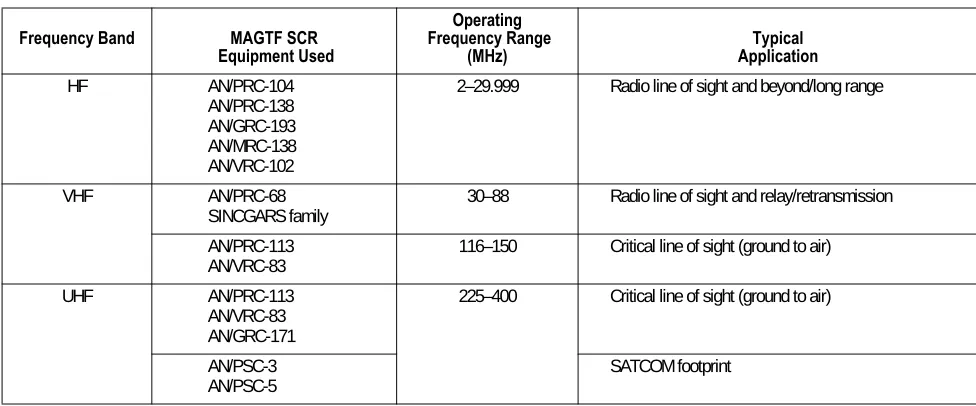
SCR is used primarily for secure voice communica-tions. However, SCR can also transmit and receive da-ta by using terminal devices such as the digida-tal message system (previously called and more common-ly known as the digital communications terminal [DCT]) and the tactical communications interface module (TCIM). Tactical SCRs operate in HF, VHF, and UHF bands as shown in table 2-1.
HF Radio
HF radio equipment is capable of both long- and short-range secure voice and data communications. The pri-mary Marine Corps HF radio is the AN/PRC-104.
VHF Radio
The primary Marine Corps VHF radio is the single channel ground and airborne system (SINCGARS). SINCGARS is a family of light-weight combat radios that serves as the primary means of communications for C2 and fire support.
UHF Radio
[image:14.612.55.543.530.733.2]Military UHF radio equipment operates in the 116– 150 megahertz upper VHF frequency range and the
Table 2-1. SCR.
Frequency Band MAGTF SCR Equipment Used
Operating Frequency Range
(MHz) ApplicationTypical
HF AN/PRC-104
AN/PRC-138 AN/GRC-193 AN/MRC-138 AN/VRC-102
2–29.999 Radio line of sight and beyond/long range
VHF AN/PRC-68
SINCGARS family 30–88 Radio line of sight and relay/retransmission AN/PRC-113
AN/VRC-83 116–150 Critical line of sight (ground to air)
UHF AN/PRC-113
AN/VRC-83 AN/GRC-171
225–400 Critical line of sight (ground to air)
AN/PSC-3
225–400 megahertz military UHF radio spectrum. UHF radios also include UHF-TACSAT radios ca-pable of long-range communications. The primary Marine Corps UHF radios are the AN/PRC-113 and the AN/PSC-5.
Local Area Networks
Local area networks (LANs) are data communications networks that are designed to support information ex-change, collaboration, and resource sharing in a partic-ular unit, agency, facility, center, or cell in a confined geographic area. Because of the limited distances in-volved, LANs can support high data throughput up to 100 megabites per second, although 10 megabites is more common. LANs include terminal equipment connected to a transmission medium such as wire or fiber-optic cable. LAN media used in the MAGTF in-clude both copper-based coaxial and twisted-pair cable used within local facilities, such as a regiment COC, and fiber-optic cable used as a higher speed backbone that connects multiple facilities in a large headquarters complex. Fiber-optic backbone LANs are also used aboard Navy ships with copper-based coaxial and twisted-pair LANs within an operational workspace such as the landing force operations center (LFOC). MCWP 6-22 contains extensive discussion on how specific LAN media, access methods, technologies, protocols, and equipment are employed to meet specif-ic unit requirements.
Switched Backbone
The MAGTF switched backbone consists of switch-ing, routswitch-ing, and wideband transmission systems that provide a high-capacity communications backbone for the MAGTF as well as connectivity with the DISN. It is the tactical equivalent of commercial local and long-distance networks and sometimes interfaces with and uses those commercial networks. Switched backbone uses a mix of older equipment developed under the TRI-TAC program and newer equipment and technol-ogy. It is tailored to meet the requirements of a partic-ular operation and can adapt to support the unfolding tactical situation and overall scheme of maneuver. Planning, redesign, and adaptation are continuous as switched backbone equipment and personnel arrive in theater and the MAGTF transitions to operations ashore. Larger headquarters, rear areas, expeditionary airfields, and C2 centers at higher echelons are
princi-pal subscribers. Maneuver battalions cannot be con-strained by the switched backbone’s inherent lack of mobility and normally link to it through an SCR inter-face. The MAGTF switched backbone includes switches, internet protocol routers, and wideband mul-tichannel radio transmission systems.
The TRI-TAC family of equipment, developed in the 1970s under a joint program of the Marine Corps, Air Force, and Army and fielded in the mid-1980s, provides the major components of the MAGTF switched back-bone. The Marine Corps and the Air Force employ the TRI-TAC-developed AN/TTC-42 and SB-3865 unit-level circuit switches (ULCSs). Computers play a key role in operation, maintenance, and control. Computer-controlled communications links and switching enable efficient, flexible use of limited resources. Computer-ized switches and routers route voice, data, and video information at various points or nodes in the network. Telephones TA-954 DNVT, TA-1042 DNVT, TSEC/ KY-68/78 DSVT, and multimedia terminals (STU-III) are used to gain access. At divisions and regiments, the switching nodes that support fire support agencies are connected via tactical multi-channel radios AN/TRC-170 and AN/MRC-142.
Wire is most often used to connect cells within a COC and connect multiple automated terminals within a cell. Where the tactical situation permits, wire pro-vides a redundancy for some radio nets. Often an FSC may want a direct wire link that does not pass through a switchboard (hotline) to the supporting artillery FDC or the TPC. Wire communications can be secured and used for voice and data communications.
Messenger
Using messengers must be planned because they pro-vide a secure, reliable means of communications. When time permits, they may be the most effective means for sending fire support plans and overlays.
Special-Purpose Systems
relay systems, and provide real-time information to tactical users at the point of need.
Precision Lightweight Global Positioning System
(GPS) Receiver (PLGR)
The AN/PSN-11 PLGR is a small, handheld, GPS re-ceiver that weighs approximately 3 pounds. It provides precise positioning and timing solutions based on sig-nals received from the GPS satellite constellation. Po-sition can be displayed in virtually any format (latitude/longitude, military grid reference system, and universal transverse mercator). It contains 49 map da-tums. Users can program way-points for navigation with back azimuths and distances to the next way-point available with the push of a button. The PLGR is compatible with night vision goggles.
Enhanced Position Location Reporting System
The enhanced position location reporting system (EPLRS) shares many characteristics with PLRS, but provides a significant increase in data communications capability. Since various data rates supporting various broadcast and point-to-point modes are currently available, EPLRS provides a dedicated data communi-cations capability between regiment and battalion tac-tical data networks (TDNs) within the GCE. This network will also be extended to lower echelons throughout the MAGTF. EPLRS serves as a source for automated friendly position location information (PLI), navigation information, and communications capability for automated systems.
Digital Communications Terminal (AN/PSC-2)
The DCT is a rugged, lightweight, microprocessor-controlled, handheld message processor. It provides Marine users at all echelons with point-to-point and netted data communications. It is compatible with most MAGTF radio, wire, and encryption equipment. It supports data transfer up to 2.4 kilobits per second in the analog frequency shift keying (FSK) mode and, depending on the transmission media, up to 16 kilobits per second in the digital baseband mode. The DCT al-lows the operator to enter and read data in both free text and fixed or variable message formats (VMFs). VMF is the tactical message standard adopted by
DOD for ground forces. All of the Services have agreed to use this standard.
Target Handoff System
The THS is still in the formative stages. It is designed to replace the digital messaging system (DMS). THS will provide personnel at the company level with a tac-tical input/output battlefield situational awareness and data communications capability. THS will be used to receive, store, retrieve, create, modify, transmit, and display fire support information and commander’s critical information via tactical radios, networks, and wirelines. THS will assist the user to manage informa-tion such as posiinforma-tions of other units, coordinates of designated points, preformatted messages, and free text information.
Data Automated Communications Terminal
The DACT provides company fire support personnel with a tactical input/output battlefield situational awareness and data communications capability. DACT will be used to receive, store, retrieve, create, modify, transmit, and display map overlays and com-mander’s critical information via tactical radios, net-works, and wire lines. DACT will use an embedded global positioning system (GPS) receiver to display its own location, which can be automatically transmitted to other stations. DACT can assist the user to manage information such as positions of other units, coordi-nates of designated points, pre-formatted messages, and free-text information.
Advanced Field Artillery Tactical Data System
The AFATDS is a joint Army/Marine Corps system to replace the initial fire support automated system (IF-SAS). It is a multi-Service, integrated, battlefield man-agement and decision support system that incorporates automation into the fires warfighting function to assist the commander in planning, delivery, and coordina-tion of supporting arms. Terminals are located in FSCCs, DASC, TACC, and artillery battalion and reg-iment FDCs.
Tactical Combat Operations
sources and disseminate selected information through-out the battlespace. TCO attributes include automated message processing, mission planning development and dissemination of operations orders and overlays, displaying friendly and enemy situations, displaying tactical control measures, and interfacing with wide and local area networks. Terminals will be located in the MEF, DASC, TACC, and COCs of divisions, in-fantry battalions and regiments, artillery battalions and regiments, and LAR and tank battalions.
FIRE SUPPORT RADIO NETS
Radio nets are groups of designated stations connected to each other. They may be identified to carry either voice and/or data transmissions. Unit standing operat-ing procedures (SOPs) should contain procedures for establishing communications and troubleshooting on voice or data nets. Data radio nets do not have the range capability of voice nets. Directional antennas help minimize this limitation. Figure 2-1 on page 2-6 shows fire support radio nets and designates control, guard, and monitor responsibilities.
The MAGTF force fires coordination (MAGTF FFC): VHF, voice/data net is activated by the MAGTF FFCC in operations that are not amphibious.
Examples of division fire support coordination (Div FSC): VHF, voice/data net traffic include fire plans, target information, and fire support coordinating mea-sures (FSCMs). Regiment FSCCs also use this net for cross-boundary coordination of aircraft and fires.
At a lower level, the regiment fire support coordination (Regt FSC) VHF: voice/data net is similar to the divi-sion FSCC net with emphasis on traffic related to coor-dination and execution of fire plans. Battalion FSCs use this net to pass fire support requirements to the reg-iment FSC and to coordinate cross-boundary fires.
These nets will normally accommodate communica-tions requirements for effective fire support. When used for their stated purpose, circuits do not become overloaded and remain free for necessary communica-tions. However, if some nets become unavailable through heavy traffic, enemy interference, or equip-ment failure, FSCC personnel should not hesitate to use any available net to pass urgent traffic.
Nets may be used as alternate tactical or command nets by maneuver units in special situations. The number of nets plus the availability of wire provides flexible options for FSCC personnel to provide con-tinuous communications.
MCWP 3-16 is the primary reference for fire support communications nets. See FMFM 6-18-1 for net con-figuring procedures for data transmission with auto-mated fire support systems. See also MCWP 6-22.
ARTILLERY AND MORTAR RADIO NETS
Artillery Conduct of Fire (Arty COF):
VHF, Voice/Data
This net provides a means for observers to request and adjust artillery fire. Artillery LNOs at regiment and battalion FSCCs monitor/receive net traffic to coordi-nate requests for fire. FOs and LNOs may use the net to exchange target and fire planning information. If conducting battalion-directed operations, the artillery battalion FDC establishes as many as three COF nets and acts as net control on each. The artillery battalion FDC may assign a COF net for each maneuver battal-ion for continuity of fire support during battery dis-placements. The supported unit’s LNOs and FOs remain on the assigned COF net. The artillery battal-ion FDC receives all calls for fire (CFFs) and deter-mines the firing battery that will provide fire support to the maneuver battalion. If conducting autonomous operations, each battery FDC maintains a COF net and acts as net control, each net is monitored by the battal-ion FDC when present. When observers are employing digital devices, one or more COF nets must be dedicat-ed to data communication.
Division/GCE Artillery Air Spot: VHF, Voice
Artillery Regiment Fire Direction
(Arty Regt FD): VHF, Voice/Data
This net provides a means for the artillery regiment to exercise tactical FD; e.g., transmitting orders, fire
mis-sions, fire plans, tactical information, and meteorolog-ical data to subordinate battalions. It also collects, exchanges, and passes combat and target information. Subordinate units may use it to request reinforcing fires. The artillery officer at the division FSCC may
Legend: C - Net Control X - Guard R - As required (When directed) LF FF C (V H F) (1 )* D IV F SC (V H F) * R EG T FS C (V H F) * LF A R TY C M D A R TY R EG T C M D (H F) A R TY R EG T FD (V H F) * A R TY R EG T TAC (V H F) D IV /G C E AR TY A IR SP O T (V H F) A R TY BN C M D (V H F) A R TY BN F D (V H F) * D /S AR TY C O F (V H F) (2 )* TAR (H F) (1 ) TAD (UH F/ VH F) (1 ) TAC P LO CA L (V H F) D IV /G C E N G F SP T (H F) N G F A IR SP O T (UH F/ VH F) N G F C O N TR O L (H F) N G F G RN D SP O T (H F) SF C P LO CA L (V H F) N G F C O N TR O L O VE R LO AD (H F) LF N G F SP T (H F) B N M O R TAR (V H F)
SACC (AFLOAT) C C C C C C
TACC (AFLOAT) X X R
MAGTF FFCC C C X R X R C
FAHQ X
DIV FSCC X C R R R X R X C C R X
DASC (ASHORE) C C
INF REGT FSCC R X C R R R R X R X X C R R
INF BN FSCC X R R X X X C R C C R X
SEP BN FSCC X R R R R R R R X X C R R C C R X
ARTY REGT R X R C C C C
D/S ARTY BN R X R X X X R C C C
ARTY BTRY R X X X
RADAR BEACON TM
ARTY FO R X
FAC X X X
MORTAR FO X
NGF SPOT TM X X
LAAD MISSILE TM (3)
FIRE SPT SHIP(S) X R X X R X
MORTAR PLAT C
NOTES:
(1) Net control located in SACC until displaced ashore.
(2) Net control at battalion (battalion directed operations) or battery (autonomous operations). (3) LAAD nets established as required.
* Data and/or voice nets.
monitor this net to keep abreast of artillery fire plan-ning and pass fire support coordination traffic if no other net is available.
Artillery Battalion Fire Direction (Arty Bn FD):
VHF, Voice/Data
When transmitting voice traffic, this net provides a means for the artillery battalion FDC to exercise tacti-cal FD of subordinate units. If tactitacti-cal FD is decentral-ized, this net may be used by batteries to request reinforcing fires. The artillery LNO at the regiment FSCC (battalion FSCC as required) may monitor the Arty Bn FD net to keep abreast of artillery fire plan-ning and significant artillery missions. When transmit-ting data traffic, tactical FD is incorporated into a COF net and the Arty Bn FD is used for coordinating rein-forcing fires.
Artillery Regiment Tactical (Arty Regt Tac):
VHF, Voice
This net provides a means for the artillery regiment commander to command and control subordinate units. Types of traffic include changes in tactical mis-sion assignments and displacement or fire capability reports. It may also be used as an alternate net for FD and fire support coordination traffic.
Artillery Regiment Command (Arty Regt Cmd):
HF, Voice
This net provides a means for the artillery regiment commander to command and coordinate administra-tive and logistical activities of subordinate units. It may be used as an alternate net for FD and tactical orders. The division FSCC may monitor this net, as re-quired, principally as an alternate net for communi-cating with the artillery regiment should other nets become inoperative.
Artillery Battalion Command (Arty Bn Cmd):
VHF, Voice
This net provides a means for the artillery battalion commander to command and control subordinate units. It is used principally for administrative, logistic,
and tactical traffic not related to FD. The supported in-fantry regiment or separate battalion FSCC may moni-tor this net, as required, principally as an alternate net for communicating with the DS battalion should other nets become inoperative.
MAGTF/LF Artillery Command/Fire Direction
(Arty Cmd/FD): HF, Voice
This net is established in amphibious operations for rapid dissemination and coordination of fire support information. It is used for the artillery regiment and SACC to remain current on the status of artillery bat-talions. When the MAGTF consists of two GCEs or a force artillery, both artillery regiments and the force artillery monitor this net. The net remains active until the artillery regiment headquarters or both artillery regiment headquarters and the force artillery are ashore and have established their own command/FD nets. If only one GCE, this net normally transitions to the artillery regiment command net with the artillery regiment as net control. If two GCEs, the net normal-ly terminates or becomes the command net of the force artillery.
Other Artillery Nets
Artillery units routinely use other radio nets for inter-nal functions; e.g., survey, meteorology or radar tell-ing. These nets are omitted from this publication since they do not pertain to fire support coordination and would not be required in an FSCC. They are discussed in FMFM 6-18-1.
Ground Combat Nets Monitored by Artillery
Artillery battalions and regiments monitor the support-ed unit’s tactical and intelligence nets. Monitoring keeps them abreast of the tactical situation and able to anticipate and project fire support requirements.
Infantry Battalion Mortar Net: VHF, Voice
NAVAL GUNFIRE RADIO NETS
NGF ships may have limited communications termi-nals that can be used for fire support. When possible, the MAGTF LF should make prior coordination with the ATF to ensure that the proposed communications plan of the AF is workable by the assigned ships.
NGF Ground Spot: HF/VHF, Voice
This net provides a means for NGF spot teams to re-quest and adjust NGF, normally between a spot team and the assigned DS ship. This net is also used to ex-change vital information between stations. The battal-ion NGLO monitors the net to provide clearance or communications relay, if necessary.
NGF Air Spot: UHF/VHF
(Depends on Aircraft), Voice
This net provides a means for aircrews to request and adjust NGF. The NGLO of the unit in whose area of operation the fires will impact monitors the net to pro-vide clearance. NGF spot teams may use this net to co-ordinate with an aircrew for attack of targets in their respective company’s area of operation.
Shore Fire Control Party Local (SFCP Local):
VHF, Voice
The SFCP local net provides a means for the battalion NGLO to coordinate the activities of his SFCP. It is al-so used for the OIC of the spot team to communicate with the members of that team when dispersed.
Division/GCE NGF Support: HF, Voice
This net provides a means for NGF planning between the division/GCE NGFO officer and regiment NGLOs. It is used by divisions and regiments to assign missions to GS ships. This net can also be used by regiments to request additional NSFS and aircrews.
MAGTF/Landing Force NGF Support: HF, Voice
This net provides a means to request NSFS and coor-dinate employment of NSFS ships in GS of the LF.
NGF Control: NGF
Control Overload: HF, Voice
This net provides the Navy amphibious commander with a means for requesting and assigning NSFS ships, making relief and emergency reports, and transmitting orders regarding the execution of scheduled fires. It is an NSFS-equivalent of the artillery command and FD nets. The SAC uses this net to coordinate NSFS ship employment. Depending on the volume of traffic or other criteria, the Navy amphibious commander may establish one or more NGF control overload nets. Ex-amples of traffic are ammunition status and results of attack on targets. Composition is the same as the NGF control net.
AVIATION RADIO NETS
The DASC, when practical, normally collocates with the GCEs senior FSCC. Optimally, collocation is by physical proximity. However, an electronic link may be an acceptable alternative when DASC siting re-quirements differ from the FSCCs; i.e., necessity for line of sight (LOS) communications with aircraft, tac-tical or geographical considerations, and communica-tions connectivity with other MACCS agencies. The following nets are normally found in the DASC and are monitored by the AirO in the FSCC.
Tactical Air Command (TAC)
This net connects the DASC to all other MACCS agencies.
Direct Air Support (DAS)
Tactical Air Request/
Helicopter Request (TAR/HR): HF, Voice
This net connects the DASC to all potential direct air sup-port aircraft requesters. It receives requests for immediate air support. FSCCs monitor and receive air requests and approve, deny or modify them. BDAs and emergency he-licopter requests may also be passed over this net. Pre-planned air support requests may be passed but should normally be passed by other means; e.g., wire or messen-ger. Multiple TAR nets may be required.
Helicopter Direction (HD)
This net is used by the DASC, airborne coordina-tors, and terminal controllers for helicopter control and coordination.
Tactical Air Direction (TAD): UHF/VHF, Voice
This net is used by the DASC, airborne coordinators, and terminal controllers to control and direct fixed-wing aircraft; e.g., FAC or FAC(A) and for an air control agency to brief support aircraft on target information and handoff to a FAC, FAC(A), or TAC(A).
Tactical Air Control Party
Local (TACP Local): VHF, Voice
P
lanning is the act of preparing for future decisions in an uncertain and time-constrained environment. It should incorporate flexibility and, when required, en-able intuitive or recognitional decisionmaking. The commander must recognize benefits and potential pitfalls of planning. He is responsible to ensure that planning is conducted properly to avoid these pit-falls. The commander disciplines the planning pro-cess and teaches the staff the relevance of product content (MCDP 5).The goal of fire support planning is coordinating and integrating fires from armed aircraft, land-based and sea-based indirect fire systems, and electronic war-fare systems that directly support land, maritime, am-phibious, and special operation forces to engage enemy forces, combat formations, and facilities in pursuit of tactical and operational objectives. Fire support planning answers the question “How will fires support the scheme of maneuver?” To accom-plish this, the staff determines—
l What types of targets to attack.
l How to acquire and track targets.
l When to attack targets.
l What fire support assets are available to attack
targets.
l How to coordinate the attacks.
l What defines success.
The collection plan must be integrated with and sup-ported by the fire support plan. Fire support planning provides crucial input for developing the collection plan. It links acquisition assets to finding specific ene-my formations to attack or required information to an-swer the commander’s CCIRs. NAIs and TAIs must support the requirements of the fire support plan.
The result of fire support planning must be an effec-tive, integrated, executable, and flexible plan. An ef-fective fire support plan clearly defines and focuses on achieving the effects required to support the scheme of maneuver, which together, form the overall concept of operation. An integrated fire support plan uses all available acquisition and attack assets and maximizes combat power to create a combined arms effect. An executable fire support plan has the time, space, and resources to achieve and assess the planned effects. A flexible plan is simple, understandable, and has the agility to support the commander’s intent when the un-foreseen arises through well-defined decision points. Finally, maneuver commanders and all fire support agencies must understand the plan.
SECTION I. PRINCIPLES
Fire support planning is a continuous, concurrent cycle of analyzing the enemy and friendly situation; con-ducting targeting; tasking and allocating fire support assets; scheduling fires; and coordinating execution to integrate fire support with the scheme of maneuver and maximize combat power. Its tangible result is a fire support plan. Effective fire support planning re-quires a continuous interaction between higher and lower echelons. The philosophy behind Marine Corps fire support planning is a top down, bottom up
refine-ment approach. The following principles provide guid-ance regardless of the tactical situation.
PLAN EARLY AND CONTINUOUSLY
guidance. The FSC should solicit that additional guid-ance from the commander whenever needed.
EXPLOIT ALL AVAILABLE
TARGETING ASSETS
The FSC should ensure that target acquisition require-ments are identified and incorporated as CCIRs in the collection plan and that target information from all available resources is rapidly evaluated. This includes information from all sources within the MAGTF.
CONSIDER ALL AVAILABLE FIRES
The FSC considers the use of available assets at both his echelon and higher. Available fires includes nonlethal means such as smoke, illumination, and EW resources. He also considers the commander’s guidance for using supporting arms in current and future operations.
USE THE LOWEST ECHELON
CAPABLE OF FURNISHING
EFFECTIVE FIRE SUPPORT
The lowest echelon that has the means to accomplish the mission should furnish the fire support. The FSC decides what is needed and, if his own assets are inad-equate, requests additional fire support from the eche-lon that controls the required asset.
USE THE MOST EFFECTIVE
FIRE SUPPORT MEANS
Requests for fire support are sent to the supporting arm that can deliver the most effective fires within the required time. In making his decision, the FSC consid-ers the nature and importance of the target, the
engage-ment time window, the availability of attack means, the results desired, and the number/type of assets re-quired to achieve the desired effect.
FURNISH THE TYPE OF
FIRE SUPPORT REQUESTED
The fire support requester is usually in the best posi-tion to determine his fire support requirements. How-ever, the FSC is in a position to weigh the request against the commander’s guidance and the current and future needs for fire support. If a request is disap-proved, the FSC stops the request and notifies all con-cerned. When possible, he substitutes a new fire support means and alerts the agencies that are to pro-vide the support and the requesting unit.
AVOID UNNECESSARY DUPLICATION
A key task for the FSC is to ensure that unnecessary duplication of fire support is resolved and that only the minimum force needed to achieve the desired effect is used. Eliminating unnecessary duplication conserves fire support assets, facilitates sustainment, and main-tains tempo. This does not mean that only one asset is used. Taking advantage of the complementary charac-teristics of different types of assets and integrating their effects provides the synergy of combined arms.
COORDINATE AIRSPACE
PROVIDE ADEQUATE SUPPORT
The mission and the commander’s guidance determine the effects that fire support must achieve for the plan to succeed. The FSC must clearly inform the maneu-ver commander when he lacks adequate resources to support his plan.
PROVIDE RAPID COORDINATION
Procedures for rapid coordination ensure speed and flexibility in delivery of fires. Established channels for coordination facilitate rapid coordination. The FSC must know the characteristics of available fire support weapons and their status. The FSC must maintain situ-ational awareness as the battle develops to attack plan-ned targets and targets of opportunity.
PROVIDE SAFEGUARDS
AND SURVIVABILITY
Force protection includes considerations of both friendly and enemy threats. The FSC must be aware of situations that increase the risk of fratricide. The pri-mary mechanisms for limiting fratricide are close coordination at all levels and situational awareness. Use of FSCMs, coordination of position areas, and the locations of friendly forces during target analysis
con-tribute to safeguarding friendly units. Safety measures must minimize the potential for fratricide while not limiting boldness and audacity in combat. Fires that increase survivability include SEAD for aviation as-sets and proactive counter fire to ensure freedom of movement of maneuver forces.
ESTABLISH FIRE SUPPORT
COORDINATING MEASURES
FSCMs facilitate the rapid engagement of targets throughout the battlespace and at the same time pro-vide safeguards for friendly forces. They ensure that fire support will not jeopardize troop safety, interfere with the delivery of other fire support means, or dis-rupt adjacent unit operations. FSCMs are discussed in appendix B.
ESTABLISH
COMMUNICATIONS SUPPORT
Timely and efficient exchange of information is a key requirement for all successful operations. Physical col-location of coordinating agencies provides the surest form of communication. If personal coordination is re-quired but collocation is not possible or desired, liai-son perliai-sonnel are used and an electronic interface is established (voice and/or data).
SECTION II. THE MARINE CORPS
PLANNING PROCESS
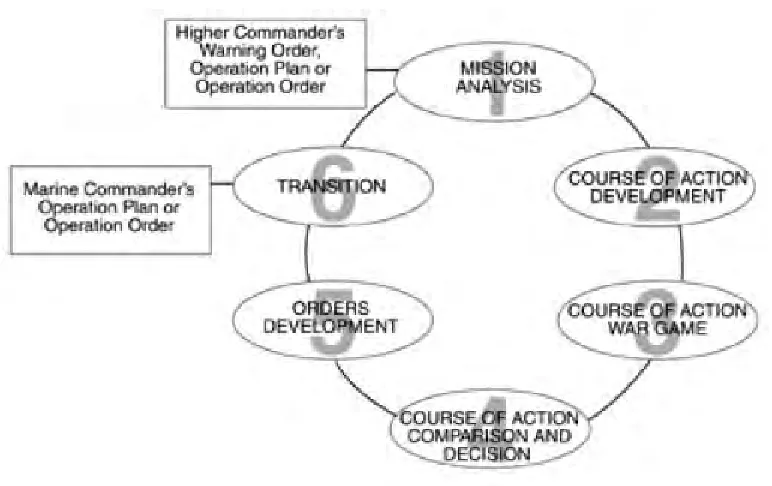
Fire support planning is a part of the Marine Corps Plan-ning Process (MCPP) and is integrated with the other warfighting functions (command and control, intelli-gence, maneuver, logistics, and force protection). It ap-plies the MCPP tenets of topdown guidance, the single battle concept, and integrated planning. Steps of the MCPP (figure 3-1 on page 3-4) support the Marine Corps warfighting philosophy of maneuver warfare. It helps or-ganize the thought process of a commander and his staff
throughout the planning and execution of military opera-tions. The MCPP applies across the range of military op-erations and is designed for use at any level of command. It can be as detailed or as abbreviated as time, staff re-sources, experience, and the tactical situation permit.
The process outlined here is intended to help FSCs to better understand their role in the overall planning pro-cess and the procedures to develop a thoroughly inte-grated and effective fire support plan. See MCWP 5-1,
Marine Corps Planning Process.
DIVISION PLANNING
Higher echelons are generally organized with more planning capacity than lower echelons. Higher echelon planning should attempt to reduce the burden of lower echelon planning. The higher echelon’s efforts are generally focused on influencing future operations while supporting current operations.
Planning includes disseminating guidance and infor-mation on targeting, anticipating requirements, allo-cating assets, and coordinating with higher and adjacent agencies. Planning should not impede nor substitute the planning efforts of lower echelons. Fire support planning by higher echelons seeks to—
l Support forces in contact by using fires to isolate
the battlefield for current operations, and providing force protection; e.g., counterfire.
l Support the commander’s plan by establishing
guidance on fire support and by using fires to shape the battlespace for future operations.
l Combine the different supporting arms to shape the
battlespace and set the stage or enable current operations.
l Sustain fire support by allocation and distribution of
assets and by anticipating requirements and providing logistical support.
REGIMENT AND BATTALION PLANNING
Lower echelons plan concurrently with higher eche-lons (see appendix C). Close liaison facilitates concur-rent planning. Lower echelons focus on providing close supporting fires and the coordination needed to integrate them with maneuver. Fire support planning at lower echelons seeks to—
l Support forces in contact by providing close
supporting fires.
l Support the commander’s scheme of maneuver.
l Integrate fire support with maneuver to create a
[image:25.612.107.493.74.317.2]combined arms effect.
l Sustain fire support by judiciously employing
limited assets where they will have the greatest effect.
COMPANY PLANNING
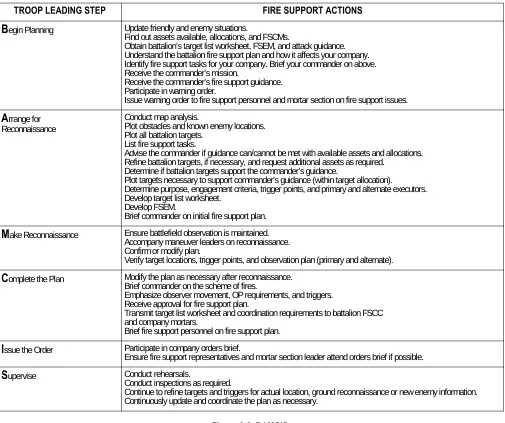
Planning at the company level may use the troop lead-ing steps commonly referred to as BAMCIS. Figure 3-2 lists the fire support actions during each step of BAMCIS. Actions may be done in any sequence or si-multaneously. The company fire support planner must organize the efforts of his assets to meet all these
re-quirements in a time-constrained environment. See MCRP 3-11.1A for more information.
MISSION ANALYSIS
Because fire support planning is a continuous process, the FSC must continually update his fire support esti-mate. Once a mission (or a probable mission) is identi-fied, the efforts of the FSCC become focused. The mission statement received includes the t