Blind Chip-Rate Multiuser Equalisation
Stephan Weiss and Mahmoud Hadef Communications Research Group School of Electronics & Computer Science
University of Southampton, UK
Email: s.weiss,mh02r @ecs.soton.ac.uk
Abstract
This paper addresses blind multiuser detection in a DS-CDMA downlink channel. The syn-chronous users are separated by re-establishing orthogonality of their spreading sequences in a common chip-rate equaliser. The adaptation algorithm can be based either on a con-stant modulus (CMA) criterion of the various users, or on a decision directed (DD) scheme. In either case, a stochastic gradient descent algorithm will result, as derived, in a multiple error filtered-X LMS type approach, whereby the equaliser input to both the multichannel CMA or DD algorithm are replaced by spreading code filtered versions. Adaptation exam-ples are given underlining some of the characteristics of the proposed algorithms.
1.
Introduction
This contribution is aimed at exploiting the power of a programmable receiver such as fund in a software defined radio in order to design and implement signal processing techniques for advanced receiver functionality. Specifically, we consider a DS-CDMA downlink system in Fig. 1 with multiple synchronous users, which for simplicity are assumed to have the same data
rate. Each user , , is code multiplexed using Walsh sequences of length
extracted from a Hadamard matrix . The code multiplexed signal is further scrambled
by multiplication with prior to transmission over a dispersive channel ! with additive
noise" .
The dispersive channel ! destroys the orthogonality of the Walsh codes, such that direct
decoding of the received signal #$ will lead to multiple access interference. Hence, much
research concentrated on symbol-rate equalisers, such as in [1, 2, 3]. The ability to apply computationally complex signal processing tasks at higher sampling rates has recently lead to attractive solutions, whereby the equaliser is operated at the chip-rate [4]. In the later, the
chip-rate equaliser%& is updated by comparing its output to a spread and scrambled training
[m]
w y[m]
[m]
c*
r [m] u0[ ]nn
[ ]
u1
−1
N [ ]n
u
[m] [m]
c n
[ ]
u0 n
[ ]
u1
−1
N [ ]n
u
H p/s s/p HT
[m]
v
[image:1.595.73.519.654.707.2]h
Fig. 1: CDMA modulation and demodulation of user signals'( ,)*+,- , incorporating
switched into a decision directed stage. Decision errors however lead to error propagation with lethal consequences for the convergence of the chip-rate equaliser and subsequently the
detected user sequences , . Therefore, in this paper we address a way of
blindly adapting the chip-rate equaliser%& .
2.
Proposed Structure
We first derive the detected user signals as a function of the chip-rate equaliser % .
Based on this, we state suitable cost functions based on which the equaliser can be adapted.
2.1 Received Signals
The short codes for multiplexing the users are assumed to be Walsh sequences taken from a
Hadamard matrix
. For the decoding, the Walsh sequences are time reversed,
(1)
Theth user is thus decoded as
. .. ' ' ' .. . ' (2) ! "$# " # . .. "%# #+ #$' .. .
#+ '& (3) " # ! ' ! . .. ! ' #$ #$ .. .
#$' & )( (4) " # ' +*, (5) with".-0/21 , ' -43517698 : 1 <; and*, -=/ >: 1
. The long spreading code has
been absorbed into a time varying short code vector !
.
2.2 CMA Cost Function
Assuming that the user signals are constant modulus signals, such as BPSK, QPSK, or
8-PAM, with a modulus? , we can formulate a cost function comprising terms
@BADCE GFIH 2 J LK
−2 −1
0 1
2
−2 −1
0 1
2 −15 −10 −5 0 5 10 15 20 25
w
1
w
0
10*log10(
ξCMA
[image:3.595.144.455.54.284.2])
Fig. 2: CMA cost function in dependency of"
%
%
, which is constrained to be real.
whereby
"
opt
ADCE
arg
@ADCE
(7)
which forces each received user symbol onto a constant modulus. Each term in the cost
function accounts for the misadjustment of the th user in the system. The shape of this cost
function is not concave, since the optimal solution in the sense of minimising (6) is ambiguous with a manifold of solutions due to an indeterminism in phase rotation.
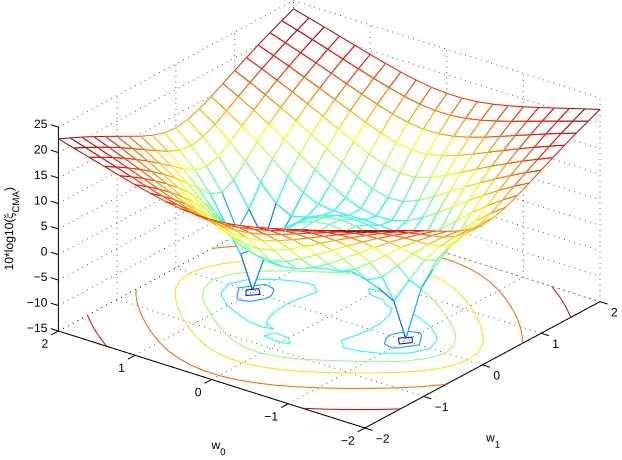
An example for @ ADCE
with users employing QPSK over a distortionless noise-free
channel in dependency of "
with& ( is given in Fig. 2. There are two symmetric solutions
"
opt
ADCE
*
only, since"
is restricted to be real. Note that a solution"
would not synchronise the codes correctly and therefore has a large cost function value. Also, the cost function can be seen to have flat points in between the minima.
2.3 Decision Directed Cost Function
By employing a non-linearity$
that maps its input onto the permitted constellation points by
means of suitable decision thresholds, a decision directed cost function
@
can be formulated,
@ GF H
J
K
$ RN T V (8)
whereby
"
opt
arg
@
(9)
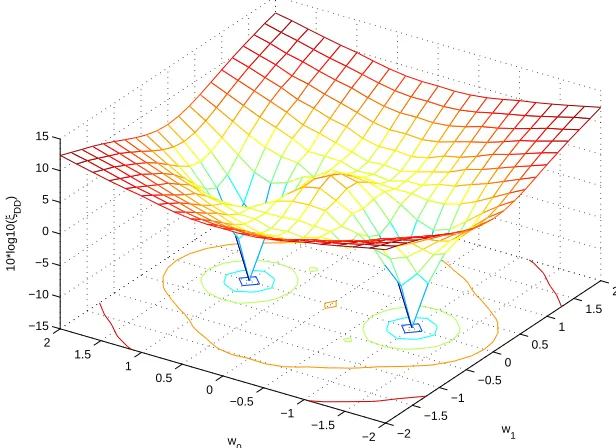
An example for @
with users employing QPSK over a distortionless noise-free
channel in dependency of "
with& ( is given in Fig. 3. There are two symmetric solutions
"
opt
; again note that"
*
−2 −1.5 −1 −0.5 0 0.5 1 1.5 2 −2 −1.5 −1 −0.5 0 0.5 1 1.5 2 −15 −10 −5 0 5 10 15 w 1 w 0 10*log10( ξDD )
Fig. 3: DD cost function in dependency of" % % .
3.
Stochastic Gradient Algorithms
A simple stochastic gradient descent update rule for %& can be found by calculating the
gradient of an instantaneous cost function, i.e. omitting the expectation operator in (6) and (8). The resulting terms are then minimised w.r.t. "
to obtain instantaneous estimates of the cost
function gradient @
"
, , leading to the stochastic gradient update
" , : " , @ "
, (10)
where is the step size. The introduction of gradient noise through inaccurate estimates of
the true underlying statistics into the update routine can be expected to assist the system in recovering from flat points in the cost functions as seen in Figs. 2 and 3.
3.1 Stochastic Gradient CMA
Based on (6) with expectations dropped, we apply complex vector calculus [5]:
" @ADCE I( 2 J K
M? N POQ RON
" # (11) I( 2 J K
? N POQ RON ' *,
* # , # ' " (12) I( 2 J K
? N POQ RON ' *,
(13)
3.2 Stochastic Gradient with Decision Directed Updating
The following derivation is based on the assumption that$' is independent of
"
:
"
@
(
2
J
K
$
"
(14)
(
2
J
K
$ ' +*,
(15)
Again, the term *,
means that the input#$ to the chip-rate equaliser needs to be filtered
by the Walsh codes before being fed into a standard DD multichannel stochastic gradient
equaliser update.
4.
Results
We assume a channel impulse response at chip rate with coefficients
,
QPSK modulated users and an equaliser length of &, coefficients. The dispersive channel
is assumed noiseless. Below we present and discuss the results using the algorithms derived in
Sec.
3.
4.1 CMA Experiment
Using the multiple error filtered-X constant modulus algorithm, an example for a learning curve
with a suitable step size is shown in Fig. 4(bottom), with the weight trajectories given in
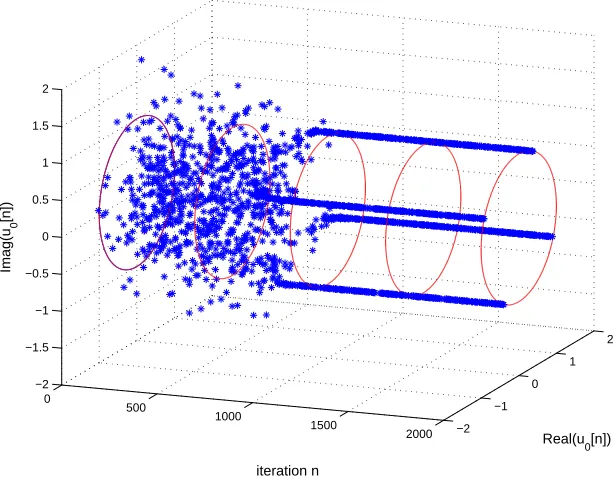
Fig. 4(top). The adaptation is initialised with the second coefficient in the weight vector set to unity, while the optimal response will need to place the maximum coefficient in the first vector element. The adapted response is a complex rotation of the ideal response, such that the received constellation pattern will be rotated as well, as can be seen in Fig. 5. Adaption is
switched on at * , but the adaptation curve shows a slow initial convergence typical of CMA
algorithms [7].
4.2 DD Experiment
The results for the decision directed stochastic gradient algorithm version are shown in Fig. 6.
The finite steady-state MSE is due to truncation of the ideal equaliser response after &
coefficients.
5.
Discussion and Conclusion
References
[1] M. Honig, U. Madhow, and S. Verdu, “Blind Adaptive Multiuser Detection,” IEEE
Trans-actions on Information Theory, vol. 41, no. 4, pp. 944–960, July 1995.
[2] F. Petre, M. Moonen, M. Engels, B. Gyselinckx, and H.D. Man, “Pilot-Aided Adaptive CHip Rate Equalizer Receiver for Interference Suppression in DS-CDMA Forward Link,” in IEEE Vehicular Technology Conference, Sept. 2000, vol. 1, pp. 303–308.
[3] M. D. Krauss, T. P. amd Zoltowski and G. Leus, “Simple MMSE Equalizers for CDMA Downlink to Restore Chip Sequence: Comparison to Zero-Forcing and Rake,” in Proc.
IEEE International Conference on Acoustics, Speech, and Signal Processing, June 2000,
vol. 5, pp. 2865–2868.
[4] P. Schniter and A. R. Margetts, “Adaptive Chip-Rate Equalization of Downlink Multi-rate Wideband CDMA,” in Asilomar Conference on Signals, Systems, and Computers, Monterey, CA, November 2002, pp. 1228–1232.
[5] T. K. Moon and W. C. Stirling, Mathematical Methods and Algorithms, Prentice Hall, Upper Saddle River, NJ, 1999.
[6] S.J. Elliott, I.M. Stothers, and P.A. Nelson, “A Multiple Error LMS Algorithm and its Ap-plication to the Active Control of Sound and Vibration,” IEEE Transactions on Acoustics,
Speech and Signal Processing, vol. Vol.35, no. No.10, pp. pp.1423–1434, 1987.
[7] C. R. Johnson, P. Schniter, T. J. Endres, J. D. Behm, D. R. Brown, and R. A. Casas, “Blind Equalization Using the Constant Modulus Criterion: A Review,” Proceedings of the IEEE, vol. 86, no. 10, pp. 1927–1950, October 1998.
[8] R. Schober, W. H. Gerstacker, and L. H. J. Lampe, “Comparison of MOE and blind LMS,”
IEEE Communications Letters, vol. 7, no. 5, pp. 204–206, May 2003.
[9] K. Fukawa and H. Suzuki, “Orthogonalizing Matched Filter (OMF) Detection for DS-CDMA Mobile Radio Systems,” in IEEE Global Telecommunications Conference, 1994, vol. 1, pp. 385–389.
[10] Y. Huang and P. M. Djuri´c, “Multiuser Detection of Synchronous Code-Division Multiple-Access Signals by Perfect Sampling,” IEEE Transactions on Signal Processing, vol. 7, no. 50, pp. 1724–1734, July 2002.
0 200 400 600 800 1000 1200 1400 1600 1800 2000 −1
−0.5 0 0.5 1
iteration n
real(w[n])
0 200 400 600 800 1000 1200 1400 1600 1800 2000
−50 −40 −30 −20 −10 0
iteration n
CMA cost function / [dB]
Fig. 4: (top) weight trajectories and (bottom) learning curve of the CMA experiment.
0
500
1000
1500
2000 −2
−1 0
1 2
−2 −1.5 −1 −0.5 0 0.5 1 1.5 2
Real(u
0[n])
iteration n
Imag(u
0
[image:7.595.146.454.125.364.2][n])
[image:7.595.146.453.409.648.2]20 40 60 80 100 120 140 160 180 200 −0.5
0 0.5 1 1.5
iteration n
weight trajectories
0 20 40 60 80 100 120 140 160 180 200
−30 −20 −10 0 10 20
iteration n
MSE / [dB]
[image:8.595.145.453.263.506.2]