Nature and Purpose: Composite and composite modified double-base propellants are heterogeneous mixtures of fuels and small particulate oxi-dizers held together by a rubbery material referred to as the binder. They provide a stable, high-performance, solid propellant for rocket motors.
Method of Operation:Selected fuels and oxidizers are mixed in exact ratios and cast (poured and then solidified) directly into rocket motor casings or into a mold for subsequent insertion into a case (cartridge loaded). When ig-nited, the propellant burns and generates high-pressure, high-temperature exhaust gases that escape at extreme speeds to provide thrust. Once ignited, the propellant cannot be readily throttled or extinguished because it burns without air and at very high temperatures.
Typical Missile-Related Uses:Composite and composite modified double-base propellants are used to provide the propulsive energy for rocket systems, kick motors for satellites, and for booster motors for launching cruise mis-siles and unmanned air vehilcles (UAVs).
Other Uses:These propellants are used in tactical rockets.
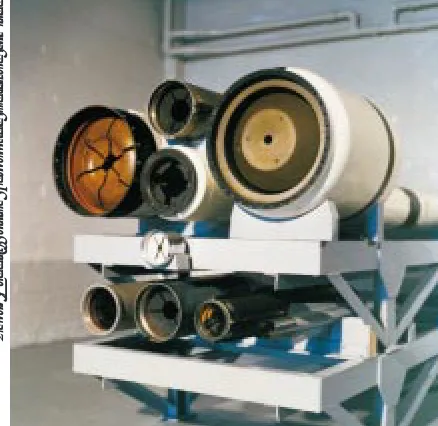
Appearance (as manufactured): Composite and composite modified double-base propellants are hard, rubbery materials resembling automobile tires in texture and appearance. Ingredients such as aluminum or other metal powder gives them a dark gray color; however, other additives may cause the color to vary from red to green to black, as shown in Figure 4-1. A piece of composite-modified double-base propellant surrounded by sam-ples of all its constituent chemicals is shown in Figure 4-2.
Appearance (as packaged): Once the components of the propellants are mixed together, they are poured directly into the missile case and solidify
Produced by companies in
•Argentina
•Brazil
•Canada
•China
•France
•Germany
•India
•Israel
•Italy
•Japan
•Norway
•Pakistan
•Republic of Korea
•Russia
•Spain
•Sweden
•Switzerland
•Taiwan
•United Kingdom
• United States
CA
TEGOR
Y II ~ ITEM 4
Propellants
Propellants and constituent chemicals for propellants as follows: (a) Composite Propellants
into a single piece of material to form a completed mo-tor. Thus, these propellants are shipped only as the major internal component in a loaded rocket motor and usually are not encountered separated from a mo-tor. Exceptions are cartridge-loaded systems that fit a cartridge of propellant into a motor case.
[image:3.612.49.268.43.256.2]Additional Information: The most commonly used fuel component of composite propellants is aluminum powder, which has better performance and greater ease of use than other metal powders that may be used. The oxidizer component of choice is ammonium perchlo-rate (AP); other oxidizers are metal perchloperchlo-rates, am-monium nitrate (AN), and amam-monium dinitramide (ADN). Metal perchlorates and AN greatly decrease performance and thus have only limited use in special-ized propellants. ADN is a new oxidizer with better performance than AP, but it has limited availability and is very difficult to work with. The high explosives HMX and RDX may be used as an adjunct to AP in order to increase propellant performance. The binder used in composite propellants is normally a synthetic rubber; the best one is hydroxyl-terminated polybutadiene (HTPB). Other binders are car-boxyl terminated polybutadiene (CTPB), polybutadiene-acrylic acid polymer
Figure 4-1:Solid propellants var y in appearance
on the basis of their requirements.
Photo Cr
edit: British Aer
ospace Defense Limited
Photo Credit: Alliant TechSystems, Inc.
Figure 4-2:
[image:3.612.101.559.376.710.2](PBAA), or polybutadiene-acrylic acid-acrylonitrile terpolymer (PBAN). Elastomeric polyesters and polyethers such as polypropylene glycol may also be used as binders. Composite modified double-base propellant also uses nitrocellulose plasticized with nitroglycerine or other nitrate esters as a binder system.
Nature and Purpose:Hydrazine, monomethylhydrazine (MMH), and un-symmetric dimethylhydrazine (UDMH) are liquid rocket fuels. They are used in a wide variety of rocket engines requiring high performance and long storage times. Hydrazine is most often used as a monopropellant (without an oxidizer) by decomposing it into hot gas with a catalyst. Up to 50 percent hydrazine is often mixed with MMH or UDMH fuels in order to improve performance.
Method of Operation: At room temperature and pressure, the hydrazine family of fuels is hypergolic (self-igniting) when mixed with various oxidiz-ers such as nitric acid, chlorine, or fluorine. When used in a bipropellant sys-tem, hydrazine releases about half of its energy by decomposing into a hot gas and half by burning with an oxidizer.
Typical Missile-Related Uses:Although hydrazine can be burned with an oxidizer, safe combustion is difficult to achieve. Thus, it is not widely used in conjunction with an oxidizer; however, it is often used as an additive to enhance performance of the more stable-burning MMH and UDMH fuels. MMH and UDMH, which remain liquid over a –50 to +70°C temperature range, are high-performance fuels used for missiles.
Other Uses: Hydrazine is the most current and common propellant for small thrusters for spacecraft attitude control and satellite maneuvering. Hydrazine is also used in electrolytic plating of metals on glass and plastics, pharmaceuticals, fuel cells, dyes, photographic chemicals, and agricultural chemicals, and as a polymerization catalyst and a corrosion inhibitor in boiler feed water and reactor cooling water. MMH is used in aircraft emer-gency power units.
Appearance (as manufactured):Hydrazine is a clear liquid with a freezing point slightly above that of water, at +1.5°C, and a normal boiling point of 114°C. Its density is slightly greater than that of water, at 1.003 g/cc. It is irritating to the skin, eyes, and lungs, and is highly toxic when taken orally. MMH is a clear liquid with a freezing point of –52°C and a normal boiling
Produced by companies in
•China
•France
•Germany
•Russia
•United Kingdom
•United States (b) Fuel Substances
(1) Hydrazine with concentration of more than 70 percent and its derivatives including monomethylhydrazine (MMH);
Produced by companies in
•Canada
•China
•France
•India
•Iran
•Japan
•Pakistan
•Russia
•United States
point of 88°C. These features make it an attractive fuel for tactical military missiles. Its density is 0.87 g/cc. It is highly toxic. UDMH is a clear liquid with a freezing point of –57°C and a normal boiling point of 62°C. Its den-sity is 0.78 g/cc. It is also highly toxic.
Appearance (as packaged):Anhydrous (water eliminated) hydrazine, MMH, and UDMH are classified as flammable liquids and poisons. Hydrazine prod-ucts can be stored and shipped in aluminum, 300-series stainless steel, and titanium alloy barrels or tanks. Small purchases are commonly packed in 55-gallon drums; larger orders are shipped in railroad tank cars. Containers of fuel in the hydrazine family are all air purged and are backfilled with an inert gas such as nitrogen to prevent contamination and slow oxidation.
Nature and Purpose: The metals aluminum, beryllium, boron, magne-sium, and zirconium are good fuels in particle sizes less than 500 ×10–6m
(500 microns). They are used as a constituent fuel to enhance solid and liq-uid rocket propellant performance. For example, aluminum powder as a fuel additive makes up 5 to 21 percent by weight of solid propellant. Combustion of the aluminum fuel increases the propellant flame tempera-ture by up to 800°K and increases specific impulse by as much as 10 percent.
Method of Operation: Metal powder is added to either the solid propel-lant grain during rocket motor production or to liquid rocket fuel to form a slurry. Because the surface-to-volume ratio of such small metal particles is very high, the oxidizer envelops and quickly burns each metal particle thereby releasing high energy per weight at very high temperature.
Typical Missile-Related Uses: Aluminum powder is relatively inexpensive and is widely used as a fuel component in solid and liquid rocket engines to increase the specific impulse of the propellant and to help stabilize combus-tion. Beryllium, boron, magnesium, and zirconium metal fuels may also be used, but, in practice, they have few military missile-related uses. Generally speaking, they are expensive, dangerous to handle, and difficult to control. Beryllium motors have been developed only as upper stages because some of their exhaust products are toxic.
(3) Spherical aluminum powder with particles of uniform diameter of less than 500 × 10–6 m (500 micrometers) and an aluminum content of
97 percent by weight or greater;
(4) Zirconium, beryllium, boron, magnesium and alloys of these in par-ticle size less than 500 × 10–6 m (500 micrometers), whether
spheri-cal, atomized, spheroidal, flaked or ground, consisting of 97 percent by weight or more of any of the above mentioned metals;
Other Uses: Aluminum powder is used as a main ingredient in aluminum spray paint. Spherical aluminum powder is used as a catalyst and as a com-ponent in coatings for turbine shells and in construction materials like foamed concrete and thermite. Magnesium is used primarily in the pyro-technics industry. Boron is sometimes used in fuel slurry for ducted rockets and solid-fuel ramjets. Zirconium has been used in some high-density com-posite propellants for volume limited tactical applications. Both boron and zirconium are used in ignition compounds for igniters.
Appearance (as manufactured): Aluminum powder is a gray or dull silver powder, as shown in the upper right of Figure 4-2. The particle size of most propellant grade aluminum powder ranges from 3 to 100 microns, although larger sizes have been used. The particle shape is more or less spherical. Beryllium, magnesium, and zirconium are also gray or dull silver powders. Boron is a dark brown powder. The appearance of boron slurry depends on the liquid to which it is added and the boron particle size; typically, the color is dark brown or black. For example, boron mixed with dicyclopenta-diene is a potential ramjet fuel and forms a chocolate-brown slurry with the consistency of honey.
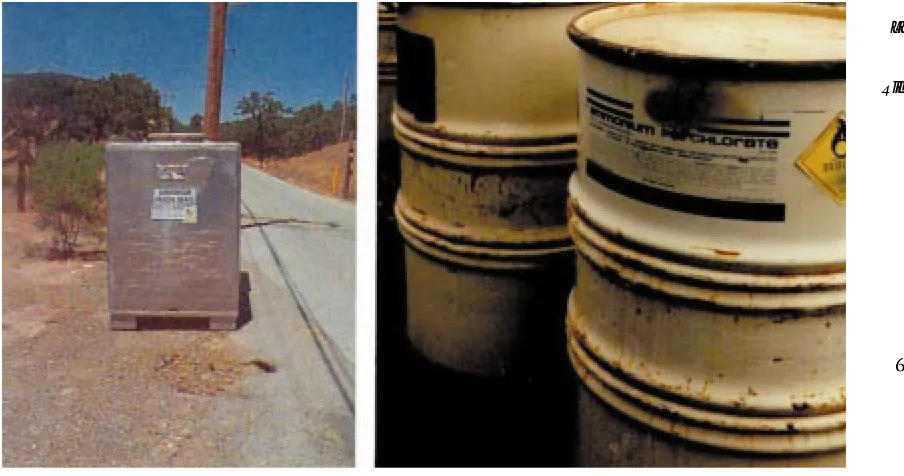
Appearance (as packaged): Aluminum powder is generally packaged and shipped in steel drums with a capacity of 30 gallons or less, similar to the am-monium perchlorate drums in Figure 4-3. Aluminum powder in a 30-gallon drum weighs approximately 180 kg. The other metals, though much less likely to be encountered, are packaged similarly.
Additional Information:Aluminum has a density of 2.7 g/cc, but its bulk density is somewhat less, depending on particle size. Beryllium and its com-bustion products are very toxic. Boron is difficult to ignite. Zirconium is very dangerous to handle in finely powdered form because it spontaneously ignites in air; thus, it is usually shipped in water.
Figure 4-3:
Two different ammonium perchlorate shipping containers.
[image:6.612.53.505.482.720.2]Produced by companies in
•Russia
•United States
For Nitric Acids
•Worldwide
Produced by companies in
There are no known suppliers of these mixtures because of the extreme fire hazard; however, many countries can create and ship such mixtures.
Nature and Purpose: Perchlorates, chlorates, and chromates mixed with fuel components of any kind (e.g., powdered metals) are extremely unsta-ble, likely to ignite or explode, and hard to control in propellants. AP, the oxidizer of choice for most solid propellant applications, is rarely shipped in large bulk quantities mixed with a fuel component because of the associated combustion hazard. However, these mixtures are shipped in components such as ignitors or in small packages (approximately 3 kg).
Method of Operation:The oxygen in perchlorates, chlorates, and chromates is released during combustion, making it available to burn the high-energy fuel in the propellant mixture. Because the oxygen is distributed evenly throughout the mixture, it burns very rapidly without air and is difficult to extinguish.
Typical Missile-Related Uses:AP mixed with powdered aluminum is rou-tinely used in solid rocket motors. Other mixtures of oxidizers and fuels are generally used in missile ignition or delay devices and are rarely used for other purposes in missiles.
Other Uses:When mixed with powdered metals, perchlorates, chlorates, or chromates have commercial use in flares and incendiary devices.
Appearance (as manufactured): The color of these materials varies with the oxidizer and fuel used. Numerous combinations exist, but the most likely (AP and aluminum powder) are light gray materials with a texture re-sembling table salt.
Appearance (as packaged): Perchlorates, chlorates, or chromates, when mixed with powdered metals, are extreme fire or explosive hazards and are very unlikely to be shipped in such mixtures. Rather, they are shipped sep-arately from powdered metals or other high-energy fuel components and then mixed together as a motor is being cast.
Nature and Purpose: Oxidizers provide oxygen or halogen to burn the fuel in any rocket motor or engine. By carrying the fuel and oxidizer
to-(c) Oxidizers/Fuels
(1) Perchlorates, chlorates or chromates mixed with powdered metals or other high energy fuel components.
(d) Oxidizer Substances (1) Liquid
(a) Dinitrogen trioxide;
(b) Nitrogen dioxide/dinitrogen tetroxide; (c) Dinitrogen pentoxide;
(d) Inhibited Red Fuming Nitric Acid (IRFNA);
gether, a missile is not dependent on the atmosphere for oxygen and can thus operate in space.
Method of Operation:In solid rocket motors, the oxidizer is mixed evenly with fuels and cast into the motor case before use. In liquid rocket engines, the oxidizer and fuel are injected into the combustion chamber at great pressure, mixed, and ignited. In either case, heat causes the oxygen to dis-associate from the oxidizer and become more available to burn with the fuel. Some liquid propellants react spontaneously on contact. Resulting hot gases accelerate through a rocket nozzle to develop reaction thrust.
Typical Missile-Related Uses:
• Dinitrogen trioxide (N2O3) is a black liquid at normal atmospheric
pres-sure that decomposes above 3.5°C and freezes at –102°C. N2O3 is not
often used as a missile propellant.
• Dinitrogen tetroxide (N2O4), also known as nitrogen tetroxide (NTO), is a
dimer of two molecules of nitrogen dioxide (NO2) gas. N2O4is a liquid at
normal atmospheric pressure and temperature (below 21°C). However, it is a liquid in a small temperature range, so it can only be used on missiles kept in temperature controlled environments such as silos. Therefore, N2O4
is not commonly used in mobile and tactical missiles. The freezing point of dinitrogen tetroxide can be depressed considerably with the addition of nitrous oxide (NO) gas up to about 40 percent by weight. The result is mixed oxides of nitrogen (MON), which are green liquids with high vapor pressures. These propellants with a lower liquid temperature range are used in tactical missile systems.
• Dinitrogen pentoxide (N2O5) is not normally used as an oxidizer in
liq-uid rocket engines because it is a solid at normal atmospheric pressure and temperature.
• Inhibited Red Fuming Nitric Acid (IRFNA) has a high density and a low freezing-point; it is a commonly available nitric acid oxidizer favored for tactical missiles. IRFNA is widely used in Scud-technology-based missile systems.
• Chlorine trifluoride (ClF3) and chloryl (per-) fluoride (ClO3F) are the
two most common halogen-based oxidizers. Because they are very toxic and energetic oxidizers, they are difficult to handle. Thus, they are rarely used except for technology development. Other inter-halogen oxidizers have been developed and tested, but they are not used because of cost, handling, and safety considerations. For example, chlorine pentafluoride (ClF5) and fluorox (ClF3O) are difficult to make safely and are not
Other Uses:
• N2O4 is commonly used in satellites and in the orbital maneuvering
sys-tem of the US space shuttle. A mixture of nitric oxide (NO2) and N2O4is
the precursor for all nitric acid production and is used as a nitrating agent for agricultural chemicals, plastics, paper, and rubber.
• N2O5is used to make explosives and is a nitrating agent in organic chemistry.
• Concentrated nitric acid, the main constituent of IRFNA, is used to make pharmaceuticals and explosives.
• Chlorine and fluorine have many commercial uses. Chlorine is used widely to purify water, to disinfect or bleach materials, and to manufac-ture many important compounds including chloroform and carbon tetra-chloride. ClF3is used in nuclear fuel reprocessing, and ClO3F is used as a
gaseous dielectric in transformers.
Appearance (as manufactured):*
• NO2 is a red-brown gas, and N2O4 is a red-brown liquid at room
tem-perature. Depending on temperature and pressure, NO2 and N2O4 form
equilibria at various percentages. MONs are mixtures of NO2 and N2O4,
and form green liquids with lower freezing points than N2O4, which
freezes at –11°C and boils at +21°C. The density of N2O4 is 1.43 g/ml.
• Red-fuming nitric acid (RFNA) is nearly anhydrous nitric acid that is stabilized with high concentrations of added nitric oxides. In the United States, about 15 percent NO2 is usually dissolved in the acid, but more
can be added to increase the liquid density. Maximum density nitric acid (MDNA) is 56 percent HNO3 and 44 percent N2O4. Because nitric acid
is corrosive to most non-noble materials (materials that react chemically), a small amount (approximately 0.75 percent) of hydrofluoric acid (HF) is added to produce IRFNA. Stored in stainless steel or aluminum con-tainers, HF forms protective fluorides, which reduce the rates of wall cor-rosion. IRFNA freezes at approximately –65°C and boils at approxi-mately +60°C. Its density at normal room temperature is about 1.55 g/ml, depending on the amount of N2O4 added.
• Fluorine is a pale yellow, highly corrosive, poisonous, gaseous, halogen element. It is usually considered the most reactive of all the elements. Its freezing point is –220°C, and its boiling point is –188°C, which makes it a cryogenic liquid. Its specific gravity in liquid state is 1.108 g/ml at its boiling point.
• Chlorine is a greenish-yellow gas, highly irritating, and capable of com-bining with nearly all other elements. It is produced mainly by electroly-sis of sodium chloride. Its freezing point is –101°C; its boiling point is –35°C; and its specific gravity is 1.56 g/ml (at –34°C).
• Chlorine pentafluoride (ClF5), which boils at –14°C at one atmosphere
pressure, must be pressurized to maintain and ship in liquid form. Its density is 1.78 g/ml at +25°C. Because chlorine trifluoride (ClF3) boils
at +12°C, it is easier to handle than ClF5, but it must still be pressurized
for shipping. Bromine pentafluoride (BrF5) boils at +40°C, but other
characteristics such as shock sensitivity, toxicity, corrosiveness, and lower specific impulse potential make it an impractical propellant.
• Nitrogen trifluoride (NF3) is a cryogenic oxidizer that boils at –130°C and
has a density of 1.55 g/ml at its normal boiling point. Nitrogen tetraflu-oride (N2F4) has a higher density and boiling point but is also cryogenic.
Appearance (as packaged):
• Nitric acids and NTO/N2O4 variants are usually stored in stainless steel
tanks that have been specially prepared. Aluminum tanks and lines are also compatible with nitric acid. Packages for shipping these chemicals use identifying words, warnings, labels, and symbols. MON must be shipped in pressurized containers due to its high vapor pressure and low boiling point.
• IRFNA is usually stored and shipped in aluminum tanks that have been specially prepared. Stainless steel tanks and lines are also compatible.
• Exotic propellants such as chlorine and fluorine are cryogenic liquids and are extremely reactive and toxic. Accordingly, their shipping and handling are tightly regulated. Ordinary metal containers cannot be used to con-tain them. Super-cooled and pressurized tanks are required to ship in liq-uid form. Oxygen difluoride (OF2) can be stored at low temperatures in
glass-lined, stainless steel tanks that have been specially prepared.
Nature and Purpose:Solid oxidizers provide oxygen needed to burn solid rocket motor fuel. By carrying fuel and oxidizer together, the rocket does not depend on the atmosphere for oxygen. Nitro-amines are not oxidizers
Produced by companies in
•Brazil
•China
•France
•India
•Japan
•Russia
•United Kingdom
•United States
Only Russia, Sweden, and the United States have produced ADN. (2) Solid
(a) Ammonium perchlorate;
(b) Ammonium Dinitramide (ADN);
per se, but high explosives added to propellants to increase their performance.
Method of Operation: The solid oxidizer is mixed evenly with fuels and cast into a rocket motor. The oxygen disassociates during the burn process and becomes available to rapidly burn available fuel and, by generating gases exhausted at very high speeds, produce thrust.
Typical Missile-Related Uses:
• Ammonium perchlorate (AP) is an oxidizing agent used by most modern solid-propellant formulas. It accounts for 50 to 85 percent of the propel-lant by weight, depending on the formulation of the propelpropel-lant.
• ADN is an oxidizing agent for solid propellant. This material is used in a manner similar to AP.
• HMX, commonly called Octogen, and RDX, commonly called Cyclonite, are high-energy explosives often added to solid propellants to lower the combustion temperature and reduce smoke. Usually less than 30 percent of the propellant weight is HMX or RDX.
Other Uses:
• AP is used in explosives, pyrotechnics, and analytical chemistry, and as an etching and engraving agent.
• ADN has no known commercial uses.
• HMX and RDX are used in warheads, military and civilian explosives, and oil well pipe cutters.
Appearance (as manufactured):
• AP is a white or, depending on purity, off-white crystalline solid, similar in appearance to common table salt. AP is shown on the right side of Figure 4-2.
• ADN is a white, waxy, crystalline solid that may appear as thin platelets or small round pills.
• HMX and RDX are white crystalline materials that resemble very fine table salt. HMX is shown on the left side of Figure 4-2.
Appearance (as packaged):
• ADN is packaged and shipped in a similar manner to AP.
• HMX and RDX are usually packaged and shipped either in water or alco-hol (because in dry form they are prone to explode) in 30- or 55-gallon polyethylene-lined drums with oxidizer or explosive symbol markings.
Additional Information:
• AP is generally produced with an average particle size of 200 to 400 mi-crons (70 to 40 mesh). The density of AP is 1.95 g/cc, but the bulk den-sity is less and varies with particle size. AP decomposes violently before it melts. The chemical formula of AP is NH4ClO4.
• ADN has a density of 1.75 g/cc and a reported melting point of 92 to 95°C. The chemical formula for ADN is NH4N(NO2)2.
• HMX and RDX are generally produced with a particle size of 150 to 160 microns (100-80 mesh). HMX has a density of 1.91 g/cc, a melting point of 275°C, and a chemical formula of C4H8N8O8. RDX has a density of 1.81
g/cc, a melting point of 204°C, and a chemical formula of C3H6N6O6.
HMX and RDX also decompose violently at their melting points.
Nature and Purpose: These five polymers are chemicals used as a binder and fuel in solid rocket motor propellant. They are liquids that polymerize during motor manufacture to form the elastic matrix that holds the solid propellant ingredients together in a rubber-like polymeric composite mate-rial. They also burn as fuels and contribute to overall thrust. GAP is the only energetic polymer in this group. It provides energy as a result of its decom-position during the combustion process.
Method of Operation:Batch mixers (or, rarely, continuous mixers for very large scale production) are used to blend carefully controlled ratios of rocket motor propellant ingredients into the polymeric substance. The viscous, well blended material is then cast into a rocket motor case, in which it polymer-izes and adheres to either an interior liner or insulator inside the rocket mo-tor case. The result is a rocket momo-tor fully loaded with solid propellant.
Typical Missile-Related Uses: These polymeric substances are used in the production of solid propellant for solid rocket motors and hybrid rocket
mo-Produced by companies in
•China
•France
•India
•Japan
•Russia
•United States (e) Polymeric Substances
(1) Carboxyl-terminated polybutadiene (CTPB); (2) Hydroxyl-terminated polybutadiene (HTPB); (3) Glycidyl azide polymer (GAP);
(4) Polybutadiene-acrylic acid (PBAA);
tors. They are also used in the production of smaller solid rocket motors used to launch UAVs and cruise missiles. These binding ingredients greatly affect motor performance, aging, storability, propellant processing, and reliability.
Although all these materials are of concern as potential solid propellant binders, HTPB is the preferred binder. At present, no fielded ballistic mis-sile systems use GAP or PBAA. CTPB and PBAN have largely supplanted PBAA because of their superior mechanical and aging characteristics.
Other Uses: PBAN has no commercial uses. HTPB has extensive uses in asphalt and electronics, and as a sealant.
Appearance (as manufactured): These five polymeric materials are clear, colorless, viscous liquids. Antioxidants are added at the level of one percent or less at the time of manufacture in order to improve shelf life; they impart a color to the materials, which may range from light yellow to dark brown. This color depends on the type and amount of antioxidant used.
The viscosity of these five liquids ranges from that of light syrup to that of heavy molasses. Except for GAP, which is nearly odorless and has a specific density of 1.3, the polybutadiene-based polymers have a very distinctive petroleum-like odor and densities slightly less than that of water (0.91 to 0.94).
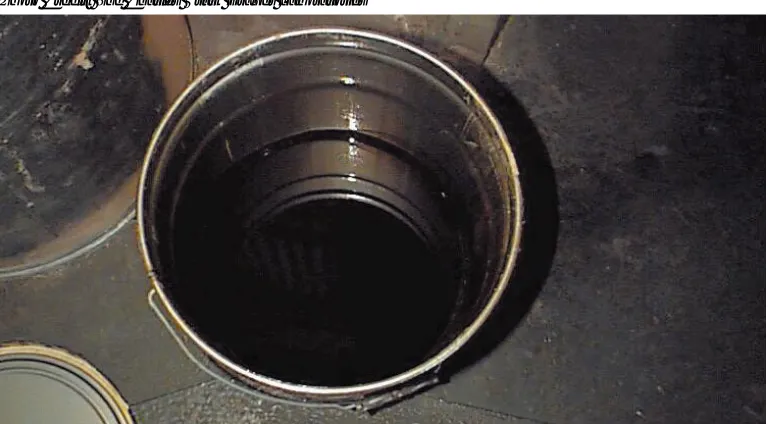
[image:13.612.175.559.491.703.2]Appearance (as packaged): These liquids are usually shipped in 55-gallon steel drums. The interiors of the drums are usually coated with an epoxy paint or other material to prevent rusting. If the liquids are shipped in stain-less steel drums, the coating is not necessary. Smaller or larger containers may be used, depending on the quantity being shipped; cars or tank-trucks may be used to ship very large quantities. An example of PBAN in its shipping drum is presented in Figure 4-4.
Figure 4-4:Top view of PBAN in a shipping drum.
Nature and Purpose: Propellant bonding agents are used to improve the bond or adhesion between the binder and the oxidizer, typically AP. This process vastly improves the physical properties of the propellant by increas-ing its capability to withstand stress and strain. Bondincreas-ing agents are normally used only with HTPB propellants. Some bonding agents are used as curing agents or crosslinkers with CTPB or PBAN propellants.
Method of Operation:Bonding agents are added to the propellant during the mixing operation at levels usually less than 0.3 percent. The bonding re-acts with the AP to produce a very thin polymeric coating on the surface of the AP particle. This polymeric coating acts as an adhesive between the AP and the HTPB binder. The molecular structure stays much the same.
Typical Missile-Related Uses:Propellant bonding agents are used to poly-merize propellants (bond the oxidizer) for solid rocket motors. They are also used in smaller rocket motors that launch UAVs, including cruise mis-siles. MAPO is a curing agent for carboxy-terminated polybutadiene (CTPB) prepolymers and a bonding agent for HTPB prepolymers. BITA is a bonding agent with HTPB. Tepan is a bonding agent with HTPB. Polyfunctional aziridene amides (PAAs) are bonding agents with HTPB and thickeners for CTPB and PBAN.
Other Uses:MAPO is used only in solid rocket propellants. BITA is used with HTPB in the commercial sector, especially in electronics, as a sealant, and as a curing agent for CTPB prepolymers. Tepanol and Tepan are used only in solid rocket propellants. PAAs are used in adhesives in the commercial sector.
Appearance (as manufactured):MAPO is a slightly viscous amber liquid. It has a very distinctive acrid odor. It polymerizes violently if it comes into con-tact with acids and AP. Its boiling point is 1,200°C at 0.004 bar; its density is 1.08 g/cc; and its chemical formula is C9H18N3OP. BITA is a light yellow,
viscous liquid; when cooled below 160°C, BITA is a pale, off-white, waxy solid. BITA has no sharply defined melting point, a density of 1.00 g/cc, and
Produced by companies in MAPO •France •India •Japan •Russia
•United States
BITA
•United States
Tepanol
•United States
Tepan
•United States
PAAs
•United States
The United States is the main
producer and supplier of these materials, but some European and Asian countries may have production licenses, and production of these materials may be more widespread because the composition of these materials is open-source information and production methods are not difficult to duplicate. (f) Other Propellant Additives and Agents
(1) Bonding Agents
(a) Tris (1-(2-methyl)) aziridinyl phosphine oxide (MAPO); (b) Trimesoyl-1-(2-ethyl) aziridene (HX-868, BITA);
(c) “Tepanol” (HX-878), reaction product of tetraethylenepen-tamine, acrylonitrile and glycidol;
(d) “Tepan” (HX-879), reaction product of tetraethylenepenta-mine and acrylonitrile;
Produced by companies in
For Catocene
•United States
For Ferrocene derivatives
•China
•France
•Germany
•Japan
•Switzerland
•United Kingdom
•United States
For Borane derivatives
•France
•Russia
•United Kingdom
•United States
For Butacene
•France
Produced by companies in
•France
•Japan
•Switzerland
•United States
a chemical formula of C21H27N3O3. Tepanol is a dark yellow, viscous liquid.
It has a very strong odor like that of ammonia. Tepan is much less viscous than Tepanol but identical to it in all other respects including a very strong odor like that of ammonia. PAAs are similar to BITA.
Appearance (as packaged): MAPO is packaged and shipped in standard, 1- to 55-gallon steel cans or drums. BITA is packaged in 1-gallon steel cans, which are usually shipped in insulated containers packed with dry ice and stored at 0°C or less in order to maintain its useful shelf life. Tepanol, Tepan, and PAA shipping and storage conditions are identical to BITA.
Nature and Purpose:Curing agents and catalysts are used to polymerize solid rocket motors; that is, they cause the viscous mixture of liquid polymeric sub-stance and other solid propellant ingredients to solidify into a rubbery com-posite, which adheres to the inner lining or insulator inside the motor case.
Method of Operation: Triphenyl bismuth (TPB) is added in relatively small quantities to HTPB to trigger a relatively mild chemical reaction known as polymerization. The molecular structure of HTPB stays much the same, but the material converts from liquid to solid form due to molecular cross-linking.
Typical Missile-Related Uses:TPB is used as a cure catalyst in HTPB solid rocket propellants.
Other Uses:TPB is used in some plastics.
Appearance (as manufactured): TPB is a white to light tan crystalline powder. TPB has a density of 1.7 g/cc, a melting point of 78°C, and the chemical formula C18H15Bi. A sample of TPB is shown in the lower left of
Figure 4-2.
Appearance (as packaged): TPB is packed in brown glass containers be-cause of its sensitivity to light. These containers range in capacity from a few grams to 5 kg. When shipped in larger quantities, TPB may be packed in polyethylene bags inside fiber packs or cardboard cartons.
(2) Curing Agents and Catalysts (a) Triphenyl Bismuth (TPB);
(3) Burning Rate Modifiers (a) Catocene;
(b) N-butyl-ferrocene; (c) Butacene;
(d) Other ferrocene derivatives;
Nature and Purpose:Burning rate modifiers are chemical additives to solid rocket propellant, which alter the rate at which the fuel burns. The purpose is to tailor the rocket motor burn time to meet requirements.
Method of Operation:Burning rate modifiers are blended in carefully con-trolled quantities into rocket motor propellant during production.
Typical Missile-Related Uses:They are added to propellant to modify burn rates and allow designers to tailor the thrust profile to meet requirements.
Other Uses: Some borane derivatives have commercial uses as catalysts in olefin polymerization and as agents in rubber vulcanization.
Appearance (as manufactured):
• Catocene is a slightly viscous, dark red liquid but appears yellow in a thin film or as a yellow stain on white cloth or paper. It is a mixture of six isomers, all with high boiling temperatures. It is insoluble in water but soluble in most organic solvents. It has a density of 1.145 g/cc, slightly greater than that of water. Catocene has the chemical formula C27H32Fe2.
Catocene, the commercial tradename for 2,2′-bis (ethylferrocenyl) pro-pane, is probably the most widely used ferrocene in the propellant industry. All ferrocene derivatives contain iron and are added to propel-lants containing AP.
• N-butyl ferrocene and other ferrocene derivatives are similar in appear-ance to catocene. Ferrocenes have fewer applications to Category I mis-siles than to smaller tactical mismis-siles. They increase propellant sensitivity to accidental ignition by friction and electrostatic discharge.
• Butacene is unique as it is both an HTPB binder and a burn rate modi-fier. It is a very high-viscosity liquid, which resembles a very heavy, dark corn syrup or molasses.
• Carboranes, decarboranes, pentaboranes, and their derivatives are clear, colorless liquids with no distinct odor. The most common carborane de-rivatives used in solid propellants are n-hexyl carborane and carboranyl-methyl propionate. Carboranes may cause nerve damage, according to a few studies. Alkali metal salts of decarborances and pentaboranes are white powders. Most borane derivatives are less dense than water and are toxic. Borane derivatives are used to produce extremely high burn rates in solid propellants. Borane derivatives are extremely expensive to pro-duce, with costs ranging from $2,200 to $11,000 per kg. They are rarely used in ballistic missile propellants.
Produced by companies in
2-NDPA
•France
•Japan
•Switzerland
•United Kingdom
•United States
MNA
•Switzerland
•United Kingdom
•United States
Produced by companies in
Any country can acquire the capability to produce these products. Any country that has set up a nitration plant, such as for the production of explosives, could produce a variety of these nitrate esters.
Nature and Purpose:These nitrate esters, also known as nitrated plasticiz-ers, are additives to solid rocket propellants used to increase their burn rate.
Method of Operation:Nitrate esters and nitrated plasticizers are liquid ex-plosives, which contain enough oxygen to support their own combustion. They are generally added to high performance propellants containing HMX and aluminum to achieve higher performance.
Typical Missile-Related Uses: Nitrate esters and nitrated plasticizers are added to double-base propellants to increase their propulsive energy. Because plasticizers do not react with the cure agents and remain liquid at low temperatures, they make solid propellants less likely to crack or shrink in cold temperatures.
Other Uses: Nitrate esters are used as components of military and com-mercial explosives.
Appearance (as manufactured):Nitrate esters are dense, oily liquids rang-ing in color from clear to slightly yellow.
Appearance (as packaged): Nitrate esters are shipped in 5 to 55 gallon steel drums marked with labels indicating explosives. Except for BTTN, these nitrate esters are shipped undiluted unless the end-user requests that they be shipped diluted with a solvent. Because of its sensitivity to shock, BTTN is shipped diluted with either methylene chloride or acetone. When diluted with methylene chloride, BTTN has a sweet odor like that of chlo-roform. When diluted with acetone, it has an odor like that of nail polish. When stabilizers are added (usually at the 1.0% level) the nitrate ester ac-quires a deep red color.
Nature and Purpose: 2-nitrodiphenylamine (2-NDPA) and N-methyl-p-nitroaniline (MNA) are additives that inhibit or reduce decomposition of rocket fuels containing nitrate esters or nitrocellulose. These types of pro-pellants are referred to as double-base, composite-modified double-base, or cross-linked double-base propellants.
(4) Nitrate Esters and Nitrated Plasticizers (a) Triethylene glycol dinitrate (TEGDN); (b) Trimethylolethane trinitrate (TMETN); (c) 1,2,4-Butanetriol trinitrate (BTTN); (d) Diethylene glycol dinitrate (DEGDN);
(5) Stabilizers, as follows
Method of Operation: These stabilizers alter the chemical environment within the propellant to reduce decomposition of its constituents.
Typical Missile-Related Uses: These stabilizers make composite propel-lants less subject to the effects of aging. As a result, they increase the effec-tive lifetime of solid propellant missiles.
Other Uses:2-NDPA is used in explosives as a nitroglycerin stabilizer. It is used widely throughout the ammunition industry. MNA has no known commercial uses.
Appearance (as manufactured):
• In its pure state, 2-NDPA is a bright yellow, crystalline solid with a den-sity of 1.15 g/cc and a melting point of 74 to 76°C. The chemical for-mula for 2-NDPA is C12H10N2O2. When exposed to light, 2-NDPA turns
to a dark orange color. A sample of 2-NDPA that has been exposed to light is shown in the lower right of Figure 4-2.
• MNA is also a bright yellow, crystalline solid with a density of 1.20 g/cc and a melting point of 152–154°C. The chemical formula for MNA is C7H8N2O2. A sample of MNA is shown in the upper left of Figure 4-2.