Original Article
TS 1494del6 polymorphism and
increased risk of developing breast cancer
Nazan Eras1, Erdinc Nayir2, Ali Arican3, Leyla Bahar4, Mehmet Guler5, Etem Akbas1
1Department of Medical Biology and Genetics, Faculty of Medicine, Mersin University, Mersin, Turkey; 2
Depart-ment of Medical Oncology, Kahramanmaras Necip Fazil City Hospital, Kahramanmaras, Turkey; 3Department of
Medical Oncology, Faculty of Medicine, Mersin University, Mersin, Turkey; 4Vocational School of Health Service,
Mersin University, Mersin, Turkey; 5Department of General Surgery, Medical Park Hospital, Antalya, Turkey Received January 7, 2016; Accepted May 4, 2016; Epub June 15, 2016; Published June 30, 2016
Abstract: Thymidylate synthase (TS) is a critical enzyme involved in folate metabolism and catalyses reductive meth-ylation of deoxyuridylate to thymidylate, which is the essential precursor for DNA. Polymorphisms in genes involved in folate metabolism may influence DNA methylation, DNA synthesis and repair. These functions may provide insight individual susceptibility to cancer. We investigated the probable effects of TS 1494del6 polymorphism on the risk of developing breast cancer. Genotypes of 298 cases and 300 controls were determined by use of PCR-RFLP. Vari-ant -6 bp allele frequency was significVari-antly higher in women with breast cancer than in controls (0.554 vs. 0.467; OR: 1.42, 95% CI: 1.13-1.78; P=0.003). The frequency of the -6 bp/-6 bp genotype was 12% in control group, while increased to 26.8% in women with breast cancer. Similarly, increased risk was observed for breast cancer of the -6 bp/-6 bp genotype compared with the +6 bp/+6 bp genotype (OR 2.59, 95% CI: 1.49-4.49; P=0.001). The risk increased in women with -6 bp/-6 bp genotype as well as age ≥55 (OR, 3.06; 95% CI: 1.15-8.07; P=0.024), BMI ≥25 kg/m2 (OR, 2.81; 95% CI: 1.45-5.46; P=0.002), early menarche (before age 13 years) (OR, 3.52; 95% CI: 1.37-9.04; P=0.009), late age at first pregnancy (OR, 2.87; 95% CI: 1.77-4.64; P=0.0001), postmenopausal status (OR 5.44; 95% CI: 2.23-13.24; P=0.001), and negative smoking history (OR=3.09; 95% CI: 1.87-5.09; P=0.001). In conclu-sion, the TS 1494del6 polymorphism gene may contribute to an increased risk for breast cancer development, particularly in the presence of 55 years of age or older, high BMI, early age at menarche, late age at first pregnancy, postmenopausal status, and negative smoking history.
Keywords: Breast cancer, thymidylate synthase, TS 1494del6, polymorphism
Introduction
Breast cancer (BC) is the most common form of cancer among women worldwide, account- ing for 37% of the cancer related deaths in fe- males between the ages of 25-64 [1]. In re- cent years risk factors for BC have been iden- tified, although the causes of breast cancer aren’t fully understood. However, it is general- ly believed that hereditary, hormonal, repro- ductive, and environmental factors play an im- portant role in the development and progres-sion of this cancer [2].
Folate is an essential cofactor for DNA synthe-sis, repair and methylation [3]. When levels of 5,10-methylene-tetrahydrofolate, which is re- quired to convert deoxyuridylate to thymidy-
stream of the ATG codon initiation site that contains triple (TSER 3R) or double (TSER 2R) repeats of a 28-bp sequence as well as se- veral rare alleles containing 4, 5 or 9 re- peats [8]. The presence of the triple (TSER 3R) versus double (TSER 2R) 28-bp repeat se- quence has been shown to enhance TS tran-scription and TYMS expression level in in vitro and in vivo studies [8, 9]. A common G->C polymorphism (rs2853542) in the second re- peat of 3R alleles that alters translation of TS gene [10]. Another TS polymorphism (rs3448- 9327), a 6-bp deletion/insertion (TAAAGT) in the 3’-UTR, may modulate TS expression levels. Previous one study suggested that a deletion of 6 bp in the 3’-UTR affects a region of TS premessenger ribonucleic acid (mRNA) that contains cis adenylateuridylate-rich elements (AREs). These elements bind to a trans AU-rich factor 1 (AUF1). AUF1, also named hnRNPD (heterogeneous nuclear ribonucleoprotein D), has a destabilizing effect on ARE-mRNAs. The 6-bp deletion at position 1494 in the TS affects mRNA stability or secondary mRNA structure and could thus ultimately affect protein levels of TS. Specifically, increased TS activity may might affect the levels of homocysteine, which is associated with cancer risk [11-14].
Germline BRCA1 and BRCA2 mutations are responsible for 5-10% of all cases of breast cancer, whereas most of breast cancer are spo-radic, resulting from polymorphic low-pene-trance genes. The primary aim of the current study was to determine whether there was association between TS 1494del6 polymor-phism and risk of breast cancer for the Turkish population in the Mersin sample. The
second-ary aim of the study was to evaluate any role of putative risk factors, such as BMI, age at first pregnancy, age at menarche, family history, menopausal status, and smoking status in breast-cancer risk in Turkish women.
Materials and methods
Study subjects
A total of 598 participants consisting of 298 women with breast cancer and 300 controls matched for region, sex, and age were enrolled in this study. Breast cancer cases comprised women who had been diagnosed with breast cancer at the Department of Medical Oncology, Mersin University Faculty of Medical and Kahramanmaraş Necip Fazil City Hospital, Turkey, between 2010 and 2015. Healthy vol-unteer women were randomly chosen from the general population of the same area and 10% of the controls had a history of personal or familial malignancy. Interview response-rates among eligible case and control participants were 96.9% and 93.1%, respectively. This study had received Ethical Approval from the Mersin University Medical Faculty Ethics Committee and informed consents were given. Detailed information on risk factors including age, repro-ductive risk factors (age at menarche, age at first pregnancy, menopausal status), family his-tory of breast cancer (first-degree relatives) and smoking status were obtained with a baseline questionnaire. The body-mass index (BMI) was calculated from the height and weight of the women by use of the formula BMI=(kg/m2). Genotyping
[image:2.612.89.289.70.211.2]Genomic DNA was extracted from peripheral blood leukocytes by using a standard (phenol-chloroform) method [15]. The polymorphism was analyzed by using of PCR/RFLP. The pri-mary sequences for the TS 1494del6 forward and reverse primers were (5’-CAA ATC TGA GGG AGC TGA GT-3’) and (5’-CAG ATA AGT GGC AGT ACA GA-3’), respectively. Genomic DNA was amplified in a 25 µL reaction mixture containing 100 ng DNA, 0.3 nM of the primers, 0.2 nM dNTP mix, 10× PCR buffer, 2.5 mM MgCl2, and 1 U Taq polymerase (MBI Fermentas, Vilnius, Lithuania). The samples were initially dena-tured for 5 min at 94°C followed by 30 cycles of denaturation for 30 s at 94°C, 45 s at 58°C and extension for 45 s at 72°C, with a Figure 1. TS 1494del6 genotyping by PCR-RFLP (+6:
final extension for 5 min at 72°C [11]. Ampli- cons (152 bp) were digested with 4 U DraI (Thermo Scientific Fermentas) by overnight in- cubation at 37°C. Restriction fragments were analyzed following electrophoresis in 3% aga-rose gel stained with ethidium bromide (0.5 µg/mL). The expected fragment sizes were 70 and 88 bp for the wild-type allele (+6 bp/+6 bp) and 152 bp for the variant allele (-6 bp/-6 bp) (Figure 1).
Statistical analysis
Differences in demographic characteristics, selected variables and frequencies of the geno-types, alleles of the TS 1494del6 polymorph- ism between the two groups were evaluated using the Chi-square test (for categorical bles) and Student’s t test (for continuous varia-bles). Hardy-Weinberg equilibrium was tested by using Chi-square test. We calculated odds ratios and 95% confidence intervals using
mul-nificant differences were found between cases and controls for late age at first pregnancy (P= 0.753), early age at menarche (P=0.83), and smoking status (P=0.811).
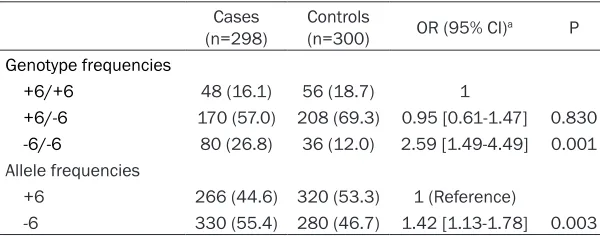
[image:3.612.91.394.96.266.2]The distribution of genotypes and the preva-lence of alleles in the cases and controls were shown in Table 2. The -6 bp allele frequency was higher in the cases than in the controls (P=0.003). TS 1494del6 genotype frequencies were 16.1% (+6 bp/+6 bp), 57% (+6 bp/-6 bp), and 26.8% (-6 bp/-6 bp), respectively, in cases and 18.7% (+6 bp/+6 bp), 69.3% (+6 bp/-6 bp), and 12% (-6 bp/-6 bp), respectively, in control subjects, and these differences were statisti-cally significant (P=0.001). Compared with the wild-type variant (+6 bp/+6 bp), a significantly increased risk was associated with the homozy-gous variant (-6 bp/-6 bp) (adjusted OR=2.59, 95% CI=1.49-4.49), but it was not related with (+6 bp/-6 bp) heterozygous genotype (OR=0.95, 95% CI=0.61-1.47). We observed significant Table 1. Comparison of cases and controls according to demographic
factors and putative risk factors for breast cancer
Variables (n=298)Cases Controls (n=300) P
Age (years [mean ± SD]) 50.64±10.27 49.14±8.37 0.510 Age at menarche (years [mean ± SD]) 13.31±3.38 13.35±1.23 0.830 Age at menopause (years [mean ± SD]) 48.17±6.19 46.65±5.28 0.036 Body-mass index (years [mean ± SD]) 28.81±5.28 26.84±5.12 0.001 Age at first pregnancy (years [mean ± SD]) 22.38±3.33 22.49±4.87 0.753 Family history (%)
No 77.2 90 0.001
Yes 22.8 10
Smoking status
Never smokers (%) 76.5 77.3 0.811
Current smokers (%) 23.5 22.7
tivariate logistic regres-sion. Statistical analyses were performed with SP- SS for windows version 22. P value <0.05 is accepted as statistically significant.
Results
The distribution of de- mographic factors and putative risk factors for breast cancer are sh- own in Table 1. The mean age of the patients was 50.64±10.27 years and the mean age of the con-trol group was 49.14± 8.37 years. Compared with control subjects, breast cancer patients had a higher BMI (P=0.001) and higher age at menopau- se (P=0.036). There were 68 (22.8%) breast cancer cases and 30 (10%) con-trols reported a family history of cancer, which was associated with a sig-nificantly increased risk for breast cancer (P= 0.001). However, no sig-Table 2. Multivariate logistic regression results of genotypes among
breast cancer cases and controls Cases
(n=298) Controls (n=300) OR (95% CI)a P
Genotype frequencies
+6/+6 48 (16.1) 56 (18.7) 1
+6/-6 170 (57.0) 208 (69.3) 0.95 [0.61-1.47] 0.830
-6/-6 80 (26.8) 36 (12.0) 2.59 [1.49-4.49] 0.001
Allele frequencies
+6 266 (44.6) 320 (53.3) 1 (Reference)
-6 330 (55.4) 280 (46.7) 1.42 [1.13-1.78] 0.003
[image:3.612.90.390.312.430.2]deviation from Hardy Weinberg equilibrium in both control and case groups (Respectively P=0.001, P=0.001).
Associations between breast cancer and pu- tative risk factors by TS 1494del6 genotypes are presented in Table 3. Women 55 years of age and older than in those younger than 55 have demonstrated that homozygosity for the -6 bp allele was associated with an increased risk for breast cancer (OR=3.06; 95% CI: 1.15-8.07; P=0.024). The OR was elevated for the -6 bp/-6 bp genotype and a BMI ≥25 kg/m2 (OR=2.81; 95% CI: 1.45-5.46; P=0.002). Wo-
[image:4.612.91.523.95.522.2]men carrying the -6 bp/-6 bp genotype with menarche at age younger than 13 had 3.52-fold increased risk for breast cancer (OR=3.52; 95% CI: 1.37-9.04; P=0.009). An increased risk for breast cancer was found in women who car-ried the -6 bp/-6 bp genotype and who were also more susceptible to estrogen [no history of pregnancy or older (≥20 years) at first full-term pregnancy] (OR=2.87; 95% CI: 1.77-4.64; P=0.0001). There was statistically significant evidence that postmenopausal status was associated with an increased breast cancer risk in women carrying the -6 bp/-6 bp geno-type (OR=5.44; 95% CI: 2.23-13.24; P=0.001). Table 3. Distribution of TS 1494del6 genotypes (case/control) and ORs (95% CI) for breast cancer according to putative risk factors
Risk factors Genotype
(+6 bp/+6 bp) (+6 bp/-6 bp) (-6 bp/-6 bp)
Age ≤44 1.0 (Ref.) 0.66 (0.29-1.52) 2.54 (1.17-5.52)
14/14 48/72 22/12
45-54 1.0 (Ref.) 1.41 (0.70-2.83) 2.81 (1.50-5.27)
16/28 68/84 38/18
≥55 1.0 (Ref.) 0.96 (0.44-2.08) 3.06 (1.15-8.07)
18/16 54/50 20/6
BMI <25 1.0 (Ref.) 0.91 (0.39-2.12) 2.57 (0.91-7.21
10/20 42/92 18/14
≥25 1.0 (Ref.) 1.12 (0.67-1.88) 2.81 (1.45-5.46)
38/38 128/114 62/22
Age at menarche <13 1.0 (Ref.) 0.65 (0.25-1.65) 3.52 (1.37-9.04)
18/8 56/38 34/6
≥13 1.0 (Ref.) 1.31 (0.67-1.88) 2.32 (1.40-3.85)
30/50 114/168 46/30
Age at first pregnancy <20 1.0 (Ref.) 0.77 (0.33-1.80) 0.90 (0.25-3.19)
12/18 32/62 4/8
≥20 or no birth 1.0 (Ref.) 1.06 (0.64-1.76) 2.87 (1.77-4.64)
36/40 138/144 76/28
Family history No 1.0 (Ref.) 1.11 (0.69-1.80) 2.61 (1.66-4.11)
36/56 128/178 66/36
Yes 1.0 (Ref.) NC NC
12/2 42/28 14/0
Menopausal status Premenopausal 1.0 (Ref.) 1.21 (0.61-2.41) 2.35 (1.34-4.11)
14/34 66/132 34/30
Postmenopausal 1.0 (Ref.) 0.99 (0.54-1.81) 5.44 (2.23-13.24)
34/24 104/74 46/6
Smoking status Never smokers 1.0 (Ref.) 1.01 (0.59-1.71) 3.09 (1.87-5.09)
30/38 134/168 64/26
Current smokers 1.0 (Ref.) 1.05 (0.48-2.30) 1.71 (0.71-4.11)
18/20 36/38 16/10
Never smokers carrying the -6 bp/-6 bp geno-type had significant increased breast cancer risk compared with smoking women with the -6 bp/-6 bp genotype (OR=3.09; 95% CI: 1.87-5.09; P=0.001).
Discussion
In this population-based case-control study, we examined the association of TS 1494del6 polymorphism in the 3’-UTR of the TS gene with risk of breast cancer in a Turkish popu- lation. Furthermore, we investigated whether putative risk factors influence breast-cancer development.
In the study of Akisik and co-workers [16], the -6 bp genotype incidence was 19.85% in a Turkish population. In our study, prevalence of the -6 bp genotype was 12.0% in a Turkish population. While the prevalence of the -6 bp allele was found as 36.4% [17], we detected it as 46.7% in a Turkish population. The -6 bp allele frequency in Asians was 71.0% (95% CI=67.7-74.3%), significantly higher than that in Caucasians (33.5%, 95% CI=31.1-35.8%, P< 0.001) [18]. The -6 bp allele frequency found in our controls (n=280) was slightly higher at 0.335 than Caucasians. As given above, there are significant ethnic differences in the fre-quency of the TS 1494del6 polymorphism. This discrepancy may reflect the limited sample size included in some studies. Genotyping of large populations is being used to evaluate disease and gene associations.
The deletion of 6 bp in the 3’-UTR may influence TS mRNA transcription, mRNA stability or pro-tein expression levels. Altered enzyme levels could affect cancer susceptibility as well as treatment efficacy [11]. One study shows that TS 3’-UTR 6 bp insertion was associated with better clinical outcome by FU-based chemo-therapy in advanced gastric cancer (OR=0.41; 95% CI, 0.22-0.76; P=0.01) [19], another study showed that -6 bp carriers were associated with better survival at 12 months when com-pared to +6 bp homozygotes lung cancer patients (P=0.006) [20]. On the other hand, one of the study, authors did not observe an association between the deletion polymor-phism at the TS 3’-UTR and survival of colorec-tal cancer patients [21].
In the current study, we observed a strong association between the heterozygotes for the
-6 bp allele and breast cancer risk factors among women with breast cancer (OR=1.42; 95% CI; 1.13-1.78; P=0.003). To date, many epidemiological studies have evaluated the polymorphisms in the 5’-UTR region of the TS gene with the risk of cancer such as blood can-cers [22, 23], lung cancer [24], gastric cancer [25] and colorectal cancer or adenoma [26-28] but the results are conflicting. It was also found
that homozygosity for the TS 1494del6
than did those with other genotypes (P<0.05). In agreement with others [12, 13] these results may be explained by a 6-bp deletion at nucleo-tide 1494 in the TS is associated with decreased mRNA stability and lower intratu-moural TS expression [31].
In this study, the -6 bp/-6 bp genotype was associated with higher breast cancer risk in women but significantly higher in women 55 years of age and older than women aged <55 years. Additional to our study, a case-control study was conducted among 432 cases and 473 controls in a Chinese population and reported a higher risk of breast cancer among older women with the -6 bp/-6 bp genotype [29]. There is substantial evidence that estro-gens play a role in the etiology of breast cancer. Several mechanisms have been suggested to account for this, including: (i) after the estrogen binds to its receptors in a cell, it stimulates breast cell proliferation through direct and indi-rect actions on the enhanced production of growth factors; (ii) estrogen metabolites, cata-lyzed mainly by cytochrome P450 enzymes, exert direct genotoxic effects that might in- crease mutation rates; and (iii) estrogen is ef- fective inducer of aneuploidy [32]. Our study detected an association between the -6 bp/-6 bp genotype and breast cancer risk among pre-menopausal and postpre-menopausal women but significantly higher in postmenopausal than premenopausal. One study also reported an increased risk of breast cancer among post-menopausal women with -6 bp/-6 bp genotype [29]. On the contrary, in other study it wasn’t observed significant modification of ORs for -6 bp/-6 bp genotype by menopausal status [33]. One of the reproductive risk factors, such as late age at first pregnancy was associated with breast cancer risk with an odds ratio of 2.87 (95% CI, 1.77-4.64). The risk was higher among women with the -6 bp/-6 bp genotype who had early menarche age (<13 years). In contrast, one study observed association between repro-ductive factors, including older age at men-arche and younger age at first-live birth and breast cancer risk [29]. Obesity, an abnormal white adipose tissue accumulation, is related to the increased peripheral conversion of androgenic precursors to estradiol due to increased aromatase enzyme activity from large amounts of adipose tissue and is also related to decrease sex hormone-binding glob-ulin [34]. Changes in endogenous sex steroid
hormone levels may play a role in the develop-ment of breast cancer. Our results showed an increase in the risk for breast cancer in individ-uals -6 bp/-6 bp genotype with women BMI ≥25 kg/m2. The association of breast cancer risk and the -6 bp/-6 bp genotype with women BMI ≥25 kg/m2, is in consistent with one of the study [33]. Cigarette smoking, which decreases age at menopause, appears to have anti-estro-genic effect and might protect against breast cancer [35]. In the present study, we found that the -6 bp/-6 bp genotype was associated with a 3-fold increased risk of breast cancer among women who have never smoked.
In conclusion, we confirmed the observation that TS 1494del6 polymorphism in the 3’-UTR of the TS gene may be a risk factor for develop-ing breast cancer in women with age ≥55, post-menopausal status, BMI ≥25 kg/m2, negative smoking history, late age at first full-term preg-nancy and early menarche age. The result of this study emphasizes the importance of assessing both genetic and putative risk fac-tors for breast carcinogenesis.
Acknowledgements
The author thanks Seval KUL for assistance with statistical analysis.
Disclosure of conflict of interest
None.
Address correspondence to: Dr. Nazan Eras, De- partment of Medical Biology and Genetics, Mersin University Ciftlik Koy Campus, 33343, Mersin, Tur- key. Tel: +90324 361 00 01; Fax: +90324 361 00 15; E-mail: [email protected]
References
[1] Siegel R, Ward E, Brawley O and Jemal A. Cancer statistics, 2011: the impact of eliminat-ing socioeconomic and racial disparities on premature cancer deaths. CA Cancer J Clin 2011; 61: 212-236.
[2] Eras-Erdogan N, Akbas E, Senli H, Kul S and Çolak T. Relationship between polymorphism in the manganese superoxide dismutase gene and breast cancer. Mutat Res 2009; 680: 7-11.
[4] Giovannucci E. Epidemiologic studies of folate and colorectal neoplasia: a review. J Nutr 2002; 132: 2350S-2355S.
[5] Wang TC, Song YS, Wang H, Zhang J, Yu SF, Gu YE, Chen T, Wang Y, Shen HQ and Jia G. Oxidative DNA damage and global DNA hypo-methylation are related to folate deficiency in chromate manufacturing workers. J Hazard Mater 2012; 30: 213-214.
[6] Danenberg PV. Thymidylate synthetase: a tar-get enzyme in cancer chemotherapy. Biochim Biophys Acta 1977; 473: 73-92.
[7] Zhang J, Cui Y, Kuang G, Li Y, Wang N, Wang R, Guo W, Wen D, Wei L, Yu F and Wang S. Association of the thymidylate synthase poly-morphisms with esophageal squamous cell carcinoma and gastric cardiac adenocarcino-ma. Carcinogenesis 2004; 25: 2479-2485. [8] Horie N, Aiba H, Oguro K, Hojo H and Takeishi
K. Functional analysis and DNA polymorphism of the tandemly repeated sequences in the 5’-terminal regulatory region of the human gene for thymidylate synthase. Cell Struct Funct 1995; 20: 191-197.
[9] Kawakami K, Omura K, Kanehira E and Watanabe Y. Polymorphic tandem repeats in the thymidylate synthase gene is associated with its protein expression in human gastroin-testinal cancers. Anticancer Res 1999; 19: 3249-3252.
[10] Mandola MV, Stoehlmacher J, Muller-Weeks S, Cesarone G, Yu MC, Lenz HJ and Ladner RD. A novel single nucleotide polymorphism within the 5’ tandem repeat polymorphism of the thy-midylate synthase gene abolishes USF-1 bind-ing and alters transcriptional activity. Cancer Res 2003; 63: 2898-2904.
[11] Ulrich CM, Bigler J, Velicer CM, Greene EA, Farin FM and Potter JD. Searching expressed sequence tag databases: discovery and confir-mation of a common polymorphism in the thy-midylate synthase gene. Cancer Epidemiol Biomarkers Prev 2000; 9: 1381-1385.
[12] Pullmann R Jr, Abdelmohsen K, Lal A, Martindale JL, Ladner RD and Gorospe M. Differential stability of thymidylate synthase 39-untranslated region polymorphic variants regulated by AUF1. J Biol Chem 2006; 281: 23456-23463.
[13] DeMaria CT and Brewer G. AUF1 binding affin-ity to A + U-rich elements correlates with rapid mRNA degradation. J Biol Chem 1996; 271: 12179-12184.
[14] Zhang Z, Shi Q, Sturgis EM, Spitz MR, Hong WK and Wei Q. Thymidylate synthase 5’- and 3’-un-translated region polymorphisms associated with risk and progression of squamous cell
car-cinoma of the head and neck. Clin Cancer Res 2004; 10: 7903-7910.
[15] Miller SA, Dykes Dd and Polesky HF. A simple salting out procedure for extracting DNA from human nucleated cells. Nucleic Acids Res 1988; 16: 1215.
[16] Akisik E and Dalay N. Functional polymorphism of thymidylate synthase, but not of the COMT and IL-1B genes, is associated with breast can-cer. J Clin Lab Anal 2007; 21: 97-102. [17] Koç YL and Akar N. Single nucleotide
polymor-phisms that affect homocysteine levels in Turkish population. Clin Appl Thromb Hemost 2009; 15: 701-704.
[18] Zhou JY, Shi R, Yu HL, Zeng Y, Zheng WL and Ma WL. The association between two polymor-phisms in the TS gene and risk of cancer: a systematic review and pooled analysis. Int J Cancer 2012; 131: 2103-2116.
[19] Shitara K, Muro K, Ito S, Sawaki A, Tajika M, Kawai H, Yokota T, Takahari D, Shibata T, Ura T, Ito H, Hosono S, Kawase T, Watanabe M, Tajima K, Yatabe Y, Tanaka H and Matsuo K. Folate intake along with genetic polymor-phisms in methylenetetrahydrofolate reduc-tase and thymidylate synthase in patients with advanced gastric cancer. Cancer Epidemiol Biomarkers Prev 2010; 19: 1311-1319. [20] Lima A, Seabra V, Martins S, Coelho A, Araújo
A and Medeiros R. Thymidylate synthase poly-morphisms are associated to therapeutic out-come of advanced non-small cell lung cancer patients treated with platinum-based chemo-therapy. Mol Biol Rep 2014; 41: 3349-3357. [21] Chen J, Hunter DJ, Stampfer MJ, Kyte C, Chan
W, Wetmur JG, Mosig R, Selhub J and Ma J. Polymorphism in the thymidylate synthase pro-moter enhancer region modifies the risk and survival of colorectal cancer. Cancer Epidemiol Biomarkers Prev 2003; 12: 958-962.
[22] Weng Y, Zhang J, Tang X, Xie X and Chen G. Thymidylate synthase polymorphisms and he-matological cancer risk: a meta-analysis. Leuk Lymphoma 2012; 53: 1345-1351.
[23] Lightfoot TJ, Johnston WT, Painter D, Simpson J, Roman E, Skibola CF, Smith MT, Allan JM and Taylor GM. United Kingdom Childhood Cancer Study. Genetic variation in the folate metabolic pathway and risk of childhood leukemia. Blood 2010; 115: 3923-3929.
[24] Shi Q, Zhang Z, Neumann AS, Li G, Spitz MR and Wei Q. Case-control analysis of thymi-dylate synthase polymorphisms and risk of lung cancer. Carcinogenesis 2005; 26: 649-656.
Merriman T, Panunzi S, Testa E, Cascinu S, Bearzi I, Tonini G and Magnani M. Association of thymidylate synthase polymorphisms with gastric cancer susceptibility. Int J Cancer 2004; 112: 1010-1014.
[26] Chen J, Hunter DJ, Stampfer MJ, Kyte C, Chan W, Wetmur JG, Mosig R, Selhub J and Ma J. Polymorphism in the thymidylate synthase pro-moter enhancer region modifies the risk and survival of colorectal cancer. Cancer Epidemiol Biomarkers Prev 2003; 12: 958-962.
[27] Kim JW, Jeon YJ, Jang MJ, Kim JO, Chong SY, Ko KH, Hwang SG, Oh D, Oh J and Kim NK. Association between folate metabolism-relat-ed polymorphisms and colorectal cancer risk. Mol Clin Oncol 2015; 3: 639-648.
[28] Ulrich CM, Bigler J, Bostick R, Fosdick L and Potter JD. Thymidylate synthase promoter poly-morphism, interaction with folate intake, and risk of colorectal adenomas. Cancer Res 2002; 62: 3361-3364.
[29] Zhai X, Gao J, Hu Z, Tang J, Qin J, Wang S, Wang X, Jin G, Liu J, Chen W, Chen F, Wang X, Wei Q and Shen H. Polymorphisms in thymidylate synthase gene and susceptibility to breast can-cer in a Chinese population: a case-control analysis. BMC Cancer 2006; 6: 138.
[30] Wang J, Wang B, Bi J and Di J. The association between two polymorphisms in the TYMS gene and breast cancer risk: a meta-analysis. Breast Cancer Res Treat 2011; 128: 203-209.
[31] Fujishima M, Inui H, Hashimoto Y, Azumi T, Yamamoto N, Kato H, Hojo T, Yamato M, Matsunami N, Shiozaki H and Watatani M. Relationship between thymidylate synthase (TYMS) gene polymorphism and TYMS protein levels in patients with high-risk breast cancer. Anticancer Res 2010; 30: 4373-4379. [32] Russo J and Russo IH. Genotoxicity of steroidal
estrogens. Trends Endocrinol Metab 2004; 15: 211-214.
[33] Justenhoven C, Hamann U, Pierl CB, Rabstein S, Pesch B, Harth V, Baisch C, Vollmert C, Illig T, Brüning T, Ko Y and Brauch H. One-carbon me-tabolism and breast cancer risk: no associa-tion of MTHFR, MTR, and TYMS polymorphisms in the GENICA study from Germany. Cancer Epidemiol Biomarkers Prev 2005; 14: 3015-3018.
[34] Jeon YW, Kang SH, Park MH, Lim W, Cho SH and Suh YJ. Relationship between body mass index and the expression of hormone tors or human epidermal growth factor recep-tor 2 with respect to breast cancer survival. BMC Cancer 2015; 15: 865.