311
Revisiting Challenges in Data-to-Text Generation with Fact Grounding
Hongmin Wang
University of California Santa Barbara hongmin [email protected]
Abstract
Data-to-text generation models face chal-lenges in ensuring data fidelity by referring to the correct input source. To inspire stud-ies in this area, Wiseman et al. (2017) in-troduced theRotoWire corpus on generat-ing NBA game summaries from the box- and line-score tables. However, limited attempts have been made in this direction and the chal-lenges remain. We observe a prominent bot-tleneck in the corpus where only about 60% of the summary contents can be grounded to the boxscore records. Such information de-ficiency tends to misguide a conditioned lan-guage model to produce unconditioned ran-dom facts and thus leads to factual halluci-nations. In this work, we restore the infor-mation balance and revamp this task to focus on fact-grounded data-to-text generation. We introduce a purified and larger-scale dataset,
RotoWire-FG(Fact-Grounding), with 50% more data from the year 2017-19 and en-riched input tables, hoping to attract more re-search focuses in this direction. Moreover, we achieve improved data fidelity over the state-of-the-art models by integrating a new form of table reconstruction as an auxiliary task to boost the generation quality.
1 Introduction
Data-to-text generation aims at automatically pro-ducing descriptive natural language texts to con-vey the messages embodied in structured data for-mats, such as database records (Chisholm et al., 2017), knowledge graphs (Gardent et al.,2017a), and tables (Lebret et al., 2016; Wiseman et al., 2017). Table 1 shows an example from the RotoWire1 (RW) corpus illustrating the task of generating document-level NBA basketball game
1https://github.com/harvardnlp/ boxscore-data
summaries from the large box- and line-score ta-bles2. It poses great challenges, requiring capabil-ities to selectwhat to say(content selection) from two levels: what entity and which attribute, and to determine how to say on both discourse (content planning) and token (surface realization) levels.
Although this excellent resource has received great research attention, very few works (Li and Wan, 2018;Puduppully et al.,2019a,b;Iso et al., 2019) have attempted to tackle the challenges on ensuring data fidelity. This intrigues us to inves-tigate the reason behind and we identify a ma-jor culprit undermining researchers’ interests: the ungrounded contents in the human-written sum-maries impedes a model to learn to generate accu-rate fact-grounded statements and leads to possi-bly misleading evaluation results when the models are compared against each other.
Specifically, we observe that about 40% of the game summary contents cannot be directly mapped to any input boxscore records, as exem-plified byTable 1. Written by professional sports journalists, these statements incorporate domain expertise and background knowledge consolidated from heterogeneous sources that are often hard to trace. The resulting information imbalance hin-ders a model to produce texts fully conditioned on the inputs and the uncontrolled randomness causes factual hallucinations, especially for the mod-ern encoder-decoder framework (Sutskever et al., 2014;Cho et al.,2014). However, data fidelity is crucial for data-to-text generation besides fluency. In this real-world application, mistaken statements are detrimental to the document quality no matter how human-like they appear to be.
Apart from the popular BLEU (Papineni et al., 2002) metric for text generation,Wiseman et al.
2Box- and line-score tables contain player and team
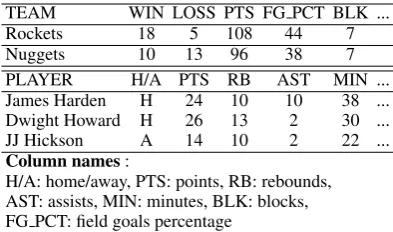
TEAM WIN LOSS PTS FG PCT BLK ... Rockets 18 5 108 44 7 Nuggets 10 13 96 38 7 PLAYER H/A PTS RB AST MIN ... James Harden H 24 10 10 38 ... Dwight Howard H 26 13 2 30 ... JJ Hickson A 14 10 2 22 ...
Column names:
H/A: home/away, PTS: points, RB: rebounds, AST: assists, MIN: minutes, BLK: blocks, FG PCT: field goals percentage
An example hallucinated statement:
After going into halftime down by eight , the Rockets came out firing in the third quarter and out - scored the Nuggets 59 - 42 to seal the victory on the road
TheHouston Rockets(18-5) defeated theDenver Nuggets(10-13)
108-96on Saturday. Houstonhas won2 straight gamesand6of their last7.Dwight Howardreturned to action Saturday after miss-ing the Rockets ’ last11 gameswith a knee injury. He was supposed to be limited to24 minutesin the game, butDwight Howard perse-vered to play30 minutesand put up a monstrous double-double of
26 pointsand13 rebounds. JoiningDwight Howardin on the fun wasJames Hardenwith a triple-double of24 points,10 rebounds
and10 assistsin38 minutes. TheRockets’ formidable defense held theNuggetsto just38 percentshooting from the field. Hous-tonwill face theNuggetsagain in their next game, going on the road toDenverfor their game on Wednesday. Denverhas lost4
[image:2.595.75.272.61.177.2]of their last5 gamesas they struggle to find footing during a tough part of their schedule ... Denverwill begin a4 - gamehomestead hosting the San Antonio Spurs on Sunday.
Table 1: An example from theRotoWirecorpus. Partial box- and line-score tables are on the top left. Grounded entities and numerical facts are inbold. Yellow sentences containredungrounded numerical facts, and team game schedule related statements. A system-generated statement with multiple hallucinations on the bottom left.
(2017) also formalized a set of post-hoc infor-mation extraction (IE) based evaluations to as-sess the data fidelity. Using the boxscore table schema, a sequence of (entity,value,type) records mentioned in a system-generated summary are ex-tracted as the content plan. They are then vali-dated for accuracy against the boxscore table and similarity with the one extracted from the human-written summary. However, any hallucinated facts may unrealistically boost the BLEU score while not penalized by the data fidelity metrics since no records can be identified from the ungrounded contents. Thus the possibly misleading evaluation results inhibit systems to demonstrate excellence on this task.
These two aspects potentially undermine peo-ple’s interests in this data fidelity oriented table-to-text generation task. Therefore, in this work, we revamp the task emphasizing this core aspect to further enable research in this direction. First, we restore the information balance by trimming the summaries of ungrounded contents and replenish the boxscore table to compensate for missing in-puts. This requires the non-trivial extraction of the latent gold standard content plans with high-quality. Thus, we take the efforts to design sophis-ticated heuristics and achieved an estimated 98% precision and 95% recall of the true content plans, retaining 74% of numerical words in the sum-maries. This yields better content plans as com-pared to the 94% precision, 80% recall by Pudup-pully et al.(2019b) and 60% retainment by Wise-man et al.(2017) respectively. Guided by the high-quality content plans, only fact-grounded contents are identified and retained as shown in Table 1.
Furthermore, by expending with 50% more games between the years 2017-19, we obtain the more fo-cusedRotoWire-FG(RW-FG) dataset.
This leads to more accurate evaluations and col-lectively paves the way for future works by pro-viding a more user-friendly alternative. With this refurbished setup, the existing models are then re-assessed on their abilities to ensure data fidelity. We discover that by only purifying theRWdataset, the models can generate more precise facts with-out sacrificing fluency. Furthermore, we propose a new form of table reconstruction as an auxiliary task to improve fact grounding. By incorporating it into the state-of-the-art Neural Content Planning (NCP) (Puduppully et al.,2019a) model, we estab-lished a benchmark on theRW-FGdataset with a 24.41 BLEU score and 95.7% factual accuracy.
Finally, these insights lead us to summarize sev-eral fine-grained future challenges based on con-crete examples, regarding factual accuracy and intra- and inter- sentence coherence.
Our contributions include:
1. We introduce a purified, enlarged and en-riched new dataset to support the more fo-cused fact-grounded table-to-text generation task. We provide high-quality summary facts to table records mappings (content plan) and a more user-friendly experimental setup. All codes and data are freely available3.
2. We re-investigate existing methods with more insights, establish a new benchmark on this task, and uncover more fine-grained chal-lenges to encourage future research.
Type His Sch Agg Game Inf Count 69 33 9 23 23 Percent 43.9 21.0 5.7 14.7 14.7
Table 2: Types of ungrounded contents about statis-tics related to His: history (e.g. recent-game/career high/average)Sch: team schedule (e.g. what is next game); Agg: aggregation of statistics from multiple players (e.g. the duo of two stars combined scoring ...) ;
Game: during the game (e.g. a game winning shot with 1 second left);Inf: inferred from aggregations (e.g. a player carried the team for winning)
2 Data-to-Text Dataset
This task requires models to take as inputs the NBA basketball game boxscore tables containing hundreds of records and generate the correspond-ing game summaries. A table can be view as a set of (entity, value,type) records whereentity is the row name andtypeis the column name inTable 1.
Formally: LetE={ek}Kk=1be the set of entities
for a game. S = {rj}Sj=1 be the set of records
where eachrjhas a valuermj , an entity namerje, a
record typerjtandrjhindicating if the entity is the HOME or AWAY team. For example, a record has
rt
j = POINTS,rje= Dwight Howard,rjm= 26, and
rjh = HOME. The summary hasT words: yˆ1:T =
ˆ
y1, . . . ,yˆT. A sample is a (S,yˆ1:T) pair.
2.1 Looking into theRotoWireCorpus
To better understand what kind of ungrounded contents are causing the interference, we manually examine a set of 30 randomly picked samples4and categorize the sentences into 5 types whose counts and percentages are tabulated inTable 2.
TheHistype occupies the majority portion, fol-lowed by the game-specific Game, Inf, and Agg
types, and the remaining goes toSch. Specifically, the His and Agg types come from exponentially large number of possible combinations of game statistics, and the Inf type is based on subjective judgments. Thus, it is difficult to trace and aggre-gate the heterogeneous sources of origin for such statements to fully balance the input and output. TheSchandGametypes require a sample from a large pool of non-numerical and time-related in-formation, whose exclusion would not affect the nature of the fact-grounding generation task. On the other hand, these ungrounded contents mis-guide a system to generate hallucinated facts and
4For convenience, they are from the validation set and also
used later for evaluation purposes.
thus defeat the purpose of developing and evalu-ating models for fact-grounded table-to-text gen-eration. Thus, we emphasize on this core aspect of the task by trimming contents not licensed by the boxscore table, which we show later still en-compasses many fine-grained challenges awaiting to be resolved. While fully restoring all desired inputs is also an interesting research challenge, it is orthogonal to our focus and thus left for future explorations.
2.2 RotoWire-FG
Motivated by these observations, we perform pu-rification and augmentation on the original dataset to obtain the newRW-FGdataset.
2.2.1 Dataset Purification
Purifying Contents: We aim to retain game sum-mary contents with facts licensed by the boxs-core records. The sports game summary genre is more descriptive than analytical and aims to con-cisely cover salient player or team statistics. Cor-respondingly, a summary often finishes describing one entity before shifting to the next. This fashion of topic shift allows us to identify the topic bound-aries using sentences as units, and thus greatly narrows down the candidate boxscore records to be aligned with a fact. The mappings can then be identified using simple pattern-based match-ing, as also explored by Wiseman et al. (2017). It also enables resolving co-reference by mapping the singular and plural pronouns to the most re-cently mentioned players and teams respectively. A numerical value associated with an entity is li-censed by the boxscore table if it equals to the record value of the desired type. Thus we design a set of heuristics to determine the types, such as mapping “Channing Frye furnished 12 points” to the (Channing Frye,12,POINTS) record in the ta-ble. Finally, consecutive sentences describing the same entity is retained if any numerical value is licensed by the boxscore table.
inaccu-Versions Examples Tokens Vocab Types Avg Len
RW 4.9K 1.6M 11.3K 39 337.1
RW-EX 7.5K 2.5M 12.7K 39 334.3
[image:4.595.313.520.63.106.2]RW-FG 7.5K 1.5M 8.8K 61 205.9
Table 3: Comparison between datasets. (RW-EXis the enlargedRWwith 50% more games)
Sents Content Plans Records Num-only Records
RW-EX 14.0 27.2 494.2 429.3
RW-FG 8.6 28.5 519.9 478.3
Table 4: Dataset statistics by the average number of each item per sample.
rate lexical matching, we achieved better quality through designing the heuristics using similar ef-forts as training and assembling the IE models byWiseman et al.(2017). Meanwhile, more accu-rate content plans provide better reliability during evaluation.
Normalization: To enhance accuracy, we convert all English number words into numerical values. As some percentages are rounded differently be-tween the summaries and the boxscore tables, such discrepancies are rectified. We also perform en-tity normalization for players and teams, resolv-ing mentions of the same entity to one lexical form. This makes evaluations more user-friendly and less prone to errors.
2.2.2 Dataset Augmentation
Enlargement: Similar toWiseman et al.(2017), we crawl the game summaries from theRotoWire Game Recaps5 between years 2017-19 and align the summaries with the officialNBA6boxscore ta-bles. This brings 2.6K more games with 56% more tokens, as tabulated inTable 4.
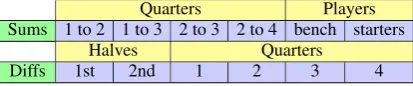
Line-score replenishment: Many team statistics in the summaries are missing in the line-score ta-bles. We recover them by aggregating other boxs-core statistics. For example, the number of shots attempted and made by the team for field goals, 3-pointers, and free-throws are calculated by sum-ming their player statistics. Besides, we supple-ment a set of team point breakdowns as shown in Table 5. The replenishment boosts the recall on numerical values from 72% to 74% and augments the content plans by 1.3 records per sample.
Finalize: We conduct the same purification proce-dures described insection 2.2.1after the
augmen-5
https://www.RotoWire.com/basketball/ game-recaps.php
6https://stats.nba.com/
Quarters Players Sums 1 to 2 1 to 3 2 to 3 2 to 4 bench starters
[image:4.595.85.276.63.107.2]Halves Quarters Diffs 1st 2nd 1 2 3 4
Table 5: Replenished line-score statistics. Each pur-ple cell corresponds to a new record type, defined as applying the the operation in the row names (green) to the source of statistics in the column names (yellow). “Sums” operates on individual teams and “Diffs” is be-tween the two teams. For example, the “1 to 2” cell in the second row means the summation of points scored by a team in the 1st and 2nd “Quarters”, the “1st” cell in the fourth row means the difference between the two teams’ 1st half points.
tations. More data collection details are included inAppendix A.
3 Re-assessing Models on PurifiedRW
3.1 Models
We re-assess three neural network based models on this task7. To feed the tables to the models, each record rj has attribute embeddings for rmj ,
rje,rtj,rjhand their concatenation is the input.
• ED-CC (Wiseman et al., 2017): This is an Encoder-Decoder (ED) (Sutskever et al., 2014;Cho et al.,2014) model with an 1-layer MLP encoder (Yang et al., 2017), and an LSTM (Hochreiter and Schmidhuber, 1997) decoder with the Conditional Copy (CC) mechanism (Gulcehre et al.,2016).
• NCP (Puduppully et al., 2019a): The Neu-ral Content Planning (NCP) model employs a pointer network (Vinyals et al.,2015) to se-lect a subset of records from the boxscore ta-ble and sequentially roll them out as the con-tent plan. Then the summary is then gener-ated only from the content plan using the ED-CC model with a Bi-LSTM encoder.
• ENT (Puduppully et al., 2019b): The EN-Tity memory network (ENT) model extends the ED-CC model with a dynamically up-dated entity-specific memory module to cap-ture topic shifts in outputs and incorporate it into each decoder step with a hierarchical at-tention mechanism.
7Iso et al.(2019) was released after this work was
3.2 Evaluation
In addition to using BLEU (Papineni et al.,2002) as a reasonable proxy for evaluating the fluency of the generated summary,Wiseman et al.(2017) designed three types of metrics to assess if a sum-mary accurately conveys the desired information.
Extractive Metrics: First, an ordered sequence of (entity, value, type) triples are extracted from the system output summary as the content plan us-ing the same heuristics insection 2.2.1. It is then checked against the table for its accuracy (RG) and the gold content plan to measure how well they match (CS & CO). Specifically, letcp={ri}and
cp0 = {r0i} be the gold and system content plan
respectively, and|.|denote set cardinality. We cal-culate the following measures:
• Content Selection (CS):
– Precision (CSP) =|cp∩cp0|/|cp0| – Recall (CSR) =|cp∩cp0|/|cp| – F1 (CSF) =2P R/(P +R) • Relation Generation (RG):
– Count(#) =|cp0|
– Precision (RGP) =|cp0∩
S|/|cp0|
• Content Ordering (CO):
– DLD: normalized Damerau Levenshtein Distance (Brill and Moore, 2000) be-tweencpandcp0
CSandRGmeasures the “what to say” andCO
measures the “how to say” aspects.
3.3 Experiments
Setup: To re-investigate the existing three meth-ods on the ability to convey accurate information conditioned on the input, we assess them by train-ing on the purifiedRWcorpus. To demonstrate the differences brought by the purification process, we keep all other settings unchanged and report re-sults on the original validation and test sets after performing early stopping (Yao et al.,2007) based on the BLEU score.
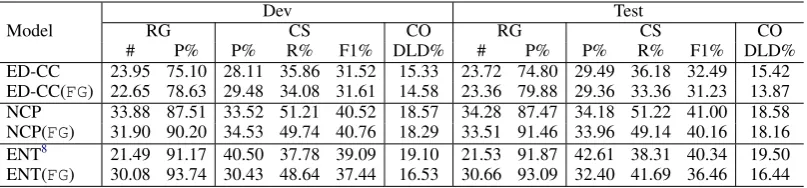
Results: As shown in Table 6, we observe in-crease in Relation Generation Precision (RGP) and on-par performance for Content Selection
8For fair comparison, we report results of ENT model
af-ter fixing a bug in the evaluation script as endorsed by the au-thor ofWiseman et al.(2017) athttps://github.com/ harvardnlp/data2text/issues/6
(CS) and Content Ordering (CO). In particular, Relation Generation Precision (RGP) is substan-tially increased by an average 2.7% for all mod-els. The Content Selection (CS) and Content Or-dering (CO) measures fluctuate above and below the references, with the biggest disparity on Con-tent Selection Precision (CSP), ConCon-tent Selection Recall (CSR) and Content Ordering (CO) for the ENT model. Since output length is a main inde-pendent variable for this set of experiments and a crucial factor in BLEU score as well, we re-port the breakdowns inTable 7. Specifically, the NCP model shows consistent improvements on all BLEU 1-4 scores, similarly for ENT on the vali-dation set. Among all fluctuation around the refer-ences, nearly all models demonstrate an increase in BLEU-1 and BLEU-4 precision. Reflected on the BP coefficients, models trained on the purified summaries produces shorter outputs, which is the major reason for lower BLEU scores when using the un-purified summaries as the references.
3.4 How Purification Affects Performance
First, simply replacing with the purified training set leads to considerable improvements in the Re-lation Generation Precision (RGP). This is be-cause removing the ungrounded facts (e.g. His,
Model
Dev Test
RG CS CO RG CS CO
# P% P% R% F1% DLD% # P% P% R% F1% DLD% ED-CC 23.95 75.10 28.11 35.86 31.52 15.33 23.72 74.80 29.49 36.18 32.49 15.42 ED-CC(FG) 22.65 78.63 29.48 34.08 31.61 14.58 23.36 79.88 29.36 33.36 31.23 13.87 NCP 33.88 87.51 33.52 51.21 40.52 18.57 34.28 87.47 34.18 51.22 41.00 18.58 NCP(FG) 31.90 90.20 34.53 49.74 40.76 18.29 33.51 91.46 33.96 49.14 40.16 18.16 ENT8 21.49 91.17 40.50 37.78 39.09 19.10 21.53 91.87 42.61 38.31 40.34 19.50 ENT(FG) 30.08 93.74 30.43 48.64 37.44 16.53 30.66 93.09 32.40 41.69 36.46 16.44
Table 6: Comparison between models trained onRWandRW-FG
Model Dev Test
B1 B2 B3 B4 BP BLEU B1 B2 B3 B4 BP BLEU ED-CC 44.42 18.16 9.40 5.95 1.00 14.57 43.22 17.64 9.16 5.81 1.00 14.19
ED-CC(FG) 46.61 17.70 9.33 6.21 0.59 8.74 45.75 17.14 9.05 5.98 0.61 8.68 NCP 48.95 20.58 10.70 6.96 1.00 16.19 49.77 21.19 11.31 7.46 0.96 16.50
NCP(FG) 56.63 24.15 12.45 8.13 0.54 10.45 56.33 23.92 12.42 8.11 0.53 10.25 ENT 51.57 21.92 11.87 8.08 0.88 15.97 53.23 23.07 12.78 8.78 0.84 16.12
[image:6.595.98.502.62.156.2]ENT(FG) 56.08 23.29 12.29 8.16 0.44 8.92 55.03 21.86 11.38 7.38 0.57 10.17
Table 7: Breakdown of BLEU scores for models trained onRWandRW-FG
when trained on the purified dataset. On the other hand, the NCP model decouples the content se-lection and planning on the discourse level from the surface realization on the token level, and thus generalizes better.
4 A New Benchmark onRW-FG
With more insights about the existing methods, we take a step further to achieve better data fidelity. Wiseman et al.(2017) achieved improvements on the ED with Joint Copy (JC) (Gu et al., 2016) model by introducing an reconstruction loss (Tu et al.,2017) during training. Specifically, the de-coder states at each time step are used to predict record values in the table to enable broader input information coverage.
However, we take a different point of view: one key mechanism to avoid reference errors is to en-sure that the set of numerical values mentioned in a sentence belongs to the correct entity with the correct record field type. While the ED-CC model is trained to achieve such alignments, it should also be able to accurately fill the numbers back to the correct cells in an empty table. This should be done by only accessing the column and row in-formation of the cells without explicitly knowing the original cell values. Further leveraging on the planner output of the NCP model, the candidate cells to be filled can be reduced to the content plan cells selected by the planner. With this intuition, we devise a new form of table reconstruction (TR) task incorporated into the NCP model.
Specifically, each content plan record has
at-tribute embeddings for rje, rjt, and rjh, excluding its value, and we encode them using a 1-layer MLP (Yang et al.,2017). We then employ the Lu-ong et al. (2015) attention mechanism at each yˆt
if it is a numerical value with the encoded content plan as the memory bank. The attention weights are then viewed as probabilities of selecting each cell to fill the numberyˆt. The model is additionally
trained to minimize the negative log-likelihood of the correct cell.
4.1 Experiments
Setup: We assess models on theRW-FGcorpus to establish a new benchmark. FollowingWiseman et al.(2017), we split all samples into train (70%), validation (15%), and test (15%) sets, and perform early stopping (Yao et al.,2007) using BLEU (Pa-pineni et al.,2002). We adapt the template-based generator by Wiseman et al. (2017) and remove the ungrounded end sentence since they are elimi-nated inRW-FG.
Model
Dev Test
RG CS CO
BLEU RG CS CO BLEU
[image:7.595.77.525.63.144.2]# P% P% R% F1% DLD% # P% P% R% F1% DLD% TMPL 51.81 99.09 23.78 43.75 30.81 10.06 11.91 51.80 98.89 23.98 43.96 31.03 10.25 12.09 WS17 30.47 81.51 36.15 39.12 37.57 18.56 21.31 30.28 82.16 35.84 38.40 37.08 18.45 20.80 ENT 35.56 93.30 40.19 50.71 44.84 17.81 21.67 35.69 93.72 39.04 49.29 43.57 17.50 21.23 NCP 36.28 94.27 43.31 55.96 48.91 24.08 24.49 35.99 94.21 43.31 55.15 48.52 23.46 23.86 NCP+TR 37.04 95.65 43.09 57.24 49.17 24.75 24.80 37.49 95.70 42.90 56.91 48.92 24.47 24.41
Table 8: Performances of models onRW-FG
Model Total(#) RP(%) WC(%) UG(%) IC(%) NCP 246 9.21 11.84 3.07 5.26 NCP+TR 228 3.66 8.94 3.25 2.03
Table 9: Error types of manual evaluation.Total: num-ber of sentences;RP: Repetition;WC: Wrong Claim;
UG: Ungrounded sentence;IC: Incoherent sentence
.
4.2 Discussion
We observe that the ED-CC model produces the least number of candidate records, and corre-spondingly achieves the lowest Content Selec-tion Recall (CSR) compared to the gold stan-dard content plans. As discussed in section 3.4, the template-like discourse pattern produced by the ENT model noticeably deteriorates its perfor-mance. It is completely outperformed by the NCP model and even achieves lower CO-DLD than the ED-CC model. Finally, as supported by the ex-tractive evaluation metrics, employing table recon-struction as an auxiliary task indeed boosts the de-coder to produce more accurate factual statements. We discuss in more detail as follows.
4.2.1 Manual Evaluation
To gain more insights into how exactly NCP+TR improves from NCP in terms of factual accuracy, we manually examined the outputs on the 30 sam-ples. We compare the two systems after catego-rizing the errors into 4 types. As shown in Ta-ble 9, the largest improvement comes from reduc-ing repeated statements and wrong fact claims, where the latter involves referring to the wrong entity or making the wrong judgment of the nu-merical value. The NCP+TR generally produces more concise outputs with a reduction in repeti-tions, consistent with the objective for table recon-struction.
4.2.2 Case study
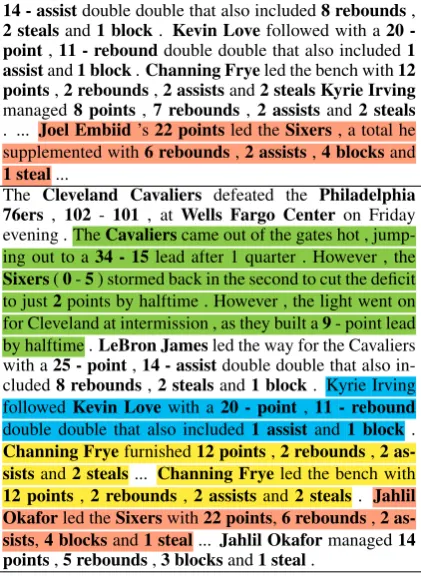
Table 10shows a pair of outputs by the two sys-tems. In this example, the NCP+TR model can correct wrong the player name “Jahlil Okafor”
by “Joel Embiid”, while keeping the statistics in-tact. It also avoids repeating on “Channing Frye” and the semantically incoherent expression about “Kevin Love” and “Kyrie Irving”. Nonetheless, this NCP output selects more records to describe the progress of the game. This shows how the NCP+TR trained with more constraints behaves more accurately but conservatively.
5 Errors and Challenges
Having revamped the task with better focus, re-assessed existing and improved models, we dis-cuss 3 future directions in this task with concrete examples inTable 11:
Content Selection: Since writers are subjective in choosing what to say given the boxscore, it is unrealistic to force a model to mimic all kinds of styles. However, a model still needs to learn from training to select both the salient (e.g. sur-prisingly high/low statistics for a team/player) and the popular (e.g. the big stars) statistics. One potential direction is to involve multiple hu-man references to help reveal such saliency and make Content Ordering (CO) and Content Selec-tion (CS) measures more interpretive. This is par-ticularly applicable for the sports domain since a game can be uniquely identified by the teams and date but mapped to articles from different sources. Besides, multi-reference has been ex-plored for evaluating data-to-text generation sys-tems (Novikova et al., 2017) and for content se-lection and planning (Gehrmann et al.,2018). It has also been studied in machine translation for evaluation (Dreyer and Marcu, 2012) and train-ing (Zheng et al.,2018).
The Cleveland Cavaliers defeated the Philadelphia 76ers, 102-101 , atWells Fargo Centeron Monday evening . LeBron Jamesled the way with a25 - point,
14 - assistdouble double that also included8 rebounds,
2 stealsand1 block. Kevin Lovefollowed with a20 -point,11 - rebounddouble double that also included1 assistand1 block.Channing Fryeled the bench with12 points,2 rebounds,2 assistsand2 steals Kyrie Irving
managed8 points, 7 rebounds, 2 assistsand2 steals
. ... Joel Embiid’s22 pointsled theSixers, a total he supplemented with6 rebounds,2 assists,4 blocksand
1 steal...
The Cleveland Cavaliers defeated the Philadelphia 76ers, 102 - 101 , atWells Fargo Center on Friday evening . TheCavalierscame out of the gates hot , jump-ing out to a34 - 15lead after 1 quarter . However , the
Sixers(0-5) stormed back in the second to cut the deficit to just2points by halftime . However , the light went on for Cleveland at intermission , as they built a9- point lead by halftime .LeBron Jamesled the way for the Cavaliers with a25 - point,14 - assistdouble double that also in-cluded8 rebounds,2 stealsand1 block. Kyrie Irving followedKevin Lovewith a20 - point,11 - rebound
double double that also included1 assist and1 block .
Channing Fryefurnished12 points,2 rebounds,2 as-sistsand2 steals... Channing Fryeled the bench with
12 points,2 rebounds,2 assistsand2 steals. Jahlil Okaforled theSixerswith22 points,6 rebounds,2 as-sists,4 blocksand1 steal... Jahlil Okaformanaged14 points,5 rebounds,3 blocksand1 steal.
Table 10: Case study comparing NCP+TR (above) and NCP (below). The records identified are inbold. The pair of sentences in orange shows an referring error toJahlil Okafor is corrected above to Joel Embiid, where all the trailing statistics actually belong toJoel Embiid, and Jahlil Okafor’s actual statistics are de-scribed at the end. The yellow sentences repeats on the same player. The green sentences actually shows some more contents selected by the NCP model. The blue sentence is a tricky one, where it should describe Kyrie Irving’s statistics but actually describingKevin Love’s but the summary above does not have this issue.
in Table 11, the links between entities and their numerical statistics are not strictly monotonic and switching the order results in errors.
On the other hand, autoregressive training for creating such content plans limits the model to capture frequent sequence patterns rather than al-lowing diverse arrangements. Moryossef et al. (2019) demonstrates isolating the content planning from the joint end-to-end training and employing multiple valid content plans during testing. Al-though the content plan extraction heuristics are dataset-dependent, it is worth exploring for data in a closed domain likeRW.
Surface Realization: Although the NCP+TR model has achieved nearly 96% Relation
Gen-(1) Intra-sentence coherence:
• TheLakerswere thesuperior shootersin this game ,
going48 percentfrom the field and24 percentfrom the three point line , while theJazzwent47 percent
from the floor and just30 percentfrom beyond the arc.
• TheRocketsgot off to a quick start in this game,out
scoringtheNuggets21-31right away in the 1st quarter.
(2) Inter-sentence coherence:
• LeBron Jameswas the lone bright spot for the Cava-liers, as he led the team with20 points. Kevin Love
wasthe only Cleveland starter in double figures, as he tallied17 points,11 reboundsand3 assistsin the loss.
• Dirk Nowitzkiled theMavericksin scoring, finishing
with22 points(7 - 13 FG,3 - 5 3PT,5 - 5 FT) ,
5 reboundsand3 assistsin37 minutes. He’s had a very strong stretch of games , scoring17 pointson6 -for -13shooting from the field and5- for -10from the three point line.JJ Bareafinished with32 points(13 -21 FG,5 - 8 3PT) and11 assists...
(3) Incorrect claim:
[image:8.595.77.288.92.382.2]• TheHeatwere able to force20turnovers from the Six-ers, which may have been the difference in this game.
Table 11: Cases for three major types of system errors
6 Related Works
Various forms of structured data has been used as input for data-to-text generation tasks, such as tree (Belz et al., 2011; Mille et al., 2018), graph (Konstas and Lapata, 2012), dia-log moves (Novikova et al., 2017), knowledge base (Gardent et al., 2017b; Chisholm et al., 2017), database (Konstas and Lapata,2012; Gar-dent et al., 2017a; Wang et al., 2018), and ta-ble (Wiseman et al., 2017; Lebret et al., 2016). The RWcorpus we studied is from the sports do-main which has attracted great interests (Chen and Mooney, 2008;Mei et al.,2016;Puduppully et al., 2019b). However, unlike generating the one-entity descriptions (Lebret et al.,2016;Wang et al.,2018) or having the output strictly bounded by the inputs (Novikova et al.,2017), this corpus poses additional challenges since the targets con-tain ungrounded contents. To facilitate better us-age and evaluation of this task, we hope to provide a refined alternative, similar to the purpose by Cas-tro Ferreira et al.(2018).
7 Conclusion
In this work, we study the core fact-grounding aspect of the data-to-text generation task and contribute a purified, enlarged, and enriched RotoWire-FGcorpus with a more fair and reli-able evaluation setup. We re-assess existing mod-els and found that the more focused setting helps the models to express more accurate statements and alleviate fact hallucinations. Improving the state-of-the-art model and setting a benchmark on the new task, we reveal fine-grained unsolved challenges hoping to inspire more research in this direction.
Acknowledgments
Thanks for the generous and valuable feedback from the reviewers. Special thanks to Dr. Jing Huang and Dr. Yun Tang for their unselfish guid-ance and support.
References
Anja Belz, Mike White, Dominic Espinosa, Eric Kow, Deirdre Hogan, and Amanda Stent. 2011. The first surface realisation shared task: Overview and evalu-ation results. InENLG.
Eric Brill and Robert C. Moore. 2000. An improved er-ror model for noisy channel spelling correction. In
Proceedings of the 38th Annual Meeting of the As-sociation for Computational Linguistics, pages 286– 293, Hong Kong. Association for Computational Linguistics.
Thiago Castro Ferreira, Diego Moussallem, Emiel Krahmer, and Sander Wubben. 2018. Enriching the WebNLG corpus. In Proceedings of the 11th In-ternational Conference on Natural Language Gen-eration, pages 171–176, Tilburg University, The Netherlands. Association for Computational Lin-guistics.
David L. Chen and Raymond J. Mooney. 2008. Learn-ing to sportscast: a test of grounded language ac-quisition. In Machine Learning, Proceedings of the Twenty-Fifth International Conference (ICML 2008), Helsinki, Finland, June 5-9, 2008, pages 128–135.
Andrew Chisholm, Will Radford, and Ben Hachey. 2017. Learning to generate one-sentence biogra-phies from Wikidata. In Proceedings of the 15th Conference of the European Chapter of the Associa-tion for ComputaAssocia-tional Linguistics: Volume 1, Long Papers, pages 633–642, Valencia, Spain. Associa-tion for ComputaAssocia-tional Linguistics.
Kyunghyun Cho, Bart van Merrienboer, Dzmitry Bah-danau, and Yoshua Bengio. 2014. On the properties of neural machine translation: Encoder-decoder ap-proaches. InProceedings of SSST@EMNLP 2014, Eighth Workshop on Syntax, Semantics and Struc-ture in Statistical Translation, Doha, Qatar, 25 Oc-tober 2014, pages 103–111.
Markus Dreyer and Daniel Marcu. 2012. HyTER: Meaning-equivalent semantics for translation eval-uation. InProceedings of the 2012 Conference of the North American Chapter of the Association for Computational Linguistics: Human Language Tech-nologies, pages 162–171, Montr´eal, Canada. Asso-ciation for Computational Linguistics.
Claire Gardent, Anastasia Shimorina, Shashi Narayan, and Laura Perez-Beltrachini. 2017a. Creating train-ing corpora for NLG micro-planners. In Proceed-ings of the 55th Annual Meeting of the Association for Computational Linguistics (Volume 1: Long Pa-pers), Vancouver, Canada. Association for Compu-tational Linguistics.
Claire Gardent, Anastasia Shimorina, Shashi Narayan, and Laura Perez-Beltrachini. 2017b. The webnlg challenge: Generating text from RDF data. In Pro-ceedings of the 10th International Conference on Natural Language Generation, INLG 2017, Santi-ago de Compostela, Spain, September 4-7, 2017, pages 124–133.
Jiatao Gu, Zhengdong Lu, Hang Li, and Victor O.K. Li. 2016. Incorporating copying mechanism in sequence-to-sequence learning. In Proceedings of the 54th Annual Meeting of the Association for Com-putational Linguistics (Volume 1: Long Papers), pages 1631–1640, Berlin, Germany. Association for Computational Linguistics.
Caglar Gulcehre, Sungjin Ahn, Ramesh Nallapati, Bowen Zhou, and Yoshua Bengio. 2016. Pointing the unknown words. In Proceedings of the 54th Annual Meeting of the Association for Computa-tional Linguistics (Volume 1: Long Papers), pages 140–149, Berlin, Germany. Association for Compu-tational Linguistics.
Sepp Hochreiter and J¨urgen Schmidhuber. 1997.
Long short-term memory. Neural Computation, 9(8):1735–1780.
Hayate Iso, Yui Uehara, Tatsuya Ishigaki, Hiroshi Noji, Eiji Aramaki, Ichiro Kobayashi, Yusuke Miyao, Naoaki Okazaki, and Hiroya Takamura. 2019. Learning to select, track, and generate for data-to-text. In Proceedings of the 57th Annual Meeting of the Association for Computational Lin-guistics, pages 2102–2113, Florence, Italy. Associa-tion for ComputaAssocia-tional Linguistics.
Ioannis Konstas and Mirella Lapata. 2012. Concept-to-text generation via discriminative reranking. InThe 50th Annual Meeting of the Association for Compu-tational Linguistics, Proceedings of the Conference, July 8-14, 2012, Jeju Island, Korea - Volume 1: Long Papers, pages 369–378.
R´emi Lebret, David Grangier, and Michael Auli. 2016.
Neural text generation from structured data with ap-plication to the biography domain. In Proceed-ings of the 2016 Conference on Empirical Methods in Natural Language Processing, pages 1203–1213, Austin, Texas. Association for Computational Lin-guistics.
Liunian Li and Xiaojun Wan. 2018. Point precisely: Towards ensuring the precision of data in gener-ated texts using delayed copy mechanism. In Pro-ceedings of the 27th International Conference on Computational Linguistics, COLING 2018, Santa Fe, New Mexico, USA, August 20-26, 2018, pages 1044–1055.
Thang Luong, Hieu Pham, and Christopher D. Man-ning. 2015. Effective approaches to attention-based neural machine translation. InProceedings of the 2015 Conference on Empirical Methods in Natu-ral Language Processing, pages 1412–1421, Lis-bon, Portugal. Association for Computational Lin-guistics.
Hongyuan Mei, Mohit Bansal, and Matthew R. Walter. 2016. What to talk about and how? selective gen-eration using LSTMs with coarse-to-fine alignment. InProceedings of the 2016 Conference of the North American Chapter of the Association for Computa-tional Linguistics: Human Language Technologies,
pages 720–730, San Diego, California. Association for Computational Linguistics.
Simon Mille, Anja Belz, Bernd Bohnet, Yvette Gra-ham, Emily Pitler, and Leo Wanner. 2018. The first multilingual surface realisation shared task (SR’18): Overview and evaluation results. InProceedings of the First Workshop on Multilingual Surface Realisa-tion, pages 1–12, Melbourne, Australia. Association for Computational Linguistics.
Amit Moryossef, Yoav Goldberg, and Ido Dagan. 2019.
Step-by-step: Separating planning from realization in neural data-to-text generation. InProceedings of the 2019 Conference of the North American Chap-ter of the Association for Computational Linguistics: Human Language Technologies, Volume 1 (Long and Short Papers), pages 2267–2277, Minneapolis, Minnesota. Association for Computational Linguis-tics.
Feng Nie, Jinpeng Wang, Jin-Ge Yao, Rong Pan, and Chin-Yew Lin. 2018. Operation-guided neu-ral networks for high fidelity data-to-text genera-tion. In Proceedings of the 2018 Conference on Empirical Methods in Natural Language Process-ing, pages 3879–3889, Brussels, Belgium. Associ-ation for ComputAssoci-ational Linguistics.
Jekaterina Novikova, Ondrej Dusek, and Verena Rieser. 2017. The E2E dataset: New challenges for end-to-end generation. InProceedings of the 18th An-nual SIGdial Meeting on Discourse and Dialogue, Saarbr¨ucken, Germany, August 15-17, 2017.
Kishore Papineni, Salim Roukos, Todd Ward, and Wei-Jing Zhu. 2002. Bleu: a method for automatic eval-uation of machine translation. InProceedings of the 40th Annual Meeting of the Association for Compu-tational Linguistics, July 6-12, 2002, Philadelphia, PA, USA., pages 311–318.
Ratish Puduppully, Li Dong, and Mirella Lapata. 2019a. Data-to-text generation with content selec-tion and planning. In The Thirty-Third AAAI Con-ference on Artificial Intelligence, AAAI 2019, The Thirty-First Innovative Applications of Artificial In-telligence Conference, IAAI 2019, The Ninth AAAI Symposium on Educational Advances in Artificial Intelligence, EAAI 2019, Honolulu, Hawaii, USA, January 27 - February 1, 2019., pages 6908–6915.
Ratish Puduppully, Li Dong, and Mirella Lapata. 2019b. Data-to-text generation with entity model-ing. In Proceedings of the 57th Annual Meeting of the Association for Computational Linguistics, pages 2023–2035, Florence, Italy. Association for Computational Linguistics.
Ilya Sutskever, Oriol Vinyals, and Quoc V. Le. 2014. Sequence to sequence learning with neural net-works. InAdvances in Neural Information Process-ing Systems 27: Annual Conference on Neural In-formation Processing Systems 2014, December 8-13 2014, Montreal, Quebec, Canada, pages 3104– 3112.
Zhaopeng Tu, Yang Liu, Lifeng Shang, Xiaohua Liu, and Hang Li. 2017. Neural machine translation with reconstruction. In Proceedings of the Thirty-First AAAI Conference on Artificial Intelligence, Febru-ary 4-9, 2017, San Francisco, California, USA., pages 3097–3103.
Oriol Vinyals, Meire Fortunato, and Navdeep Jaitly. 2015. Pointer networks. In Advances in Neural Information Processing Systems 28: Annual Con-ference on Neural Information Processing Systems 2015, December 7-12, 2015, Montreal, Quebec, Canada, pages 2692–2700.
Qingyun Wang, Xiaoman Pan, Lifu Huang, Boliang Zhang, Zhiying Jiang, Heng Ji, and Kevin Knight. 2018. Describing a knowledge base. In Proceed-ings of the 11th International Conference on Natural Language Generation, pages 10–21, Tilburg Uni-versity, The Netherlands. Association for Computa-tional Linguistics.
Sam Wiseman, Stuart Shieber, and Alexander Rush. 2017. Challenges in data-to-document generation. In Proceedings of the 2017 Conference on Empiri-cal Methods in Natural Language Processing, pages 2253–2263, Copenhagen, Denmark. Association for Computational Linguistics.
Zichao Yang, Phil Blunsom, Chris Dyer, and Wang Ling. 2017. Reference-aware language models. In
Proceedings of the 2017 Conference on Empirical Methods in Natural Language Processing, pages 1850–1859, Copenhagen, Denmark. Association for Computational Linguistics.
Yuan Yao, Lorenzo Rosasco, and Andrea Caponnetto. 2007. On early stopping in gradient descent learn-ing. Constructive Approximation, 26(2):289–315.
Renjie Zheng, Mingbo Ma, and Liang Huang. 2018.
A Appendices
A.1 Data Collection Details
• We use the text2num9 package to convert all English number words into numerical values
• We first get the summary title, date, and the contents fromRotoWire Game Recaps. The title contains the home and visiting team. To-gether with the date, this game is uniquely identified with aGAME ID. Then we use the
nba api10package to query thestats.nba.com
by NBA.com11 to obtain the game boxscore and line scores. Wiseman et al.(2017) used the nba py12 package , which unfortunately has become obsolete due to lack of main-tenance. To obtain the line scores with the same set of column types as the original RotoWire dataset, we collectively used two APIs,BoxScoreTraditionalV2and BoxScore-SummaryV2.
9https://github.com/ghewgill/text2num/ blob/master/text2num.py
10https://github.com/swar/nba_api 11