563
Neural Generation for Czech: Data and Baselines
Ondˇrej Duˇsek and Filip Jurˇc´ıˇcek
Charles University, Faculty of Mathematics and Physics Institute of Formal and Applied Linguistics
Prague, Czech Republic
{odusek,jurcicek}@ufal.mff.cuni.cz
Abstract
We present the first dataset targeted at end-to-end NLG in Czech in the restaurant domain, along with several strong baseline models us-ing the sequence-to-sequence approach. While non-English NLG is under-explored in general, Czech, as a morphologically rich language, makes the task even harder: Since Czech re-quires inflecting named entities, delexicaliza-tion or copy mechanisms do not work out-of-the-box and lexicalizing the generated outputs is non-trivial.
In our experiments, we present two different approaches to this this problem: (1) using a neural language model to select the correct in-flected form while lexicalizing, (2) a two-step generation setup: our sequence-to-sequence model generates an interleaved sequence of lemmas and morphological tags, which are then inflected by a morphological generator.
1 Introduction
While most current neural NLG systems do not explicitly contain language-specific components and are thus capable of multilingual generation in principle, there has been little work to test these capabilities experimentally. This goes hand in hand with the scarcity of non-English training datasets for NLG – the only data-to-text NLG set known to us is a small sportscasting Korean dataset (Chen
et al.,2010),1which only contains a limited
num-ber of named entities, reducing the need for their inflection.
Since most generators are only tested on En-glish, they do not need to handle grammar com-plexities not present in English. A prime exam-ple is the delexicalization technique used by most
current generators (e.g.,Oh and Rudnicky,2000;
Mairesse et al.,2010;Wen et al.,2015a,b;Juraska
1http://www.cs.utexas.edu/users/ml/
clamp/sportscasting/
et al.,2018): It is generally assumed that attribute
(slot) values from the input meaning representa-tion (MR) can be replaced by placeholders during generation and inserted into the output verbatim. Delexicalization or an analogous technique, such
as a copy mechanism (Gu et al.,2016;Gehrmann
et al.,2018), is required for most generation
scenar-ios to allow generalization to unseen entity names: sets of entities are open (potentially infinite and subject to change) while training data is scarce. However, the verbatim insertion assumption does not hold for languages with extensive noun inflec-tion – attribute values need to be inflected here to
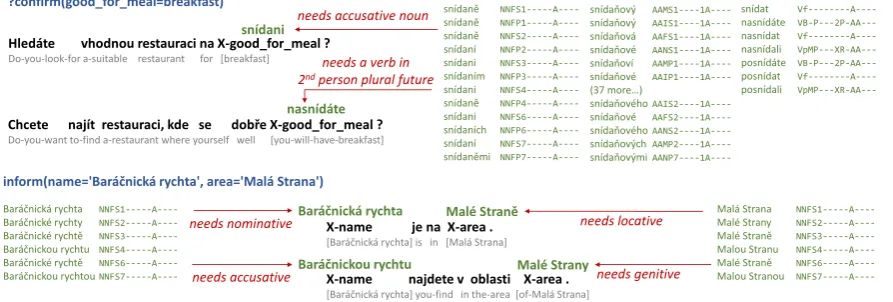
produce fluent outputs (see Figure1).
This paper presents the following contributions:
• We create a novel dataset for Czech
delexical-ized generation; this extends the typical task of data-to-text NLG by requiring attribute value
inflection (Section 2). We choose Czech as
an example of a morphologically complex
lan-guage (Cotterell et al., 2018) with a large set
of NLP tools readily available (e.g.Popel and
ˇ
Zabokrtsk´y,2010;Strakov´a et al.,2014;Straka
and Strakov´a,2017).
• We present baseline models based on the TGen
sequence-to-sequence (seq2seq) system (Duˇsek
and Jurˇc´ıˇcek,2016), with two novel extensions
to the model for our task (Section3):
– A model for lexicalization, i.e., selecting the
correct inflected surface form for a slot value, based on a recurrent neural network language model (RNN LM);
– A new generation mode, where the seq2seq
generator produces interleaved sequences of lemmas (base word forms) and morphological tags that are postprocessed using a morpho-logical generator.
• Using both automatic and manual evaluation in
Hledáte vhodnou restauraci na X-good_for_meal ?
Do-you-look-for a-suitable restaurant for [breakfast]
X-name najdete v oblasti X-area .
[Baráčnickárychta] you-find in the-area [of-Malá Strana]
Chcete najít restauraci, kde se dobřeX-good_for_meal ?
Do-you-want to-find a-restaurant where yourself well [you-will-have-breakfast]
X-name je na X-area .
[Baráčnickárychta] is in [Malá Strana]
Malá Strana NNFS1---A----Malé Strany NNFS2---A----MaléStraně NNFS3---A----Malou Stranu NNFS4---A----MaléStraně NNFS6---A----Malou Stranou NNFS7---A----needs locative
needs genitive
MaléStraně
Malé Strany Baráčnickárychta
NNFS1---A----Baráčnickérychty
NNFS2---A----Baráčnické rychtě
NNFS3---A----Baráčnickourychtu
NNFS4---A----Baráčnické rychtě
NNFS6---A----Baráčnickourychtou
NNFS7---A----Baráčnickárychta
Baráčnickourychtu
needs nominative
needs accusative
snídaně
NNFS1---A----snídaně
NNFP1---A----snídaně NNFS2---A----snídaní NNFP2---A----snídani NNFS3---A----snídaním NNFP3---A----snídani
NNFS4---A----snídaně NNFP4---A----snídani NNFS6---A----snídaních NNFP6---A----snídaní
NNFS7---A----snídaněmi
NNFP7---A----snídaňový
AAMS1----1A----snídaňový
AAIS1----1A----snídaňová
AAFS1----1A----snídaňové
AANS1----1A----snídaňoví
AAMP1----1A----snídaňové
AAIP1----1A----(37 more…)
snídaňového
AAIS2----1A----snídaňové
AAFS2----1A----snídaňového
AANS2----1A----snídaňových
AAMP2----1A----snídaňovými
AANP7----1A----snídat Vf---A----nasnídáte VB-P---2P-AA---nasnídat Vf---A----nasnídali VpMP---XR-AA---posnídáte VB-P---2P-AA---posnídat Vf---A----posnídali
VpMP---XR-AA---snídani
?confirm(good_for_meal=breakfast)
inform(name='Baráčnickárychta', area='Malá Strana')
needs accusative noun
nasnídáte
[image:2.595.78.525.78.229.2]needs a verb in 2ndperson plural future
Figure 1: Example of delexicalized generation in Czech. Input MRs are shown in bold blue, corresponding target (delexicalized) outputs in bold black, with “X-” marking slot value placeholders. English glosses are shown below each word in gray. Appropriate inflected forms to be filled into slot placeholders are shown in bold green, with lists of all possible forms along with their morphological tags (Hajiˇc,2004). Note that the surface form for “X-good for meal” can even have different parts-of-speech (left column: noun, middle: adjective, right: verb forms).
over the base model, but do not solve the task completely.
We propose improvements for future work in
Sec-tion6. Our dataset and all experimental code are
released on GitHub.2
2 Dataset
Our goal was to create a dataset comparable in size and domain to existing English data-to-text NLG datasets used in experiments with neural sys-tems. Since there are few to none Czech speakers
on crowdsourcing platforms (Pavlick et al.,2014;
Duˇsek et al.,2014), we were not able to use them
for data collection. Recruiting freelance transla-tors seemed easier than training annotatransla-tors; there-fore, we turned to localizing and translating an existing dataset instead of creating a new one from
scratch. We chose the restaurant dataset ofWen
et al.(2015b) due to its manageable, yet non-trivial
size and the familiarity of the domain (cf.Mairesse
et al., 2010; Duˇsek et al., 2019). The original
dataset contains 5,192 MR-sentence pairs, where MRs come in the form of dialogue acts (DAs). A
DA consists of DA type (e.g.,request,confirm,
in-form) and a list of slots (attributes) and their values
(e.g.,name,price range,address,area). There are
8 different DA types and 12 slots in the dataset. All
slots except the binarykids allowedare
delexical-ized during generation (cf. Figure1).
2
Dataset: https://github.com/UFAL-DSG/cs_
restaurant_dataset, code: https://github.
com/UFAL-DSG/tgen.
Ananta – feminine noun, inflected (nom: Ananta, gen:
Ananty, dat, loc: Anantˇe, acc: Anantu, inst: Anantou)
BarBar – masculine inanimate noun, inflected (nom, acc: BarBar, gen, dat, loc: BarBaru, inst: Bar-Barem)
Caf´e Savoy– neuter noun, not inflected
M´ısto – neuter noun, inflected (nom, acc: M´ısto, gen: M´ısta, dat:M´ıstu, loc:M´ıstˇe, inst:M´ıstem)
U Konˇsel ˚u – prepositional phrase, not inflected
Figure 2: Examples of restaurant names from the local-ized data with different morphosyntactic behavior (nom = nominative, gen = genitive, dat= dative, acc= ac-cusative,loc= locative,inst= instrumental).
2.1 Localizing the Data
We first needed to localize the dataset, replacing the original setting of San Francisco with a Czech one. In particular, we aimed at using domestic entity names (DA slot values) that need to be inflected since foreign names are often kept uninflected in Czech, using less fluent and conspicuous
grammat-ical constructions to avoid inflection.3
We localized the following slots in both DAs and texts from the dataset: restaurant names, areas, food types, street addresses, and landmarks. We
3This is not to say that we avoided using any foreign words
used a list of randomly chosen restaurant names from the Prague city center as well as lists of Prague neighborhoods, streets, and landmarks. The resulting sentences contain mostly factually inac-curate, yet meaningful utterances about restaurants in Prague.
The localized lists are quite short, with just 15 different restaurant names and a similar number of landmarks, streets, and neighborhoods. While much longer lists would be needed for a real-world scenario, this is sufficient to cover most common classes of names with different inflection patterns
and/or syntactic behavior (see Figure2).
2.2 Translation
We recruited six translators and asked them to trans-late all unique texts in the localized dataset. They were given the following instructions:
• translate the utterances in isolation,
• use fluent, spoken-style Czech,
• strive to preserve the facts but not necessarily all
nuances of the original,
• use varying synonyms (as long as they belong
to casual, fluent Czech), including for entity names or slot values (such as price ranges or meal types),
• inflect entity names as needed,
• use formal address (or plural) when addressing
the user, and use the female form in the first
person for self-references.4
All rules but the last one aim at obtaining a varied and fluent dataset; the last rule strives for consis-tency. Note that the translators were not given the input DAs – these carry no more information than the corresponding English sentences, and we as-sume that they would only confuse the translators and could hurt the fluency of the results.
2.3 Consistency Checks and Deduplication
We checked the translated Czech texts for the pres-ence of all required slot values. We took the fol-lowing iterative, partially automatic approach: 1. Create a list of possible inflected surface forms
for all slot values in the dataset. We used
4Czech grammar requires a selection between formal an
informal address whenever using a verb in the 2nd person
(Naughton,2005, p. 134ff.). For verbs with past tense or
con-ditional and in any person, gender must be selected (Naughton,
2005, p. 140ff.). Here we opted for a feminine form when-ever the system addresses itself, and formal address (mostly homonymous with plural) when addressing the user.
the morphological generator ofStrakov´a et al.
(2014) to inflect the surface forms automatically and manually checked for errors.
2. Given a DA and a translated sentence, check (using an automatic script) that the sentence con-tains surface forms for all slots in the DA.
3. Given a sentence found by the script to miss a value, check if it contains an alternative surface
form not included in the list from Step1. If so,
add this alternative surface form to the list.
4. If the translated sentence does not contain any mention of the DA value, fix the translation.
5. Repeat from Step2until there are no missing
DA value mentions in the whole set.
Note that these checks result not only in greater consistency of the dataset, but also in a list of pos-sible surface realizations for all slot values in the dataset. We store this list including morphological information provided by the tagger (with manually corrected errors), and we use it for lexicalization
(see Section3).5
2.4 Duplicate Sentence Handling
If the exact lexicalization is not taken into account,
the original dataset ofWen et al.(2015b) contains a
lot of duplicate texts – the total number of DA-text pairs is 5,192, but only 2,648 are unique. There-fore, we chose to only translate unique texts, in order to speed up the translation process and lower the costs, albeit at a cost of a lower-quality result. We ensured that the translations preserve the same number of unique sentences by modifying any du-plicate translations, manually replacing selected words or phrases with synonyms.
After the dataset was translated, we expanded it to obtain the same number of instances and the same distribution of different DAs as in the original. Given a delexicalized DA, a list of corresponding translated sentences, and the target number of cor-responding sentences to match the original set, we sampled additional copies of the existing transla-tions to match the number of originals. To esti-mate probabilities of the individual translations for
the sampling, we used a 5-gram LM6 trained on
lemmatized and delexicalized translations (see
Fig-ure3for details). We obtained LM scores for all
5
We treat multiword slot values as single tokens in our surface form list. We assign them a morphological tag that fits the whole expression best, e.g., a noun tag for noun phrases.
6We used the implementation in the KenLM toolkit
m´ıt M´am I have
pro pro for
ty V´as you
vhodn´y vhodnou a suitable
restaurace restauraci restaurant
. . .
jeho Jej´ı Its
n´azev n´azev name
b´yt je is
X-name Koˇc´ar z V´ıdnˇe Koˇc´ar z V´ıdnˇe
a a and
moci m˚uˇzete you can
se si yourself
d´at d´at give
X-food ˇceskou Czech
kuchynˇe kuchyni cuisine
. . .
‘I have a suitable restaurant for you. Its name is Koˇc´ar z V´ıdnˇe and you can have Czech cuisine.’
Figure 3: Lemmatized and delexicalized form of the translations for LM scoring. Top: lemmatized and delexical-ized Czech used for the LM; middle: original Czech sentence including lexicalization; bottom: English word-by-word gloss. An English translation is shown below the example.
English Czech
[image:4.595.74.525.63.95.2]Number of instances 5,192 5,192 Unique delexicalized instances 2,648 2,752 Unique delexicalized DAs 248 248 Unique lemmas (in delexicalized set) 399 532 Unique word forms (in delexicalized set) 455 962 Average lexicalizations per slot value 1 3.84
Table 1: Statistics of our translated Czech dataset and a comparison to the English original of Wen et al. (2015b). The average lexicalizations per slot value shows the number of different surface lexical forms per slot value, as it appears in the dataset. Numerals were disregarded when computing this value.
translations, used softmax to obtain a probability distribution, and sampled additional copies from this distribution. This ensures that translations us-ing more frequent phrasus-ing are more likely to be used multiple times in the set.
We then relexicalized the sampled copies: We randomly changed DA slot values and replaced their surface forms in the text using the surface forms list, checking for roughly corresponding morphology. Since the morphological informa-tion used by this approach was rather crude (e.g., noun/adjective gender was not taken into account),
disfluencies ensued in some cases. Therefore,
we manually corrected all relexicalized sentences, changing inflection or wording where needed.
2.5 Dataset Statistics
The final Czech set contains the same number of instances as the English original, copies the DA distribution of the original, and contains a slightly higher number of unique delexicalized sentences
due to post-expansion corrections (see Section2.4).
A statistics of the dataset size is shown in Table1,
with a comparison to the original English set. We can see that while the number of unique word lem-mas (disregarding restaurant and place names) is slightly higher in the Czech set, the number of unique inflected word forms is more than twice as
Part Train Dev Test
Unique delexicalized DAs 144 51 53 Total number of instances 3,569 781 842
Table 2: Dataset split statistics.
high. It is also clear that using slot values verba-tim in the text is not possible in the Czech set as the number of possible lexical realizations for each value is much higher than one.
2.6 Data Split
The original dataset ofWen et al.(2015b), which
used a sequential 3:1:1 split into training, develop-ment and test parts, suffered from a lot of overlap in terms of delexicalized DAs between the sections. This means that a system can perform quite well on this dataset and still be unable to generalize to
unseen DAs (Lampouras and Vlachos,2016). To
make testing systems’ generalization capabilities possible on our Czech dataset, we opted for a dif-ferent data split. We roughly keep the same 3:1:1
size proportion (see Table2), but we make sure
no delexicalized DA appears in two different parts. On the other hand, we ensure that most DA types
(inform, confirmetc.) are represented in all data
parts, so the system has access to all general types
of sentences during training.7
3 Model
We use TGen (Duˇsek and Jurˇc´ıˇcek,2016) in our
ex-periments, which is a freely available NLG system based on the seq2seq model with attention
(Bah-danau et al.,2015).
The seq2seq model consists of the encoder, the decoder, and the attention model. Both the encoder and decoder are recurrent neural networks (RNN)
7
with LSTM cells (Hochreiter and Schmidhuber, 1997). The encoder takes the input DA as a
se-quence of triples “DA type – slot – value”8 and
produces a sequence of hidden states. The last hid-den state is used to initialize the decoder, all hidhid-den states serve as input into the attention model. The attention model produces their weighted combi-nation for each decoder step using a 1-layer fully connected network. The decoder generates output tokens one-by-one using the previously generated token and the attention model as inputs.
In addition to the basic seq2seq model, TGen adds beam search and a reranker for the candi-date outputs on the generation beam that checks if the input semantics is preserved. The reranker en-codes a candidate output using an LSTM RNN and produces a binary classification of DA types and slot-value pairs present. The number of differences against the input DA is used as penalty.
3.1 Basic Extensions
We added two features fairly standard in seq2seq-based models but absent from TGen:
• Bidirectional encoder (Bahdanau et al.,2015) –
the input sequence is encoded in both directions and the resulting hidden states are joined. We added this for both the main seq2seq generator and the reranker.
• Dropout (Hinton et al.,2012) – this zeroes out
certain connections within the network with a given probability during the training process; it serves as regularization feature. We use this in the main generator only.
We use these extensions in all our setups as they improved results in our preliminary experiments.
3.2 Lemma-tag Generation Mode
Duˇsek and Jurˇc´ıˇcek(2016) experiment with
gen-erating syntactic trees and realizing them using an external surface realizer; they report slightly worse performance than generating tokens directly.
In order to fight data sparsity coming from the rich morphology of Czech, we decided to explore the middle ground between syntactic trees and full word-form generation: generating base forms (lem-mas) and morphological tags that indicate how the form should be inflected. We train TGen to simply generate an interleaved sequence of lemmas and
tags (see Figure4), which are then postprocessed
8DA type is repeated for each slot-value pair.
using the dictionary-based morphological
genera-tor ofStrakov´a et al.(2014) to obtain the inflected
word forms.
In the lemma-tag mode, the set of possible output tokens is reduced compared to direct token gener-ation, but the postprocessing step is much simpler than using a full syntactic surface realizer. More-over, the generated morphological tags following slot placeholders can be used to limit the scope of possible surface forms during lexicalization (see
Section3.3).
This approach is inspired by similar approaches
in phrase-based MT (Bojar,2007;Toutanova et al.,
2008;Fraser,2009) and was developed in parallel
to recent similar experiments with two-step
neu-ral MT (Nadejde et al., 2017; Tamchyna et al.,
2017). We compare the lemma-tag generation mode against the TGen default direct word-form generation mode in our experiments.
3.3 Lexicalization
We experiment with three different approaches for selecting the surface form for a DA slot value place-holder from a set of applicable ones – two very straightforward baselines requiring no training and our proposed solution based on a neural LM: • Random baseline. This selects a surface form
at random. This approach is certainly not suit-able for a real application, we only use it for comparison.
• Most frequent baseline. Here, the applicable surface form that occurs overall most frequently in the training data is selected. This represents a stronger baseline than the random method.
• RNN-based language model.Our main solution attempts to choose the best surface form using a bidirectional LSTM RNN-based LM (Mikolov
et al.,2010), trained to predict a token probability
distribution given all previous and all following tokens. During decoding, the RNN LM estimates the probabilities of all applicable surface forms, and we select the most probable surface form for the output.
When selecting a surface form during direct word-form generation, all possible forms for the given slot value are considered. In the lemma-tag
mode (Section3.2), only forms matching the
mor-phological tag following the slot placeholder are
considered (cf. Figure4) – first the ones matching
hledat search
VB-P---2P-AA---verb, 2nd person present formal vhodn´y suitable
AAFS4----1A----adjective, fem sg acc
restaurace restaurant
NNFS4---A----noun, fem sg acc
na for
RR--4---preposition, acc
X-good for meal slot placeholder
NNFS4---A----noun, fem sg acc
? ?
[image:6.595.72.477.62.110.2]
Z:---final punctuation
Figure 4: Example interleaved lemma-tag sequence for the input DA?confirm(good for meal=breakfast), the first output from Figure1(acc = accusative, fem = feminine, sg = singular; cf. (Hajiˇc,2004) for tagset details). Note that the morphological tag for the slot placeholder is included and can be used during lexicalization (cf. Section3.3).
3.4 Lexicalized Input DAs
Some slot values in our dataset may require certain morphosyntactic structure of their neighborhood. This is the case for restaurant counts: Czech cardi-nal numerals 2-4 behave as adjectives, while higher numerals behave as nouns and take the counted quantity as genitive object. The correct nomina-tive forms when counting restaurants are then “2
restaurace”, but “5 restaurac´ı” (Naughton, 2005,
p. 113ff.). Another example are area names requir-ing different prepositions for location – the correct
form for “in Mal´a Strana” is “naMal´e Stranˇe”, but
for “in Karl´ın”, it is “vKarl´ınˇe” (Naughton,2005,
p. 202).
Therefore, inspired bySharma et al.(2017), we
test using fully lexicalized input DAs with the main generator to check if it learns to produce more appropriate structure for concrete values (while
still producing delexicalized output).9We compare
this setup against the default with delexicalized DAs.
4 Experiments
4.1 Experimental Setup
We test all combinations of the features described
in Section3:
• Direct token vs. lemma-tag generation
• Random / most-frequent / RNN LM lexicalizer
• Delexicalized vs. lexicalized input DAs
We train the resulting 12 model variants using
the Adam optimizer (Kingma and Ba, 2015) to
minimize cross entropy on the training set; this approach is used for all parts of the system: the main seq2seq generator, the reranker, and the RNN LM lexicalizer. After each training data pass, we validate the models and keep the best-performing parameters. We use BLEU score (Papineni et al.,
9
We exploit the fact that the number of possible values for different slots in the dataset is relatively small (cf. Section2); morphosyntactic classes of the values would need to be used if the number of values was higher.
2002), classification error, and LM perplexity as the respective validation criteria. We set hyperpa-rameters based on TGen defaults for other datasets
and a few experiments on the development set.10
Training the baseline lexicalizers is trivial: the random baseline does not require any training, it simply uses the list of possible surface forms; the most frequent baseline just memorizes surface form frequencies in the training data.
To reduce the effect of random initialization, we train five runs using different random seeds and use results of all of them for evaluation. In addition, we fix the random seeds so that identical seq2seq generators and rerankers are used in setups that only differ in the lexicalization method.
4.2 Metrics
We use the suite of word-overlap-based automatic metrics from the E2E NLG Challenge (Duˇsek et al.,
2019),11supporting BLEU (Papineni et al.,2002),
NIST (Doddington,2002), ROUGE-L (Lin,2004),
METEOR (Lavie and Agarwal,2007) and CIDEr
(Vedantam et al.,2015). Although multiple texts
often correspond to the same delexicalized DA, we treat each instance individually both in training and testing since the particular slot values influence
the shape of the whole sentence (see Sections2.4
and3.4). This means that only a single reference
output per instance is available to be used with
automatic metrics (see Section4.3).
10
The main generator uses embedding and LSTM cell size 200, learning rate 0.005, dropout rate 0.5, and batch size 20. At least 50 and up to 1000 training data passes are used, with early stopping if the top 10 validation BLEU scores do not change for 50 passes. Beam size 20 is used for decoding.
The reranker uses embedding and LSTM cell size 50, no dropout, learning rate 0.001, and batch size 20. Training runs for 100 passes, performance is validated starting with pass 10. The reranker is validated both on training and development data; classification error on the development set is given 10 times more weight than training set error.
The RNN LM lexicalizer uses the same parameters as the reranker, with training for 50 passes maximum and validation (on development data only) starting after the first pass.
11https://github.com/tuetschek/
Input DAs Generator mode Lexicalizer BLEU NIST METEOR ROUGE-L CIDEr SER
Delexicalized
Word forms
Random 15.51‡ 3.7352 18.60 35.00 1.3922 00.70
Most frequent 20.28‡ 4.5192 22.69 40.92 1.9399 00.70
RNN LM 20.74∗ 4.5096 22.61 40.72 1.9924 00.70
Lemma-tag
Random 19.66† 4.4884†‡ 22.19 41.42 1.8844 01.85 Most frequent 21.21†‡ 4.6900†‡ 23.07 42.62 2.0983 01.85 RNN LM 21.96∗†‡ 4.7720∗†‡ 23.32 42.95 2.1783 01.85
Lexicalized
Word forms
Random 14.70 3.7595 18.29 35.64 1.3712 02.30 Most frequent 19.73 4.5618 22.45 41.71 1.9473 02.30 RNN LM 20.48∗ 4.6060∗‡ 22.55 41.66 2.0192 02.30
Lemma-tag
[image:7.595.122.482.281.373.2]Random 18.92† 4.3501† 21.76 40.55 1.8014 03.08 Most frequent 19.44 4.4453 22.22 41.26 1.8801 03.08 RNN LM 20.42∗ 4.5460∗ 22.56 41.73 1.9796 03.08
Table 3: Automatic metrics results. See Section4.2for metrics; scores are averaged over 5 different random ini-tializations, all scores except for NIST and CIDEr are percentages.∗= significantly better than the corresponding most frequent baseline lexicalizer,† = significantly better than the corresponding word forms mode,‡ = signifi-cantly better than the corresponding (de)lexicalized input DAs. Significance was assessed using pairwise bootstrap resampling (Koehn,2004),p <0.01.
Input DAs Generator mode Lexicalizer S R F I L F+I+L Σ
Delexicalized
Word forms Most frequent 8 0 5 11 57 73 81
RNN LM 8 0 5 11 25 41 49
Lemma-tag
Most frequent 12 2 5 11 45 61 75
RNN LM 12 2 5 11 6 22 36
Lexicalized
Word forms Most frequent 14 5 14 6 34 54 73 RNN LM 14 5 14 6 10 30 49
Lemma-tag
Most frequent 15 4 6 4 34 44 63
RNN LM 15 4 6 4 4 14 33
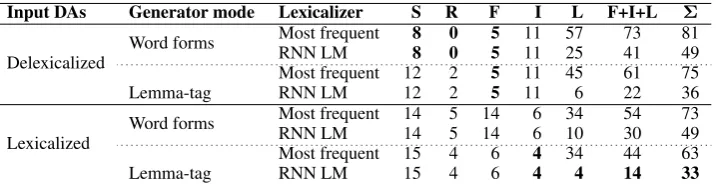
Table 4: Manual evaluation results on 100 sampled sentences – absolute numbers of different types of errors (S = semantic errors, R = repetition, F = fluency problems except lexicalization, I = impossible to lexicalize correctly with the given value, L = lexicalization errors). All error types are exemplified in Figure5.
In addition to word-overlap metrics, we use the
slot error rate (SER;Wen et al.,2015b) to
evalu-ate semantic accuracy of the outputs. This metric counts slot placeholders in the output before lexical-ization and compares them to slots in the input DA. It reliably measures the amount of missed/added
content in all delexicalized slots (cf. Section2), but
the non-delexicalized binarykids allowedslot is
ignored.
4.3 Results
The automatic metrics scores for all setups are
shown in Table3. In terms of generator mode,
us-ing lemma-tag generation significantly12improves
word-overlap metrics over direct token generation in the delexicalized input setting. However, it also leads to an increased SER. The RNN LM brings a
significant12improvement over both baselines in
all setups; the very low performance of the random baseline only documents that inflection indeed mat-ters for slot values. The lexicalized input DAs did not bring improvement over the delexicalized
set-12BLEU and NIST differences are statistically significant
(p <0.01) according to bootstrap resampling (Koehn,2004).
ting – lexicalized setups seem to perform slightly worse in terms of both word-overlap metrics and SER.
4.4 Manual Error Analysis
To obtain a deeper insight into the results and ac-count for automatic metrics’ inaccuracy (Novikova
et al.,2017;Reiter,2018), we performed a detailed
manual error analysis on a sample of 100 outputs produced by all systems except the ones with ran-dom baseline lexicalizers, which clearly perform poorly. This was a blind annotation of semantic and fluency errors; it is not a preference rating. We categorized multiple error types; the results are
shown in Table4.
Input DA inform(food=Turkish, name=“Green Spirit”, price range=expensive)
Systems
Delex. input DAs, any mode Most frequent
Green Spirit je is drah´e expensive tureck´a Turkish restaurace restaurant .
Delex. input DAs, any mode RNN LM
Green Spirit je is drah´a expensive tureck´a Turkish restaurace restaurant .
Lex. DAs, word forms Most frequent
Green Spirit je is drah´e expensive tureck´a Turkish restaurace restaurant
Lex. DAs, word forms RNN LM
Green Spirit je is drah´a expensive tureck´a Turkish restaurace restaurant
Lex. DAs, lemma-tag Most frequent
Green Spirit je drah´e expensive restaurace restaurant , kter´a which pod´av´a serves tureck´a Turkish j´ıdla meals .
Lex. DAs, lemma-tag RNN LM
Green Spirit je is drah´a expensive restaurace restaurant , kter´a which pod´av´a serves tureck´a Turkish j´ıdla meals .
Input DA inform(area=dont care, count=218, food=dont care, price range=dont care, type=restaurant)
Systems
(an
y
le
xicalizer)
Delex. input DAs Word forms mode
Pokud if v´am you nez´aleˇz´ı don’t-care na about druhu type j´ıdla of-food
, naˇsla jsem I-found 218 ::::::restaurace restaurants v in r˚uzn´ych various cenov´ych price skupin´ach ranges
.(missing area)
Delex. input DAs Lemma-tag mode Pokud if v´am you nez´aleˇz´ı don’t-care na about druhu type j´ıdla of-food
, naˇsla jsem I-found 218 restaurac´ı restaurants v in r˚uzn´ych various cenov´ych price skupin´ach ranges
.(missing area)
Lex. input DAs Word forms mode
V into ´uvahu consideration::::: pˇripadaj´ı come 218 restaurac´ı restaurants , pokud if v´am you nez´aleˇz´ı don’t-care na about druhu type j´ıdla of-food , pokud if v´am you nez´aleˇz´ı don’t-care na about druhu type j´ıdla of-food .
(missing area, price range)
Lex. input DAs Lemma-tag mode M´am I-have tu here 218 restaurac´ı restaurants , pokud if v´am you nez´aleˇz´ı don’t-care na about. . . .
druhu type cenov´ych price skupin´ach ranges
[image:8.595.73.526.62.306.2].(missing area, food type)
Figure 5: Examples from manual error analysis. Errors are marked with color and underlining: semantic errors,
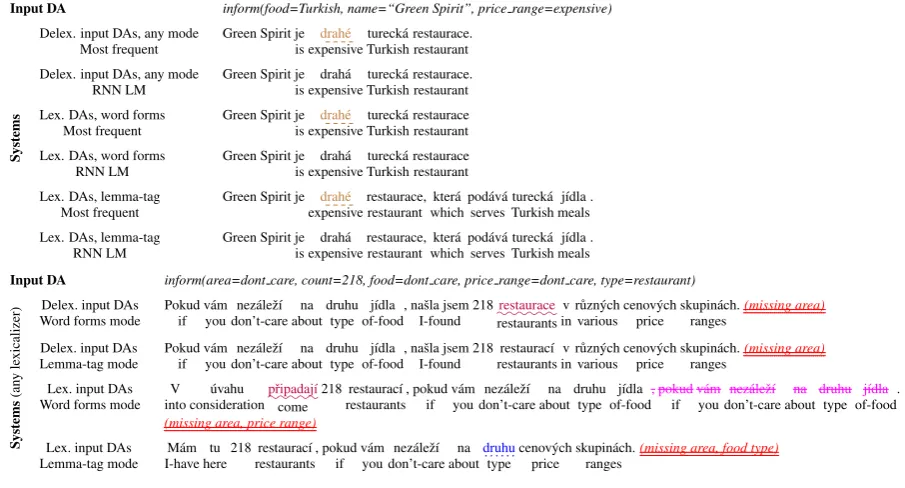
repetition,fluency. . . .,:::::::::impossible::to::::::::lexicalize::::::::correctly,lexicalization(cf. Table4). In the top example, the RNN LM lexicalizer is able to select the correct feminine singular form, while the most frequent baseline selects a neuter form. In the bottom example, systems with lexicalized input DAs make more semantic errors. The lemma-tag mode is able to select a more appropriate syntactic structure for the numeral 218.
baseline, especially in combination with lemma-tag
generation (see top example in Figure5). None of
the systems produce perfect output; they seem to struggle especially with DAs that are very differ-ent from the ones found in the training set and/or occur less frequently (see bottom example in
Fig-ure5, cf. Section2.6). We believe that an increased
amount of training data could improve the situa-tion.
5 Related Work
NLG experiments for non-English languages are relatively rare and fully trainable approaches even rarer. Our work is, to our knowledge, the first ap-plication of neural NLG to a non-English language for data-to-text generation.
Most works concerned with multiple languages focus on surface realization. There have been a few approaches using handcrafted grammars (Bateman,
1997;Allman et al.,2012). The procedural
Sim-pleNLG realizer (Gatt and Reiter,2009) has also
been ported into multiple languages (Bollmann,
2011;Vaudry and Lapalme,2013;de Oliveira and
Sripada, 2014;Mazzei et al.,2016;Ramos-Soto
et al.,2017;Cascallar-Fuentes et al.,2018;Chen
et al.,2018;de Jong and Theune,2018). Further
works using multilingual rule-based surface
realiza-tion pipelines were developed in the context of
ma-chine translation (Aikawa et al.,2001;Zabokrtsk´yˇ
et al., 2008; Duˇsek et al., 2015). Bohnet et al.
(2010) created the first statistical multilingual re-alizer based on a pipeline of SVMs, the recent
surface realization challenge (Mille et al.,2018)
then features further fully trainable realizers tested on multiple languages, including neural models.
In data-to-text generation, the recent work of
Moussallem et al.(2018) is applied to Portuguese,
but is largely rule-based. The works ofChen et al.
(2010) andKim and Mooney(2010) represent the
only data-to-text end-to-end NLG system with mul-tilingual experiments known to us; they generate English and Korean sport commentary sentences using an inverted (non-neural) semantic parser. Our dataset is ca. 2.5 times larger and more complex, given the slot value inflection.
Other works on neural non-English NLG solve in fact different tasks from ours: Chinese poetry
gen-eration (Zhang and Lapata,2014;Yi et al.,2017;
Wang et al.,2016), non-task-oriented response
gen-eration in chatbots (Xing et al., 2016, 2017), or
morphological inflection (e.g.Faruqui et al.,2016;
6 Conclusions and Future Work
We presented the first dataset targeted at end-to-end neural non-English NLG, containing Czech texts from the restaurant domain. We show that the task of data-to-text NLG here is harder as slot val-ues require morphological inflection. We apply to our data the freely available, state-of-the-art TGen
NLG system (Duˇsek and Jurˇc´ıˇcek,2016) based on
the seq2seq architecture, and we implement two extensions for Czech: (1) an RNN LM model to select the correct inflected surface form for slot values and (2) lemma-tag generation mode, where the generator produces an interleaved sequences of base form and morphological tags, which are postprocessed by a morphological generator. We also experiment with lexicalized and delexicalized slot values in generator inputs. Using both auto-matic metrics and manual analysis, we show that the RNN LM brings clear benefits. The lemma-tag mode and lexicalized inputs improve fluency but hurt semantic accuracy of the outputs. We release our dataset dataset and all experimental code on
GitHub.13
In future work, we will collect a large unanno-tated dataset and pretrain the generator (Chen et al., 2019). We believe that this will lead to increased output fluency and accuracy. We are also consider-ing usconsider-ing machine translation to obtain more syn-thetic training data points.
Acknowledgments
This research was supported by the Charles Univer-sity project PRIMUS/19/SCI/10 and by the Min-istry of Education, Youth and Sports of the Czech Republic under the grant agreement LK11221. This work used using language resources dis-tributed by the LINDAT/CLARIN project of the Ministry of Education, Youth and Sports of the Czech Republic (project LM2015071).
References
T. Aikawa, M. Melero, L. Schwartz, and A. Wu. 2001. Generation for multilingual MT. In Proceedings of the MT-Summit, pages 9–14, Santiago de Com-postela, Spain.
T. Allman, S. Beale, and R. Denton. 2012. Linguist’s Assistant: A Multi-Lingual Natural Language Gen-erator based on Linguistic Universals, Typologies,
13Dataset: https://github.com/UFAL-DSG/cs_
restaurant_dataset, code: https://github.
com/UFAL-DSG/tgen.
and Primitives. In INLG 2012 Proceedings of the Seventh International Natural Language Generation Conference, pages 59–66, Utica, IL, USA.
Dzmitry Bahdanau, Kyunghyun Cho, and Yoshua Bengio. 2015. Neural Machine Translation by Jointly Learning to Align and Translate. In 3rd International Conference on Learning Rep-resentations (ICLR2015), San Diego, CA, USA. arXiv:1409.0473.
J. A. Bateman. 1997. Enabling technology for multilin-gual natural language generation: the KPML devel-opment environment. Natural Language Engineer-ing, 3(1):15–55.
B. Bohnet, L. Wanner, S. Mille, and A. Burga. 2010. Broad coverage multilingual deep sentence genera-tion with a stochastic multi-level realizer. In Pro-ceedings of the 23rd International Conference on Computational Linguistics, pages 98–106, Beijing, China.
Ondˇrej Bojar. 2007. English-to-Czech factored ma-chine translation. In Proceedings of the Sec-ond Workshop on Statistical Machine Translation – StatMT ’07, pages 232–239, Prague, Czech Repub-lic.
M. Bollmann. 2011. Adapting SimpleNLG to Ger-man. In Proceedings of the 13th European Work-shop on Natural Language Generation, pages 133– 138, Nancy, France.
Andrea Cascallar-Fuentes, Alejandro Ramos-Soto, and Alberto Bugar´ın Diz. 2018. Adapting SimpleNLG to Galician language. InProceedings of the 11th In-ternational Conference on Natural Language Gener-ation, pages 67–72, Tilburg, The Netherlands.
David L. Chen, Joohyun Kim, and Raymond J. Mooney. 2010. Training a multilingual sportscaster: Using perceptual context to learn language. Journal of Ar-tificial Intelligence Research, 37:397–435.
Guanyi Chen, Kees van Deemter, and Chenghua Lin. 2018. SimpleNLG-ZH: a Linguistic Realisation En-gine for Mandarin. InProceedings of the 11th Inter-national Conference on Natural Language Genera-tion, pages 57–66, Tilburg, The Netherlands.
Zhiyu Chen, Harini Eavani, Yinyin Liu, and William Yang Wang. 2019.Few-shot NLG with Pre-trained Language Model.arXiv:1904.09521 [cs].
Ryan Cotterell, Sebastian J. Mielke, Jason Eisner, and Brian Roark. 2018. Are All Languages Equally Hard to Language-Model? In Proceedings of the 2018 Conference of the North American Chapter of the Association for Computational Linguistics: Hu-man Language Technologies, Volume 2 (Short Pa-pers), pages 536–541, New Orleans, LA, USA.
Technology Research, HLT ’02, pages 138–145, San Francisco, CA, USA.
Ondˇrej Duˇsek, Ondˇrej Pl´atek, Luk´aˇs ˇZilka, and Filip Jurˇc´ıˇcek. 2014. Alex: Bootstrapping a Spoken Di-alogue System for a New Domain by Real Users. In Proceedings of the 15th Annual Meeting of the Special Interest Group on Discourse and Dialogue, pages 79–83, Philadelphia, PA, USA.
Ondˇrej Duˇsek, Lu´ıs Gomes, Michal Nov´ak, Martin Popel, and Rudolf Rosa. 2015. New Language Pairs in TectoMT. InProceedings of the 10th Workshop on Machine Translation, pages 98–104, Lisbon, Por-tugal.
Ondˇrej Duˇsek and Filip Jurˇc´ıˇcek. 2016. Sequence-to-Sequence Generation for Spoken Dialogue via Deep Syntax Trees and Strings. In Proceedings of the 54th Annual Meeting of the Association for Compu-tational Linguistics (Volume 2: Short Papers), pages 45–51, Berlin. arXiv:1606.05491.
Ondˇrej Duˇsek, Jekaterina Novikova, and Verena Rieser. 2019. Evaluating the State-of-the-Art of End-to-End Natural Language Generation: The E2E NLG Chal-lenge. Computer Speech & Language, 59:123–156. arXiv:1901.07931.
Manaal Faruqui, Yulia Tsvetkov, Graham Neubig, and Chris Dyer. 2016. Morphological Inflection Genera-tion Using Character Sequence to Sequence Learn-ing. In Proceedings of the 2016 Conference of the North American Chapter of the Association for Computational Linguistics: Human Language Tech-nologies, pages 634–643, San Diego, CA, USA. arXiv:1512.06110.
Alexander Fraser. 2009. Experiments in Morphosyn-tactic Processing for Translating to and from Ger-man. In Proceedings of the Fourth Workshop on Statistical Machine Translation, pages 115–119, Athens, Greece.
A. Gatt and E. Reiter. 2009.SimpleNLG: A realisation engine for practical applications. InProceedings of the 12th European Workshop on Natural Language Generation, pages 90–93.
Sebastian Gehrmann, Falcon Z. Dai, Henry Elder, and Alexander M. Rush. 2018. End-to-End Content and Plan Selection for Data-to-Text Generation. In Pro-ceedings of the 11th International Conference on Natural Language Generation, Tilburg, The Nether-lands. arXiv:1810.04700.
Jiatao Gu, Zhengdong Lu, Hang Li, and Victor O. K. Li. 2016. Incorporating Copying Mechanism in Sequence-to-Sequence Learning. InProceedings of the 54th Annual Meeting of the Association for Com-putational Linguistics, pages 1631–1640, Berlin, Germany. arXiv:1603.06393.
Jan Hajiˇc. 2004. Disambiguation of rich inflection: computational morphology of Czech. Karolinum, Praha.
Kenneth Heafield. 2011. KenLM: Faster and smaller language model queries. InProceedings of the Sixth Workshop on Statistical Machine Translation, pages 187–197, Edinburgh, Scotland, UK.
Geoffrey E. Hinton, Nitish Srivastava, Alex Krizhevsky, Ilya Sutskever, and Ruslan R. Salakhut-dinov. 2012. Improving neural networks by preventing co-adaptation of feature detectors. arXiv:1207.0580 [cs].
Sepp Hochreiter and J¨urgen Schmidhuber. 1997. Long short-term memory. Neural computation, 9(8):1735–1780.
Ruud de Jong and Mari¨et Theune. 2018.Going Dutch: Creating SimpleNLG-NL. In Proceedings of the 11th International Conference on Natural Language Generation, pages 73–78, Tilburg, The Netherlands.
Juraj Juraska, Panagiotis Karagiannis, Kevin K. Bow-den, and Marilyn A. Walker. 2018. A Deep En-semble Model with Slot Alignment for Sequence-to-Sequence Natural Language Generation. InNAACL, New Orleans, LA, USA. arXiv:1805.06553.
Katharina Kann and Hinrich Sch¨utze. 2016. Single-Model Encoder-Decoder with Explicit Morpholog-ical Representation for Reinflection. In Proceed-ings of the 54th Annual Meeting of the Asso-ciation for Computational Linguistics (Volume 2: Short Papers), pages 555–560, Berlin, Germany. arXiv:1606.00589.
Joohyun Kim and Raymond J. Mooney. 2010. Gen-erative Alignment and Semantic Parsing for Learn-ing from Ambiguous Supervision. InProceedings of the 23rd International Conference on Computa-tional Linguistics: Posters, pages 543–551, Beijing, China.
Diederik Kingma and Jimmy Ba. 2015. Adam: A Method for Stochastic Optimization. In Pro-ceedings of the 3rd International Conference on Learning Representations, San Diego, CA, USA. arXiv:1412.6980.
Philipp Koehn. 2004. Statistical significance tests for machine translation evaluation. InProceedings of the 2004 Conference on Empirical Methods in Natu-ral Language Processing, pages 388–395.
Gerasimos Lampouras and Andreas Vlachos. 2016. Imitation learning for language generation from un-aligned data. In Proceedings of COLING 2016, the 26th International Conference on Computational Linguistics: Technical Papers, pages 1101–1112, Osaka, Japan.
Chin-Yew Lin. 2004. ROUGE: A package for auto-matic evaluation of summaries. InText summariza-tion branches out: Proceedings of the ACL-04 work-shop, pages 74–81. Barcelona, Spain.
F. Mairesse, M. Gaˇsi´c, F. Jurˇc´ıˇcek, S. Keizer, B. Thom-son, K. Yu, and S. Young. 2010. Phrase-based sta-tistical language generation using graphical models and active learning. InProceedings of the 48th An-nual Meeting of the Association for Computational Linguistics, page 1552–1561, Uppsala, Sweden.
Alessandro Mazzei, Cristina Battaglino, and Cristina Bosco. 2016. SimpleNLG-IT: Adapting Sim-pleNLG to Italian. In The 9th International Nat-ural Language Generation conference, pages 184– 192, Edinburgh, Scotland, UK.
Tom´aˇs Mikolov, Martin Karafi´at, Luk´aˇs Burget, Jan ˇ
Cernock´y, and Sanjeev Khudanpur. 2010. Recur-rent neural network based language model. In In-terspeech, pages 1045–1048, Makuhari, Japan.
Simon Mille, Anja Belz, Bernd Bohnet, Yvette Gra-ham, Emily Pitler, and Leo Wanner. 2018. The First Multilingual Surface Realisation Shared Task (SR’18): Overview and Evaluation Results. In Pro-ceedings of the First Workshop on Multilingual Sur-face Realisation, pages 1–12, Melbourne, Australia.
Diego Moussallem, Thiago Castro Ferreira, Marcos Zampieri, Maria Claudia Cavalcanti, Geraldo Xex´eo, Mariana Neves, and Axel-Cyrille Ngonga Ngomo. 2018. RDF2pt: Generating Brazilian Portuguese Texts from RDF Data. In Proceedings of the Eleventh International Conference on Language Re-sources and Evaluation (LREC-2018), Miyazaki, Japan. arXiv:1802.08150.
Maria Nadejde, Siva Reddy, Rico Sennrich, Tomasz Dwojak, Marcin Junczys-Dowmunt, Philipp Koehn, and Alexandra Birch. 2017. Predicting Target Lan-guage CCG Supertags Improves Neural Machine Translation. InProceedings of the Second Confer-ence on Machine Translation, pages 68–79, Copen-hagen, Denmark.
James Naughton. 2005. Czech : an essential grammar. Routledge, London.
Jekaterina Novikova, Ondˇrej Duˇsek, Amanda Cer-cas Curry, and Verena Rieser. 2017. Why We Need New Evaluation Metrics for NLG. InProceedings of the 2017 Conference on Empirical Methods in Natu-ral Language Processing, pages 2243–2253, Copen-hagen, Denmark. arXiv:1707.06875.
A. H. Oh and A. I. Rudnicky. 2000. Stochastic lan-guage generation for spoken dialogue systems. In Proceedings of the 2000 ANLP/NAACL Workshop on Conversational systems-Volume 3, page 27–32, Seat-tle, WA, USA.
Rodrigo de Oliveira and Somayajulu Sripada. 2014. Adapting SimpleNLG for Brazilian Portuguese reali-sation. InProceedings of the 8th International Natu-ral Language Generation Conference (INLG), pages 93–94, Philadelphia, PA, USA.
Kishore Papineni, Salim Roukos, Todd Ward, and Wei-Jing Zhu. 2002.BLEU: a method for automatic eval-uation of machine translation. InProceedings of the 40th annual meeting of the Association for Compu-tational Linguistics, pages 311–318.
Ellie Pavlick, Matt Post, Ann Irvine, Dmitry Kachaev, and Chris Callison-Burch. 2014. The language de-mographics of Amazon Mechanical Turk. Transac-tions of the Association for Computational Linguis-tics, 2:79–92.
Martin Popel and Zdenˇek ˇZabokrtsk´y. 2010. TectoMT: modular NLP framework. InProceedings of IceTAL, 7th International Conference on Natural Language Processing, pages 293–304, Reykjav´ık, Iceland.
Alejandro Ramos-Soto, Julio Janeiro-Gallardo, and Al-berto Bugar´ın Diz. 2017. Adapting SimpleNLG to Spanish. InProceedings of the 10th International Conference on Natural Language Generation, pages 144–148, Santiago de Compostela, Spain.
Ehud Reiter. 2018.A Structured Review of the Validity of BLEU. Computational Linguistics, 44(3):1–8.
Shikhar Sharma, Jing He, Kaheer Suleman, Hannes Schulz, and Philip Bachman. 2017. Natural Lan-guage Generation in Dialogue using Lexicalized and Delexicalized Data. In ICLR Workshop Track, Toulon, France. arXiv:1606.03632.
Milan Straka and Jana Strakov´a. 2017. Tokenizing, POS Tagging, Lemmatizing and Parsing UD 2.0 with UDPipe. InProceedings of the CoNLL 2017 Shared Task: Multilingual Parsing from Raw Text to Universal Dependencies, pages 88–99, Vancou-ver, Canada.
Jana Strakov´a, Milan Straka, and Jan Hajiˇc. 2014. Open-Source Tools for Morphology, Lemmatization, POS Tagging and Named Entity Recognition. In Proceedings of 52nd Annual Meeting of the Associa-tion for ComputaAssocia-tional Linguistics: System Demon-strations, pages 13–18, Baltimore, MD, USA.
Aleˇs Tamchyna, Marion Weller-Di Marco, and Alexan-der Fraser. 2017. Modeling Target-Side Inflection in Neural Machine Translation. InProceedings of the Conference on Machine Translation (WMT), Vol-ume 1: Research Papers, Copenhagen, Denmark. arXiv:1707.06012.
Pierre-Luc Vaudry and Guy Lapalme. 2013. Adapt-ing SimpleNLG for bilAdapt-ingual English-French reali-sation. InProceedings of the 14th European Work-shop on Natural Language Generation, pages 183– 187, Sofia, Bulgaria.
Ramakrishna Vedantam, C. Lawrence Zitnick, and Devi Parikh. 2015. CIDEr: Consensus-Based Im-age Description Evaluation. InProceedings of the IEEE Conference on Computer Vision and Pattern Recognition, pages 4566–4575, Boston, MA, USA. arXiv:1411.5726.
Zhe Wang, Wei He, Hua Wu, Haiyang Wu, Wei Li, Haifeng Wang, and Enhong Chen. 2016. Chinese Poetry Generation with Planning based Neural Net-work. In Proceedings of COLING 2016, the 26th International Conference on Computational Linguis-tics: Technical Papers, pages 1051–1060, Osaka, Japan. arXiv:1610.09889.
Tsung-Hsien Wen, Milica Gasic, Dongho Kim, Nikola Mrksic, Pei-Hao Su, David Vandyke, and Steve Young. 2015a. Stochastic Language Generation in Dialogue using Recurrent Neural Networks with Convolutional Sentence Reranking. InProceedings of the 16th Annual Meeting of the Special Interest Group on Discourse and Dialogue, pages 275–284, Prague, Czech Republic.
Tsung-Hsien Wen, Milica Gasic, Nikola Mrkˇsi´c, Pei-Hao Su, David Vandyke, and Steve Young. 2015b. Semantically Conditioned LSTM-based Nat-ural Language Generation for Spoken Dialogue Sys-tems. In Proceedings of the 2015 Conference on Empirical Methods in Natural Language Processing, pages 1711–1721, Lisbon, Portugal.
Chen Xing, Wei Wu, Yu Wu, Jie Liu, Yalou Huang, Ming Zhou, and Wei-Ying Ma. 2016. Topic Aug-mented Neural Response Generation with a Joint At-tention Mechanism.arXiv:1606.08340 [cs].
Chen Xing, Wei Wu, Yu Wu, Jie Liu, Yalou Huang, Ming Zhou, and Wei-Ying Ma. 2017. Topic Aware Neural Response Generation. InProceedings of the Thirty-First AAAI Conference on Artificial Intelli-gence (AAAI-17), pages 3351–3357, San Francisco, CA, USA.
Xiaoyuan Yi, Ruoyu Li, and Maosong Sun. 2017. Gen-erating Chinese Classical Poems with RNN Encoder-Decoder. In Chinese Computational Linguistics and Natural Language Processing Based on Natu-rally Annotated Big Data, pages 211–223, Nanjing, China. arXiv:1604.01537.
Xingxing Zhang and Mirella Lapata. 2014. Chinese poetry generation with recurrent neural networks. In Proceedings of the 2014 Conference on Empirical Methods in Natural Language Processing (EMNLP), pages 670–680, Doha, Qatar.
Z. ˇZabokrtsk´y, J. Pt´aˇcek, and P. Pajas. 2008. TectoMT: highly modular MT system with tectogrammatics