The Influence of Spelling Errors on Content Scoring Performance
Andrea Horbach, Yuning Ding, Torsten Zesch Language Technology Lab,
Department of Computer Science and Applied Cognitive Science, University of Duisburg-Essen, Germany
{andrea.horbach|torsten.zesch}@uni-due.de [email protected]
Abstract
Spelling errors occur frequently in edu-cational settings, but their influence on automatic scoring is largely unknown. We therefore investigate the influence of spelling errors on content scoring perfor-mance using the example of the short answer data set of the Automated Stu-dent Assessment Prize (ASAP). We con-duct an annotation study on the nature of spelling errors in the ASAP dataset and utilize these finding in machine learning experiments that measure the influence of spelling errors on automatic content scor-ing. Our main finding is that scoring meth-ods using both token and character n-gram features are robust against spelling errors up to the error frequency seen in ASAP.
1 Introduction
Spelling errors occur frequently in educational as-sessment situations, not only in language learn-ing scenarios, but also with native speakers, espe-cially when answers are written without the help of a spell-checker.1 In automatic content scoring
for short answer questions, a model is learnt about which content needs to be present in a correct an-swer. Spelling mistakes interfere with this pro-cess, as they should be mostly ignored for content scoring. It is still largely unknown how severe the problem is in a practical setting.
Consider the following answer to the first prompt of the short answer data set of the Auto-mated Student Assessment Prize (ASAP):2
1Note that we do not distinguish between the termserror andmistakeused byEllis(1994) to denote competence and performance errors respectively. We use the two terms inter-changeably.
2https://www.kaggle.com/c/asap-sas
(1) Some additional information you will
need are the material. You also need to
know the size of thecontaneirto measure
how the acid raineffectedit. You need to
know how muchvineageris used for each
sample. Another thing that would help is to know how big the sample stones are by
measureingthe best possible way.
In this answer, three non-word spelling errors (printed in bold) occur. In addition, there is also one real-word spelling error, which leads to an ex-isting word:effected, which should beaffected.
While a teacher who is manually scoring learner answers can simply try to ignore spelling mis-takes as far as possible, automatic scoring meth-ods must include a spell-checking component to normalize an occurrence of vineager to vinegar. Thus spell-checking components are also a part of some content scoring systems, such as the top two performing systems in the ASAP challenge ( Tan-dalla,2012;Zbontar,2012). However, it is unclear what impact spelling errors really have on the per-formance of content scoring systems.
Many systems in the ASAP challenge, as well as some participating systems in the SemEval 2013 Student Response Analysis Task (Heilman and Madnani, 2013; Levy et al., 2013), used shallow features such as token n-grams (Zbontar,
2012;Conort,2012). If a token in the test data is misspelled, then there is no way of knowing that it has the same meaning as the correct spelling of the word in the training data. At the same time, in-dividual spelling error instances are often not oc-curring uniquely in a dataset: Depending on fac-tors such as the learner group (for example native speakers or language learners with a certain na-tive language) or the data collection method (hand-writing vs. typing) some spelling errors will oc-cur frequently while others will be rare. The
spelled form vineger, for example, might be fre-quent enough that an occurrence feature for the misspelled version provides valuable information which a classifier can learn. Whether this observa-tion mitigates the effect of spelling errors depends on the frequency of individual errors and therefore also on the shape of error distributions.
Contributions In this paper, we investigate how the presence or absence of spelling errors in-fluences the task of content scoring, taking the afore-mentioned influence criteria of error fre-quency and error distribution into account. We conduct our analyses and experiments on the fre-quently used ASAP content scoring dataset ( Hig-gins et al.,2014). The dataset contains 10 different prompts about different topics ranging from sci-ences over biology to literature questions. Each prompt comes with 2,200 answers on average. Although this dataset has been used in a lot of studies concerning content scoring, much about the spelling errors in the dataset is still unknown. Our manual annotations and corpus analyses will therefore also provide insight on the number, the nature and the distribution of spelling errors in this dataset.
First, we present an analysis of the frequency and distribution of non-word spelling errors in the ASAP corpus and compare several spelling dictio-naries. We provide a gold-standard correction for the non-word errors found automatically by a spell checker in the test section of the data. We com-pare error correction methods based on phonetic and edit distance and extend them with a domain-specific method that prefers suggestions occurring in the material for a specific prompt.
Next, we investigate the effect of manipulating the number and distribution of spelling errors on the performance of an automatic content scoring system. We experiment with two ways of regu-lating the number of misspellings. We automati-cally and manually spell check the corpus to re-place non-word spelling errors by their corrected version. This only allows us to decrease the num-ber of errors. To increase the amount of spelling errors further, we also introduce errors artificially in two conditions: (i) adding random noise as a worst-case scenario, and (ii) adding mistakes ac-cording to the error distribution in the test data.
We find that token and character n-gram scoring features are largely robust against spelling errors with a frequency present in our data. Character
n-gram features are contributing towards this ro-bustness. When introducing more errors, we see a substantial drop in performance, such that the im-portance of spell-checking components in content scoring depends on the frequency of errors in the data.
2 Annotating Spelling Errors
In order to evaluate the influence of spelling errors on content scoring, we need an error-annotated corpus. However, a full manual annotation of the complete dataset, which contains around one million tokens, was beyond our means. Instead, we decided to annotate a representative sample of the ASAP corpus which we utilize to evaluate the performance of spelling error detection methods. This allows us to estimate whether we can draw reliable conclusions from applying existing spell checking methods to the full dataset.
We manually annotated the first 20 answers in each prompt using WebAnno (Yimam et al.,
2013). In order to facilitate the annotation process, we automatically pre-annotate potential spelling errors using the Jazzy spelling dictionary.3 Two
annotators (non-native speakers and two of the au-thors of this paper) reviewed the error candidates and either accepted or rejected them, but could also mark additional spelling errors which were not detected automatically.
In this manual annotation process, we distin-guish between non-word and real-word spelling errors. We annotate a mistake as real-word error if another word with a different root is clearly in-tended in the context, such as “Theirare two sam-ples”. We do not distinguish between spelling er-rors and grammatical erer-rors among the non-word errors, i.e., we do not filter out non-words that could originate from grammatical errors such as incorrect 3rd person forms like dryed instead of
dried. We do not mark grammatical errors that
lead to a real-word error, such as wrong preposi-tions. Equally, we do not mark lexically unsuitable words which are morphologically possible, but do not fit in the context, such ascounter partnerin a context wherecounter partwas clearly intended.
In total, we annotated 9,995 tokens and reach an inter-annotator agreement of 0.87 Cohen’s kappa (Cohen, 1960) on the binary decision whether a
word is a spelling mistake or not. Main sources of disagreement were (i) misses of real word spelling errors not marked in the pre-annotation (e.g.koala beer), and (ii) disagreements as to whether com-pounds may be written as one word or not (e.g.
micro debrisvs.microdebris), a decision which is
often ambiguous. In case of disagreement between the annotators, the final decision is made through adjudication by both annotators.
The resulting dataset contains 297 spelling er-rors, including 48 real-word errors which will not be considered for further evaluations and exper-iments. The resulting ratio of spelling errors in the dataset is about 3%, which is in line with the expected frequency of spelling errors in human-typed text (Kukich, 1992). However, it would be an interesting follow-up work to determine the fre-quency of spelling errors in other content scoring datasets.
2.1 Evaluating Automatic Spell-checking
Using our annotated answers, we now evaluate different spell-checking dictionaries. Note that the size and quality of those dictionaries influence the trade-off between precision and recall of error detection. For example, a very small dictionary yields almost perfect recall, as most spelling errors are not in the dictionary and flagged accordingly. However, precision would be rather low as some of the detected errors are perfectly valid words that are just missing from the dictionary. On the other hand, a very large dictionary lowers recall as some words that are definitely a spelling error in the context of the writing task in this dataset might be valid words in some very special context. For example, the HunSpell dictionary contains the abbreviationAZT, standing among others for ‘azi-dothymidine’ and ‘Azerbaijan time’. In the con-text of our learner answers, the string would likely never occur as a valid word, but would be counted as a non-word misspelling.
In order to find a suitable dictionary for our task, we evaluate the following setups: As base-line dictionary, we use the one that comes with the
Jazzyspell checker.4 It is relatively small (about
47,000 entries) and does not contain inflected forms (such as third person singular). Thus, we also use the English HunSpell dictionary with more than 120,000 entries.5 Both are general
4http://jazzy.sourceforge.net 5https://sourceforge.net/projects/
Dictionary P R F
Jazzy .25 .98 .39
HunSpell .63 .89 .74
[image:3.595.329.502.62.139.2]HunSpell -abbr .63 .95 .76 HunSpell +prompt .88 .88 .88 HunSpell -abbr +prompt .86 .94 .90
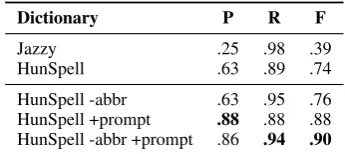
Table 1: Evaluation of different error detection dictionaries
purpose dictionaries, which we can adapt in or-der to get better performance. First, we remove all-uppercase abbreviations from the dictionary (-abbr), as they can lead to the above-mentioned problem.6 Second, we extend the dictionary
with prompt-specific lexical material (+prompt), which we extract automatically from the reading material and scoring rubrics associated with each prompt. This step adds about 600 tokens to the dictionary. Third, we combine both strategies (-abbr +prompt), keeping a word if it is contained both in the list of abbreviations and in the prompt material.
After checking the first results, we found that some artifacts influence the results. First, the to-kenizer splits words likecan’t into two tokensca
andn’t, which are then detected as spelling errors. Second, the learner answers often contain bullets used in lists, such asa), b), etc. For the final re-sults, we do not count these cases as spelling er-rors.
Results Table1gives an overview of the results. As expected, the rather small Jazzy dictionary has very high recall as many words are not found in the dictionary, including almost all spelling er-rors but also a lot of valid words, which results in low precision. Using the larger HunSpell dic-tionary lowers recall a bit, but dramatically im-proves precision. Excluding abbreviations has less effect than expected. It might even hurt a bit, if words such as DNA are removed, which are fre-quently used in the biology prompts. Extending the dictionary with the small number of prompt-specific terms brings large boosts in detection pre-cision with an – in comparison – moderate drop of recall. Excluding the abbreviations before adding the prompt-specific terms recovers most of the lost
hunspell/files/Spelling%20dictionaries/ en_US/
recall and trades in some precision, but yields the best F-score.
It might be surprising that we do not reach a perfect recall in error detection, i.e. that there are words in the dictionary which we mark as incor-rect. These include tokens from the prompt mate-rial which were annotated as incorrect (such as
mi-crodebrisinstead ofmicro debris), as well as
erro-neously tokenized words such asa dditionwhere both parts have been marked as part of a non-word spelling error althoughaappears in the dictionary.
Hunspell -abbr +prompt gives us overall the best performance and is thus used in the following experiments.
3 Annotating Error Corrections
In order to evaluate the performance of error cor-rection methods, we manually correct part of the data. We use theHunspell -abbr +prompt dic-tionary with the Jazzy spell-checker to detect and correct all errors in the test data part of ASAP. A list of these errors and their corrections are then presented to two human annotators (the same as in the previous annotation task). We showed each in-stance within a 20 character window to the left and right to allow for a decision in context, but anno-tators could inspect the full learner answer if that window was not sufficient. Annotators performed two consecutive tasks: First they accepted or re-jected a word as a spelling error, thus sorting out words that should not have been flagged as an er-ror in the first place. Next, they either accepted a proposed correction or changed it to a different one.
This approach was much less time consuming than performing manual error detection and cor-rection on raw data, and allowed us to annotate the complete test data section of the corpus with 6,400 proposed error candidates. As the recall of the er-ror detection approach is expected to be around 90-95% (see evaluation results in Table1), we will miss some errors. However, we decided that an imperfect annotation of the full test data section is more useful than an almost perfect annotation of only parts of the answers.
For prompts 1 and 2, two annotators checked all instances on the training as well as on the test data. On these items, annotators reached an inter-annotator agreement of κ=0.90 on the deci-sion whether a word should be considered an er-ror. For those candidates considered an error by
both annotators, they found the same correction in 86% of all cases. In addition, the test data for all 10 prompts was annotated by one annotator each. On this data, out of 6,400 error candidates, about 5,200 were accepted as errors. The resulting error detection precision of 81% is close to the values shown in Table1.
There was a surprisingly high number of errors for which it was not possible to annotate a correc-tion, because the answer was so garbled that anno-tators could not find a target hypothesis. An exam-ple for such a sentence is the following:[. . . ] but they don;t tell me to subtract the end mass from the
slurhnf. When looking at the wider context, it is somewhat plausible thatslurhnf should be some-thing along the lines ofstart mass, it remains un-clear what the student meant. We checked some of these candidates with a native speaker, but still remained with almost 3% of uncorrectable errors. We ignore these cases when we evaluate different spell-checkers.
3.1 Evaluating Automatic Error Correction
We compare four setups of error correction meth-ods. As a baseline, we use the original Jazzy spellchecker7, which only generates candidates
with the same phonetic code usingMetaphone en-coding. If there is more than one candidate, we select one randomly.
As a variant to random error candidate se-lection, we additionally use prompt knowledge (+prompt), i.e. we make use of the prompt ma-terial and of the frequency of words and bigrams in all answers for a prompt. We prefer material occurring in the prompt of an answer, if there are several candidates, we take the one occurring most frequently in the data. We observed in our annota-tions that a number of identified errors (1,065) are the result of tokenization errors on the side of the students, i.e. they often omit whitespace between two words. Often these errors evolve around punc-tuation marks (e.g. content.they), in which cases they are easy to detect and correct. In cases with-out punctuation showing the token boundary, we check whether an unknown word can be split into two in-dictionary words and accept the candidate if the resulting bigram also occurs in the answers for that prompt.
into account, but all candidates up to a certain Lev-enshteindistance (3 was an optimal value in our case) using LibLevenshtein8 for an efficient
im-plementation, but prefers candidates with a shorter distance if possible. In analogy to theMetaphone
setup, we test (i) a basic version where a candidate is randomly selected should several occur and (ii) a prompt-specific version.
Table2shows correction accuracy of the differ-ent methods on the annotated gold-standard, i.e. we check how often the correction method found the same correction as annotated, ignoring capi-talization and ignoring words we could not manu-ally correct. We also show coverage values, which specify for how many gold standard errors the respective method was able to provide a correc-tion candidate at all. For our following experi-ments, we select the best-performingLevenshtein +promptmethod.
Method Variant acc coverage
Jazzy Metaphone .51 .85
Jazzy Metaphone +prompt .55 .82
Our Levenshtein .46 .96
Our Levenshtein +prompt .69 .95
Table 2: Performance of different error correction methods
4 Dataset Analysis
To get a better understanding of the nature of spelling errors, we provide additional analyses on our annotations.
4.1 Error Detection Analysis
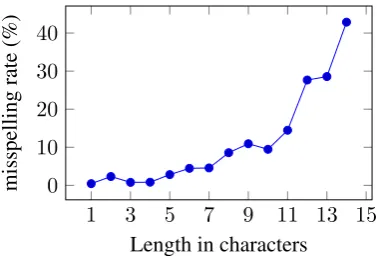
For the error detection annotations, we compare the length of a token in characters to its likelihood of being misspelled and find that longer words have higher chances to be misspellings (see Fig-ure1).
To further drill down on the nature of errors we compute the probability of spelling errors across different coarse-grained POS tags. We map the Penn Treebank tagset to 12 coarse-grained tags as described in (Petrov et al.,2011). Table3 shows that error occur mainly in content words (only 17 out of 255 annotated errors occur in function words).
Next, we investigate, how many errors are au-tomatically detected in ASAP using the best
per-8https://github.com/
universal-automata/liblevenshtein-java
1 3 5 7 9 11 13 15
0 10 20 30 40
Length in characters
misspelling
rate
[image:5.595.310.499.60.189.2](%)
Figure 1: Probability for words of a certain length to be misspelled in our annotated data
POS # instances P(error|POS)
. 1 0.1
ADJ 26 4.2
ADP 5 0.5
ADV 27 4.8
CONJ -
-DET 3 0.3
NOUN 140 6.2
NUM -
-PRON 3 0.4
PRT 1 0.3
VERB 45 2.2
[image:5.595.337.496.243.386.2]X 4 0.2
Table 3: Probability for tokens from a certain POS class to be misspelled.
forming dictionary. Table4provides an overview of the frequency of errors for each prompt, as well as the type-token-ratio for error tokens. We see that many errors occur more than once, which might have consequences for content scoring if a model is able to associate frequent misspellings with a certain label. Table 5 shows as an ex-ample the top 10 most frequent misspellings for prompt 2. We see that there are a few very fre-quent misspellings centered around important vo-cabulary for that prompt and a long tail of infre-quent misspellings (not shown in the table).
We also check whether there is a correlation be-tween the number of spelling errors in an answer and the content score assigned by a teacher. We normalize by the number of tokens in the answer to avoid length artifacts and find no significant cor-relation. This is in line with our general assump-tion that spelling errors are ignored by teachers when scoring a learner answer.
4.2 Error Correction Analysis
prompt # errors TTR
1 1.2 .69
2 1.2 .64
3 1.0 .62
4 2.0 .51
5 7.7 .43
6 5.8 .62
7 1.5 .63
8 2.3 .42
9 2.1 .59
10 2.2 .43
[image:6.595.311.510.62.197.2]∅ 2.3 .56
Table 4: Average number of spelling mistakes per 100 tokens (punctuation excluded) and type-token-ratio for errors for the individual ASAP prompts.
Misspelling # streched 117
strech 31
strechable 18
nt 16
streching 15 expirement 13 streached 10 expiriment 9 strechiest 8
streches 6
Table 5: Top-10 most frequent misspellings for prompt 2
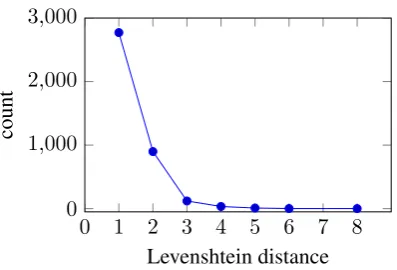
corrected test data. First, we categorized errors according to the Levenshtein distance between an error and its corrected version (see Figure2). A number of instances with very high distances orig-inate from errors involving tokenization, e.g. sev-eral words concatenated without a whitespace. To avoid such artifacts in the analysis, we counted only cases where both the original token and its corrected version did not include any whitespace.
There is still a surprisingly high number of words with a Levenshtein distance greater than 1. An example for a word with a high Levenshtein distance would be satalight instead of satellite. This shows that finding the right correction can be a challenging task, as correction candidates with a lower distance often exist. For example, in the answer The students could have impared the
ex-periment by (. . . ), it becomes clear from the
ques-tion context (Describe two ways the student could
have improved the experimental design) that the
right correction forimpared isimproved and not
impaired.
0 1 2 3 4 5 6 7 8 0
1,000 2,000 3,000
Levenshtein distance
count
Figure 2: Distribution of errors across different Levenshtein distances.
5 Influence of Spelling Errors on Scoring
In the following experiments, we vary the amount of spelling errors in the data systematically. We use automatic and manual spell-checking to de-crease the error rate and add artificial errors for a higher number of errors.
5.1 Experimental Setup
In our experimental studies, we examine the in-fluence of spelling deviations and spell-checking on content scoring. We train one classification model for each of the ten ASAP prompts, using the published data split into training data and “pub-lic leaderbord” data for testing. We preprocess the data using the ClearNLP segmenter and POS tagger provided through DKPro Core (Eckart de Castilho and Gurevych,2014). We use a standard feature set often used in content scoring (Higgins et al.,2014) and extract token 1–3 grams and char-acter 2–4 grams using the top 10,000 most fre-quent n-grams in each feature group. We then train a SVM classifier (Hall et al.,2009) with de-fault parameter settings provided through DKPro TC (Daxenberger et al.,2014). We evaluate using both accuracy and quadratically weighted kappa (QWK,Cohen(1968)), as proposed in the Kaggle competition for this dataset and present results av-eraged across all 10 prompts.
One important property of this feature setup is that the character n-gram features could be able to cover useful information from misspelled words. If the wordexperimentis, for example, misspelled
as expirment, there are n-grams shared between
these two versions, such as the character trigrams
[image:6.595.123.239.62.201.2]tokens & chars tokens only QWK acc QWK acc
baseline .68 .71 .66 .70
spell-check train .66 .70 .66 .70 spell-check test .68 .70 .66 .70 spell-check both .68 .70 .66 .70
[image:7.595.336.498.64.123.2]gold test .68 .70 .66 .70
Table 6: Scoring performance on ASAP with and without spell checking
5.2 Experiment 1 – Decreased Error Frequency
In a first machine learning experiment, we investi-gate the influence of spell-checking on the perfor-mance of content scoring. We systematically vary three sets of influence factors: First, we use either our automatically corrected learner answers as a realistic spell checking scenario or the corrected gold-standard version of the learner answers. We consider the latter an oracle condition to estimate an upper bound of improvement that filters out noise introduced by the spell checker. Second, we use two different feature sets: either the full feature set covering both token and character n-grams or the reduced feature set with only token n-grams. Third, we vary which part of the data is spell-checked. We either correct both the training and the test data or only training or only test data. In the oracle condition, we have only annotations for the test set, so that we use only the test condi-tion here.
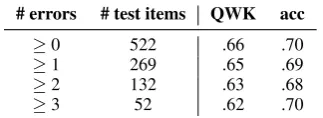
Table6shows the results. We see that it makes little difference whether we spell-check the data (be it automatically or manually). One possible explanation for the very small difference is that there are many answers without any spelling mis-takes at all. Thus, we also comparing the perfor-mance for answers with different minimal num-ber of errors. Table 7 shows the breakdown of the results per number of errors. We observe a reduced performance in kappa for answers with more spelling errors, but do not see that repeated in the accuracy, i.e. misclassified answers with more errors have a higher tendency to be completely misclassified.
5.3 Experiment 2 – Simulating Increased Error Frequencies
As we have seen in the above experimental study, there is little difference between the scoring
qual-# errors # test items QWK acc
≥0 522 .66 .70
≥1 269 .65 .69
≥2 132 .63 .68
≥3 52 .62 .70
Table 7: Scoring performance on ASAP when us-ing only answers with a certain minimal number of errors for testing.
ity on original data vs. spell-checked data. We al-ready ruled out that this might be due to a noisy spell-checker by also evaluating on the annotated gold standard. Another potential reason for our findings is that the amount of errors present in the data is just not large enough to make a difference. To check that, we artificially introduce different amounts of new errors into the learner answers. In this way, we can also simulate corpora with differ-ent properties, so that practitioners can check the average amount of spelling errors in their data and can get an estimation of what performance drop to expect.
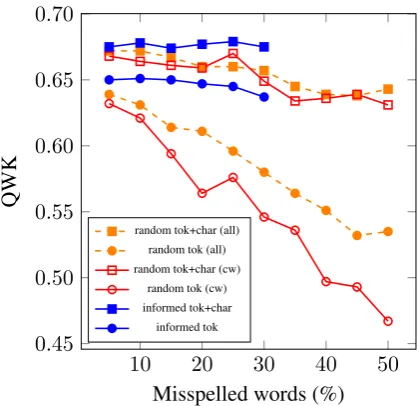
Generating Spelling Errors In order to gener-ate additional spelling errors, we use two different models:
Random Error Generation introduces errors by either adding, deleting, or substituting a letter or by swapping two letters in randomly selected words. This error generation process is a worst case experiment in the sense that there is no pre-dictable pattern in the produced errors.
Informed Error Generation produces errors according to the distribution of errors in the data. This means we introduce errors only to words that were misspelled in our annotated gold-standard, and we introduce errors by using the misspelled version actually occurring in the data consider-ing the error distribution. In this way, there are chances that – like in real life – some errors will be more frequent than others such that a classifier might be able to learn from them.
[image:7.595.78.282.65.156.2]10 20 30 40 50 0.45
0.50 0.55 0.60 0.65 0.70
Misspelled words (%)
QWK
random tok+char (all) random tok (all) random tok+char (cw)
random tok (cw) informed tok+char
[image:8.595.75.285.63.266.2]informed tok
Figure 3: Scoring performance on ASAP with in-creasing amounts of additional introduced errors.
we make sure that the overall error rate across all tokens matches the desired percentage. Addi-tionally, we use either only token features (tok), that will be more sensitive towards spelling errors, or also include the character features (tok+char), which we know to be more robust.
Figure3 shows the performance of the two er-ror generation models in their different variants for different amounts of artificial errors. Note that there was a natural upper bound for the amount of errors which can be introduced using the informed error generator. As expected, we see that content words are more important for scoring than func-tion words as introducing errors to only content words yields a larger performance drop. We see for both generation models that a scoring model using character n-grams is largely robust against spelling mistakes while a model using only infor-mation on the token level is not. We also see that a more realistic error generation process is not as detrimental for the scoring performance as ran-dom errors. Of course, our error model might be slightly over-optimistic and in real life with such a high number of errors we might see new ortho-graphic variants for individual words that were not covered in our annotations. We therefore believe the realistic curve to be somewhere between the informed and the random model.
6 Related Work
We are not aware of other works studying the im-pact of spelling errors on content scoring
perfor-mance.
In general, spell checking is often used as a pre-processing step in educational applications, espe-cially those dealing with input written by learn-ers, either non-natives or natives. In some works the influence of spell-checking is explicitly ad-dressed.Pilan et al.(2016) predict the proficiency level of language learners using textbook material as training data and find that spell-checking im-proves classification performance. Keiper et al.
(2016) show that normalizing reading comprehen-sion answers written by language learners is bene-ficial for POS tagging accuracy.
In some areas however, spelling errors can also be a useful source of information: In the related domain of native language identification, a disci-pline also dealing with learner texts, Chen et al.
(2017) found that spelling errors provide valuable information when determining the native language of an essay’s author.
7 Conclusions
We presented a corpus study on spelling errors in the ASAP dataset and provide gold-standard anno-tations for error detection and correction on large parts of the data.
Next, we examined the influence of spelling er-rors on content scoring performance. Surprisingly, we found very little influence of spelling mistakes on grading performance for our model and on the ASAP dataset. In our setup, spellchecking seems negligible.
There are several explanations for that: First, we found that we observe a drop in performance if we artificially increase the number of spelling errors. This drop is especially pronounced, if (a) no character n-gram information is used for scor-ing and (b) if errors follow no specific pattern. If a dataset is expected to contain a higher percent-age of spelling errors it will therefore be helpful to correct errors automatically and/or to mitigate the effect of misspelled word by the usage of character n-gram features.
Second, our scoring models relied on shallow features. We assume that scoring models using higher linguistic processing such as dependency triples might suffer more substantially, a question that will be pursued further in future work.
work on spell-checking in the educational domain.
Acknowledgments
This work is funded by the German Federal Min-istry of Education and Research under grant no. FKZ 01PL16075.
References
Lingzhen Chen, Carlo Strapparava, and Vivi Nastase. 2017. Improving native language identification by using spelling errors. InProceedings of the 55th An-nual Meeting of the Association for Computational Linguistics (Volume 2: Short Papers). Association for Computational Linguistics, Vancouver, Canada, pages 542–546. http://aclweb.org/anthology/P17-2086.
Jacob Cohen. 1960. A coefficient of agreement for nominal scales. Educational and Psychological Measurement20(1):37–46.
Jacob Cohen. 1968. Weighted kappa - nominal scale agreement with provision for scaled disagreement or partial credit 70:213–20.
X Conort. 2012. Short answer scoring: Explanation of gxav solution. ASAP Short Answer Scoring Compe-tition System Description. Retrieved July28:2014. Johannes Daxenberger, Oliver Ferschke, Iryna
Gurevych, Torsten Zesch, et al. 2014. Dkpro tc: A java-based framework for supervised learning experiments on textual data. In ACL (System Demonstrations). pages 61–66.
Richard Eckart de Castilho and Iryna Gurevych. 2014. A broad-coverage collection of portable nlp com-ponents for building shareable analysis pipelines. In Proceedings of the Workshop on Open In-frastructures and Analysis Frameworks for HLT (OIAF4HLT) at COLING. pages 1–11.
Rod Ellis. 1994. The study of second language acqui-sition. Oxford University.
Mark Hall, Eibe Frank, Geoffrey Holmes, Bernhard Pfahringer, Peter Reutemann, and Ian H Witten. 2009. The weka data mining software: an update. ACM SIGKDD explorations newsletter11(1):10–18. Michael Heilman and Nitin Madnani. 2013. Ets: Do-main adaptation and stacking for short answer scor-ing. InSemEval@ NAACL-HLT. pages 275–279. Derrick Higgins, Chris Brew, Michael Heilman,
Ra-mon Ziai, Lei Chen, Aoife Cahill, Michael Flor, Nitin Madnani, Joel R Tetreault, Daniel Blanchard, Diane Napolitano, Chong Min Lee, and John Black-more. 2014. Is getting the right answer just about choosing the right words? The role of syntactically-informed features in short answer scoring. Compu-tation and Languagehttp://arxiv.org/abs/1403.0801.
Lena Keiper, Andrea Horbach, and Stefan Thater. 2016. Improving pos tagging of german learner language in a reading comprehension scenario. In LREC.
Karen Kukich. 1992. Techniques for automatically correcting words in text. ACM Computing Surveys (CSUR)24(4):377–439.
Omer Levy, Torsten Zesch, Ido Dagan, and Iryna Gurevych. 2013. Ukp-biu: Similarity and entail-ment metrics for student response analysis. In Sec-ond Joint Conference on Lexical and Computational Semantics (* SEM), Volume 2: Proceedings of the Seventh International Workshop on Semantic Evalu-ation (SemEval 2013). volume 2, pages 285–289. Slav Petrov, Dipanjan Das, and Ryan T. McDonald.
2011. A universal part-of-speech tagset. CoRR abs/1104.2086. http://arxiv.org/abs/1104.2086. Ildiko Pilan, Elena Volodina, and Torsten Zesch.
2016. Predicting proficiency levels in learner writ-ings by transferring a linguistic complexity model from expert-written coursebooks. In Proceedings of COLING 2016, the 26th International Confer-ence on Computational Linguistics: Technical Pa-pers. Osaka, Japan, pages 2101 – 2111.
Luis Tandalla. 2012. Scoring short answer essays. ASAP Short Answer Scoring Competition System Description. Retrieved July28:2014.
Seid Muhie Yimam, Iryna Gurevych, Richard Eckart de Castilho, and Chris Biemann. 2013. Webanno: A flexible, web-based and visually supported sys-tem for distributed annotations. InACL (Conference System Demonstrations). pages 1–6.