132
A Research Platform for Multi-Robot Dialogue with Humans
Matthew Marge, Stephen Nogar, Cory J. Hayes, Stephanie M. Lukin, Jesse Bloecker, Eric Holder, Clare Voss
U.S. Army Research Laboratory Adelphi, MD 20783
Abstract
This paper presents a research platform that supports spoken dialogue interaction with multiple robots. The demonstration show-cases our crafted MultiBot testing scenario in which users can verbally issue search, nav-igate, and follow instructions to two robotic teammates: a simulated ground robot and an aerial robot. This flexible language and robotic platform takes advantage of existing tools for speech recognition and dialogue management that are compatible with new domains, and im-plements an inter-agent communication pro-tocol (tactical behavior specification), where verbal instructions are encoded for tasks as-signed to the appropriate robot.
1 Introduction
We investigate dialogue dynamics between a hu-man and multiple robotic teammates in scenarios that reflect the urgency of tasks, such as search and rescue. While multi-participant dialogue has long been studied (Sacks et al., 1978), human-robot communication remains an area that merits further investigation. Natural language offers hu-man teammates a hands-free way to interact with multiple robots, unlikedirect teleoperationwhere a robot is controlled with a hand-held device. Lan-guage also encourages human teammates to issue complex, abstract-level instructions, rather than lower-level command-and-control instructions.
This demonstration shows the completed inte-gration of spoken dialogue with simulated robots in a simulated environment. A ground robot (Clearpath Husky) and a small, quadrotor aerial robot (Qualcomm Snapdragon Flight) work with a human teammate in a search and rescue sce-nario using a platform we call MultiBot. Spo-ken instructions are interpreted and independent tasks are delegated by a dialogue manager to
these robots, including waypoint navigation, ex-ploration, and object detection, as well as joint tasks such as following one another. The robots adapt their behavior to meet human-specified con-ditions, e.g., moving quickly given an urgent task. One contribution of this research is a soft-ware platform for exploring new aspects of multi-robot dialogue to explore language, multi-robotics, and human-robot interaction research. Natural lan-guage serves as a single interface to consistently interact with multiple robots on a team, despite these robots having different capabilities. The robotic behaviors are built on top of the Robot Operating System (ROS), an open-source frame-work that uses the same communication protocols for physical platforms as in simulation, to explore how interaction dynamics change in new environ-ments and tasks.
A second contribution of this research is methodological: the software components within our platform for dialogue management and robot navigation are “wizard-swappable”, meaning that human operators (i.e., wizards) may stand-in func-tionally for software components yet to be devel-oped, typically in the initial design stage of an autonomous system. This approach supports col-lecting training data for the underlying algorithms. The most immediate application of our research platform is for collecting natural language data from experiment participants to use in modeling how humans communicate with multiple robots in task-oriented dialogue.
2 Scenarios and Research Approach
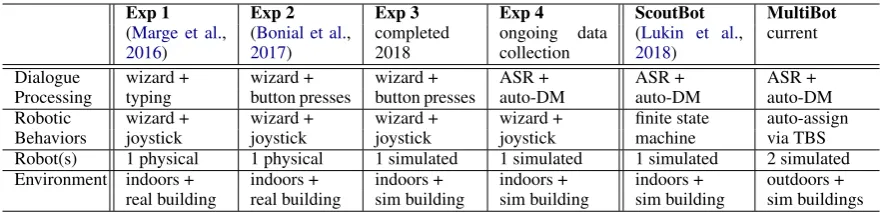
under-Exp 1 Exp 2 Exp 3 Exp 4 ScoutBot MultiBot
(Marge et al., 2016)
(Bonial et al., 2017)
completed 2018
ongoing data collection
(Lukin et al., 2018)
current
Dialogue wizard + wizard + wizard + ASR + ASR + ASR + Processing typing button presses button presses auto-DM auto-DM auto-DM Robotic wizard + wizard + wizard + wizard + finite state auto-assign Behaviors joystick joystick joystick joystick machine via TBS Robot(s) 1 physical 1 physical 1 simulated 1 simulated 1 simulated 2 simulated Environment indoors + indoors + indoors + indoors + indoors + outdoors +
[image:2.595.78.519.61.168.2]real building real building sim building sim building sim building sim buildings
Table 1: Testing scenarios over time. Columns depict progression of testing scenario experimentation and devel-opment; rows represent scenario components (DM: Dialogue Management; TBS: tactical behavior specification)
standing and dialogue management capabilities, as well as the physical or simulated environment and user task. Scenarios can be crafted for the following interdisciplinary research objectives:
Language research, to test linguistically-challenging instructions that are situationally-relevant given different objects, structures, landmarks, and locations within the environment;
Robotics research, to demonstrate robotic behav-iors on the ground and in the air, feasible for the physical robots and their simulated counterparts;
Human-robot interaction research, to track effec-tive navigation and coordinated exploration in the environment by multiple autonomous robots as a result of spoken dialogue with human teammates. The MultiBot Platform was built upon a foun-dation of prior research and development efforts in these areas of research. The columns of Table1
show the temporal progression and development of various testing scenarios leading up to Multi-Bot. Technical details specific to MultiBot follow in Section3.
Components supported by the MultiBot Plat-form are depicted as rows in Table 1. The key milestones in the progression included using hu-man wizards through Experiments 1-4 (prior and ongoing work) with different methods of per-forming the task (typing or pressing buttons that have predefined text messages) to build up the databases of dialogue interactions, a dialogue manager, and robot behaviors. The data col-lected in these prior experiments was used to train the ScoutBot system as an end-to-end, fully au-tonomous dialogue management and auau-tonomous robot implementation (Lukin et al.,2018) for con-trol of a single simulated robot in an indoor simu-lated building.
The crafting of a new, realistic testing scenario for dialogue with more than one autonomous robot made evident new integration requirements in our
research platform. We needed a testing scenario with a coherent, structured narrative involving a ground and an aerial robot demonstrating new be-havior sequences as the software components were being developed. To develop MultiBot, we used a simulated outdoor environment that covers a com-plex region of roads and buildings. MultiBot also builds on the ScoutBot testing scenario with two other significant changes: (i) the human operator can now address these two robots, each of which may verbally respond with their own feedback, and (ii) the navigation commands to the robot from the dialogue manager are now adaptable, pivot-ing through an intermediary computational repre-sentation language that can in turn be mapped to robot-specific behaviors.
The MultiBot Platform supports targeted eval-uation of the individual components (the rows in Table1) as well as holistic, systematic evaluation. Possible measures of these components include evaluation of the robot behaviors (e.g., distance to goal), the performance of the robot itself (e.g., en-ergy efficiency in performing tasks), and dialogue processing (e.g., coverage of utterances and appro-priateness of recovery strategies). Holistic evalu-ation in human subject experiments can measure perceived task workload, success, and satisfaction, as well as overall task completion and efficiency both for individual robots and as a team in com-parison to a system using direct teleoperation of the robots.
3 Architecture Overview
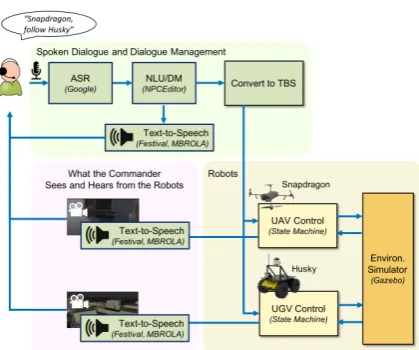
Figure 1: Platform Architecture, MultiBot Testing Sce-nario
corner of Figure1) passes the user utterance to a Natural Language Understanding (NLU) and Dia-logue Management (DM) process. The NLU/DM module ensures the utterance is well-formed and executable, and may prompt for additional infor-mation from the user. Well-formed instructions are then sent to a process that formats them into an unambiguous, structured command that triggers robot behaviors (lower right-hand corner) which work in tandem with the environment simulator to continuously update the status of the robot(s) within the simulated environment. The platform generates verbal feedback from the robots, and the visualization is updated based on the actions of the robot(s).
3.1 Spoken Dialogue and Dialogue Management
The MultiBot Platform is designed to support ex-perimentation through the swapping of different language understanding and processing capabil-ities. The capabilities chosen for the MultiBot testing scenario leverage existing components of a spoken dialogue and dialogue management inter-face, extending these tools to support conversing with multiple robots. Speech recognition is sup-ported by Google’s Automatic Speech Recogni-tion API. Dialogue processing utilizes the NPCEd-itor dialogue manager (Leuski and Traum, 2011;
Hartholt et al.,2013). The NLU/DM module inter-prets dialogue instructions and produces responses using statistical retrieval algorithms from prior dialogue system implementations (Traum et al.,
2015;Lukin et al.,2018) which allow for a range of unconstrained speech input. This testing
sce-nario uses a novel configuration with five cate-gories of instructions: (1) wake (get a particular robot’s attention), (2) waypoint navigation of one or more robots, (3) follow-behind commands, (4) inspection, and (5) patrol of a pre-defined area.
We use the simultaneous message generation that the ScoutBot system implements to support generating clarification responses to the human teammate and to the robotic platforms, the latter of which are converted into an instruction issued us-ing a Tactical Behavior Specification (TBS) mes-sage (Oh et al.,2015) for MultiBot. This provides a common format for issuing a high level action with relevant location data and object information. When robot actions are completed, a text message signal is sent that may either be converted from text to speech, as depicted in Figure1, or shown in a chat window if the environment is noisy or if stealth is desired. Text-to-speech synthesis of the robots and the NLU/DM module is performed using the Festival Speech Synthesis System1with MBROLA voices.2
3.2 Robotic Behaviors
Robotic behaviors tailored for a particular task may be substituted using the MultiBot Platform. For the teaming application supported by the MultiBot testing scenario, robots need the abil-ity to make independent decisions once a verbal instruction has been issued. To support complex actions, we implement a behavior tree based on the open-source Smach library3within ROS.4The library is an implementation of a finite state ma-chine that manages the robot’s behavior, chain-ing simple actions into more complex actions or tasks. Each robot state (e.g., searching, follow-ing, landing) must terminate with one of multiple specific outcomes (e.g., succeeded, failed, inter-rupted). This outcome determines the next action according to the behavior tree. Once an instruction is implemented as a chain of actions, it can be used as a building block in other instruction, providing a framework for more advanced behaviors.
TBS messages are defined in ROS in coordi-nation with the Smach-based behavior trees. The output of the behaviors are any discovered objects of interest and the resulting state of the robot, such as position, and are provided back to the human
1
http://www.cstr.ed.ac.uk/projects/festival/ 2
http://tcts.fpms.ac.be/synthesis/mbrola.html 3
http://wiki.ros.org/smach 4
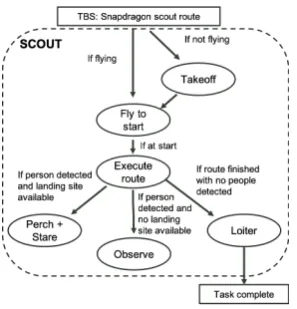
Figure 2: Behavior tree for “scout” instruction
operator through the speech synthesis previously described. Included behaviors are “go-to”, “fol-low”, “scout”, “search”, and (for the aerial robot) “takeoff/land”. The “scout” instruction is pre-sented in Figure2. As the robot moves, it uses an onboard camera and an object classifier (Bjelonic,
2016–2018) to search for objects of interest. In the MultiBot testing scenario, if it recognizes an injured person it can consider multiple actions on how best to continue observation. If a suitable landing location is nearby, the robot will execute a “perch and stare” behavior, otherwise it will hover nearby and observe.
4 Demo Summary
A demonstration of the developed behaviors for the MultiBot testing scenario was performed in a software in the loop simulation (SITL). This simulates the robotic sensors and actuators, al-lowing for verification of the developed language comprehension, perception algorithms, and be-havior trees by maximizing the similarity of the code between the robot and the simulator. The demonstration showcases the natural language in-terface and robot capabilities in a search scenario in which the ground and aerial robotic teammates, named Husky and Snapdragon respectively, are given verbal instructions from a Commander to explore the environment and identify injured in-dividuals. A video recording of the testing sce-nario can be found at https://youtu.be/ 5kVvj9xEK3E.
In the live demonstration, visitors will engage with the two simulated robots in a game scenario to coordinate and navigate both robots to a desig-nated zone along a route with injured individuals. Visitors will be given a 2D map of the environ-ment as well as a set of navigation functions and
robot names. The robots will follow the visitor’s instructions autonomously, allowing the visitor to analyze the entire map and plan the best route for the robots while simultaneously overcoming sev-eral challenges in the task and environment.
5 Ongoing Research
This research platform has been used to inves-tigate multi-participant dialogue, with a particu-lar focus on interaction between one human and multiple robots. The testing scenario presented in this demo utilizes anexplicit addresseeapproach, where tasks require first getting an individual robot’s attention before issuing a task. In our on-going research, we explore animplicit addressee
approach by leveraging the NPCEditor dialogue retrieval algorithm, which matches responses to instructions using a word co-occurrence metric. This required creating a synthetic dataset of possi-ble instructions. By associating tasks to robots di-rectly in the training data, the dialogue retrieval al-gorithm can automatically match tasks specific to one robot without requiring mention of that robot’s name. For example, tasks related to flying, such as
“Scout route bravo”, will be automatically bound to the aerial robot when the instruction is passed as a TBS. No commonsense reasoning is required for this capability. In this research, robot capabilities have been shown to disambiguate which robot per-forms which task implicitly, an improvement over the explicit addressee approach and allows further research on multi-participant dialogue.
6 Related Work
Several other architectures have explored dialogue with robots. TeamTalk (Marge and Rudnicky,
2019) for example, controls multiple ground robots by way of a predefined grammar, while DIARC (Scheutz et al., 2019) also supports di-alogue with multiple robots, and has been im-plemented on ground, aerial, and social robots. Open-source architectures such as OpenDial ( Li-son and Kennington, 2016), IrisTK (Skantze and Al Moubayed,2012), and Microsoft’s PSI (Bohus et al., 2017) can be used to build many situated dialogue agents, including robots. Compared to similar architectures, MultiBot leverages wizard-swappable components from ScoutBot and ex-tends the mode of interaction to multi-participant dialogue. Training data for a MultiBot-based sys-tem can be collected from Wizard-of-Oz studies or synthetically derived and easily incorporated into MultiBot to accommodate a new domain, feature, or capability, as Table1details.
7 Summary and Future Work
This paper presents a platform to conduct spo-ken dialogue interaction with robots in a flexible, scenario-based architecture. The demonstrated testing scenario, MultiBot, is an implementation of autonomous dialogue management and naviga-tion of two simulated robots in a large, outdoor simulated environment. This platform enables the crafting of various testing scenarios to perform language, robotics, and human-robot interaction research in a physical or simulated environment with multiple robots, while testing various lan-guage and robotic behavior capabilities. The plat-form provides the opportunity to study human-robot communication and behaviors in compet-itive and cooperative teaming and train future human-robot teams for a variety of challenging environments. Additionally, the platform may be used to experiment with new tasks in simulation as new autonomous robot navigation capabilities emerge.
Acknowledgments
This work was supported by the U.S. Army Re-search Laboratory. The authors thank the anony-mous reviewers for their feedback, as well as Ju-dith Klavans, Chris Kroninger, and Garrett War-nell for their contributions to this project.
References
Marko Bjelonic. 2016–2018. YOLO ROS: Real-Time Object Detection for ROS. https://github.
com/leggedrobotics/darknet_ros.
Dan Bohus, Sean Andrist, and Mihai Jalobeanu. 2017. Rapid Development of Multimodal Interactive Sys-tems: A Demonstration of Platform for Situated In-telligence. InProceedings of the 19th ACM Interna-tional Conference on Multimodal Interaction.
Claire Bonial, Matthew Marge, Ron Artstein, Ashley Foots, Felix Gervits, Cory J. Hayes, Cassidy Henry, Susan G. Hill, Anton Leuski, Stephanie M. Lukin, Pooja Moolchandani, Kimberly A. Pollard, David Traum, and Clare R. Voss. 2017. Laying Down the Yellow Brick Road: Development of a Wizard-of-Oz Interface for Collecting Human-Robot Dialogue. InProceedings of the AAAI Fall Symposium Series: Natural Communication for Human-Robot Collabo-ration.
Arno Hartholt, David Traum, Stacy C Marsella, Ari Shapiro, Giota Stratou, Anton Leuski, Louis-Philippe Morency, and Jonathan Gratch. 2013. All Together Now: Introducing the Virtual Human Toolkit. In Proceedings of the International Con-ference on Intelligent Virtual Agents.
Cory J. Hayes, Matthew Marge, Ethan Stump, Claire Bonial, Clare Voss, and Susan G. Hill. 2018. To-wards Learning User Preferences for Remote Robot Navigation. InProceedings of the RSS 2018 Work-shop on Models and Representations for Human-Robot Communication.
Anton Leuski and David Traum. 2011. NPCEditor: Creating Virtual Human Dialogue Using Informa-tion Retrieval Techniques. AI Magazine, 32(2).
Pierre Lison and Casey Kennington. 2016. OpenDial: A Toolkit for Developing Spoken Dialogue Systems with Probabilistic Rules. InProceedings of the An-nual Meeting of the Association for Computational Linguistics - System Demonstrations.
Stephanie M. Lukin, Felix Gervits, Cory J. Hayes, An-ton Leuski, Pooja Moolchandani, John G. Rogers, Carlos Sanchez Amaro, Matthew Marge, Clare Voss, and David Traum. 2018. ScoutBot: A Dialogue Sys-tem for Collaborative Navigation. InProceedings of the Annual Meeting of the Association for Computa-tional Linguistics - System Demonstrations.
Matthew Marge, Claire Bonial, Kimberly A. Pollard, Ron Artstein, Brendan Byrne, Susan G Hill, Clare Voss, and David Traum. 2016. Assessing Agree-ment in Human-Robot Dialogue Strategies: A Tale of Two Wizards. InProceedings of the International Conference on Intelligent Virtual Agents.
Jean Oh, Arne Suppe, Felix Duvallet, Abdeslam Boularias, Jerry Vinokurov, Luis Ernesto Navarro-Serment, Oscar Romero, Robert Dean, Christian Lebiere, Martial Hebert, and Anthony (Tony) Stentz. 2015. Toward Mobile Robots Reasoning Like Hu-mans. In Proceedings of the Twenty-Ninth AAAI Conference on Artificial Intelligence.
Harvey Sacks, Emanuel A Schegloff, and Gail Jeffer-son. 1978. A Simplest Systematics for the Organi-zation of Turn-Taking for Conversation. Langauge, 50(4).
Matthias Scheutz, Thomas Williams, Evan Krause, Bradley Oosterveld, Vasanth Sarathy, and Tyler Frasca. 2019. An Overview of the Distributed Inte-grated Cognition Affect and Reflection DIARC Ar-chitecture. InCognitive Architectures.
Gabriel Skantze and Samer Al Moubayed. 2012. IrisTK: A Statechart-Based Toolkit for Multi-Party Face-to-Face Interaction. InProceedings of the 14th ACM International Conference on Multimodal Inter-action.