Proceedings of the Biomedical NLP Workshop associated with RANLP 2017, pages 49–54,
One model per entity: using hundreds of machine learning models to
recognize and normalize biomedical names in text
Victor Bellon
MINES ParisTech, PSL-Research University, CBIO-Centre de bio-informatique
Raul Rodriguez-Esteban
Roche Innovation Center Basel
Abstract
We explored a new approach to named entity recognition based on hundreds of machine learning models, each trained to distinguish a single entity, and showed its application to gene name identifica-tion (GNI). The raidentifica-tionale for our approach, which we named “one model per entity” (OMPE), was that increasing the num-ber of models would make the learn-ing task easier for each individual model. Our training strategy leveraged freely-available database annotations instead of manually-annotated corpora. While its performance in our proof-of-concept was disappointing, we believe that there is enough room for improvement that such approaches could reach competitive per-formance while eliminating the cost of creating costly training corpora.
1 Background
Recognizing names in text is a longstanding task in natural language processing (NLP) known as named-entity recognition (NER). In biomedical text mining (or BioNLP), the focus of NER is on certain technical names (terms) such as those of chemical compounds, genes, species and anatom-ical parts. Recognizing such names alone, how-ever, is of limited application as, in practice, they often need to be linked to other facts. This can be done by first mapping them to unique name identifiers—a task known as normalization or grounding. Recognizing and normalizing names of genes and gene products, in particular, has drawn much attention from the BioNLP commu-nity (Leser and Hakenberg, 2005). These names are usually considered a single class of terms due to their overlapping vocabularies ( Hatzivas-siloglou et al.,2001). Thus, here we refer to them as simply gene names.
The tasks of gene name recognition (GNR) and gene name normalization (GNN) involve, respec-tively, the recognition and normalization of gene names found in text. Gene name identification (GNI) is the combination of gene name recogni-tion and normalizarecogni-tion (GNR + GNN) (see the framework by Krauthammer and Nenadic (2004)). State-of-the-art GNI methods involve machine learning algorithms, such as conditional random fields (CRF), trained under supervised learning. Supervised learning requires gold-standard train-ing and testtrain-ing sets, which for GNI typically are sets of documents (corpora) that have been man-ually annotated for gene names by expert cura-tors. Several community challenges have been or-ganized to foster the improvement of GNI algo-rithms (Morgan et al.,2008;Lu et al.,2011). How-ever, despite such efforts, even the best algorithms suffer from an important weakness. Namely that their performance has been shown to degrade out-side of their training and testing corpora, decaying to levels barely above those of rule-based systems involving dictionary-matching rules together with filtering of noisy names (Rebholz-Schuhmann et al.,2013;Rodriguez-Esteban,2016b,a).
It has been suggested that the shortcomings of current GNI machine learning algorithms could be addressed in two ways: (1) by training models with different, diverse corpora ( Rebholz-Schuhmann et al., 2013) (see, in that respect, the work of Kaewphan et al. (2016) with cell line names), and (2) by using “domain adaptation” techniques, which consist in adapting machine learning models to the characteristics of the in-put text. The limited size and number of exist-ing gold-standard corpora, and the cost of createxist-ing new ones, represent, however, a bottleneck for (1). For (2), experiments with domain adaptation in biomedical text have led, thus far, only to modest improvements in performance (Miwa et al.,2012). Here we describe an alternative approach that
can be applied to problems that require the iden-tification of large but finite sets of entities, par-ticularly in biomedicine. To begin with, instead of using a gold-standard corpus as training set, we propose utilizing the wealth of manual annotations that currently exist in biomedical databases. In-deed, several freely-available databases provide a growing number of annotations concerning gene name identifiers associated to biomedical docu-ments. The main drawback of these annotations is that they are weakly labeled, as they do not specify the precise location in which the genes are men-tioned within the documents. However, there are ways to infer these locations (Jain et al.,2016).
While past GNI studies have not leveraged an-notations from biomedical databases, there are ex-amples of their use for GNN (Wermter et al.,2009; Zwick, 2015; Chen et al., 2015). In these stud-ies contextual features were created out of the an-notated biomedical documents to resolve ambigu-ous gene mentions. Besides for GNN, weakly-labeled database annotations have been used in BioNLP for identifying protein-specific residues (Ravikumar et al., 2012) and annotating Med-line abstracts with Gene Ontology terms ( Gob-eill et al., 2013). In another example, Furrer et al. (2014) used a biomedical database called Bi-oGRID (Chatr-Aryamontri et al., 2015) for the purpose of training and testing an algorithm for extracting protein-protein interactions (PPI).
Leveraging database annotations for GNI is not straightforward. We have implemented our ap-proach in a way that, as far as we can tell, has not been described in the NER literature be-fore (biomedical or otherwise). Our method in-volves training many machine learning models, each model trained to identify a single entity (i.e. a single gene) rather than, as it is commonplace, training one or a handful of models to identify all entities. We call this approach “one model per en-tity” (OMPE).
2 Methods
As building block for our OMPE system we used BANNER (Leaman and Gonzalez, 2008), which is a machine learning algorithm for NER built on CRF. While BANNER is based on a generic model that can be trained to identify any class of terms, it has shown state-of-the-art performance in GNR (Kabiljo et al.,2009). Our strategy consists in us-ing multiple BANNER models, each model beus-ing
responsible for detecting the mentions of a single gene. That means that a gene name mention that is recognized by a BANNER model can be auto-matically mapped to the gene for which the model was trained.
2.1 Training set
To create our training set we built first a database of positive training examples contain-ing sentences that mention gene names. Each sentence in the database was associated to a gene identifier (NCBI Gene ID), correspond-ing to a gene mentioned in the sentence, and to a document identifier (PubMed ID), corre-sponding to the document source of the sen-tence. The {NCBI Gene ID, PubMed ID}
pairs came from the following publicly-available databases: gene2pubmed, UniProt, BioGRID (Chatr-Aryamontri et al., 2015) and Gene Refer-ence into Function (GeneRIF) (see Table1).
Source Genes Documents Mentions gene2pubmed 34 004 493 620 1 087 465 UniProt 21 383 22 539 68 966 BioGRID 11 832 23 925 66 358 GeneRIF 17 462 386 927 641 354
Table 1: Statistics of the different datasets used.
Because these databases do not specify the loca-tion of the gene menloca-tions in the source documents, we retrieved each source document from the Med-line baseMed-line 2015 and attempted to find their loca-tions. In order to do that we leveraged gene names and synonyms from the NCBI Gene database. This database, however, does not include all the gene name variations and synonyms that authors use in practice (Hirschman et al.,2002;Liu et al., 2006). To increase recall we therefore expanded the list of gene names and synonyms following Schuemie et al. (2007). By using this expanded list to look up gene names in the source documents we created a set of positive examples for each of the genes annotated in the aforementioned databases.
Negative training examples were selected ac-cording to different strategies. First, we created certain modified versions of the positive examples. Modifications consisted in the deletion of words within the gene names that made reference to a certain function, such as receptor, inhibitor, en-hancer. For example, whileTNF-αreceptorrefers to gene ID7132, TNF-α corresponds to gene ID 7124.
The second type of negative examples that we selected consisted in positive examples belonging to genes that share synonyms. For example, the gene name FAT may refer to gene ID 2195 or 948. Thus, positive examples for gene948can be used as negative examples for gene2195. Finally, we included as negative examples randomly se-lected sentences from the English Wikipedia (not from any particular domain) and positive exam-ples from randomly selected genes.
2.2 Test set
For testing the performance of our OMPE sys-tem we used a modified dataset based on the gold standard from the BioCreative 2 Gene Normal-ization (BC2GN) challenge (Morgan et al.,2008). The BC2GN training set covers 281 abstracts and 684 gene annotations, and the testing set covers 262 abstracts and 785 gene annotations. As we used an independent training set based on freely-available database annotations we could employ both BC2GN training and testing datasets to create our BC2GNmodtest dataset.
When building the BC2GNmoddataset we only
considered gene annotations for621unique genes from the 1156 genes present in the original BC2GN datasets—those for which we had more than32positive examples in our training database. Thus, BC2GNmodcontained a total of841human
gene annotations.
We compared our OMPE system against GNAT (Hakenberg et al., 2008, 2011), which is a state-of-the-art system for GNI (Rebholz-Schuhmann et al., 2013). We evaluated the prediction qual-ity of our system according to the number of true positives (TP), false positives (FP) and false neg-atives (FN), and according to precision (P), recall (R) and F-measure (F).
2.3 Computation
We made use of two different computational con-figurations for training and testing. First, we used a server with 40 CPU cores at 2.4 GHz and 567 GB
RAM. This server was used for both generating the training set and making the final predictions. As training the models is the most computationally demanding task, we used a cluster computer with 164 nodes, each node possessing 2 CPUs with 12 cores (Intel Xeon Processor E5-2680 v3) and 256 GB of memory. In this configuration the median model training time was 212 seconds.
3 Results
Two versions of the OMPE system were tested and compared against the output of GNAT. The first version (OMPE1) used the standard BANNER im-plementation, in which the most probable class is associated to every token. The second version (OMPE2) used a modified BANNER that required the probability of a token being a mention to be larger than a certain threshold, which we set to 0.95.
Results for predictions over the BC2GNmod
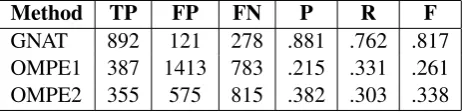
dataset can be seen in Table 2. GNAT showed a high performance, with a recall of0.762and a precision of0.881, corresponding to892TPs and only 121FPs. The OMPE1 system achieved, on the other hand, a recall of0.331and a precision of 0.215caused by the large number of FPs,1413.
Method TP FP FN P R F
[image:3.595.308.540.441.497.2]GNAT 892 121 278 .881 .762 .817 OMPE1 387 1413 783 .215 .331 .261 OMPE2 355 575 815 .382 .303 .338
Table 2: Performance of the 3 different methods.
To reduce the number of FPs we set a thresh-old to the probability of accepting a prediction (OMPE2). By using the threshold we dramatically reduced the number of FPs from1413to575, in-creasing the precision to0.382while slightly de-creasing the recall to0.303.
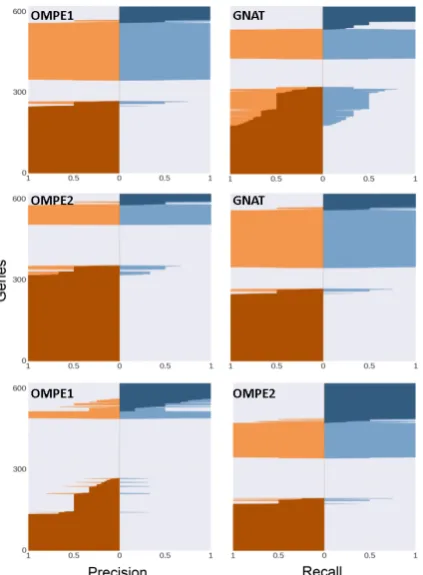
Figure 1: Difference in precision and recall of the different methods on an individual gene basis. The first row compares OMPE1 and GNAT, while the second row compares OMPE2 and GNAT. The last row compares OMPE1 and OMPE2. The first and second column show the precision and recall, re-spectively. Light colors represent the individual performance of the methods and dark colors the difference between them. Genes were ordered ac-cording to performance differences between meth-ods.
Figure 1 shows that there is a set of genes in which one of the algorithms works well but the other algorithms do not. Moreover, the use of a threshold in OMPE2 leads to an increase in the precision over a large number of genes and to a de-crease in only a small number of them. Figure2, on the other hand, shows the cumulative frequency distribution of precision and recall for genes pre-dicted in the test datasets with the different meth-ods.
4 Discussion
[image:4.595.310.523.68.267.2]An advantage of the OMPE approach is that it allows targeted performance improvements with respect to specific gene names. Positive exam-ples and synonyms belonging to particularly chal-lenging gene names can be modified interactively
Figure 2: Cumulative frequency distribution of genes at each precision and recall level. (A) Re-call for prediction of genes in the test dataset. (B) Precision for prediction of genes in the test dataset. (C) Precision for algorithms focused on the genes known to be present in the test dataset.
without the need for retraining the entire sys-tem (all models in our case), unlike in interac-tive single-model approaches such astagtog( Ce-juela et al.,2014). Another advantage of OMPE is its robustness, as it is not trained on a particular hand-selected corpus. Thus, our results with the BC2GNmodcorpus are not biased by the training
set utilized.
A challenge for training the OMPE system is the selection of negative examples. It is impor-tant to select negative examples that are as simi-lar as possible to the positive examples, meaning examples that are closest to the class separation boundary—analogous to what support vectors rep-resent for support vector machines (SVMs). One of our approach’s limitations is its reduced recall due to the low number of positive examples that exist for many genes. Such genes are, on the other hand, less likely to be mentioned in the biomedical literature and, as biomedical databases continue to grow, the number of positive examples for those genes will keep increasing as well.
In this sense, and in the reliance on large, grow-ing biomedical databases, our approach has a fu-turistic stance, meaning that it will become more feasible with time. As “Big Computing” infras-tructure, such as cloud computing, becomes in-creasingly available and more powerful, it will be-come more practical to implement systems such as OMPE. It is important to stress that computa-tional requirements differ greatly between training an OMPE system and deploying it for prediction, which requires far lower computational power.
Beyond the GNI example shown here, OMPE can be used to identify other types of entities with a finite cardinality, such as (in the BioNLP field) diseases, cell types, cell lines and anatomical parts. We have focused here on GNI because it has been already widely investigated and has multiple applications, such as the tracking of biomedical facts and trends (Cokol and Rodriguez-Esteban, 2008;Cokol et al.,2007;Rodriguez-Esteban and Loging,2013). Beyond NER, the OMPE approach could also be applied to other classification prob-lems in which the class cardinality is below a computationally-feasible threshold. The rationale would again be that increasing the number of mod-els could ease (”relieve”) the learning task to each individual model.
5 Conclusion
In this study we have shown a new approach for GNI that takes advantage of the decreasing costs of computing and the increasing availability of an-notated data to train hundreds of machine learn-ing models. Our proof of concept did not reach acceptable performance levels but, due to the fact that there remains ample room for potential im-provements, such strategies could become com-petitive for GNI and other domains in the future. Following the remarks from Halevy et al. (2009) in “The unreasonable effectiveness of data,” we should learn to “use available large-scale data rather than hoping for annotated data that isn’t available.”
References
JM Cejuela, P McQuilton, L Ponting, SJ Mary-gold, R Stefancsik, GH Millburn, B Rost, and FlyBase Consortium. 2014. tagtog: interactive and text-mining-assisted anno-tation of gene mentions in PLOS full-text
articles. Database (Oxford) 0(bau033).
https://doi.org/10.1093/database/bau033.
A Chatr-Aryamontri, B J Breitkreutz, R Oughtred, L Boucher, S Heinicke, D Chen, C Stark, A Breitkreutz, N Kolas, L O’Donnell, T Reg-uly, J Nixon, L Ramage, A Winter, A Sellam, C Chang, J Hirschman, C Theesfeld, J Rust, M S Livstone, K Dolinski, and M Tyers. 2015.
The BioGRID interaction database: 2015 update.
Nucleic Acids Res 43(Database issue):D470–478.
https://doi.org/10.1093/nar/gku1204.
G Chen, J Zhao, T Cohen, C Tao, J Sun, H Xu, E V Bernstam, A Lawson, J Zeng, A M Johnson, V Holla, A M Bailey, H Lara-Guerra, B Litzenburger, F Meric-Bernstam, and W Jim Zheng. 2015. Using ontology fingerprints to disambiguate gene name entities in the biomed-ical literature. Database (Oxford) 2015:bav034.
https://doi.org/10.1093/database/bav034.
M Cokol and R Rodriguez-Esteban. 2008. Vi-sualizing evolution and impact of biomedical fields. J Biomed Inform 41(6):1050–1052.
https://doi.org/10.1016/j.jbi.2008.05.002.
M Cokol, R Rodriguez-Esteban, and A Rzhetsky. 2007.
A recipe for high impact. Genome Biol 8(5):406.
https://doi.org/10.1186/gb-2007-8-5-406.
I Ezkurdia, D Juan, J Rodriguez, A Frankish, M Diekhans, J Harrow, J Vazquez, A Valencia, and M Tress. 2014. Multiple evidence strands suggest that there may be as few as 19 000 human protein-coding genes. Hum Mol Genet23(22):5866–5878.
https://doi.org/10.1093/hmg/ddu309.
L Furrer, S Clematide, H Marques, R Rodriguez-Esteban, M Romacker, and F Rinaldi. 2014.
Collection-wide extraction of proteprotein in-teractions. 6th International Symposium on Semantic Mining in Biomedicine pages 61–66.
https://doi.org/10.5167/uzh-101472.
J Gobeill, E Pasche, D Vishnyakova, and P Ruch. 2013. Managing the data deluge: data-driven go category assignment improves while complexity of functional annotation increases. Database (Oxford) 2013:bat041.
https://doi.org/10.1093/database/bat041.
J Hakenberg, M Gerner, M Haeussler, I Solt, C Plake, M Schroeder, G Gonzalez, G Ne-nadic, and C M Bergman. 2011. The GNAT library for local and remote gene mention normalization. Bioinformatics 27:2769–2771.
https://doi.org/10.1093/bioinformatics/btr455.
A Halevy, P Norvig, and F Pereira. 2009.
The unreasonable effectiveness of data.
IEEE Intelligent Systems 24(2):8–12.
https://doi.org/10.1109/MIS.2009.36.
V Hatzivassiloglou, P A Dubou, and A Rzhet-sky. 2001. Disambiguating proteins, genes, and rna in text: a machine learning ap-proach. Bioinformatics 17 Suppl 1:S97–106.
https://doi.org/10.1093/bioinformatics/17.suppl 1.S97. L Hirschman, AA Morgan, and AS Yeh. 2002.
Rutabaga by any other name: extracting biolog-ical names. J Biomed Inform 35(4):247–259.
https://doi.org/10.1016/S1532-0464(03)00014-5. S Jain, K R, T T Kuo, S Bhargava, G Lin,
and C N Hsu. 2016. Weakly supervised learn-ing of biomedical information extraction from cu-rated data. BMC Bioinformatics 17 Suppl 1:1.
https://doi.org/10.1186/s12859-015-0844-1. R Kabiljo, A B Clegg, and A Shepherd.
2009. A realistic assessment of meth-ods for extracting gene/protein interactions from free text. BMC Bioinformatics 10:233.
https://doi.org/10.1186/1471-2105-10-233.
S Kaewphan, S Van Landeghem, T Ohta, Y Van de Peer, F Ginter, and S Pyysalo. 2016. Cell line name recognition in support of the identification of synthetic lethality in can-cer from text. Bioinformatics 32(2):276–282.
https://doi.org/10.1093/bioinformatics/btv570. M Krauthammer and G Nenadic. 2004. Term
identification in the biomedical litera-ture. J Biomed Inform 37(6):512–526.
https://doi.org/10.1016/j.jbi.2004.08.004.
R Leaman and G Gonzalez. 2008. BANNER: an exe-cutable survey of advances in biomedical named en-tity recognition. Pac Symp Biocomputpages 652– 663. https://doi.org/10.1142/9789812776136 0062. U Leser and J Hakenberg. 2005. What makes a gene name? Named entity recognition in the biomedical literature. Brief Bioinform 6(4):357– 369. https://doi.org/10.1093/bib/6.4.357.
H Liu, ZZ Hu, M Torii, C Wu, and C Fried-man. 2006. Quantitative assessment of dictionary-based protein named entity tag-ging. J Am Med Inform Assoc 13(5):497–507.
https://doi.org/10.1197/jamia.M2085.
Z Lu, H Y Kao, C H Wei, M Huang, J Liu, C J Kuo, C N Hsu, R T Tsai, H J Dai, N Okazaki, H C Cho, M Gerner, I Solt, S Agarwal, F Liu, D Vishnyakova, P Ruch, M Romacker, F Rinaldi, S Bhattacharya, P Srinivasan, H Liu, M Torii, S Matos, D Cam-pos, K Verspoor, K M Livingston, and W J Wilbur. 2011. The gene normalization task in BioCre-ative III. BMC Bioinformatics 12 Suppl 8:S2.
https://doi.org/10.1186/1471-2105-12-S8-S2.
M Miwa, P Thompson, and S Ananiadou. 2012.
Boosting automatic event extraction from the literature using domain adaptation and corefer-ence resolution. Bioinformatics 28:1759–1765.
https://doi.org/10.1093/bioinformatics/bts237. A A Morgan, Z Lu, X Wang, A M Cohen, J Fluck,
P Ruch, A Divoli, K Fundel, R Leaman, J Haken-berg, C Sun, H H Liu, R Torres, M Krauthammer, W W Lau, H Liu, C N Hsu, M Schuemie, K B Co-hen, and L Hirschman. 2008. Overview of BioCre-ative II gene normalization. Genome Biol9 Suppl 2:S3. https://doi.org/10.1186/gb-2008-9-s2-s3. K Ravikumar, H Liu, J D Cohn, M E Wall, and K
Ver-spoor. 2012. Literature mining of protein-residue associations with graph rules learned through dis-tant supervision.J Biomed Semantics3 Suppl 3:S2.
https://doi.org/10.1186/2041-1480-3-S3-S2. D Rebholz-Schuhmann, S Kafkas, J H Kim, C Li,
A Jimeno Yepes, R Hoehndorf, R Backofen, and I Lewin. 2013. Evaluating gold standard cor-pora against gene/protein tagging solutions and lexical resources. J Biomed Semantics 4:28.
https://doi.org/10.1186/2041-1480-4-28.
R Rodriguez-Esteban. 2016a. Additional knowledge-based analysis approaches. In W Loging, ed-itor, Bioinformatics and Computational Biology in Drug Discovery and Development, Cambridge University Press, Cambridge, United Kingdom.
https://doi.org/10.1017/CBO9780511989421.011. R Rodriguez-Esteban. 2016b. Understanding
hu-man disease knowledge through text mining: What is text mining? In W Loging, ed-itor, Bioinformatics and Computational Biology in Drug Discovery and Development, Cambridge University Press, Cambridge, United Kingdom.
https://doi.org/10.1017/cbo9780511989421.004. R Rodriguez-Esteban and W T Loging. 2013.
Quantifying the complexity of medical re-search. Bioinformatics 29:2918–2924.
https://doi.org/10.1093/bioinformatics/btt505. M J Schuemie, B Mons, M Weeber, and J A Kors.
2007. Evaluation of techniques for increasing re-call in a dictionary approach to gene and protein name identification. J Biomed Inform40:316–324.
https://doi.org/10.1016/j.jbi.2006.09.002.
J Wermter, K Tomanek, and U Hahn. 2009.
High-performance gene name normaliza-tion with GeNo. Bioinformatics 25:815–821.
https://doi.org/10.1093/bioinformatics/btp071. M Zwick. 2015. Automated curation of gene
name normalization results using the Konstanz in-formation miner. J Biomed Inform 53:58–64.