An RNN-based Binary Classifier for the Story Cloze Test
Melissa Roemmele
Institute for Creative Technologies University of Southern California
Sosuke Kobayashi∗
Preferred Networks, Inc. [email protected]
Naoya Inoue
Tohoku University
Andrew M. Gordon
Institute for Creative Technologies University of Southern California
Abstract
The Story Cloze Test consists of choos-ing a sentence that best completes a story given two choices. In this paper we present a system that performs this task us-ing a supervised binary classifier on top of a recurrent neural network to predict the probability that a given story ending is correct. The classifier is trained to distinguish correct story endings given in the training data from incorrect ones that we artificially generate. Our experiments evaluate different methods for generating these negative examples, as well as dif-ferent embedding-based representations of the stories. Our best result obtains 67.2% accuracy on the test set, outperforming the existing top baseline of 58.5%.
1 Introduction
Automatically predicting ”what happens next” in a story is an emerging AI task, situated at the point where natural language processing meets com-monsense reasoning research. Story understand-ing began as classic AI plannunderstand-ing research (Mee-han, 1977, e.g.), and has evolved with the shift to data-driven AI approaches by which large sets of stories can be analyzed from text (Granroth-Wilding and Clark, 2016; Li et al., 2013; McIntyre and Lapata, 2009, e.g.). A barrier to this research has been the lack of standard evaluation schemes for benchmarking progress. The new Story Cloze Test (Mostafazadeh et al., 2016) addresses this need through a binary-choice evaluation format: given the beginning sentences of a story, the task is to choose which of two given sentences best completes the story. The cloze framework also
∗This research was conducted at his previous affiliation, Tohoku University.
provides training stories (referred to here as the ROC corpus) in the same domain as the evalua-tion items. Mostafazadeh et al. details the crowd-sourced authoring process for this dataset. Ulti-mately the training data consists of 97,027 five-sentence stories. The separate cloze test has 3742 items (divided equally between validation and test sets) each containing the first four sentences of a story with a correct and incorrect ending to choose from.
In the current paper, we describe a set of ap-proaches for performing the Story Cloze Test. Our best result obtains 67.2% accuracy on the test set, outperforming Mostafazadeh et al.’s best baseline of 58.5%. We first report two additional unsuper-vised baselines used in other narrative prediction tasks. We then describe our supervised approach, which uses a recurrent neural network (RNN) with a binary classifier to distinguish correct story end-ings from artificially generated incorrect endend-ings. We compare the performance of this model when alternatively trained on different story encodings and different strategies for generating incorrect endings.
2 Story Representations
We examined two ways of representing stories in our models, both of which encode stories as vec-tors of real numbers known as embeddings. This was motivated by the top performing baseline in Mostafazadeh et al. which used embeddings to select the candidate story ending with the higher cosine similarity to its context.
Word Embeddings: We first tried encod-ing stories with word-level embeddencod-ings usencod-ing the word2vec model (Mikolov et al., 2013), which learns to represent words as n-dimensional vec-tor of real values based on neighboring words. We compared two different sets of vectors:
dimension vectors trained on the 100-billion word Google News dataset1and 300-dimension vectors that we trained on ROC corpus itself. The latter were trained using the gensim word2vec library2, with a window size of 10 words and negative sam-pling of 25 noise words. All other parameters were set to the default values given by the library. By comparing these two sets of embeddings, we in-tended to determine the extent to which our mod-els can rely only on the limited training data pro-vided for this task. In our supervised experiments we averaged the embeddings of the words in each sentence, resulting in a single vector representa-tion of the entire sentence.
Sentence Embeddings: The second embed-ding strategy we used was the skip-thought model (Kiros et al., 2015), which produces vectors that encode an entire sentence. Analogous to train-ing word vectors by predicttrain-ing nearby words, the skip-thought vectors are trained to predict nearby sentences. We evaluated two sets of sentence vectors: 4800-dimension vectors trained on the 11,000 books in the BookCorpus dataset3, and 2400-dimension vectors we trained ourselves on the ROC corpus4. The latter BookCorpus vectors were also used in a baseline that measured vector similarity between the story context and candidate endings in Mostafazadeh et al.
3 Unsupervised Approaches
Mostafazadeh et al. applied several unsupervised baselines to the Story Cloze Test. We evaluated two additional approaches due to their success on other narrative prediction tasks.
Average Maximum Similarity (AveMax):
The AveMax model is a slight variation on Mostafazadeh et al.’s averaged word2vec baseline. It is currently implemented to predict story contin-uations from user input in the recently developed DINE application5. Instead of selecting the em-bedded candidate ending most similar to the con-text, this method iterates through each word in the ending, finds the word in the context with most similar embedding, and then takes the mean of these maximum similarity embeddings. We evalu-ated this method using both the word embeddings
1https://code.google.com/archive/p/word2vec/
2https://radimrehurek.com/gensim/models/word2vec.html 3https://github.com/ryankiros/skip-thoughts
4We used the same code and default parameters available
at the above GitHub page.
5http://dine.ict.usc.edu
from the Google News dataset and the ROC cor-pus.
Pointwise Mututal Information (PMI): The PMI model was used successfully on the Choice of Plausible Alternatives task (COPA) (Roemmele et al., 2011; Gordon et al., 2011; Gordon et al., 2012; Luo et al., 2016) which similarly to the Story Cloze Test uses a binary-choice format to elicit inferences about a segment of narrative text. This model relies on lexical co-occurrence counts (of raw words rather than embeddings) to compute a ‘causality score’ about how likely one sentence is to follow another in a story. We applied the same approach to the Story Cloze Test to select the final sentence with the higher causality score of the two candidates. We evaluated word counts from two different sources: a corpus of one million stories extracted from personal weblogs (as was used in Gordon et al.) and the ROC corpus.
4 Supervised Approaches
Given the moderate size of the ROC corpus at almost 100,000 stories, and that the Story Cloze Test can be viewed as a classification task choos-ing from two possible outputs, we investigated a supervised approach. Unlike the training data for traditional classification models, the ROC corpus does not involve a set of discrete categories by which stories are labeled. Moreover, while the Story Cloze Test provides a correct and incorrect outcome to choose from, the training data only contains the correct ending for a given story. So our strategy was to create a new training set with binary labels of 1 for correct endings (positive amples) and 0 for incorrect endings (negative ex-amples). Each story in the corpus was considered a positive example. Given a positive example, we generated a negative example by replacing its final sentence with an incorrect ending. As described below, we generated more than one negative end-ing per story, so that each positive example had multiple negative counterparts. Our methods for generating negative examples are described in the next section. Our approach was to train a binary classifier to distinguish between these positive and negative examples.
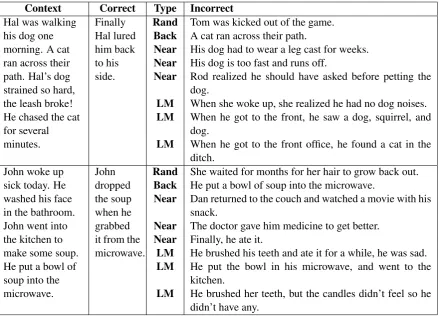
in-Context Correct Type Incorrect
Hal was walking his dog one morning. A cat ran across their path. Hal’s dog strained so hard, the leash broke! He chased the cat for several minutes.
Finally Hal lured him back to his side.
Rand Tom was kicked out of the game.
Back A cat ran across their path.
Near His dog had to wear a leg cast for weeks.
Near His dog is too fast and runs off.
Near Rod realized he should have asked before petting the dog.
LM When she woke up, she realized he had no dog noises.
LM When he got to the front, he saw a dog, squirrel, and dog.
LM When he got to the front office, he found a cat in the ditch.
John woke up sick today. He washed his face in the bathroom. John went into the kitchen to make some soup. He put a bowl of soup into the microwave.
John dropped the soup when he grabbed it from the microwave.
Rand She waited for months for her hair to grow back out.
Back He put a bowl of soup into the microwave.
Near Dan returned to the couch and watched a movie with his snack.
Near The doctor gave him medicine to get better.
Near Finally, he ate it.
LM He brushed his teeth and ate it for a while, he was sad.
LM He put the bowl in his microwave, and went to the kitchen.
[image:3.595.81.521.61.385.2]LM He brushed her teeth, but the candles didn’t feel so he didn’t have any.
Table 1: Examples of generated negative endings
put and then returns the probability of that ending being correct, using the ending labels as feedback during training. Specifically, we combine the tence representations of the context and final sen-tences into one sequence and feed each sentence as a timestep into a single 1000-node GRU (Cho et al., 2014) hidden layer. The values of the final hidden state are given to a top feed-forward layer composed of one node with sigmoid activation. A binary cross-entropy objective function is applied to train the network to maximize the probability of positive examples being correct. All experiments used RMSprop (Hinton et al., 2012) with a batch size of 100 to optimize the model over 10 train-ing epochs. After traintrain-ing, given a cloze test item, the model predicted a probability score for each candidate ending, and the ending with the higher score was selected as the response for that item.
5 Incorrect Ending Generation
We examined four different ways to generate the incorrect endings for the classifier. Table 1 shows examples of each.
Random (Rand): First, we simply replaced each story’s ending with a randomly selected
end-ing from a different story in the trainend-ing set. In most cases this ending will not be semantically re-lated to the story context, so this approach would be expected to predict endings based strictly on se-mantic overlap with the context.
Backward (Back):The Random approach gen-erates negative examples in which the semantics of the context and ending are most often far apart. However, these examples may not represent the items in the Story Cloze Test, where the endings generally both have some degree of semantic co-herence with the context sentences. To generate negative examples in the same semantic space as the correct ending, we replaced the fifth sentence of a given story with one of its four context sen-tences (i.e. a backward sentence). This results in an ending that is semantically related to the story, but is typically incoherent given its repetition in the story.
retrieved the most similar story in the corpus (in terms of cosine similarity), and then projected the final sentence of the similar story as the ending of the given story. Multiple endings were produced by finding the N most similar stories. The neg-ative examples generated by this scheme can be seen as ‘almost’ positive examples with likely co-herence errors, given the sparsity of the corpus. This is in line with the cloze task where both end-ings are plausible, but the correct answer is more likely than the other.
Language Model (LM):Separate from the bi-nary classifier, we trained an RNN-based language model (Mikolov et al., 2010) on the ROC cor-pus. The LM learns a conditional probability dis-tribution indicating the chance of each possible word appearing in a sequence given the words that precede it. During training, the LM iterated through a story word by word, each time updat-ing its predicted probability of the next observed word. During generation, we gave the LM the context of each training story and had it produce a final sentence by sampling words one by one ac-cording to the predicted distribution, as described in Sutskever et al. (2011). Multiple sentences were generated for the same story by sampling the N most probable words at each timestep. The LM had a 200-node embedding layer and two 500-node GRU layers, and was trained using the Adam optimizer (Kingma and Ba, 2015) with a batch size of 50. This approach has an advantage over the Nearest-Ending method in that it leverages all the stories in the training data for generation, rather than predicting an ending based on a single story. Thus, it can generate endings that are not directly observed in the training corpus. Like the nearest-ending approach, an ideal LM would be expected to generate positive examples similar to the orig-inal stories it is trained on. However, we found that the LM-generated endings were relevant to the story context but had less of a commonsense inter-pretation than the provided endings, again likely due to training data sparsity.
6 Experiments
We trained a classifier for each type of nega-tive ending and additionally for each type of em-bedding, shown in Table 2. For each correct example, we generated multiple incorrect exam-ples. We found that setting the number of neg-ative samples per positive example near 6
pro-duced the best results on the validation set for all configurations, so we kept this number consistent across experiments. The exception is the Back-ward method, which can only generate one of the first four sentences in each story. For each gen-eration method, the negative samples were kept the same across runs of the model with different embeddings, rather than re-sampling for each run. After discovering that our best validation results came from the random endings, we also evaluated combinations of these endings with the other types to see if they could further boost the model’s per-formance. The samples used by these combined-method experiments were a subset of the negative samples generated for the single-method results.
Table 2 shows the accuracy of all unsupervised and supervised models on both the validation and test sets, with the best test result within each group in bold. Among the unsupervised models, the AveMax model with the GoogleNews embed-dings (55.2% test accuracy) performs compara-bly to Mostafazadeh et al.’s word2vec similarity model (53.9%). The PMI approach performs at the same level as the current best baseline of 58.5%, and the counts from the ROC stories are just as ef-fective (59.9%) as those from the much larger blog corpus (59.1%).
cor-Val Test
Unsupervised
AveMax
GoogleNews WordEmb 0.553 0.552
ROC WordEmb 0.548 0.547
PMI
Blog Corpus 0.585 0.591 ROC Corpus 0.581 0.599
Supervised
Rand-6
GoogleNews WordEmb 0.625 0.585 ROC WordEmb 0.605 0.584 BookCorpus SentEmb 0.645 0.632
ROC SentEmb 0.639 0.631
Back-4
GoogleNews WordEmb 0.529 0.540 ROC WordEmb 0.528 0.553 BookCorpus SentEmb 0.545 0.539 ROC SentEmb 0.548 0.560 Near-6
GoogleNews WordEmb 0.641 0.615 ROC WordEmb 0.585 0.588 BookCorpus SentEmb 0.649 0.621
ROC SentEmb 0.632 0.615
LM-6
GoogleNews WordEmb 0.524 0.534 ROC WordEmb 0.523 0.544
BookCorpus SentEmb 0.520 0.507 ROC SentEmb 0.514 0.512
Rand-4 + Back-2
BookCorpus SentEmb 0.662 0.669
ROC SentEmb 0.664 0.664
Rand-4 + Near-2
BookCorpus SentEmb 0.636 0.641
ROC SentEmb 0.650 0.609
Rand-4 + LM-2
BookCorpus SentEmb 0.624 0.607 ROC SentEmb 0.640 0.653 Rand-3 + Back-1
+ Near-1 + LM-1
ROC WordEmb (2400) 0.599 0.579 BookCorpus SentEmb 0.656 0.672
[image:5.595.84.279.55.654.2]ROC SentEmb 0.680 0.661
Table 2: Accuracy on the Story Cloze Test
responding ROC sentence embeddings (66.1%), supporting our idea that the skip-thought embed-dings are a better sentence representation. In-terestingly, though the BookCorpus sentence vec-tors obtained the best result overall (67.2%), they
performed on average the same as the ROC ones (mean accuracy of 61.1% versus 61.3%, respec-tively), despite that the former have more dimen-sions (4800) and were trained on several more sto-ries. This might suggest it helps to model the unique genre of stories contained in the ROC cor-pus for this task.
The best results in terms of data generation in-corporate the Random endings, suggesting that for many of the items in the Story Cloze Test, the correct ending is the one that is more semanti-cally similar to the context. Not surprisingly, the Backward endings have limited effect on their own (best result 56%), but they boost the performance of the Random endings when combined (best re-sult 66.9%). We expected that the Nearest-Ending and LM endings would have an advantage over the Random endings, but our results didn’t show this. The best result for the Nearest-Ending method was 62.1% compared to 63.2% produced by the Ran-dom endings. The LM endings fared particularly badly on their own (best result 54.4%). We no-ticed the LM seemed to produce very similar end-ings across different stories, which possibly influ-enced this result. The best result overall (67.2%) was produced by the model that sampled from all four types of endings, though it was only trivially higher than the best result for the combined Ran-dom and Backward endings (66.9%). Still, we see opportunity in the technique of using generative methods to expand the training set. We only gen-erated incorrect endings in this work, but ideally this approach could generate correct endings as well, given that a story has multiple possible cor-rect endings. It is possible that the small size of the ROC corpus limited our current success with this idea, so in the future we plan to pursue this using a much larger story dataset.
7 Acknowledgments
References
Kyunghyun Cho, Bart van Merrienboer, Dzmitry Bah-danau, and Yoshua Bengio. 2014. On the properties of neural machine translation: Encoder-decoder
ap-proaches. InProceedings of SSST-8, Eighth
Work-shop on Syntax, Semantics and Structure in Statisti-cal Translation, pages 103–111, Doha, Qatar, Octo-ber. Association for Computational Linguistics.
Andrew S. Gordon, Cosmin Adrian Bejan, and Kenji Sagae. 2011. Commonsense causal reasoning using millions of personal stories. InProceedings of the Twenty-Fifth AAAI Conference on Artificial Intelli-gence, AAAI’11, pages 1180–1185. AAAI Press.
Andrew S. Gordon, Zornitsa Kozareva, and Melissa Roemmele. 2012. Semeval-2012 task 7: Choice of plausible alternatives: An evaluation of common-sense causal reasoning. InProceedings of the First Joint Conference on Lexical and Computational Se-mantics - Volume 1: Proceedings of the Main Con-ference and the Shared Task, and Volume 2: Pro-ceedings of the Sixth International Workshop on Se-mantic Evaluation, SemEval ’12, pages 394–398, Stroudsburg, PA, USA. Association for Computa-tional Linguistics.
Mark Granroth-Wilding and Stephen Clark. 2016. What Happens Next? Event Prediction Using a
Compositional Neural Network Model. In
Proceed-ings of the Thirtieth AAAI Conference on Artificial Intelligence, AAAI’16, pages 2727–2733. AAAI Press.
Geoffrey Hinton, Nitish Srivastava, and Kevin
Swersky. 2012. Overview of mini-batch
gra-dient descent. http://www.cs.toronto.
edu/˜tijmen/csc321/slides/lecture_ slides_lec6.pdf.
Mohit Iyyer, Anupam Guha, Snigdha Chaturvedi, Jor-dan Boyd-Graber, and Hal Daum´e III. 2016. Feud-ing families and former friends: Unsupervised learn-ing for dynamic fictional relationships. In Proceed-ings of the 2016 Conference of the North Ameri-can Chapter of the Association for Computational Linguistics: Human Language Technologies, pages 1534–1544, San Diego, California, June. Associa-tion for ComputaAssocia-tional Linguistics.
Diederik Kingma and Jimmy Ba. 2015. Adam: A
method for stochastic optimization. In The
Inter-national Conference on Learning Representations (ICLR), San Diego, May.
Ryan Kiros, Yukun Zhu, Ruslan R Salakhutdinov, Richard Zemel, Raquel Urtasun, Antonio Torralba, and Sanja Fidler. 2015. Skip-thought vectors. In C. Cortes, N. D. Lawrence, D. D. Lee, M. Sugiyama,
and R. Garnett, editors, Advances in Neural
Infor-mation Processing Systems 28, pages 3294–3302. Curran Associates, Inc.
Boyang Li, Stephen Lee-Urban, George Johnston, and Mark O. Riedl. 2013. Story generation with
crowd-sourced plot graphs. InProceedings of the
Twenty-Seventh AAAI Conference on Artificial Intelligence, AAAI’13, pages 598–604. AAAI Press.
Zhiyi Luo, Yuchen Sha, Kenny Q. Zhu, Seung-won Hwang, and Zhongyuan Wang. 2016. Common-sense causal reasoning between short texts. In Pro-ceedings of the Fifteenth International Conference on Principles of Knowledge Representation and Reasoning, KR’16, pages 421–430. AAAI Press. Neil McIntyre and Mirella Lapata. 2009. Learning
to tell tales: A data-driven approach to story
gen-eration. In Proceedings of the Joint Conference of
the 47th Annual Meeting of the ACL and the 4th In-ternational Joint Conference on Natural Language Processing of the AFNLP, pages 217–225, Suntec, Singapore, August. Association for Computational Linguistics.
James R. Meehan. 1977. Tale-spin, an interactive pro-gram that writes stories. InProceedings of the 5th International Joint Conference on Artificial Intelli-gence - Volume 1, IJCAI’77, pages 91–98, San Fran-cisco, CA, USA. Morgan Kaufmann Publishers Inc. Tomas Mikolov, Martin Karafiat, Lukas Burget, Jan Cernocky, and Sanjeev Khudanpur. 2010.
Recur-rent Neural Network based language model. In
Pro-ceedings of the 11th Annual Conference of the In-ternational Speech Communication Association, IN-TERSPEECH 2010, pages 1045–1048.
Tomas Mikolov, Ilya Sutskever, Kai Chen, Greg Cor-rado, and Jeffrey Dean. 2013. Distributed repre-sentations of words and phrases and their composi-tionality. In Proceedings of the 26th International Conference on Neural Information Processing
Sys-tems, NIPS’13, pages 3111–3119, USA. Curran
As-sociates Inc.
Nasrin Mostafazadeh, Nathanael Chambers, Xiaodong He, Devi Parikh, Dhruv Batra, Lucy Vanderwende, Pushmeet Kohli, and James Allen. 2016. A cor-pus and cloze evaluation for deeper understanding
of commonsense stories. In Proceedings of the
2016 Conference of the North American Chapter of the Association for Computational Linguistics: Hu-man Language Technologies, pages 839–849, San Diego, California, June. Association for Computa-tional Linguistics.
Karl Pichotta and Raymond J. Mooney. 2016. Learn-ing statistical scripts with lstm recurrent neural
net-works. In Proceedings of the Thirtieth AAAI
Con-ference on Artificial Intelligence, AAAI’16, pages 2800–2806. AAAI Press.
Melissa Roemmele, Cosmin Adrian Bejan, and An-drew S. Gordon. 2011. Choice of Plausible Alterna-tives : An Evaluation of Commonsense Causal
Rea-soning. AAAI Spring Symposium: Logical
Ilya Sutskever, James Martens, and Geoffrey Hinton. 2011. Generating text with recurrent neural net-works. In Lise Getoor and Tobias Scheffer, editors, Proceedings of the 28th International Conference on Machine Learning (ICML-11), ICML ’11, pages 1017–1024, New York, NY, USA, June. ACM. Reid Swanson and Andrew S. Gordon. 2012. Say
any-thing: Using textual case-based reasoning to enable
open-domain interactive storytelling. ACM Trans.