Polite Dialogue Generation Without Parallel Data
Tong Niu and Mohit Bansal UNC Chapel Hill
{tongn, mbansal}@cs.unc.edu
Abstract
Stylistic dialogue response generation, with valuable applications in personality-based conversational agents, is a challenging task because the response needs to be fluent, contextually-relevant, as well as paralinguis-tically accurate. Moreover, parallel datasets for regular-to-stylistic pairs are usually un-available. We present three weakly-supervised models that can generate diverse, polite (or rude) dialogue responses without parallel data. Our late fusion model (Fusion) merges the decoder of an encoder-attention-decoder dia-logue model with a language model trained on stand-alone polite utterances. Our label-fine-tuning (LFT) model prepends to each source sequence a politeness-score scaled label (pre-dicted by our state-of-the-art politeness classi-fier) during training, and at test time is able to generate polite, neutral, and rude responses by simply scaling the label embedding by the cor-responding score. Our reinforcement learn-ing model (Polite-RL) encourages politeness generation by assigning rewards proportional to the politeness classifier score of the sam-pled response. We also present two retrieval-based, polite dialogue model baselines. Hu-man evaluation validates that while the Fu-sion and the retrieval-based models achieve politeness with poorer context-relevance, the LFT and Polite-RL models can produce sig-nificantly more polite responses without sacri-ficing dialogue quality.
1 Introduction
Generating stylistic, personality-based language is crucial to developing engaging, convincing, and
trustworthy conversational agents, for their effec-tive application in intelligent tutoring, home assis-tance, online reservations/purchasing, health care, etc. Most current chatbots and conversational mod-els lack any such style, which can be a social issue because human users might learn biased styles from such interactions, e.g., kids learning to be rude be-cause the dialogue system encourages short, curt re-sponses, and also does not itself use politeness to set an example.1 In this work, we focus on the
impor-tant and diverse paralinguistic style axis of polite-ness vs. rudepolite-ness (Brown and Levinson, 1987).
Generating stylistic dialogue responses is a sub-stantially challenging task because the generated re-sponse needs to be syntactically and semantically fluent, contextually-relevant to the conversation, as well as convey accurate paralinguistic features. This is further complicated by the fact that content and style are only available in separate unpaired datasets, as opposed to translation-type parallel datasets con-taining regular-to-stylistic text pairs. Hence, we need indirectly-supervised models that can incorpo-rate style into the geneincorpo-rated response in absence of parallel data (i.e., where the training data for the conversation, versus style components, comes from two different datasets or domains), while still main-taining conversation relevance.
In this work, we present three such weakly-supervised models2 that can generate diverse,
nat-ural, and contextually-relevant polite (and rude)
di-1 https://qz.com/701521/parents-are-worried-the-amazon-echo-is-conditioning-their-kids-to-be-rude/
2The first version of this paper with the three Fusion, Discrete-LFT, and Polite-RL models was submitted on Oct 1, 2017. The two retrieval baselines and the continuous version
373
alogue responses, using data from separate style and dialogue domains: theStanford Politeness Cor-pus (Danescu-Niculescu-Mizil et al., 2013) with Wikipedia and Stack Exchange requests, and the
MovieTriples Dialogue Corpus(Serban et al., 2016)
with IMSDB movie scripts, respectively. Each of our three models is based on a state-of-the-art polite-ness classifier and a sequence-to-sequence dialogue model. The first model (Fusion) employs a late fu-sion technique to merge the response generation de-coder of the dialogue model with a language model trained on polite utterances chosen by the politeness classifier. The second label-fine-tuning (LFT) model prepends to the input utterance a single politeness la-bel whose embedding is continuously scaled by the politeness score of the target sequence during train-ing. This score is determined by feeding the cor-responding ground-truth target sequence to our po-liteness classifier. During test time, we show that the LFT model is able to control the politeness level of generated responses by simply scaling the la-bel’s embedding by the continuous target politeness score of our choice. Our third reinforcement-based model (Polite-RL) encourages politeness generation by using the continuous-scale politeness score of the decoder-sampled sentence as a reward (via mixed-objective policy gradient methods), i.e., polite utter-ances are encouraged with positive reward, and rude ones discouraged with negative reward.
Hence, our models only need a style classifier (without parallel data) to automatically influence and encourage continuous-scale stylistic language generation in a complex dialogue setup, which also requires maintaining relevance to conversational context. Each of these models requires minimal changes to the architecture of either the underly-ing sequence-to-sequence (Seq2seq) dialogue base model or the style classifier, and hence can mod-ularly update the architecture with the latest state-of-the-art dialogue models or style classifiers (and for diverse styles). In addition, we also employ two retrieval-based models, where we output the re-sponse which has the highest match with the in-put context from a set of classifier-picked polite responses or manually-picked generic polite
utter-of the LFT model were added to the Feb 1, 2018 resubmission based on reviewer discussions.
ances. These two retrieval models serve as parallel investigations on the performance of our three pro-posed generative models above.
We conducted multiple human evaluations (for style and dialogue quality) on Amazon Mechani-cal Turk (MTurk) (Buhrmester et al., 2011) for all three models plus the base sequence-to-sequence di-alogue model and the retrieval-based models, and show that while the Fusion and the two retrieval models increase the politeness level of responses at the cost of poorer dialogue quality, both our LFT and Polite-RL models can successfully produce po-lite responses (capturing several popo-liteness strategies discussed by Brown and Levinson (1987)), without sacrificing dialogue coherence and relevance com-pared to the base Seq2seq model (hence better bal-ance between politeness and dialogue quality). We also compare the output dialogue politeness levels of the continuous LFT model for three different po-liteness levels. Finally, we present several detailed qualitative and quantitative analyses, including pos-itive and negative output examples, automatic metric results on output responses, classifier error analysis, and visualization of the RL rewards.
2 Related Works
2.1 Models for Style Transfer
Style Transfer with Parallel Data There have
classifier score, we are essentially converting non-parallel data to (noisy) non-parallel data (by using a clas-sifier with high accuracy).
Style Transfer without Parallel Data Several
previous works have looked at style transfer with-out parallel data, in both vision (Gatys et al., 2016; Zhu et al., 2017; Liu and Tuzel, 2016; Liu et al., 2017; Taigman et al., 2016; Kim et al., 2017; Yi et al., 2017), and text (Sennrich et al., 2016a; Hu et al., 2017; Ghosh et al., 2017; Zhao et al., 2017; Mueller et al., 2017; Wang et al., 2017; Luan et al., 2017). Among these models, some are bag-of-words based, i.e., they use style-related keywords to annotate the target sequences in the training set. For example, to control how formal the output sequences are in a EN-DE translation task, Sennrich et al. (2016a) la-beled each target sequence based on whether it con-tains formal or informal verbs and pronouns (hon-orifics). To build a language model that generates utterances with the desired style, Ficler and Gold-berg (2017) annotated their text with meta-data and keywords/POS tags based heuristics, while Ghosh et al. (2017) also adopted keyword spotting based on a dictionary of emotional words. The basic ideas of their models are similar to that of our LFT model. However, these keyword-spotting approaches do not fully extend to our politeness generation task, be-cause politeness strategies follow complex patterns of grammar, word order, and phrasing (Danescu-Niculescu-Mizil et al., 2013). For example, the po-liteness of pleasedepends on where it occurs in a sentence, and what other politeness markers it co-occurs with (e.g., ‘could/would you’ style counter-factual modals vs. ‘can/will you’ style indicative modals). Therefore, our novel polite dialogue mod-els are based on an accurate neural classifier, which is better at capturing several compositional paralin-guistic features (as visualized in Aubakirova and Bansal (2016), whose politeness classifier we ex-tend). Moreover, our LFT and Polite-RL models can generate a continuum of style levels based on the continuously-scaled (by the politeness score) label embedding or reinforcement rewards.
Lastly, there have also been style transfer mod-els that rely on the latent representation of text and use variational auto-encoders or cross-alignment to disentangle the representation of content and style
in text (Hu et al., 2017; Shen et al., 2017; Zhao et al., 2017; Fu et al., 2018). During inference time, the latent style representation is combined with new content to generate stylized, content-preserving text. Although both fall into the category of style transfer, our task differs in two important aspects from their tasks. First, as opposed to the task of strict content preservation when rephrasing a sentence to a differ-ent style, our task is about maintaining good rele-vance to the context when adding style, especially useful for dialogue-based tasks. Another distinc-tive trait of our task is that politeness resides in a spectrum rather than a fixed category or topic (e.g., Shakespearean), and our models can treat politeness as a continuum, i.e., controlling the politeness level by adjusting the fusion rate in the Fusion model, the magnitude of the continuous label in the LFT model, or the RL weight in the Polite-RL model.
2.2 Multi-Task Learning and Style Transfer
2.3 Politeness Studies
Danescu-Niculescu-Mizil et al. (2013) created the Stanford Politeness Corpus and trained an SVM classifier using a list of useful linguistic features based on strategies from Brown and Levinson’s
theory of politeness (Brown and Levinson, 1987).
Aubakirova and Bansal (2016) recently took an end-to-end neural approach to this politeness classifi-cation task by training a CNN model that directly learns to identify polite requests without using any hand-engineered features, while still improving on prediction accuracy. They also visualized what fea-tures the CNN model was learning and discovered some new features along the way. Our classifier mainly extends their work by adding a bi-directional LSTM layer (Hochreiter and Schmidhuber, 1997; Schuster and Paliwal, 1997) before the CNN layer to capture long-distance relationships in the sentence, which leads to higher cross-domain performance.
A related early work in personality-based dia-logue is Mairesse and Walker (2007), who stud-ied introvert/extrovert personality language based on templated content and sentence planning (via personality dimensions such as hedges, tag ques-tions, negaques-tions, subject implicitness, etc.). Relat-edly, Sennrich et al. (2016a) use an English to Ger-man translation task to present a model that can gen-erate target sequences that are either formal or infor-mal, specifically based on honorifics-related verbs and pronouns. Our task is more general, taking into account several politeness-related paralinguis-tic features of Brown and Levinson (1987) and al-lowing end-to-end trainable stylistic dialogue gen-eration with a polite-to-rude spectrum (based on a politeness classifier, without relying on parallel data). Moreover, our approaches allow simply re-placing the politeness classifier with any other emo-tion or personality based language classifier to gen-erate stylistic dialogue for that new style dimension.
3 Politeness Classification Model
In order to develop an accurate politeness classifier for effective use in stylistic dialogue response gener-ation, we extend and improve upon the state-of-the-art CNN model of Aubakirova and Bansal (2016), and propose a bi-directional LSTM followed by a convolutional layer (see Figure 1), in order to both
S1 S2 S3 S4
embedding
Convolution layer
polite rude
LSTM LSTM LSTM LSTM LSTM LSTM LSTM LSTM concat concat concat concat
Softmax
[image:4.612.339.510.53.275.2]Max-pooling
Figure 1: Our LSTM-CNN politeness classifier.
capture long-distance relationships in the sentence as well as windowed filter based features. For a sentencev1:n(where each tokenvi is ad-dim word embedding vector), the LSTM layer first produces hidden states h1:n (where ht is the concatenation of forward and backward hidden states at time step t). A filter m is then applied on a window of u hidden states. This produces a convolution feature ci = f(m∗vi:i+u−1+b), wheref is a non-linear
function and b is a bias term. Every feature map c ∈ Rn−u+1 is applied to each window, so that
c = [c1, ..., cn−u+1]. The output of the
convolu-tional layer is then fed to a max-pooling layer (Col-lobert et al., 2011) which gives C = max{c} for the filter. Filters of various sizes are used to ob-tain multiple features. The result is then passed to a fully-connected softmax layer that outputs proba-bilities over two labels, namelyPoliteandRude.
Our classification model achieves compara-ble in-domain accuracy and improved cross-domain accuracy over the state-of-the-art results reported in Danescu-Niculescu-Mizil et al. (2013) and Aubakirova and Bansal (2016). We will discuss these results in detail in Section 6.
4 Polite-Style Dialogue Models
mod-Input S1 S2 S3
Response by Seq2seq
Q1 Q3
T1 T2
<start>
Response by LM G1 G2 G3
<end>
[image:5.612.317.541.53.135.2]Q2
Figure 2: Fusion model: the output probability distribu-tions of the decoder and the polite-LM are linearly mixed to generate the final decoded outputs.
els are built, and then present these three models that can generate polite dialogue responses. As a paral-lel investigation on the performance of our proposed models, we also employ two retrieval-based polite dialogue models toward the end.
4.1 Base Seq2seq Dialogue Model
Our base dialogue model is a simple sequence-to-sequence (Seq2seq) model that consists of a two-layer bi-directional LSTM-RNN encoder to encode the conversation history turns, and a four-layer LSTM-RNN decoder to generate the response. Ad-ditive attention from the output of the encoder is ap-plied to the last layer of the decoder. This archi-tecture is almost identical to that proposed by Bah-danau et al. (2015), except with more layers (simi-lar to Shao et al. (2017)). Our base dialogue model achieves perplexity and word error rate results on par with those reported for the popular hierarchical HRED models in Serban et al. (2016), thus serving as a good base model to incorporate style into. De-tails will be discussed in Section 6.
4.2 Fusion Model
Inspired by the ‘late fusion’ approach in Venu-gopalan et al. (2016), our Fusion model (Fig. 2) combines the response generation decoder of the base Seq2seq dialogue model with a language model (polite-LM) trained exclusively on polite utterances. These utterances are chosen by feeding the classifier all response utterances in the MovieTriples training set, and only keeping those with politeness scores great than a certain threshold (set to0.8in our
ex-periments, as will be discussed in Section 4.5). The polite-LM model is a two-layer LSTM-RNN based on Jozefowicz et al. (2016).
During inference time, we used the language
<label> S1 S2 S3 <start>
G1 G2 G3
T1 T2 T3
<end>
Input
Generated Response
Politeness Classifier
Target politeness score
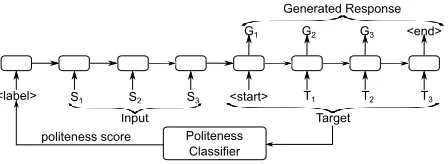
Figure 3: Label-Fine-Tuning model: during training, the embedding of the prepended label is scaled by the style classifier’s continuous score on the ground-truth (target) sequence. During testing, we scale the embedding of the label by the desired (continuous) politeness score of the generated response.
model to re-score the final output of the Seq2seq decoder (for each time step) by computing a lin-ear combination of the output vocabulary distribu-tions proposed by the Seq2seq model and polite-LM. Specifically, letpS2St andptLMdenote the output probability distributions proposed by the Seq2seq model and the LM model at timet, respectively. The final ‘fused’ distributionptfor that time step is:
pt=α ptS2S+ (1−α)pLMt (1)
where thefusion ratioαis a hyperparameter that in-dicates how much Seq2seq output will influence the final output.
4.3 Label-Fine-Tuning Model
There are at least two drawbacks of the Fusion model. First, half of its output is determined by a po-lite language model that has not attended to the con-versation context, making the response more likely to be irrelevant. Second, the model does not learn politeness during training, but is forced to be polite only during inference time. To address these two is-sues, we present our label-fine-tuning (LFT) model, which prepends a predicted continuous style label at the beginning of each input sentence to specify the intended politeness level.
[image:5.612.71.298.54.137.2]classi-Input
S1 S2 S3
<start>
G1 G2 G3
T1 T2 T3
<end> Generated Response
Target
<start>
H1 H2 H3
H1 H2 H3
<end>
Sampled Response Politeness
Classifier
RL loss
MLE Loss
RL Loss
[image:6.612.99.519.55.180.2]+ Total Loss
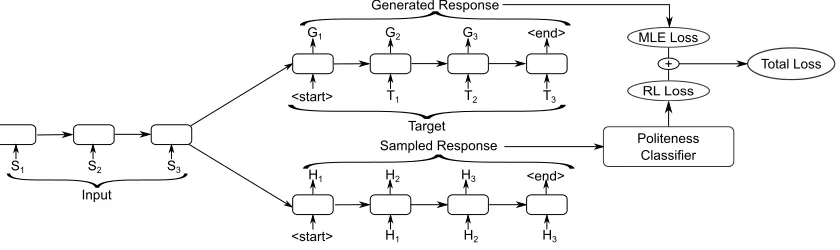
Figure 4: Polite-RL model: upper-right shows max-likelihood (ML) training with generated and ground-truth target sequences; lower-right shows RL training with a randomly sampled response generated by the model and the reward it generates after getting fed into the style classifier. Note that the attention mechanism is not shown here for clarity.
fier (see Figure 3), while during test time, we are free to scale the prepended politeness label with dif-ferent scores of our choice (i.e., when we want the model to generate a polite response, we scale the la-bel’s embedding by a score between 0.5 and 1.0,
whereas, to generate a rude response, we scale the embedding by a score between0.0and0.5). This ap-proach is related to the ‘numerically-grounded’ lan-guage model (Spithourakis et al., 2016), except that we scale the politeness label embedding by its corre-sponding politeness score, rather than concatenating the two as input to the LSTM.3
Thus, the LFT model is able to simultaneously produce polite, neutral and rude responses depend-ing on the prepended label, similar to recent multi-label, multi-space, and zero-shot machine trans-lation work using language identity or style la-bels (Sennrich et al., 2016a; Johnson et al., 2017; Ghosh et al., 2017). Intuitively, this prepended label serves as the prior for the intended style of the gen-erated response sequence, while the source utterance serves as the prior for the content of the generated sequence. In other words, the label and the source sentence cooperatively determine what the overall response looks like.4
3Although we trained the politeness classifier to be binary, its outputs are probabilities ranging from0.0to1.0. This allows
us to interpret the outputs as continuous politeness scores. 4Note that the position of the label did not affect the results much (e.g., Sennrich et al. (2016a) appended the label at the end of the input sequence). Moreover, our models use a bidi-rectional encoder, which does not distinguish between the be-ginning and end of the source sequence.
4.4 Polite Reinforcement Learning Model
The LFT model incorporates style more directly into its training procedure than the fusion model, but it still does not fully exploit the value of the style clas-sifier since it only supervises the dialogue model once by initially classifying the style of all the tar-get sequences in the training set. Ideally we would want the classifier to constantly monitor and influ-ence what style the model produces. Moreover, many contexts do not naturally elicit a polite re-sponse,5 in which case we do not want to force
the model to generate an utterance that matches the target politeness score, but rather to ask the model to generate as polite and natural a response as it could. These limitations motivate us to propose the third model: Polite Reinforcement Learning model (Polite-RL), where the style classifier regularly up-dates the model parameters (via sampling-based pol-icy gradient) with continuous-spectrum rewards that encourage decoder-generated response samples to be polite and discourage them from being rude.
Following work from Paulus et al. (2018), our loss function consists of two terms. The first term is the traditional maximum likelihood loss (LML), which we refer to as the teacher forcing part. The other one is the reinforcement learning loss (LRL) based on politeness scores, which we refer to as thereinforce part. The total lossLthen takes the form:
L=LML+β LRL (2)
where β is a hyperparameter indicating how much weight we want to give to the style reward compo-nent of the loss. The teacher forcing part minimizes the average of the maximum-likelihood loss at each decoding step. Specifically, lety∗={y∗1, y∗2, ..., y∗n} be the ground-truth response for a given source (conversation history) utterance sequence x. The maximum-likelihood training objective is the min-imization of the loss:
LML =− n
X
t=1
logp(yt∗|y1∗, ..., yt∗−1, x). (3)
We use a policy gradient method (Williams, 1992; Sutton et al., 2000) to calculate the second term in the objective function. Specifically, we sam-ple a generated response for each input sequence (conversation history) x, and assign to it a reward R, which in our case is the politeness classifier’s probability of the response classified as polite. Let ys ={y1s, y2s, ..., ysn}be the sampled response, then the reinforce part of the loss is:
LRL =−(R−Rb) n
X
t=1
logp(yst|y1s, ..., yst−1, x)
(4) where Rb is a baseline that helps reduce variance during training (Ranzato et al., 2016).
Note that we can invert the classifier scores or re-ward (by flipping the first minus sign in Eq. 4), if we want to encourage rudeness as the style, instead of politeness. This also shows that an advantage of our implementations of the LFT model over the Polite-RL model (at the cost of shallower training) is that the LFT model can multitask to simultaneously produce responses of different style labels at test time, whereas reward-based reinforcement learning can only work in one direction at a time (based on the reward sign).6
4.5 Retrieval-based Models
We employ two retrieval-based baseline models as a sanity check to the proposed approaches’
perfor-6However, to make the reward-based model capable of mul-titasking, one could also prepend various politeness labels to each of the context in the training set (thus generating several examples out of one context), and encourage the generated re-sponse to be consistent with the given label. We will explore this extension in future work.
mance: the first with oracle-level fluency, the second with additional oracle-level politeness.
Classifier-based Retrieval Following Lowe et al.
(2015), for a[X1, Y, X2]triple, our retrieval model
treats the context (X1, Y) and each response (X2) as
two documents and converts them to their TF-IDF based vectors (Ramos, 2003) to check for similarity. Specifically, we first obtain all candidate responses in the training set that are polite,7and calculate their
TF-IDF vectors. Then for each context TF-IDF vec-tor in the test set, we calculate its cosine similarity with that of each such polite-classified candidate re-sponse, and output the one with the highest value. Intuitively, for each context we are choosing a re-sponse that is both polite and most relevant to (hav-ing the most word overlaps with) the context.
Generic-10 This approach is similar to the one
above but uses the10 manually-chosen most-polite
generic utterances as candidate responses for each context. Specifically, we collect all ground-truth po-lite requests from the Stanford Popo-liteness Corpus, split each one into sentences, and then manually pick the most frequent 10 polite sentences.8 We then
determine which one to retrieve as a response for each input context, based again on the TF-IDF vec-tor similarity method described above.
5 Experimental Setup
5.1 Datasets
As discussed above, we propose models that can deal with style data coming from an unpaired, non-parallel domain, different from the domain of the di-alogue dataset. For our style (politeness) domain, we use the Stanford Politeness Corpus (Danescu-Niculescu-Mizil et al., 2013), which contains a col-lection of requests fromWikipedia (WIKI) editor’s
talk pages and the Stack Exchange (SE) question-answering communities. Based on scores from hu-man annotators, these requests are labeled with ei-therPoliteorRude, with each class equally consist-ing of 1,089 requests for the Wikipedia domain and 1,651 requests for the Stack Exchange domain. For the content (dialogue) domain, we use the popular MovieTriplesdialogue corpus (Serban et al., 2016), which contains 245K conversations extracted from IMSDB movie scripts inX-Y-Xtriplet-utterance for-mat, where X and Y correspond to two movie char-acters (and the model’s task is to generate the last response).
5.2 Evaluation Methods
Human To evaluate our models’ ability to
gen-erate polite responses without sacrificing dialogue quality, we conducted several comprehensive hu-man evaluation studies on Amazon Mechanical Turk (MTurk). Specifically, we compare the three stylis-tic models w.r.t. the base model on both dialogue quality (i.e., context relevance and coherence) and politeness level.9 For this, we randomly sampled
300contexts covering all types of conversations and
their generated responses from the Seq2seq base model, the three stylistic models, and the retrieval-based models. For each source input, the six re-sponses are randomly shuffled to anonymize model identities. Each response was then annotated by two human evaluators that were located in the US, had an approval rate greater than98%, and had at least 10,000approved HITs (Human Intelligence Tasks)
on record (to prevent those who had just started using MTurk and hence unconditionally enjoyed a high acceptance rate.). All our human evaluations are performed by two annotators (for both dialogue quality and politeness level) in order to calculate inter-rater agreement, for which we employ Cohens Kappaκ (Cohen, 1968), a score that measures the level of inter-rater agreement between two annota-tors on a classification problem (Artstein and
Poe-9We opted for dialogue quality rather than several separated, fine-grained metrics such as relevance, specificity, informative-ness because Lowe et al. (2017) found that little additional in-formation was provided by adding in more metrics on top of overall dialogue quality, and it also confused MTurkers in many scenarios. We had similar observations in our initial human study on MTurk.
sio, 2008). For both dialogue quality and polite-ness evaluations, the human raters were shown the conversation context (input) and the six shuffled re-sponses (from the six models). Clear instructions (closely following those from Wang et al. (2017)) corresponding to each score were shown in the in-terface. More specifically, we asked the annota-tors to first read the context and each of the gener-ated/retrieved responses, and assign a score to each response. They then scored each response on a five-point Likert scale (Likert, 1932) (for both polite-ness and dialogue quality), hence providing absolute measurements but in an overall comparative (rela-tive) setting.10We explicitly stated that it is possible
for them to find some conversation disconnected or lacking context, and encouraged them to make the best guess when in doubt. Using similar instruc-tions (and a 300-sized sample), we also performed
a separate 3-way LFT model comparison by setting its target politeness scores to 1.0, 0.5, and0.0,
re-spectively.
Automatic Since there do not exist ground-truth
stylized versions of the response to the MovieTriples conversations, we only use automatic evaluation metrics as complementary and trend-verification in-formation to the primary human perception studies in this work: we compute BLEU (a phrase-matching based metric; (Papineni et al., 2002)) as an approx-imation of dialogue quality as used by some previ-ous work (Ritter et al., 2011; Galley et al., 2015; Li et al., 2016c). Note that we choose to report BLEU scores not to draw any immediate conclusion (Liu et al. (2016) found that BLEU does not corre-late well with human studies on dialogue quality), but rather to check for match with the trends from
human evaluation. We also compute the politeness classifier’s scores as an approximation of politeness level. Sec. 6.3 discusses these results.
5.3 Training Details
We now present some important training details.11
Embedding Initialization For all our models, we
initialized the embedding matrix with word2vec trained on Google News dataset (about 100 billion words)12 (Mikolov et al., 2013); we use Xavier
initializer (Glorot and Bengio, 2010) for out-of-vocabulary words.
Pretraining Following Serban et al. (2016), we
pretrained the Seq2seq base model for4epochs with
Q-A SubTle corpus (Ameixa et al., 2014), which contains around5.5M movie subtitle Q&A pairs.
Implementation Details We used 300-dim
em-beddings, the AdamOptimizer (Kingma and Ba, 2015) with a learning rate of 0.001, and a dropout
rate of 0.2. All models were trained with a
mini-batch of size 96. The classifier was trained for 3 epochs, and the three proposed stylistic models were each trained for 35 epochs. The polite language model used in the Fusion model was trained until there was no improvement for perplexity on a held-out dev-set (all tuning decisions were made on the respective dev-sets). We use a balanced value of0.5
for the fusion ratio (α in Eq. 1), and2.0for the RL
weight (β in Eq. 4) after some light empirical tun-ing. Due also to the nearly perfect balance between the number of polite and rude examples in the Stan-ford Politeness Corpus, we set the baseline reward of Polite-RL (Rb in Eq. 4) to a constant 0.5 at all times.13 Note that for effective and non-confusing
MTurk studies, for all our models (the base model
11We will add all reproducibility details and more analysis examples in a post-publication supplement on our webpage.
12https://code.google.com/archive/p/
word2vec/
13We also tried using a self-critical baseline as in Rennie et al. (2017), but found that our way of setting the constant-based baseline led to better responses. We speculate that this is be-cause a self-critical approach tries to make an utterance as po-lite as possible, which usually leads to a few very generic and very polite responses at convergence (because the model gets a positive reward only when the sampled utterance is more polite than the greedy-decoded one).
WIKI SE
SVM 82.6% 65.2%
CNN 85.8% 66.4%
[image:9.612.351.504.53.104.2]LSTM-CNN 85.0% 70.2%
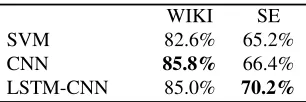
Table 1: Politeness classification accuracies. Top results are boldfaced.
and the three stylistic models), we avoid UNK to-kens to appear in the generated response, by not back-propagating the MLE loss for these tokens. We also do the same for a short list (around 10) of very offensive swear words (from Wiktionary).
6 Results
In this results section, we first briefly present our po-liteness classifier (Sec. 3) and base dialogue model (Sec. 4.1) results, and then focus on the stylistic-dialogue results (retrieval and generative).
6.1 Politeness Classification Results
Following Danescu-Niculescu-Mizil et al. (2013), we use accuracy (i.e., percentage of correctly la-beled messages for binary polite/rude labels) to eval-uate our politeness classifier’s generalization ability. Specifically, we used data from the training set of WIKI, and test on both the test set of WIKI and the entire SE (Stack Exchange) corpus. We used the same train-validation-test split setup (7:1:2) as
in Aubakirova and Bansal (2016).14 As shown in
Table 1, our LSTM-CNN model improved cross-domain accuracy (while maintaining comparable in-domain accuracy) compared to that of the SVM and CNN models reported in Aubakirova and Bansal (2016). This is similar to how Zhou et al. (2015) also found that a combination of LSTM-RNNs and CNNs is superior to an LSTM-RNN or CNN alone for sentiment classification, likely because the joint model captures both long-distance relationships as well as local windowed filter-based features, and this could make it easier to separate in-domain and out-of-domain properties. We also observe more im-provement on cross-domain accuracy because it has much more space for improvement, as opposed to
Model PPL PPL@L WER WER@L
RNN 27.09 26.67 64.10 64.07
[image:10.612.333.520.54.137.2]HRED 27.14 26.60 64.10 64.03 HRED-Bidir. 26.81 26.31 63.93 63.91 Seq2seq 25.96 25.85 64.27 64.25 Table 2: PPL, WER results computed on{U1, U2, U3}
and PPL@L, WER@L computed on{U3} conditioned
on{U1, U2}. Lower is better for all metrics. Top results
are boldfaced.
in-domain accuracy which is already very close to human performance. The higher accuracy is also important because we need a cross-domain-accurate style classifier so that it can effectively stylize re-sponses in diverse dialogue corpora domains such as MovieTriples.
6.2 Base Dialogue Model Results
Next, in Table 2, we show that our starting point, base dialogue model is comparable in quality to a popular, representative previous model of Serban et al. (2016), trained on the same corpora with sim-ilar model architectures. We use their Perplexity (PPL) and Word Error Rate(WER) metrics. In or-der to have a meaningful perplexity (i.e., the prob-ability of regenerating a reference response) com-parison between two language generation models, they should have the same vocabulary set. Since the vocabulary of our politeness dialogue models is a combination of vocabulary sets drawn from the MovieTriples and Stanford Politeness corpora, for fair comparison in this section, we separately train a base Seq2seq model following exactly the vocabu-lary (10,000most frequent tokens, plus an UNK for
the rest) and preprocessing protocols from Serban et al. (2016). We bootstrapped the model with4epochs
on the SubTle corpus (see Sec. 5.3), and then trained on MovieTriples until there was no improvement on perplexity for the validation set. The comparison for this base model with their hierarchical-encoder HRED models is presented in Table 2. As shown, we get comparable results overall on all metrics, and hence we have a good starting-point dialogue model, to which we add politeness, via the following three approaches.
6.3 Stylistic Dialogue Model Results
Primary Human Evaluation Results In this
sec-tion, we present our primary human evaluation
Politeness Quality Difference Retrieval 3.57 3.15 0.42 Generic-10 3.66 2.99 0.67 Seq2seq 3.11 3.42 0.31 Fusion 3.23 3.05 0.18
LFT 3.63 3.39 0.24
Polite-RL 3.50 3.54 0.04
Table 3: MTurk human evaluation results on politeness level and dialogue quality (as well as the absolute value difference between the two, to show balance) of the Re-trieval Models, Seq2seq and the three proposed genera-tive models (avg. of two annotators is shown here). Top results are boldfaced.
(MTurk) results on both politeness level and dia-logue quality (context-relevance) of the generated response, based on two annotators and a 300-sized test sample. Table 3 shows the annotator-average scores for each of these two metrics and their ab-solute difference, based on our Likert scales of1to 5 (see Sec. 5.2). We can first see that all three of
our stylistic generative models improve on polite-ness compared to the Seq2seq base model. How-ever, the Fusion model’s politeness gain is not sta-tistically significant,15and moreover it achieves this
minor politeness level improvement at the cost of significantly compromising dialogue quality (be-cause its output is half-determined by a standalone politeness-trained LM that ignores context).
Next, we see that the LFT model is the most po-lite (stat. significance ofp <0.01over the Seq2seq
model), and also has dialogue quality close (statisti-cally equal) to that of Seq2seq. Our final Polite-RL model wins over Seq2seq on politeness (stat. sig-nificance of p < 0.01) as well as achieves a small
improvement in dialogue quality (though not at stat. significance level; but it is stat. significantly bet-ter in quality than Retrieval, Generic-10 and Fu-sion.). Moreover, the politeness levels of the LFT and Polite-RL models are statistically equal. There-fore, both models, with their training depth and mul-titasking trade-offs (see Sec. 4), can produce strong levels of stylistic content, without harming context-relevance.
Lastly, we can also see that our two retrieval-based models are both very polite (but not stat.
[image:10.612.74.299.54.117.2]nificantly better over LFT); and as expected, they both have dialogue quality lower than Seq2seq, Polite-RL and LFT (stat. significance ofp < 0.01).
They also feature two of the worst balances between average politeness and dialogue quality score. This is the type of sacrifice we want to avoid from im-posing on dialogue quality when building a stylistic dialogue model.
For inter-annotator agreement, the Kappa score was 0.35 (fair16) on Dialogue Quality and 0.46
(moderate) on Politeness. If we employ a collapsed-Likert version, where the more ambiguous and ex-treme scores of {1,2} and{4,5} are bucketed to-gether,17 we obtained a Kappa score of0.42
(mod-erate) on Dialogue Quality and0.55 (moderate) on
Politeness.
Human Evaluation Results on 3-way LFT Mod-els We also present results on a 3-way politeness level comparison MTurk study among the Polite-LFT, Neutral-Polite-LFT, and Rude-LFT models, i.e., the LFT model with three levels (scores) of scaling the prepended style label, corresponding to polite-ness scores1.0, 0.5 and0.0, respectively (Table 4,
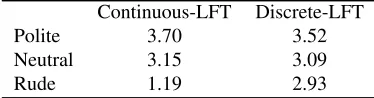
Continuous-LFT column). The table shows that
Polite-LFT is significantly more polite than Neutral-LFT (stat. significance ofp < 0.01), and
Neutral-LFT is in turn more polite than Rude-Neutral-LFT (stat. sig-nificance of p < 0.01). For inter-annotator
agree-ment on this 3-way LFT study, we get a Kappa of 0.51 (moderate), and 0.61 (substantial) for the collapsed-Likert case.
We also experimented earlier with a discrete ver-sion of LFT, where we treated responses in the
[0.8,1.0] range as polite, [0.2,0.8] as neutral, and [0.0,0.2] asrude. Instead of scaling a single label
embedding with continuous politeness scores (as de-scribed in Section 4.3), we assigned to each response one of these three labels with no scaling, accord-ing to its correspondaccord-ing politeness bin. The human evaluation scores for that model were3.52,3.09and 2.93, respectively, which features less score
differ-ence between neutral and rude (Table 4
Discrete-16These levels were defined by Landis and Koch (1977); also seehttps://en.wikipedia.org/wiki/Cohens_kappa
17As discussed in Weijters et al. (2010), James et al. (1984), and https://en.wikipedia.org/wiki/Likert_ scale, the ‘central tendency bias’ makes raters avoid using the two extreme response categories.
Continuous-LFT Discrete-LFT
Polite 3.70 3.52
Neutral 3.15 3.09
[image:11.612.331.518.55.104.2]Rude 1.19 2.93
Table 4: MTurk human evaluation results on politeness level of 3 LFT models, for both the continuous and the discrete versions.
LFTcolumn).
Automatic Metric Evaluation Results As
dis-cussed in Sec. 5.2, we also use some automatic eval-uation metrics to complement and verify the MTurk human study results. In Table 5, we present the av-erage politeness classifier and BLEU-4 scores of re-sponses from each model. First, we can see that our politeness classifier agrees reasonably well with the human politeness judgments in Table 3, since both identify the Retrieval-based models and LFT as the most polite, followed by Polite-RL and Fusion in descending order. We quantified this ‘agreement’ concretely, and found high correlation between the six human Politeness scores (Table 3Politeness col-umn) and the six automatic classifier scores (Ta-ble 5 Politeness Score column): Pearson correla-tion is 0.827(stat. significance p = 0.0422), and
Spearman’s rank-order correlation is 0.9276 (p = 0.0077). Next, for BLEU scores, although these scores (as percentages) are very low (consistent with the observation in Ritter et al. (2011) and Li et al. (2016b)), their relative system-ranking still roughly agrees with that of human judgments — we found reasonably high correlation between human Dia-logue Quality and BLEU (based on the six scores in Table 3Qualitycolumn and Table 5BLEU-4 col-umn): Pearson correlation is 0.793 (stat.
signifi-cancep = 0.0597), and Spearman’s rank-order cor-relation is0.771(p= 0.0724).
main-Politeness Score BLEU-4
Retrieval 0.88 0.59
Generic-10 0.93 0.03
Seq2seq 0.49 1.05
Fusion 0.61 0.78
LFT 0.72 1.02
[image:12.612.312.537.52.465.2]Polite-RL 0.61 0.94
Table 5: Automatic metrics: avg. politeness and BLEU-4 scores for the two Retrieval models, Seq2seq and three proposed models. Also, the politeness score of Neutral-LFT and Rude-Neutral-LFT are 0.48, 0.25, resp. Top results are boldfaced.
Target Sequence Score
Polite Examples
well , thanks . that ’s . i appreciate that . 0.99 hnumi,hnumiof them in los angeles . i checked . nice work , though . 0.98 nah . i have curfew . he starts to walk away , then
stops . quincy oh , by the way . congratulations .
0.97
thank you , ma’am . um , may i ask what this is regarding ?
0.91
hi ,hpersoni. how are you ? 0.89
i know . amazing . 0.89
Rude Examples
you really should pay more attention to what you
read ,hpersoni. 0.11 they were in a car accident . 0.10 you calling more of your stupid friends again ? ya
prick .
0.05
[image:12.612.97.273.54.140.2]are you a bad boy ? 0.05 then she ’s a liar . 0.04 excuse me , does that flask belong to this man ? 0.03 oh , well , excuse me all to hell . 0.02 Table 6: Analysis of politeness classifier: sampled re-sponses from MovieTriples dialogue corpus (without cherry-picking) and their politeness score. The double line separates polite and rude classified responses.
tain comparable quality with improved politeness over the base model (Seq2seq). For the retrieval models, we again see that their politeness levels are better than LFT and RL models, but with a corre-sponding loss in dialogue quality.
7 Analysis
7.1 Analysis of Politeness Classifier
We start our analysis by providing qualitative exam-ples of how well our politeness classifier performs on the target sequences from MovieTriples train dataset. This is important to check because the clas-sifier is trained on Wikipedia (Wiki) admin request messages, and while our LSTM-CNN performs
bet-Input X: for what ?
Y: for forcing me to face my life honestly for the first time .
Retrieval X: what ’s the c . w . for ?
Generic-10 X: thanks for the answer .
S2S X: that ’s not true .
Fusion X: i do n’t know . I mean , it ’s just a feeling , but that ’s not what i ’m saying .
LFT X: you ’ll be fine .
RL X: i wish i could .
Input X: no, but i wanted to.
Y: are you a total lying , scumsucking pig , hpersoni?
Retrieval X: sohpersoni, what did it total out at ?
Generic-10 X: no problem .
S2S X: oh , that ’s ridiculous .
Fusion X: well , you ’re not a little funny .
LFT X: i do n’t think so , sir .
RL X: you ’re hurting me !
Input X: you ’re sweet to say so .
Y: pretty song .
Retrieval X: is there a song you do n’t know ?
Generic-10 X: can you clarify ?
S2S X:hpersoni, i know .
Fusion X: you ’re a good man .
LFT X: i love this song .
RL X: you sound like a goddess .
Input X: i find it hard to believe myself .
Y: his lips , unused as they are to such a contortion , twisted and stretched . into a smile .
Retrieval X: thank you . and always smile .
Generic-10 X: nice .
S2S X: how can you be so sure ?
Fusion X: you ’re a good man , mr .
LFT X: your lips are well .
RL X: your lips are so beautiful .
Table 7: Output dialogue response examples by Retrieval, Generic-10, Seq2seq (denoted as S2S) and the 3 genera-tive polite models Fusion, LFT, and RL (shows conversa-tion history turns of X and Y, and then the generated 3rd turn response by X).
[image:12.612.73.298.207.447.2]Danescu-i am sorry
i
really am
sorry ,
. yes
sir i will take care of it . you
are a smart looking guy .
0 100 200 300
[image:13.612.75.297.56.153.2]0 100 200 300 00 100 200 300 0 100 200 300 Figure 5: Saliency heatmaps of the classifier’s attention (reward for sampled responses in Polite-RL model).
Niculescu-Mizil et al. (2013), e.g., positive ones such as gratitude, deference, greeting, positive lexi-con, indirection, indicative modal, and negative ones such as negative lexicon, direct question, direct start, 2nd person start. However, it does occasionally give strongly polite or rude scores to some mild or neu-tral responses, e.g., “they were in a car accident”, showing scope for classifier improvements.
7.2 Output Examples of Stylistic Dialogue
Next, we show some output examples of our polite dialogue models w.r.t. the base Seq2seq model as well as the retrieval-based models. We use these ex-amples to demonstrate the politeness strategies our proposed generative models have learned (in Ta-ble 7). In the first example, our stylistic models use politeness strategies such as indirection, pos-itive lexicon and counterfactual modal (Danescu-Niculescu-Mizil et al., 2013). This example also illustrates the behavior of the Retrieval model, i.e., most of the time it just outputs an utterance that has word overlap with but totally irrelevant to the con-text. Thus although all its retrieved responses have oracle-level fluency and grammaticality, its average dialogue quality score in the human evaluation is still not as good as that of Seq2seq.
In the second example, Fusion uses indirection, while LFT is being polite even when disagreeing with the abusive language from Y. This example also shows that Generic-10, due to its limited space for retrieval, oftentimes fails to provide a relevant answer, although it is the most polite one since its candidate responses are manually picked. In the third example, Fusion and LFT both use positive licon, and RL makes a compliment. In the fourth ex-ample, each of the three proposed models uses pos-itive lexicon. It is worth noting that in the last ex-ample, while LFT and Polite-RL seem to provide a
relevant compliment, they are actually compliment-ing the wrong person. This kind of issue motivates us toward creating persona-based (Li et al., 2016c) politeness models for future work.
7.3 Visualization of Polite-RL Reward
Using derivative saliency (Simonyan et al., 2013; Li et al., 2016a; Aubakirova and Bansal, 2016), we also visualize how much each token in the sampled re-sponse contributes to the classifier’s reward during Polite-RL model’s training. Fig. 5 shows three such heatmaps that correspond to the magnitudes of the derivative in absolute value with respect to each di-mension. The figures clearly show that the classifier has learned to identify multiple politeness strategies, e.g., “smart” (deference), “sir” (polite address), and the two “sorry”s (apologizing).
8 Conclusion and Future Work
We first presented three diverse generative mod-els that can generate rich polite-to-rude spectrum dialogue responses (based on the politeness theo-ries by Brown and Levinson (1987)), without us-ing any parallel data (which is usually assumed for tasks such as machine translation) and only relying on a style classifier. Via multiple human evalua-tion studies and automatic metrics, we demonstrated that all three models generate more polite responses (displaying several politeness strategies discussed in previous psycholinguistic works), while LFT and Polite-RL are able to do so without losing dialogue quality, as opposed to the Fusion model as well as the two retrieval-based models.
In future work, there is still much room for im-provement on the politeness as well as dialogue quality side, and one could employ more recent, ad-vanced models such as variational, adversarial, and decoder-regulation techniques.
of the generated response and then only feeding the politeness portion to the classifier for RL training.
Acknowledgments
We thank the action editor and the anonymous re-viewers for their helpful comments and discussions. This work was supported by DARPA (YFA17-D17AP00022), Facebook ParlAI Research Award, Google Faculty Research Award, Bloomberg Data Science Research Grant, and Nvidia GPU awards. The views, opinions, and/or findings contained in this article are those of the authors and should not be interpreted as representing the official views or policies, either expressed or implied, of the funding agency.
References
David Ameixa, Luisa Coheur, Pedro Fialho, and Paulo Quaresma. 2014. Luke, I am your father: Dealing with out-of-domain requests by using movies subti-tles. InInternational Conference on Intelligent Virtual Agents, pages 13–21. Springer.
Ron Artstein and Massimo Poesio. 2008. Inter-coder agreement for computational linguistics. Computa-tional Linguistics, 34(4):555–596.
Malika Aubakirova and Mohit Bansal. 2016. Interpret-ing neural networks to improve politeness compre-hension. InProceedings of the 2016 Conference on Empirical Methods in Natural Language Processing, pages 2035–2041.
Dzmitry Bahdanau, Kyunghyun Cho, and Yoshua Ben-gio. 2015. Neural machine translation by jointly learning to align and translate. InProceedings of In-ternational Conference on Learning Representations, pages 1–15.
Penelope Brown and Stephen C. Levinson. 1987. Polite-ness: Some Universals in Language Usage, volume 4. Cambridge University Press.
Michael Buhrmester, Tracy Kwang, and Samuel D. Gosling. 2011. Amazon’s Mechanical Turk: A new source of inexpensive, yet high-quality, data? Per-spectives on Psychological Science, 6(1):3–5.
Jacob Cohen. 1968. Weighted Kappa: Nominal scale agreement provision for scaled disagreement or partial credit.Psychological Bulletin, 70(4):213–220. Ronan Collobert, Jason Weston, L´eon Bottou, Michael
Karlen, Koray Kavukcuoglu, and Pavel Kuksa. 2011. Natural language processing (almost) from scratch. Journal of Machine Learning Research, 12(Aug):2493–2537.
Cristian Danescu-Niculescu-Mizil, Moritz Sudhof, Dan Jurafsky, Jure Leskovec, and Christopher Potts. 2013. A computational approach to politeness with appli-cation to social factors. In Proceedings of the 51st Annual Meeting of the Association for Computational Linguistics, pages 250–259.
Daxiang Dong, Hua Wu, Wei He, Dianhai Yu, and Haifeng Wang. 2015. Multi-task learning for multi-ple language translation. InProceedings of the 53rd Annual Meeting of the Association for Computational Linguistics and the 7th International Joint Conference on Natural Language Processing (Volume 1: Long Pa-pers), pages 1723–1732.
Bradley Efron and Robert J. Tibshirani. 1994. An Intro-duction to the Bootstrap. CRC press.
Jessica Ficler and Yoav Goldberg. 2017. Controlling linguistic style aspects in neural language generation. InProceedings of the Workshop on Stylistic Variation, pages 94–104.
Zhenxin Fu, Xiaoye Tan, Nanyun Peng, Dongyan Zhao, and Rui Yan. 2018. Style transfer in text: Exploration and evaluation. InProceedings of the Thirty-Second AAAI Conference on Artificial Intelligence (AAAI-18), pages 663–670.
Michel Galley, Chris Brockett, Alessandro Sordoni, Yangfeng Ji, Michael Auli, Chris Quirk, Margaret Mitchell, Jianfeng Gao, and Bill Dolan. 2015. deltaBLEU: A discriminative metric for generation tasks with intrinsically diverse targets. In Proceed-ings of the 53rd Annual Meeting of the Association for Computational Linguistics and the 7th Interna-tional Joint Conference on Natural Language Process-ing (Short Papers), pages 445–450.
Leon A. Gatys, Alexander S. Ecker, and Matthias Bethge. 2016. Image style transfer using convolutional neu-ral networks. InProceedings of the IEEE Conference on Computer Vision and Pattern Recognition, pages 2414–2423.
Sayan Ghosh, Mathieu Chollet, Eugene Laksana, Louis-Philippe Morency, and Stefan Scherer. 2017. Affect-LM: A neural language model for customizable affec-tive text generation. InProceedings of the 55th Annual Meeting of the Association for Computational Linguis-tics (Volume 1: Long Papers), pages 634–642. Xavier Glorot and Yoshua Bengio. 2010. Understanding
the difficulty of training deep feedforward neural net-works. InProceedings of the International Conference on Artificial Intelligence and Statistics (AISTATS’10). Society for Artificial Intelligence and Statistics, pages 249–256.
Zhiting Hu, Zichao Yang, Xiaodan Liang, Ruslan Salakhutdinov, and Eric P. Xing. 2017. Toward controlled generation of text. In Proceedings of the 34th International Conference on Machine Learning, PMLR 70, pages 1587–1596.
Lawrence R. James, Robert G. Demaree, and Gerrit Wolf. 1984. Estimating within-group interrater reliability with and without response bias. Journal of Applied Psychology, 69(1):85.
Harsh Jhamtani, Varun Gangal, Eduard Hovy, and Eric Nyberg. 2017. Shakespearizing modern language us-ing copy-enriched sequence-to-sequence models. In Proceedings of the Workshop on Stylistic Variation, pages 10–19.
Melvin Johnson, Mike Schuster, Quoc V. Le, Maxim Krikun, Yonghui Wu, Zhifeng Chen, Nikhil Thorat, Fernanda Vi´egas, Martin Wattenberg, Greg Corrado, Macduff Hughes, and Jeffrey Dean. 2017. Google’s multilingual neural machine translation system: En-abling zero-shot translation. Transactions of the Asso-ciation for Computational Linguistics, v. 5, pages 339– 351.
Rafal Jozefowicz, Oriol Vinyals, Mike Schuster, Noam Shazeer, and Yonghui Wu. 2016. Exploring the limits of language modeling. CoRR abs/1602.02410. Yuta Kikuchi, Graham Neubig, Ryohei Sasano, Hiroya
Takamura, and Manabu Okumura. 2016. Controlling output length in neural encoder-decoders. In Proceed-ings of the 2016 Conference on Empirical Methods in Natural Language Processing, pages 1328–1338. Taeksoo Kim, Moonsu Cha, Hyunsoo Kim, Jungkwon
Lee, and Jiwon Kim. 2017. Learning to discover cross-domain relations with generative adversarial net-works. InProceedings of the 34th International Con-ference on Machine Learning, pages 1857–1865. Diederik Kingma and Jimmy Ba. 2015. Adam: A
method for stochastic optimization. In Proceedings of International Conference on Learning Representa-tions.
Catherine Kobus, Josep Crego, and Jean Senellart. 2017. Domain control for neural machine translation. In Proceedings of Recent Advances in Natural Language Processing, pages 372–378.
J. Richard Landis and Gary G. Koch. 1977. The mea-surement of observer agreement for categorical data. Biometrics, pages 159–174.
Jiwei Li, Xinlei Chen, Eduard Hovy, and Dan Jurafsky. 2016a. Visualizing and understanding neural models in NLP. InProceedings of North American Chapter of the Association for Computational Linguistics-HLT, pages 681–691.
Jiwei Li, Michel Galley, Chris Brockett, Jianfeng Gao, and Bill Dolan. 2016b. A diversity-promoting
objec-tive function for neural conversation models. In Pro-ceedings of North American Chapter of the Associa-tion for ComputaAssocia-tional Linguistics-HLT, pages 110– 119.
Jiwei Li, Michel Galley, Chris Brockett, Jianfeng Gao, and Bill Dolan. 2016c. A persona-based neural con-versation model. InProceedings of the 54th Annual Meeting of the Association for Computational Linguis-tics, pages 994–1003.
Rensis Likert. 1932. A technique for the measurement of attitudes.Archives of Psychology.
Ming-Yu Liu and Oncel Tuzel. 2016. Coupled genera-tive adversarial networks. InAdvances in Neural In-formation Processing Systems, pages 469–477. Chia-Wei Liu, Ryan Lowe, Iulian V. Serban, Michael
Noseworthy, Laurent Charlin, and Joelle Pineau. 2016. How NOT to evaluate your dialogue system: An empirical study of unsupervised evaluation metrics for dialogue response generation. In Proceedings of the 2016 Conference on Empirical Methods in Natural Language Processing, pages 2122–2132.
Ming-Yu Liu, Thomas Breuel, and Jan Kautz. 2017. Unsupervised image-to-image translation networks. In Proceedings of the 2016 Conference on Empiri-cal Methods in Natural Language Processing, pages 2122–2132.
Ryan Lowe, Nissan Pow, Iulian V. Serban, and Joelle Pineau. 2015. The Ubuntu Dialogue Corpus: A large dataset for research in unstructured multi-turn di-alogue systems. In Proceedings of the 16th Annual Meeting of the Special Interest Group on Discourse and Dialogue (SIGDIAL 2015), pages 285–294. Ryan Lowe, Michael Noseworthy, Iulian V. Serban,
Nicolas Angelard-Gontier, Yoshua Bengio, and Joelle Pineau. 2017. Towards an automatic turing test: Learning to evaluate dialogue responses. In Proceed-ings of the 55th Annual Meeting of the Association for Computational Linguistics, pages 1116–1126. Yi Luan, Chris Brockett, Bill Dolan, Jianfeng Gao, and
Michel Galley. 2017. Multi-task learning for speaker-role adaptation in neural conversation models. In Pro-ceedings of the 8th International Joint Conference on Natural Language Processing, pages 605–614. Minh-Thang Luong, Quoc V. Le, Ilya Sutskever, Oriol
Vinyals, and Lukasz Kaiser. 2016. Multi-task se-quence to sese-quence learning. In Proceedings of In-ternational Conference on Learning Representations. Franc¸ois Mairesse and Marilyn Walker. 2007.
Person-age: Personality generation for dialogue. In Proceed-ings of the 45th Annual Meeting of the Association of Computational Linguistics, pages 496–503.
representa-tions in vector space. InProceedings of International Conference on Learning Representations Workshop. Jonas Mueller, David Gifford, and Tommi Jaakkola.
2017. Sequence to better sequence: Continuous revi-sion of combinatorial structures. InInternational Con-ference on Machine Learning, pages 2536–2544. Eric W. Noreen. 1989. Computer-Intensive Methods for
Testing Hypotheses. Wiley New York.
Kishore Papineni, Salim Roukos, Todd Ward, and Wei-Jing Zhu. 2002. BLEU: A method for automatic evaluation of machine translation. In Proceedings of the 40th Annual Meeting on Association for Computa-tional Linguistics, pages 311–318.
Romain Paulus, Caiming Xiong, and Richard Socher. 2018. A deep reinforced model for abstractive sum-marization. In Proceedings of International Confer-ence on Learning Representations.
Juan Ramos. 2003. Using TF-IDF to determine word relevance in document queries. InProceedings of the First Instructional Conference on Machine Learning, volume 242, pages 133–142.
Marc’Aurelio Ranzato, Sumit Chopra, Michael Auli, and Wojciech Zaremba. 2016. Sequence level training with recurrent neural networks. InProceedings of In-ternational Conference on Learning Representations. Steven J Rennie, Etienne Marcheret, Youssef Mroueh,
Jarret Ross, and Vaibhava Goel. 2017. Self-critical sequence training for image captioning. In2017 IEEE Conference on Computer Vision and Pattern Recogni-tion, page 1197.
Alan Ritter, Colin Cherry, and William B. Dolan. 2011. Data-driven response generation in social media. In Proceedings of the Conference on Empirical Methods in Natural Language Processing, pages 583–593. Mike Schuster and Kuldip K Paliwal. 1997.
Bidirec-tional recurrent neural networks. IEEE Transactions on Signal Processing, 45(11):2673–2681.
Rico Sennrich, Barry Haddow, and Alexandra Birch. 2016a. Controlling politeness in neural machine trans-lation via side constraints. In Proceedings of North American Chapter of the Association for Computa-tional Linguistics, pages 35–40.
Rico Sennrich, Barry Haddow, and Alexandra Birch. 2016b. Improving neural machine translation mod-els with monolingual data. InProceedings of the 54th Annual Meeting of the Association for Computational Linguistics, pages 86–96.
Iulian Vlad Serban, Alessandro Sordoni, Yoshua Bengio, Aaron C. Courville, and Joelle Pineau. 2016. Build-ing end-to-end dialogue systems usBuild-ing generative hier-archical neural network models. InThe Thirtieth AAAI Conference on Artificial Intelligence (AAAI-16), pages 3776–3784.
Yuanlong Shao, Stephan Gouws, Denny Britz, Anna Goldie, Brian Strope, and Ray Kurzweil. 2017. Gen-erating high-quality and informative conversation re-sponses with sequence-to-sequence models. In Pro-ceedings of the 2017 Conference on Empirical Meth-ods in Natural Language Processing, pages 2210– 2219.
Tianxiao Shen, Tao Lei, Regina Barzilay, and Tommi Jaakkola. 2017. Style transfer from non-parallel text by cross-alignment. InAdvances in Neural Informa-tion Processing Systems, pages 6833–6844.
Karen Simonyan, Andrea Vedaldi, and Andrew Zisser-man. 2013. Deep inside convolutional networks: Visualising image classification models and saliency maps. arXiv preprint arXiv:1312.6034.
Georgios P. Spithourakis, Isabelle Augenstein, and Se-bastian Riedel. 2016. Numerically grounded language models for semantic error correction. InProceedings of the 2016 Conference on Empirical Methods in Nat-ural Language Processing, pages 987–992.
Richard S. Sutton, David Mcallester, Satinder Singh, and Yishay Mansour. 2000. Policy gradient methods for reinforcement learning with function approximation. In Advances in Neural Information Processing Sys-tems 12, pages 1057–1063. MIT Press.
Yaniv Taigman, Adam Polyak, and Lior Wolf. 2016. Unsupervised cross-domain image generation. arXiv preprint arXiv:1611.02200.
Subhashini Venugopalan, Lisa Anne Hendricks, Ray-mond J. Mooney, and Kate Saenko. 2016. Improving LSTM-based video description with linguistic knowl-edge mined from text. In Proceedings of the 2016 Conference on Empirical Methods in Natural Lan-guage Processing, pages 1961–1966.
Di Wang, Nebojsa Jojic, Chris Brockett, and Eric Ny-berg. 2017. Steering output style and topic in neural response generation. InProceedings of the 2017 Con-ference on Empirical Methods in Natural Language Processing, pages 2140–2150.
Bert Weijters, Elke Cabooter, and Niels Schillewaert. 2010. The effect of rating scale format on response styles: The number of response categories and re-sponse category labels. International Journal of Re-search in Marketing, 27(3):236–247.
Ronald J Williams. 1992. Simple statistical gradient-following algorithms for connectionist reinforcement learning. In Reinforcement Learning, pages 5–32. Springer.
Wei Xu, Alan Ritter, Bill Dolan, Ralph Grishman, and Colin Cherry. 2012. Paraphrasing for style. In Proceedings of the 24th International Conference on Computational Linguistics, pages 2899–2914. Hayahide Yamagishi, Shin Kanouchi, Takayuki Sato, and
sentence in Japanese-to-English neural machine trans-lation. InProceedings of the 3rd Workshop on Asian Translation (WAT2016), pages 203–210.
Zili Yi, Hao Zhang, Ping Tan, and Minglun Gong. 2017. DualGAN: Unsupervised dual learning for image-to-image translation. In Proceedings of International Conference on Computer Vision.
Tiancheng Zhao, Ran Zhao, and Maxine Eskenazi. 2017. Learning discourse-level diversity for neural dialog models using conditional variational autoencoders. In Proceedings of the 55th Annual Meeting of the Associ-ation for ComputAssoci-ational Linguistics (Volume 1: Long Papers), pages 654–664.
Chunting Zhou, Chonglin Sun, Zhiyuan Liu, and Francis Lau. 2015. A C-LSTM neural network for text classi-fication.arXiv preprint arXiv:1511.08630.