Proceedings of NAACL-HLT 2018, pages 2049–2059
Dialog Generation Using Multi-turn Reasoning Neural Networks
Xianchao Wu1, Ander Mart´ınez2∗, Momo Klyen1
1A.I.&Research, Microsoft Development Co., Ltd.
2Graduate School of Information Science, Nara Institute of Science and Technology
{xiancwu, momokl}@microsoft.com, [email protected]
Abstract
In this paper, we propose a generalizable
di-alog generation approach that adapts
multi-turn reasoning, one recent advancement in the field of document comprehension, to gener-ate responses (“answers”) by taking current conversation session context as a “document” and current query as a “question”. The major idea is to represent a conversation session into memories upon which attention-based mem-ory reading mechanism can be performed mul-tiple times, so that (1) user’s query is properly extended by contextual clues and (2) optimal responses are step-by-step generated. Consid-ering that the speakers of one conversation are not limited to be one, we separate the single memory used for document comprehension into different groups for speaker-specific topic and opinion embedding. Namely, we utilize the queries’ memory, the responses’ memory, and their unified memory, following the time sequence of the conversation session. Experi-ments on Japanese 10-sentence (5-round) con-versation modeling show impressive results on how multi-turn reasoning can produce more diverse and acceptable responses than state-of-the-art single-turn and non-reasoning base-lines.
1 Introduction
Dialogue systems such as chatbots are a thriving topic that is attracting increasing attentions from researchers (Sordoni et al., 2015; Serban et al., 2016;Li et al., 2015;Wen et al., 2016). Recent achievements, such as deep neural networks for text generating, user profiling (Li et al.,2014), and natural language understanding, have accelerated the progresses of this field, which was historically approached by conventional rule-based and/or sta-tistical response ranking strategies.
∗
Work done when Ander was an intern in Microsoft. Wu and Ander contributed equally to this paper.
Response ranking models retrieve the most suit-able response(s) from a fixed set of (question, answer) pairs given a dialogue context and cur-rent query from a user (Banchs and Li, 2012; Lowe et al., 2015). Learning-to-rank approaches were applied to compute the similarity scores of between (query, context) and indexed candidate (question, answer) pairs to return the optimal “an-swer” to the user. These ranking-based retrieval strategies have been well-applied as an impor-tant approach to dialogue systems, yet the set of scripted responses are limited and are short at gen-eralization. On the other hand, statistical machine translation (SMT) systems have been applied to dialogue systems (Ritter et al.,2011), taking user’s query as a source language sentence and the chat-bot’s response as a target language sentence. La-beled data for learning-to-ranking training will not be necessary anymore and all we need is the large-scale (question, answer) pairs.
The sequence-to-sequence model proposed in (Sutskever et al., 2014) applied end-to-end train-ing of neural networks to text generation. This model, further enhanced by an attention mecha-nism (Bahdanau et al., 2014), was generic and allowed its application to numerous sequence-to-sequence learning tasks such as neural ma-chine translation (NMT) (Cho et al., 2014; Bah-danau et al., 2014), image captioning (Donahue et al., 2015; Mao et al., 2015), speech recogni-tion (Chan et al., 2015) and constituency parsing (Vinyals et al., 2015). The simplicity of these models makes them attractive, since “translation” and “alignment” are learned jointly on the fly.
Specially, Vinyals and Le (2015) applied the sequence-to-sequence model to conversational modeling and achieved impressive results on var-ious datasets. Their model was trained to predict a response given the previous sentence (s). Shang et al.(2015) combined local and global attentions
and reported better results than retrieval based sys-tems. Sordoni et al.(2015) explored three differ-ent end-to-end approaches for the problem of pre-dicting the response given a query attached with a single message context.
Multi-turn conversation modeling is considered to be more difficult than machine translation, since there are many more acceptable responses for a given (context, query) input and these often rely on external knowledge and/or contextual reason-ing. Dialogue systems trained with a maximum likelihood estimation (MLE) objective function, as most SMT utilizes, often learn to reply generic sentences as “I don’t know” or “sounds good”, which have a high incidence in the “answer” part of (question, answer) style training datasets. There have been various attempts atdiversifyingthe re-sponses (Li et al.,2016a;Yu et al.,2016;Li et al., 2017) but the lack of variations in the responses remains as an essential challenge. We wonder that if this stress can be relieved by modeling the prior context in a rather fine-grained way.
In document comprehension fields, multi-turn reasoning (also called multi-hop reasoning) has delivered impressive results by assimilating vari-ous pieces of information to produce an unified answer (Hill et al., 2015; Dhingra et al., 2016). Through multi-turn reading the document’s mem-ory using attention models, current question can be extended with much richer knowledge. This makes it easier to figure out the correct answer from that document. Different documents need to be read different times to yield out the correct an-swer for the input question. Specially,Shen et al. (2016) use a dynamic number of turns by intro-ducing a termination gate to control the number of iterations of reading and reasoning.
Motivated by the reasoning network for docu-ment comprehension (Shen et al.,2016), we pro-pose multi-turn reasoning neural networks that generate the proper response (or, “answer”) by attention-based reasoning from current conver-sation session (“document”) and current query (identical to “question” in document comprehen-sion) from the user. In particular, our networks utilize conversation context and explicitly sep-arate speakers’ interventions into sentence-level and conversation-level memories. Our first model uses plain single-turn attention to integrate all the memories, and the second approach integrates multi-turn reasoning. The formulation of our
pro-posed approach is designed in a generalized way, allowing for inclusion of additional information such as external knowledge bases (Yih and Ma, 2016;Ghazvininejad et al.,2017;Han et al.,2015) or emotional memories (Zhou et al.,2017). More-over, our approach for two-speaker scenario can be easily extended to group chatting by a further speaker-specific memory splitting.
We evaluate the performances of our meth-ods by comparing three configurations trained on a Japanese twitter conversation session dataset. Each conversation session contains 10 sentences which are 5-round between two real-world speak-ers. The results provide evidences that multi-turn reasoning neural networks can help improving the consistency and diversity of multi-turn conversa-tion modeling.
This paper is structured as follows: Section 2 gives a general description of multi-turn conver-sation modeling; Section3describes background neural language modeling, text generation, and at-tention mechanisms; Section4.1first introduces a model with multiple attention modules and then explains how the multi-turn reasoning mechanism can be further integrated into the previous mod-els; Sections 5, 6 and 7 describe the experimen-tal settings and results using automatic evaluation metrics, detailed human-evaluation based analy-sis, and conclusions, respectively.
2 Multi-turn Conversation Modeling
Consider a dataset D consisting of a list of
con-versations between two speakers. Each conversa-tion d ∈ D is an ordered sequence of sentences
si, wherei∈[1, Td]andTdis the number of sen-tences ind, produced by two speakers alternately. In this way, forsi, sj ∈d, both sentences are from the same speaker if and only if i ≡ j (mod 2).
Note that, our definition includes the case that one speaker continuously expresses his/her message through several sentences. We simply concatenate these sentences into one to ensure that the conver-sation is modeled with alternate speakers.
A multi-turn conversation model is trained to search parameters that maximize the likelihood of every sentence si ∈ d where i ≥ 2, supposing that the beginning sentences1is always given as a
precondition:
θM = arg max
θ {L
where
L(θ,D) =X
d∈D Td Y
i=2
p(si|s<i). (2)
Here,s<iare sentencessj ∈dandj < i.
The probability of each sentence, p(si|s<i), is frequently estimated by a conditional language model. Note that, traditional single-turn conver-sation models or NMT models are a special case of this model by simply settingTdto be 2. That is, the generation of the next sentence is session-insensitive and is only determined by the former single sentence. Another aspect of understand-ing this contextual conversation model is that, the number of reference contextual sentences s<i is not limited to be one. Suppose there are already 9 sentences known in one conversation session and we want to generate the 10-th sentence, then from
p(s1) to p(s9) are all preconditions and we will
only need to focus on estimatingp(s10|s<10).
We adapt sequence-to-sequence neural models (Sutskever et al., 2014) for multi-turn conversa-tion modeling. They are separated into an encoder part and a decoder part. The encoder part applies a RNN on the input sequence(s)s<i to yield prior information. The decoder part estimates the prob-ability of the generated output sequencesiby em-ploying the last hidden state of the encoder as the initial hidden state of the decoder. Sutskever et al. (2014) applied this technique to NMT and impres-sive experimental results were reported thereafter. Using Equation 2, we are modeling two chat-bots talking with each other, since all thes2,...,Td
are modeled step-by-step on the fly. However, we can add constraints to determine whose responses to be generated, either one speaker or both of them. That is, whenitakes odd integers of 1, 3, 5
and so on, we are modeling the first speaker. Even integers ofiindicates a generation of responses for
the second speaker.
3 Language Modeling and Text Generation
Language models (LM) are trained to compute the probability of a sequence of tokens (words or char-acters or other linguistic units) being a linguistical sentence. Frequently, the probability of a sentence
s with Ts tokens is computed by the production of the probabilities of each tokenyj ∈sgiven its
contextsy<j andy>j:
p(s) =
Ts Y
j=1
p(yj|y<j, y>j). (3)
When generating a sequence based on a LM, we can generate one word at a time based on the previously predicted words. In this situation, only the previously predicted words are known and the probability of current sequence is approximated by dropping the posterior context. That is,
p(yj|y<j, y>j)≈p(yj|y<j). (4)
We construct a sequence generation LM using sequence-to-sequence neural networkf. The
neu-ral network intercalates linear combinations and non-linear activate functions to estimate the prob-ability of mass function. Then, in the encoder part off, the contextual information is represented by
a fixed-size hidden vectorhj:
p(yj|y<j, y>j)≈f(yj−1, hj, θf), (5)
whereθf representsf’s trainable parameters. To embed the previous word sequence into a fixed-size vector, recurrent neural networks (RNN) such as long short term memory (LSTM) networks (Hochreiter and Schmidhuber,1997) or gated recurrent units (GRU) (Cho et al.,2014) are widely used. These networks repeat a recurrent operation on each input word:
hj =g(hj−1, yj−1, θg), (6)
whereθg represents the trainable parameters of a RNN functiong, andhj is the hidden state of the RNN at timej.
3.1 Conditional Language Modeling
The hidden statehof a RNN can accumulate
infor-mation from previous words (yj ∈ sandj < Ts) or previous sentences (si ∈ dandi < Td) which ensures the encoding and decoding processes in sequence-to-sequence models. Since the contex-tual sentences are known already, the encoder can represent them in both forward (~hj) and back-ward ( j~h ) directions. The results from both
re-cursions can be combined by a concatenated op-eration. This is referred to as bidirectional RNN shorted as BiRNN (Schuster and Paliwal,1997).
hj = [~h>j; ~h >
For each sentence si ∈ d (i < Td), we annotate the combination of the final states of each RNN direction as a memory vector mi =
[(~h(Ti)
si) T; ( ~h(i)
1 )T]T. A projection of annotationmi can be used as the decoder’s initial statet0such as t0 = tanh(WsmTd0) andTd0 < Td. Ws here is
a weight matrix that projects mTd0 into a vector that shares a same dimension with t0. In
(Bah-danau et al.,2014) for NMT, 1~h, backward
encod-ing of a sencod-ingle source sentence, was used to initial-izet0 =tanh(Ws 1~h ).
3.2 Attention Mechanism
Summarizing all contextual information into one single fixed-length vector becomes weaker to guide the generation of the target sentence as the contextual information grows longer. To tackle this problem, an attention mechanism (Bahdanau et al., 2014) was applied to NMT for learning to align and translate jointly. In this attention-based model, the conditional probability in Equation4is defined as:
p(yj|y<j) =f(yj−1, tj, cj, θf), (8)
where
tj =g(tj−1, yj−1, cj, θg) (9)
is a RNN hidden state in the decoder part for time
j and cj = PTi=1s α(ij)hi is a context vector, a weighted combination of the annotation set mem-ory (h1, ..., hTs) produced by encoding a source
sentenceswith lengthTs. The weightα(ij)of each (source) annotationhiis computed by
α(ij)= exp(e
(j)
i )
PTs
l=1exp(e (j)
l )
. (10)
where e(ij) is an alignment model and is imple-mented by a feed-forward networka:
e(ij)=a(hi, tj−1). (11)
This method was applied to single-turn conver-sation modeling (Vinyals and Le, 2015). We use this model, with attention over each immediately previous sentencesi−1 ∈ dfor generatingsi, as
a baseline for our experiments. We annotate this model asSIMPLEsubsequently in this paper.
4 Multi-turn Reasoning Network with Multiple Type Memories
The attention mechanism described in Equations 8and9is performed in a single-turn feed-forward fashion. However, for complex context and com-plex queries, human readers often revisit the given context in order to perform deeper inference af-ter one turn reading. This real-world reading phe-nomenon motivated the multi-turn reasoning net-works for document comprehension (Shen et al., 2016). Considering dialog generation scenario with given rich context, we intuitively think if the attentions can be performed multi-turns so that the conversation session is better understood and the simple query, which frequently omits unknown number of context-sensitive words, can be ex-tended for a better generation of the response. The domain adaptation from document comprehension to dialog generation is feasible by taking the rich context of the speakers as a “document”, current user’s query as a “question” and the chatbot’s re-sponse as an “answer”.
However, there are still several major chal-lenges for this domain adaptation. First, a docu-ment is frequently written by a single author with one (hidden) personality, one writing style, and one distribution of the engagement rates of the top-ics appearing in that document. These are not the case for conversation scenario in which at least two speakers are involved with different (hidden) personalities, personalized speaking styles, and di-verse engagement rate distributions of the topics in that conversation session. Second, for document comprehension, the output is frequently a single named entity (Shen et al.,2016) and thus a single softmax function can satisfy this one-shot rank-ing problem. However, we will need a RNN de-coder utilizing context vectors for generating the target response sentence being a sequence of to-kens (words or characters) instead of one single named entity.
We tackle the first challenge by separating the context into multiple type memories upon which attention models are performed. For the second difference, we replace the simple softmax output layer by a GRU decoder employing reasoning-attention context vectors.
during decoding, using a separator symbol such asEOSfor end-of-sentence. Sordoni et al.(2015) separated the query message and the previous two context messages when conditioning the response. The previous context messages were concatenated and treated as a single message.
In our proposed models, we use more than three turns for the context. We separate the last mes-sage (the query) from the previous turns to pro-duce a set of annotationsh, one per character1 in
the sentence. While encoding the contextual in-formation, we separate themi from each speaker into two sets. The motivation is to capture indi-vidual characteristics such as personalized topical information and speaking style (Li et al.,2016b). We refer to the set of annotations from the same speaker as one memory. That is, the sentences for which the probabilities are being predicted asMr (response memory, specially corresponds to the chatbot’s side) and the question set asMq (query memory, specially corresponds to the user’s side). We further apply a RNN on top ofmi to produce one more set of vectorsMc(context memory):
Mc= Tc [
i=0
{m(ic)}, (12)
in which,
m(ic)=RNN(mi, m(i−c)1), (13)
whereTcis the number of turns (sentences) in the conversation. The initial statem(0c) is a trainable parameter.
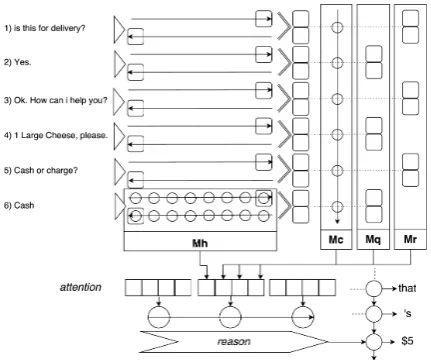
We apply an attention mechanism on each of the memoriesMq,Mr,McandMh(of current query) separately. Refer to Figure1for an intuitive illus-tration of these memories. Following (Shen et al., 2016), we choose projected cosine similarity func-tion as the attenfunc-tion module. The attenfunc-tion score
aqj,ion memorymqi ∈Mqfor a RNN hidden state
tj in the decoder part is computed as follows:
aqj,i=softmaxi=1,...,|Mq|cos(W1qmqi, W2qtj), (14) whereW1q andW2q are weight vectors associated
with mqi and tj, respectively. Consequently, the attention vector on the query sequences is given by:
cqj =
|MXq|
i=1
aqj,imqi. (15)
1Most Japanese characters, such as Kanji, have
indepen-dent semantic meanings other than English letters
Figure 1: Illustration of the architecture of our
REASONmodel. In the example conversation session, six context sentences are encoded independently by a biRNN. The character-specific annotations from the sixth sentence (i.e., current query) compose the only
sentence-level Mh memory. Mr,q,care
conversation-levelmemories. The last mi from each sentence are
distributed alternately inMq andMrmemories. Also,
m1,...,6 are iterated sequentially by a single-direction
RNN to produce six context annotations inMc using
Equation13. In the bottom of the diagram, a reasoning
module (Figure2) is used instead of the plain attention
used inMULTI.
Similarly, the attention scores and attention vec-tors on the other three memories can be derived by replacingqwithr,c, andhin Equations14,15.
We then concatenate these resulting attention vectors into a final context vector cMj , which is
consequently applied to Equations8and9. Since the dimension of the updated context vectorcMj is
four times larger, its weight matrix C will need
to be enlarged with a same column dimension with the dimension ofcMj so thatCcMj still aligns
with the dimension of the hidden layer vectortj.
More details of the GRU function style definition of tj using cj can be found in (Bahdanau et al., 2015). We refer to this model that integrates multi-ple types of memories through separated attention mechanisms asMULTI.
[image:5.595.306.522.61.241.2]read-✁ ✂✄ ☎✆ ✁✂✄ ✝ ✞✟ ✠✁ ✡✄ ☛ ✡☞ ☛ ✡✌ ☛ ✍ ✄ ✍ ☞ ✍ ✌ ✎✏ ✑ ✒✓ ✎✏✑ ✒✓ ✔✕ ✖✗ ✘✕✖✙ ✔ ✕✖ ✗ ✘ ✕✖ ✙ ✚ ✛ ✜ ✓ ✢✍✔✣✤✥✦ ✔ ✧✕✕ ✗ ✘ ✧✕✕ ✙ ★✁✩ ☛ ✄ ✪✓✫✬✛✭✓✒✮✯✰✩✱✩✲✩✳ ✏✴ ✴✓✵ ✴✭✬✵ ✔ ✧✕✕ ✗✘ ✧✕✕ ✙ ★✁✩ ☛ ☞ ✔ ✕ ✖ ✗✘ ✕✖ ✙ ✴✓✛✫✭✵✏✴✭✬✵ ✁ ☎ ✆✁ ✝ ✞✟ ✪✓✫✬✛✭✓✒✮✯✰✩✱✩✲✩✳ ✞✓✏ ✒✬✵✭✵✶✷✬✸ ✞✓✏✒✬ ✵✭✵✶✷✬✸ ✹ ✺✻ ✹✏✴✓✻ ✼ ✠ ✁✂✄ ★✽ ✁✩ ☛ ✾ ✿☞ ✼ ✢✍✔✣✤✥ ✦ ★✽ ✁ ❀✄ ❁ ☛ ✾ ★✽ ✁✩ ☛ ✾ ✿☞
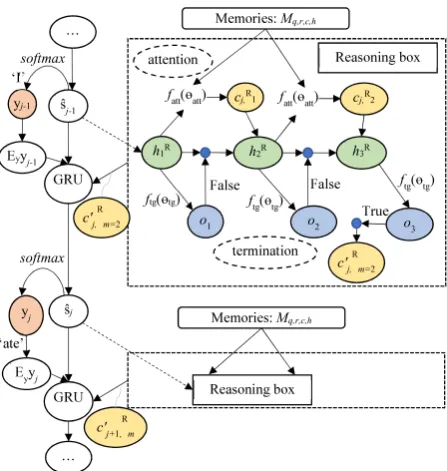
Figure 2: Illustration of thereasonpart of theREASON
model. This figure is drawn by partially referring Fig-ure 1 in (Shen et al.,2016).
ing all the memories. The theoretical benefit is that the chatbot can softly keep track of each indi-vidual speaker’s topics and then make a decision of how to response to that speaker. Another exten-sion will be using a reinforcement learning policy to determine when to let the chatbot to give a re-sponse to which speaker in current group chatting. Generally, the number and type of memories can be enlarged in a reasonable way, such as by in-troducing external knowledge (Yih and Ma,2016; Ghazvininejad et al., 2017; Han et al., 2015) or performing sentiment analysis to the “fact mem-ories” to yield emotional memories (Zhou et al., 2017). A detailed description and experimental testifying is out of the scope of this paper.
4.2 Reasoning Neural Dialogue System As illustrated in Figure 2, we apply a multi-turn reasoning mechanism, followingShen et al. (2016), to the multiple-type annotation memories. This reasoning mechanism replaces the single-turn attention mechanism. We adapt the idea of us-ing a termination state durus-ing the inference to dy-namically determine how many turns to reason. The termination module can decide whether to continue to infer the next turn (of re-reading the four types of memories) after digesting interme-diate topical and speaker-specific information, or to terminate the whole inference process when it
concludes that existing information is sufficient to generate the next word in a response. Generally, the idea is to construct a reasoning attention vector that works as a context vector during generating the next word. This idea is included in the “Rea-soning box” in Figure2. Specially,yj−1stands for
a former word generated by the hidden stateˆsj−1
in the GRU decoder.Ey is the embedding matrix. We use a full-connection layer to map fromˆsj−1
to the initial reasoning hidden statehR1, sincehRm
should be with the same length alike each memory vector inMq,r,c,handˆsj−1’s dimension is smaller
than that. Thus, (1) outside the “reasoning box”, we use a GRU decoder to yieldsˆj so that a next wordyj can be generated, and (2) inside the “rea-soning box”, we read the memories to yield the “optimal” contextual vector. The “reasoning box” takes the memoriesMq,r,c,handˆsj−1as inputs and
finally outputscRj,m.
The number of reasoning turns for yielding the “reasoning attention vectors” (cRj which is further
indexed by reasoning steps of 1, 2 in Figure 2) during the decoding inference is dynamically pa-rameterized by both the contextual memories and current query, and is generally related to the com-plexities of the conversation context and current query.
The training steps are performed as per the gen-eral framework as described in Equations8and9. For each reasoning hidden statehRm, the
termina-tion probability om is estimated by ftg(hRm;θtg), which is
om= (1−om−1)∗σ(wt>hRm+bt), (16) where θtg = {wt, bt}, wt is a weight vector, bt is a bias, and σ is the sigmoid logistic function.
Then, different hidden stateshRmare first weighted
by their termination probabilities om and then summed to produce a reasoning-attention context vector cRj (using the equations as described
pre-viously in Section 3.2), which is consequently used to construct the next reasoning step’s hR2 =
RNN(hR1,cRj,1). The finalcRj,m (m ≥1 is the final
reasoning step) will be used in Equations8and9 in a way alike former attention vectors. During our experiments, we instead used a sum of from
o2×cRj,1toom+1×cRj,mas the finalc0j,mR for next word generation.
During generating each word in the response, our network performs a response action rm at the m-th step, which implies that the
A: i’m bored B: boooring
A: isn’t it? (ˆ_ˆ) B: everybody is asleep A: really?
(ˆ_ˆ) my friends are still awake! :P B: lucky!
xD feels lonely with everyone asleep A: almost everyone is awake (ˆvˆ) B: whyyy?!
[image:7.595.73.290.62.207.2]my friends go early to bed. Or is it me that’s late? xD A: it’s us who are late! xD B: true, very true xD
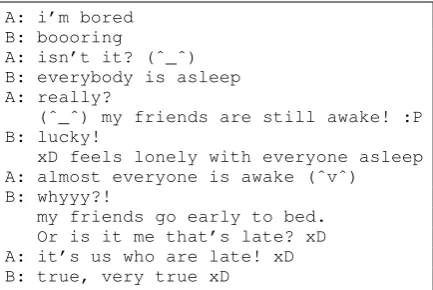
Figure 3: A 5-round conversation of speakersAandB.
0, ..., om−1 = 0, om = 1). A stochastic pol-icyπ((om, rm)|hRm, tj;θ)with parametersθto get a distribution of termination actions, to continue reading the conversation context (i.e.,Mq,r,c,h) or
to stop, and of response actions rm for predict-ing the next word if the model decides to stop at current step. In our experiments, we set a max-imum step parameter Tmax to be 5 for heuristi-cally avoiding too many reasoning times. We fol-low (Shen et al., 2016) to compute the expected reward and its gradient for one instance. We refer to this model with multi-turn reasoning attentions asREASON.
5 Experiments
In our experiments, we used a dataset consisting of Japanese twitter conversations. Each conversation contains 10 sentences from two real-world alter-nating speakers. Given the origin of the dataset, it is quite noisy, containing misspelled words, slang and kaomoji(multi-character sequences of facial emoticons) among meaningful words and charac-ters. Preliminary experiments by using a word-based approach resulted in the vocabulary size be-ing too big and with too many word breakbe-ing er-rors, we instead used a character-based approach. Figure 3 shows a sample 10-sentence conversa-tion in which original Japanese sentences were translated into English and similar spelling pat-terns were kept in a sense (such asboooringfor
boringandwhyyyforwhy).
We kept the conversations in which all sen-tences were no more than 20 characters. This fil-tering strategy resulted in a dataset of 254K con-versations from which 100 (1K sentences) where taken out for testing and another 100 for
validat-Conversation Characters sessions Sentences (Unique)
Train 253K 2.5M 24M (6,214)
Validation 100 1K 10K (836)
[image:7.595.309.527.69.259.2]Test 100 1K 9.3K (780)
Table 1: Statistics of the filtered datasets.
Figure 4: Cost curves of NLL during training.
ing and hyper-parameter tuning. The training set contains 6,214 unique characters, which are used as our vocabulary with the addition of two spe-cial symbols, anUNK(out-of-vocabulary unknown word) and an EOS (end-of-sentence). Table 1 shows major statistics of the dataset.
The training minimizes negative log-likelihood (NLL) per character on the nine sentencess2,...,10
of each conversation. One configuration inMULTI
and REASON is that, we respectively use the reference contexts (instead of former automati-cally generated sentences) to generate current sen-tence. That is, when generating si, we use the
golden contextual sentences of from s1 to si−1.
These three systems were respectively trained 3 epochs (10,000 iterations) on an AdaDelta (Zeiler, 2012) optimizer. Character embedding matrix was shared by both the encoder and the decoder parts. All the hidden layers, in the encoding/decoding parts and the attention models, were of size 200 and the character embeddings were of size 100. The recurrent units that we used were GRU. The gradients were clipped at the maximum gradient norm of 1. The reasoning module’s maximum stepsTmaxwas set to be 5. The data was iterated
on mini-batches of less than 1,500 symbols each. We initialized the recurrent weight matrices in GRUs as random orthogonal matrices. Unless spe-cially mentioned, all the elements of the 0-indexed vectors and all bias vectors were initialized to be zero. Any other weight matrices were initial-ized by sampling from the Gaussian distribution of mean 0 and variance 0.01.
SIMPLE MULTI REASON
BLEU-4
Train 1.98 1.97 2.30
Validation 1.80 2.12 2.62
Test 2.20 2.13 2.89
BLEU-2
Train 6.77 6.78 7.03
Validation 6.67 6.89 8.14
[image:8.595.84.280.60.135.2]Test 7.19 7.24 7.97
Table 2: Character-level BLEU-2/4 (%) scores.
character during training. The validation costs be-gun converging in the third epoch for the three models. The plot roughly shows lower cost for more complex models.
Galley et al. (2015) obtained better correla-tion with human evaluacorrela-tion when using BLEU-2 rather than BLEU-4. We thus report both of these scores for automatic evaluation and comparison. The character-level BLEU-4 and BLEU-2 scores for the trained models are reported in Table 2. The REASON model achieved consistently better BLEU-2 and BLEU-4 scores in the three datasets.
MULTIperformed slightly better thanSIMPLEon the validation set yet that performance is less sta-ble thanREASON.
Figure 4 also reflects that, (1) the final train-ing costs ofSIMPLEandMULTI are quite close with each other at iteration 10,000; (2) there is a big margin of between the final training cost of
REASONand that ofSIMPLEorMULTI; and (3) the validation costs exactly follows an order of
SIMPLE>MULTI>REASON.
6 Analysis
Figure5illustrates an English translation of a con-versation and the responses suggested by each of the described models. This conversation is ex-tracted from the test set. The three responses are different from the reference response, but the one fromREASONlooks the most consistent with the given context. The response fromMULTIis con-tradicting the context of speaker B as he/she said Not at allin a former sentence.
As it has been shown in (Liu et al.,2016) that BLEU doesn’t correlate well with human judg-ments, we asked three human evaluators to re-spectively examine 900 responses from each of the models given their reference contexts. The evalua-tors were asked to judge (1) whether one response is acceptable and (2) whether one response is bet-ter than the other two responses. A summary of this evaluation is displayed in Table3. The accept-ablecolumn refers to the percentage of responses
A: I feel nostalgic. This was so cute. B: It’s gross. What’s that picture? A: It’s cute! It used to be on TV. B: Isn’t that from a children’s show? A: Yes
B: I know that one!! A: Isn’t it cute? B: Not at all
A: Uh! I can’t believe it...
SIMPLE(B:) MULTI(B:) REASON(B:) Uh! it isn’t. It’s cute! Do you think it’s cute? Reference
[image:8.595.311.522.61.195.2]B: Are you asking me whether the picture is cute?
Figure 5: Sample responses generated by the three models and the recorded reference response, translated
to English. BothMULTIandREASONincludecute, yet
MULTIcontradicts a previous responseNot at all.
accept- best-of- > >
able three† SIMPLE‡ MULTI‡
SIMPLE 42% 25% - 45%
MULTI 52% 29% 55%
-REASON 65% 46% 59% 58%
Table 3: Human evaluation of the responses generated
by the three models. †Percentage over the
conversa-tions that had at least one response accepted. ‡From
the cases where any of both compared models was ac-ceptable.>= “better than”.
that were considered acceptable by at least two of the human evaluators while the best-of-three columns refers to the percentage of times that each model’s response was considered by at least two evaluators to be better than the other two’s, from the contexts that had at least one acceptable re-sponse. The last two columns make one-to-one comparisons. In 18% of the contexts, none of the models produced an acceptable response.
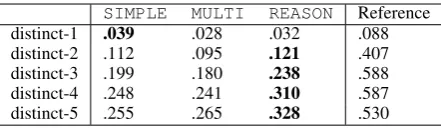
This human evaluation shows that complexer models are more likely to produce acceptable re-sponses. The MULTI and REASON models are only different in the attention mechanism of multi-turn reasoning. The reasoning module performed better than single-turn attention 58% of the times. Table 4 contains the character-level distinct-n (Li et al.,2016a) metrics for n-grams where 1 ≤
n ≤ 5. This metric measures the number of
dis-tinct grams divided by the total number of n-grams in the generated responses. The displayed results are computed on the concatenation of all the responses to the test-set contexts. The Refer-ence column was computed on the reference re-sponses and represents the optimal human-like ra-tio.
[image:8.595.309.524.264.317.2]diver-SIMPLE MULTI REASON Reference distinct-1 .039 .028 .032 .088 distinct-2 .112 .095 .121 .407 distinct-3 .199 .180 .238 .588 distinct-4 .248 .241 .310 .587 distinct-5 .255 .265 .328 .530
Table 4: N-gram diversity metrics of between (1) the responses generated to the test set and (2) their refer-ence responses.
sity. For n-grams n ≥ 2, REASON produced the most diverse outputs. While the results for
REASON were consistently better than the other two models, the results for MULTI were not al-ways better thanSIMPLE. This indicatesMULTI
does not always benefit from the augmented con-text without the multi-turn reasoning attentions.
7 Conclusions
We have presented a novel approach to multi-turn conversation modeling. Our approach uses multi-ple explicitly separated memories to represent rich conversational contexts. We also presented multi-turn reasoning attentions to integrate various an-notation memories. We run experiments on three different models with and without the introduced approaches and measured their performances us-ing automatic metrics and human evaluation.
Experimental results verified that the increased contexts are able to help producing more accept-able and diverse responses. Driven by the depth of the reasoning attention, the diversities of the responses are significantly improved. We argue that the reasoning attention mechanism helps in-tegrating the multiple pieces of information as it can combine them in a more complex way than a simple weighted sum. We further observed that as the accuracy of the conversation model improves, the diversity of the generated responses increases. The proposed approach of multi-turn reason-ing over multiple memory attention networks is presented in a general framework that allows the inclusion of memories of multiple resources and types. Applying to group chatting with more than two speakers and reasoning over emotion embed-dings or knowledge vectors included from an ex-ternal knowledge base/graph are taken as our fu-ture directions.
Acknowledgments
The authors thank the anonymous reviewers for their impressive comments and suggestions for
improving the earlier version.
References
Dzmitry Bahdanau, Kyunghyun Cho, and Yoshua
Ben-gio. 2014. Neural Machine Translation by Jointly
Learning to Align and Translate. arXiv:1409.0473 [cs, stat] ArXiv: 1409.0473. http://arxiv. org/abs/1409.0473.
Dzmitry Bahdanau, Jan Chorowski, Dmitriy
Serdyuk, Philemon Brakel, and Yoshua
Ben-gio. 2015. End-to-End Attention-based
Large Vocabulary Speech Recognition.
arXiv:1508.04395 [cs] ArXiv: 1508.04395.
http://arxiv.org/abs/1508.04395.
Rafael E. Banchs and Haizhou Li. 2012. IRIS: a
Chat-oriented Dialogue System based on the Vec-tor Space Model. InProceedings of the ACL 2012 System Demonstrations. Association for Computa-tional Linguistics, Jeju Island, Korea, pages 37– 42.http://www.aclweb.org/anthology/ P12-3007.
William Chan, Navdeep Jaitly, Quoc V. Le, and
Oriol Vinyals. 2015. Listen, Attend and Spell.
arXiv:1508.01211 [cs, stat] ArXiv: 1508.01211.
http://arxiv.org/abs/1508.01211.
Kyunghyun Cho, Bart van Merrienboer, Caglar Gulcehre, Dzmitry Bahdanau, Fethi Bougares, Holger Schwenk, and Yoshua Bengio. 2014.
Learning Phrase Representations using RNN Encoder-Decoder for Statistical Machine Transla-tion. arXiv:1406.1078 [cs, stat]ArXiv: 1406.1078.
http://arxiv.org/abs/1406.1078.
Bhuwan Dhingra, Hanxiao Liu, Zhilin Yang, William W. Cohen, and Ruslan Salakhutdinov. 2016.
Gated-Attention Readers for Text Comprehension.
arXiv:1606.01549 [cs] ArXiv: 1606.01549.
http://arxiv.org/abs/1606.01549.
Jeff Donahue, Lisa Anne Hendricks, Sergio Guadar-rama, Marcus Rohrbach, Subhashini Venugopalan,
Kate Saenko, and Trevor Darrell. 2015.
Long-term Recurrent Convolutional Networks for Visual
Recognition and Description. InCVPR.
Michel Galley, Chris Brockett, Alessandro Sordoni, Yangfeng Ji, Michael Auli, Chris Quirk, Mar-garet Mitchell, Jianfeng Gao, and Bill Dolan. 2015.
deltaBLEU: A Discriminative Metric for Genera-tion Tasks with Intrinsically Diverse Targets. In
Proceedings of the 53rd Annual Meeting of the Association for Computational Linguistics and the 7th International Joint Conference on Natural Lan-guage Processing (Volume 2: Short Papers). Associ-ation for ComputAssoci-ational Linguistics, Beijing, China,
pages 445–450. http://www.aclweb.org/
Marjan Ghazvininejad, Chris Brockett, Ming-Wei Chang, Bill Dolan, Jianfeng Gao, Wen-tau Yih,
and Michel Galley. 2017. A knowledge-grounded
neural conversation model. CoRRabs/1702.01932.
http://arxiv.org/abs/1702.01932.
Sangdo Han, Jeesoo Bang, Seonghan Ryu, and
Gary Geunbae Lee. 2015. Exploiting
knowl-edge base to generate responses for natural lan-guage dialog listening agents. In Proceedings of the 16th Annual Meeting of the Special Inter-est Group on Discourse and Dialogue. Association for Computational Linguistics, Prague, Czech
Re-public, pages 129–133. http://aclweb.org/
anthology/W15-4616.
Felix Hill, Antoine Bordes, Sumit Chopra, and Jason
Weston. 2015. The Goldilocks Principle: Reading
Children’s Books with Explicit Memory Represen-tations.arXiv:1511.02301 [cs]ArXiv: 1511.02301.
http://arxiv.org/abs/1511.02301.
Sepp Hochreiter and J¨urgen Schmidhuber. 1997. Long
short-term memory. Neural Comput. 9(8):1735–
1780. https://doi.org/10.1162/neco.
1997.9.8.1735.
Jiwei Li, Michel Galley, Chris Brockett, Jianfeng Gao,
and Bill Dolan. 2015. A Diversity-Promoting
Ob-jective Function for Neural Conversation Models.
arXiv:1510.03055 [cs]ArXiv: 1510.03055. http: //arxiv.org/abs/1510.03055.
Jiwei Li, Michel Galley, Chris Brockett, Jianfeng Gao,
and Bill Dolan. 2016a. A Diversity-Promoting
Ob-jective Function for Neural Conversation Models. In
Proceedings of the 2016 Conference of the North American Chapter of the Association for Compu-tational Linguistics: Human Language
Technolo-gies. Association for Computational Linguistics,
San Diego, California, pages 110–119. http://
www.aclweb.org/anthology/N16-1014.
Jiwei Li, Michel Galley, Chris Brockett, Georgios
Sp-ithourakis, Jianfeng Gao, and Bill Dolan. 2016b. A
Persona-Based Neural Conversation Model. In Pro-ceedings of the 54th Annual Meeting of the Associa-tion for ComputaAssocia-tional Linguistics (Volume 1: Long Papers). Association for Computational Linguistics,
Berlin, Germany, pages 994–1003. http://www.
aclweb.org/anthology/P16-1094.
Jiwei Li, Will Monroe, Tianlin Shi, Sbastien Jean,
Alan Ritter, and Dan Jurafsky. 2017.
Adver-sarial Learning for Neural Dialogue Generation.
arXiv:1701.06547 [cs]ArXiv: 1701.06547. http: //arxiv.org/abs/1701.06547.
Jiwei Li, Alan Ritter, and Eduard Hovy. 2014.
Weakly supervised user profile extraction from twit-ter. In Proceedings of the 52nd Annual Meet-ing of the Association for Computational LMeet-inguis- Linguis-tics (Volume 1: Long Papers). Association for Computational Linguistics, Baltimore, Maryland,
pages 165–174. http://www.aclweb.org/
anthology/P14-1016.
Chia-Wei Liu, Ryan Lowe, Iulian Serban, Mike Nose-worthy, Laurent Charlin, and Joelle Pineau. 2016.
How NOT To Evaluate Your Dialogue System: An Empirical Study of Unsupervised Evaluation Metrics for Dialogue Response Generation. In
Proceedings of the 2016 Conference on Empiri-cal Methods in Natural Language Processing. As-sociation for Computational Linguistics, Austin,
Texas, pages 2122–2132. https://aclweb.
org/anthology/D16-1230.
Ryan Lowe, Nissan Pow, Iulian Serban, and Joelle
Pineau. 2015. The Ubuntu Dialogue Corpus: A
Large Dataset for Research in Unstructured Multi-Turn Dialogue Systems. arXiv:1506.08909 [cs]
ArXiv: 1506.08909. http://arxiv.org/
abs/1506.08909.
Junhua Mao, Wei Xu, Yi Yang, Jiang Wang, Zhiheng Huang, and Alan Yuille. 2015. Deep Captioning with Multimodal Recurrent Neural Networks
(m-RNN). ICLR.
Alan Ritter, Colin Cherry, and William B. Dolan. 2011.
Data-Driven Response Generation in Social Media. In Proceedings of the 2011 Conference on Empiri-cal Methods in Natural Language Processing. As-sociation for Computational Linguistics, Edinburgh,
Scotland, UK., pages 583–593. http://www.
aclweb.org/anthology/D11-1054.
M. Schuster and K.K. Paliwal. 1997. Bidirectional
Recurrent Neural Networks. Trans. Sig. Proc.
45(11):2673–2681. https://doi.org/10.
1109/78.650093.
Iulian V. Serban, Alessandro Sordoni, Yoshua Bengio,
Aaron Courville, and Joelle Pineau. 2016. Building
End-to-end Dialogue Systems Using Generative Hi-erarchical Neural Network Models. InProceedings of the Thirtieth AAAI Conference on Artificial Intel-ligence. AAAI Press, Phoenix, Arizona, AAAI’16,
pages 3776–3783. http://dl.acm.org/
citation.cfm?id=3016387.3016435.
Lifeng Shang, Zhengdong Lu, and Hang Li. 2015.
Neural Responding Machine for Short-Text Conver-sation. In Proceedings of the 53rd Annual Meet-ing of the Association for Computational LMeet-inguis- Linguis-tics and the 7th International Joint Conference on Natural Language Processing (Volume 1: Long Pa-pers). Association for Computational Linguistics,
Beijing, China, pages 1577–1586. http://www.
aclweb.org/anthology/P15-1152.
Yelong Shen, Po-Sen Huang, Jianfeng Gao, and
Weizhu Chen. 2016. ReasoNet: Learning
to Stop Reading in Machine Comprehension.
arXiv:1609.05284 [cs] ArXiv: 1609.05284.
https://doi.org/10.1145/3097983. 3098177.
A Neural Network Approach to Context-Sensitive Generation of Conversational Responses. In Pro-ceedings of the 2015 Conference of the North Amer-ican Chapter of the Association for Computational Linguistics: Human Language Technologies. Asso-ciation for Computational Linguistics, Denver,
Col-orado, pages 196–205. http://www.aclweb.
org/anthology/N15-1020.
Ilya Sutskever, Oriol Vinyals, and Quoc V Le. 2014. Sequence to Sequence Learning with Neural Net-works. In Z. Ghahramani, M. Welling, C. Cortes,
N. D. Lawrence, and K. Q. Weinberger, editors,
Ad-vances in Neural Information Processing Systems
27, Curran Associates, Inc., pages 3104–3112.
Oriol Vinyals, ukasz Kaiser, Terry Koo, Slav Petrov,
Ilya Sutskever, and Geoffrey Hinton. 2015.
Gram-mar as a Foreign Language. In C. Cortes, N. D. Lawrence, D. D. Lee, M. Sugiyama, and R. Garnett,
editors,Advances in Neural Information Processing
Systems 28, Curran Associates, Inc., pages 2773–
2781. http://papers.nips.cc/paper/
5635-grammar-as-a-foreign-language. pdf.
Oriol Vinyals and Quoc Le. 2015. A Neural
Conversational Model. arXiv:1506.05869 [cs]
ArXiv: 1506.05869. http://arxiv.org/
abs/1506.05869.
Tsung-Hsien Wen, Milica Gasic, Nikola Mrksic, Lina M. Rojas-Barahona, Pei-Hao Su, David
Vandyke, and Steve Young. 2016. Multi-domain
Neural Network Language Generation for Spo-ken Dialogue Systems. In Proceedings of the 2016 Conference of the North American Chap-ter of the Association for Computational Linguis-tics: Human Language Technologies. Association for Computational Linguistics, San Diego,
Cali-fornia, pages 120–129. http://www.aclweb.
org/anthology/N16-1015.
Wen-tau Yih and Hao Ma. 2016. Question
Answer-ing with Knowledge Base, Web and Beyond. In
Proceedings of the 2016 Conference of the North American Chapter of the Association for Computa-tional Linguistics: Tutorial Abstracts. Association for Computational Linguistics, San Diego,
Califor-nia, pages 8–10. http://www.aclweb.org/
anthology/N16-4003.
Lantao Yu, Weinan Zhang, Jun Wang, and Yong Yu.
2016. SeqGAN: Sequence Generative
Adversar-ial Nets with Policy Gradient. arXiv:1609.05473
[cs]ArXiv: 1609.05473. http://arxiv.org/
abs/1609.05473.
Matthew D. Zeiler. 2012. ADADELTA: An
Adap-tive Learning Rate Method. arXiv:1212.5701 [cs]
ArXiv: 1212.5701. http://arxiv.org/abs/
1212.5701.
Hao Zhou, Minlie Huang, Tianyang Zhang, Xiaoyan
Zhu, and Bing Liu. 2017. Emotional chatting
ma-chine: Emotional conversation generation with in-ternal and exin-ternal memory.CoRRabs/1704.01074.