Proceedings of NAACL-HLT 2018, pages 431–441
Being Negative but Constructively:
Lessons Learnt from Creating Better Visual Question Answering Datasets
Wei-Lun Chao∗, Hexiang Hu∗, Fei Sha
University of Southern California Los Angeles, California, USA
[email protected], [email protected], [email protected]
Abstract
Visual question answering (Visual QA) has at-tracted a lot of attention lately, seen essentially as a form of (visual) Turing test that artificial intelligence should strive to achieve. In this paper, we study a crucial component of this task: how can we design good datasets for the task? We focus on the design of multiple-choice based datasets where the learner has to select the right answer from a set of candi-date ones including the target (i.e. the correct one) and the decoys (i.e. the incorrect ones). Through careful analysis of the results attained by state-of-the-art learning models and human annotators on existing datasets, we show that the design of the decoy answers has a sig-nificant impact on how and what the learn-ing models learn from the datasets. In par-ticular, the resulting learner can ignore the vi-sual information, the question, or both while still doing well on the task. Inspired by this, we propose automatic procedures to remedy such design deficiencies. We apply the pro-cedures to re-construct decoy answers for two popular Visual QA datasets as well as to cre-ate a new Visual QA dataset from the Vi-sual Genome project, resulting in the largest dataset for this task. Extensive empirical stud-ies show that the design deficiencstud-ies have been alleviated in the remedied datasets and the performance on them is likely a more faith-ful indicator of the difference among learn-ing models. The datasets are released and
publicly available viahttp://www.teds.
usc.edu/website_vqa/.
1 Introduction
Multimodal information processing tasks such as
image captioning (Farhadi et al., 2010; Ordonez
et al., 2011;Xu et al.,2015) and visual question
answering (Visual QA) (Antol et al., 2015) have
∗Equal contributions
Question:
What vehicle is pictured?
Image only Unresolvable (IoU)
a. Overcast. (0.5455) b. Daytime. (0.4941) c. A building. (0.4829) d. A train. (0.5363)
Question only Unresolvable (QoU)
a. A bicycle. (0.2813) b. A truck. (0.5364) c. A boat. (0.4631) d. A train. (0.5079)
Original
a. A car. (0.2083) b. A bus. (0.6151) c. A cab. (0.5000) d. A train. (0.7328)
[image:1.595.308.529.224.373.2]Candidate Answers:
Figure 1: An illustration of how the shortcuts in the Vi-sual7W dataset (Zhu et al.,2016) should be remedied. In the original dataset, the correct answer “A train” is easily selected by a machine as it is far often used as the correct answer than the other decoy (negative) an-swers. (The numbers in the brackets are probability
scores computed using eq. (2)). Our two procedures —
QoU and IoU (cf. Sect.4) — create alternative decoys
such that both the correct answer and the decoys are highly likely by examining either the image or the ques-tionalone. In these cases, machines make mistakes
un-less they consider all informationtogether. Thus, the
alternative decoys suggested our procedures are better designed to gauge how well a learning algorithm can understand all information equally well.
gained a lot of attention recently. A number of sig-nificant advances in learning algorithms have been made, along with the development of nearly two dozens of datasets in this very active research do-main. Among those datasets, popular ones include
MSCOCO (Lin et al.,2014;Chen et al.,2015),
Vi-sual Genome (Krishna et al.,2017), VQA (Antol
et al., 2015), and several others. The overarch-ing objective is that a learnoverarch-ing machine needs to go beyond understanding different modalities of information separately (such as image recognition alone) and to learn how to correlate them in order to perform well on those tasks.
To evaluate the progress on those complex and more AI-like tasks is however a challenging topic. For tasks involving language generation, develop-ing an automatic evaluation metric is itself an open
problem (Anderson et al., 2016;Kilickaya et al.,
2017;Liu et al., 2016;Kafle and Kanan,2017b). Thus, many efforts have concentrated on tasks
such as multiple-choiceVisual QA (Antol et al.,
2015;Zhu et al.,2016;Jabri et al.,2016) or
select-ing the best caption (Hodosh et al.,2013;Hodosh
and Hockenmaier,2016;Ding et al.,2016;Lin and Parikh, 2016), where the selection accuracy is a natural evaluation metric.
In this paper, we study how to design high-quality multiple choices for the Visual QA task. In this task, the machine (or the human annotator) is presented with an image, a question and a list of candidate answers. The goal is to select the correct answer through a consistent understanding of the image, the question and each of the candidate an-swers. As in any multiple-choice based tests (such as GRE), designing what should be presented as
negative answers — we refer them asdecoys— is
as important as deciding the questions to ask. We all have had the experience of exploiting the
elim-ination strategy: This question is easy — none of
the three answers could be right so the remaining one must be correct!
While a clever strategy for taking exams, such “shortcuts” prevent us from studying faithfully how different learning algorithms comprehend the meanings in images and languages (e.g., the qual-ity of the embeddings of both images and lan-guages in a semantic space). It has been noted that machines can achieve very high accuracies of selecting the correct answer without the visual
in-put (i.e., the image), the question, or both (Jabri
et al.,2016;Antol et al.,2015). Clearly, the learn-ing algorithms have overfit on incidental statistics in the datasets. For instance, if the decoy answers have rarely been used as the correct answers (to any questions), then the machine can rule out a de-coy answer with a binary classifier that determines whether the answers are in the set of the correct answers — note that this classifier does not need to examine the image and it just needs to memo-rize the list of the correct answers in the training
dataset. See Fig.1for an example, and Sect.3for
more and detailed analysis.
We focus on minimizing the impacts of exploit-ing such shortcuts. We suggest a set of principles
for creating decoy answers. In light of the amount of human efforts in curating existing datasets for the Visual QA task, we propose two procedures that revise those datasets such that the decoy an-swers are better designed. In contrast to some earlier works, the procedures are fully automatic and do not incur additional human annotator ef-forts. We apply the procedures to revise both
Vi-sual7W (Zhu et al.,2016) and VQA (Antol et al.,
2015). Additionally, we create new
multiple-choice based datasets from COCOQA (Ren et al.,
2015) and the recently released VQA2 (Goyal
et al.,2017) and Visual Genome datasets (Krishna
et al., 2017). The one based on Visual Genome
becomes the largest multiple-choice dataset for the Visual QA task, with more than one million image-question-candidate answers triplets.
We conduct extensive empirical and human studies to demonstrate the effectiveness of our pro-cedures in creating high-quality datasets for the Visual QA task. In particular, we show that ma-chines need to use all three information (image, questions and answers) to perform well — any missing information induces a large drop in per-formance. Furthermore, we show that humans dominate machines in the task. However, given the revised datasets are likely reflecting the true gap between the human and the machine under-standing of multimodal information, we expect that advances in learning algorithms likely focus more on the task itself instead of overfitting to the idiosyncrasies in the datasets.
The rest of the paper is organized as follows.
In Sect.2, we describe related work. In Sect. 3,
we analyze and discuss the design deficiencies in
existing datasets. In Sect. 4, we describe our
au-tomatic procedures for remedying those
deficien-cies. In Sect.5we conduct experiments and
anal-ysis. We conclude the paper in Sect.6.
2 Related Work
Wu et al. (2017) and Kafle and Kanan (2017b)
annota-tions. We concentrate on 3 datasets: VQA (Antol et al.,2015), Visual7W (Zhu et al.,2016), and
Vi-sual Genome (Krishna et al., 2017). All of them
use images from MSCOCO (Lin et al.,2014).
Besides the pairs of questions and correct
an-swers, VQA, Visual7W, and visual Madlibs (Yu
et al.,2015) provide decoy answers for each pair so that the task can be evaluated in multiple-choice
selection accuracy. What decoy answers to useis
the focus of our work.
In VQA, the decoys consist of human-generated plausible answers as well as high-frequency and random answers from the datasets. In Visual7W, the decoys are all human-generated plausible ones.
Note that, humans generate those decoys byonly
looking at the questions and the correct answers butnotthe images. Thus, the decoys might be un-related to the corresponding images. A learning algorithm can potentially examine the image alone and be able to identify the correct answer.
In visual Madlibs, the questions are generated with a limited set of question templates and the detailed annotations (e.g., objects) of the images. Thus, similarly, a learning model can examine the image alone and deduce the correct answer.
We propose automatic procedures to re-vise VQA and Visual7W (and to create new
datasets based on COCOQA (Ren et al., 2015),
VQA2 (Goyal et al.,2017), and Visual Genome)
such that the decoy generation is carefully orches-trated to prevent learning algorithms from exploit-ing the shortcuts in the datasets by overfittexploit-ing on incidental statistics. In particular, our design goal is that a learning machine needs to understand all the 3 components of an image-question-candidate answers triplet in order to make the right choice — ignoring either one or two components will result in drastic degradation in performance.
Our work is inspired by the experiments in (Jabri et al.,2016) where they observe that ma-chines without looking at images or questions can still perform well on the Visual QA task.
Oth-ers have also reported similar issues (Goyal et al.,
2017; Zhang et al., 2016; Johnson et al., 2017; Agrawal et al., 2016; Kafle and Kanan, 2017a; Agrawal et al.,2018), though not in the multiple-choice setting. Our work extends theirs by
pro-viding more detailed analysisas well as automatic
proceduresto remedy those design deficiencies.
Besides Visual QA, VisDial (Das et al., 2017)
and Ding et al. (2016) also propose automatic
ways to generate decoys for the tasks of multiple-choice visual captioning and dialog, respectively.
Recently, Lin and Parikh (2017) study active
learning for Visual QA: i.e., how to select infor-mative image-question pairs (for acquiring anno-tations) or image-question-answer triplets for ma-chines to “learn” from. On the other hand, our work further focuses on designing better datasets for “evaluating” a machine.
3 Analysis of Decoy Answers’ Effects
In this section, we examine in detail the dataset
Visual7W (Zhu et al.,2016), a popular choice for
the Visual QA task. We demonstrate how the de-ficiencies in designing decoy questions impact the performance of learning algorithms.
In multiple-choice Visual QA datasets, a train-ing or test example is a triplet that consists of an image I, a question Q, and a candidate an-swer set A. The set A contains a target T (the
correct answer) andKdecoys (incorrect answers)
denoted by D. An IQA triplet is thus{I,Q,A =
{T,D1,· · ·,DK}}. We use C to denote either the
target or a decoy.
3.1 Visual QA models
We investigate how well a learning algorithm can perform when supplied with different modalities of information. We concentrate on the one
hidden-layer MLP model proposed in (Jabri et al.,2016),
which has achieved state-of-the-art results on the dataset Visual7W. The model computes a scoring functionf(c, i)
f(c, i) =σ(Umax(0,Wg(c, i)) +b) (1)
over a candidate answercand the multimodal
in-formationi, where g is the joint feature of (c, i)
andσ(x) = 1/(1 + exp(−x)). The informationi can be null, the image (I) alone, the question (Q) alone, or the combination of both (I+Q).
Given an IQA triplet, we use the penultimate
layer of ResNet-200 (He et al.,2016) as visual
fea-tures to represent I and the average WORD2VEC
embeddings (Mikolov et al.,2013) as text features
to represent Q and C. To form the joint feature
g(c, i), we just concatenate the features together.
The candidatec ∈ A that has the highestf(c, i)
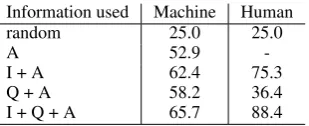
Information used Machine Human
random 25.0 25.0
A 52.9
-I + A 62.4 75.3
Q + A 58.2 36.4
[image:4.595.106.261.64.127.2]I + Q + A 65.7 88.4
Table 1: Accuracy of selecting the right answers out of 4 choices (%) on the Visual QA task on Visual7W.
Each question has 4 candidate answers. The
pa-rameters off(c, i)are learned by minimizing the
binary logistic loss of predicting whether or not a
candidatecis the target of an IQA triplet. Details
are in Sect.5and the Supplementary Material.
3.2 Analysis results
Machines find shortcuts Table 1 summarizes
the performance of the learning models, together with the human studies we performed on a subset
of 1,000 triplets (c.f. Sect.5for details). There are
a few interesting observations.
First, in the row of “A” where only the candidate answers (and whether they are right or wrong) are used to train a learning model, the model performs significantly better than random guessing and hu-mans (52.9% vs. 25%) — huhu-mans will deem each
of the answers equally likely without looking at
both the image and the question! Note that in this
case, the informationiin eq. (1) contains nothing.
The model learns the specific statistics of the can-didate answers in the dataset and exploits those. Adding the information about the image (i.e., the row of “I+A”), the machine improves significantly and gets close to the performance when all infor-mation is used (62.4% vs. 65.7%). There is a weaker correlation between the question and the answers as “Q+A” improves over “A” only mod-estly. This is expected. In the Visual7W dataset, the decoys are generated by human annotators as plausible answers to the questions without being shown the images — thus, many decoy answers do not have visual groundings. For instance, a ques-tion of “what animal is running?” elicits equally likely answers such as “dog”, “tiger”, “lion”, or “cat”, while an image of a dog running in the park will immediately rule out all 3 but the “dog”, see
Fig. 1 for a similar example. Thus, the
perfor-mance of “I+A” implies that many IQA triplets can be solved by object, attribute or concept detec-tion on the image, without understanding the ques-tions. This is indeed the case also for humans — humans can achieve 75.3% by considering “I+A” and not “Q”. Note that the difference between
ma-chine and human on “I+A” are likely due to their difference in understanding visual information.
Note that human improves significantly from “I+A” to “I+Q+A” with “Q” added, while the ma-chine does so only marginally. The difference can be attributed to the difference in understanding the question and correlating with the answers between the two. Since each image corresponds to multiple questions or have multiple objects, solely relying on the image itself will not work well in principle. Such difference clearly indicates that in the Visual QA model, the language component is weak as the model cannot fully exploit the information in “Q”, making a smaller relative improvement 5.3% (from 62.4% to 65.7%) where humans improved relatively 17.4%.
Shortcuts are due to design deficiencies We probe deeper on how the decoy answers have im-pacted the performance of learning models.
As explained above, the decoys are drawn from all plausible answers to a question, irrespective of whether they are visually grounded or not. We have also discovered that the targets (i.e., correct answers) are infrequently used as decoys.
Specifically, among the 69,817 training sam-ples, there are 19,503 unique correct answers and each one of them is used about 3.6 times as cor-rect answers to a question. However, among all the
69,817×3 ≈210Kdecoys, each correct answer
appears 7.2 times on average, far below a chance
level of 10.7 times (210K÷19,503≈10.7). This
disparity exists in the test samples too. Conse-quently, the following rule, computing each an-swer’s likelihood of being correct,
P(correct|C) = (
0.5, if C is never seen in training,
# times C as target
# times C as target+(# times C as decoys)/K, otherwise,
(2)
should perform well. Essentially, it measures how unbiased C is used as the target and the decoys. In-deed, it attains an accuracy of 48.73% on the test data, far better than the random guess and is close to the learning model using the answers’
informa-tion only (the “A” row in Table1).
Good rules for designing decoys Based on our analysis, we summarize the following guidance
rules to design decoys: (1)Question only
plausible to the question. Otherwise, machines can rely on the correlation between the question and candidate answers to tell the target from de-coys, even without the images. Note that this is a principle that is being followed by most datasets. (2) Neutrality. The decoys answers should be
equally likely used as the correct answers. (3)
Im-age only Unresolvable (IoU). The decoys need to be plausible to the image. That is, they should ap-pear in the image, or there exist questions so that the decoys can be treated as targets to the image. Otherwise, Visual QA can be resolved by objects, attributes, or concepts detection in images, even without the questions.
Ideally, each decoy in an IQA triplet should
meet the three principles. Neutralityis
compara-bly easier to achieve byreusing terms in the whole
set of targets as decoys. On the contrary, a decoy
may hardly meetQoU andIoUsimultaneously1.
However, as long as all decoys of an IQA triplet meetNeutralityand some meetQoUand others
meetIoU, the triplet as a whole still achieves the
three principles — a machine ignoring either im-ages or questions will likely perform poorly.
4 Creating Better Visual QA Datasets
In this section, we describe our approaches of rem-edying design deficiencies in the existing datasets for the Visual QA task. We introduce two auto-matic and widely-applicable procedures to create new decoys that can prevent learning models from exploiting incident statistics in the datasets.
4.1 Methods
Main ideas Our procedures operate on a dataset that already contains image-question-target (IQT) triplets, i.e., we do not assume it has decoys al-ready. For instance, we have used our procedures to create a multiple-choice dataset from the Vi-sual Genome dataset which has no decoy. We as-sume that each image in the dataset is coupled with “multiple” QT pairs, which is the case in nearly all the existing datasets. Given an IQT triplet (I, Q, T), we create two sets of decoy answers.
• QoU-decoys. We search among all other triplets
that have similar questions to Q. Thetargetsof
those triplets are then collected as the decoys for T. As the targets to similar questions are likely
1E.g., in Fig 1, for the question “What vehicle is pic-tured?”, the only answer that meets both principles is “train”, which is the correct answer instead of being a decoy.
plausible for the question Q, QoU-decoys likely
follow the rules of Neutrality and Question
only Unresolvable (QoU). We compute the
av-erageWORD2VEC(Mikolov et al.,2013) to
rep-resent a question, and use the cosine similarity to measure the similarity between questions.
• IoU-decoys. We collect thetargetsfrom other
triplets of thesameimage to be the decoys for T.
The resulting decoys thus definitely follow the
rules ofNeutralityandImage only
Unresolv-able (IoU).
We then combine the triplet (I, Q, T) with QoU-decoys and IoU-QoU-decoys to form an IQA triplet as a training or test sample.
Resolving ambiguous decoys One potential
drawback of automatically selected decoys is that they may be semantically similar, ambiguous, or
rephrased terms to the target (Zhu et al., 2016).
We utilize two filtering steps to alleviate it. First, we perform string matching between a decoy and the target, deleting those decoys that contain or are covered by the target (e.g., “daytime” vs. “during the daytime” and “ponytail” vs. “pony tail”).
Secondly, we utilize the WordNet hierarchy and
the Wu-Palmer (WUP) score (Wu and Palmer,
1994) to eliminate semantically similar decoys.
The WUP score measures how similar twoword
senses are (in the range of [0,1]), based on the
depth of them in the taxonomy and that of their least common subsumer. We compute the similar-ity of two strings according to the WUP scores in
a similar manner to (Malinowski and Fritz,2014),
in which the WUP score is used to evaluate Visual QA performance. We eliminate decoys that have higher WUP-based similarity to the target. We use
the NLTK toolkit (Bird et al., 2009) to compute
the similarity. See the Supplementary Material for more details.
Other details For QoU-decoys, we sort and
keep for each triplet the topN (e.g., 10,000)
sim-ilar triplets from the entire dataset according to the question similarity. Then for each triplet, we compute the WUP-based similarity of each poten-tial decoy to the target successively, and accept
those with similarity below 0.9 until we haveK
decoys. We choose 0.9 according to (Malinowski
and Fritz, 2014). We also perform such a check
similarity with a threshold of 0.9 is then applied to remove ambiguous decoys.
4.2 Comparison to other datasets
Several authors have noticed the design deficien-cies in the existing databases and have proposed
“fixes” (Antol et al., 2015; Yu et al., 2015; Zhu
et al.,2016;Das et al.,2017). No dataset has used a procedure to generate IoU-decoys. We empiri-cally show that how the IoU-decoys significantly remedy the design deficiencies in the datasets.
Several previous efforts have generated decoys
that are similar in spirit to ourQoU-decoys. Yu et
al. (2015), Das et al. (2017), and Ding et al. (2016)
automatically find decoys from similar questions or captions based on question templates and
an-notated objects, tri-grams and GLOVE
embed-dings (Pennington et al., 2014), and paragraph
vectors (Le and Mikolov,2014) and linguistic
sur-face similarity, respectively. The later two are for different tasks from Visual QA, and only Ding
et al. (2016) consider removing semantically
am-biguous decoys like ours. Antol et al. (2015) and
Zhu et al. (2016) ask humans to create decoys,
given the questions and targets. As shown earlier,
such decoys may disobey the rule ofNeutrality.
Goyal et al. (2017) augment the VQA dataset
(Antol et al.,2015) (by human efforts) with addi-tional IQT triplets to eliminate the shortcuts (lan-guage prior) in the open-ended setting. Their ef-fort is complementary to ours on the multiple-choice setting. Note that an extended task of
Vi-sual QA, viVi-sual dialog (Das et al., 2017), also
adopts the latter setting.
5 Empirical Studies
5.1 Dataset
We examine our automatic procedures for creating
decoys on five datasets. Table 2 summarizes the
characteristics of the three datasets we focus on.
VQA Real (Antol et al.,2015) The dataset uses
images from MSCOCO (Lin et al., 2014) under
the same training/validation/testing splits to con-struct IQA triplets. Totally 614,163 IQA triplets are generated for 204,721 images. Each question has 18 candidate answers: in general 3 decoys are human-generated, 4 are randomly sampled, and 10 are randomly sampled frequent-occurring targets.
As the test set does not indicate the targets, our studies focus on the training and validation sets.
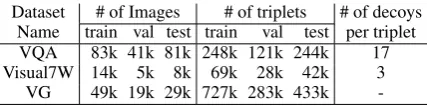
Dataset # of Images # of triplets # of decoys Name train val test train val test per triplet VQA 83k 41k 81k 248k 121k 244k 17 Visual7W 14k 5k 8k 69k 28k 42k 3
VG 49k 19k 29k 727k 283k 433k
-Table 2: Summary of Visual QA datasets.
Visual7W Telling (Visual7W) (Zhu et al.,2016) The dataset uses 47,300 images from MSCOCO
(Lin et al., 2014) and contains 139,868 IQA
triplets. Each has 3 decoys generated by humans. Visual Genome (VG) (Krishna et al., 2017) The dataset uses 101,174 images from MSCOCO
(Lin et al., 2014) and contains 1,445,322 IQT
triplets. No decoys are provided. Human anno-tators are asked to write diverse pairs of questions and answers freely about an image or with respect to some regions of it. On average an image is cou-pled with 14 question-answer pairs. We divide the dataset into non-overlapping 50%/20%/30% for training/validation/testing. Additionally, we par-tition such that each portion is a “superset” of the corresponding one in Visual7W, respectively. VQA2 (Goyal et al.,2017) and COCOQA (Ren et al.,2015) We describe the datasets and exper-imental results in the Supplementary Material.
Creating decoys We create 3 QoU-decoys and
3 IoU-decoys for every IQT triplet in each dataset,
following the steps in Sect. 4.1. In the cases that
we cannot find 3 decoys, we include random ones from the original set of decoys for VQA and Vi-sual7W; for other datasets, we randomly include those from the top 10 frequently-occurring targets. 5.2 Setup
Visual QA models We utilize the MLP
mod-els mentioned in Sect. 3 for all the experiments.
We denoteMLP-A, MLP-QA, MLP-IA,
MLP-IQAas the models using A (Answers only), Q+A
(Question plus Answers), I+A (Image plus swers), and I+Q+A (Image, Question and An-swers) for multimodal information, respectively. The hidden-layer has 8,192 neurons. We use a
200-layer ResNet (He et al.,2016) to compute
vi-sual features which are 2,048-dimensional. The
ResNet is pre-trained on ImageNet (Russakovsky
et al., 2015). The WORD2VEC feature (Mikolov
et al., 2013) for questions and answers are
300-dimensional, pre-trained on Google News2. The
[image:6.595.310.524.64.117.2]parameters of the MLP models are learned by minimizing the binary logistic loss of predicting whether or not a candidate answer is the target of the corresponding IQA triplet. Please see the Sup-plementary Material for details on optimization.
We further experiment with a variant of the
spa-tial memory network (denoted asAttention) (Xu
and Saenko, 2016) and the HieCoAttmodel (Lu
et al., 2016) adjusted for the multiple-choice set-ting. Both models utilize the attention mechanism. Details are listed in the Supplementary Material.
Evaluation metric For VQA and VQA2, we
follow their protocols by comparing the picked an-swer to 10 human-generated targets. The accu-racy is computed based on the number of exactly matched targets (divided by 3 and clipped at 1). For others, we compute the accuracy of picking the target from multiple choices.
Decoy sets to compare For each dataset, we
de-rive several variants: (1)Orig: the original decoys
from the datasets, (2) QoU: Orig replaced with
ones selected by our QoU-decoys generating
pro-cedure, (3)IoU:Origreplaced with ones selected
by our IoU-decoys generating procedure, (4)QoU
+IoU:Orig replaced with ones combining QoU
andIoU, (5)All: combiningOrig,QoU, andIoU.
User studies Automatic decoy generation may
lead to ambiguous decoys as mentioned in Sect.4
and (Zhu et al.,2016). We conduct a user study via
Amazon Mechanic Turk (AMT) to test humans’ performance on the datasets after they are reme-died by our automatic procedures. We select 1,000 IQA triplets from each dataset. Each triplet is an-swered by three workers and in total 169 workers get involved. The total cost is $215 — the rate for every 20 triplets is $0.25. We report the average human performance and compare it to the learn-ing models’. See the Supplementary Material for more details.
5.3 Results
The performances of learning models and humans
on the 3 datasets are reported in Table3,4, and53.
3We note that in Table3, the 4.3% drop of the human per-formance on IoU +QoU, compared to Orig, is likely due to that IoU +QoU has more candidates (7 per question). Be-sides, the human performance on qaVG cannot be directly compared to that on the other datasets, since the questions on qaVG tend to focus on local image regions and are considered harder.
Method Orig IoU QoU IoU +QoU All MLP-A 52.9 27.0 34.1 17.7 15.6 MLP-IA 62.4 27.3 55.0 23.6 22.2 MLP-QA 58.2 84.1 40.7 37.8 31.9 MLP-IQA 65.7 84.1 57.6 52.0 45.1
HieCoAtt∗ 63.9 - - 51.5
-Attntion∗ 65.9 - - 52.8
-Human 88.4 - - 84.1
[image:7.595.314.522.64.163.2]-Random 25.0 25.0 25.0 14.3 10.0 ∗: based on our implementation or modification
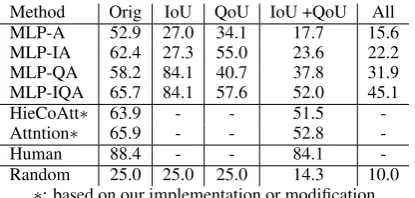
Table 3: Test accuracy (%) on Visual7W.
Effectiveness of new decoys A better set of de-coys will force learning models to integrate all 3 pieces of information — images, questions and answers — to make the correct selection from multiple-choices. In particular, they should pre-vent learning algorithms from exploiting shortcuts such that partial information is sufficient for per-forming well on the Visual QA task.
Table 3 clearly indicates that those goals have
been achieved. With the Orig decoys, the rela-tively small gain from MLP-IA to MLP-IQA sug-gests that the question information can be ignored to attain good performance. However, with the IoU-decoys which require questions to help to re-solve (as image itself is inadequate to rere-solve), the gain is substantial (from 27.3% to 84.1%). Likewise, with the QoU-decoys (question itself is not adequate to resolve), including images in-formation improves from 40.7% (MLP-QA) sub-stantially to 57.6% (MLP-IQA). Note that with the Orig decoys, this gain is smaller (58.2% vs. 65.7%).
It is expected that MLP-IA matches better QoU-decoys but not IoU-QoU-decoys, and MLP-QA is the other way around. Thus it is natural to combine these two decoys. What is particularly appealing is that MLP-IQA improves noticeably over models learned with partial information on the combined
IoU +QoU-decoys (and “All” decoys4).
Further-more, using answer information only (MLP-A) at-tains about the chance-level accuracy.
On the VQA dataset (Table4), the same
obser-vations hold, though to a lesser degree. On any of the IoU or QoU columns, we observe
substan-4We note that the decoys in Orig are not trivial, which can be seen from the gap between All and IoU +QoU. Our main concern on Orig is that for those questions that machines can accurately answer, they mostly rely on only partial informa-tion. This will thus hinder designing machines to fully com-prehend and reason from multimodal information. We further experiment on random decoys, which can achieveNeutrality
Method Orig IoU QoU IoU +QoU All MLP-A 31.2 39.9 45.7 31.2 27.4 MLP-IA 42.0 39.8 55.1 34.1 28.7 MLP-QA 58.0 84.7 55.1 54.4 50.0 MLP-IQA 64.6 85.2 65.4 63.7 58.9
HieCoAtt∗ 63.0 - - 63.7
-Attntion∗ 66.0 - - 66.7
-Human 88.5† - - 89.0
-Random 5.6 25.0 25.0 14.3 4.2
∗: based on our implementation or modification
[image:8.595.77.287.64.177.2]†: taken from (Antol et al.,2015)
Table 4: Accuracy (%) on the validation set in VQA.
Method IoU QoU IoU +QoU
MLP-A 29.1 36.2 19.5
MLP-IA 29.5 60.2 25.2 MLP-QA 89.3 45.6 43.9 MLP-IQA 89.2 64.3 58.5
HieCoAtt∗ - - 57.5
Attntion∗ - - 60.1
Human - - 82.5
Random 25.0 25.0 14.3 ∗: based on our implementation or modification
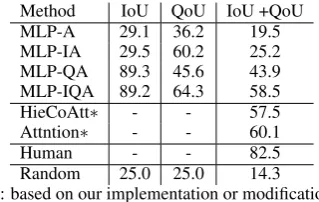
Table 5: Test accuracy (%) on qaVG.
tial gains when the complementary information is added to the model (such as IA to MLP-IQA). All these improvements are much more vis-ible than those observed on the original decoy sets.
Combining both Table 3and 4, we notice that
the improvements from MLP-QA to MLP-IQA tend to be lower when facing IoU-decoys. This is also expected as it is difficult to have decoys that are simultaneously both IoU and QoU — such an-swers tend to be the target anan-swers. Nonetheless, we deem this as a future direction to explore.
Differences across datasets Contrasting Vi-sual7W to VQA (on the column IoU +QoU), we notice that Visual7W tends to have bigger im-provements in general. This is due to the fact that VQA has many questions with “Yes” or “No” as the targets — the only valid decoy to the target “Yes” is “No”, and vice versa. As such decoys are already captured by Orig of VQA (‘Yes” and “No” are both top frequently-occurring targets), adding other decoy answers will not make any noticeable improvement. In Supplementary Material, how-ever, we show that once we remove such ques-tions/answers pairs, the degree of improvements increases substantially.
Comparison on Visual QA models As
pre-sented in Table3and4, MLP-IQA is on par with
or even outperformsAttentionandHieCoAtton
the Orig decoys, showing how the shortcuts make
Datasets Decoys Best w/o qaVG model using qaVG initial fine-tuned Visual7W IoU +QoUOrig 65.752.0 60.558.1 69.158.7
All 45.1 48.9 51.0
VQA IoU +QoUOrig 64.663.7 42.247.9 65.664.1
[image:8.595.310.529.64.146.2]All 58.9 37.5 59.4
Table 6: Using models trained on qaVG to improve Vi-sual7W and VQA (Accuracy in %).
it difficult to compare different models. By elim-inating the shortcuts (i.e., on the combined IoU +QoU-decoys), the advantage of using
sophisti-cated models becomes obvious (Attention
outper-forms MLP-IQA by 3% in Table4), indicating the
importance to design advanced models for achiev-ing human-level performance on Visual QA.
For completeness, we include the results on the
Visual Genome dataset in Table5. This dataset has
no “Orig” decoys, and we have created a
multiple-choice based datasetqaVGfrom it for the task —
it has over 1 million triplets, the largest dataset on this task to our knowledge. On the combined IoU +QoU-decoys, we again clearly see that machines need to use all the information to succeed.
WithqaVG, we also investigate whether it can
help improve the multiple-choice performances on the other two datasets. We use the MLP-IQA trained on qaVG with both IoU and QoU decoys to initialize the models for the Visual7W and VQA datasets. We report the accuracies before and after fine-tuning, together with the best results learned
solely on those two datasets. As shown in Table6,
fine-tuning largely improves the performance,
jus-tifying the finding by Fukui et al. (2016).
5.4 Qualitative Results
In Fig.2, we present examples of
image-question-target triplets fromV7W,VQA, andVG, together
with our IoU-decoys (A, B, C) and QoU-decoys (D, E, F). G is the target. The predictions by the corresponding MLP-IQA are also included. Ignor-ing information from images or questions makes it extremely challenging to answer the triplet cor-rectly, even for humans.
Our automatic procedures do fail at some triplets, resulting in ambiguous decoys to the
tar-gets. See Fig. 3 for examples. We categorized
those failure cases into two situations.
• Our filtering steps in Sect.4fail, as observed in
[image:8.595.100.260.213.314.2]re-What is the train traveling over?
A. Yes. B. Blue. C. Tracks.
D. Train. E. South. F. Forward. G. Bridge.
What is the color of his wetsuit?
A. When waves are bigger. B. It is not soft and fine. C. It is a picture of nature.
D. Green. E. Blue. F. Red. G. It is black.
Where do the stairs lead? A. A parking lot. B. The building. C. The windows.
D. From the canal to the bridge. E. Up. F. To the building. G. To the plane.
What is the right man on the right holding? A. Brown. B. The man on the right. C. Four.
D. A bottle. E. A surfboard. F. Cellphone. G. A bat.
What is the man wearing? A. Black.
B. Mountains. C. The beach.
D. Board shorts. E. He wears white shoes. F. A white button down shirt and a black tie. G. Wetsuit.
What are these people about to do? A. Yellow. B. Yes. C. Four.
[image:9.595.80.517.65.188.2]D. Surf. E. Fly kite. F. Play frisbee. G. Ski.
Figure 2: Example image-question-target triplets from Visual7W, VQA, and VG, together with our IoU-decoys (A, B, C.) and QoU-decoys (D, E, F). G is the target. Machine’s selections are denoted by green ticks (correct) or red crosses (wrong).
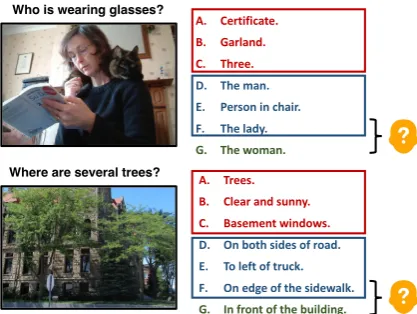
A. Trees. B. Clear and sunny. C. Basement windows.
D. On both sides of road. E. To left of truck. F. On edge of the sidewalk. G. In front of the building.
A. Certificate. B. Garland. C. Three.
D. The man. E. Person in chair. F. The lady. G. The woman. Who is wearing glasses?
Where are several trees?
Figure 3: Ambiguous examples by our IoU-decoys (A, B, C) and QoU-decoys (D, E, F). G is the target. Am-biguous decoys F are marked.
lies on the WordNet hierarchy. For some seman-tically similar words like “lady” and “woman”, the similarity is only 0.632, much lower than that of 0.857 between “cat” and “dog”. This is-sue can be alleviated by considering alternative
semantic measures by WORD2VECor by those
used in (Das et al.,2017;Ding et al.,2016) for
searching similar questions.
• The question is ambiguous to answer. In the
bot-tom example in Fig.3, both candidates D and F
seem valid as a target. Another representative case is when asked about the background of a image. In images that contain sky and moun-tains in the distance, both terms can be valid.
6 Conclusion
We perform detailed analysis on existing datasets for multiple-choice Visual QA. We found that the design of decoys can inadvertently provide “short-cuts” for machines to exploit to perform well on the task. We describe several principles of con-structing good decoys and propose automatic
pro-cedures to remedy existing datasets and create new ones. We conduct extensive empirical stud-ies to demonstrate the effectiveness of our meth-ods in creating better Visual QA datasets. The remedied datasets and the newly created ones are
released and available athttp://www.teds.
usc.edu/website_vqa/.
Acknowledgments
This work is partially supported by USC Grad-uate Fellowship, NSF IIS-1065243, 1451412, 1513966/1632803, 1208500, CCF-1139148, a Google Research Award, an Alfred. P. Sloan Re-search Fellowship and ARO# W911NF-12-1-0241 and W911NF-15-1-0484.
References
Aishwarya Agrawal, Dhruv Batra, and Devi Parikh. 2016. Analyzing the behavior of visual question
an-swering models. InEMNLP.
Aishwarya Agrawal, Dhruv Batra, Devi Parikh, and Aniruddha Kembhavi. 2018. Don’t just assume; look and answer: Overcoming priors for visual
ques-tion answering. InCVPR.
Peter Anderson, Basura Fernando, Mark Johnson, and Stephen Gould. 2016. Spice: Semantic
proposi-tional image caption evaluation. InECCV.
Stanislaw Antol, Aishwarya Agrawal, Jiasen Lu, Mar-garet Mitchell, Dhruv Batra, C Lawrence Zitnick, and Devi Parikh. 2015. Vqa: Visual question
an-swering. InICCV.
Steven Bird, Ewan Klein, and Edward Loper. 2009. Natural language processing with Python: analyz-ing text with the natural language toolkit. ” O’Reilly Media, Inc.”.
[image:9.595.79.288.243.400.2]Data collection and evaluation server. arXiv preprint arXiv:1504.00325.
Abhishek Das, Satwik Kottur, Khushi Gupta, Avi Singh, Deshraj Yadav, Jos´e MF Moura, Devi Parikh,
and Dhruv Batra. 2017. Visual dialog. InCVPR.
Nan Ding, Sebastian Goodman, Fei Sha, and Radu Soricut. 2016. Understanding image and text simul-taneously: a dual vision-language machine
compre-hension task. arXiv preprint arXiv:1612.07833.
Ali Farhadi, Mohsen Hejrati, Mohammad Amin Sadeghi, Peter Young, Cyrus Rashtchian, Julia Hockenmaier, and David Forsyth. 2010. Every pic-ture tells a story: Generating sentences from images.
InECCV.
Akira Fukui, Dong Huk Park, Daylen Yang, Anna Rohrbach, Trevor Darrell, and Marcus Rohrbach. 2016. Multimodal compact bilinear pooling for vi-sual question answering and vivi-sual grounding. In EMNLP.
Yash Goyal, Tejas Khot, Douglas Summers-Stay, Dhruv Batra, and Devi Parikh. 2017. Making the v in vqa matter: Elevating the role of image
under-standing in visual question answering. InCVPR.
Kaiming He, Xiangyu Zhang, Shaoqing Ren, and Jian Sun. 2016. Deep residual learning for image
recog-nition. InCVPR.
Micah Hodosh and Julia Hockenmaier. 2016. Focused evaluation for image description with binary
forced-choice tasks. InACL Workshop.
Micah Hodosh, Peter Young, and Julia Hockenmaier. 2013. Framing image description as a ranking task:
Data, models and evaluation metrics. Journal of
Ar-tificial Intelligence Research.
Allan Jabri, Armand Joulin, and Laurens van der Maaten. 2016. Revisiting visual question answering
baselines. InECCV.
Justin Johnson, Bharath Hariharan, Laurens van der Maaten, Li Fei-Fei, C Lawrence Zitnick, and Ross Girshick. 2017. Clevr: A diagnostic dataset for compositional language and elementary visual
rea-soning. InCVPR.
Kushal Kafle and Christopher Kanan. 2017a. An anal-ysis of visual question answering algorithms. In ICCV.
Kushal Kafle and Christopher Kanan. 2017b. Visual question answering: Datasets, algorithms, and
fu-ture challenges. Computer Vision and Image
Un-derstanding.
Mert Kilickaya, Aykut Erdem, Nazli Ikizler-Cinbis, and Erkut Erdem. 2017. Re-evaluating automatic
metrics for image captioning. InEACL.
Ranjay Krishna, Yuke Zhu, Oliver Groth, Justin John-son, Kenji Hata, Joshua Kravitz, Stephanie Chen, Yannis Kalantidis, Li-Jia Li, David A Shamma, Michael Bernstein, and Li Fei-Fei. 2017. Visual genome: Connecting language and vision using
crowdsourced dense image annotations. IJCV.
Quoc V Le and Tomas Mikolov. 2014. Distributed
rep-resentations of sentences and documents. InICML.
Tsung-Yi Lin, Michael Maire, Serge Belongie, James Hays, Pietro Perona, Deva Ramanan, Piotr Doll´ar, and C Lawrence Zitnick. 2014. Microsoft coco:
Common objects in context. InECCV.
Xiao Lin and Devi Parikh. 2016. Leveraging visual question answering for image-caption ranking. In ECCV.
Xiao Lin and Devi Parikh. 2017. Active learning for
vi-sual question answering: An empirical study. arXiv
preprint arXiv:1711.01732.
Chia-Wei Liu, Ryan Lowe, Iulian V Serban, Michael Noseworthy, Laurent Charlin, and Joelle Pineau. 2016. How not to evaluate your dialogue system: An empirical study of unsupervised evaluation
met-rics for dialogue response generation. InEMNLP.
Jiasen Lu, Jianwei Yang, Dhruv Batra, and Devi
Parikh. 2016. Hierarchical question-image
co-attention for visual question answering. InNIPS.
Mateusz Malinowski and Mario Fritz. 2014. A multi-world approach to question answering about
real-world scenes based on uncertain input. InNIPS.
Tomas Mikolov, Ilya Sutskever, Kai Chen, Greg S Cor-rado, and Jeff Dean. 2013. Distributed representa-tions of words and phrases and their compositional-ity. InNIPS.
Vicente Ordonez, Girish Kulkarni, and Tamara L Berg. 2011. Im2text: Describing images using 1 million
captioned photographs. InNIPS.
Jeffrey Pennington, Richard Socher, and Christopher D Manning. 2014. Glove: Global vectors for word
representation. InEMNLP.
Mengye Ren, Ryan Kiros, and Richard Zemel. 2015. Exploring models and data for image question
an-swering. InNIPS.
Olga Russakovsky, Jia Deng, Hao Su, Jonathan Krause, Sanjeev Satheesh, Sean Ma, Zhiheng Huang, An-drej Karpathy, Aditya Khosla, Michael Bernstein, Alexander C. Berg, and Li Fei-Fei. 2015. ImageNet
large scale visual recognition challenge. IJCV.
Qi Wu, Damien Teney, Peng Wang, Chunhua Shen, Anthony Dick, and Anton van den Hengel. 2017. Visual question answering: A survey of methods and
datasets. Computer Vision and Image
Zhibiao Wu and Martha Palmer. 1994. Verbs semantics and lexical selection. InACL.
Huijuan Xu and Kate Saenko. 2016. Ask, attend and answer: Exploring question-guided spatial attention
for visual question answering. InECCV.
Kelvin Xu, Jimmy Ba, Ryan Kiros, Kyunghyun Cho, Aaron C Courville, Ruslan Salakhutdinov, Richard S Zemel, and Yoshua Bengio. 2015. Show, attend and tell: Neural image caption generation with visual
at-tention. InICML.
Licheng Yu, Eunbyung Park, Alexander C Berg, and Tamara L Berg. 2015. Visual madlibs: Fill in the blank description generation and question
answer-ing. InICCV.
Peng Zhang, Yash Goyal, Douglas Summers-Stay, Dhruv Batra, and Devi Parikh. 2016. Yin and yang: Balancing and answering binary visual questions. In CVPR.
Yuke Zhu, Oliver Groth, Michael Bernstein, and Li Fei-Fei. 2016. Visual7w: Grounded question answering