Proceedings of NAACL-HLT 2018, pages 1206–1215
Diverse Few-Shot Text Classification with Multiple Metrics
Mo Yu⇤ Xiaoxiao Guo⇤ Jinfeng Yi⇤ Shiyu Chang
Saloni Potdar Yu Cheng Gerald Tesauro Haoyu Wang Bowen Zhou
AI Foundations – Learning, IBM Research
IBM T. J. Watson Research Center, Yorktown Heights, NY 10598
Abstract
We study few-shot learning in natural lan-guage domains. Compared to many ex-isting works that apply either metric-based or optimization-based meta-learning to image domain with low inter-task variance, we con-sider a more realistic setting, where tasks are diverse. However, it imposes tremendous diffi-culties to existing state-of-the-art metric-based algorithms since a single metric is insufficient to capture complex task variations in natu-ral language domain. To alleviate the prob-lem, we propose an adaptive metric learn-ing approach that automatically determines the best weighted combination from a set of met-rics obtained from meta-training tasks for a newly seen few-shot task. Extensive quantita-tive evaluations on real-world sentiment anal-ysis and dialog intent classification datasets demonstrate that the proposed method per-forms favorably against state-of-the-art few shot learning algorithms in terms of predictive accuracy. We make our code and data avail-able for further study.1
1 Introduction
Few-shot learning (FSL) (Miller et al., 2000; Li et al., 2006; Lake et al., 2015) aims to learn classifiers from few examples per class. Re-cently, deep learning has been successfully ex-ploited for FSL via learning meta-models from a large number of meta-training tasks. These meta-models can be then used for rapid-adaptation for the target/meta-testing tasks that only have few training examples. Examples of such meta-models include: (1) metric-/similarity-based mod-els, which learn contextual, and task-specific sim-ilarity measures (Koch,2015;Vinyals et al.,2016;
⇤
Equal contributions from the corresponding authors:
[email protected], [email protected], [email protected].
1https://github.com/Gorov/DiverseFewShot_Amazon
Snell et al., 2017); and (2) optimization-based models, which receive the input of gradients from a FSL task and predict either model parameters or parameter updates (Ravi and Larochelle,2017; Munkhdalai and Yu,2017;Finn et al.,2017;Wang et al.,2017).
In the past, FSL has mainly considered im-age domains, where all tasks are often sampled from one huge collection of data, such as Om-niglot (Lake et al., 2011) and ImageNet (Vinyals et al.,2016), making tasks come from a single do-main thus related. Due to such a simplified set-ting, almost all previous works employ a com-mon meta-model (metric-/optimization-based) for all few-shot tasks. However, this setting is far from the realistic scenarios in many real-world ap-plications of few-shot text classification. For ex-ample, on an enterprise AI cloud service, many clients submit various tasks to train text classifica-tion models for business-specific purposes. The tasks could be classifying customers’ comments or opinions on different products/services, moni-toring public reactions to different policy changes, or determining users’ intents in different types of personal assistant services. As most of the clients cannot collect enough data, their submitted tasks form a few-shot setting. Also, these tasks are sig-nificantly diverse, thus a common metric is insuf-ficient to handle all these tasks.
We consider a more realistic FSL setting in this paper, where tasks are diverse. In such a sce-nario, the optimal meta-model may vary across tasks. Our solution is based on the metric-learning approach (Snell et al., 2017) and the key idea is to maintain multiple metrics for FSL. The meta-learner selects and combines multiple metrics for learning the target task usingtask clustering on the meta-training tasks. During the meta-training, we propose to first partition the meta-training tasks into clusters, making the tasks in each cluster
likely to be related. Then within each cluster, we train a deep embedding function as the metric. This ensures the common metric is only shared across tasks within the same cluster. Further, dur-ing meta-testdur-ing, each target FSL task is assigned to a task-specific metric, which is a linear combi-nation of the metrics defined by different clusters. In this way, the diverse few-shot tasks can derive different metrics from the previous learning expe-rience.
The key of the proposed FSL framework is the task clustering algorithm. Previous works (Kumar and Daume III, 2012; Kang et al., 2011; Cram-mer and Mansour, 2012; Barzilai and Crammer, 2015) mainly focused on convex objectives, and assumed the number of classes is the same across different tasks (e.g. binary classification is often considered). To make task clustering (i) compat-ible with deep networks and (ii) able to handle tasks with a various number of labels, we propose
amatrix-completion based task clustering
algo-rithm. The algorithm utilizes task similarity mea-sured by cross-task transfer performance, denoted by matrixS. The(i, j)-entry ofSis the estimated
accuracy by adapting the learned representations on the i-th (source) task to the j-th (target) task. We rely on matrix completion to deal with miss-ing and unreliable entries in S and finally apply spectral clustering to generate the task partitions.
To the best of our knowledge, our work is the first one addressing the diverse few-shot learning problem and reporting results on real-world few-shot text classification problems. The experimen-tal results show that the proposed algorithm pro-vides significant gains on few-shot sentiment clas-sification and dialog intent clasclas-sification tasks. It provides positive feedback on the idea of using multiple meta-models (metrics) to handle diverse FSL tasks, as well as the proposed task clustering algorithm on automatically detecting related tasks.
2 Problem Definition
Few-Shot Learning Since we focus ondiverse
metric-based FSL, the problem can be
formu-lated in two stages: (1) meta-training, where a set of metricsM = {⇤1,· · · ,⇤K}is learned on
the meta-training tasks T. Each ⇤i maps two
input(x1, x2)to a scalar of similarity score. Here
T ={T1,T2,· · · ,TN}is a collection ofN tasks.
Here K is a pre-defined number (usually K ⌧
N). Each taskTi consists of training, validation,
and testing set denoted as Dtrain
i , Divalid, Dtesti ,
respectively. Note that the definition of T is a generalized version ofD(meta train)in (Ravi and
Larochelle, 2017), since each task Ti can be
ei-ther few-shot (where Divalid is empty) or regu-lar2. (2) meta-testing: the trained metrics in M is applied to meta-testing tasks denoted as T0 = {T01,· · · ,T0
N0}, where eachT0i is a
few-shot learning task consisting of both training and testing data as D0train
i , Di0test .D0itrainis a small
labeled set for generating the prediction modelM0i
for eachT0i. Specifically,M0is are kNN-based
pre-dictors built upon the metrics inM. We will
de-tail the construction ofM0i in Section 3, Eq. (6).
It is worth mentioning that the definition ofT0 is
the same asD(meta test)in (Ravi and Larochelle,
2017). Theperformance of few-shot learningis the macro-average ofM0i’s accuracy on all the
test-ing setD0test i s.
Our definitions can be easily generalized to other meta-learning approaches (Ravi and Larochelle,2017;Finn et al.,2017;Mishra et al., 2017). The motivation of employing multiple met-rics is that when the tasks are diverse, one metric model may not be sufficient. Note that previous metric-based FSL methods can be viewed as a spe-cial case of our definition whereMonly contains a single⇤, as shown in the two base model
exam-ples below.
Base Model: Matching Networks In this paper
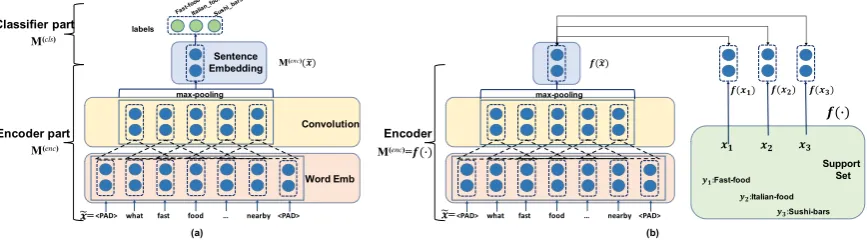
we use the metric-based model Matching Network (MNet) (Vinyals et al., 2016) as the base metric model. The model (Figure1b) consists of a neural network as the embedding function (encoder) and an augmented memory. The encoder, f(·), maps
an inputxto ad-length vector. The learned met-ric ⇤ is thus the similarity between the encoded vectors,⇤(x1, x2) =f(x1)Tf(x2), i.e. the metric
⇤ is modeled by the encoder f. The augmented memory stores a support set S = {(xi, yi)}|i=1S|,
where xi is the supporting instance and yi is its
corresponding label in a one-hot format. The MNet explicitly defines a classifierMconditioned
on the supporting set S. For any new dataxˆ, M
predicts its label via a similarity function ↵(., .)
2For example, the methods in (Triantafillou et al.,2017)
Sentence Embedding
…
…
Convolution
Word Emb
<PAD> what fast food … nearby <PAD> Encoder part
M(enc)
Classifier part M(cls)
labels
(a) (b)
…
…
max-pooling max-pooling
<PAD> what fast food … nearby <PAD> Encoder
M(enc)=!(#)
%&= %&=
'(:Fast-food '*:Italian-food
'+:Sushi-bars
!(%&)
M(enc)(%&)
%( %* %+
Support Set
[image:3.595.85.519.68.188.2]!(#) !(%() !(%*) !(%+)
Figure 1: The Convolutional Neural Networks (CNN) used in this work: (a) A CNN classifier. The encoder com-ponent takes the sentence as input and outputs a fixed-length sentence embedding vector; the classifier comcom-ponent predicts class labels with the sentence embedding. (b) A Matching Network, which only contains an encoder like in (a), and makes prediction via a k-Nearest-Neighbor classifier with the similarity defined by the encoder.
between the test instancexˆand the support setS:
y=P(.|x, Sˆ ) = |S| X
i=1
↵(ˆx, xi;✓)yi, (1)
where we defined ↵(., .) to be a softmax
distribution given ⇤(ˆx, xi), where xi is
a supporting instance, i.e., ↵(ˆx, xi;✓) = exp(f(ˆx)Tf(x
i))/P|jS=1| exp(f(ˆx)Tf(x
j)), where ✓
are the parameters of the encoderf. Thus,yis a valid distribution over the supporting set’s labels
{yi}|i=1S| . To adapt the MNet to text classification,
we choose encoderf to be a convolutional neural network (CNN) following (Kim, 2014; Johnson and Zhang, 2016). Figure 1 shows the MNet with the CNN architecture. Following (Collobert et al., 2011; Kim, 2014), the model consists of a convolution layer and a max-pooling operation over the entire sentence.
To train the MNets, we first sample the training dataset D for taskT from all tasks T, with no-tation simplified asD ⇠ T. For each class in the sampled datasetD, we samplekrandom instances in that class to construct a support setS, and sam-ple a batch of training instancesB as training ex-amples, i.e., B, S ⇠ D. The training objective is to minimize the prediction error of the training samples given the supporting set (with regard to the encoder parameters✓) as follows:
E
D⇠T h
E
B,S⇠D
⇥ X
(x,y)2B
log(P(y|x, S;✓))⇤i. (2)
Base Model: Prototypical Networks
Prototyp-ical Network (ProtoNet) (Snell et al., 2017) is a variation of Matching Network, which also de-pends on metric learning but builds the classifier
Mdifferent from Eq. (1):
y=P(.|x, Sˆ ) =
L
X
i=1
↵(ˆx, Si;✓)yi. (3)
Lis the number of classes andSi={x|(x, y)2S^
y=yi}is the support set of classyi. ↵(ˆx, Si;✓) = exp⇣f(ˆx)TP
x2Sif(x) ⌘
/PL j=1exp
⇣
f(ˆx)TP
x02Sjf(x0) ⌘
.
3 Methodology
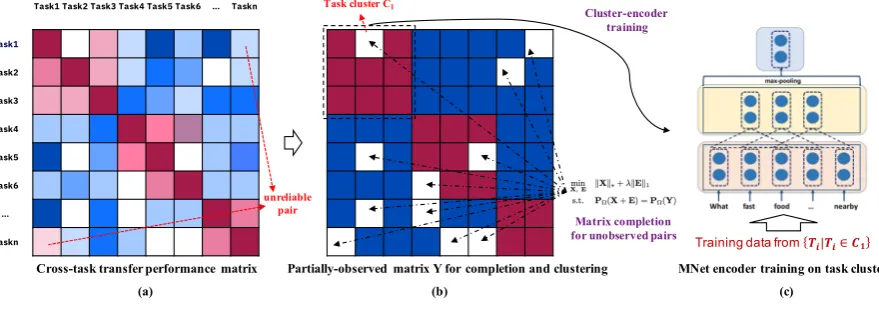
We propose a task-clustering framework to ad-dress the diverse few-shot learning problem stated in Section2. We have the FSL algorithm summa-rized in Algorithm1. Figure2gives an overview of our idea. The initial step of the algorithm is a novel task clustering algorithm based on matrix completion, which is described in Section3.1. The few-shot learning method based on task clustering is then introduced in Section3.2.
3.1 Robust Task Clustering by Matrix Completion
Our task clustering algorithm is shown in Algo-rithm2. The algorithm first evaluates the transfer performance by applying a single-task modelito another task j (Section 3.1.1), which will result in a (partially observed) cross-task transfer perfor-mance matrixS. The matrixSis then cleaned and completed, giving a symmetry task similarity ma-trixYfor spectral clustering (Ng et al.,2002).
3.1.1 Estimation of Cross-Task Transfer Performance
Task1
Task2
Task3
Task4
Task5
Task6
…
Taskn
Task1 Task2 Task3 Task4 Task5 Task6 … Taskn Cluster-encoder
training
Cross-task transfer performance matrix
Matrix completion for unobserved pairs
(a) (c)
MNet encoder training on task cluster (b)
Partially-observed matrix Y for completion and clustering
unreliable pair
pair pair
pair
pair
Task cluster C1
[image:4.595.81.521.67.223.2]Training data from !"|!"∈ %&
Figure 2: Overview of the idea of our multi-metric learning approach for few-shot learning. (a) an illustration of the sparse cross-tasks transfer-performance matrix with unobserved entries (white blocks) and unreliable values (top-right and bottom-left corners), where red colors indicate positive transfer and blue colors indicate negative transfer; (b) the constructed binary partially-observed matrix with low-rank constraint for matrix completion and clustering (see Section3.1for the details); (c) an encoder trained with the matching network objective Eq. (2) on a task cluster (tasks 1, 2 and 3 in the example).
Tj(j 6= i). This forms ann⇥npair-wise
classi-fication performance matrixS, called the transfer-performance matrix. Note that S is asymmetric since usuallySij 6=Sji.
Algorithm 1:ROBUSTTC-FSL: Task
Cluster-ing for Few-Shot LearnCluster-ing
Input :Nmeta-training tasksT={T1,T2,· · ·,Tn}; number of clustersK;N0target few-shot meta-testing tasksT0
Output:Meta-modelM={C1:K(Ktask clusters),
F={f1, f2,· · ·, fK} (Ktask encoders)}.
One classifierM0ifor each target taskT0.
1 Robust Task Clustering:C1:K= ROBUSTTC(T,K)
(Algorithm2)
2 Cluster-Model Training: Train one encoder (multi-task MNet)fion each task clusterCi(Section3.2.1)
3 Few-Shot Learning on Cluster-models: Train a model
Mtrgon taskTtrgwith the method in Section3.2.2.
Ideally, the transfer performance could be esti-mated by training a MNet on taski and directly evaluating it on taskj. However, the limited train-ing data usually lead to generally low transfer per-formance of single-task MNet. As a result we adopt the following approach to estimateS:
We train a CNN classifier (Figure1(a)) on task i, then take only the encoderMenc
i fromMi and
freeze it to train a classifier on taskj. This gives us a new task j model, and we test this model on Dvalid
j to get the accuracy as the
transfer-performanceSij. The score shows how the
repre-sentations learned on taskican be adapted to task j, thus indicating the similarity between tasks.
Algorithm 2:ROBUSTTC: Robust Task
Clus-tering based on Matrix Completion
Input :A set ofntasksT ={T1,T2,· · ·,Tn}, number of task clustersK
Output:Ktask clustersC1:K
1 Learning of Single-Task Models: train single-task modelsMifor each taskTi
2 Evaluation of Transfer-Performance Matrix: get performance matrixS(Section3.1.1)
3 Score Filtering: Filter the uncertain scores inSand construct the symmetric matrixYusing Eq. (4) 4 Matrix Completion: Complete the similar matrixX
fromYusing Eq. (5)
5 Task Clustering:C1:K=SpectralClustering(X, K)
Remark: Out-of-Vocabulary Problem In text
classification tasks, transferring an encoder with fine-tuned word embeddings from one task to an-other is difficult as there can be a significant differ-ence between the two vocabularies. Hdiffer-ence, while learning the single-task CNN classifiers, we al-ways make the word embeddings fixed.
3.1.2 Task Clustering Method
Directly using the transfer performance for task clustering may suffer from both efficiency and ac-curacy issues. First, evaluation of all entries in the matrixSinvolves conducting the source-target transfer learningO(n2)times, wherenis the
num-ber of meta-training tasks. For a large numnum-ber of diverse tasks where the n can be larger than 1,000, evaluation of the full matrix is unaccept-able (over 1M entries to evaluate). Second, the estimated cross-task performance (i.e. some Sij
size or label noise. When the number of the un-certain values is large, they can collectively mis-lead the clustering algorithm to output an incor-rect task-partition. To address the aforementioned challenges, we propose a novel task clustering al-gorithm based on the theory of matrix comple-tion (Cand`es and Tao,2010). Specifically, we deal with the huge number of entries by randomly sam-ple task pairs to evaluate the Sij andSji scores.
Besides, we deal with the unreliable entries and asymmetry issue by keeping only task pairs(i, j)
with consistentSijandSjiscores. as will be
intro-duced in Eq. (4). Below, we describe our method in detail.
Score Filtering First, we use only reliable task
pairs to generate a partially-observed similarity matrix Y. Specifically, if Sij and Sji are high
enough, then it is likely that tasks{i, j}belong to a same cluster and share significant information. Conversely, if Sij and Sji are low enough, then
they tend to belong to different clusters. To this end, we need to design a mechanism to determine if a performance is high or low enough. Since dif-ferent tasks may vary in difficulty, a fixed thresh-old is not suitable. Hence, we define a dynamic threshold using the mean and standard deviation of the target task performance, i.e.,µj = mean(S:j)
and j = std(S:j), where S:j is thej-th column
ofS. We then introduce two positive parameters p1andp2, and define high and low performance as
Sijgreater thanµj+p1 jor lower thanµj p2 j,
respectively. When bothSij andSji are high and
low enough, we set their pairwise similarity as1
and0, respectively. Other task pairs are treated as
uncertain task pairs and are marked as unobserved, and don’t influence our clustering method. This leads to a partially-observed symmetric matrixY, i.e.,
Yij=Yji=
8 > < > :
1 if Sij> µj+p1 j
and Sji> µi+p1 i
0 if Sij< µj p2 j
and Sji< µi p2 i
unobserved otherwise
(4)
Matrix Completion Given the partially
ob-served matrixY, we then reconstruct the full sim-ilarity matrix X 2 Rn⇥n. We first note that the
similarity matrixXshould be of low-rank (proof deferred to appendix). Additionally, since the ob-served entries of Y are generated based on high and low enough performance, it is safe to assume that most observed entries are correct and only a
few may be incorrect. Therefore, we introduce a sparse matrixEto capture the observed incorrect entries inY. Combining the two observations, Y
can be decomposed into the sum of two matricesX
andE, whereXis a low rank matrix storing simi-larities between task pairs, andEis a sparse matrix that captures the errors inY. The matrix comple-tion problem can be cast as the following convex optimization problem:
min
X,E kXk⇤+ kEk1 (5)
s.t. P⌦(X+E) =P⌦(Y),
wherek k⇤denotes the matrix nuclear norm, the
convex surrogate of rank function. ⌦is the set of
observed entries inY, andP⌦ :Rn⇥n7!Rn⇥nis
a matrix projection operator defined as
[P⌦(A)]ij =
⇢
Aij if(i, j)2⌦
0 otherwise
Finally, we apply spectral clustering on the ma-trixXto get the task clusters.
Remark: Sample Efficiency In the Appendix
A, we show a Theorem 7.1 as well as its proof, implying that under mild conditions, the problem (5) can perfectly recover the underlying similarity matrix X⇤ if the number of observed correct
en-tries is at leastO(nlog2n). This theoretical
guar-antee implies that for a large numbernof training tasks, only a tiny fraction of all task pairs is needed to reliably infer similarities over all task pairs.
3.2 Few-Shot Learning with Task Clusters 3.2.1 Training Cluster Encoders
For each clusterCk, we train a multi-task MNet
model (Figure1(b)) with all tasks in that cluster to encourage parameter sharing. The result, denoted asfkis called thecluster-encoderof clusterCk.
Thek-th metric of the cluster is thus⇤(x1, x2) =
fk(x1)|fk(x2).
3.2.2 Adapting Multiple Metrics for Few-Shot Learning
To build a predictorMwith access to only a
lim-ited number of training samples, we make the pre-diction probability by linearly combining predic-tion from learned cluster-encoders:
p(y|x) =X
k
where fk is the learned (and frozen) encoder of
thek-th cluster,{↵k}Kk=1are adaptable parameters
trained with few-shot training examples. And the predictorP(y|x;fk)from each cluster is
P(y=yl|x;fk) =
exp{fk(xl)|fk(x)}
P
iexp{fk(xi)|fk(x)}
(7)
xlis the corresponding training sample of labelyl.
Remark: Joint Method versus Pipeline Method
End-to-end joint optimization on training data be-comes a popular methodology for deep learning systems, but it is not directly applicable to di-verse FSL. One main reason is that deep networks could easily fit any task partitions if we optimize on training loss only, making the learned metrics not generalize, as discussed in Section 6. As a result, this work adopts a pipeline training ap-proach and employing validation sets for task clus-tering. Combining reinforcement learning with meta-learning could be a potential solution to en-able an end-to-end training for future work.
4 Tasks and Data Sets
We test our methods by conducting experiments on two text classification data sets. We used NLTK toolkit3for tokenization. The task are divided into
meta-training tasks and meta-testing tasks (target tasks), where the meta-training tasks are used for clustering and cluster-encoder training. The meta-testing tasks are few-shot tasks, which are used for evaluating the method in Eq. (6).
4.1 Amazon Review Sentiment Classification
First, followingBarzilai and Crammer(2015), we construct multiple tasks with the multi-domain sentiment classification (Blitzer et al.,2007) data set. The dataset consists of Amazon product re-views for 23 types of products (see Appendix D for the details). For each product domain, we con-struct three binary classification tasks with differ-ent thresholds on the ratings: the tasks consider a review as positive if it belongs to one of the fol-lowing buckets = 5 stars, >= 4 stars or >= 2
stars.4 These buckets then form the basis of the
task-setup, giving us 23⇥3=69 tasks in total. For
each domain we distribute the reviews uniformly
3http://www.nltk.org/
4Data downloaded fromhttp://www.cs.jhu.edu/
˜mdredze/datasets/sentiment/, in which the
3-star samples were unavailable due to their ambiguous nature (Blitzer et al.,2007).
to the 3 tasks. For evaluation, we select 12 (4⇥3) tasks from 4 domains (Books, DVD, Electronics, Kitchen) as the meta-testing (target) tasks out of all 23 domains. For the target tasks, we create 5-shot learning problems.
4.2 Real-World Tasks: User Intent Classification for Dialog System
The second dataset is from an online service which trains and serves intent classification models to various clients. The dataset comprises recorded conversations between human users and dialog systems in various domains, ranging from per-sonal assistant to complex service-ordering or customer-service request scenarios. During clas-sification, intent-labels5are assigned to user
utter-ances (sentences). We use a total of 175 tasks from different clients, and randomly sample 10 tasks from them as our target tasks. For each meta-training task, we randomly sample 64% data into a training set, 16% into a validation set, and use the rest as the test set. The number of labels for these tasks varies a lot (from 2 to 100, see Appendix D for details), making regulark-shot settings not essentially limited-resource problems (e.g., 5-shot on 100 classes will give a good amount of 500 training instances). Hence, to adapt this to a FSL scenario, for target tasks we keep one example for each label (one-shot), plus 20 randomly picked la-beled examples to create the training data. We be-lieve this is a fairly realistic estimate of labeled examples one client could provide easily.
Remark: Evaluation of the Robustness of
Al-gorithm2 Our matrix-completion method could
handle a large number of tasks via task-pair sam-pling. However, the sizes of tasks in the above two few-shot learning datasets are not too huge, so evaluation of the whole task-similarity matrix is still tractable. In our experiments, the incomplete matrices mainly come from the score-filtering step (see Eq. 4). Thus there is limited randomness in-volved in the generation of task clusters.
To strengthen the conclusion, we evaluate our algorithm on an additional dataset with a much larger number of tasks. The results are reported in the multi-task learning setting instead of the few-shot learning setting focused in this paper. There-fore we put the results to a non-archive version of
5In conversational dialog systems, intent-labels are used
this paper6for further reference.
5 Experiments
5.1 Experiment Setup
Baselines We compare our method to the
fol-lowing baselines: (1) Single-task CNN: train-ing a CNN model for each task individually;
(2) Single-task FastText: training one FastText
model (Joulin et al.,2016) with fixed embeddings for each individual task; (3)Fine-tuned the
holis-tic MTL-CNN: a standard transfer-learning
ap-proach, which trains one MTL-CNN model on all the training tasks offline, then fine-tunes the clas-sifier layer (i.e. M(cls) Figure1(a)) on each target
task; (4) Matching Network: a metric-learning based few-shot learning model trained on all train-ing tasks; (5) Prototypical Network: a varia-tion of matching network with different predic-tion funcpredic-tion as Eq. 3; (6) Convex combining
all single-task models: training one CNN
clas-sifier on each meta-training task individually and taking the encoder, then for each target task train-ing a linear combination of all the above strain-ingle- single-task encoders with Eq. (6). This baseline can be viewed as a variation of our method without task clustering. We initialize all models with pre-trained 100-dim Glove embeddings (pre-trained on 6B corpus) (Pennington et al.,2014).
Hyper-Parameter Tuning In all experiments,
we set bothp1andp2parameters in (4) to0.5. This
strikes a balance between obtaining enough ob-served entries inY, and ensuring that most of the retained similarities are consistent with the clus-ter membership. The window/hidden-layer sizes of CNN and the initialization of embeddings (ran-dom or pre-trained) are tuned during the cluster-encoder training phase, with the validation sets of meta-training tasks. We have the CNN with win-dow size of 5 and 200 hidden units. The single-metric FSL baselines have 400 hidden units in the CNN encoders. On sentiment classification, all cluster-encoders use random initialized word embeddings for sentiment classification, and use Glove embeddings as initialization for intent clas-sification, which is likely because the training sets of the intent tasks are usually small.
Since all the sentiment classification tasks are binary classification based on our dataset con-struction. A CNN classifier with binary output
6https://arxiv.org/pdf/1708.07918.pdf
layer can be also trained as the cluster-encoder for each task cluster. Therefore we compared CNN classifier, matching network, and prototypical net-work on Amazon review, and found that CNN classifier performs similarly well as prototypical network. Since some of the Amazon review data is quite large which involves further difficulty on the computation of supporting sets, we finally use binary CNN classifiers as cluster-encoders in all the sentiment classification experiments.
Selection of the learning rate and number of training epochs for FSL settings, i.e., fitting↵s in Eq. (6), is more difficult since there is no valida-tion data in few-shot problems. Thus we pre-select a subset of meta-training tasks as meta-validation tasks and tune the two hyper-parameters on the meta-validation tasks.
5.2 Experimental Results
Table 1 shows the main results on (i) the 12 few-shot product sentiment classification tasks by leveraging the learned knowledge from the 57 pre-viously observed tasks from other product do-mains; and (ii) the 10 few-shot dialog intent clas-sification tasks by leveraging the 165 previously observed tasks from other clients’ data.
Due to the limited training resources, all the supervised-learning baselines perform poorly. The two state-of-the-art metric-based FSL approaches, matching network (4) and prototypical network (5), do not perform better compared to the other baselines, since the single metric is not sufficient for all the diverse tasks. On intent classification where tasks are further diverse, all the single-metric or single-model methods (3-5) perform worse compared to the single-task CNN baseline (1). The convex combination of all the single training task models is the best performing base-line overall. However, on intent classification it only performs on par with the single-task CNN (1), which does not use any meta-learning or trans-fer learning techniques, mainly for two reasons: (i) with the growth of the number of meta-training tasks, the model parameters grow linearly, mak-ing the number of parameters (165 in this case) in Eq.(6) too large for the few-shot tasks to fit; (ii) the meta-training tasks in intent classification usually contain less training data, making the single-task encoders not generalize well.
In contrast, our ROBUSTTC-FSL gives
Model Sentiment IntentAvg Acc
(1) Single-task CNN w/pre-trained emb 65.92 34.46 (2) Single-task FastText w/pre-trained emb 63.05 23.87 (3) Fine-tuned holistic MTL-CNN 76.56 30.36 (4) Matching Network (Vinyals et al.,2016) 65.73 30.42 (5) Prototypical Network (Snell et al.,2017) 68.15 31.51 (6) Convex combination of all single-task models 78.85 34.43
ROBUSTTC-FSL 83.12 37.59
[image:8.595.141.463.62.204.2]Adaptive ROBUSTTC-FSL - 42.97
Table 1: Accuracy of FSL on sentiment classification (Sentiment) and dialog intent classification (Intent) tasks. The target tasks of sentiment classification are 5-shot ones; and each intent target task contains one training example per class and 20 random labeled examples.
It outperforms the baselines in previous work (1-5) by a large margin of more than 6% on the senti-ment classification tasks, and more than 3% on the intent classification tasks. It is also significantly better than our proposed baseline (6), showing the advantages of the usage of task clustering.
Adaptive ROBUSTTC-FSL Although the RO
-BUSTTC-FSL improves over baselines on intent
classification, the margin is smaller compared to that on sentiment classification, because the in-tent classification tasks are more diverse in na-ture. This is also demonstrated by the training accuracy on the target tasks, where several tasks fail to find any cluster that could provide a met-ric that suits their training examples. To deal with this problem, we propose an improved algorithm to automatically discover whether a target task be-longs to none of the task-clusters. If the task doesn’t belong to any of the clusters, it cannot ben-efit from any previous knowledge thus falls back to single-task CNN. The target task is treated as “out-of-clusters” when none of the clusters could achieve higher than 20% accuracy (selected on meta-validation tasks) on its training data. We call this method Adaptive ROBUSTTC-FSL, which gives more than 5% performance boost over the best ROBUSTTC-FSL result on intent
classifica-tion. Note that the adaptive approach makes no difference on the sentiment tasks, because they are more closely related so re-using cluster-encoders always achieves better results compared to single-task CNNs.
5.3 Analysis
Effect of the number of clusters Figure 3
shows the effect of cluster numbers on the two tasks. ROBUSTTC achieves best performance
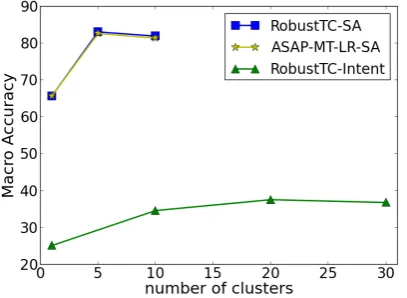
Figure 3: Effect of clusters. ROBUSTTC-SA and RO -BUSTTC-Intent: the performance of our ROBUSTTC clusters on the sentiment and intent classification tasks. ASAP-MT-LR-SA: the state-of-the-art ASAP-MT-LR clusters on the sentiment-analysis tasks (the method is not applicable to the intent-classification tasks).
with 5 clusters on sentiment analysis (SA) and 20 clusters on intent classification (Intent). All clus-tering results significantly outperform the single-metric baselines (#cluster=1 in the figure).
Effect of the clustering algorithms Compared
to previous task clustering algorithms, our RO -BUSTTC is the only one that can cluster tasks with
varying numbers of class labels (e.g. in intent clas-sification tasks). Moreover, we show that even in the setting of all binary classifications tasks (e.g. the sentiment-analysis tasks) that previous task clustering research work on, our ROBUSTTC
is still slightly better for the diverse FSL problems. Figure3compares with a state-of-the-art logistic regression based task clustering method ( ASAP-MT-LR) (Barzilai and Crammer,2015). Our RO -BUSTTC clusters give slightly better FSL
[image:8.595.316.520.263.412.2]Clus0 Clus1 Clus2 Clus3 Clus4 Clus5 Clus6 Clus7 Clus8 Clus9
automotive.t2 apparel.t2 baby.t5 automotive.t5 apparel.t5 beauty.t4 camera.t4 gourmet.t5 cell.t4 apparel.t4
camera.t2 automotive.t4 magazines.t5 baby.t4 camera.t5 beauty.t5 software.t2 magazines.t4 software.t5 toys.t2
health.t2 baby.t2 sports.t5 health.t4 grocery.t5 cell.t5 software.t4 music.t4 toys.t4
magazines.t2 cell.t2 toys.t5 health.t5 jewelry.t5 gourmet.t2 music.t5
office.t2 computer.t2 video.t5 gourmet.t4 video.t4
outdoor.t2 computer.t4 grocery.t2
sports.t2 computer.t5 grocery.t4
sports.t4 jewelry.t4 office.t4
music.t2 outdoor.t4
video.t2
dvd-t4 0.4844 0.4416 0.4625 0.7843 0.7970 0.7196 0.8952 0.3763 0.7155 0.6315
dvd-t5 0.0411 -0.2493 0.5037 0.3567 0.1686 -0.0355 0.4150 -0.2603 -0.0867 0.0547
[image:9.595.78.521.62.161.2]kitchen-t4 0.6823 0.7268 0.7929 1.2660 1.1119 0.7255 1.2196 0.7065 0.6625 1.0945
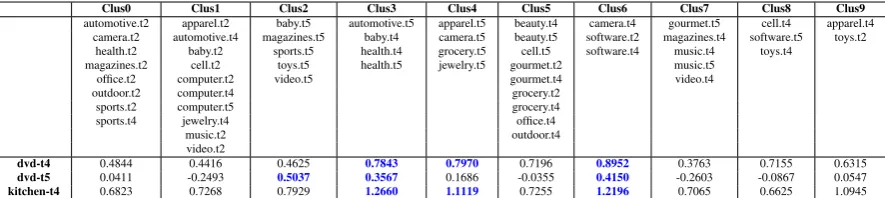
Table 2: Visualization of clusters on the Amazon review domain. The top shows the training tasks assigned to the 10 clusters. Here the number N2 {2,4,5}refers to the threshold of stars for positive reviews. At the bottom we show three tasks with largest improvement from ROBUSTTC-FSL. The top-3 most relevant task clusters (i.e. with highest weights↵s in Eq.6) are highlighted withblue boldfont.
Visualization of Task Clusters The top rows of
Table2shows the ten clusters used to generate the sentiment classification results in Figure3. From the results, we can see that tasks with same thresh-olds are usually grouped together; and tasks in similar domains also tend to appear in the same clusters, even the thresholds are slightly different (e.g. t2 vs t4 and t4 vs t5).
The bottom of the table shows the weights ↵s in Eq.(6) for the target tasks with the largest im-provement. It confirms that our ROBUSTTC-FSL
algorithm accurately adapts multiple metrics for the target tasks.
6 Related Work
Few Shot Learning FSL (Li et al.,2006;Miller
et al., 2000) aims to learn classifiers for new classes with only a few training examples per class. Bayesian Program Induction (Lake et al., 2015) represents concepts as simple programs that best explain observed examples under a Bayesian criterion. Siamese neural networks rank similar-ity between inputs (Koch,2015). Matching Net-works (Vinyals et al., 2016) map a small labeled support set and an unlabeled example to its la-bel, obviating the need for fine-tuning to adapt to new class types. These approaches essentially learn one metric for all tasks, which is sub-optimal when the tasks are diverse. An LSTM-based meta-learner (Ravi and Larochelle,2017) learns the ex-act optimization algorithm used to train another learner neural-network classifier for the few-shot setting.
Previous FSL research usually adopts the k -shot, N-way setting, where all the few-shot tasks have the same number ofN class labels, and each label has k training instances. Moreover, these few-shot tasks are usually constructed by sam-pling from one huge dataset, thus all the tasks are
guaranteed to be related to each other. However, in real-world applications, the few-shot learning tasks could be diverse: there are different tasks with varying number of class labels and they are not guaranteed to be related to each other. As a re-sult, a single meta-model or metric-model is usu-ally not sufficient to handle all the few-shot tasks.
Task Clustering Previous task clustering
meth-ods measure the task relationships in terms of sim-ilarities among single-task model parameters ( Ku-mar and Daume III,2012;Kang et al., 2011); or jointly assign task clusters and train model pa-rameters for each cluster to minimize the overall training loss (Crammer and Mansour,2012; Barzi-lai and Crammer,2015;Murugesan et al.,2017). These methods usually work on convex models but do not fit the deep networks, mainly because of (i) the parameters of deep networks are very high-dimensional and their similarities are not neces-sarily related to the functional similarities; and (ii) deep networks have flexible representation power so they may overfit to arbitrary cluster assignment if we consider training loss alone. Moreover, these methods require identical class label sets across different tasks, which does not hold in most of the realistic settings.
7 Conclusion
References
Aviad Barzilai and Koby Crammer. 2015. Convex multi-task learning by clustering. InAISTATS.
John Blitzer, Mark Dredze, and Fernando Pereira. 2007. Biographies, bollywood, boom-boxes and blenders: Domain adaptation for sentiment classi-fication. InACL, volume 7, pages 440–447.
Emmanuel J Cand`es and Terence Tao. 2010. The power of convex relaxation: Near-optimal matrix completion. IEEE Transactions on Information The-ory, 56(5):2053–2080.
Venkat Chandrasekaran, Sujay Sanghavi, Pablo A Par-rilo, and Alan S Willsky. 2011. Rank-sparsity inco-herence for matrix decomposition. SIAM Journal on Optimization, 21(2):572–596.
Yu Cheng, Mo Yu, Xiaoxiao Guo, and Bowen Zhou. 2017. Few-shot learning with meta metric learners. InNIPS 2017 Workshop on Meta-Learning.
Ronan Collobert, Jason Weston, L´eon Bottou, Michael Karlen, Koray Kavukcuoglu, and Pavel Kuksa. 2011. Natural language processing (almost) from scratch. Journal of Machine Learning Research, 12(Aug):2493–2537.
Koby Crammer and Yishay Mansour. 2012. Learn-ing multiple tasks usLearn-ing shared hypotheses. In Ad-vances in Neural Information Processing Systems, pages 1475–1483.
Chelsea Finn, Pieter Abbeel, and Sergey Levine. 2017. Model-agnostic meta-learning for fast adaptation of deep networks. arXiv preprint arXiv:1703.03400.
Rie Johnson and Tong Zhang. 2016. Supervised and semi-supervised text categorization using one-hot lstm for region embeddings. stat, 1050:7.
Armand Joulin, Edouard Grave, Piotr Bojanowski, and Tomas Mikolov. 2016. Bag of tricks for efficient text classification. arXiv preprint arXiv:1607.01759.
Zhuoliang Kang, Kristen Grauman, and Fei Sha. 2011. Learning with whom to share in multi-task feature learning. In Proceedings of the 28th International Conference on Machine Learning (ICML-11), pages 521–528.
Yoon Kim. 2014. Convolutional neural networks for sentence classification. In EMNLP, pages 1746– 1751, Doha, Qatar. Association for Computational Linguistics.
Gregory Koch. 2015.Siamese neural networks for one-shot image recognition. Ph.D. thesis, University of Toronto.
Abhishek Kumar and Hal Daume III. 2012. Learning task grouping and overlap in multi-task learning. In
Proceedings of the 29th International Conference on Machine Learning (ICML-12).
Brenden M Lake, Ruslan Salakhutdinov, Jason Gross, and Joshua B Tenenbaum. 2011. One shot learning of simple visual concepts. InCogSci, volume 172, page 2.
Brenden M Lake, Ruslan Salakhutdinov, and Joshua B Tenenbaum. 2015. Human-level concept learning through probabilistic program induction. Science, 350(6266):1332–1338.
Fei-Fei Li, Rob Fergus, and Pietro Perona. 2006. One-shot learning of object categories. IEEE Transac-tions on Pattern Analysis and Machine Intelligence, 28(4):594–611.
Erik G Miller, Nicholas E Matsakis, and Paul A Viola. 2000. Learning from one example through shared densities on transforms. In Computer Vision and Pattern Recognition, 2000. Proceedings. IEEE Con-ference on, volume 1, pages 464–471. IEEE.
Nikhil Mishra, Mostafa Rohaninejad, Xi Chen, and Pieter Abbeel. 2017. A simple neural attentive meta-learner. InNIPS 2017 Workshop on Meta-Learning.
Tsendsuren Munkhdalai and Hong Yu. 2017. Meta net-works. arXiv preprint arXiv:1703.00837.
Keerthiram Murugesan, Jaime Carbonell, and Yiming Yang. 2017. Co-clustering for multitask learning.
arXiv preprint arXiv:1703.00994.
Andrew Y Ng, Michael I Jordan, and Yair Weiss. 2002. On spectral clustering: Analysis and an algorithm. In Advances in neural information processing sys-tems, pages 849–856.
Jeffrey Pennington, Richard Socher, and Christopher D Manning. 2014. Glove: Global vectors for word representation. InEMNLP, volume 14, pages 1532– 1543.
Sachin Ravi and Hugo Larochelle. 2017. Optimization as a model for few-shot learning. InInternational Conference on Learning Representations, volume 1, page 6.
Jake Snell, Kevin Swersky, and Richard S Zemel. 2017. Prototypical networks for few-shot learning. arXiv preprint arXiv:1703.05175.
Eleni Triantafillou, Richard Zemel, and Raquel Urta-sun. 2017. Few-shot learning through an informa-tion retrieval lens. InAdvances in Neural Informa-tion Processing Systems, pages 2252–2262.
Oriol Vinyals, Charles Blundell, Tim Lillicrap, Daan Wierstra, et al. 2016. Matching networks for one shot learning. In Advances in Neural Information Processing Systems, pages 3630–3638.