Semantic Coherence Scoring Using an Ontology
Iryna Gurevych
Rainer Malaka
Robert Porzel
Hans-Peter Zorn
European Media Lab GmbH
Schloss-Wolfsbrunnenweg 31c
D-69118 Heidelberg, Germany
gurevych,malaka,porzel,[email protected]
Abstract
In this paper we present ONTOSCORE, a sys-tem for scoring sets of concepts on the basis of an ontology. We apply our system to the task of scoring alternative speech recognition hypotheses (SRH) in terms of their semantic coherence. We conducted an annotation exper-iment and showed that human annotators can reliably differentiate between semantically co-herent and incoco-herent speech recognition hy-potheses. An evaluation of our system against the annotated data shows that, it successfully classifies 73.2% in a German corpus of 2.284 SRHs as either coherent or incoherent (given a baseline of 54.55%).
1
Introduction
Following Allen et al. (2001), we can distinguish be-tween controlled and conversational dialogue systems. Since controlled and restricted interactions between the user and the system increase recognition and understand-ing accuracy, such systems are reliable enough to be de-ployed in various real world applications, e.g. public transportation or cinema information systems. The more conversational a dialogue system becomes, the less pre-dictable are the users’ utterances. Recognition and pro-cessing become increasingly difficult and unreliable.
Today’s dialogue systems employ domain- and discourse-specific knowledge bases, so-called ontologies, to represent the individual discourse entities as concepts, and their relations to each other. In this paper we present an algorithm for measuring the semantic coherence of sets of concepts against such an ontology. In the fol-lowing, we will show how the semantic coherence mea-surement can be applied to estimate how well a given speech recognition hypothesis (SRH) fits with respect to the existing knowledge representation, thereby providing a mechanism that increases the robustness and reliability of dialogue systems.
In Section 2 we discuss the problem of scoring and classifying SRHs in terms of their semantic coherence
followed by a description of our annotation experiment. Section 3 contains a description of the kind of knowledge representations employed by ONTOSCORE. We present the algorithm in Section 4, and an evaluation of the cor-responding system for scoring SRHs is given in Section 5. A conclusion and additional applications are given in Section 6.
2
Semantic Coherence and Speech
Recognition Hypotheses
2.1 The Problem
While a simple one-best hypothesis interface between au-tomatic speech recognition (ASR) and natural language understanding (NLU) suffices for restricted dialogue sys-tems, more complex systems either operate on n-best lists as ASR) output or convert ASR word graphs (Oerder and Ney, 1993) into n-best lists, given the distribution of acoustic and language model scores (Schwartz and Chow, 1990; Tran et al., 1996). For example, in our data a user expressed the wish to see a specific city map again, as:1
(1) Ich I
w¨urde would
die the
Karte map
gerne like
wiedersehen to see again
Looking at two SRHs from the ensuing n-best list we found that Example (1a) constituted a suitable represen-tation of the utterance, whereas Example (1b) constituted a less adequate representation thereof.
(1a) Ich I
w¨urde would
die the
Karte map
eine one
wieder again
sehen see
(1b) Ich I
w¨urde would
die the
Karte map
eine one
Wiedersehen Good Bye
Facing multiple representations of a single utterance consequently poses the question, which of the different hypotheses corresponds most likely to the user’s utter-ance. Several ways of solving this problem have been
1All examples are displayed with the German original on top
and a glossed translation below.
proposed and implemented in various systems. Fre-quently the scores provided by the ASR system itself are used, e.g. acoustic and language model probabilities. More recently also scores provided by the NLU system have been employed, e.g. parsing scores or discourse scores (Litman et al., 1999; Engel, 2002; Alexanders-son and Becker, 2003). However, these methods assign higher scores to SRHs which are semantically incoher-ent and lower scores to semantically coherincoher-ent ones and disagree with other.
For instance, the acoustic and language model scores of Example (1b) are actually better than for Example (1a), which results from the fact that the frequencies and cor-responding probabilities for important expressions, such as Good Bye, are rather high, thereby ensuring their reli-able recognition. Another phenomenon found in our data consists of hypotheses such as:
(2) Zeige Show
mir me
alle all
Vergn¨ugen pleasures
(3) Zeige Show
mir me
alle all
Filmen Films
In these cases language model scores are higher for Ex-ample (2) than ExEx-ample (3), as the incorrect inflection on alle Filmen was less frequent in the training material than that of the correct inflection on alle Vergn ¨ugen.
Our data also shows - as one would intuitively ex-pect - that the understanding-based scores generally re-flect how well a given SRH is covered by the grammar employed. In many less well-formed cases these scores do not correspond to the correctness of the SRH. Gener-ally we find instances where all existing scoring methods disagree with each other, diverge from the actual word er-ror rate and ignore the semantic coherence.2 Neither of the aforementioned approaches systematically employs the system’s knowledge of the domains at hand. This in-creases the number of times where a suboptimal recogni-tion hypothesis is passed through the system. This means that, while there was a better representation of the actual utterance in the n-best list, the NLU system is processing an inferior one, thereby causing overall dialogue metrics, in the sense of Walker et al. (2000), to decrease. We pro-pose an alternative way to rank SRHs on the basis of their semantic coherence with respect to a given ontology rep-resenting the domains of the system.
2.2 Annotation Experiments
In a previous study (Gurevych et al., 2002), we tested if human annotators could reliably classify SRHs in terms
2
As the numbers evident from large vocabulary speech recognition performance (Cox et al., 2000), the occurrence of less well formed and incoherent SRHs increases the more con-versational a system becomes.
of their semantic coherence. The task of the annotators was to determine whether a given hypothesis representsa n internally coherent utterance or not.
In order to test the reliability of such annotations, we collected a corpus of SRHs. The data collection was con-ducted by means of a hidden operator test. We had 29 subjects prompted to say certain inputs in 8 dialogues. 1.479 turns were recorded. Each user-turn in the dialogue corresponded to a single intention, e.g. a route request or a sight information request. The audio files were then sent to the speech recognizer and the input to the seman-tic coherence scoring module, i.e. n-best lists of SRHs were recorded in log-files. The final corpus consisted of 2.284 SRHs. All hypotheses were then randomly mixed to avoid contextual influences and given to separate an-notators. The resulting Kappa statistics (Carletta, 1996) over the annotated data yields
, which seems to indicate that human annotators can reliably distinguish between coherent samples (as in Example (1a)) and inco-herent ones (as in Example (1b)).
The aim of the work presented here, then, was to pro-vide a knowledge-based score, that can be employed by any NLU system to select the best hypothesis from a given n-best list. ONTOSCORE, the resulting system will be described below, followed by its evaluation against the human gold standard.
3
The Knowledge Base
In this section, we provide a description of the pre-existing knowledge source employed by ONTOSCORE, as far as it is necessary to understand the empirical data generated by the system. It is important to note that the ontology employed in this evaluation existed already and was crafted as a general knowledge representation for various processing modules within the system.3
Ontologies have traditionally been used to represent general and domain specific knowledge and are employed for various natural language understanding tasks, e.g. se-mantic interpretation (Allen, 1987). We propose an addi-tional way of employing ontologies, i.e. to use the knowl-edge modeled therein as the basis for evaluating the se-mantic coherence of sets of concepts.
The system described herein can be employed indepen-dently of the specific ontology language used, as the un-derlying algorithm operates only on the nodes and named edges of the directed graph represented by the ontology. The specific knowledge base, e.g. written in DAML+OIL or OWL,4is converted into a graph, consisting of:
3
Alternative knowledge representations, such as WORD -NET, could have been employed in theory as well, however most of the modern domains of the system, e.g. electronic me-dia or program guides, are not covered by WORDNET.
4
the class hierarchy, with each class corresponding to a concept representing either an entity or a process;
the slots, i.e. the named edges of the graph corsponding to the class properties, constraints and re-strictions.
The ontology employed herein has about 730 concepts and 200 relations. It includes a generic top-level ontol-ogy whose purpose is to provide a basic structure of the world, i.e. abstract classes to divide the universe in dis-tinct parts as resulting from the ontological analysis. The top-level was developed following the procedure outlined in Russell and Norvig (1995).
In the view of the ontology employed herein, Role
is the most general class in the ontology and represents a role that any entity or process can perform. It is di-vided intoEventandAbstract Event. Eventis used to describe a kind of role any entity or process may have in a ”real” situation or process, e.g. a building or an information search. It is contrasted withAbstract Event, which is abstracted from a set of situations and processes. It reflects no reality and is used for the gen-eral categorization and description, e.g. Number,Set,
Spatial Relation. There are two kinds of events:
Physical ObjectandProcess.
The classPhysical Objectdescribes any kind of objects we come in contact with - living as well as non-living - having a location in space and time in contrast to abstract objects. These objects refer to different domains, such asSightandRoutein the tourism domain,Av
MediumandActorin the TV and cinema domain, etc.,
and can be associated with certain relations in the pro-cesses via slot constraint definitions.
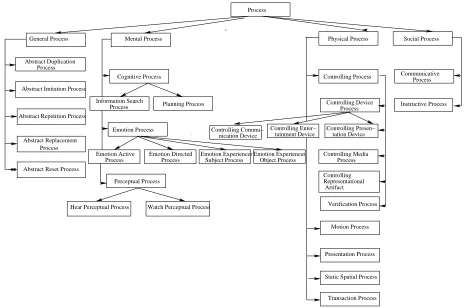
The modeling of Process as a kind of event that is continuous and homogeneous in nature, follows the frame semantic analysis used for generating the FRAMENET data (Baker et al., 1998). Currently, there are four groups of processes (see Figure 1):
General Process, a set of the most general
pro-cesses such as duplication, imitation or repetition processes;
Mental Process, a set of processes such as
cog-nitive, emotional or perceptual processes;
Physical Process, a set of processes such as
motion, transaction or controlling processes;
Social Process, a set of processes such as
communication or instruction processes.
Let us consider the definition of theInformation
Search Processin the ontology. It is modeled as a
projects. For more detail, see www.w3c.org.
subclass of theCognitive Process, which is a sub-class of theMental Processand inherits the follow-ing slot constraints:
begin time, a time expression indicating the starting
time point;
end time, a time expression indicating the time
point when the process is complete;
state, one of the abstract process states, e.g. start,
continue, interrupt, etc.;
cognizer, filled with a class Person including its
subclasses.
Information Search Process features one
ad-ditional slot constraint, piece-of-information. The possi-ble slot-fillers are a range of domain objects, e.g.Sight,
Performance, or whole sets of those, e.g. Tv
Program, but also processes, e.g.Controlling Tv
Device Process. This way, an utterance such as:
(4) I I
h¨atte gerne would like
Informationen information
zum about
Schloss castle
can also be mapped onto Information Search
Process, which has an agent of typeUserand a piece
of information of typeSight. Sighthas a name of typeCastle. Analogously, the utterance:
(5) Wie How
kann can
ich I
den the
Fernseher TV
steuern control
can be mapped onto Information Search
Process, which has an agent of type User and
has a piece of information of typeControlling Tv
Device Process.
4
Ontology-based Scoring of SRHs
ONTOSCORE performs a number of processing steps, each of them will be described separately in the respec-tive subsections.
4.1 Mapping of SRH to Sets of Concepts
Process
Static Spatial Process
Transaction Process Emotion Process
Social Process
Controlling Process
Verification Process
Motion Process
Presentation Process Hear Perceptual Process
General Process
Perceptual Process
Emotion Experiencer Emotion Experiencer Subject Process Object Process Planning Process
Cognitive Process Mental Process
Information Search Process
Controlling Commu− Controlling Presen− Physical Process
Communicative Process
Instructive Process Process
Controlling Device
Abstract Reset Process Process Abstract Replacement Abstract Repetition Process
Abstract Imitation Process
Controlling Representational
Artifact nication Device tainment Device
Controlling Enter−
tation Device
Controlling Media Process Emotion Active
Process
Emotion Directed Process Abstract Duplication
Process
[image:4.595.78.542.70.378.2]Watch Perceptual Process
Figure 1: Upper part of the process hierarchy.
4.2 Mapping of CR to Graphs
ONTOSCORE converts the domain model, i.e. an ontol-ogy, into a directed graph with concepts as nodes and re-lations as edges. One additional problem that needed to be solved lies in the fact that the directed subclass-of rela-tions enable path algorithms to ascend the class hierarchy upwards, but do not let them descend, therefore missing a significant set of possible paths. In order to remedy that situation the graph was enriched during its conversion by corresponding parent-of relations, which eliminated the directionality problems as well as avoids cycles and 0-paths. In order to find the shortest path between two con-cepts, ONTOSCORE employs the single source shortest path algorithm of Dijkstra (Cormen et al., 1990).
Given a concept representation CR
, ...,
, the algorithm runs once for each concept. The Dijkstra algo-rithm calculates minimal paths from a source node to all other nodes. Then, the minimal paths connecting a given concept with every other concept in CR (excluding itself) are selected, resulting in an matrix of the respective paths.
4.3 The Scoring Algorithm
To score the minimal paths connecting all concepts with each other in a given CR, we first adopted a method
pro-posed by Demetriou and Atwell (1994) to score the se-mantic coherence of alternative sentence interpretations against graphs based on the Longman Dictionary of Con-temporary English (LDOCE). To construct the graph the dictionary lemmata were represented as nodes in an isa hierarchy and their semantic relations were represented as edges, which were extracted automatically from the LDOCE.
As defined by Demetriou and Atwell (1994),
is the set of direct relations (both isa and semantic relations) that can connect two nodes (con-cepts); and
is the set of corre-sponding weights, where the weight of each isa relation is set to
and that of each other relation to . For each two concepts
,
the set
denotes the scores of all possible paths that link the two concepts. The score for path!#"$! %
&('
can be given as:
*)
+
-,.0/ 1
where
/
represents the number of times the relation exists in path! . The ensuing distance between two con-cepts
and
derived between and , i.e.: " ' & " )' ! &
The algorithm selects from the set of all paths between two concepts the one with the smallest weight, i.e. the cheapest. The distances between all concept pairs in CR are summed up to a total score. The set of concepts with the lowest aggregate score represents the combina-tion with the highest semantic relatedness.
Demetriou and Atwell (1994) do not provide concrete evaluation results for the method. Also, their algorithm only allows for a relative judgment stating which of a set of interpretations given a single sentence is more seman-tically related.
Since our objective is to compute semantic coherence scores of arbitrary CRs on an absolute scale, certain ex-tensions are necessary. In this application, the CRs to be scored can differ in terms of their content, the num-ber of concepts contained therein and their mappings to the original SRH. Moreover, in order to achieve absolute values, the final score should be related to the number of concepts in an individual set and the number of words in the original SRH. Therefore, the results must be normal-ized in order to allow for evaluation, comparability and clearer interpretation of the semantic coherence scores.
4.4 Scoring Concept Representations
We modified the algorithm described above to make it applicable and evaluatable with respect to the task at hand as well as other possible tasks. The basic idea is to calculate a score based on the path distances in . Since short distances indicate coherence and many con-cept pairs in a given may have no connecting path, we define the distance between two concepts and
that are only connected via isa relations in the knowledge base as . This maximum value can also serve as a maximum for long distances and can thus help to prune the search tree for long paths. This constant has to be set according to the structure of the knowledge base. For example, employing the ontology described above, the maximum distance between two concepts does not ex-ceed ten and we chose in that case
.
We can now define the semantic coherence score for
as the average path length between all concept pairs in :
" ' , " '
Since the ontology is a directed graph, we have
pairs of concepts with possible directed connections, i.e., a path from concept to concept
may be completely different to that from
to or even be missing. As a symmetric alternative, we may want to
consider a path from to and a path from to to be semantically equivalent and thus model every relation in a bidirectional way. We can then compute a symmetric score ! " ' as: " ' " $# & " " ' " " ' '
ONTOSCORE implements both options. In the ontol-ogy currently employed by the system some reverse re-lations can be found, e.g. given
=Broadcastand
=Channel, there exists a path from
to
via the relation has-channel and a different path from
to
via the relation has-broadcast. However, such reverse relations are only sporadically represented in the ontol-ogy. Consequently, it is difficult to account for their in-fluence on
"
'
in general. That is why we chose the !
"
'
function for the evaluation, i.e. only the best path
"
'
between a given pair of concepts, regardless of the direction, is taken into account.
4.5 Word/Concept Relation
Given the algorithm proposed above, a significant num-ber of misclassifications for SRHs would result from the cases when an SRH contains a high proportion of func-tion words (having no conceptual mappings in the result-ing CR) and only a few content words. Let’s consider the following example: (6) Wo Where den the Informationen information zu to das the gleiche same
The corresponding CR is constituted out of a single concept Information Search Process. ON TOSCOREwould classify the CR as coherent with the highest possible score, as this is the only concept in the set. This, however, would often lead to misclassifications. We, therefore, included a post-processing technique that takes the relation between the number of ontology con-cepts%
in a given CR and the total number of words%'& in the original SRH into account. This relation is defined by the ratio( )%
*
%+& . ONTOSCORE automatically classifies an SRH as being incoherent irrespective of its semantic coherence score, if( is less then the threshold set. The threshold may be set freely. The corresponding findings are presented in the evaluation section.
4.6 ONTOSCOREat Work
Looking at an example of ONTOSCORE at work, we will examine the utterance given in Example (1). The resulting two SRHs -
-,
and -,
- are given in Example (1a) and (1b) respectively. The human annota-tors considered
.,
to be coherent and labeled .,
concept representations. As no ambiguous words are found in this example,
corresponds to
-,
and
corresponds to
-,
:
: Person; Map; Watch Perceptual
Process
;
: Person; Map; Parting Process
.
They are converted into a graph. According to the algo-rithm shown in Section 4.3, all paths between the con-cepts of each graph are calculated and weighted. This yields the following non- paths:
"
'
% via the relation has-watcher;
"
'
% via the relation has-watchable object.
"
'
via the relation has-agent;
The ensuing results are:
According to
According to
" '
! "
' "!
" '
"# %$
! "
'
In both cases the results are sufficient for a relative judg-ment, i.e.
-,
constitutes a less semantically coherent structure as
-,
. To allow for a binary classification into semantically coherent vs. incoherent samples, a cut-off threshold must be set. The results of the correspond-ing experiments will be presented in Section 5.2.
4.7 Word Sense Disambiguation
Due to lexical ambiguity, the process of transforming an n-best list of SRH to concept representations often re-sults in a set of CRs that is greater than 1, i.e. a given SRH could be transformed into a set of CRs
, ...,
*
. Word sense disambiguation could, therefore, also independently be performed using the semantic coher-ence scoring described herein as an additional application of our approach. However, that has not been investigated thoroughly yet.
For example, lexicon entries for the words:
I - Person
am - Static Spatial Process,
Self Identification Process, None on - Two Point Relation, None
the - None
Philosopher’s Walk - Location
yield a set of interpretations for an SRH such as:
(7) Ich I
bin am
auf on
dem the
Philosophenweg Philosopher’s Walk
&('*),+
Person, Static Spatial Process, Location
-&('/.0+
Person, Static Spatial Process, Two Point Relation, Location
-&('213+
Person, Self Identification Process, Location
-&('243+
Person, Self Identification Process, Two Point Relation, Location -&('/50+
Person, Two Point Relation, Location
-&('263+
Person, Location
-and corresponding final scores: 798&('*);:=<?>
;
798&(' . :=<0@BACED
;
798&(' 1 :=<0FBAG @
;
798&('24H:=<0F
;
798&('/5I:=<0@BA@
;
798&('26H:=<KJML*<3NPORQIS
;
The examination of the resulting scores allows us to conclude that
constitutes the most semantically co-herent representation of the initial SRH,
and PT display a slightly lesser degree of semantic coherence, whereas VU , PW and VX are much less coherent and may, thus, be considered inadequate.
5
Evaluation
5.1 Context
The ONTOSCORE software runs as a module in SMARTKOM(Wahlster et al., 2001), a multi-modal and multi-domain spoken dialogue system. The system fea-tures the combination of speech and gesture as its input and output modalities. The domains of the system in-clude cinema and TV program information, home elec-tronic device control, mobile services for tourists, e.g. tour planning and sights information.
ONTOSCORE operates on n-best lists of SRHs pro-duced by the language interpretation module out of the ASR word graphs. It computes a numerical ranking of alternative SRH and thus provides an important aid to the understanding component of the system in determin-ing the best SRH. The ONTOSCORE software employs two knowledge sources, an ontology (about 730 concepts and 200 relations) and a word/concept lexicon (ca. 3.600 words), covering the respective domains of the system.
5.2 Results
com-parison in this evaluation. Therefore, we decided to use the results from human annotation (s. Section 2.2) as the baseline.
A gold standard for the evaluation of ONTOSCORE
was derived by the annotators agreeing on the correct so-lution in cases of disagreement. This way, we obtained 1.246 (54.55%) SRH classified as coherent by humans, which is also assumed to be the baseline for this evalua-tion.
Additionally, we performed an inverse linear transfor-mation of the scores (which range from 1 to
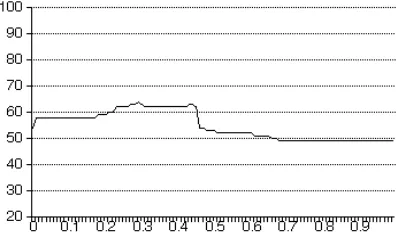
), so that the output produced by ONTOSCORE is a score on the scale from 0 to 1, where higher scores indicate greater coherence. In order to obtain a binary classification of SRHs into coherent versus incoherent with respect to the knowledge base, we set a cutoff thresh old. The depen-dency graph of the threshold value and the results of the program in % is shown in Figure 1.
Figure 2: Finding the optimal threshold for the coherent versus incoherent classification
[image:7.595.321.517.75.193.2]The best results are achieved with the threshold 0.29. With this threshold, ONTOSCORE correctly classifies 1.487 SRH, i.e. 65.11% in the evaluation dataset (the word/concept relation is not taken into account at this point).
Figure 3 shows the dependency graph between( , rep-resenting the threshold for the word/concept relation and the results of ONTOSCORE, given the best cutoff thresh-old for the classification (i.e. 0.29) derived in the previous experiments.
The best results are achieved with the (
. In other words, the proportion of concepts vs. words must be no less than 1 to 3. Under these settings, ONTOSCORE
correctly classifies 1.672 SRH, i.e. 73.2% in the evalua-tion dataset. This way, the technique brings an addievalua-tional improvement of 8.09% as compared to initial results.
6
Concluding Remarks
The ONTOSCOREsystem described herein automatically performs ontology-based scoring of sets of concepts
con-Figure 3: Finding the optimal threshold for the word/concept relation
stituting an adequate representation of speech recogni-tion hypotheses. To date, the algorithm has been im-plemented in a software which is employed by a multi-domain and multi-modal dialogue system and applied to the task of scoring n-best lists of SRH, thus produc-ing a score expressproduc-ing how well a given SRH fits within the domain model. For this task, it provides an alterna-tive knowledge-based score next to the ones provided by the ASR and the NLU system. In the evaluation of our system we employed an ontology that was not designed for this task, but already existed as the system’s internal knowledge representation.
As future work we will examine how the computa-tion of a discourse dependent semantic coherence score, i.e. how well a given SRH fits within domain model with respect to the previous discourse, can improve the overall score. Additionally, we intend to calculate the semantic coherence score with respect to individual do-mains of the system, thus enabling domain recognition and domain change detection in complex multi-modal and multi-domain spoken dialogue systems. Currently, we are also beginning to investigate whether the proposed method can be applied to scoring sets of potential candi-dates for resolving the semantic interpretation of ambigu-ous, polysemous and metonymic language use.
Acknowledgments
[image:7.595.76.274.304.420.2]References
Jan Alexandersson and Tilman Becker. 2003. The For-mal Foundations Underlying Overlay. In Proceedings of the Fifth International Workshop on Computational Semantics (IWCS-5), Tilburg, The Netherlands, Febru-ary.
James F. Allen, George Ferguson, and Amanda Stent. 2001. An architecture for more realistic conversational system. In Proceedings of Intelligent User Interfaces, pages 1–8, Santa Fe, NM.
James F. Allen. 1987. Natural Language Understanding. Menlo Park, Cal.: Benjamin Cummings.
Collin F. Baker, Charles J. Fillmore, and John B. Lowe. 1998. The Berkeley FrameNet Project. In Proceedings of COLING-ACL, Montreal, Canada.
Jean Carletta. 1996. Assessing agreement on classifi-cation tasks: The kappa statistic. Computational Lin-guistics, 22(2):249–254.
Thomas H. Cormen, Charles E. Leiserson, and Ronald R. Rivest. 1990. Introduction to Algorithms. MIT press, Cambridge, MA.
R.V. Cox, C.A. Kamm, L.R. Rabiner, J. Schroeter, and J.G. Wilpon. 2000. Speech and language process-ing for next-millenium communications services. Pro-ceedings of the IEEE, 88(8):1314–1334.
George Demetriou and Eric Atwell. 1994. A seman-tic network for large vocabulary speech recognition. In Lindsay Evett and Tony Rose, editors, Proceed-ings of AISB workshop on Computational Linguistics for Speech and Handwriting Recognition, University of Leeds.
Ralf Engel. 2002. SPIN: Language understanding for spoken dialogue systems using a production system ap-proach. In Proceedings of ICSLP 2002.
Iryna Gurevych, Robert Porzel, and Michael Strube. 2002. Annotating the semantic consistency of speech recognition hypotheses. In Proceedings of the Third SIGdial Workshop on Discourse and Dialogue, pages 46–49, Philadelphia, USA, July.
Diane J. Litman, Marilyn A. Walker, and Michael S. Kearns. 1999. Automatic detection of poor speech recognition at the dialogue level. In Proceedings of the 37th Annual Meeting of the Association for Com-putational Linguistics, College Park, Md., 20–26 June 1999, pages 309–316.
Martin Oerder and Hermann Ney. 1993. Word graphs: An efficient interface between continuous-speech recognition and language understanding. In ICASSP Volume 2, pages 119–122.
Stuart J. Russell and Peter Norvig. 1995. Artificial In-telligence. A Modern Approach. Prentice Hall, Engle-wood Cliffs, N.J.
R. Schwartz and Y. Chow. 1990. The n-best algo-rithm: an efficient and exact procedure for finding the n most likely sentence hypotheses. In Proceedings of ICASSP’90, Albuquerque, USA.
B-H. Tran, F. Seide, V. Steinbiss, R. Schwartz, and Y. Chow. 1996. A word graph based n-best search in continuous speech recognition. In Proceedings of ICSLP’96.
Wolfgang Wahlster, Norbert Reithinger, and Anselm Blocher. 2001. Smartkom: Multimodal communica-tion with a life-like character. In Proceedings of the 7th European Conference on Speech Communication and Technology, pages 1547–1550.