Unsupervised methods for developing taxonomies by combining syntactic
and statistical information
Dominic Widdows
Center for the Study of Language and Information, Stanford University
[email protected]
Abstract
This paper describes an unsupervised algo-rithm for placing unknown words into a taxon-omy and evaluates its accuracy on a large and varied sample of words. The algorithm works by first using a large corpus to find semantic neighbors of the unknown word, which we ac-complish by combining latent semantic analy-sis with part-of-speech information. We then place the unknown word in the part of the tax-onomy where these neighbors are most concen-trated, using a class-labelling algorithm devel-oped especially for this task. This method is used to reconstruct parts of the existing Word-Net database, obtaining results for common nouns, proper nouns and verbs. We evaluate the contribution made by part-of-speech tag-ging and show that automatic filtering using the class-labelling algorithm gives a fourfold im-provement in accuracy.
1
Introduction
The importance of automatic methods for enriching lex-icons, taxonomies and knowledge bases from free text is well-recognized. For rapidly changing domains such as current affairs, static knowledge bases are inadequate for responding to new developments, and the cost of building and maintaining resources by hand is prohibitive.
This paper describes experiments which develop auto-matic methods for taking an original taxonomy as a skele-ton and fleshing it out with new terms which are discov-ered in free text. The method is completely automatic and it is completely unsupervised apart from using the origi-nal taxonomic skeleton to suggest possible classifications for new terms. We evaluate how accurately our meth-ods can reconstruct the WordNet taxonomy (Fellbaum, 1998).
The problem of enriching the lexical information in a taxonomy can be posed in two complementary ways.
Firstly, given a particular taxonomic class (such as fruit) one could seek members of this class (such as apple,
ba-nana). This problem is addressed by Riloff and Shepherd
(1997), Roark and Charniak (1998) and more recently by Widdows and Dorow (2002). Secondly, given a partic-ular word (such as apple), one could seek suitable tax-onomic classes for describing this object (such as fruit,
foodstuff). The work in this paper addresses the second
of these questions.
The goal of automatically placing new words into a taxonomy has been attempted in various ways for at least ten years (Hearst and Sch ¨utze, 1993). The process for placing a wordwin a taxonomyTusing a corpusCoften contains some version of the following stages:
• For a wordw, find words from the corpusCwhose occurrences are similar to those of w. Consider these the ‘corpus-derived neighbors’N(w)ofw.
• Assuming that at least some of these neighbors are already in the taxonomyT, mapwto the place in the taxonomy where these neighbors are most con-centrated.
Hearst and Sch ¨utze (1993) added 27 words to Word-Net using a version of this process, with a 63% ac-curacy at assigning new words to one of a number of disjoint WordNet ‘classes’ produced by a previous al-gorithm. (Direct comparison with this result is prob-lematic since the number of classes used is not stated.) A more recent example is the top-down algorithm of Alfonseca and Manandhar (2001), which seeks the node inT which shares the most collocational properties with the wordw, adding 42 concepts taken from The Lord of
the Rings with an accuracy of 28%.
The algorithm as presented above leaves many degrees of freedom and open questions. What methods should be used to obtain the corpus-derived neighborsN(w)? This question is addressed in Section 2. Given a col-lection of neighbors, how should we define a “place in the taxonomy where these neighbors are most concen-trated?” This question is addressed in Section 3, which
defines a robust class-labelling algorithm for mapping a list of words into a taxonomy. In Section 4 we describe experiments, determining the accuracy with which these methods can be used to reconstruct the WordNet taxon-omy. To our knowledge, this is the first such evaluation for a large sample of words. Section 5 discusses related work and other problems to which these techniques can be adapted.
2
Finding semantic neighbors: Combining
latent semantic analysis with
part-of-speech information.
There are many empirical techniques for recognizing when words are similar in meaning, rooted in the idea that “you shall know a word by the company it keeps” (Firth, 1957). It is certainly the case that words which repeat-edly occur with similar companions often have related meanings, and common features used for determining this similarity include shared collocations (Lin, 1999), co-occurrence in lists of objects (Widdows and Dorow, 2002) and latent semantic analysis (Landauer and Du-mais, 1997; Hearst and Sch ¨utze, 1993).
The method used to obtain semantic neighbors in our experiments was a version of latent semantic analysis, descended from that used by Hearst and Sch ¨utze (1993, §4). First, 1000 frequent words were chosen as col-umn labels (after removing stopwords (Baeza-Yates and Ribiero-Neto, 1999, p. 167)). Other words were assigned co-ordinates determined by the number of times they oc-cured within the same context-window (15 words) as one of the 1000 column-label words in a large corpus. This gave a matrix where every word is represented by a row-vector determined by its co-occurence with frequently oc-curing, meaningful words. Since this matrix was very sparse, singular value decomposition (known in this con-text as latent semantic analysis (Landauer and Dumais, 1997)) was used to reduce the number of dimensions from 1000 to 100. This reduced vector space is called WordSpace (Hearst and Sch ¨utze, 1993, §4). Similarity between words was then computed using the cosine sim-ilarity measure (Baeza-Yates and Ribiero-Neto, 1999, p. 28). Such techniques for measuring similarity between words have been shown to capture semantic properties: for example, they have been used successfully for recog-nizing synonymy (Landauer and Dumais, 1997) and for finding correct translations of individual terms (Widdows et al., 2002).
The corpus used for these experiments was the British National Corpus, which is tagged for parts-of-speech. This enabled us to build syntactic distinctions into WordSpace — instead of just giving a vector for the string
test we were able to build separate vectors for the nouns,
verbs and adjectives test. An example of the
contribu-tion of part-of-speech informacontribu-tion to extracting seman-tic neighbors of the word fire is shown in Table 2. As can be seen, the noun fire (as in the substance/element) and the verb fire (mainly used to mean firing some sort of weapon) are related to quite different areas of mean-ing. Building a single vector for the string fire confuses this distinction — the neighbors of fire treated just as a string include words related to both the meaning of fire as a noun (more frequent in the BNC) and as a verb.
Part of the goal of our experiments was to investi-gate the contribution that this part-of-speech information made for mapping words into taxonomies. As far as we are aware, these experiments are the first to investigate the combination of latent semantic indexing with part-of-speech information.
3
Finding class-labels: Mapping
collections of words into a taxonomy
Given a collection of words or multiword expressions which are semantically related, it is often important to know what these words have in common. All adults with normal language competence and world knowledge are adept at this task — we know that plant, animal and
fun-gus are all living things, and that plant, factory and works
are all kinds of buildings. This ability to classify objects, and to work out which of the possible classifications of a given object is appropriate in a particular context, is es-sential for understanding and reasoning about linguistic meaning. We will refer to this process as class-labelling. The approach demonstrated here uses a hand-built tax-onomy to assign class-labels to a collection of similar nouns. As with much work of this nature, the taxonomy used is WordNet (version 1.6), a freely-available broad-coverage lexical database for English (Fellbaum, 1998). Our algorithm finds the hypernyms which subsume as many as possible of the original nouns, as closely as pos-sible1. The conceptv is said to be a hypernym ofwif wis a kind ofv. For this reason this sort of a taxonomy is sometimes referred to as an ‘IS A hierarchy’. For ex-ample, the possible hypernyms given for the word oak in WordNet 1.6 are
oak ⇒ wood ⇒ plant material ⇒ material, stuff⇒ substance, matter⇒object, physical object⇒entity, something
1Another method which could be used for
fire (string only) fire nn1 fire vvi fire 1.000000 fire nn1 1.000000 fire vvi 1.000000 flames 0.709939 flames nn2 0.700575 guns nn2 0.663820 smoke 0.680601 smoke nn1 0.696028 firing vvg 0.537778 blaze 0.668504 brigade nn1 0.589625 cannon nn0 0.523442 firemen 0.627065 fires nn2 0.584643 gun nn1 0.484106 fires 0.617494 firemen nn2 0.567170 fired vvd 0.478572 explosion 0.572138 explosion nn1 0.551594 detectors nn2 0.477025 burning 0.559897 destroyed vvn 0.547631 artillery nn1 0.469173 destroyed 0.558699 burning aj0 0.533586 attack vvb 0.468767 brigade 0.532248 blaze nn1 0.529126 firing nn1 0.459000 arson 0.528909 arson nn1 0.522844 volley nn1 0.458717 accidental 0.519310 alarms nn2 0.512332 trained vvn 0.447797 chimney 0.489577 destroyed vvd 0.512130 enemy nn1 0.445523 blast 0.488617 burning vvg 0.502052 alert aj0 0.443610 guns 0.487226 burnt vvn 0.500864 shoot vvi 0.443308 damaged 0.484897 blast nn1 0.498635 defenders nn2 0.438886
Table 1: Semantic neighbors of fire with different parts-of-speech. The scores are cosine similarities
oak, oak tree⇒tree⇒woody plant, ligneous plant⇒vascular plant, tracheophyte⇒plant, flora, plant life⇒life form, organism, being, living thing⇒entity, something
LetSbe a set of nouns or verbs. If the wordw∈Sis recognized by WordNet, the WordNet taxonomy assigns towan ordered set of hypernymsH(w).
Consider the union
H= [
w∈S
H(w).
This is the set of all hypernyms of any member ofS. Our intuition is that the most appropriate class-label for the setS is the hypernymh ∈ Hwhich subsumes as many as possible of the members ofS as closely as possible in the hierarchy. There is a trade-off here between sub-suming ‘as many as possible’ of the members ofS, and subsuming them ‘as closely as possible’. This line of rea-soning can be used to define a whole collection of ‘class-labelling algorithms’.
For eachw∈Sand for eachh∈ H, define the affinity
score functionα(w, h)betweenwandhto be
α(w, h) =
f(dist(w, h)) ifh∈H(w)
−g(w, h) ifh /∈H(w), (1)
wheredist(w, h)is a measure of the distance betweenw andh,fis some positive, monotonically decreasing func-tion, andgis some positive (possibly constant) function.
The functionf accords ‘positive points’ tohifh sub-sumesw, and the condition thatf be monotonically de-creasing ensures that h gets more positive points the closer it is tow. The functiongsubtracts ‘penalty points’ ifhdoes not subsumew. This function could depend in many ways onwandh— for example, there could be a smaller penalty ifhis a very specific concept than ifhis a very general concept.
The distance measure dist(w, h) could take many forms, and there are already a number of distance mea-sures available to use with WordNet (Budanitsky and
Hirst, 2001). The easiest method for assigning a distance between words and their hypernyms is to count the num-ber of intervening levels in the taxonomy. This assumes that the distance in specificity between ontological levels is constant, which is of course not the case, a problem addressed by Resnik (1999).
Given an appropriate affinity score, it is a simple matter to define the best class-label for a collection of objects.
Definition 1 Let S be a set of nouns, let H =
S
w∈SH(w)be the set of hypernyms ofSand letα(w, h)
be an affinity score function as defined in equation (1). The best class-labelhmax(S)forSis the nodehmax∈ H with the highest total affinity score summed over all the members ofS, sohmaxis the node which gives the max-imum score
max
h∈H
X
w∈S
α(w, h).
SinceHis determined byS,hmaxis solely determined by the setSand the affinity scoreα.
In the event thathmaxis not unique, it is customary to take the most specific class-label available.
Example
A particularly simple example of this kind of algorithm is used by Hearst and Sch ¨utze (1993). First they parti-tion the WordNet taxonomy into a number of disjoint sets which are used as class-labels. Thus each concept has a single ‘hypernym’, and the ‘affinity-score’ between a wordwand a classhis simply the set membership func-tion,α(w, h) = 1ifw∈hand0otherwise. A collection of words is assigned a class-label by majority voting.
3.1 Ambiguity
could refer. (So eachc ∈ C is a possible sense ofw.) Then
α(w, h) = max
c∈C(w)
f(dist(c, h)) ifh∈H(c) −g(w, c) ifh /∈H(c), (2)
This implies that the ‘preferred-sense’ ofwwith respect to the possible subsumerhis the sense closest toh. In practice, our class-labelling algorithm implements this preference by computing the affinity scoreα(c, h)for all c ∈ C(w) and only using the best match. This selec-tive approach is much less noisy than simply averaging the probability mass of the word over each possible sense (the technique used in (Li and Abe, 1998), for example).
3.2 Choice of scoring functions for the class-labelling algorithm
The precise choice of class-labelling algorithm depends on the functions f and g in the affinity score function αof equation (2). There is some tension here between being correct and being informative: ‘correct’ but unin-formative class-labels (such as entity, something) can be obtained easily by preferring nodes high up in the hier-archy, but since our goal in this work was to classify un-known words in an informative and accurate fashion, the functionsf andghad to be chosen to give an appropriate balance. After a variety of heuristic tests, the functionf was chosen to be
f = 1
dist(w, h)2,
where for the distance functiondist(w, h)we chose the computationally simple method of counting the number of taxonomic levels between w and h (inclusively to avoid dividing by zero). For the penalty functiong we chose the constantg= 0.25.
The net effect of choosing the reciprocal-distance-squared and a small constant penalty function was that hypernyms close to the concept in question received mag-nified credit, but possible class-labels were not penalized too harshly for missing out a node. This made the algo-rithm simple and robust to noise but with a strong prefer-ence for detailed information-bearing class-labels. This configuration of the class-labelling algorithm was used in all the experiments described below.
4
Experiments and Evaluation
To test the success of our approach to placing unknown words into the WordNet taxonomy on a large and signif-icant sample, we designed the following experiment. If the algorithm is successful at placing unknown words in the correct new place in a taxonomy, we would expect it to place already known words in their current position. The experiment to test this worked as follows.
• For a word w, find the neighbors N(w) of w in WordSpace. Removewitself from this set.
• Find the best class-label hmax(N(w)) for this set (using Definition 1).
• Test to see if, according to WordNet,hmaxis a hy-pernym of the original wordw, and if so check how closelyhmaxsubsumeswin the taxonomy.
Since our class-labelling algorithm gives a ranked list of possible hypernyms, credit was given for correct clas-sifications in the top 4 places. This algorithm was tested on singular common nouns (PoS-tag nn1), proper nouns (PoS-tag np0) and finite present-tense verbs (PoS-tag
vvb). For each of these classes, a random sample of words
was selected with corpus frequencies ranging from 1000 to 250. For the noun categories, 600 words were sam-pled, and for the finite verbs, 420. For each wordw, we found semantic neighbors with and without using part-of-speech information. The same experiments were carried out using 3, 6 and 12 neighbors: we will focus on the re-sults for 3 and 12 neighbors since those for 6 neighbors turned out to be reliably ‘somewhere in between’ these two.
Results for Common Nouns
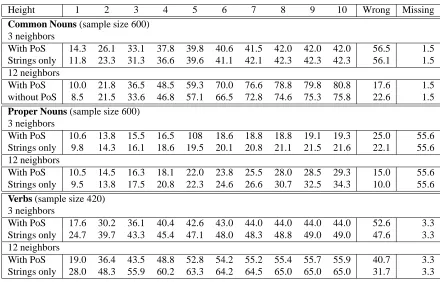
The best results for reproducing WordNet classifica-tions were obtained for common nouns, and are sum-marized in Table 2, which shows the percentage of test wordswwhich were given a class-labelhwhich was a correct hypernym according to WordNet (so for which h ∈ H(w)). For these words for which a correct clas-sification was found, the ‘Height’ columns refer to the number of levels in the hierarchy between the target word wand the class-labelh. If the algorithm failed to find a class-labelhwhich is a hypernym ofw, the result was counted as ‘Wrong’. The ‘Missing’ column records the number of words in the sample which are not in WordNet at all.
Height 1 2 3 4 5 6 7 8 9 10 Wrong Missing
Common Nouns (sample size 600)
3 neighbors
With PoS 14.3 26.1 33.1 37.8 39.8 40.6 41.5 42.0 42.0 42.0 56.5 1.5 Strings only 11.8 23.3 31.3 36.6 39.6 41.1 42.1 42.3 42.3 42.3 56.1 1.5 12 neighbors
With PoS 10.0 21.8 36.5 48.5 59.3 70.0 76.6 78.8 79.8 80.8 17.6 1.5 without PoS 8.5 21.5 33.6 46.8 57.1 66.5 72.8 74.6 75.3 75.8 22.6 1.5
Proper Nouns (sample size 600)
3 neighbors
With PoS 10.6 13.8 15.5 16.5 108 18.6 18.8 18.8 19.1 19.3 25.0 55.6 Strings only 9.8 14.3 16.1 18.6 19.5 20.1 20.8 21.1 21.5 21.6 22.1 55.6 12 neighbors
With PoS 10.5 14.5 16.3 18.1 22.0 23.8 25.5 28.0 28.5 29.3 15.0 55.6 Strings only 9.5 13.8 17.5 20.8 22.3 24.6 26.6 30.7 32.5 34.3 10.0 55.6
Verbs (sample size 420)
3 neighbors
With PoS 17.6 30.2 36.1 40.4 42.6 43.0 44.0 44.0 44.0 44.0 52.6 3.3 Strings only 24.7 39.7 43.3 45.4 47.1 48.0 48.3 48.8 49.0 49.0 47.6 3.3 12 neighbors
[image:5.612.85.525.134.416.2]With PoS 19.0 36.4 43.5 48.8 52.8 54.2 55.2 55.4 55.7 55.9 40.7 3.3 Strings only 28.0 48.3 55.9 60.2 63.3 64.2 64.5 65.0 65.0 65.0 31.7 3.3
Table 2: Percentage of words which were automatically assigned class-labels which subsume them in the WordNet taxonomy, showing the number of taxonomic levels between the target word and the class-label
Height 1 2 3 4 5 6 Wrong
Common Nouns 0.799 0.905 0.785 0.858 0.671 0.671 0.569 Proper Nouns 1.625 0.688 0.350 0.581 0.683 0.430 0.529 Verbs 1.062 1.248 1.095 1.103 1.143 0.750 0.669
[image:5.612.142.469.585.634.2]In conclusion, taking more neighbors makes the chances of obtaining some correct classification for a wordwgreater, but taking fewer neighbors increases the chances of ‘hitting the nail on the head’. The use of part-of-speech information reliably increases the chances of correctly obtaining both exact and broadly correct classi-fications, though careful tuning is still necessary to obtain optimal results for either.
Results for Proper Nouns and Verbs
The results for proper nouns and verbs (also in Table 2) demonstrate some interesting problems. On the whole, the mapping is less reliable than for common nouns, at least when it comes to reconstructing WordNet as it cur-rently stands.
Proper nouns are rightly recognized as one of the cat-egories where automatic methods for lexical acquisition are most important (Hearst and Sch ¨utze, 1993, §4). It is impossible for a single knowledge base to keep up-to-date with all possible meanings of proper names, and this would be undesirable without considerable filtering abil-ities because proper names are often domain-specific.
Ih our experiments, the best results for proper nouns were those obtained using 12 neighbors, where a cor-rect classification was found for206/266 = 77%of the proper nouns that were included in WordNet, using no part-of-speech information. Part-of-speech information still helps for mapping proper nouns into exactly the right place, but in general degrades performance.
Several of the proper names tested are geographical, and in the BNC they often refer to regions of the British Isles which are not in WordNet. For example, hampshire is labelled as a territorial division, which as an English county it certainly is, but in WordNet hampshire is in-stead a hyponym of domestic sheep. For many of the proper names which our evaluation labelled as ‘wrongly classified’, the classification was in fact correct but a dif-ferent meaning from those given in WordNet. The chal-lenge for these situations is how to recognize when cor-pus methods give a correct meaning which is different from the meaning already listed in a knowledge base. Many of these meanings will be systematically related (such as the way a region is used to name an item or product from that region, as with the hampshire example above) by generative processes which are becoming well understood by theoretical linguists (Pustejovsky, 1995), and linguistic theory may help our statistical algorithms considerably by predicting what sort of new meanings we might expect a known word to assume through metonymy and systematic polysemy.
Typical first names of people such as lisa and ralph al-most always have neighbors which are also first names (usually of the same gender), but these words are not rep-resented in WordNet. This lexical category is ripe for
automatic discovery: preliminary experiments using the two names above as ‘seed-words’ (Roark and Charniak, 1998; Widdows and Dorow, 2002) show that by taking a few known examples, finding neighbors and removing words which are already in WordNet, we can collect first names of the same gender with at least 90% accuracy.
Verbs pose special problems for knowledge bases. The usefulness of anIS Ahierarchy for pinpointing informa-tion and enabling inference is much less clear-cut than for nouns. For example, sleeping does entail breathing and arriving does imply moving, but the aspectual prop-erties, argument structure and case roles may all be dif-ferent. The more restrictive definition of troponymy is used in WordNet to describe those properties of verbs that are inherited through the taxonomy (Fellbaum, 1998, Ch 3). In practice, the taxonomy of verbs in WordNet tends to have fewer levels and many more branches than the noun taxonomy. This led to problems for our class-labelling algorithm — class-labels obtained for the verb
play included exhaust, deploy, move and behave, all of
which are ‘correct’ hypernyms according to WordNet, while possible class-labels obtained for the verb appeal included keep, defend, reassert and examine, all of which were marked ‘wrong’. For our methods, the WordNet taxonomy as it stands appears to give much less reli-able evaluation criteria for verbs than for common nouns. It is also plausible that similarity measures based upon simple co-occurence are better for modelling similarity between nominals than between verbs, an observation which is compatible with psychological experiments on word-association (Fellbaum, 1998, p. 90).
In our experiments, the best results for verbs were clearly those obtained using 12 neighbors and no part-of-speech information, for which some correct classifi-cation was found for273/406 = 59%of the verbs that were included in WordNet, and which achieved better re-sults than those using part-of-speech information even for finding exact classifications. The shallowness of the tax-onomy for verbs means that most classifications which were successful at all were quite close to the word in question, which should be taken into account when in-terpreting the results in Table 2.
As we have seen, part-of-speech information degraded performance overall for proper nouns and verbs. This may be because combining all uses of a particular word-form into a single vector is less prone to problems of data sparseness, especially if these word-forms are semanti-cally related in spite of part-of-speech differences2. It is also plausible that discarding part-of-speech information
2
should improve the classification of verbs for the
follow-ing reason. Classification usfollow-ing corpus-derived neighbors is markedly better for common nouns than for verbs, and most of the verbs in our sample (57%) also occur as com-mon nouns in WordSpace. (In contrast, only 13% of our common nouns also occur as verbs, a reliable asymmetry for English.) Most of these noun senses are semantically related in some way to the corresponding verbs. Since using neighboring words for classification is demonstra-bly more reliable for nouns than for verbs, putting these parts-of-speech together in a single vector in WordSpace might be expected to improve performance for verbs but degrade it for nouns.
Filtering using Affinity scores
One of the benefits of the class-labelling algorithm (Definition 1) presented in this paper is that it returns not just class-labels but an affinity score measuring how well each class-label describes the class of objects in question. The affinity score turns out to be signficantly correlated with the likelihood of obtaining a successful classifica-tion. This can be seen very clearly in Table 3, which shows the average affinity score for correct class-labels of different heights above the target word, and for incorrect labels — as a rule, correct and informative class-labels have significantly higher affinity scores than incor-rect class-labels. It follows that the affinity score can be used as an indicator of success, and so filtering out class-labels with poor scores can be used as a technique for improving accuracy.
To test this, we repeated our experiments using 3 neighbors and this time only using class-labels with an affinity score greater than 0.75, the rest being marked ‘unknown’. Without filtering, there were 1143 success-ful and 1380 unsuccesssuccess-ful outcomes: with filtering, these numbers changed to 660 and 184 respectively. Filtering discarded some 87% of the incorrect labels and kept more than half of the correct ones, which amounts to at least a fourfold improvement in accuracy. The improvement was particularly dramatic for proper nouns, where filtering re-moved 270 out of 283 incorrect results and still retained half of the correct ones.
Conclusions
For common nouns, where WordNet is most reliable, our mapping algorithm performs comparatively well, ac-curately classifying several words and finding some cor-rect information about most others. The optimum num-ber of neighbors is smaller if we want to try for an exact classification and larger if we want information that is broadly reliable. Part-of-speech information noticeably improves the process of both broad and narrow classifi-cation. For proper names, many classifications are cor-rect, and many which are absent or incorrect according to WordNet are in fact correct meanings which should
be added to the knowledge base for (at least) the domain in question. Results for verbs are more difficult to inter-pret: reasons for this might include the shallowness and breadth of the WordNet verb hierarchy, the suitability of our WordSpace similarity measure, and many theoretical issues which should be taken into account for a successful approach to the classification of verbs.
Filtering using the affinity score from the class-labelling algorithm can be used to dramatically increase performance.
5
Related work and future directions
The experiments in this paper describe one combination of algorithms for lexical acquisition: both the finding of semantic neighbors and the process of class-labelling could take many alternative forms, and an exhaustive evaluation of such combinations is far beyond the scope of this paper. Various mathematical models and distance measures are available for modelling semantic proxim-ity, and more detailed linguistic preprocessing (such as chunking, parsing and morphology) could be used in a variety of ways. As an initial step, the way the granularity of part-of-speech classification affects our results for lex-ical acquistion will be investigated. The class-labelling algorithm could be adapted to use more sensitive mea-sures of distance (Budanitsky and Hirst, 2001), and corre-lations between taxonomic distance and WordSpace sim-ilarity used as a filter.
The coverage and accuracy of the initial taxonomy we are hoping to enrich has a great influence on success rates for our methods as they stand. Since these are precisely the aspects of the taxonomy we are hoping to improve, this raises the question of whether we can use automati-cally obtained hypernyms as well as the hand-built ones to help classification. This could be tested by randomly removing many nodes from WordNet before we begin, and measuring the effect of using automatically derived classifications for some of these words (possibly those with high confidence scores) to help with the subsequent classification of others.
The use of semantic neighbors and class-labelling for computing with meaning go far beyond the experimen-tal set up for lexical acquisition described in this pa-per — for example, Resnik (1999) used the idea of a most informative subsuming node (which can be re-garded as a kind of class-label) for disambiguation, as did Agirre and Rigau (1996) with the conceptual density algorithm. Taking a whole domain as a ‘context’, this approach to disambiguation can be used for lexical tun-ing. For example, using the Ohsumed corpus of medical abstracts, the top few neighbors of operation are
amputa-tion, disease, therapy and resection. Our algorithm gives medical care, medical aid and therapy as possible
of operation which is most important for the medical do-main.
The level of detail which is appropriate for defining and grouping terms depends very much on the domain in question. For example, the immediate hypernyms offered by WordNet for the word trout include
fish, foodstuff, salmonid, malacopterygian, teleost fish, food fish, saltwater fish
Many of these classifications are inappropriately fine-grained for many circumstances. To find a degree of abstraction which is suitable for the way trout is used in the BNC, we found its semantic neighbors which in-clude herring swordfish turbot salmon tuna. The highest-scoring class-labels for this set are
2.911 saltwater fish 2.600 food fish 1.580 fish
1.400 scombroid, scombroid 0.972 teleost fish
The preferred labels are the ones most humans would an-swer if asked what a trout is. This process can be used to select the concepts from an ontology which are ap-propriate to a particular domain in a completely unsuper-vised fashion, using only the documents from that do-main whose meanings we wish to describe.
Demonstration
Interactive demonstrations of the class-labelling al-gorithm and WordSpace are available on the web at
http://infomap.stanford.edu/classesand
http://infomap.stanford.edu/webdemo. An
interface to WordSpace incorporating the part-of-speech information is currently under consideration.
Acknowledgements
This research was supported in part by the Research Collaboration between the NTT Communication Science Laboratories, Nippon Telegraph and Telephone Corpora-tion and CSLI, Stanford University, and by EC/NSF grant IST-1999-11438 for the MUCHMORE project.
References
E. Agirre and G. Rigau. 1996. Word sense disambigua-tion using conceptual density. In Proceedings of
COL-ING’96, pages 16–22, Copenhagen, Denmark.
Enrique Alfonseca and Suresh Manandhar. 2001. Im-proving an ontology refinement method with hy-ponymy patterns. In Third International Conference
on Language Resources and Evaluation, pages 235–
239, Las Palmas, Spain.
Ricardo Baeza-Yates and Berthier Ribiero-Neto. 1999.
Modern Information Retrieval. Addison Wesley / ACM press.
A. Budanitsky and G. Hirst. 2001. Semantic distance in wordnet: An experimental, application-oriented evalu-ation of five measures. In Workshop on WordNet and
Other Lexical Resources, Pittsburgh, PA. NAACL.
Christiane Fellbaum, editor. 1998. WordNet: An
elec-tronic lexical database. MIT press, Cambridge MA.
J. Firth. 1957. A synopsis of linguistic theory 1930-1955. Studies in Linguistic Analysis, Philological
So-ciety, Oxford, reprinted in Palmer, F. (ed. 1968)
Se-lected Papers of J. R. Firth, Longman, Harlow.
Marti Hearst and Hinrich Sch ¨utze. 1993. Customizing a lexicon to better suit a computational task. In ACL
SIGLEX Workshop, Columbus, Ohio.
T. Landauer and S. Dumais. 1997. A solution to plato’s problem: The latent semantic analysis theory of acqui-sition. Psychological Review, 104(2):211–240.
Hang Li and Naoki Abe. 1998. Generalizing case frames using a thesaurus and the mdl principle.
Computa-tional Linguistics, 24(2):217–244.
Dekang Lin. 1999. Automatic identification of non-compositional phrases. In ACL:1999, pages 317–324.
James Pustejovsky. 1995. The Generative Lexicon. MIT press, Cambridge, MA.
Philip Resnik. 1999. Semantic similarity in a taxonomy: An information-based measure and its application to problems of ambiguity in natural language. Journal of
artificial intelligence research, 11:93–130.
Ellen Riloff and Jessica Shepherd. 1997. A corpus-based approach for building semantic lexicons. In Claire Cardie and Ralph Weischedel, editors, Proceedings of
the Second Conference on Empirical Methods in Natu-ral Language Processing, pages 117–124. Association
for Computational Linguistics, Somerset, New Jersey.
Brian Roark and Eugene Charniak. 1998. Noun-phrase co-occurence statistics for semi-automatic semantic lexicon construction. In COLING-ACL, pages 1110– 1116.
Dominic Widdows and Beate Dorow. 2002. A graph model for unsupervised lexical acquisition. In 19th
In-ternational Conference on Computational Linguistics,
pages 1093–1099, Taipei, Taiwan, August.
Dominic Widdows, Beate Dorow, and Chiu-Ki Chan. 2002. Using parallel corpora to enrich multilingual lexical resources. In Third International Conference
on Language Resources and Evaluation, pages 240–