ATT1: Temporal Annotation Using Big Windows and Rich Syntactic and
Semantic Features
Hyuckchul Jung and Amanda Stent
AT&T Labs - Research 180 Park Ave
Florham Park, NJ 07932, USA
hjung, [email protected]
Abstract
In this paper we present the results of exper-iments comparing (a) rich syntactic and se-mantic feature sets and (b) big context win-dows, for the TempEval time expression and event segmentation and classification tasks. We show that it is possible for models using only lexical features to approach the perfor-mance of models using rich syntactic and se-mantic feature sets.
1 Introduction
TempEval-3 Temporal Annotation Task (UzZaman et al., 2012) has three subtasks:
A Time expression extraction and classification -extract time expressions from input text, and de-termine the type and normalised value for each extracted time expression.
B Event extraction and classification- extract event mentions from input text, and determine the class, tense and aspect features for each extracted event.
C Temporal link identification - identify and cate-gorise temporal links between events in the same or consecutive sentences, events and time expres-sions in the same sentence, and events and the document creation time of the input text.
Here we report results for the first two tasks. Previous TempEval competitions have shown that rich syntactic and semantic feature sets can lead to good performance on event and time expression ex-traction and classification tasks (e.g. (Llorens et al.,
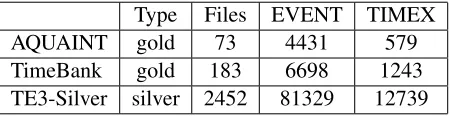
[image:1.612.315.540.244.302.2]Type Files EVENT TIMEX AQUAINT gold 73 4431 579 TimeBank gold 183 6698 1243 TE3-Silver silver 2452 81329 12739
Table 1: Frequency of event and time expressions in the text portions of the TempEval-3 data sets
2010; UzZaman and Allen, 2010)). In this work, we show that with large windows of context, it is pos-sible for models using only lexical features to ap-proach the performance of models using rich syn-tactic and semantic feature sets.
2 Data
Using the gold and silver data distributed by the TempEval-3 task organizers (see Table 1), we pro-cessed each input file with the Stanford CoreNLP (Stanford Natural Language Processing Group, 2012) and SENNA (Collobert et al., 2011) open-source NLP tools. From the Stanford CoreNLP tools we obtained a tokenization of the input text, the lemma and part of speech (POS) tag for each token, and dependency and constituency parses for each sentence. From SENNA, we obtained a seman-tic role labelling for each sentence.
3 Approach
We were curious to explore the tradeoff between ad-ditional context on the one hand, and adad-ditional lay-ers of representation on the other, for the event and time expression extraction tasks. Researchers have investigated the impacts of different sets of features (Adafre and de Rijke, 2005; Angeli et al., 2012;
Feature type Features Used in
Lexical 1 token ATT1,
ATT2, ATT3
Lexical 2 lemma ATT1, ATT2
Part of speech POS tag ATT1, ATT2
Dependency governing verb, governing verb POS, governing preposition, phrase tag, path to root of parse tree, head word, head word lemma, head word POS
ATT1, ATT2
Constituency parse
governing verb, governing verb POS, governing preposition, phrase tag, path to root of parse tree
ATT1, ATT2
Semantic role semantic role label, semantic role labels along path to root of parse tree
[image:2.612.77.537.59.230.2]ATT1
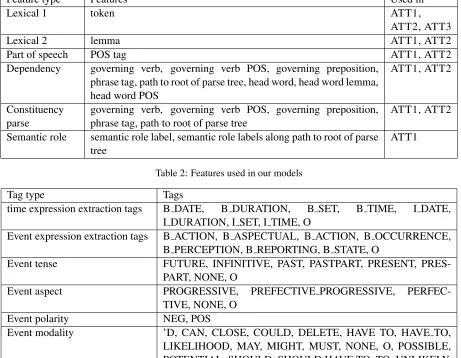
Table 2: Features used in our models
Tag type Tags
time expression extraction tags B DATE, B DURATION, B SET, B TIME, I DATE, I DURATION, I SET, I TIME, O
Event expression extraction tags B ACTION, B ASPECTUAL, B ACTION, B OCCURRENCE, B PERCEPTION, B REPORTING, B STATE, O
Event tense FUTURE, INFINITIVE, PAST, PASTPART, PRESENT, PRES-PART, NONE, O
Event aspect PROGRESSIVE, PREFECTIVE PROGRESSIVE, PERFEC-TIVE, NONE, O
Event polarity NEG, POS
Event modality ’D, CAN, CLOSE, COULD, DELETE, HAVE TO, HAVE TO, LIKELIHOOD, MAY, MIGHT, MUST, NONE, O, POSSIBLE, POTENTIAL, SHOULD, SHOULD HAVE TO, TO, UNLIKELY, UNTIL, WOULD, WOULD HAVE TO
Table 3: Tags assigned by our classifiers for TempEval-3 tasks A and B
Rigo and Lavelli, 2011). In particular, (Rigo and Lavelli, 2011) also examined performance based on different sizes of n-grams in a small scale (n=1,3).
In this work, we intended to systematically inves-tigate the performance of various models with differ-ent layers of represdiffer-entation (based on much larger sets of rich syntactic/semantic features) as well as additional context. For each time expression/event segmentation/classification task, we trained twelve models exploring these two dimensions, three of which we submitted for TempEval-3.
Additional layers of representation We trained three types of model: (ATT1) STAN-FORD+SENNA, (ATT2) STANFORD and (ATT3) WORDS ONLY. The basic features used in each type of model are given in Table 2: ATT1 models
include lexical, syntactic and semantic features, ATT2 models include only lexical and syntactic features, and ATT3 models include only lexical features. For the ATT1 models we had 18 basic features per token, for the ATT2 models we had 16 basic features per token, and for the ATT3 models we had one basic feature per token.
[image:2.612.77.538.68.426.2]window, so up to 240 basic features for each token to be labeled. The ATT3 models had 1 basic feature per token in the context window, so up to 15 basic features for each token to be labeled.
Model trainingFor event extraction and classifica-tion, time expression extraction and classificaclassifica-tion, and event feature classification, we used the machine learning toolkit LLAMA (Haffner, 2006). LLAMA encodes multiclass classification problems using bi-nary MaxEnt classifiers to increase the speed of training and to scale the method to large data sets. We also used a front-end to LLAMA that builds un-igram, bigram and trigram extended features from basic features; for example, from the basic feature “go there today”, it would build the features “go”, “there”, “today”, “go there”, “there today”, and “go there today”. We grouped our basic features (see Ta-ble 2) by type rather than by token, and the LLAMA front-end then produced ngram features. We chose LLAMA primarily because of the proven power of the ngram feature-extraction front-end for NLP tasks.
4 Event and Time Expression Extraction
For event and time expression extraction, we trained BIO classifiers. A BIO classifier tags each input to-ken as either Beginning, In, or Out of an event/time expression. Our classifier for events simultaneously assigns a B, I or O to each token, and classifies the class of the event for tokens that Begin or are In an event. Our time expression classifier simultaneously assigns a B, I, or O to each token, and classifies the type of the time expression for tokens that Begin or are In a time expression (see Table 3).
A BIO model may sometimes be inconsistent; for example, a token may be labeled as Inside a segment of a particular type, while the previous token may be labeled as Out of any segment. We considered the two most likely labels for each token (as long as each had likelihood at least 0.9), choosing the one most consistent with the context.
5 Event Feature Classification
We determined the event features for each extracted event using four additional classifiers, one each for tense, aspect, polarity and modality. These classi-fiers were trained only on tokens identified as part of
event expressions. Since the event expressions were single words for all but a few (erroneous) cases in the silver data, for determining the event features, we used the same features as before, with the single ad-dition of the event class (during testing, we used the dynamically assigned event class from the event seg-mentation classifier). As before, we experimented with ATT1, ATT2, and ATT3 models. TempEval-3 only includes evaluation of tense and aspect fea-tures, so we only report for those. The tags assigned by each classifier are listed in Table 3.
6 Time Normalization
To compute TIMEX3 standard based values for extracted time expressions, we used the TIMEN (Llorens et al., 2012) and TRIOS (UzZaman and Allen, 2010) time normalizers. Values from the normalizers were validated in post-processing (e.g.
“T2445” is invalid) and, when the normalizers re-turned different non-nil values, TIMEN’s values were selected without further reasoning. Time nor-malization was out of scope in our research for this evaluation, but it remains as part of our future work.
7 Results and Discussion
Our results for event segmentation/classification on the TempEval-3 test data are provided in Table 4. The absence of semantic features causes only small changes in F1. The absence of syntactic features causes F1 to drop slightly (less than 2.5% for all but the smallest window size), with recall decreasing while precision improves somewhat. Attribute F1 is also impacted minimally by the absence of semantic features, and about 2-5% by the absence of syntactic features for all but the smallest window size.1
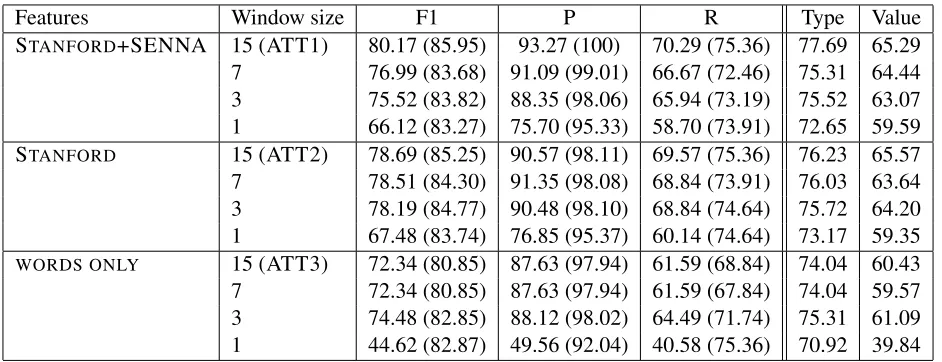
Our results for time expression extraction and classification on the TempEval-3 test data are pro-vided in Table 5. Here, the performance drops more in the absence of semantic and syntactic features; however, there is an interaction between length of time expression and performance drop which we may be able to ameliorate in future work by han-dling consistency issues in the BIO time expression extraction model better.
1
Features Window size F1 P R Class Tense Aspect STANFORD+SENNA 15 (ATT1) 81.16 81.49 80.83 71.60 59.62 73.76
7 81.08 81.74 80.43 71.49 59.05 73.78 3 80.35 81.23 79.49 71.41 58.67 73.17 1 80.94 80.77 81.10 72.37 58.06 73.71 STANFORD 15 (ATT2) 80.86 81.02 80.70 71.05 59.10 73.34 7 81.30 81.90 80.70 71.57 59.01 74.14 3 80.87 81.58 80.16 71.94 58.96 73.70 1 80.78 80.72 80.83 71.80 57.47 73.41
WORDS ONLY 15 (ATT3) 78.58 81.95 75.47 69.5 55.27 70.76
[image:4.612.103.513.59.239.2]7 78.40 82.21 74.93 69.14 55.54 70.27 3 78.14 82.44 74.26 69.39 52.75 70.38 1 73.55 79.78 68.23 66.33 44.94 63.15
Table 4: Event extraction results (F1, P and R, strict match); feature classification results (attribute F1)
Features Window size F1 P R Type Value
STANFORD+SENNA 15 (ATT1) 80.17 (85.95) 93.27 (100) 70.29 (75.36) 77.69 65.29 7 76.99 (83.68) 91.09 (99.01) 66.67 (72.46) 75.31 64.44 3 75.52 (83.82) 88.35 (98.06) 65.94 (73.19) 75.52 63.07 1 66.12 (83.27) 75.70 (95.33) 58.70 (73.91) 72.65 59.59 STANFORD 15 (ATT2) 78.69 (85.25) 90.57 (98.11) 69.57 (75.36) 76.23 65.57 7 78.51 (84.30) 91.35 (98.08) 68.84 (73.91) 76.03 63.64 3 78.19 (84.77) 90.48 (98.10) 68.84 (74.64) 75.72 64.20 1 67.48 (83.74) 76.85 (95.37) 60.14 (74.64) 73.17 59.35 WORDS ONLY 15 (ATT3) 72.34 (80.85) 87.63 (97.94) 61.59 (68.84) 74.04 60.43 7 72.34 (80.85) 87.63 (97.94) 61.59 (67.84) 74.04 59.57 3 74.48 (82.85) 88.12 (98.02) 64.49 (71.74) 75.31 61.09 1 44.62 (82.87) 49.56 (92.04) 40.58 (75.36) 70.92 39.84
Table 5: Time expression extraction results (F1, P and R, strict match with relaxed match in parentheses); attribute F1 for type and value features
A somewhat surprising finding is that both event and time expression extraction are subject to rela-tively tight constraints from the lexical context. We were surprised by how well the ATT3 (WORDS ONLY) models performed, especially in terms of precision. We were also surprised that the words only models with window sizes of 3 and 7 performed as well as the models with a window size of 15. We think these results are promising for “big data” text analytics, where there may not be time to do heavy preprocessing of input text or to train large models.
8 Future Work
For us, participation in TempEval-3 is a first step in developing a temporal understanding component
for text analytics and virtual agents. We now in-tend to appy our best performing models to this task. In future work, we plan to evaluate our initial re-sults with larger data sets (e.g., cross validation on the tempeval training data) and experiment with hy-brid/ensemble methods for performing time expres-sion and temporal link extraction.
Acknowledgments
[image:4.612.72.543.268.449.2]References
S. F. Adafre and M. de Rijke. 2005. Feature engineering and post-processing for temporal expression recogni-tion using condirecogni-tional random fields. InProceedings of the ACL Workshop on Feature Engineering for
Ma-chine Learning in Natural Language Processing.
G. Angeli, C. D. Manning, and D. Jurafsky. 2012. Pars-ing time: LearnPars-ing to interpret time expressions. In
Proceedings of the Conference of the North American Chapter of the Association for Computational
Linguis-tics: Human Language Technologies (HLT-NAACL).
R. Collobert, J. Weston, L. Bottou, M. Karlen, K. Kavukcuoglu, and P. Kuksa. 2011. Natural lan-guage processing (almost) from scratch. Journal of
Machine Learning Research, 12.
P. Haffner. 2006. Scaling large margin classifiers for spo-ken language understanding. Speech Communication, 48(3–4).
H. Llorens, E. Saquete, and B. Navarro. 2010. TIPSem (English and Spanish): Evaluating CRFs and semantic roles in TempEval-2. In Proceedings of the
Interna-tional Workshop on Semantic Evaluation (SemEval).
H. Llorens, L. Derczynski, R. Gaizauskas, and E. Sa-quete. 2012. Timen: An open temporal expression normalisation resource. InProceedings of the Interna-tional Conference on Language Resources and Evalu-ation (LREC).
S. Rigo and A. Lavelli. 2011. Multisex - a multi-language timex sequential extractor. In Proceedings
of Temporal Representation and Reasoning (TIME).
Stanford Natural Language Processing Group. 2012. Stanford CoreNLP. http://nlp.stanford.
edu/software/corenlp.shtml.
N. UzZaman and J. F. Allen. 2010. TRIPS and TRIOS system for TempEval-2: Extracting temporal informa-tion from text. In Proceedings of the International
Workshop on Semantic Evaluation (SemEval).