Regular polysemy: A distributional model
Gemma Boleda
Dept. of Linguistics University of Texas at Austin
Sebastian Pad´o
ICL
University of Heidelberg
Jason Utt
IMS
University of Stuttgart
Abstract
Many types of polysemy are not word specific, but are instances of general sense alternations such as ANIMAL-FOOD. Despite their perva-siveness, regular alternations have been mostly ignored in empirical computational semantics. This paper presents (a) a general framework which grounds sense alternations in corpus data, generalizes them above individual words, and allows the prediction of alternations for new words; and (b) a concrete unsupervised implementation of the framework, the Cen-troid Attribute Model. We evaluate this model against a set of 2,400 ambiguous words and demonstrate that it outperforms two baselines.
1 Introduction
One of the biggest challenges in computational se-mantics is the fact that many words arepolysemous. For instance,lambcan refer to an animal (as inThe lamb squeezed through the gap) or to a food item (as inSue had lamb for lunch). Polysemy is pervasive in human language and is a problem in almost all applications of NLP, ranging from Machine Trans-lation (as word senses can translate differently) to Textual Entailment (as most lexical entailments are sense-specific).
The field has thus devoted a large amount of effort to the representation and modeling of word senses. The arguably most prominent effort is Word Sense Disambiguation, WSD (Navigli, 2009), anin-vitro
task whose goal is to identify which, of a set of pre-defined senses, is the one used in a given context.
In work on WSD and other tasks related to pol-ysemy, such as word sense induction, sense alter-nations are treated asword-specific. As a result, a model for the meaning oflambthat accounts for the relation between the animal and food senses cannot predict that the same relation holds between instances ofchickenorsalmonin the same type of contexts.
A large number of studies in linguistics and cog-nitive science show evidence that there are regulari-ties in the way words vary in their meaning (Apres-jan, 1974; Lakoff and Johnson, 1980; Copestake and Briscoe, 1995; Pustejovsky, 1995; Gentner et al., 2001; Murphy, 2002), due to general analogical processes such as regular polysemy, metonymy and metaphor. Most work in theoretical linguistics has focused onregular,systematic, orlogicalpolysemy, which accounts for alternations likeANIMAL-FOOD. Sense alternations also arise from metaphorical use of words, asdarkindark glass-dark mood, and also from metonymy when, for instance, using the name of a place for a representative (as inGermany signed the treatise). Disregarding this evidence is empiri-cally inadequate and leads to the well-knownlexical bottleneckof current word sense models, which have serious problems in achieving high coverage (Navigli, 2009).
We believe that empirical computational semantics could profit from a model of polysemy1which (a) is applicable across individual words, and thus capable of capturing general patterns and generalizing to new
1Our work is mostly inspired in research on regular polysemy. However, given the fuzzy nature of “regularity” in meaning variation, we extend the focus of our attention to include other types of analogical sense construction processes.
words, and (b) is induced in an unsupervised fashion from corpus data. This is a long-term goal with many unsolved subproblems.
The current paper presents two contributions to-wards this goal. First, since we are working on a relatively unexplored area, we introduce a formal framework that can encompass different approaches (Section 2). Second, we implement a concrete instan-tiation of this framework, the unsupervised Centroid Attribute Model (Section 3), and evaluate it on a new task, namely, to detect which of a set of words in-stantiate a given type of polysemy (Sections 4 and 5). We finish with some conclusions and future work (Section 7).
2 Formal framework
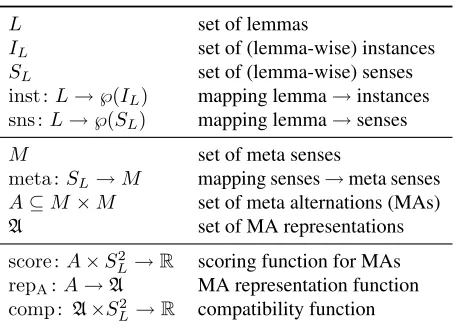
In addition to introducing formal definitions for terms commonly found in the literature, our framework pro-vides novel terminology to deal with regular poly-semy in a general fashion (cf. Table 1; capital letters designate sets and small letters elements of sets).2
For a lemma l like lamb, we want to know how well a meta alternation (such as ANIMAL
-FOOD) explains a pair of its senses (such as the animal and food senses of lamb).3 This is for-malized through the function score, which maps a meta alternation and two senses onto a score. As an example, let lambanm denote the ANIMAL
sense of lamb, lambfod the FOOD sense, and
lambhum the PERSON sense. Then, an
appropri-ate model of meta alternations should predict that
score(animal,food,lambanm,lambfod)is greater
thanscore(animal,food,lambanm,lambhum).
Meta alternations are defined as unordered pairs ofmeta senses, or cross-word senses likeANIMAL. The meta sensesMcan be defined a priori or induced from data. They are equivalence classes of senses to which they are linked through the functionmeta. A sensesinstantiatesa meta sensemiff meta(s) = m. Functionsinst andsnsallow us to define meta senses and lemma-specific senses in terms of actual instances, or occurrences of words in context.
2
We re-useinstas a function that returns the set of instances for a sense: SL → ℘(IL)and assume that senses partition
lemmas’ instances:∀l: inst(l) =S
s∈sns(l)inst(s).
3Consistent with the theoretical literature, this paper focuses on two-way polysemy. See Section 7 for further discussion.
L set of lemmas
IL set of (lemma-wise) instances
SL set of (lemma-wise) senses inst :L→℘(IL) mapping lemma→instances sns :L→℘(SL) mapping lemma→senses
M set of meta senses
meta :SL→M mapping senses→meta senses
A⊆M×M set of meta alternations (MAs)
A set of MA representations
score :A×SL2 →R scoring function for MAs repA:A→A MA representation function
[image:2.612.315.542.55.218.2]comp : A×SL2 →R compatibility function
Table 1: Notation and signatures for our framework.
We decompose thescorefunction into two parts: arepresentationfunctionrepAthat maps a meta al-ternation into some suitable representation for meta alternations,A, and acompatibilityfunctioncomp
that compares the relation between the senses of a word to the meta alternation’s representation. Thus,
comp◦repA= score.
3 The Centroid Attribute Model
The Centroid Attribute Model (CAM) is a simple instantiation of the framework defined in Section 2, designed with two primary goals in mind. First, it is a data-driven model. Second, it does not require any manual sense disambiguation, a notorious bottleneck. To achieve the first goal, CAM uses a distribu-tional approach. It represents the relevant entities as
co-occurrence vectorsthat can be acquired from a large corpus (Turney and Pantel, 2010). To achieve the second goal, CAM represents meta senses using
monosemouswords only, that is, words whose senses all correspond to one meta sense.4 Examples are
cattle and robin for the meta sense ANIMAL. We
define the vector for a meta sense as thecentroid (av-erage vector) of the monosemous words instantiating it. In turn, meta alternations are represented by the centroids of their meta senses’ vectors.
This strategy is not applicable to test lemmas, which instantiate some meta alternation and are by definition ambiguous. To deal with these without
4
vecI:IL→Rk instance vector computation
C:Rk×m→Rk centroid computation
vecL:L→Rk lemma (type) vector computation repM:M →Rk meta sense representation
Table 3: Additional notation and signatures for CAM
explicit sense disambiguation, CAM represents lem-mas by their type vectors, i.e., thecentroidof their instances, and compares their vectors (attributes) to those of the meta alternation – hence the name.
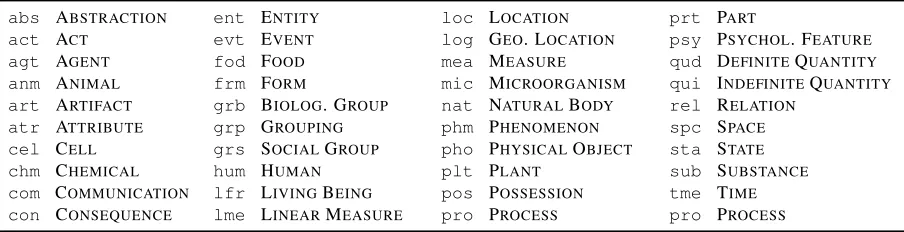
CoreLex: A Semantic Inventory. CAM uses CoreLex (Buitelaar, 1998) as its meta sense inven-tory. CoreLex is a lexical resource that was designed specifically for the study of polysemy. It builds on WordNet (Fellbaum, 1998), whose sense distinctions are too fine-grained to describe general sense al-ternations. CoreLex defines a layer of abstraction above WordNet consisting of 39basic types, coarse-grained ontological classes (Table 2). These classes are linked to one or more Wordnet anchor nodes, which define a mapping from WordNet synsets onto basic types: A synsetsmaps onto a basic typebifb
has an anchor node that dominatessand there is no other anchor node on the path frombands.5
We adopt the WordNet synsets as S, the set of senses, and the CoreLex basic types as our set of meta sensesM. Themetafunction (mapping word senses onto meta senses) is given directly by the an-chor mapping defined in the previous paragraph. This means that the set of meta alternations is given by the set of pairs of basic types. Although basic types do not perfectly model meta senses, they constitute an approximation that allows us to model many promi-nent alternations such as ANIMAL-FOOD.
Vectors for Meta Senses and Alternations. All representations used by CAM are co-occurrence vec-tors inRk(i.e.,A:=Rk). Table 3 lists new concepts that CAM introduces to manipulate vector represen-tations. vecIreturns a vector for a lemma instance,
vecLa (type) vector for a lemma, andCthe centroid of a set of vectors.
We leavevecIandCunspecified: we will experi-ment with these functions in Section 4. CAM does fix
5This is necessary because some classes have non-disjoint anchor nodes: e.g.,ANIMALs are a subset ofLIVING BEINGs.
the definitions forvecLandrepA. First,vecLdefines a lemma’s vector as the centroid of its instances:
vecL(l) =C{vecI(i)|i∈inst(l)} (1)
Before definingrepA, we specify a functionrepM that computes vector representations for meta senses
m. In CAM, this vector is defined as the centroid of the vectors for all monosemous lemmas whose WordNet sense maps ontom:
repM(m) =C{vecL(l)|meta(sns(l)) ={m}} (2)
Now,repAcan be defined simply as the centroid of the meta senses instantiatinga:
repA(m1, m2) =C{repM(m1),repM(m2)} (3)
Predicting Meta Alternations. The final compo-nent of CAM is an instantiation ofcomp(cf. Table 1), i.e., the degree to which a sense pair(s1, s2)matches a meta alternationa. Since CAM does not represent these senses separately, we definecompas
comp(a, s1, s2) = sim(a,vecL(l))
so that{s1, s2}= sns(l) (4)
The complete model,score, can now be stated as:
score(m, m0, s, s0) = sim(repA(m, m0),vecL(l))
so that{s, s0}= sns(l) (5)
CAM thus assesses how well a meta alternation
a= (m, m0)explains a lemmalby comparing the centroid of the meta sensesm, m0tol’s centroid.
Discussion. The central feature of CAM is that it avoids word sense disambiguation, although it still relies on a predefined sense inventory (Word-Net, through CoreLex). Our use of monosemous words to represent meta senses and meta alternations goes beyond previous work which uses monosemous words to disambiguate polysemous words in context (Izquierdo et al., 2009; Navigli and Velardi, 2005).
abs ABSTRACTION ent ENTITY loc LOCATION prt PART
act ACT evt EVENT log GEO. LOCATION psy PSYCHOL. FEATURE
agt AGENT fod FOOD mea MEASURE qud DEFINITEQUANTITY
anm ANIMAL frm FORM mic MICROORGANISM qui INDEFINITEQUANTITY
art ARTIFACT grb BIOLOG. GROUP nat NATURALBODY rel RELATION
atr ATTRIBUTE grp GROUPING phm PHENOMENON spc SPACE
cel CELL grs SOCIALGROUP pho PHYSICALOBJECT sta STATE
chm CHEMICAL hum HUMAN plt PLANT sub SUBSTANCE
com COMMUNICATION lfr LIVINGBEING pos POSSESSION tme TIME
[image:4.612.80.532.58.174.2]con CONSEQUENCE lme LINEARMEASURE pro PROCESS pro PROCESS
Table 2: CoreLex’s basic types with their corresponding WordNet anchors. CAM adopts these as meta senses.
4 Evaluation
We test CAM on the task of identifying which lem-mas of a given set instantiate a specific meta alterna-tion. We let the model rank the lemmas through the
scorefunction (cf. Table (1) and Eq. (5)) and evaluate the ranked list using Average Precision. While an alternative would be to rank meta alternations for a given polysemous lemma, the method chosen here has the benefit of providing data on the performance of individual meta senses and meta alternations.
4.1 Data
All modeling and data extraction was carried out on the written part of the British National Corpus (BNC; Burnage and Dunlop (1992)) parsed with the C&C tools (Clark and Curran, 2007).6
For the evaluation, we focus ondisemous words, words which instantiate exactly two meta senses according to WordNet. For each meta alternation
(m, m0), we evaluate CAM on a set of disemous tar-gets(lemmas that instantiate(m, m0)) and disemous
distractors(lemmas that do not). We define three types of distractors: (1) distractors sharingm with the targets (but not m0), (2) distractors sharing m0
with the targets (but notm), and (3) distractors shar-ing neither. In this way, we ensure that CAM cannot obtain good results by merely modeling the similarity of targets to eithermorm0, which would rather be a coarse-grained word sense modeling task.
To ensure that we have enough data, we evaluate CAM on all meta alternations with at least ten targets that occur at least 50 times in the corpus, discarding nouns that have fewer than 3 characters or contain non-alphabetical characters. The distractors are
cho-6
The C&C tools were able to reliably parse about 40M words.
sen so that they match targets in frequency. This leaves us with 60 meta alternations, shown in Ta-ble 5. For each meta alternation, we randomly select 40 lemmas as experimental items (10 targets and 10 distractors of each type) so that a total of 2,400 lem-mas is used in the evaluation.7 Table 4 shows four targets and their distractors for the meta alternation ANIMAL-FOOD.8
4.2 Evaluation Measure and Baselines
To measure success on this task, we use Average Precision (AP), an evaluation measure from IR that reaches its maximum value of 1 when all correct items are ranked at the top (Manning et al., 2008). It interpolates the precision values of the top-n pre-diction lists for all positionsnin the list that con-tain a target. Let T = hq1, . . . , qmi be the list of targets, and letP =hp1, . . . , pnibe the list of pre-dictions as ranked by the model. LetI(xi) = 1if
pi ∈ T, and zero otherwise. Then AP(P, T) =
1
m
Pm i=1I(xi)
Pi j=1I(xi)
i . AP measures the quality of the ranked list for a single meta alternation. The overall quality of a model is given by Mean Average Precision (MAP), the mean of the AP values for all meta alternations.
We consider two baselines: (1) Arandom baseline
that ranks all lemmas in random order. This baseline is the same for all meta alternations, since the distri-bution is identical. We estimate it by sampling. (2) A meta alternation-specificfrequency baselinewhich orders the lemmas by their corpus frequencies. This
7
Dataset available at http://www.nlpado.de/ ˜sebastian/data.shtml.
8
Targets Distractors with meta senseanm Distractors with meta sensefod Random distractors
[image:5.612.82.530.59.129.2]carp amphibian(anm-art) mousse(art-fod) appropriation(act-mea) duckling ape(anm-hum) parsley(fod-plt) scissors(act-art) eel leopard(anm-sub) pickle(fod-sta) showman(agt-hum) hare lizard(anm-hum) pork(fod-mea) upholstery(act-art)
Table 4: Sample of experimental items for the meta alternationanm-fod. (Abbreviations are listed in Table 2.)
baseline uses the intuition that frequent words will tend to exhibit more typical alternations.
4.3 Model Parameters
There are four more parameters to set.
Definition of vector space. We instantiate thevecI function in three ways. All three are based on dependency-parsed spaces, following our intuition that topical similarity as provided by window-based spaces is insufficient for this task. The functions dif-fer in the definition of the space’s dimensions, incor-porating different assumptions about distributional differences among meta alternations.
The first option, gram, uses grammatical paths of lengths 1 to 3 as dimensions and thus character-izes lemmas and meta senses in terms of their gram-matical context (Schulte im Walde, 2006), with a total of 2,528 paths. The second option,lex, uses words as dimensions, treating the dependency parse as a co-occurrence filter (Pad´o and Lapata, 2007), and captures topical distinctions. The third option,
gramlex, uses lexicalized dependency paths like
obj–seeto mirror more fine-grained semantic proper-ties (Grefenstette, 1994). Bothlexandgramlex
use the 10,000 most frequent items in the corpus.
Vector elements. We use “raw” corpus co-occurrence frequencies as well as log-likelihood-transformed counts (Lowe, 2001) as elements of the co-occurrence vectors.
Definition of centroid computation. There are three centroid computations in CAM: to combine instances into lemma (type) vectors (functionvecL in Eq. (1)); to combine lemma vectors into meta sense vectors (functionrepMin Eq. (2)); and to com-bine meta sense vectors into meta alternation vectors (functionrepAin Eq. (3)).
For vecL, the obvious definition of the centroid function is as amicro-average, that is, a simple av-erage over all instances. ForrepMandrepA, there
is a design choice: The centroid can be computed by micro-averaging as well, which assigns a larger weight to more frequent lemmas (repM) or meta senses (repA). Alternatively, it can be computed bymacro-averaging, that is, by normalizing the in-dividual vectors before averaging. This gives equal weight to the each lemma or meta sense, respectively. Macro-averaging inrepA thus assumes that senses are equally distributed, which is an oversimplifica-tion, as word senses are known to present skewed distributions (McCarthy et al., 2004) and vectors for words with a predominant sense will be similar to the dominant meta sense vector. Micro-averaging par-tially models sense skewedness under the assumption that word frequency correlates with sense frequency.
Similarity measure. As the vector similarity mea-sure in Eq. (5), we use the standard cosine similar-ity (Lee, 1999). It ranges between−1and1, with1
denoting maximum similarity. In the current model where the vectors do not contain negative counts, the range is[0; 1].
5 Results
Effect of Parameters The four parameters of Sec-tion 4.3 (three space types, macro-/micro-averaging forrepM andrepA, and log-likelihood transforma-tion) correspond to 24 instantiations of CAM.
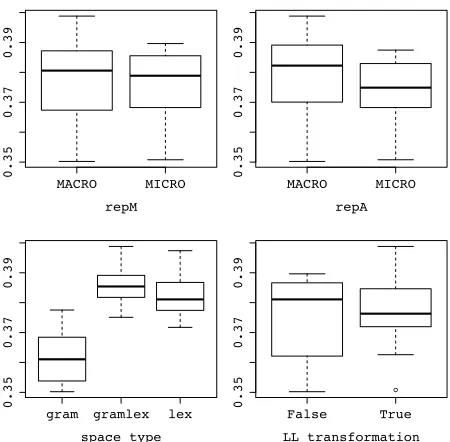
Figure 1 shows the influence of the four parame-ters. The only significant difference is tied to the use of lexicalized vector spaces (gramlex /lex are better thangram). The statistical significance of this difference was verified by a t-test (p <0.01). This indicates that meta alternations can be characterized better through fine-grained semantic distinctions than by syntactic ones.
MACRO MICRO
0.35
0.37
0.39
repM
MACRO MICRO
0.35
0.37
0.39
repA
gram gramlex lex
0.35
0.37
0.39
space type
●
False True
0.35
0.37
0.39
[image:6.612.74.299.55.276.2]LL transformation
Figure 1: Effect of model parameters on performance. A data point is the mean AP (MAP) across all meta alterna-tions for a specific setting.
modeled. Focusing on meta alternations, whether the two intervening meta senses should be balanced or not can be expected to depend on the frequencies of the concepts denoted by each meta sense, which vary for each case. Indeed, for AGENT-HUMAN, the alter-nation which most benefits from the micro-averaging setting, the targets are much more similar to the HU
-MANmeta sense (which is approximately 8 times as frequent as AGENT) than to the AGENTmeta sense. The latter contains anything that can have an effect on something, e.g.emulsifier, force, valium. The targets for AGENT-HUMAN, in contrast, contain words such asengineer, manipulator, operative, which alternate between an agentive role played by a person and the person herself.
While lacking in clear improvement, log-likelihood transformation tends to reduce variance, consistent with the effect previously found in selec-tional preference modeling (Erk et al., 2010).
Overall Performance Although the performance of the CAM models is still far from perfect, all 24 models obtain MAP scores of 0.35 or above, while the random baseline is at 0.313, and the overall fre-quency baseline at 0.291. Thus, all models con-sistently outperform both baselines. A bootstrap resampling test (Efron and Tibshirani, 1994)
con-firmed that the difference to the frequency baseline is significant at p < 0.01 for all 24 models. The difference to the random baseline is significant at
p < 0.01 for 23 models and at p < 0.05 for the remaining model. This shows that the models cap-ture the meta alternations to some extent. The best model uses macro-averaging forrepMandrepAin a log-likelihood transformedgramlexspace and achieves a MAP of 0.399.
Table 5 breaks down the performance of the best CAM model by meta alternation. It shows an en-couraging picture: CAM outperforms the frequency baseline for 49 of the 60 meta alternations and both baselines for 44 (73.3%) of all alternations. The per-formance shows a high degree of variance, however, ranging from 0.22 to 0.71.
Analysis by Meta Alternation Coherence Meta alternations vary greatly in their difficulty. Since CAM is an attribute similarity-based approach, we expect it to perform better on the alternations whose meta senses are ontologically more similar. We next test this hypothesis.
Let Dmi = {dij} be the set of distractors for the targetsT = {tj}that share the meta sensemi, andDR={d3j}the set of random distractors. We define the coherenceκof an alternation aof meta sensesm1, m2 as the mean (ø) difference between the similarity of each target vector toaand the simi-larity of the corresponding distractors toa, or for-mally κ(a) = ø sim(repA(m1, m2),vecL(tj))−
sim(repA(m1, m2),vecL(dij)), for1 ≤ i ≤ 3and
1 ≤ j ≤ 10. That is,κmeasures how much more similar, on average, the meta alternation vector is to the target vectors than to the distractor vectors. For a meta alternation with a higherκ, the targets should be easier to distinguish from the distractors.
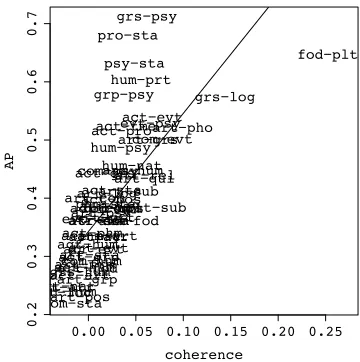
Figure 2 plots AP byκfor all meta alternations. As we expect from the definition ofκ, AP is strongly correlated with κ. However, there is a marked Y shape, i.e., a divergence in behavior between
high-κand mid-AP alternations (upper right corner) and mid-κand high-AP alternations (upper left corner).
grs-psy 0.709 com-evt 0.501 art-com 0.400 atr-com 0.361 art-frm 0.286 pro-sta 0.678 art-grs 0.498 act-pos 0.396 atr-sta 0.361 act-hum 0.281 fod-plt 0.645 hum-psy 0.486 phm-sta 0.388 act-phm 0.339 art-fod 0.280 psy-sta 0.630 hum-nat 0.456 atr-psy 0.384 anm-art 0.335 grs-hum 0.272 hum-prt 0.602 anm-hum 0.448 fod-hum 0.383 art-atr 0.333 act-art 0.267 grp-psy 0.574 com-psy 0.443 plt-sub 0.383 act-psy 0.333 art-grp 0.258 grs-log 0.573 act-grs 0.441 act-com 0.382 agt-hum 0.319 art-nat 0.248 act-evt 0.539 atr-rel 0.440 grp-grs 0.379 art-evt 0.314 act-atr 0.246 evt-psy 0.526 art-qui 0.433 art-psy 0.373 atr-evt 0.312 art-hum 0.240 act-tme 0.523 act-sta 0.413 art-prt 0.364 art-sta 0.302 art-loc 0.238 art-pho 0.520 art-sub 0.412 evt-sta 0.364 act-grp 0.296 art-pos 0.228 act-pro 0.513 art-log 0.407 anm-fod 0.361 com-hum 0.292 com-sta 0.219 Table 5: Meta alternations and their average precision values for the task. The random baseline performs at 0.313 while the frequency baseline ranges from 0.255 to 0.369 with a mean of 0.291. Alternations for which the model outperforms the frequency baseline are in boldface (mean AP: 0.399, standard deviation: 0.119).
grs-psy democracy, faculty, humanism, regime,
pro-sta bondage, dehydration, erosion,urbanization
psy-sta anaemia,delight, pathology, sensibility
hum-prt bum, contractor, peter, subordinate
grp-psy category, collectivism, socialism, underworld Table 6: Sample targets for meta alternations with high AP and mid-coherence values.
a PLANTsense by WordNet, but no FOODsense. In the case of SOCIALGROUP-GEOGRAPHICALLOCA
-TION, distractorslaboratoryandprovinceare miss-ing SOCIALGROUPsenses, which they clearly pos-sess (cf.The whole laboratory celebrated Christmas). This suggests that our approach can help in Word Sense Induction and thesaurus construction.
In the second case, meta alternations perform bet-ter than expected: They have a low κ, but a high AP. These includegrs-psy,pro-sta,psy-sta,
hum-prtandgrp-psy. These meta alternations involve fairly abstract meta senses such as PSYCHO -LOGICAL FEATURE and STATE.9 Table 6 lists a sample of targets for the five meta alternations in-volved. The targets are clearly similar to each other on the level of their meta senses. However, they can occur in very different semantic contexts. Thus, here it is the underlying model (thegramlexspace) that can explain the lower than average coherence. It is striking that CAM can account for abstract words and meta alternations between these, given that it uses first-order co-occurrence information only.
9An exception ishum-prt. It has a low coherence because many WordNet lemmas with a PARTsense are body parts.
0.00 0.05 0.10 0.15 0.20 0.25
0.2
0.3
0.4
0.5
0.6
0.7
coherence
AP
act−art act−atr
act−com act−evt
act−grp act−grs
act−hum act−phm
act−pos act−pro
act−psy act−sta
act−tme
agtanm−hum−art anm−fod
anm−hum
art−atr art−com
art−evt art−fod art−frm art−grp
art−grs
art−hum art−loc
art−log
art−nat
art−pho
art−pos art−prt art−psy
art−qui
art−sta art−sub
atr−com
atr−evt atr−psy
atr−rel
atr−sta com−evt
com−hum com−psy
com−sta
evt−psy
evtfod−sta−hum
fod−plt
grp−grs grp−psy
grs−hum
grs−log grs−psy
hum−nat hum−prt
hum−psy
phm−staplt−sub pro−sta
psy−sta
Figure 2: Average Precision and Coherence (κ) for each meta alternation. Correlation:r= 0.743(p <0.001)
6 Related work
As noted in Section 1, there is little work in empiri-cal computational semantics on explicitly modeling sense alternations, although the notions that we have formalized here affect several tasks across NLP sub-fields.
[image:7.612.336.516.258.439.2]on the default meaning arising from word combina-tions, as opposed to the polysemy of single words as in this study.
Meta alternations other than regular polysemy, such as metonymy, play a crucial role in Informa-tion ExtracInforma-tion. For instance, the meta alternaInforma-tion SOCIALGROUP-GEOGRAPHICALLOCATION cor-responds to an ambiguity between the LOCATION
-ORGANIZATION Named Entity classes which is known to be a hard problem in Named Entity Recog-nition and Classification (Markert and Nissim, 2009). Metaphorical meta alternations have also received attention recently (Turney et al., 2011)
On a structural level, the prediction of meta al-ternations shows a clear correspondence to analogy prediction as approached in Turney (2006) ( carpen-ter:wood is analogous to mason:stone, but not to
photograph:camera). The framework defined in Sec-tion 2 conceptualizes our task in a way parallel to that of analogical reasoning, modeling not “first-order” semantic similarity, but “second-order” semantic re-lations. However, the two tasks cannot be approached with the same methods, as Turney’s model relies on contexts linking two nouns in corpus sentences (what does A do to B?). In contrast, we are interested in relationswithinwords, namely between word senses. We cannot expect two different senses of the same noun to co-occur in the same sentence, as this is dis-couraged for pragmatic reasons (Gale et al., 1992).
A concept analogous to our notion of meta sense (i.e., senses beyond single words) has been used in previous work on class-based WSD (Yarowsky, 1992; Curran, 2005; Izquierdo et al., 2009), and indeed, the CAM might be used for class-based WSD as well. However, our emphasis lies rather on modeling polysemy across words (meta alternations), some-thing that is absent in WSD, class-based or not. The only exception, to our knowledge, is Ando (2006), who pools the labeled examples for all words from a dataset for learning, implicitly exploiting regularities in sense alternations.
Meta senses also bear a close resemblance to the notion of semantic class as used in lexical acqui-sition (Hindle, 1990; Merlo and Stevenson, 2001; Schulte im Walde, 2006; Joanis et al., 2008). How-ever, in most of this research polysemy is ignored. A few exceptions use soft clustering for multiple as-signment of verbs to semantic classes (Pereira et al.,
1993; Rooth et al., 1999; Korhonen et al., 2003), and Boleda et al. (to appear) explicitly model regular polysemy for adjectives.
7 Conclusions and Future Work
We have argued that modeling regular polysemy and other analogical processes will help improve current models of word meaning in empirical computational semantics. We have presented a formal framework to represent and operate with regular sense alterna-tions, as well as a first simple instantiation of the framework. We have conducted an evaluation of dif-ferent implementations of this model in the new task of determining whether words match a given sense alternation. All models significantly outperform the baselines when considered as a whole, and the best implementation outperforms the baselines for 73.3% of the tested alternations.
We have two next steps in mind. The first is to become independent of WordNet by unsupervised induction of (meta) senses and alternations from the data. This will allow for models that, unlike CAM, can go beyond “disemous” words. Other improve-ments on the model and evaluation will be to develop more informed baselines that capture semantic shifts, as well as to test alternate weighting schemes for the co-occurrence vectors (e.g. PMI) and to use larger corpora than the BNC.
The second step is to go beyond the limited in-vitro evaluation we have presented here by integrating al-ternation prediction into larger NLP tasks. Knowl-edge about alternations can play an important role in counteracting sparseness in many tasks that involve semantic compatibility, e.g., testing the applicability of lexical inference rules (Szpektor et al., 2008).
Acknowledgements
References
Rie Kubota Ando. 2006. Applying alternating structure optimization to word sense disambiguation. In Proceed-ings of the 10th Conference on Computational Natural Language Learning, pages 77–84, New York City, NY. Iurii Derenikovich Apresjan. 1974. Regular polysemy.
Linguistics, 142:5–32.
Gemma Boleda, Sabine Schulte im Walde, and Toni Badia. to appear. Modeling regular polysemy: A study of the semantic classification of Catalan adjectives. Computa-tional Linguistics.
Paul Buitelaar. 1998. CoreLex: An ontology of sys-tematic polysemous classes. In Proceedings of For-mal Ontologies in Information Systems, pages 221–235, Amsterdam, The Netherlands.
Gavin Burnage and Dominic Dunlop. 1992. Encoding the British National Corpus. In Jan Aarts, Pieter de Haan, and Nelleke Oostdijk, editors,English Language Corpora: Design, Analysis and Exploitation, Papers from the Thirteenth International Conference on En-glish Language Research on Computerized Corpora. Rodopi, Amsterdam.
Stephen Clark and James R. Curran. 2007. Wide-coverage efficient statistical parsing with ccg and log-l inear models.Computational Linguistics, 33(4). Ann Copestake and Ted Briscoe. 1995. Semi-productive
Polysemy and Sense Extension. Journal of Semantics, 12(1):15–67.
James Curran. 2005. Supersense tagging of unknown nouns using semantic similarity. InProceedings of the 43rd Annual Meeting of the Association for Computa-tional Linguistics (ACL’05), pages 26–33, Ann Arbor, Michigan.
Bradley Efron and Robert Tibshirani. 1994. An Introduc-tion to the Bootstrap. Monographs on Statistics and Applied Probability 57. Chapman & Hall.
Katrin Erk, Sebastian Pad´o, and Ulrike Pad´o. 2010. A flexible, corpus-driven model of regular and inverse selectional preferences. Computational Linguistics, 36(4):723–763.
Christiane Fellbaum, editor. 1998. WordNet: an elec-tronic lexical database. MIT, London.
William A. Gale, Kenneth W. Church, and David Yarowsky. 1992. One sense per discourse. In Proceed-ings of the 1992 ARPA Human Language Technologies Workshop, pages 233–237, Harriman, NY.
Dedre Gentner, Brian F. Bowdle, Phillip Wolff, and Con-suelo Boronat. 2001. Metaphor is like analogy. In D. Gentner, K. J. Holyoak, and B. N. Kokinov, edi-tors,The analogical mind: Perspectives from Cognitive Science, pages 199–253. MIT Press, Cambridge, MA. Gregory Grefenstette. 1994. Explorations in Automatic Thesaurus Discovery. Kluwer Academic Publishers.
Donald Hindle. 1990. Noun classification from predicate-argument structures. InProceedings of the 28th Meet-ing of the Association for Computational LMeet-inguistics, pages 268–275.
Rub´en Izquierdo, Armando Su´arez, and German Rigau. 2009. An empirical study on class-based word sense disambiguation. InProceedings of the 12th Conference of the European Chapter of the ACL (EACL 2009), pages 389–397, Athens, Greece.
Eric Joanis, Suzanne Stevenson, and David James. 2008. A general feature space for automatic verb classifica-tion.Natural Language Engineering, 14(03):337–367. Anna Korhonen, Yuval Krymolowski, and Zvika Marx. 2003. Clustering polysemic subcategorization frame distributions semantically. InProceedings of the 41st Annual Meeting of the Association for Computational Linguistics, pages 64–71.
George Lakoff and Mark Johnson. 1980.Metaphors We Live By. University of Chicago Press.
Mirella Lapata. 2000. The Acquisition and Modeling of Lexical Knowledge: A Corpus-based Investigation of Systematic Polysemy. Ph.D. thesis, University of Edinburgh.
Lillian Lee. 1999. Measures of distributional similarity. InProceedings of the 37th Annual Meeting on Asso-ciation for Computational Linguistics, pages 25–32, College Park, MA.
Will Lowe. 2001. Towards a theory of semantic space. In Proceedings of the 23rd Annual Meeting of the Cogni-tive Science Society, pages 576–581, Edinburgh, UK. Christopher D. Manning, Prabhakar Raghavan, and
Hin-rich Sch¨utze. 2008. Introduction to Information Re-trieval. Cambridge University Press, Cambridge, UK, 1st edition.
Katja Markert and Malvina Nissim. 2009. Data and models for metonymy resolution. Language Resources and Evaluation, 43(2):123–138.
Diana McCarthy, Rob Koeling, Julie Weeds, and John Car-roll. 2004. Using automatically acquired predominant senses for word sense disambiguation. InProceedings of the ACL SENSEVAL-3 workshop, pages 151–154. Paola Merlo and Suzanne Stevenson. 2001. Automatic
verb classification based on statistical distributions of argument structure. Computational Linguistics, 27(3):373–408.
Gregory L. Murphy. 2002. The Big Book of Concepts. MIT Press, Cambridge, MA.
Roberto Navigli. 2009. Word sense disambiguation: A survey. ACM Computing Surveys, 41:10:1–10:69, February.
Sebastian Pad´o and Mirella Lapata. 2007. Dependency-based construction of semantic space models. Compu-tational Linguistics, 33(2):161–199.
Patrick Pantel and Dekang Lin. 2002. Discovering word senses from text. In Proceedings of ACM SIGKDD Conference on Knowledge Discovery and Data Mining 2002, pages 613–619, Edmonton.
Fernando C. N. Pereira, Naftali Tishby, and Lillian Lee. 1993. Distributional clustering of English words. In Proceedings of the 31st Meeting of the Association for Computational Linguistics, pages 183–190, Columbus, OH.
James Pustejovsky. 1995.The Generative Lexicon. MIT Press, Cambridge, MA.
Joseph Reisinger and Raymond J. Mooney. 2010. Multi-prototype vector-space models of word meaning. In Proceedings of the 11th Annual Conference of the North American Chapter of the Association for Computational Linguistics (NAACL-2010), pages 109–117.
Mats Rooth, Stefan Riezler, Detlef Prescher, Glenn Car-roll, and Franz Beil. 1999. Inducing a semantically annotated lexicon via EM-based clustering. In Proceed-ings of the 37th Annual Meeting of the Association for Computational Linguistics, College Park, MD. Sabine Schulte im Walde. 2006. Experiments on the
automatic induction of German semantic verb classes. Computational Linguistics, 32(2):159–194.
Hinrich Sch¨utze. 1998. Automatic word sense discrimi-nation. Computational Linguistics, 24(1):97–123. Idan Szpektor, Ido Dagan, Roy Bar-Haim, and Jacob
Gold-berger. 2008. Contextual preferences. In Proceed-ings of the 46th Annual Meeting of the Association for Computational Linguistics, pages 683–691, Columbus, Ohio.
Noriko Tomuro. 2001. Tree-cut and a lexicon based on systematic polysemy. InProceedings of the second meeting of the North American Chapter of the Asso-ciation for Computational Linguistics on Language technologies, NAACL ’01, pages 1–8, Stroudsburg, PA, USA. Association for Computational Linguistics. Peter D. Turney and Patrick Pantel. 2010. From frequency
to meaning: Vector space models of semantics. Journal of Artificial Intelligence Research, 37:141–188. Peter Turney, Yair Neuman, Dan Assaf, and Yohai Cohen.
2011. Literal and metaphorical sense identification through concrete and abstract context. InProceedings of the Conference on Empirical Methods in Natural Language Processing, pages 680–690, Edinburgh, Scot-land, UK.
Peter D. Turney. 2006. Similarity of semantic relations. Computational Linguistics, 32:379–416.
Jason Utt and Sebastian Pad´o. 2011. Ontology-based distinction between polysemy and homonymy. In Pro-ceedings of the 9th International Conference on Com-putational Semantics, Oxford, UK.