Proceedings of NAACL-HLT 2018, pages 444–451
Object Ordering with Bidirectional Matchings for Visual Reasoning
Hao Tan and Mohit Bansal
UNC Chapel Hill
{haotan, mbansal}@cs.unc.edu
Abstract
Visual reasoning with compositional natu-ral language instructions, e.g., based on the newly-released Cornell Natural Language Vi-sual Reasoning (NLVR) dataset, is a challeng-ing task, where the model needs to have the ability to create an accurate mapping between the diverse phrases and the several objects placed in complex arrangements in the image. Further, this mapping needs to be processed to answer the question in the statement given the ordering and relationship of the objects across three similar images. In this paper, we propose a novel end-to-end neural model for the NLVR task, where we first use joint bidirectional at-tention to build a two-way conditioning be-tween the visual information and the language phrases. Next, we use an RL-based pointer network to sort and process the varying num-ber of unordered objects (so as to match the order of the statement phrases) in each of the three images and then pool over the three de-cisions. Our model achieves strong improve-ments (of 4-6% absolute) over the state-of-the-art on both the structured representation and raw image versions of the dataset.
1 Introduction
Visual Reasoning (Antol et al., 2015; Andreas
et al.,2016;Bisk et al.,2016;Johnson et al.,2017) requires a sophisticated understanding of the com-positional language instruction and its relationship
with the corresponding image. Suhr et al.(2017)
recently proposed a challenging new NLVR task and dataset in this direction with natural and com-plex language statements that have to be classified as true or false given a multi-image set (shown in
Fig.1). Specifically, each task instance consists of
an image with three sub-images and a statement which describes the image. The model is asked to answer the question whether the given statement is consistent with the image or not.
To solve the task, the designed model needs to fuse the information from two different domains,
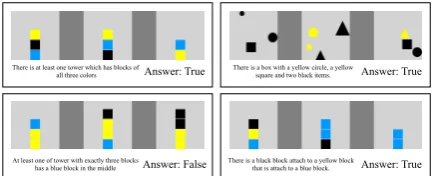
There is at least one tower which has blocks of
all three colors There is a box with a yellow circle, a yellow square and two black items.
At least one of tower with exactly three blocks has a blue block in the middle
Answer: True Answer: True
There is a black block attach to a yellow block that is attach to a blue block.
[image:1.595.308.525.205.293.2]Answer: False Answer: True
Figure 1: NLVR task: given an image with 3 sub-images and a statement, the model needs to predict whether the statement correctly describes the image or not. We show 4 such examples which our final BiATT-Pointer model correctly classifies but the strong
base-line models do not (see Sec.5).
the visual objects and the language, and learn ac-curate relationships between the two. Another dif-ficulty is that the objects in the image do not have a fixed order and the number of objects also varies. Moreover, each statement reasons for truth over three sub-images (instead of the usual single im-age setup), which also breaks most of the exist-ing models. In our paper, we introduce a novel end-to-end model to address these three problems, leading to strong gains over the previous best model. Our pointer network based LSTM-RNN sorts and learns recurrent representations of the objects in each sub-image, so as to match it bet-ter with the order of the phrases in the language statement. For this, it employs an RL-based pol-icy gradient method with a reward extracted from the subsequent comprehension model. With these strong representations of the visual objects and the statement units, a joint-bidirectional attention flow model builds consistent, two-way matchings be-tween the representations in different domains. Fi-nally, since the scores computed by the bidirec-tional attention are about the three sub-images, a pooling combination layer over the three sub-image representations is required to give the final score of the whole image.
On the structured-object-representation version of the dataset, our pointer-based, end-to-end
rectional attention model achieves an accuracy of 73.9%, outperforming the previous (end-to-end) state-of-the-art method by 6.2% absolute, where both the pointer network and the bidirectional at-tention modules contribute significantly. We also contribute several other strong baselines for this
new NLVR task based on Relation Networks (
San-toro et al., 2017) and BiDAF (Seo et al., 2016).
Furthermore, we also show the result of our joint bidirectional attention model on the raw-image version (with pixel-level, spatial-filter CNNs) of the NLVR dataset, where our model achieves an accuracy of 69.7% and outperforms the previous best result by 3.6%. On the unreleased leader-board test set, our model achieves an accuracy of 71.8% and 66.1% on the structured and raw-image versions, respectively, leading to 4% absolute im-provements on both tasks.
2 Related work
Besides the NLVR corpus with a focus on
com-plex and natural compositional language (Suhr
et al.,2017), other useful visual reasoning datasets have been proposed for navigation and
assem-bly tasks (MacMahon et al., 2006; Bisk et al.,
2016), as well as for visual Q&A tasks which
fo-cus more on complex real-world images (Antol
et al., 2015; Johnson et al., 2017). Specifically
for the NLVR dataset, previous models have in-corporated property- and count-based features of
the objects and the language (Suhr et al., 2017),
or extra semantic parsing (logical form)
annota-tions (Goldman et al.,2017) – we focus on
end-to-end models for this visual reasoning task.
Attention mechanism (Bahdanau et al., 2014;
Luong et al., 2015; Xu et al., 2015) has been
widely used for conditioned language generation tasks. It is further used to learn alignments
be-tween different modalities (Lu et al.,2016;Wang
and Jiang, 2016;Seo et al., 2016;Andreas et al.,
2016;Chaplot et al.,2017). In our work, a bidirec-tional attention mechanism is used to learn a joint representation of the visual objects and the words by building matchings between them.
Pointer network (Vinyals et al., 2015) was
in-troduced to learn the conditional probability of an
output sequence. Bello et al.(2016) extended this
to near-optimal combinatorial optimization via re-inforcement learning. In our work, a policy gra-dient based pointer network is used to “sort” the objects conditioned on the statement, such that the sequence of ordered objects is sent to the
subse-quent comprehension model for a reward.
3 Model
The training datum for this task consists of the
statements, the structured-representation objects
o in the image I, and the ground truth label y
(which is1for true and0 for false). Our
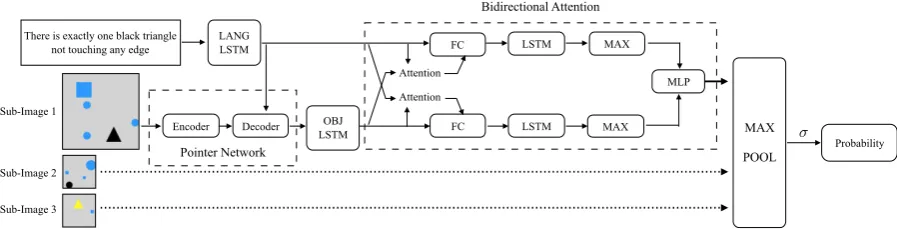
BiATT-Pointer model (shown in Fig.2) for the
structured-representation task uses the pointer network to sort the object sequence (optimized by policy gradi-ent), and then uses the comprehension model to
calculate the probabilityP(s, o) of the statement
s being consistent with the image. Our
CNN-BiATT model for the raw-imageI dataset version
is similar but learns the structure directly via
pixel-level, spatial-filter CNNs – details in Sec. 5 and
the appendix. In the remainder of this section, we first describe our BiATT comprehension model and then the pointer network.
3.1 Comprehension Model with Joint Bidirectional Attention
We use one bidirectional LSTM-RNN (
Hochre-iter and Schmidhuber,1997) (denoted by
LANG-LSTM) to read the statements=w1, w2, . . . , wT,
and output the hidden state representations{hi}.
A word embedding layer is added before the LSTM to project the words to high-dimension
vec-tors{w˜i}.
h1,h2, . . . , hT = LSTM ( ˜w1,w˜2, . . . ,w˜T) (1)
The raw features of the objects in the j-th
sub-image are{ojk}(since the NLVR dataset has 3
sub-images per task). A fully-connected (FC) layer without nonlinearity projects the raw features to
object embeddings{ejk}. We then go through all
the objects in random order (or some learnable
or-der, e.g., via our pointer network, see Sec. 3.2)
by another bidirectional LSTM-RNN (denoted by OBJ-LSTM), whose output is a sequence of
vec-tors{gjk}which is used as the (left plus right
mem-ory) representation of the objects (the objects in different sub-images are handled separately):
ejk=W ojk+b (2)
g1j, gj2, . . . , gjN
j = LSTM (e j
1, ej2, . . . , ejNj) (3)
where Nj is the number of the objects injth
be-There is exactly one black triangle not touching any edge
Encoder Decoder OBJ LSTM
Pointer Network
FC Attention
LSTM
LSTM
MAX
MAX Sub-Image 1
MLP
Bidirectional Attention
MAX
POOL
Probability Attention
FC LANG
LSTM
Sub-Image 2
[image:3.595.75.524.63.178.2]Sub-Image 3
Figure 2: Our BiATT-Pointer model with a pointer network and a joint bidirectional attention module.
tween the statement and the image’s object struc-ture. To simplify the notation, we will ignore the
sub-image index j. We first merge the
LANG-LSTM hidden outputs {hi} and the object-aware
context vectors{ci}together to get the joint
rep-resentation{ˆhi}. The object-aware context vector
ci for a particular wordwi is calculated based on
the bilinear attention between the word
representa-tionhiand the representations of the objects{gk}:
αi,k = softmaxk(h|i B1gk) (4)
ci =
X
k
αi,k·gk (5)
ˆ
hi = relu (WLANG[hi;ci;hi−ci;hi◦ci]) (6)
where the symbol ◦ denotes element-wise
multi-plication.
Improvement over BiDAF The BiDAF model
of Seo et al. (2016) does not use a full
object-to-words attention mechanism. The
query-to-document attention module in BiDAF added the attended-context vector to the document represen-tation instead of the query represenrepresen-tation. How-ever, the inverse attention from the objects to the words is important in our task because the repre-sentation of the object depends on its correspond-ing words. Therefore, different from the BiDAF model, we create an additional ‘symmetric’
atten-tion to merge the OBJ-LSTM hidden outputs{gk}
and the statement-aware context vectors{dk}
to-gether to get the joint representation {gˆk}. The
improvement (6.1%) of our BiATT model over the
BiDAF model is shown in Table1.
βk,i= softmaxi gk|B2hi (7)
dk=
X
i
βk,i·hi (8)
ˆ
gk= relu (WOBJ[gk;dk;gk−dk;gk◦dk]) (9)
These above vectors {ˆhi} and{ˆgk} are the
rep-resentations of the words and the objects which
are aware of each other bidirectionally. To make the final decision, two additional bidirectional LSTM-RNNs are used to further process the above attention-based representations via an additional memory-based layer. Lastly, two max pooling layers over the hidden output states create two single-vector outputs for the statement and the sub-image, respectively:
¯
h1,¯h2, . . . ,¯hT = LSTM(ˆh1,ˆh2, . . . ,ˆhT) (10)
¯
g1,¯g2, . . . ,¯gN= LSTM(ˆg1,gˆ2, . . . ,gˆN) (11)
¯
h= ele max
i
¯
hi (12)
¯
g= ele max
k {¯gk} (13)
where the operatorele max denotes the
element-wise maximum over the vectors. The final scalar score for the sub-image is given by a 2-layer MLP
over the concatenation ofh¯and¯gas follows:
score =W2 tanh W1[¯h; ¯g] +b1
(14)
Max-Pooling over Sub-Images In order to
ad-dress the 3 sub-images present in each NLVR task, a max-pooling layer is used to combine the above-defined scores of the sub-images. Given that the sub-images do not have any specific order-ing among them (based on the data collection
pro-cedure (Suhr et al.,2017)), a pooling layer is
suit-able because it is permutation invariant. Moreover, many of the statements are about the existence of a special object or relationship in one sub-image
(see Fig.1) and hence the max-pooling layer
ef-fectively captures the meaning of these statements. We also tried other combination methods (mean-pooling, concatenation, LSTM, early pooling on the features/vectors, etc.); the max pooling (on scores) approach was the simplest and most effec-tive method among these (based on the dev set).
score. The loss of the comprehension model is the negative log probability (i.e., the cross entropy):
P(s, o) =σ
max
j score j
(15)
L(s, o, y) =−y logP(s, o)
−(1−y) log(1−P(s, o)) (16)
whereyis the ground truth label.
3.2 Pointer Network
Instead of randomly ordering the objects, humans look at the objects in an appropriate order w.r.t. their reading of the given statement and after the first glance of the image. Following this idea,
we use an additional pointer network (Vinyals
et al.,2015) to find the best object ordering for the subsequent language comprehension model. The pointer network contains two RNNs, the encoder and the decoder. The encoder reads all the objects in a random order. The decoder then learns a
per-mutationπ of the objects’ indices, by recurrently
outputting a distribution over the objects based on the attention over the encoder hidden outputs. At each time step, an object is sampled without re-placement following this distribution. Thus, the
pointer network models a distribution p(π | s, o)
over all the permutations:
p(π|s, o) =Y
i
p(π(i)|π(< i), s, o) (17)
Furthermore, the appropriate order of the objects depends on the language statement, and hence the decoder importantly attends to the hidden outputs
of the LANG-LSTM (see Eqn.1).
The pointer network is trained via reinforce-ment learning (RL) based policy gradient
opti-mization. The RL loss LRL(s, o, y) is defined
as the expected comprehension loss (expectation over the distribution of permutations):
LRL(s, o, y) =Eπ∼p(·|s,o)L(s, o[π], y) (18)
whereo[π]denotes the permuted input objects for
permutationπ, andLis the loss function defined
in Eqn. 16. Suppose that we sampled a
permu-tationπ∗ from the distributionp(π|s, o); then the
above RL loss could be optimized via policy
gra-dient methods (Williams,1992). The rewardRis
the negative loss of the subsequent comprehension
model L(s, o[π∗], y). A baseline b is subtracted
from the reward to reduce the variance (we use the
self-critical baseline ofRennie et al.(2016)). The
gradient of the loss LRL could then be
approxi-mated as:
R=−L(s, o[π∗], y) (19)
∇θLRL(s, o, y)≈ −(R−b)∇θlogp(π∗ |s, o)
+∇θL(s, o[π∗], y) (20)
This overall BiATT-Pointer model (for the
structured-representation task) is shown in Fig.2.
4 Experimental Setup
We evaluate our model on the NLVR dataset (Suhr
et al.,2017), for both the structured and raw-image versions. All model tuning was performed on the dev set. Given the fact that the dataset is balanced (the number of true labels and false labels are roughly the same), the accuracy of the whole cor-pus is used as the metric. We only use the raw fea-tures of the statement and the objects with mini-mal standard preprocessing (e.g., tokenization and UNK replacement; see appendix for reproducibil-ity training details).
5 Results and Analysis
Results on Structured Representations Dataset:
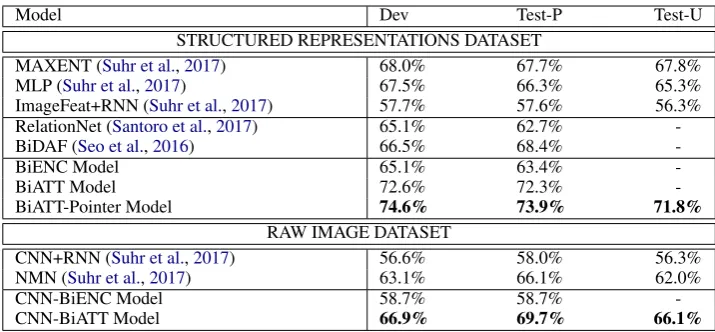
Table1shows our primary model results. In terms
of previous work, the state-of-the-art result for
end-to-end models is ‘MAXENT’, shown inSuhr
et al.(2017).1 Our proposed BiATT-Pointer model
(Fig.2) achieves a 6.2% improvement on the
pub-lic test set and a 4.0% improvement on the unre-leased test set over this SotA model. To show the individual effectiveness of our BiATT and Pointer components, we also provide two ablation results: (1) the bidirectional attention BiATT model with-out the pointer network; and (2) our BiENC base-line model without any attention or the pointer mechanisms. The BiENC model uses the similar-ity between the last hidden outputs of the
LANG-LSTM and the OBJ-LANG-LSTM as the score (Eqn.14).
Finally, we also reproduce some recent
popu-lar frameworks, i.e., Relationship Network (
San-toro et al., 2017) and BiDAF model (Seo et al.,
2016), which have been proven to be successful in
other machine comprehension and visual reason-ing tasks. The results of these models are weaker than our proposed model. Reimplementation de-tails are shown in the appendix.
Model Dev Test-P Test-U STRUCTURED REPRESENTATIONS DATASET
MAXENT (Suhr et al.,2017) 68.0% 67.7% 67.8%
MLP (Suhr et al.,2017) 67.5% 66.3% 65.3%
ImageFeat+RNN (Suhr et al.,2017) 57.7% 57.6% 56.3% RelationNet (Santoro et al.,2017) 65.1% 62.7%
-BiDAF (Seo et al.,2016) 66.5% 68.4%
-BiENC Model 65.1% 63.4%
-BiATT Model 72.6% 72.3%
-BiATT-Pointer Model 74.6% 73.9% 71.8%
RAW IMAGE DATASET
CNN+RNN (Suhr et al.,2017) 56.6% 58.0% 56.3%
NMN (Suhr et al.,2017) 63.1% 66.1% 62.0%
CNN-BiENC Model 58.7% 58.7%
[image:5.595.119.477.60.226.2]-CNN-BiATT Model 66.9% 69.7% 66.1%
Table 1: Dev, Test-P (public), and Test-U (unreleased) results of our model on the structured-representation and raw-image datasets, compared to the previous SotA results and other reimplemented baselines.
The top of the three towers
are not the same. Correct Answer: True There are 2 boxes with at least 2 blue items. Correct Answer: True There is a blue object
touching the base. Correct Answer: False There are at least three yellow objects
touching any edge. Correct Answer: True
[image:5.595.73.290.265.356.2]Negative Examples
Figure 3: Incorrectly-classified examples.
Results on Raw Images Dataset: To further show
the effectiveness of our BiATT model, we apply this model to the raw image version of the NLVR dataset, with minimal modification. We simply replace each object-related LSTM with a visual feature CNN that directly learns the structure via pixel-level, spatial filters (instead of a pointer net-work which addresses an unordered sequence of structured object representations). As shown in
Table 1, this CNN-BiATT model outperforms the
neural module networks (NMN) (Andreas et al.,
2016) previous-best result by 3.6% on the public
test set and 4.1% on the unreleased test set. More details and the model figure are in the appendix.
Output Example Analysis: Finally, in Fig. 1,
we show some output examples which were suc-cessfully solved by our BiATT-Pointer model but failed in our strong baselines. The left two
ex-amples in Fig. 1could not be handled by the
Bi-ENC model. The right two examples are incorrect for the BiATT model without the ordering-based pointer network. Our model can quite successfully understand the complex meanings of the attributes and their relationships with the diverse objects, as well as count the occurrence of and reason over objects without any specialized features.
Next, in Fig.3, we also show some negative
ex-amples on which our model fails to predict the cor-rect answer. The top two examples involve
com-plex high-level phrases e.g., “touching any edge” or “touching the base”, which are hard for an end-to-end model to capture, given that such state-ments are rare in the training data. Based on the re-sult of the validation set, the max-pooling layer is selected as the combination method in our model. The max-pooling layer will choose the highest score from the sub-images as the final score. Thus, the layer could easily handle statements about single-subimage-existence based reasoning (e.g.,
the 4 positively-classified examples in Fig. 1).
However, the bottom two negatively-classified
ex-amples in Fig. 3 could not be resolved because
of the limitation of the max-pooling layer on sce-narios that consider multiple-subimage-existence. We did try multiple other pooling and combination
methods, as mentioned in Sec.3.1. Among these
methods, the concatenation, early pooling and LSTM-fusion approaches might have the ability to solve these particular bottom-two failed state-ments. In our future work, we are addressing mul-tiple types of pooling methods jointly.
6 Conclusion
We presented a novel end-to-end model with joint bidirectional attention and object-ordering pointer networks for visual reasoning. We evaluate our model on both the structured-representation and raw-image versions of the NLVR dataset and achieve substantial improvements over the previ-ous end-to-end state-of-the-art results.
Acknowledgments
References
Jacob Andreas, Marcus Rohrbach, Trevor Darrell, and
Dan Klein. 2016. Neural module networks. In
Pro-ceedings of the IEEE Conference on Computer Vi-sion and Pattern Recognition, pages 39–48.
Stanislaw Antol, Aishwarya Agrawal, Jiasen Lu, Mar-garet Mitchell, Dhruv Batra, C Lawrence Zitnick, and Devi Parikh. 2015. Vqa: Visual question
an-swering. InProceedings of the IEEE International
Conference on Computer Vision, pages 2425–2433.
Dzmitry Bahdanau, Kyunghyun Cho, and Yoshua Ben-gio. 2014. Neural machine translation by jointly
learning to align and translate. arXiv preprint
arXiv:1409.0473.
Irwan Bello, Hieu Pham, Quoc V Le, Mohammad Norouzi, and Samy Bengio. 2016. Neural combi-natorial optimization with reinforcement learning.
arXiv preprint arXiv:1611.09940.
Yonatan Bisk, Deniz Yuret, and Daniel Marcu. 2016. Natural language communication with robots. In
HLT-NAACL, pages 751–761.
Devendra Singh Chaplot, Kanthashree Mysore
Sathyendra, Rama Kumar Pasumarthi, Dheeraj Rajagopal, and Ruslan Salakhutdinov. 2017. Gated-attention architectures for task-oriented language
grounding. arXiv preprint arXiv:1706.07230.
Omer Goldman, Veronica Latcinnik, Udi Naveh, Amir Globerson, and Jonathan Berant. 2017. Weakly-supervised semantic parsing with abstract examples.
arXiv preprint arXiv:1711.05240.
Kaiming He, Xiangyu Zhang, Shaoqing Ren, and Jian Sun. 2016. Identity mappings in deep residual
net-works. In European Conference on Computer
Vi-sion, pages 630–645. Springer.
Sepp Hochreiter and J¨urgen Schmidhuber. 1997.
Long short-term memory. Neural computation,
9(8):1735–1780.
Justin Johnson, Bharath Hariharan, Laurens van der Maaten, Li Fei-Fei, C Lawrence Zitnick, and Ross Girshick. 2017. Clevr: A diagnostic dataset for compositional language and elementary visual
rea-soning. In2017 IEEE Conference on Computer
Vi-sion and Pattern Recognition (CVPR), pages 1988–
1997. IEEE.
Jiasen Lu, Jianwei Yang, Dhruv Batra, and Devi
Parikh. 2016. Hierarchical question-image
co-attention for visual question answering. InAdvances
In Neural Information Processing Systems, pages
289–297.
Minh-Thang Luong, Hieu Pham, and Christopher D Manning. 2015. Effective approaches to
attention-based neural machine translation. arXiv preprint
arXiv:1508.04025.
Matt MacMahon, Brian Stankiewicz, and Benjamin Kuipers. 2006. Walk the talk: Connecting language,
knowledge, and action in route instructions. Def,
2(6):4.
Steven J Rennie, Etienne Marcheret, Youssef Mroueh, Jarret Ross, and Vaibhava Goel. 2016. Self-critical
sequence training for image captioning. arXiv
preprint arXiv:1612.00563.
Adam Santoro, David Raposo, David GT Barrett, Ma-teusz Malinowski, Razvan Pascanu, Peter Battaglia,
and Timothy Lillicrap. 2017. A simple neural
network module for relational reasoning. arXiv
preprint arXiv:1706.01427.
Minjoon Seo, Aniruddha Kembhavi, Ali Farhadi, and Hannaneh Hajishirzi. 2016. Bidirectional attention
flow for machine comprehension. arXiv preprint
arXiv:1611.01603.
Alane Suhr, Mike Lewis, James Yeh, and Yoav Artzi. 2017. A corpus of natural language for visual
rea-soning. In55th Annual Meeting of the Association
for Computational Linguistics, ACL.
Oriol Vinyals, Meire Fortunato, and Navdeep Jaitly.
2015. Pointer networks. InAdvances in Neural
In-formation Processing Systems, pages 2692–2700.
Shuohang Wang and Jing Jiang. 2016. Machine com-prehension using match-lstm and answer pointer.
arXiv preprint arXiv:1608.07905.
Ronald J Williams. 1992. Simple statistical gradient-following algorithms for connectionist
reinforce-ment learning. In Reinforcement Learning, pages
5–32. Springer.
Kelvin Xu, Jimmy Ba, Ryan Kiros, Kyunghyun Cho, Aaron Courville, Ruslan Salakhudinov, Rich Zemel, and Yoshua Bengio. 2015. Show, attend and tell: Neural image caption generation with visual
at-tention. In International Conference on Machine
Learning, pages 2048–2057.
A Supplementary Material
A.1 CNN-BiATT Model Details
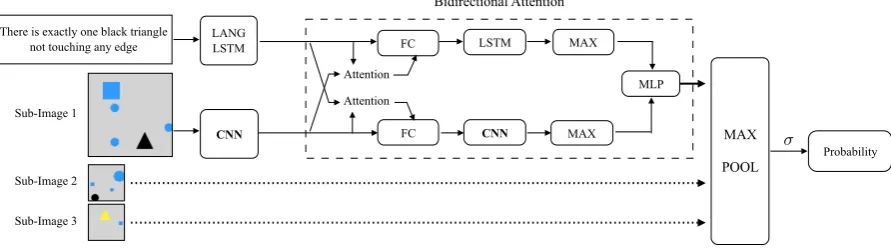
As shown in Fig. 4, we apply our BiATT model
to the raw image dataset with minimal modifica-tion. The visual input of the model for this task is changed from the unordered structured
repre-sentation set of objects o to the raw image
pix-elsI. Hence, we replace all object-related LSTMs
(e.g., the OBJ-LSTM and the LSTM-RNN in the
bidirectional attention in Fig. 2) with visual
There is exactly one black triangle not touching any edge
CNN
FC
Attention
LSTM
CNN
MAX
MAX
MLP Bidirectional Attention
MAX
POOL
Probability Attention
FC LANG
LSTM
Sub-Image 1
Sub-Image 2
[image:7.595.77.523.67.193.2]Sub-Image 3
Figure 4: Our CNN-BiATT model for the raw-image dataset version replaces every object-related LSTM-RNN with a spatial-filter convolutional neural network (CNN). The CNN for the raw image-pixels is a pretrained ResNet-v2-101. A 3-layers CNN with relu activation is used in the bidirectional attention.
The training datum for the NLVR raw-image
version consists of the statement s, the image I
and the ground truth label y. The image I
con-tains three sub-images x1, x2 and x3. We will
usexto indicate any sub-image. The superscript
which indicates the index of the sub-image is ig-nored to simplify the notation. The representation
of the statement{hi}is calculated by the
LANG-LSTM as before. For the image representation, we project the sub-image to a sequence of feature
vec-tors (i.e., the feature map){al :l= 1, . . . , L}
cor-responding to the different image locations. L =
m ×m is the size of the features and m is the
width and height of the feature map. The
projec-tion consists of ResNet-V2-101 (He et al.,2016)
and a following fully-connected (FC) layer. We only use the blocks in the ResNet before the aver-age pooling layer and the output of the ResNet is
a feature map of sizem×m×2048.
f1, . . . , fL= ResNet(x) (21) al= relu(Wxfl+bx) (22)
The joint-representation of the statement {ˆhi} is
the combination of the LANG-LSTM hidden
out-put states{hi}and the image-aware context
vec-tors{ci}:
αi,l= softmaxl(h|i B1al) (23)
ci=
X
l
αi,l·al (24)
ˆ
hi= relu (WLANG[hi;ci;hi−ci;hi◦ci]) (25)
The joint-representation of the image{aˆl}is
cal-culated in the same way:
βl,i= softmaxi a|l B2hi
(26)
dl=
X
i
βl,i·hi (27)
ˆ
al= relu (WIMG[al;dl;al−dl;al◦dl]) (28)
The joint-representation of the statement is further processed by a LSTM-RNN. Different from our BiATT model, a 3-layers CNN is used for
model-ing the joint-representation of the image{aˆl}. The
output of the CNN layer is another feature map
{¯al}. Each CNN layer has kernel size3×3 and
uses relu as the activation function, and then we finally use element-wise max operator similar to
Sec.3.1:
¯
h1,¯h2, . . . ,¯hT = LSTM(ˆh1,hˆ2, . . . ,ˆhT) (29)
¯
a1,a¯2, . . . ,a¯L’ = CNN(ˆa1,ˆa2, . . . ,ˆaL) (30)
¯
h= ele max
i
¯
hi (31)
¯
a= ele max
l {¯al} (32)
At last, we use the same method as our BiATT model to calculate the score and the loss function:
score(s, x) =W2 tanh W1[¯h; ¯a] +b1 (33)
P(s, I) =σ
max
j score(s, x j)
(34)
L(s, I, y) =−y logP(s, I)
−(1−y) log(1−P(s, I)) (35)
A.2 Reimplementation Details for Relationship Network and BiDAF Models
We reimplement a Relationship Network (
256 units per layer in the G-net and a three-layer MLP consisting of 256, 256 (with 0.3 dropout), and 1 units with ReLU nonlinearities for F-net.
We also reimplement a BiDAF model (Seo et al.,
2016) using 128-dimensional word embedding,
256-dimensional LSTM-RNN and 0.3 dropout rate. A max pooling layer on top of the model-ing layer of BiDAF is used to merge the hidden outputs to a single vector.
A.3 Experimental Setup and Training Details for Our BiATT-Pointer, BiENC, and CNN-BiATT Models
A.3.1 BiATT-Pointer
For preprocessing, we replace the words whose
occurrence is less than 3with the “UNK” token.
We create a9 dimension vector as the feature of
each object. This feature contains the location
(x, y)in 2D coordinate, the size of the object and
two 3-dimensional hot vectors for the shape and
the color. The(x, y) coordinates are normalized
to the range[−1,1].
For the model hyperparameters (all lightly tuned on dev set), the dimension of the word embedding is 128, and the number of units in an LSTM cell is 256. The word embedding is trained from scratch. The object feature is pro-jected to a 64-dimensional vector. The dimensions
of joint representationhˆiandˆgkare both 512. The
first fully-connected layer in calculating the sub-images score has 512 units. All the trainable vari-ables are initialized with the Xavier initializer. To regularize the training process, we add a dropout
rate0.3to the hidden output of the LSTM-RNNs
and before the last MLP layer which calculates the score for sub-images. We also clip the gradients by their norm to avoid gradient exploding. The losses are optimized by a single Adam optimizer and the learning rate is fixed at 1e-4.
For the pointer network, we sample the objects following the distribution of the objects at each de-coder step during training. In inference, we select the object with maximum probability. We use the
self-critical baseline (Rennie et al., 2016) to
sta-bilize the RL training, where the final score in in-ference (choosing object with maximum probabil-ity) is subtracted from the reward. To reduce the number of parameters, we share the weight of the fully-connected layer which projects the raw ob-ject feature to the high dimensional vector in the pointer encoder, the pointer decoder, and the
OBJ-LSTM. The pointer decoder attends to the hidden outputs of the LANG-LSTM using bilinear
atten-tion (Luong et al.,2015).
A.3.2 CNN-BiATT
We initialize our model with weights of the pub-lic pretrained ResNet-V2-101 (based on the Ima-geNet dataset) and freeze it during training. The ResNet projects the sub-image to a feature map of
10×10 ×2048. The feature map is normalized
to a mean of 0 and a standard deviation of 1 be-fore feeding into the FC layer. The fully connected layer after the ResNet has 512 units. Each layer of the 3-layers CNN in the bidirectional attention has
kernel size3×3with512filters and no padding.
A.3.3 BiENC