Using contextual information for automatic triage of posts in a
peer-support forum
Edgar Altszyler
Universidad de Buenos Aires, FCEyN, DC; CONICET-ICC; Fundaci´on Sadosky
Ariel J. Berenstein
Hospital de Ni˜nos Ricardo Gutierrez Traslational Bioinformatics Unit [email protected]
David Milne
School of Electrical and Information Engineering, The University of Sydney
Rafael A. Calvo
School of Electrical and Information Engineering, The University of Sydney [email protected]
Diego Fernandez Slezak
Universidad de Buenos Aires, FCEyN, DC; CONICET-ICC
Abstract
Mental health forums are online spaces where people can share their experiences anony-mously and get peer support. These forums, require the supervision of moderators to pro-vide support in delicate cases, such as posts expressing suicide ideation. The large increase in the number of forum users makes the task of the moderators unmanageable without the help of automatic triage systems. In the present pa-per, we present a Machine Learning approach for the triage of posts. Most approaches in the literature focus on the content of the posts, but only a few authors take advantage of fea-tures extracted from the context in which they appear. Our approach consists of the devel-opment and implementation of a large vari-ety of new features from both, the content and the context of posts, such as previous mes-sages, interaction with other users and au-thor’s history. Our method has competed in the CLPsych 2017 Shared Task, obtaining the first place for several of the subtasks. Moreover, we also found that models that take advantage of post context improve significantly its perfor-mance in the detection of flagged posts (posts that require moderators attention), as well as those that focus on post content outperforms in the detection of most urgent events.
1 Introduction
According to the World Health Organization (WHO), 20% of children and adolescents in the world have mental disorders or problems (WHO, 2014). Suicide ranks as the second leading cause of death in the 15-29 years old group and every 40 seconds a person dies by suicide in the world. The WHO pointed early identification and inter-vention as a key factor in ensuring that people re-ceive the care they need (WHO, 2014). Mental health problems have a strong impact on our soci-ety and require the use of new techniques for their study, prevention, and intervention.
In this context, text mining tools are emerg-ing as a powerful channel to study and detect the mental state of the writers (Calvo and Mac Kim, 2013;Bedi et al.,2015,2014;De Choudhury et al., 2013a,b;Coppersmith et al.,2015). In particular, there is a greater interest in the study and detec-tion of suicidal ideadetec-tion in texts coming from so-cial networks. In this line,Tong et al.(2014) and O’Dea et al.(2015) developed automatic detection systems to identify suicidal thoughts in tweets, and Homan et al. (2014) studied the network struc-ture of users with suicidal ideation in a forum. Furthermore, the CLPsych 2016 shared task pro-posed the triage of posts, based on urgency, from a peer-support mental health forum (for a more
haustive review see (Calvo et al., 2017)). In the present article, we build an automatic post triage system and compete in the CLPsych 2017 shared task (Milne et al., 2016). The automatic detec-tion of suicidal ideadetec-tion in social networks and forums provide a powerful tool to address early interventions in serious situations. Additionally, these techniques allow tracking the prevalence of different suicide risk factors among the population (Jashinsky et al.,2014;Fodeh et al.,2017), which provides valuable information that can be capital-ized for the design of prevention plans.
1.1 CLPsych 2017 Shared Task
The CLPsych 2017 shared task involves the triage of posts from an Australian mental health forum, Reachout.com, which provides a peer-support on-line space for adolescents and young adults. Rea-chout.comoffers a space to read about other peo-ples experiences and talk anonymously. Addition-ally, the forum has trained moderators who inter-vene in delicate situations, such as when a user is expressing suicidal ideation. There is an es-calation process to follow when forum members might be at risk of harm. As the number of fo-rum members increases the reading of all post be-come impossible, thus an automatic triage that ef-ficiently guides moderator’s attention to the most urgent posts result essential (Calvo et al., 2016). The CLPsych 2017 Shared Task consists of identi-fying each forum post with one of four triage lev-els: crisis, red, amber and green (in decreasing priority). A crisis label indicates that the author is in risk so moderators should prioritize this post above all others, while agreenlabel indicates that post does not require the attention of any modera-tor. SeeMilne et al.(2016) for a detailed descrip-tion of the annotadescrip-tion process and the ethical con-siderations.
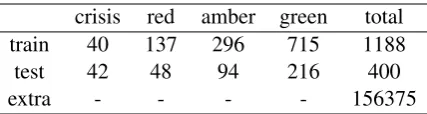
CLPsych 2017 Shared Task dataset consists of 157963 posts written between July 2012 and March 2017 (see Table 1). Among these posts, 1188 were labeled by 3 annotators in order to train the model (training set), and 400 were selected to form the testing set. Posts in the training set were written between April 2015 and June 2016 while posts in the test set were written between August 2016 and March 2017.
Fifteen teams took part in CLPsych 2017 shared task, with unlimited submissions per group. Each post of the dataset contains the text of the subject
crisis red amber green total
train 40 137 296 715 1188
test 42 48 94 216 400
[image:2.595.310.524.61.118.2]extra - - - - 156375
Table 1: Training dataset and extra unlabeled dataset statistics. Crisis, red, amber and green, are the four triage levels and reflects a decreasing priority of re-quired moderator intervention/response. We had access to the test dataset only after the competition have fin-ished
and the body, structured in XML format. Addi-tional metadata is also provided, such as boards, thread, post time, or if the post was written by a moderator or not. The official metrics of the task are:
• Macro-averaged f-score: the average f1-score amongcrisis,redandamberlabels.
• F-score for flagged vs. non-flagged: the av-erage f1-score among flagged (crisis+red+ amber) and non-flagged (green) labels. This is considered considered by the task organiz-ers as the most important metric, given that it measures the system’s capability to identify post that need moderators attention.
• F-score for urgent vs. non-urgent: the aver-age f1-score among urgent (crisis+red) and non-urgent (amber+green) labels.
The official measures are the f-scores, as accu-racy is known to be less sensitive to misclassifi-cation of elements in the minority class in highly unbalanced datasets. In this paper, we also ana-lyze the f-score for crisis vs. non-crisis, which measures the system’s capability to identify the most serious cases. This competition is a new version of the CLPsych 2016 Shared Task (Milne et al.,2016), which has the same goal but counts with a smaller dataset. The different approaches used in 2016 competition involved a huge variety of features, such as N-grams, lexicon-based fea-tures, word embeddings, and metadata. Most of the models extracted features from the content of posts, but only a few authors took advantage of features extracted from the context of the posts, such as n-grams of previous posts of the thread, or previous author’s posts (Malmasi et al., 2016; Cohan et al.,2016;Pink et al.,2016).
posts and the context in which the posts occur, such as: (1) authors’ history, (2) adjacent posts, and (3) the authors’ interaction network. We hy-pothesize that the contextual features will be use-ful to capture new elements that allow building a better profile of the author of the posts. This idea is grounded in Van Orden et al. (2010) observa-tion that suicidal behavior tends to persist over the lifetime, and also De Choudhury et al. (2013b), Homan et al. (2014) studies in which they show that interaction patterns have valuable information about the underlying mental state of the users.
2 Method
To triage posts we apply a supervised classification-based approach. In the present section, we describe the texts preprocessing step, the features that were used, the feature transformation process and the classification method.
First, we preprocessed the body of the post: we removed HTML format and eliminated quotes (HTML quotes tags), we converted ReachOut links, other webpage links, author mentions, and forum’s emoticons to tokens such as #rea-chout link, #ref link, #reference, #SmileyHappy respectively. Then we transformed the text to lowercase and word-tokenized it with the hap-pierfuntokenizing.py (World Well-Being Project, 2017), which can handle most common emoti-cons.
We extracted a total of 2799 features from each post. We organized features in seven main cat-egories, four of them are content based features: (Word2vec - N-grams - Metadata - Body), and the remaining are context-based ones (Interaction fea-tures - Adjacent feafea-tures - Author feafea-tures).
After the feature extraction process, a Z-score transformation was applied to all features, with the exception of n-grams features in which we per-formed a TF-IDF weighting. Then, missing values were filled with the mean value of those features in the unlabeled dataset.
Following we present a brief description of each category (see Table 2 for features statistics). In this section, we will use parenthesis to show the number of features.
Given the large number of features, in some cat-egories we built subsets of features, in which we selected the features that we considered the most
relevant in each case (see Supplemental Material A.1 for a detailed description of each subset).
Feature Type Complete Subset
Word2vec content 50
-N-grams content 2274 50
Metadata content 23 7
Body content 68 23
Interaction context 155 57
Adjacent context 152 100
Author’s context 77 50
Total both 2799
-Table 2: Features statistics. For each feature category, we show the type, the number of extracted features (noted as complete), and the number of selected fea-tures in its subset (Noted as Subset)
2.1 Word2vec representation (50 features) We used all post bodies in the unlabeled dataset to train a Skip-gram model (Mikolov et al., 2013a) of 50 dimensions. We discarded infrequent to-kens, with less than 5 repetitions and very fre-quent tokens, with a frequency higher than10−3. We set the window size and negative sampling to 15 (which were found to be maximal in two se-mantic tasks over TASA corpus (Altszyler et al., 2017)). Word2vec semantic representations were generated with the Gensim Python library ( Re-huek and Sojka,2010). After the training, the re-sulting Word2vec post’s features were computed as the average of all word-embeddings in the post.
2.2 N-grams (2274 features)
We extracted unigrams and bigrams from all body posts, and kept the 3000 most frequent N-grams in the training corpus (following (Brew, 2016)) and applied a TF-IDF transformation. As the train-ing and test sets contain posts from different time periods, the language patterns may have changed during this time lapse. In order to eliminate most different N-grams, we have excluded all N-grams with a frequency lower than 5.10−5 in the posts form unlabeled dataset in the period Aug 2016 -Mar 2017 (726 N-grams where eliminated in this way).
2.3 Metadata features (23 features)
board (5), whether the author is a moderator or not (1), whether the author created the thread (1) and time since the last edition (1). Additionally, We subdivided the day in 8 timeslots of 3 hours, and create post timefeatures, consisting of 8 dummy variables to identify the timeslot of the post (8).
2.4 Body content features (68 features) These features aim to characterize the emotional and psychological state of the author of the post. We employed several well-established lexicons, such as Emolex (Mohammad and Turney, 2010) (10), Hedonometer (Dodds et al.,2011)(1), DAL (Whissell,1989) (3), Warriner’s Norms (Warriner et al., 2013) (3), Age of Adquisition (Kuperman et al.,2012)(1), Bristol familiarity and imaginary norms (Stadthagen-Gonzalez and Davis, 2006) (2), and WWBP lexicons (Schwartz et al., 2016, 2013;World Well-Being Project,2017) which in-cludes: PERMA (10), OCEAN (5), time-oriented (3) and affect-intensity lexicons (2). We also used MentalDisLex (Zirikly et al.,2016) (1), profanity word-list (Smedt and Daelemans, 2012) (1), Von Ahn offensive lexicon (Von Ahn, 2016) (1), sub-jectivity and sentiment analysis (Smedt and Daele-mans,2012) (2), fraction of first person singular and second person pronouns (2), determiners (1), word counts (1), mean word length (1), number of webpage links (1), lexical diversity (1)(mean frac-tion of different words among 100 random sub-samples of 10 words) and the fraction of words semantically similar to several keywords1(8). The semantic similarity was measure with word2vec pre-trained vectors (Mikolov et al.,2013b) and the threshold to identify a word as similar was set to 0.3.
We also included categorical features, such as predefined forum emoticons (4), references to helplines2(1), references to advisors3(1) and self-harm expressions were present or not 4 (2). We
1Word2vec keywords: depression, suicide, fear,
men-tal health, suicidal ideation, antidepressant, hopelessness and anxiety
2helplines keywords: kidshelpline, eheadspace, helpline,
kidshelp, khl, counselling, headspace, helplines, mensline, www.eheadspace.org, 1800respect, beyondblue, lifeline, callback, lifeline’s, scbs, catt, triage, suicideline
3advisors keywords: supervisor, supervisors, mentor,
manager, tutor, manager, casemanager, managers, manager’s, psych, pysch, psychiatrist, gp, gp’s, counsellor, counsellor, counselor
4Self-harm regular expressions: “suicid\w∗”,“kill\w∗ myself”, “kill\w∗my self”, “cut\w∗myself”, “cut\w∗my self”, “hurt\w∗myself”, “hurt\w∗my self”, “harm\w∗ my-self”, “harm\w∗my self”, “I want\w∗to die” , “I don’t want
only take into account self-harm expressions in which only appears first-person pronouns and did not appears negations in a window of 15 or 50 words around the regexp.
Missing values in lexicon-based features which have a neutral value were filled by the neutral value (for example in DAL, pleasantness range from 1 (unpleasant) to 3 (pleasant), thus we re-placed missing values with 2). All features show-ing lack of variability (std = 0) in our trainshow-ing set were removed.
2.5 Interaction features (155 features)
We believe that the interaction patterns between users hold valuable information about the under-lying intention and emotions of the posts. To this end, we built a directed mention graph where a node (post),nihas an incoming edge fromnjifnj
has mentioned thenipost author within a 10 post
temporal windows, or an outgoing edge ifni has
mentionednj author in the same period. First, we
take advantage of this network to extract seven ba-sic network structural features such as: in/out de-gree, number of in/out edge from different authors, number of loops, number of post from the author in the window, out degree of the author mentioned in the post.
Then, we define on this graph node attributes based on some set ofBodyandWord2Vecfeatures, namelyfa. After that, for the k-th node (post) in
our network, we define a new set of interaction-based featuresF inta, by averaging the featurefa
across the neighborhood of the post (N ei). It is:
F inta:= 1
|N ei| X
k∈N ei
fa (1)
74 features were extracted from incoming edges and 74 from outgoing edges. The extracted fea-tures consist on, Word2vec (50), WWBP lexicons (20), Hedonometer (1), pronouns (2) and seman-tic coherence (1), which is measured as the cosine similarity between the word2vec embedding of the node and the central post.
which count outgoing edges were filled by−1and missing values inF intafeatures were filled with
the mean value of the feature ain the unlabeled dataset.
2.6 Adjacent features (152)
For each post, we extract 76 features from the previous post in the same thread and 76 features from the previous post produced by the same au-thor in the thread. The extracted features consist on: Word2vec (50), WWBP lexicons (20), Hedo-nometer (1), pronouns (2) semantic coherence be-tween the post and the previous post (1), post day of the previous post (1), time between posts (1).
2.7 Authors’ features (77 features)
We replicated and extended Shickel et al’s (Shickel and Rashidi, 2016) idea of deriving at-tributes from the history of the authors. For each post, we computed the mean value of several fea-tures for all the previous posts written by the same author. These features provide a baseline for the authors, which may allow the machine learning al-gorithm to identify when a post differs from the typical behavior of its author. The extracted fea-tures consist on, Word2vec (50), WWBP lexicons (20), Hedonometer (1), pronouns (2), post day (1) Additionally, we added other features to idtify more general authors behavior, such as, en-tropy in thread and board participation (2) and me-dian time between posts measured in log-scale, log(#minutes+ 1)(1).
2.8 Models
We used Support Vector Machine classifiers (SVM) with linear kernels and Radial Basis Func-tion (RBF) kernels. Each model was trained on different combinations of features, and the hy-perparameter C was selected with a grid search scheme for each model. In the grid search, the performance metric was the macro f-score with a 10-fold Cross-Validation (CV). The C hyper-parameters were varied among {0.1, 0.2, 0.5, 1, 2, 5, 10, 20, 50, 100} for the SVM-RBF mod-els and among {0.0001, 0.0002, 0.0005, 0.001, 0.002, 0.005, 0.01, 0.02, 0.05, 0.1}for the SVM-linear models. As the training dataset is highly imbalanced, both SVM models were trained with class weights inversely proportional to class fre-quencies in the training dataset. We also tested XGBoost and Random Forest models which un-derperformed the SVM models, and a feature
se-lection process which did not produce significant performance improvements in the SVM RBF and SVM linear models (see Supplemental Material A.3). All the models were implemented in python with Sklearn or XGBoost packages, and all other parameters, not included in the grid search, were set to their default values.
We have built nine collections of features com-posed of different categories and features subsets (for a full description of the collections see Sup-plementary Materials A.2). With this features col-lections, we trained 18 SVM models, half with an RBF kernel and half with a linear kernel. Ad-ditionally, we implemented four ensemble mod-els composed by SVM’s combined with a ma-jority voting method. We used ensembles with four and seven SVMs with RBF and linear kernels and the differences within the voting SVM’s are their training features (see Supplementary Materi-als A.4 for a full description of the voting SVM’s features). In case of a tie between classes, the post is classified as the most urgent class.
3 Results
Table 3 shows the top performing models of the CLPsych 2017 challenge divided by metric, in which only the best model of each team is showed. We have obtained the2nd positionin the Macro-averaged f-score with an ensemble of 4 SVM-linear models, the 1st position in the flagged vs non-flaggedf-score with an ensemble of 7 SVM-RBF models, the 1st position in the urgent vs non-urgentf-score with a SVM-RBF trained with Word2vec + N-grams + subset of body features, and the1st positionincrisis vs non-crisisf-score with a SVM-RBF trained with Word2vec + N-grams + subset of metadata features.
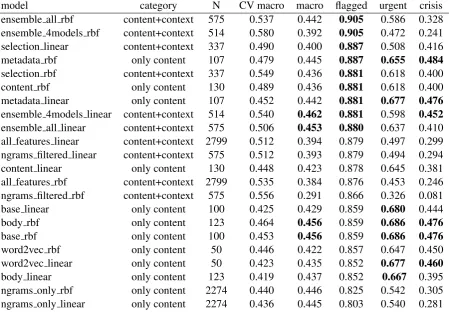
In Table4we show our model’s results ordered by the performance in the flagged vs non-flagged metric, which is considered by the organizers as the most relevant metric, as it measures the sys-tem’s capability to identify posts that need moder-ators attention.
It is worth noting that there is not a univer-sal best model, however, our approach obtains very good results in all performance measures. In particular, our models tend to outperforms other team’s models in the flagged vs non-flagged f-scores, where nine of the top ten models are from our team (see bold scores in Table4).
advan-metric pos team model f-score macro averaged
f-score
1st Xia and Liu voteing submission 0.467 2nd Our team ensemble 4models linear 0.462
3rd Nair et al. Run23 0.461
flagged vs non-flagged
1st Our team ensemble all rbf 0.905 2nd Yates et al. mpid5 cl17out 20 v3 0.883
3rd French et al. 15 0.877
urgent vs non-urgent
1st Our team body rbf 0.686
2nd Yates et al. 53 0.673
3rd French et al. C13/SH2 0.624
crisis vs non-crisis
1st Our team metadata rbf 0.484
2nd Xia and Liu jxufe-lda-svm 0.480
3rd Nair et al. Run23 0.468
Table 3: Official results for the CLPsych 2017 shared task. We also show the f-scores forcrisisvs. non-crisis, which measures the system’s capability to identify the most serious cases. Flagged refers tocrisis + red + amber, while urgent tocrisis + red. For each metric, only the best model of each team is showed
model category N CV macro macro flagged urgent crisis
ensemble all rbf content+context 575 0.537 0.442 0.905 0.586 0.328
ensemble 4models rbf content+context 514 0.580 0.392 0.905 0.472 0.241
selection linear content+context 337 0.490 0.400 0.887 0.508 0.416
metadata rbf only content 107 0.479 0.445 0.887 0.655 0.484
selection rbf content+context 337 0.549 0.436 0.881 0.618 0.400
content rbf only content 130 0.489 0.436 0.881 0.618 0.400
metadata linear only content 107 0.452 0.442 0.881 0.677 0.476
ensemble 4models linear content+context 514 0.540 0.462 0.881 0.598 0.452
ensemble all linear content+context 575 0.506 0.453 0.880 0.637 0.410
all features linear content+context 2799 0.512 0.394 0.879 0.497 0.299
ngrams filtered linear content+context 575 0.512 0.393 0.879 0.494 0.294
content linear only content 130 0.448 0.423 0.878 0.645 0.381
all features rbf content+context 2799 0.535 0.384 0.876 0.453 0.246
ngrams filtered rbf content+context 575 0.556 0.291 0.866 0.326 0.081
base linear only content 100 0.425 0.429 0.859 0.680 0.444
body rbf only content 123 0.464 0.456 0.859 0.686 0.476
base rbf only content 100 0.453 0.456 0.859 0.686 0.476
word2vec rbf only content 50 0.446 0.422 0.857 0.647 0.450
word2vec linear only content 50 0.423 0.435 0.852 0.677 0.460
body linear only content 123 0.419 0.437 0.852 0.667 0.395
ngrams only rbf only content 2274 0.440 0.446 0.825 0.542 0.305
[image:6.595.128.470.62.242.2]ngrams only linear only content 2274 0.436 0.445 0.803 0.540 0.281
Table 4: Our models’ scores, ordered by the performance in the flagged vs non-flagged metric. We show in bold the scores of the models that are within the top ten among the 251 models that have participated in the shared task
tage of contextual features tend to obtain better flagged vs non-flagged f-scores (p-value= 4.09E-09, Wilcoxon rank sum test). Amber class in-cludes posts where the author is following up on their own previousredorcrisispost (Milne et al., 2016), thus, the inclusion of contextual features is essential to capture these situations. On the
[image:6.595.77.527.297.610.2]corre-lation between the number of features (columnN in Table4) and the differences in f-scores between the Cross-Validation and the test set (columnCV macro- columnmacroin Table4), Spearman cor-relation of 0.523 with a p-value=0.012. Also, this effect may explain the good performance obtained by less complex models, such as the SVM-linear trained with only 50 word2vec features. Further-more, it can be seen that models that use only con-tent features tend to obtain better results inurgent vs non-urgentandcrisis vs non-crisismetrics (p-value= 4.17E-09 and p-(p-value= 4.15E-09 respec-tively, Wilcoxon rank sum test).
We propose that training with a greater amount of data with more users diversity will avoid this overfitting, thus boosting the performance of the models that use more number of features.
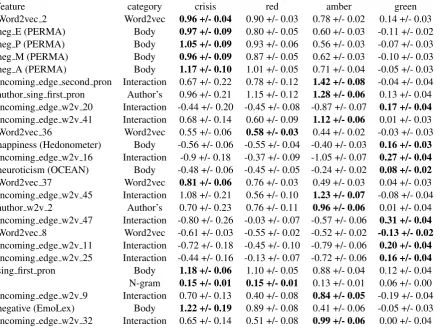
Finally, we extract the 25 most relevant features given by the random forest importance measure when it is trained with the training dataset and all the 2799 features (see Table 5). Within the most important features, 10 came from theInteraction category, 8 from the Body, 4 from Word2vec, 2 fromauthor’sand 1 fromN-grams.
Furthermore, Table 5 shows that crisis posts tend to exhibit more negative PERMA elements, negative sentiment, first person reference and less happiness than non-crisis posts (p-value¡0.5e-6 in each comparison with a Wilcoxon rank sum test). Depict Word2vec dimensions have not a straightforward interpretation, it can be seen that there is no shared Word2vec components within the relevant interaction features and the selected Word2vec features extracted from posts text. These results show that content of severe posts and their interacting posts provide different features which result useful in the post triaging task.
4 Conclusion
Mental health forums, such as ReachOut.com, are online spaces where users can share their experi-ences and get peer support. The large increase in the number of users makes the task of the modera-tors considerably difficult. This ends in the loss of critical messages that would require immediate at-tention. In this context, an automatic triaging sys-tem is a valuable tool to guide moderators effort.
In the present paper, we present a machine learning approach for the automatic triage of posts from ReachOut.com forum. Our models
partici-pated in the CLPsych 2017 Shared Task compe-tition, obtaining very good results along with all official metrics.
The CLPsych 2017 Shared Task is the second part of the 2016 edition, but with more training data and a more balanced test set. Most of ap-proaches used in CLPsych 2016 Shared Task ex-tract features from the content of the posts, but only a few took advantage of features extracted from the posts context. In the present paper we fo-cused on the development and implementation of a large variety of new features from both, the con-tent and the context of posts. The concon-tent-based features consist on N-grams, Word2vec, metadata and other features from the body of the posts, while the context-based features extract attributes from the content and structure of the user history, other post in the conversation and the interaction network.
Our implementation obtained the first position on several official metrics. In particular, we ob-tained the best performance in the flagged vs non-flagged measure, which tests the system’s capa-bility to identify posts that require attention from moderators.
We found that exploitation of contextual fea-tures tend to improve the detection of posts that re-quire attention from moderator. On the other hand, complex models with many features may learn the particularities and details of the authors present in the training set, thus decreasing the predictive ca-pability in posts from authors never seen before. To avoid this overfitting effect we propose to feed the models with a greater amount of training data with more diversity of users. This can be easily solved with the use of online classifiers (Bordes et al.,2005;Calvo et al.,2016), in which the model can continuously learn from the manual classifica-tions made by the moderators, ensuring that the system is kept up-to-date.
feature category crisis red amber green
Word2vec 2 Word2vec 0.96 +/- 0.04 0.90 +/- 0.03 0.78 +/- 0.02 0.14 +/- 0.03
neg E (PERMA) Body 0.97 +/- 0.09 0.80 +/- 0.05 0.60 +/- 0.03 -0.11 +/- 0.02
neg P (PERMA) Body 1.05 +/- 0.09 0.93 +/- 0.06 0.56 +/- 0.03 -0.07 +/- 0.03
neg M (PERMA) Body 0.96 +/- 0.09 0.87 +/- 0.05 0.62 +/- 0.03 -0.10 +/- 0.03
neg A (PERMA) Body 1.17 +/- 0.10 1.01 +/- 0.05 0.71 +/- 0.04 -0.05 +/- 0.03
incoming edge second pron Interaction 0.67 +/- 0.22 0.78 +/- 0.12 1.42 +/- 0.08 -0.04 +/- 0.04
author sing first pron Author’s 0.96 +/- 0.21 1.15 +/- 0.12 1.28 +/- 0.06 0.13 +/- 0.04
incoming edge w2v 20 Interaction -0.44 +/- 0.20 -0.45 +/- 0.08 -0.87 +/- 0.07 0.17 +/- 0.04
incoming edge w2v 41 Interaction 0.68 +/- 0.14 0.60 +/- 0.09 1.12 +/- 0.06 0.01 +/- 0.03
Word2vec 36 Word2vec 0.55 +/- 0.06 0.58 +/- 0.03 0.44 +/- 0.02 -0.03 +/- 0.03
happiness (Hedonometer) Body -0.56 +/- 0.06 -0.55 +/- 0.04 -0.40 +/- 0.03 0.16 +/- 0.03
incoming edge w2v 16 Interaction -0.9 +/- 0.18 -0.37 +/- 0.09 -1.05 +/- 0.07 0.27 +/- 0.04
neuroticism (OCEAN) Body -0.48 +/- 0.06 -0.45 +/- 0.05 -0.24 +/- 0.02 0.08 +/- 0.02
Word2vec 37 Word2vec 0.81 +/- 0.06 0.76 +/- 0.03 0.49 +/- 0.03 0.04 +/- 0.03
incoming edge w2v 45 Interaction 1.08 +/- 0.21 0.56 +/- 0.10 1.23 +/- 0.07 -0.08 +/- 0.04
author w2v 2 Author’s 0.70 +/- 0.23 0.76 +/- 0.11 0.96 +/- 0.06 0.01 +/- 0.04
incoming edge w2v 47 Interaction -0.80 +/- 0.26 -0.03 +/- 0.07 -0.57 +/- 0.06 0.31 +/- 0.04
Word2vec 8 Word2vec -0.61 +/- 0.03 -0.55 +/- 0.02 -0.52 +/- 0.02 -0.13 +/- 0.02
incoming edge w2v 11 Interaction -0.72 +/- 0.18 -0.45 +/- 0.10 -0.79 +/- 0.06 0.20 +/- 0.04
incoming edge w2v 25 Interaction -0.44 +/- 0.16 -0.13 +/- 0.07 -0.72 +/- 0.06 0.16 +/- 0.04
sing first pron Body 1.18 +/- 0.06 1.10 +/- 0.05 0.88 +/- 0.04 0.12 +/- 0.04
i N-gram 0.15 +/- 0.01 0.15 +/- 0.01 0.13 +/- 0.01 0.06 +/- 0.00
incoming edge w2v 9 Interaction 0.70 +/- 0.13 0.40 +/- 0.08 0.84 +/- 0.05 -0.19 +/- 0.04
negative (EmoLex) Body 1.22 +/- 0.19 0.89 +/- 0.08 0.41 +/- 0.06 -0.05 +/- 0.03
[image:8.595.83.524.62.392.2]incoming edge w2v 32 Interaction 0.65 +/- 0.14 0.51 +/- 0.08 0.99 +/- 0.06 0.00 +/- 0.04
Table 5: Statistics of the 25 most relevant features for the triage task, ordered by the random forest importance measure when it is trained with all features. The numbers are showing the mean value and the standard deviation of the mean for each feature in each triage level. For each feature, we have highlighted in bold the highest mean value among the different groups. Sing first pron refers to the fraction of words that are first-person pronouns, such as I, me, myself,etc.
References
Edgar Altszyler, Sidarta Ribeiro, Mariano Sigman, and Diego Fern´andez Slezak. 2017. The interpretation of dream meaning: Resolving ambiguity using latent semantic analysis in a small corpus of text. Con-sciousness and Cognition.
Gillinder Bedi, Facundo Carrillo, Guillermo A Cec-chi, Diego Fern´andez Slezak, Mariano Sigman, Nat´alia B Mota, Sidarta Ribeiro, Daniel C Javitt, Mauro Copelli, and Cheryl M Corcoran. 2015. Automated analysis of free speech predicts psy-chosis onset in high-risk youths. npj Schizophrenia
1:15030.
Gillinder Bedi, Guillermo A Cecchi, Diego F Slezak, Facundo Carrillo, Mariano Sigman, and Harriet De Wit. 2014. A window into the intoxicated mind? speech as an index of psychoactive drug effects.
Neuropsychopharmacology39(10):2340–2348.
Antoine Bordes, Seyda Ertekin, Jason Weston, and L´eon Bottou. 2005. Fast kernel classifiers with on-line and active learning. Journal of Machine Learn-ing Research6(Sep):1579–1619.
Chris Brew. 2016. Classifying reachout posts with a radial basis function svm. Proceedings of the Third Workshop on Computational Linguistics and Clini-cal Psychology: From Linguistic Signal to CliniClini-cal Reality.
Rafael A Calvo, M Sazzad Hussain, David Milne, Kjar-tan Nordbo, Ian Hickie, and P Danckwerts. 2016. Augmenting online mental health support services.
Integrating Technology in Positive Psychology Prac-ticepage 82.
Rafael A Calvo and Sunghwan Mac Kim. 2013. Emo-tions in text: dimensional and categorical models.
Computational Intelligence29(3):527–543.
Rafael A Calvo, David N Milne, M Sazzad Hussain, and Helen Christensen. 2017. Natural language processing in mental health applications using non-clinical texts. Natural Language Engineeringpages 1–37.
Signal to Clinical Reality, San Diego, California, USA, June. volume 16.
Glen Coppersmith, Mark Dredze, Craig Harman, Kristy Hollingshead, and Margaret Mitchell. 2015. Clpsych 2015 shared task: Depression and ptsd on twitter. In Proceedings of the 2nd Workshop on Computational Linguistics and Clinical Psychology: From Linguistic Signal to Clinical Reality. pages 31–39.
Munmun De Choudhury, Scott Counts, and Eric Horvitz. 2013a. Social media as a measurement tool of depression in populations. InProceedings of the 5th Annual ACM Web Science Conference. ACM, pages 47–56.
Munmun De Choudhury, Michael Gamon, Scott Counts, and Eric Horvitz. 2013b. Predicting depres-sion via social media. InICWSM. page 2.
Peter Sheridan Dodds, Kameron Decker Harris, Is-abel M Kloumann, Catherine A Bliss, and Christo-pher M Danforth. 2011. Temporal patterns of hap-piness and information in a global social network: Hedonometrics and twitter. PloS one6(12):e26752.
Samah Fodeh, Joseph Goulet, Cynthia Brandt, and Al-Talib Hamada. 2017. Leveraging twitter to better identify suicide risk. In Medical Informatics and Healthcare. pages 1–7.
Christopher M Homan, Naiji Lu, Xin Tu, Megan C Lytle, and Vincent Silenzio. 2014. Social structure and depression in trevorspace. InProceedings of the 17th ACM conference on Computer supported coop-erative work & social computing. ACM, pages 615– 625.
Jared Jashinsky, Scott H Burton, Carl L Hanson, Josh West, Christophe Giraud-Carrier, Michael D Barnes, and Trenton Argyle. 2014. Tracking suicide risk fac-tors through twitter in the us.Crisis.
Victor Kuperman, Hans Stadthagen-Gonzalez, and Marc Brysbaert. 2012. Age-of-acquisition ratings for 30,000 english words. Behavior Research Meth-ods44(4):978–990.
Shervin Malmasi, Marcos Zampieri, and Mark Dras. 2016. Predicting post severity in mental health forums. Proceedings of the Third Workshop on Computational Linguistics and Clinical Psychology: From Linguistic Signal to Clinical Reality.
Tomas Mikolov, Greg Corrado, Kai Chen, and Jeffrey Dean. 2013a. Efficient Estimation of Word Repre-sentations in Vector Space. Proceedings of the Inter-national Conference on Learning Representations (ICLR 2013)http://arxiv.org/pdf/1301. 3781v3.pdf.
Tomas Mikolov, Greg Corrado, Kai Chen, and Jeffrey Dean. 2013b. Pre-trained word2vec representation.
https://code.google.com/archive/p/word2vec/.
David N Milne, Glen Pink, Ben Hachey, and Rafael A Calvo. 2016. Clpsych 2016 shared task: Triaging content in online peer-support forums .
Saif M Mohammad and Peter D Turney. 2010. Emo-tions evoked by common words and phrases: Us-ing mechanical turk to create an emotion lexicon. In Proceedings of the NAACL HLT 2010 workshop on computational approaches to analysis and gen-eration of emotion in text. Association for Computa-tional Linguistics, pages 26–34.
Bridianne O’Dea, Stephen Wan, Philip J Batterham, Alison L Calear, Cecile Paris, and Helen Chris-tensen. 2015. Detecting suicidality on twitter. In-ternet Interventions2(2):183–188.
Glen Pink, Will Radford, and Ben Hachey. 2016. Clas-sification of mental health forum posts.Proceedings of the Third Workshop on Computational Linguistics and Clinical Psychology: From Linguistic Signal to Clinical Reality.
Radim Rehuek and Petr Sojka. 2010. Software Frame-work for Topic Modelling with Large Corpora. In
Proceedings of the LREC 2010 Workshop on New Challenges for NLP Frameworks. ELRA, Valletta, Malta, pages 45–50.
H Andrew Schwartz, Johannes C Eichstaedt, Mar-garet L Kern, Lukasz Dziurzynski, Stephanie M Ra-mones, Megha Agrawal, Achal Shah, Michal Kosin-ski, David Stillwell, Martin EP Seligman, et al. 2013. Personality, gender, and age in the language of social media: The open-vocabulary approach.
PloS one8(9):e73791.
HA Schwartz, Sap M, ML Kern, Eichstaedt JC, A Kapelner, Agrawal M., E Blanco, L Dziurzyn-ski, G Park, D Stillwell, M KosinDziurzyn-ski, M Seligman, and Ungar LH. 2016. Predicting individual well-being through the language of social media pages 516–527.
Benjamin Shickel and Parisa Rashidi. 2016. Automatic triage of mental health forum posts. Proceedings of the Third Workshop on Computational Linguistics and Clinical Psychology: From Linguistic Signal to Clinical Reality.
Tom De Smedt and Walter Daelemans. 2012. Pattern for python. Journal of Machine Learning Research
13(Jun):2063–2067.
Hans Stadthagen-Gonzalez and Colin J. Davis. 2006.
The bristol norms for age of acquisition, image-ability, and familiarity. Behavior Research Meth-ods 38(4):598–605. https://doi.org/10. 3758/BF03193891.
Kimberly A Van Orden, Tracy K Witte, Kelly C Cukrowicz, Scott R Braithwaite, Edward A Selby, and Thomas E Joiner Jr. 2010. The interpersonal theory of suicide. Psychological review117(2):575.
Luis Von Ahn. 2016. web-page: http://www.cs. cmu.edu/˜biglou/resources/. Accessed: September 2016.
Amy Beth Warriner, Victor Kuperman, and Marc Brys-baert. 2013. Norms of valence, arousal, and dom-inance for 13,915 english lemmas. Behavior re-search methods45(4):1191–1207.
Cynthia Whissell. 1989. The dictionary of affect in lan-guage. Emotion: Theory, research, and experience
4(113-131):94.
WHO. 2014. Preventing suicide: a global imperative. World Health Organization.
WWBP World Well-Being Project. 2017. web-page: http://www.wwbp.org/data.html. Ac-cessed: September 2017.
A Supplemental Material
A.1 Features subsets
We build subsets of features, in which we selected the ones that we consider the most relevant in each category:
• Subsets of body features (23): self-harm regular expression (1), MentalDisLex (1), advisor and helplines keywords (2), nega-tive PERMA features (5), neuroticism from OCEAN (1), affect lexicon from WWBP (1), pronouns (2), Hedonometer (1), negative lex-icon from EmoLex (1) and word2vec seman-tic similarity to keywords (8).
• Subsets of metadata features (7):A selection of 5 boards (ToughTimes Hosted chats, Everyday life stuff, Intros, Some-thing Not Right, Getting Help), whether the author is a moderator or not (1), and whether the author created the thread (1).
• Subsets of interaction features (57): num-ber of in/out edges from different authors (2), number of loops (1), number of authors post in the window (1), out degree of the author mentioned in the post (1), mean pronouns from incoming edges (2) and mean word2vec from incoming edges (50).
• The subsets of author and adjacent fea-tures(50 and 100 features respectively) con-sist of the subsets of features that consider Word2vec representations.
• Subsets of N-grams (50): We performed a random forest feature importance procedure over word2vec and N-grams, in which we kept the 100 most relevant features. The se-lected features consist of all the 50 Word2vec features and 50 N-grams, thus this procedure led us only to a discarding of N-grams.
A.2 Features collections
Starting from the set of all the features, we pro-gressively discarded some of them, thus gener-ating nine collections of features of decreasing quantity. Each collection was used to train SVM-linear and SVM-RBF models, resulting in 18 of our 22 models (the other four are ensembles).
The collections are:
• all features (2799): all 2799 features
• ngrams only (2274): the complete set of 2274 N-grams
• ngrams filtered (575): all features but using the subset of N-grams instead of the complete set
• selection (337): Word2vec + N-grams sub-set + metadata subsub-set + body subsub-set + author subset + adjacent subset + interaction subset
• content (130): Word2vec + N-grams subset + metadata subset + body subset
• metadata (107): Word2vec + N-grams subset + metadata subset
• body (123): Word2vec + N-grams subset + body subset
• base (100): Word2vec + N-grams subset
• word2vec (50): Word2vec
A.3 Models comparison
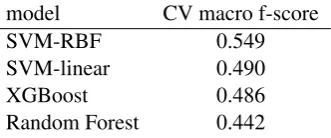
In table6we compare the macro f-scores of differ-ent models in a 10-fold cross-validation scheme with the training set and the 337 features of the selection collection (described in section A.2). The models were implemented with sklearn or xgboost python packages. For each model, a grid search was applied to select the best pa-rameters. For the SVM-RBF model the hyper-parameter C was varied among {0.1, 0.2, 0.5, 1, 2, 5, 10, 20, 50, 100}, for the SVM-linear among {0.0001, 0.0002, 0.0005, 0.001, 0.002, 0.005, 0.01, 0.02, 0.05, 0.1}, for the XGBoost the max depth was varied among [2, 4, 6, 8] and the learning rate among [0.001, 0.01, 0.1, 0.3] and for the Random Forest the max features was var-ied among [10,20,40,60,80,100,120,140,160,200]. All other parameters were set to their default val-ues. Among the models, the SVM classifiers out-performed the tree-based models. Given the large
model CV macro f-score
SVM-RBF 0.549
SVM-linear 0.490
XGBoost 0.486
[image:11.595.335.501.630.699.2]Random Forest 0.442
Table 6: Macro f-scores of different models in a 10-fold cross-validation scheme with the training set and the 337 features of theselectioncollection.
selection stage using the importance measure of a random forest classifier. In the grid search, not only the parameter C was varied but also the number of selected features, taking values among [50,100,150,200,250,300]. The best SVM RBF model obtained f-score=0.518 with the selection of the best 300 features, while the SVM linear model obtained f-score=0.514 with the selection of the best 250 features. Since the feature selection process did not produce significant performance improvements, it was not included in the contest models.
A.4 Ensemble models
We implemented four ensemble models com-posed by SVM’s combined with a majority voting method.
The features sets of the voting models which compose the ensembles architectures are:
1. X = Word2vec + body subset + metadata sub-set (80)
2. X + N-grams subset (130)
3. Word2vec + metadata + body (141)
4. X + interaction (235)
5. X + adjacent (232)
6. X + author (157)
7. X + N-grams subset + author subset + adja-cent subset + interaction subset (337)
We used two different structures of ensemble:
• ensemble all: in which, each of the 7 features sets are used to train a SVM
• ensemble 4models: in which, only features sets 4, 5, 6 and 7 are used to train a SVM. These features sets are selected because are the ones that produce the best macro f-score in the Cross-Validation (data not showed).