Transition-Based Syntactic Linearization
Yijia Liu†‡, Yue Zhang†, Wanxiang Che‡, Bing Qin‡ †Singapore University of Technology and Design
‡Research Center for Social Computing and Information Retrieval Harbin Institute of Technology, China
{yjliu,car,bqin}@ir.hit.edu.cn yue [email protected]
Abstract
Syntactic linearization algorithms take a bag of input words and a set of optional con-straints, and construct an output sentence and its syntactic derivation simultaneously. The search problem is NP-hard, and the current best results are achieved by bottom-up best-first search. One drawback of the method is low efficiency; and there is no theoretical guarantee that a full sentence can be found within bounded time. We propose an alter-native algorithm that constructs output struc-tures from left to right using beam-search. The algorithm is based on incremental parsing al-gorithms. We extend the transition system so that word ordering is performed in addition to syntactic parsing, resulting in a linearization system that runs in guaranteed quadratic time. In standard evaluations, our system runs an or-der of magnitude faster than a state-of-the-art baseline using best-first search, with improved accuracies.
1 Introduction
Linearizationis the task of ordering a bag of words into a grammatical and fluent sentence. Syntax-based linearization algorithms generate a sentence along with its syntactic structure. Depending on how much syntactic information is available as inputs, re-cent work on syntactic linearization can be classified intofree word ordering(Wan et al., 2009; Zhang et al., 2012; de Gispert et al., 2014), which orders a bag of words without syntactic constraints,full tree linearization(He et al., 2009; Bohnet et al., 2010; Song et al., 2014), which orders a bag of words
Initial State ([ ],[1...n],∅)
Final State ([ ],[ ], A)
Induction Rules:
SHIFT ([(σ,σ|[ii]|β, β, A], A))
LEFTARC ([σ|i([], β, Aσ|j i]∪ {, β, Aj←) i})
[image:1.612.344.503.243.374.2]RIGHTARC ([σ|j([], β, Aσ|j i]∪ {, β, Aj →) i})
Figure 1: Thearc-standardparsing algorithm.
given a full-spanning syntactic tree, andpartial tree linearization(Zhang, 2013), which orders a bag of words given some syntactic relations between them as partial constraints.
The search space for syntactic linearization is huge. Even with a full syntax tree being available as constraints, permutation of nodes on each level is an NP-hard problem. As a result, heuristic search has been adopted by most previous work, and the best results have been achieved by a time-constrained best-first search framework (White, 2004a; White and Rajkumar, 2009; Zhang and Clark, 2011b; Song et al., 2014). Though empirically highly accurate, one drawback of this approach is that there is no asymptotic upper bound on the time complexity of finding the first full sentence. As a result, it can take 5–10 seconds to process a sentence, and sometimes fail to yield a full sentence at timeout. This issue is more severe for larger bags of words, and makes the algorithms practically less useful.
We study the effect of an alternative learning and search framework for the linearization
.. ..
NP VBD.. NP.. IN.. NP.. ... ..
[image:2.612.315.547.57.215.2]Dr. Talcott1 led..2 a team.. 3...of..4 Harvard University.. 5 6...
Figure 2: Example dependency tree.
lem, which has a theoretical upper bound on the time complexity, and always yields a full sentence in quadratic time. Our method is inspired by the con-nection between syntactic linearization and syntactic parsing: both build a syntactic tree over a sentence, with the former performing word ordering in addi-tion to derivaaddi-tion construcaddi-tion. As a result, syntac-tic linearization can be treated as a generalized form of parsing, for which there is no input word order, and therefore extensions to parsing algorithms can be used to perform linearization.
For syntactic parsing, the algorithm of Zhang and Nivre (2011) gives competitive accuracies under lin-ear complexity. Compared with parsers that use dy-namic programming (McDonald and Pereira, 2006; Koo and Collins, 2010), the efficient beam-search system is more suitable for the NP-hard lineariza-tion task. We extend the parser of Zhang and Nivre (2011), so that word ordering is performed in addi-tion to syntactic tree construcaddi-tion. Experimental re-sults show that the transition-based linearization sys-tem runs an order of magnitude faster than a state-of-the-art best-first baseline, with improved accuracies in standard evaluation. Our linearizer is publicly available under GPL athttp://sourceforge. net/projects/zgen/.
2 Transition-Based Parsing
The task ofdependency parsingis to find a depen-dency treegiven an input sentence. Figure 2 shows an example dependency tree, which consists of de-pendency arcsthat represent syntactic relations be-tween pairs of words. A transition-based depen-dency parsing algorithm (Nivre, 2008) can be for-malized as atransition system,S = (C, T, cs, Ct),
whereC is the set of states,T is a set of transition actions, cs is the initial state andCtis a set of
ter-minal states. The parsing process is modeled as an application of a sequence of actions, transducing the initial state into a final state, while constructing
de-Transition σ β A
0 [] [1...6] ∅
1 SHIFT [1] [2...6]
2 SHIFT [1 2] [3...6]
3 SHIFT [1 2 3] [4...6]
4 SHIFT [1 2 3 4] [5,6]
5 SHIFT [1 2 3 4 5] [6]
6 RIGHTARC [1 2 3 4] [6] A∪ {4→5}
7 RIGHTARC [1 2 3] [6] A∪ {3→4}
8 RIGHTARC [1 2] [6] A∪ {2→3}
9 SHIFT [1 2 6] []
10 RIGHTARC [1 2] [] A∪ {2→6}
[image:2.612.77.301.63.120.2]11 LEFTARC [2] [] A∪ {1←2}
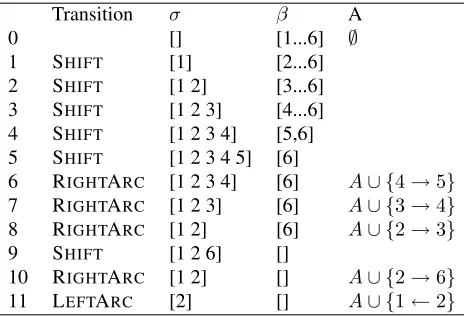
Table 1:arc-standardtransition action sequence for parsing the sentence in Figure 2.
pendency arcs. Each state in the transition system can be formalized as a tuple(σ, β, A), whereσ is a stack that maintains a partial derivation,βis a buffer of incoming input words andAis the set of depen-dency relations that have been built.
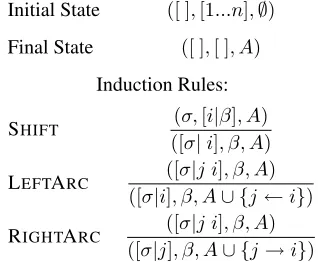
Our work is based on thearc-standardalgorithm (Nivre, 2008). The deduction system of the arc-standard algorithm is shown in Figure 1. In this system, three transition actions are used: LEFT-ARC, RIGHTARC and SHIFT. Given a state s = ([σ|j i],[k|β], A),
• LEFTARCbuilds an arc{j←i}and popsjoff the stack.
• RIGHTARC builds an arc {j → i}and popsi off the stack.
• SHIFTremoves the front wordkfrom the buffer β, and shifts it onto the stack.
In the notations above,i,jandkare word indices of an input sentence. Thearc-standardsystem assumes that each input word has been assigned a part-of-speech (POS) tag.
Initial State ([ ], set(1..n),∅)
Final State ([ ],∅, A)
Induction Rules:
SHIFT-i-POS (σ, ρ, A) ([σ|i], ρ− {i}, A)
LEFTARC ([σ|j i], ρ, A) ([σ|i], ρ, A∪ {j←i})
[image:3.612.313.539.60.244.2]RIGHTARC ([σ|j([], ρ, Aσ|j i]∪ {, ρ, Aj→) i})
Figure 3: Deduction system for transition-based lin-earization. Indicesi,jdo not reflect word order.
3 Transition-Based Linearization
The main difference between linearization and de-pendency parsing is that the input words are ordered for linearization, which results in an un-ordered bufferρ. At a certain state s = (σ, ρ, A), any word in the buffer ρ can be shifted onto the stack. In addition, unlike a parser, the vanilla lin-earization task does not assume that input words are assigned POS. To extend thearc-standardalgorithm for linearization, we incorporate word and POS into the SHIFToperation, transforming thearc-standard SHIFToperation to SHIFT-Word-POS, which selects the wordWord from the bufferρ, tags it with POS and shifts it onto the stack. Since the order of words in an output sentence equals to the order in which they are shifted onto the stack, word ordering is per-formed along with the parsing process.
Under such extension, the sentence in Figure 2 can be generated by the transition sequence (SHIFT-Dr. Talcott-NP, SHIFT-led-VBD, SHIFT-of-NP, SHIFT-a team-NP, SHIFT-of-IN, SHIFT-Harvard University-NP, RIGHTARC, RIGHTARC, RIGHTARC, SHIFT-.-., RIGHTARC, LEFTARC), given the unordered bag of words (Dr. Talcott,led, a team,of,Harvard University, .).
The deduction system for the linearization algo-rithm is shown in Figure 3. Given an input bag of nwords, this algorithm also takes2ntransition ac-tions to construct an output, by the same reason as thearc-standardparser.
3.1 Search and Learning
We apply the learning and search framework of Zhang and Clark (2011a), which gives
state-of-the-Algorithm 1:transition-based linearization
Input:C, a set of input syntactic constraints Output: The highest-scored final state
1 candidates←([ ], set(1..n),∅) 2 agenda← ∅
3 fori←1..2ndo
4 forsincandidatesdo
5 foractioninGETPOSSIBLEACTIONS(s,
C)do
6 agenda←APPLY(s, action)
7 candidates←TOP-K(agenda) 8 agenda← ∅
9 best←BEST(candidates) 10 returnbest
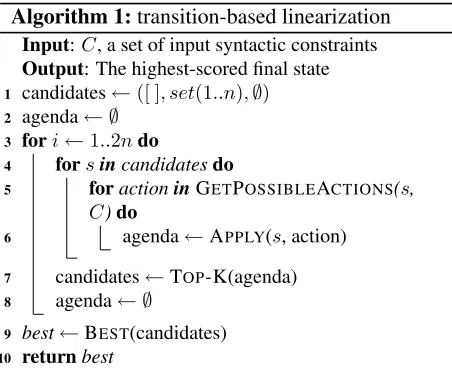
art transition-based parsing accuracies and runs in linear time (Zhang and Nivre, 2011). Pseudocode of the search algorithm is shown in Algorithm 1. It per-forms beam-search by using an agenda to keep the k-best states at each incremental step. When decod-ing starts, the agenda contains only the initial state. At each step, each state in the agenda is advanced by applying all possible transition actions (GETPOSSI-BLEACTIONS), leading to a set of new states. The k best are selected for the new states, and used to replace the current states in the agenda, before the next decoding step starts. Given an input bag ofn words, the process repeats for2nsteps, after which all the states in the agenda are terminal states, and the highest-scored state in the agenda is taken for the final output. The complexity of this algorithm isn2, because it takes a fixed2nsteps to construct
an output, and in each step the number of possible SHIFTaction is proportional to the size ofρ.
The search algorithm ranks search hypotheses, which are sequences of state transitions, by their scores. A global linear model is used to score search hypotheses. Given a hypothesish, its score is calcu-lated by:
Score(h) = Φ(h)·⃗θ,
where ⃗θ is the parameter vector of the model and
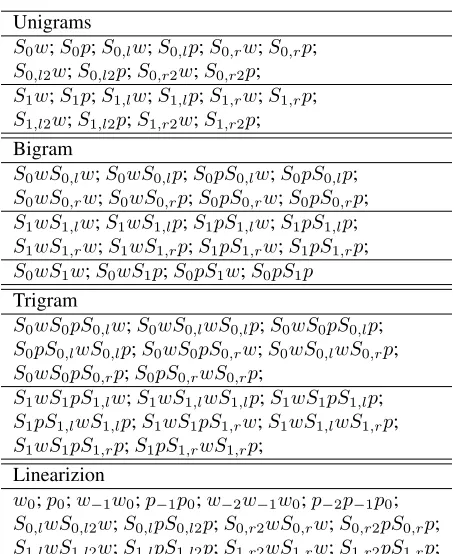
Φ(h) is the global feature vector ofh, extracted by instantiating the feature templates in Table 2 accord-ing to each state in the transition sequence.
In the table, S0 represents the first word on the
top of the stack,S1 represents the second word on
rep-Unigrams
S0w;S0p;S0,lw;S0,lp;S0,rw;S0,rp;
S0,l2w;S0,l2p;S0,r2w;S0,r2p;
S1w;S1p;S1,lw;S1,lp;S1,rw;S1,rp;
S1,l2w;S1,l2p;S1,r2w;S1,r2p;
Bigram
S0wS0,lw;S0wS0,lp;S0pS0,lw;S0pS0,lp;
S0wS0,rw;S0wS0,rp;S0pS0,rw;S0pS0,rp;
S1wS1,lw;S1wS1,lp;S1pS1,lw;S1pS1,lp;
S1wS1,rw;S1wS1,rp;S1pS1,rw;S1pS1,rp;
S0wS1w;S0wS1p;S0pS1w;S0pS1p
Trigram
S0wS0pS0,lw;S0wS0,lwS0,lp;S0wS0pS0,lp;
S0pS0,lwS0,lp;S0wS0pS0,rw;S0wS0,lwS0,rp;
S0wS0pS0,rp;S0pS0,rwS0,rp;
S1wS1pS1,lw;S1wS1,lwS1,lp;S1wS1pS1,lp;
S1pS1,lwS1,lp;S1wS1pS1,rw;S1wS1,lwS1,rp;
S1wS1pS1,rp;S1pS1,rwS1,rp; Linearizion
w0;p0;w−1w0;p−1p0;w−2w−1w0;p−2p−1p0;
S0,lwS0,l2w;S0,lpS0,l2p;S0,r2wS0,rw;S0,r2pS0,rp;
[image:4.612.72.300.53.330.2]S1,lwS1,l2w;S1,lpS1,l2p;S1,r2wS1,rw;S1,r2pS1,rp;
Table 2: Feature templates.
resent a POS-tag. The feature templates can be clas-sified into four types:unigram,bigram,trigramand linearization. The first three types are taken from the dependency parser of Zhang and Nivre (2011), which capture context information for S0, S1 and
their modifiers. The original feature templates of Zhang and Nivre (2011) also contain information of the front words on the buffer. However, since the buffer is unordered for linearization, we do not in-clude these features.
The linearization feature templates are specific for linearization, and captures surface ngram infor-mation. Each search state represents a partially lin-earized sentence. We represents the last word in the partially linearized sentence as w0 and the second
last asw−1.
Given a set of labeled training examples, the av-eraged perceptron (Collins, 2002) with early update (Collins and Roark, 2004; Zhang and Nivre, 2011) is used to train the parameters⃗θof the model.
3.2 Input Syntactic Constraints
The use of syntactic constraints to achieve better lin-earization performance has been studied in previous work. Wan et al. (2009) employ POS constraints
.
.
.
.
. ..
NP VBD.. NP.. IN.. NP.. ... ..
[image:4.612.317.556.64.119.2]Dr. Talcott1 led..2 a team.. 3....of..4 Harvard University.. 5 6...
Figure 4: Example partial tree. Words in the same sub dependency trees are grouped by rounded boxes. Word indices do not specify their orders. Base phrases (e.g.Dr. Talcott) are treated as single words.
in learning a dependency language model. Zhang and Clark (2011b) take supertags as constraints to a CCG linearizer. Zhang (2013) demonstrates the pos-sibility ofpartial-tree linearization, which allows a whole spectrum of input syntactic constraints. In practice, input syntactic constraints, including POS and dependency relations, can be obtained from ear-lier stage of a generation pipeline, such as lexical transfer results in machine translation.
It is relatively straightforward to apply input con-straints to a best-first system (Zhang, 2013), but less so for beam-search. In this section, we utilize the input syntactic constraints by letting the information decide the possible actions for each state, namely the return value of GETPOSSIBLEACTIONS in Al-gorithm 1, thus, when input POS-tags and depen-dencies are given, the generation system can achieve more specified outputs.
3.2.1 POS Constraints
POS is the simplest form of constraints to the transition-based linearization system. When the POS of an input word is given, the POS-tag com-ponent in SHIFT-Word-POSoperation is fixed, and the number of SHIFTactions for the word is reduced from the number of all POS to 1.
3.2.2 Partial Tree Constraints
be-Algorithm 2:GETPOSSIBLEACTIONS for par-tial tree linearization, whereCis a partial tree
Input: A states= ([σ|j i], ρ, A)and partial treeC Output: A set of possible transition actionsT
1 ifs.σis emptythen 2 fork∈s.ρdo
3 T ←T ∪(SHIFT, P OS, k)
4 else
5 ifREDUCABLE(s,i,j,C)then
6 T ←T ∪(LEFTARC)
7 ifREDUCABLE(s,j,i,C)then
8 T ←T ∪(RIGHTARC)
9 fork∈s.βdo
10 ifSHIFTLEGAL(s,k,C)then 11 T ←T∪(SHIFT, P OS, k)
12 returnT
.. stackσ
.
. . .... 4 3
4 .
5 (a)
..
. . .... 3 1
[image:5.612.322.537.59.273.2]3 . 4 . 5 (b)
Figure 5: Two conditions for a valid LEFTARC ac-tion in partial-tree linearizaac-tion. The indices corre-spond to those in Figure 4. A shaded triangle repre-sents the readily built arcs under a root word.
cause this action will result in a sub-sequence ( Har-vard University5, a team3, of4), which cannot have
the dependency arcs{3 → 4},{4 → 5}by using arc-standardactions.
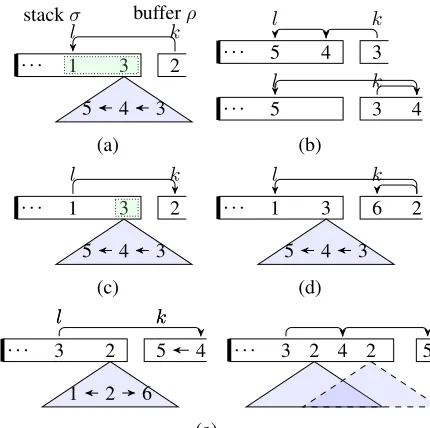
Algorithm 3 shows pseudocode of GETPOSSI-BLEACTIONSwhenCis a partial tree. Given a state s = ([σ|j i], ρ, A) the LEFTARC action builds an arc {j ← i} and pops the word j off the stack. Since the popped word j cannot be linked to any words in future transitions, all the descendants ofj should have been processed and removed from the stack. In addition, constrained by the given partial tree, the arc {j ← i} should be an arc in C (Fig-ure 5a), orjshould be the root of a sub dependency tree inC (Figure 5b). We denote the conditions as REDUCABLE(s, i, j, C) (lines 5-6). The case for RIGHTARCis similar to LEFTARC(lines 7-8).
For the SHIFT action, the conditions are more complex. Due to space limitation, we briefly sketch
.. . . .. l . k . 1 . 3 . 2 . stackσ . bufferρ . 3 . 4 . 5 (a) .. l . k .
. . .. 5... 4 3
l . k . . . . . 3 . 5 . 4 (b) .. l . k .
. . .. 1... 3 2 3 . 4 . 5 (c) .. l . k . 1 . 3 . 6 . 2 . . . .. 3 . 4 . 5 (d) .. l . k .
. . .. 3.... 2 5 4 1 . 2 . 6 . l . k . . . . . 3 . 2 . 4 . 2 . 5 (e)
Figure 6: 5 relations betweenkandl. The indices correspond to those in Figure 4. The words in green boxes must have arcs withkin future transitions.
[image:5.612.71.301.81.382.2]Algorithm 3: GETPOSSIBLEACTIONS for full tree linearization, whereCis a full tree
Input: A states= ([σ|j i], ρ, A)and gold treeC Output: A set of possible transition actionsT
1 T ← ∅
2 ifs.σis emptythen 3 fork∈s.ρdo
4 T ←T ∪(SHIFT, P OS, k)
5 else
6 if∃j, j∈(DESCENDANTS(i)∩s.ρ)then
7 forj∈(DESCENDANTS(i)∩s.ρ)do
8 T ←T∪(SHIFT, P OS, j)
9 else
10 if{j→i} ∈Cthen
11 T ←T∪(RIGHTARC)
12 else if{j←i} ∈Cthen
13 T ←T∪(LEFTARC)
14 else
15 for
k∈(SIBLINGS(i)∪HEAD(i))∩s.ρdo
16 T ←T∪(SHIFT, P OS, k)
17 returnT
3.2.3 Full Tree Constraints
Algorithm 2 can also be used with full-tree straints, which are a special case of partial-tree con-straints. However, there is a conceptually simpler algorithm that leverages full-tree constraints. Be-cause tree linearization is frequently studied in the literature, we describe this algorithm in Algorithm 3. When the stack is empty, we can freely move any word in the bufferρonto the stack (line 2-4). If not all the descendants of the stack topihave been processed, the next transition actions should move them onto the stack, so that arcs can be constructed betweeniand these words (line 6-8). If all the de-scendants ofihave been processed, the next action should eagerly build arcs between top two wordsi andj on the stack (line 10-13). If no arc exists be-tweeniandj, the next action should shift the parent word ofior a word ini’s sibling tree (line 14-16).
4 Experiments
We follow previous work and conduct experiments on the Penn Treebank (PTB), using Wall Street
Jour-0.35 0.40 0.45
0 10 20 30 40 50
iteration
BLEU
[image:6.612.321.531.64.187.2]beamsize X1 X4 X16 X64 X128
Figure 7: Dev. results with different beam sizes.
nal sections 2–21 for training, 22 for development testing and 23 for final testing. Gold-standard de-pendency trees are derived from bracketed sentences in the treebank using Penn2Malt1, and base noun
phrases are treated as a single word (Wan et al., 2009; Zhang, 2013). The BLEU score (Papineni et al., 2002) is used to evaluate the performance of lin-earization, which has been adopted in former liter-als (Wan et al., 2009; White and Rajkumar, 2009; Zhang and Clark, 2011b) and recent shared-tasks (Belz et al., 2011). We use our implementation of the best-first system of Zhang (2013), which gives the state-of-the-art results, as the baseline.
4.1 Influence of Beam size
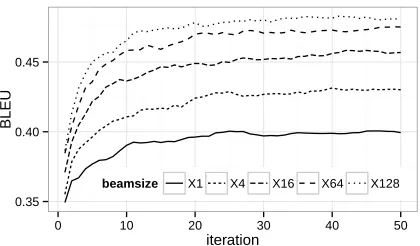
We first study the influence of beam size by per-forming free word ordering on the development test data. BLEU score curves with different beam sizes are shown in Figure 7. From this figure, we can see that the systems with beam 64 and 128 achieve the best results. However, the 128-beam system does not improve the performance significantly (48.2 vs 47.5), but runs twice slower. As a result, we set the beam size to 64 in the remaining experiments.
4.2 Input Syntactic Constraints
To test the effectiveness of GETPOSSIBLEACTIONS under different input constraints, we follow Zhang (2013) and feed different amounts of POS-tags and dependencies to our transition-based linearization system. Input syntactic constraints are obtained by randomly sampling POS and dependencies from the gold dependency tree. Nine development experi-ments under different inputs are performed, and the
no pos 50% pos all pos no pos 50% pos all pos no pos 50% pos all pos no dep no dep no dep 50% dep 50% dep 50% dep all dep all dep all dep BL SP BL SP BL SP BL SP BL SP BL SP BL SP BL SP BL SP Z13 42.9 4872 43.4 4856 44.7 4826 50.5 4790 51.4 4737 52.2 4720 73.3 4600 74.7 4431 76.3 4218 Ours 47.5 155 47.9 119 48.8 74 54.8 132 55.2 91 56.2 41 77.8 40 79.1 28 81.1 22
Table 3: Partial-tree linearizion results on the development test set. BL– the BLEU score,SP– number of milliseconds to order one sentence. Z13 refers to the best-first system of Zhang (2013).
0.900 0.925 0.950 0.975 1.000
1−8 9−11
12−14 15−17 18−20 21−24 25−32 33−164
system
bestfirst
[image:7.612.86.291.183.294.2]ours
Figure 8: Comparison between transition-based and best-first systems on surface string brevity.
Precision Recall F len Z13 ours Z13 ours Z13 ours
<5 24.63 20.45 14.56 21.82 18.3 21.11
<10 15.20 16.33 10.59 15.88 12.48 16.1
<15 10.82 14.73 9.38 14.08 10.05 14.4
<30 8.18 12.54 8.26 12.43 8.22 12.49
Table 4: Precision, recall and F-score comparison on different spans lengths.
BLEU scores along with the average time to order one sentence are shown in Table 3.
With more syntactic information in the input, our linearization system achieves better performance, showing that GETPOSSIBLEACTIONS can take ad-vantage of the input constraints and yield more spec-ified output. In addition, because input constraints reduce the search space, the systems with more syn-tactic information achieve faster decoding speeds. In comparison with Zhang (2013), the transition-based system achieves improved accuracies under the set-tings, and the decoding speed can be over two orders of magnitude faster (22ms vs. 4218ms). We give more detailed analysis next.
4.3 Comparison with Best-First
The beam-search linearizer takes a very differ-ent search strategy compared with best-first search, which affects the error distribution. As mentioned earlier, one problem of best-first is the lack of the-oretical guarantee on time complexity. As a result, a time constraint is used and default output can be constructed when no full output is found (White, 2004b; Zhang and Clark, 2011b). This may result in incomplete output sentences and intuitively, this problem is more severe for larger bag of words. In contrast, the transition-based linearization algorithm takes|2n|steps to generate a sentence and thus guar-antees to order all the input words. Figure 8 shows the results by comparing the brevity scores (i.e. the number of words in the output divided by the num-ber of words in reference sentence) on different sizes of inputs. Best-search can fail to order all the in-put words even on bags of 9 – 11 words, and the case is more severe for larger bag of words. On the other hand, the transition-based method uses all the input words to generate output and the brevity score is constant 1. Since the BLEU score consists two parts: the n-gram precision and brevity, this com-parison partly explains why the transition-based lin-earization algorithm achieves higher BLEU scores.
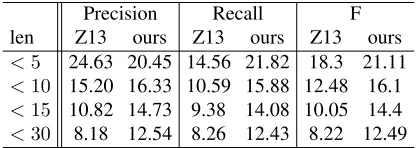
To further compare the difference between the two systems, we evaluate the qualities of projective spans, which are dependency treelets. Both systems build outputs bottom-up by constructing projective spans, and a break-down of span accuracies against span sizes shows the effects of the different search algorithms. The results are shown in Table 4. Ac-cording to this table, the best-first system tends to construct smaller spans more precisely, but the re-call is relatively lower. Overall, higher F-scores are achieved by the transition-based system.
[image:7.612.81.290.370.444.2]0.0 0.1 0.2
2 4 6 8 10 12 14 16 18 20 22 24 26 28 30
system
bestfirst
ours
[image:8.612.315.539.56.266.2]gold
Figure 9: Distributions of spans outputted by the best-first, transition-based systems and the gold trees.
[image:8.612.86.292.65.180.2]no pos all pos all pos no dep no dep all dep Wan et al. (2009) - 33.7 -Zhang and Clark (2011b) - 40.1 -Zhang et al. (2012) - 43.8 -Zhang (2013) 44.7 46.8 76.2 This paper 49.4 50.8 82.3
Table 5: Final results.
those that have higher scores. As a result, the num-ber of expanded spans do not have a fixed correlation with the size, and there can be fewer but better small spans expanded. In contrast, the transition-based system models transition sequences rather than indi-vidual spans, and therefore the distribution of spans of different sizes in each hypothesis resembles that of the training data. Figure 9 verifies the analysis by counting the distributions of spans with respect to the length, in the search algorithms of the two sys-tems and the gold dependency trees. The distribu-tion of the transidistribu-tion-based system is closer to that of gold dependency trees, while the best-first sys-tem outputs less smaller spans and more longer ones. This explains the higher precision for the best-first system on smaller spans.
4.4 Final Results
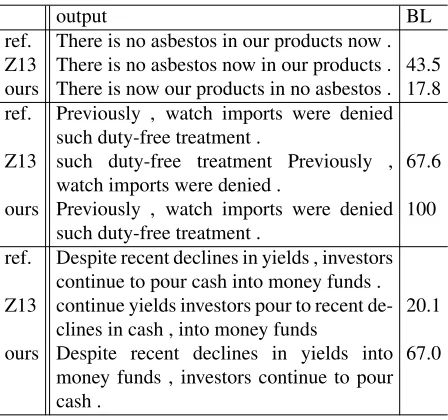
The final results on the test set of Penn Treebank are shown in Table 5. Compared with previous studies, our transition-based linearization system achieves the best results on all the tests. Table 6 shows some example output sentences, when there are no input constraints. For longer sentences, the transition-based method gives noticeably better results.
output BL
ref. There is no asbestos in our products now . Z13 There is no asbestos now in our products . 43.5 ours There is now our products in no asbestos . 17.8 ref. Previously , watch imports were denied
such duty-free treatment .
Z13 such duty-free treatment Previously , watch imports were denied . 67.6 ours Previously , watch imports were denied
such duty-free treatment . 100 ref. Despite recent declines in yields , investors
continue to pour cash into money funds . Z13 continue yields investors pour to recent
de-clines in cash , into money funds 20.1 ours Despite recent declines in yields into
money funds , investors continue to pour cash .
67.0
Table 6: Example outputs.
5 Related Work
The input to practical natural language generation (NLG) system (Reiter and Dale, 1997) can range from a bag of words and phrases to a bag of lem-mas without punctuation (Belz et al., 2011). The linearization module of this paper can serve as the final stage in a pipeline when the bag of words and their optional syntactic information are given. There has also been work to jointly perform linearization and morphological generation (Song et al., 2014).
There has been work on linearization with unla-beled and launla-beled dependency trees (He et al., 2009; Zhang, 2013). These methods mostly use greedy or best-first algorithms to order each tree node. Our work is different by performing word ordering using a transition process.
[image:8.612.72.305.239.326.2]6 Conclusion
We studied transition-based syntactic linearization as an extension to transition-based parsing. Com-pared with best-first systems, the advantage of our transition-based algorithm includes bounded time complexity, and the guarantee to yield full sen-tences when given a bag of words. Experimen-tal results show that our algorithm achieves im-proved accuracies, with significantly faster decod-ing speed compared with a state-of-the-art best-first baseline. We publicly release our code at http:
//sourceforge.net/projects/zgen/.
For future work, we will study the incorporation of large-scale language models, and the integration of morphology generation and linearization.
Acknowledgments
We thank the anonymous reviewers for their con-structive comments. This work was supported by the National Key Basic Research Program of China via grant 2014CB340503 and the Singapore Ministry of Education (MOE) AcRF Tier 2 grant T2MOE201301 and SRG ISTD 2012 038 from Sin-gapore University of Technology and Design.
References
Anja Belz, Mike White, Dominic Espinosa, Eric Kow, Deirdre Hogan, and Amanda Stent. 2011. The first surface realisation shared task: Overview and evaluation results. In Proceedings of the Genera-tion Challenges Session at the 13th European Work-shop on Natural Language Generation, pages 217– 226, Nancy, France, September. Association for Com-putational Linguistics.
Bernd Bohnet, Leo Wanner, Simon Mill, and Alicia Burga. 2010. Broad coverage multilingual deep sen-tence generation with a stochastic multi-level realizer. In Proceedings of the 23rd International Conference on Computational Linguistics (Coling 2010), pages 98–106, Beijing, China, August. Coling 2010 Orga-nizing Committee.
Michael Collins and Brian Roark. 2004. Incremental parsing with the perceptron algorithm. InProceedings of the 42nd Meeting of the Association for Computa-tional Linguistics (ACL’04), Main Volume, pages 111– 118, Barcelona, Spain, July.
Michael Collins. 2002. Discriminative training meth-ods for hidden markov models: Theory and experi-ments with perceptron algorithms. InProceedings of
the 2002 Conference on Empirical Methods in Natu-ral Language Processing, pages 1–8. Association for Computational Linguistics, July.
Adri`a de Gispert, Marcus Tomalin, and Bill Byrne. 2014. Word ordering with phrase-based grammars. In Pro-ceedings of the 14th Conference of the European Chapter of the Association for Computational Linguis-tics, pages 259–268, Gothenburg, Sweden, April. As-sociation for Computational Linguistics.
Wei He, Haifeng Wang, Yuqing Guo, and Ting Liu. 2009. Dependency based chinese sentence realization. In
Proceedings of the Joint Conference of the 47th An-nual Meeting of the ACL and the 4th International Joint Conference on Natural Language Processing of the AFNLP, pages 809–816, Suntec, Singapore, Au-gust. Association for Computational Linguistics. Terry Koo and Michael Collins. 2010. Efficient
third-order dependency parsers. InProceedings of the 48th Annual Meeting of the Association for Computational Linguistics, pages 1–11, Uppsala, Sweden, July. Asso-ciation for Computational Linguistics.
Ryan T McDonald and Fernando CN Pereira. 2006. On-line learning of approximate dependency parsing algo-rithms. InEACL.
Joakim Nivre. 2008. Algorithms for deterministic incre-mental dependency parsing. Computational Linguis-tics, 34(4):513–553.
Kishore Papineni, Salim Roukos, Todd Ward, and Wei-Jing Zhu. 2002. Bleu: a method for automatic eval-uation of machine translation. InProceedings of 40th Annual Meeting of the Association for Computational Linguistics, pages 311–318, Philadelphia, Pennsylva-nia, USA, July. Association for Computational Lin-guistics.
Ehud Reiter and Robert Dale. 1997. Building applied natural language generation systems. Nat. Lang. Eng., 3(1):57–87, March.
Kenji Sagae, Alon Lavie, and Brian MacWhinney. 2005. Automatic measurement of syntactic development in child language. In Proceedings of the 43rd Annual Meeting of the Association for Computational Linguis-tics (ACL’05), pages 197–204, Ann Arbor, Michigan, June. Association for Computational Linguistics. Linfeng Song, Yue Zhang, Kai Song, and Qun Liu.
2014. Joint morphological generation and syntactic linearization. InAAAI, pages 1522–1528.
Michael White and Rajakrishnan Rajkumar. 2009. Per-ceptron reranking for CCG realization. InProceedings of the 2009 Conference on Empirical Methods in Nat-ural Language Processing, pages 410–419, Singapore, August. Association for Computational Linguistics. Michael White. 2004a. Reining in CCG chart
realiza-tion. InIn Proc. INLG-04, pages 182–191.
Michael White. 2004b. Reining in ccg chart realiza-tion. In Natural Language Generation, pages 182– 191. Springer.
Wenduan Xu, Stephen Clark, and Yue Zhang. 2014. Shift-reduce ccg parsing with a dependency model. In
Proceedings of the 52nd Annual Meeting of the Associ-ation for ComputAssoci-ational Linguistics (Volume 1: Long Papers), pages 218–227, Baltimore, Maryland, June. Association for Computational Linguistics.
Yue Zhang and Stephen Clark. 2011a. Syntactic process-ing usprocess-ing the generalized perceptron and beam search.
Computational Linguistics, 37(1):105–151.
Yue Zhang and Stephen Clark. 2011b. Syntax-based grammaticality improvement using CCG and guided search. In Proceedings of the 2011 Conference on Empirical Methods in Natural Language Processing, pages 1147–1157, Edinburgh, Scotland, UK., July. As-sociation for Computational Linguistics.
Yue Zhang and Joakim Nivre. 2011. Transition-based dependency parsing with rich non-local features. In
Proceedings of the 49th Annual Meeting of the Asso-ciation for Computational Linguistics: Human Lan-guage Technologies, pages 188–193, Portland, Ore-gon, USA, June. Association for Computational Lin-guistics.
Yue Zhang, Graeme Blackwood, and Stephen Clark. 2012. Syntax-based word ordering incorporating a large-scale language model. In Proceedings of the 13th Conference of the European Chapter of the As-sociation for Computational Linguistics, pages 736– 746, Avignon, France, April. Association for Compu-tational Linguistics.