Recurrent Neural Network Grammars
Chris Dyer♠ Adhiguna Kuncoro♠ Miguel Ballesteros♦♠ Noah A. Smith♥ ♠School of Computer Science, Carnegie Mellon University, Pittsburgh, PA, USA
♦NLP Group, Pompeu Fabra University, Barcelona, Spain
♥Computer Science & Engineering, University of Washington, Seattle, WA, USA
{cdyer,akuncoro}@cs.cmu.edu, [email protected], [email protected]
Abstract
We introduce recurrent neural network gram-mars, probabilistic models of sentences with explicit phrase structure. We explain efficient inference procedures that allow application to both parsing and language modeling. Experi-ments show that they provide better parsing in English than any single previously published supervised generative model and better lan-guage modeling than state-of-the-art sequen-tial RNNs in English and Chinese.
1 Introduction
Sequential recurrent neural networks (RNNs) are remarkably effective models of natural language. In the last few years, language model results that substantially improve over long-established state-of-the-art baselines have been obtained using RNNs (Zaremba et al., 2015; Mikolov et al., 2010) as well as in various conditional language modeling tasks such as machine translation (Bahdanau et al., 2015), image caption generation (Xu et al., 2015), and dia-logue generation (Wen et al., 2015). Despite these impressive results, sequential models are a priori
inappropriate models of natural language, since re-lationships among words are largely organized in terms of latent nested structures rather than sequen-tial surface order (Chomsky, 1957).
In this paper, we introducerecurrent neural net-work grammars (RNNGs; §2), a new generative probabilistic model of sentences that explicitly mod-els nested, hierarchical relationships among words and phrases. RNNGs operate via a recursive syntac-tic process reminiscent of probabilissyntac-tic context-free grammar generation, but decisions are parameter-ized using RNNs that condition on the entire syntac-tic derivation history, greatly relaxing context-free independence assumptions.
The foundation of this work is a top-down vari-ant of transition-based parsing (§3). We give two variants of the algorithm, one for parsing (given an observed sentence, transform it into a tree), and one for generation. While several transition-based neu-ral models of syntactic generation exist (Hender-son, 2003, 2004; Emami and Jelinek, 2005; Titov and Henderson, 2007; Buys and Blunsom, 2015b), these have relied on structure building operations based on parsing actions in shift-reduce and left-corner parsers which operate in a largely bottom-up fashion. While this construction is appealing be-cause inference is relatively straightforward, it lim-its the use of top-down grammar information, which is helpful for generation (Roark, 2001).1 RNNGs maintain the algorithmic convenience of transition-based parsing but incorporate top-down (i.e., root-to-terminal) syntactic information (§4).
The top-down transition set that RNNGs are based on lends itself to discriminative modeling as well, where sequences of transitions are modeled conditional on the full input sentence along with the incrementally constructed syntactic structures. Sim-ilar to previously published discriminative bottom-up transition-based parsers (Henderson, 2004; Sagae and Lavie, 2005; Zhang and Clark, 2011,inter alia), greedy prediction with our model yields a linear-time deterministic parser (provided an upper bound on the number of actions taken between process-ing subsequent terminal symbols is imposed); how-ever, our algorithm generates arbitrary tree struc-tures directly, without the binarization required by shift-reduce parsers. The discriminative model also lets us use ancestor sampling to obtain samples of parse trees for sentences, and this is used to solve
1The left-corner parsers used by Henderson (2003, 2004)
incorporate limited top-down information, but a complete path from the root of the tree to a terminal is not generally present when a terminal is generated. Refer to Henderson (2003, Fig. 1) for an example.
a second practical challenge with RNNGs: approx-imating the marginal likelihood and MAP tree of a sentence under the generative model. We present a simple importance sampling algorithm which uses samples from the discriminative parser to solve in-ference problems in the generative model (§5).
Experiments show that RNNGs are effective for both language modeling and parsing (§6). Our gen-erative model obtains (i) the best-known parsing re-sults using a single supervised generative model and (ii) better perplexities in language modeling than state-of-the-art sequential LSTM language models. Surprisingly—although in line with previous pars-ing results showpars-ing the effectiveness of genera-tive models (Henderson, 2004; Johnson, 2001)— parsing with the generative model obtains signifi-cantly better results than parsing with the discrim-inative model.
2 RNN Grammars
Formally, an RNNG is a triple(N,Σ,Θ)consisting of a finite set of nonterminal symbols (N), a finite set of terminal symbols (Σ) such thatN ∩Σ = ∅, and a collection of neural network parametersΘ. It does not explicitly define rules since these are im-plicitly characterized by Θ. The algorithm that the grammar uses to generate trees and strings in the lan-guage is characterized in terms of a transition-based algorithm, which is outlined in the next section. In the section after that, the semantics of the param-eters that are used to turn this into a stochastic al-gorithm that generates pairs of trees and strings are discussed.
3 Top-down Parsing and Generation RNNGs are based on a top-down generation algo-rithm that relies on a stack data structure of par-tially completed syntactic constituents. To empha-size the similarity of our algorithm to more familiar bottom-up shift-reduce recognition algorithms, we first present the parsing (rather than generation) ver-sion of our algorithm (§3.1) and then present modi-fications to turn it into a generator (§3.2).
3.1 Parser Transitions
The parsing algorithm transforms a sequence of wordsxinto a parse treeyusing two data structures
(a stack and an input buffer). As with the bottom-up algorithm of Sagae and Lavie (2005), our algo-rithm begins with the stack (S) empty and the com-plete sequence of words in the input buffer (B). The buffer contains unprocessed terminal symbols, and the stack contains terminal symbols, “open” nonter-minal symbols, and completed constituents. At each timestep, one of the following three classes of op-erations (Fig. 1) is selected by a classifier, based on the current contents on the stack and buffer:
• NT(X)introduces an “open nonterminal” X onto the top of the stack. Open nonterminals are written as a nonterminal symbol preceded by an open parenthesis, e.g., “(VP”, and they represent a nonterminal whose child nodes have not yet been fully constructed. Open nonterminals are “closed” to form complete constituents by subse-quentREDUCEoperations.
• SHIFT removes the terminal symbol x from the front of the input buffer, and pushes it onto the top of the stack.
• REDUCE repeatedly pops completed subtrees or terminal symbols from the stack until an open nonterminal is encountered, and then this open NT is popped and used as the label of a new con-stituent that has the popped subtrees as its chil-dren. This new completed constituent is pushed onto the stack as a single composite item. A single REDUCE operation can thus create constituents with an unbounded number of children.
The parsing algorithm terminates when there is a single completed constituent on the stack and the buffer is empty. Fig. 2 shows an example parse using our transition set. Note that in this paper we do not model preterminal symbols (i.e., part-of-speech tags) and our examples therefore do not in-clude them.2
Our transition set is closely related to the op-erations used in Earley’s algorithm which likewise introduces nonterminals symbols with itsPREDICT
2Preterminal symbols are, from the parsing algorithm’s
operation and laterCOMPLETEs them after consum-ing terminal symbols one at a time usconsum-ing SCAN (Earley, 1970). It is likewise closely related to the “linearized” parse trees proposed by Vinyals et al. (2015) and to the top-down, left-to-right decompo-sitions of trees used in previous generative parsing and language modeling work (Roark, 2001, 2004; Charniak, 2010).
A further connection is to LL(∗) parsing which uses an unbounded lookahead (compactly repre-sented by a DFA) to distinguish between parse alter-natives in a top-down parser (Parr and Fisher, 2011); however, our parser uses an RNN encoding of the lookahead rather than a DFA.
Constraints on parser transitions. To guarantee that only well-formed phrase-structure trees are pro-duced by the parser, we impose the following con-straints on the transitions that can be applied at each step which are a function of the parser state(B, S, n)
wherenis the number of open nonterminals on the stack:
• TheNT(X)operation can only be applied ifB is not empty andn <100.3
• The SHIFToperation can only be applied ifB is not empty andn≥1.
• TheREDUCEoperation can only be applied if the top of the stack is not an open nonterminal sym-bol.
• TheREDUCEoperation can only be applied ifn≥ 2or if the buffer is empty.
To designate the set of valid parser transitions, we writeAD(B, S, n).
3.2 Generator Transitions
The parsing algorithm that maps from sequences of words to parse trees can be adapted with mi-nor changes to produce an algorithm that stochas-tically generates trees and terminal symbols. Two changes are required: (i) there is no input buffer of
3Since our parser allows unary nonterminal productions,
there are an infinite number of valid trees for finite-length sen-tences. Then < 100constraint prevents the classifier from misbehaving and generating excessively large numbers of non-terminals. Similar constraints have been proposed to deal with the analogous problem in bottom-up shift-reduce parsers (Sagae and Lavie, 2005).
unprocessed words, rather there is an output buffer (T), and (ii) instead of a SHIFToperation there are GEN(x)operations which generate terminal symbol
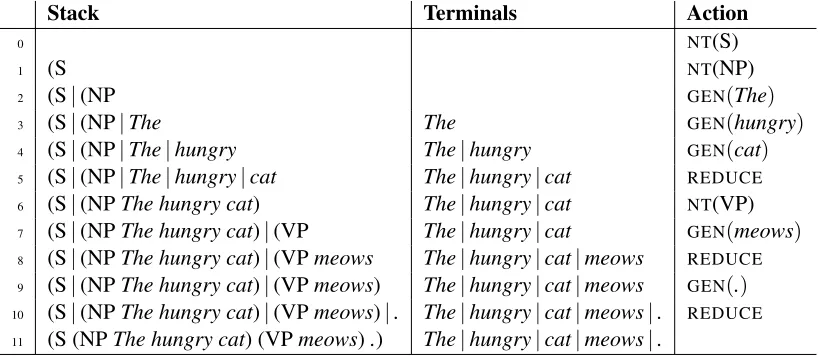
x∈Σand add it to the top of the stack and the out-put buffer. At each timestep an action is stochasti-cally selected according to a conditional distribution that depends on the current contents of B and T. The algorithm terminates when a single completed constituent remains on the stack. Fig. 4 shows an example generation sequence.
Constraints on generator transitions. The gen-eration algorithm also requires slightly modified constraints. These are:
• TheGEN(x)operation can only be applied ifn≥ 1.
• The REDUCEoperation can only be applied if the top of the stack is not an open nonterminal symbol andn≥1.
To designate the set of valid generator transitions, we writeAG(T, S, n).
This transition set generates trees using nearly the same structure building actions and stack configura-tions as the “top-down PDA” construction proposed by Abney et al. (1999), albeit without the restriction that the trees be in Chomsky normal form.
3.3 Transition Sequences from Trees
Any parse tree can be converted to a sequence of transitions via a depth-first, left-to-right traversal of a parse tree. Since there is a unique depth-first, left-ro-right traversal of a tree, there is exactly one tran-sition sequence of each tree. For a tree y and a sequence of symbols x, we write a(x,y) to indi-cate the corresponding sequence of generation tran-sitions, andb(x,y)to indicate the parser transitions.
3.4 Runtime Analysis
Stackt Buffert Open NTst Action Stackt+1 Buffert+1 Open NTst+1
S B n NT(X) S |(X B n+ 1
S x|B n SHIFT S | x B n
[image:4.612.73.550.64.120.2]S|(X|τ1 |. . .|τ` B n REDUCE S |(Xτ1 . . . τ`) B n−1
Figure 1:Parser transitions showing the stack, buffer, and open nonterminal count before and after each action type.Srepresents the stack, which contains open nonterminals and completed subtrees;Brepresents the buffer of unprocessed terminal symbols;x
is a terminal symbol,Xis a nonterminal symbol, and eachτis a completed subtree. The top of the stack is to the right, and the buffer is consumed from left to right. Elements on the stack and buffer are delimited by a vertical bar (|).
Input:The hungry cat meows .
Stack Buffer Action
0 The|hungry|cat|meows|. NT(S)
1 (S The|hungry|cat|meows|. NT(NP)
2 (S|(NP The|hungry|cat|meows|. SHIFT
3 (S|(NP|The hungry|cat|meows|. SHIFT
4 (S|(NP|The|hungry cat|meows|. SHIFT
5 (S|(NP|The|hungry|cat meows|. REDUCE
6 (S|(NPThe hungry cat) meows|. NT(VP)
7 (S|(NPThe hungry cat)|(VP meows|. SHIFT
8 (S|(NPThe hungry cat)|(VPmeows . REDUCE
9 (S|(NPThe hungry cat)|(VPmeows) . SHIFT
10 (S|(NPThe hungry cat)|(VPmeows)|. REDUCE
[image:4.612.110.510.199.394.2]11 (S (NPThe hungry cat) (VPmeows).)
Figure 2:Top-down parsing example.
Stackt Termst Open NTst Action Stackt+1 Termst+1 Open NTst+1
S T n NT(X) S |(X T n+ 1
S T n GEN(x) S | x T |x n
S|(X|τ1 |. . .|τ` T n REDUCE S |(Xτ1 . . . τ`) T n−1
Figure 3:Generator transitions. Symbols defined as in Fig. 1 with the addition ofTrepresenting the history of generated terminals.
Stack Terminals Action
0 NT(S)
1 (S NT(NP)
2 (S|(NP GEN(The)
3 (S|(NP|The The GEN(hungry)
4 (S|(NP|The|hungry The|hungry GEN(cat)
5 (S|(NP|The|hungry|cat The|hungry|cat REDUCE
6 (S|(NPThe hungry cat) The|hungry|cat NT(VP)
7 (S|(NPThe hungry cat)|(VP The|hungry|cat GEN(meows)
8 (S|(NPThe hungry cat)|(VPmeows The|hungry|cat|meows REDUCE 9 (S|(NPThe hungry cat)|(VPmeows) The|hungry|cat|meows GEN(.) 10 (S|(NPThe hungry cat)|(VPmeows)|. The|hungry|cat|meows|. REDUCE 11 (S (NPThe hungry cat) (VPmeows).) The|hungry|cat|meows|.
[image:4.612.69.548.420.476.2] [image:4.612.102.511.510.689.2]applying a number of pops that is linear in the num-ber of input symbols, the total numnum-ber of pop opera-tions across an entire parse/generation run will also be linear). Since there is no way to bound the num-ber of output nodes in a parse tree as a function of the number of input words, stating the runtime com-plexity of the parsing algorithm as a function of the input size requires further assumptions. Assuming our fixed constraint on maximum depth, it is linear.
3.5 Comparison to Other Models
Our generation algorithm algorithm differs from previous stack-based parsing/generation algorithms in two ways. First, it constructs rooted tree struc-tures top down (rather than bottom up), and sec-ond, the transition operators are capable of directly generating arbitrary tree structures rather than, e.g., assuming binarized trees, as is the case in much prior work that has used transition-based algorithms to produce phrase-structure trees (Sagae and Lavie, 2005; Zhang and Clark, 2011; Zhu et al., 2013).
4 Generative Model
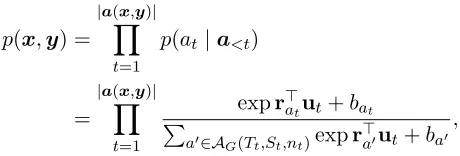
RNNGs use the generator transition set just pre-sented to define a joint distribution on syntax trees (y) and words (x). This distribution is defined as a sequence model over generator transitions that is pa-rameterized using a continuous space embedding of the algorithm state at each time step (ut); i.e.,
p(x,y) =
|a(Yx,y)|
t=1
p(at|a<t)
=
|a(Yx,y)|
t=1
expr>
atut+bat
P
a0∈AG(Tt,St,nt)expr>a0ut+ba0,
and where action-specific embeddings ra and bias
vectorbare parameters inΘ.
The representation of the algorithm state at time
t,ut, is computed by combining the representation
of the generator’s three data structures: the output buffer (Tt), represented by an embedding ot, the
stack (St), represented by an embeddingst, and the
history of actions (a<t) taken by the generator,
rep-resented by an embeddinght,
ut= tanh (W[ot;st;ht] +c),
whereW andc are parameters. Refer to Figure 5 for an illustration of the architecture.
The output buffer, stack, and history are se-quences that grow unboundedly, and to obtain rep-resentations of them we use recurrent neural net-works to “encode” their contents (Cho et al., 2014). Since the output buffer and history of actions are only appended to and only contain symbols from a finite alphabet, it is straightforward to apply a stan-dard RNN encoding architecture. The stack (S) is more complicated for two reasons. First, the ele-ments of the stack are more complicated objects than symbols from a discrete alphabet: open nontermi-nals, terminontermi-nals, and full trees, are all present on the stack. Second, it is manipulated using both push and pop operations. To efficiently obtain representations ofS under push and pop operations, we use stack LSTMs (Dyer et al., 2015).
4.1 Syntactic Composition Function
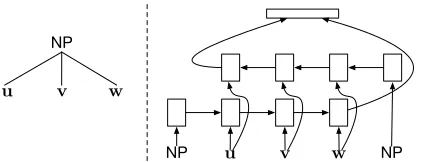
When a REDUCE operation is executed, the parser pops a sequence of completed subtrees and/or to-kens (together with their vector embeddings) from the stack and makes them children of the most recent open nonterminal on the stack, “completing” the constituent. To compute an embedding of this new subtree, we use a composition function based on bidirectional LSTMs, which is illustrated in Fig. 6.
The first vector read by the LSTM in both the for-ward and reverse directions is an embedding of the label on the constituent being constructed (in the fig-ure, NP). This is followed by the embeddings of the child subtrees (or tokens) in forward or reverse or-der. Intuitively, this order serves to “notify” each LSTM what sort of head it should be looking for as it processes the child node embeddings. The final state of the forward and reverse LSTMs are concatenated, passed through an affine transformation and atanh
nonlinearity to become the subtree embedding.4 Be-cause each of the child node embeddings (u,v,win Fig. 6) is computed similarly (if it corresponds to an
4We found the many previously proposed syntactic
[image:5.612.71.301.473.551.2]The hungry cat
NP (VP (S
REDUCEGENNT(NP)NT(VP)…
cat hungry The a<t
p(at)
ut
Tt
z }| {
St
[image:6.612.97.510.60.202.2]z
}|
{
Figure 5: Neural architecture for defining a distribution overatgiven representations of the stack (St), output buffer (Tt) and
history of actions (a<t). Details of the composition architecture of the NP, the action history LSTM, and the other elements of the
stack are not shown. This architecture corresponds to the generator state at line 7 of Figure 4.
NP
u v w
NP u v w NP
x x
Figure 6: Syntactic composition function based on bidirec-tional LSTMs that is executed during aREDUCEoperation; the
network on the right models the structure on the left.
internal node), this composition function is a kind of recursive neural network.
4.2 Word Generation
To reduce the size of AG(S, T, n), word
genera-tion is broken into two parts. First, the decision to generate is made (by predicting GENas an action), and then choosing the word, conditional on the cur-rent parser state. To further reduce the computa-tional complexity of modeling the generation of a word, we use a class-factored softmax (Baltescu and Blunsom, 2015; Goodman, 2001). By using p|Σ|
classes for a vocabulary of size|Σ|, this prediction step runs in timeO(p|Σ|)rather than theO(|Σ|)of the full-vocabulary softmax. To obtain clusters, we use the greedy agglomerative clustering algorithm of Brown et al. (1992).
4.3 Training
The parameters in the model are learned to maxi-mize the likelihood of a corpus of trees.
4.4 Discriminative Parsing Model
A discriminative parsing model can be obtained by replacing the embedding ofTtat each time step with
an embedding of the input bufferBt. To train this
model, the conditional likelihood of each sequence of actions given the input string is maximized.5
5 Inference via Importance Sampling Our generative model p(x,y) defines a joint dis-tribution on trees (y) and sequences of words (x). To evaluate this as a language model, it is neces-sary to compute the marginal probability p(x) = P
y0∈Y(x)p(x,y0). And, to evaluate the model as
a parser, we need to be able to find the MAP parse tree, i.e., the treey∈ Y(x)that maximizesp(x,y). However, because of the unbounded dependencies across the sequence of parsing actions in our model, exactly solving either of these inference problems is intractable. To obtain estimates of these, we use a variant of importance sampling (Doucet and Jo-hansen, 2011).
Our importance sampling algorithm uses a condi-tional proposal distribution q(y | x) with the fol-lowing properties: (i) p(x,y) > 0 =⇒ q(y |
x) > 0; (ii) samples y ∼ q(y | x) can be ob-tained efficiently; and (iii) the conditional probabil-ities q(y | x) of these samples are known. While many such distributions are available, the
discrim-5For the discriminative parser, the POS tags are processed
[image:6.612.81.292.286.367.2]inatively trained variant of our parser (§4.4) ful-fills these requirements: sequences of actions can be sampled using a simple ancestral sampling ap-proach, and, since parse trees and action sequences exist in a one-to-one relationship, the product of the action probabilities is the conditional probability of the parse tree underq. We therefore use our discrim-inative parser as our proposal distribution.
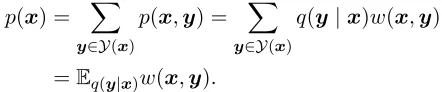
Importance sampling uses importance weights, which we define asw(x,y) =p(x,y)/q(y|x), to compute this estimate. Under this definition, we can derive the estimator as follows:
p(x) = X y∈Y(x)
p(x,y) = X y∈Y(x)
q(y|x)w(x,y)
=Eq(y|x)w(x,y).
We now replace this expectation with its Monte Carlo estimate as follows, usingN samples fromq:
y(i)∼q(y|x) fori∈ {1,2, . . . , N}
Eq(y|x)w(x,y)
MC
≈ N1 N X
i=1
w(x,y(i))
To obtain an estimate of the MAP treeyˆ, we choose the sampled tree with the highest probability under the joint modelp(x,y).
6 Experiments
We present results of our two models both on parsing (discriminative and generative) and as a language model (generative only) in English and Chinese. Data. For English, §2–21 of the Penn Treebank are used as training corpus for both, with§24 held out as validation, and§23 used for evaluation. Sin-gleton words in the training corpus with unknown word classes using the the Berkeley parser’s map-ping rules.6 Orthographic case distinctions are pre-served, and numbers (beyond singletons) are not normalized. For Chinese, we use the Penn Chinese Treebank Version 5.1 (CTB) (Xue et al., 2005).7 For
6http://github.com/slavpetrov/ berkeleyparser
7§001–270 and 440–1151 for training, §301–325
develop-ment data, and§271–300 for evaluation.
[image:7.612.319.536.106.165.2]the Chinese experiments, we use a single unknown word class. Corpus statistics are given in Table 1.8
Table 1:Corpus statistics.
PTB-train PTB-test CTB-train CTB-test Sequences 39,831 2,416 50,734 348 Tokens 950,012 56,684 1,184,532 8,008 Types 23,815 6,823 31,358 1,637
UNK-Types 49 42 1 1
Model and training parameters. For the dis-criminative model, we used hidden dimensions of 128 and 2-layer LSTMs (larger numbers of dimen-sions reduced validation set performance). For the generative model, we used 256 dimensions and 2-layer LSTMs. For both models, we tuned the dropout rate to maximize validation set likelihood, obtaining optimal rates of 0.2 (discriminative) and 0.3 (generative). For the sequential LSTM baseline for the language model, we also found an optimal dropout rate of 0.3. For training we used stochas-tic gradient descent with a learning rate of 0.1. All parameters were initialized according to recommen-dations given by Glorot and Bengio (2010).
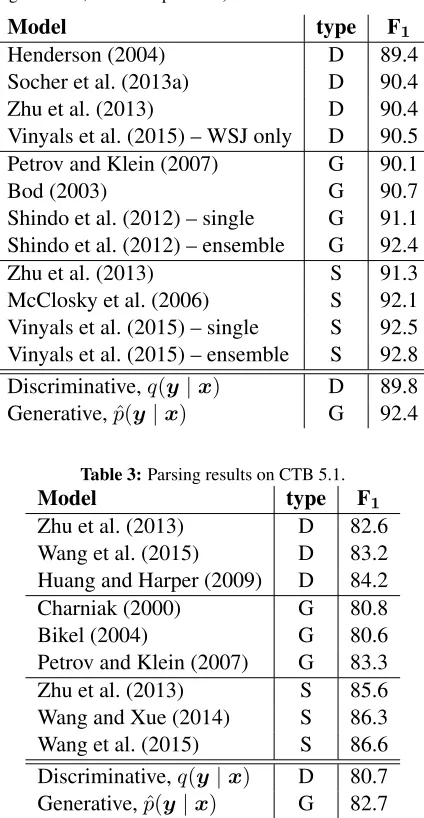
English parsing results. Table 2 (last two rows) gives the performance of our parser on Section 23, as well as the performance of several representa-tive models. For the discriminarepresenta-tive model, we used a greedy decoding rule as opposed to beam search in some shift-reduce baselines. For the generative model, we obtained 100 independent samples from a flattened distribution of the discriminative parser (by exponentiating each probability byα = 0.8and renormalizing) and reranked them according to the generative model.9
Chinese parsing results. Chinese parsing results were obtained with the same methodology as in En-glish and show the same pattern (Table 6).
Language model results. We report held-out per-word perplexities of three language models, both se-quential and syntactic. Log probabilities are normal-ized by the number of words (excluding the stop
8This preprocessing scheme is more similar to what is
stan-dard in parsing than what is stanstan-dard in language modeling. However, since our model is both a parser and a language model, we opted for the parser normalization.
9The valueα = 0.8was chosen based on the diversity of
[image:7.612.74.295.235.281.2]Table 2: Parsing results on PTB §23 (D=discriminative, G=generative, S=semisupervised).
Model type F1
Henderson (2004) D 89.4
Socher et al. (2013a) D 90.4
Zhu et al. (2013) D 90.4
Vinyals et al. (2015) – WSJ only D 90.5
Petrov and Klein (2007) G 90.1
Bod (2003) G 90.7
Shindo et al. (2012) – single G 91.1 Shindo et al. (2012) – ensemble G 92.4
Zhu et al. (2013) S 91.3
McClosky et al. (2006) S 92.1
Vinyals et al. (2015) – single S 92.5 Vinyals et al. (2015) – ensemble S 92.8 Discriminative,q(y|x) D 89.8 Generative,pˆ(y|x) G 92.4
Table 3:Parsing results on CTB 5.1.
Model type F1
Zhu et al. (2013) D 82.6
Wang et al. (2015) D 83.2
Huang and Harper (2009) D 84.2
Charniak (2000) G 80.8
Bikel (2004) G 80.6
Petrov and Klein (2007) G 83.3
Zhu et al. (2013) S 85.6
Wang and Xue (2014) S 86.3
Wang et al. (2015) S 86.6
Discriminative,q(y|x) D 80.7 Generative,pˆ(y|x) G 82.7
symbol), inverted, and exponentiated to yield the perplexity. Results are summarized in Table 4. 7 Discussion
It is clear from our experiments that the proposed generative model is quite effective both as a parser and as a language model. This is the result of (i) relaxing conventional independence assumptions (e.g., context-freeness) and (ii) inferring continu-ous representations of symbols alongside non-linear models of their syntactic relationships. The most significant question that remains is why the dis-criminative model—which has more information available to it than the generative model—performs
Table 4:Language model perplexity results. Model test ppl(PTB) test ppl(CTB)
IKN 5-gram 169.3 255.2
LSTM LM 113.4 207.3
RNNG 102.4 171.9
worse than the generative model. This pattern has been observed before in neural parsing by Hender-son (2004), who hypothesized that larger, unstruc-tured conditioning contexts are harder to learn from, and provide opportunities to overfit. Our discrimi-native model conditions on the entire history, stack, and buffer, while our generative model only ac-cesses the history and stack. The fully discrimina-tive model of Vinyals et al. (2015) was able to obtain results similar to those of our generative model (al-beit using much larger training sets obtained through semisupervision) but similar results to those of our discriminative parser using the same data. In light of their results, we believe Henderson’s hypothesis is correct, and that generative models should be con-sidered as a more statistically efficient method for learning neural networks from small data.
8 Related Work
Buys and Blunsom, 2015a,b). Modeling generation top-down as a rooted branching process that recur-sively rewrites nonterminals has been explored by Charniak (2000) and Roark (2001). Of particular note is the work of Charniak (2010), which uses ran-dom forests and hand-engineered features over the entire syntactic derivation history to make decisions over the next action to take.
The neural networks we use to model sentences are structured according to the syntax of the sen-tence being generated. Syntactically structured neu-ral architectures have been explored in a num-ber of applications, including discriminative pars-ing (Socher et al., 2013a; Kiperwasser and Gold-berg, 2016), sentiment analysis (Tai et al., 2015; Socher et al., 2013b), and sentence representa-tion (Socher et al., 2011; Bowman et al., 2006). However, these models have been, without excep-tion, discriminative; this is the first work to use syn-tactically structured neural models to generate lan-guage. Earlier work has demonstrated that sequen-tial RNNs have the capacity to recognize context-free (and beyond) languages (Sun et al., 1998; Siegelmann and Sontag, 1995). In contrast, our work may be understood as a way of incorporating a context-free inductive bias into the model structure.
9 Outlook
RNNGs can be combined with a particle filter infer-ence scheme (rather than the importance sampling method based on a discriminative parser,§5) to pro-duce a left-to-right marginalization algorithm that runs in expected linear time. Thus, they could be used in applications that require language models.
A second possibility is to replace the sequential generation architectures found in many neural net-work transduction problems that produce sentences conditioned on some input. Previous work in ma-chine translation has showed that conditional syn-tactic models can function quite well without the computationally expensive marginalization process at decoding time (Galley et al., 2006; Gimpel and Smith, 2014).
A third consideration regarding how RNNGs, hu-man sentence processing takes place in a left-to-right, incremental order. While an RNNG is not a processing model (it is a grammar), the fact that it is
left-to-right opens up several possibilities for devel-oping new sentence processing models based on an explicit grammars, similar to the processing model of Charniak (2010).
Finally, although we considered only the super-vised learning scenario, RNNGs are joint models that could be trained without trees, for example, us-ing expectation maximization.
10 Conclusion
We introduced recurrent neural network grammars, a probabilistic model of phrase-structure trees that can be trained generatively and used as a language model or a parser, and a corresponding discrimina-tive model that can be used as a parser. Apart from out-of-vocabulary preprocessing, the approach re-quires no feature design or transformations to tree-bank data. The generative model outperforms ev-ery previously published parser built on a single su-pervised generative model in English, and a bit be-hind the best-reported generative model in Chinese. As language models, RNNGs outperform the best single-sentence language models.
Acknowledgments
We thank Brendan O’Connor, Swabha
References
Steven Abney, David McAllester, and Fernando Pereira. 1999. Relating probabilistic grammars and automata. InProc. ACL.
Dzmitry Bahdanau, Kyunghyun Cho, and Yoshua Ben-gio. 2015. Neural machine transation by jointly learn-ing to align and translate. InProc. ICLR.
James K. Baker. 1979. Trainable grammars for speech recognition. The Journal of the Acoustical Society of America, 65(S1):S132–S132.
Paul Baltescu and Phil Blunsom. 2015. Pragmatic neural modelling in machine translation. InProc. NAACL. Dan Bikel. 2004. On the parameter space of generative
lexicalized statistical parsing models. Ph.D. thesis, University of Pennsylvania.
Rens Bod. 2003. An efficient implementation of a new DOP model. InProc. EACL.
Samuel R. Bowman, Jon Gauthier, Abhinav Rastogi, Raghav Gupta, Christopher D. Manning, and Christo-pher Potts. 2006. A fast unified model for parsing and sentence understanding.CoRR, abs/1603.06021. Peter F. Brown, Peter V. deSouza, Robert L. Mercer,
Vin-cent J. Della Pietra, and Jenifer C. Lai. 1992. Class-based n-gram models of natural language. Computa-tional Linguistics, 18(4):467–479.
Jan Buys and Phil Blunsom. 2015a. A Bayesian model for generative transition-based dependency parsing. CoRR, abs/1506.04334.
Jan Buys and Phil Blunsom. 2015b. Generative incre-mental dependency parsing with neural networks. In Proc. ACL.
Eugene Charniak. 2000. A maximum-entropy-inspired parser. InProc. NAACL.
Eugene Charniak. 2010. Top-down nearly-context-sensitive parsing. InProc. EMNLP.
Ciprian Chelba and Frederick Jelinek. 2000. Structured language modeling. Computer Speech and Language, 14(4).
Kyunghyun Cho, Bart van Merri¨enboer, Caglar Gulcehre, Dzmitry Bahdanau, Fethi Bougares, Holger Schwenk, and Yoshua Bengio. 2014. Learning phrase represen-tations using rnn encoder–decoder for statistical ma-chine translation. InProc. EMNLP.
Noam Chomsky. 1957. Syntactic Structures. Mouton, The Hague/Paris.
Arnaud Doucet and Adam M. Johansen. 2011. A tutorial on particle filtering and smoothing: Fifteen years later. InHandbook of Nonlinear Filtering. Oxford.
Chris Dyer, Miguel Ballesteros, Wang Ling, Austin Matthews, and Noah A. Smith. 2015. Transition-based
dependency parsing with stack long short-term mem-ory. InProc. ACL.
Jay Earley. 1970. An efficient context-free parsing algo-rithm. Communications of the ACM, 13(2):94–102. Jeffrey L. Elman. 1990. Finding structure in time.
Cog-nitive Science, 14:179–211.
Ahmad Emami and Frederick Jelinek. 2005. A neural syntactic language model.Machine Learning, 60:195– 227.
Michel Galley, Jonathan Graehl, Kevin Knight, Daniel Marcu, Steve DeNeefe, Wei Wang, and Ignacio Thayer. 2006. Scalable inference and training of context-rich syntactic translation models. In Proc. ACL.
Kevin Gimpel and Noah A. Smith. 2014. Phrase de-pendency machine translation with quasi-synchronous tree-to-tree features. Computational Linguistics, 40(2).
Xavier Glorot and Yoshua Bengio. 2010. Understanding the difficulty of training deep feedforward neural net-works. InProc. ICML.
Joshua Goodman. 2001. Classes for fast maximum en-tropy training. CoRR, cs.CL/0108006.
James Henderson. 2003. Inducing history representations for broad coverage statistical parsing. InProc. NAACL. James Henderson. 2004. Discriminative training of a
neu-ral network statistical parser. InProc. ACL.
Zhongqiang Huang and Mary Harper. 2009. Self-training PCFG grammars with latent annotations across lan-guages. InProc. EMNLP.
Frederick Jelinek and John D. Lafferty. 1991. Compu-tation of the probability of initial substring generation by stochastic context-free grammars. Computational Linguistics, 17(3):315–323.
Mark Johnson. 2001. Joint and conditional estimation of tagging and parsing models. InProc. ACL.
Eliyahu Kiperwasser and Yoav Goldberg. 2016. Easy-first dependency parsing with hierarchical tree LSTMs. ArXiv:1603.00375.
David McClosky, Eugene Charniak, and Mark Johnson. 2006. Effective self-training for parsing. In Proc. NAACL.
Tom´aˇs Mikolov, Martin Karafi´at, Luk´aˇs Burget, Jan ˇCernock´y, and Sanjeev Khudanpur. 2010. Recurrent neural network based language model. InProc. Inter-speech.
Process-ing, pages 322–332. Association for Computational Linguistics, Seattle, Washington, USA. URLhttp: //www.aclweb.org/anthology/D13-1032. Terence Parr and Kathleen Fisher. 2011. LL(*): The
foundation of the ANTLR parser generator. InProc. PLDI.
Slav Petrov and Dan Klein. 2007. Improved inference for unlexicalized parsing. InProc. NAACL.
Brian Roark. 2001. Probabilistic top-down parsing and language modeling.Computational Linguistics, 27(2). Brian Roark. 2004. Robust garden path parsing. JNLE,
10(1):1–24.
Kenji Sagae and Alon Lavie. 2005. A classifier-based parser with linear run-time complexity. InProc. IWPT. Hiroyuki Shindo, Yusuke Miyao, Akinori Fujino, and Masaaki Nagata. 2012. Bayesian symbol-refined tree substitution grammars for syntactic parsing. InProc. ACL.
Hava T. Siegelmann and Eduardo D. Sontag. 1995. On the computational power of neural nets. Journal of Computer and System Sciences, 50.
Richard Socher, John Bauer, Christopher D. Manning, and Andrew Y. Ng. 2013a. Parsing with compositional vectors. InProc. ACL.
Richard Socher, Eric H. Huang, Jeffrey Pennington, An-drew Y. Ng, and Christopher D. Manning. 2011. Dy-namic pooling and unfolding recursive autoencoders for paraphrase detection. InProc. NIPS.
Richard Socher, Alex Perelygin, Jean Y. Wu, Jason Chuang, Christopher D. Manning, Andrew Y. Ng, and Christopher Potts. 2013b. Recursive deep models for semantic compositionality over a sentiment treebank. InProc. EMNLP.
Guo-Zheng Sun, C. Lee Giles, and Hsing-Hen Chen. 1998. The neural network pushdown automaton: Ar-chitecture, dynamics and training. In Adaptive Pro-cessing of Sequences and Data Structures, volume 1387 of Lecture Notes in Computer Science, pages 296–345.
Kai Sheng Tai, Richard Socher, and Christopher D. Man-ning. 2015. Improved semantic representations from tree-structured long short-term memory networks. In Proc. ACL.
Ivan Titov and James Henderson. 2007. A latent variable model for generative dependency parsing. In Proc. IWPT.
Kristina Toutanova, Dan Klein, Christopher D. Manning, and Yoram Singer. 2003. Feature-rich part-of-speech tagging with a cyclic dependency network. In Proc. NAACL.
Oriol Vinyals, Lukasz Kaiser, Terry Koo, Slav Petrov, Ilya Sutskever, and Geoffrey Hinton. 2015. Grammar as a foreign language. InProc. ICLR.
Zhiguo Wang, Haitao Mi, and Nianwen Xue. 2015. Fea-ture optimization for constituent parsing via neural networks. InProc. ACL-IJCNLP.
Zhiguo Wang and Nianwen Xue. 2014. Joint POS tag-ging and transition-based constituent parsing in Chi-nese with non-local features. InProc. ACL.
Tsung-Hsien Wen, Milica Gaˇsi´c, Nikola Mrkˇsi´c, Pei-Hao Su, David Vandyke, and Steve Young. 2015. Semanti-cally conditioned LSTM-based natural language gen-eration for spoken dialogue systems. InProc. EMNLP. Kelvin Xu, Jimmy Lei Ba, Ryan Kiros, Kyunghyun Cho, Aaron Courville, Ruslan Salakhutdinov, Richard S. Zemel, and Yoshua Bengio. 2015. Show, attend and tell: Neural image caption generation with visual at-tention. InProc. ICML.
Naiwen Xue, Fei Xia, Fu-dong Chiou, and Marta Palmer. 2005. The Penn Chinese TreeBank: Phrase structure annotation of a large corpus. Nat. Lang. Eng., 11(2). Wojciech Zaremba, Ilya Sutskever, and Oriol Vinyals.
2015. Recurrent neural network regularization. In Proc. ICLR.
Yue Zhang and Stephen Clark. 2011. Syntactic process-ing usprocess-ing the generalized perceptron and beam search. Computational Linguistics, 37(1).