Deconstructing Complex Search Tasks: A Bayesian Nonparametric
Approach for Extracting Sub-tasks
Rishabh Mehrotra Dept. of Computer Science University College London
London, UK [email protected]
Prasanta Bhattacharya Dept. of Information Systems National University of Singapore
Singapore
Emine Yilmaz Dept. of Computer Science University College London
London, UK [email protected]
Abstract
Search tasks, comprising a series of search queries serving a common informational need, have steadily emerged as accurate units for developing the next generation of task-aware web search systems. Most prior research in this area has focused on segmenting chrono-logically ordered search queries into higher level tasks. A more naturalistic viewpoint would involve treating query logs as convo-luted structures of tasks-subtasks, with com-plex search tasks being decomposed into more focused sub-tasks. In this work, we focus on extracting sub-tasks from a given collec-tion of on-task search queries. We jointly leverage insights from Bayesian nonparamet-rics and word embeddings to identify and ex-tract sub-tasks from a given collection of on-taskqueries. Our proposed model can inform the design of the next generation of task-based search systems that leverage user’s task behav-ior for better support and personalization.
1 Introduction
Search behavior, and information behavior more generally, is often motivated by tasks that prompt search processes that are often lengthy, iterative, and intermittent, and are characterized by distinct stages, shifting goals and multitasking (Kelly et al., 2013; Mehrotra et al., 2016). Current search sys-tems do not provide adequate support for users tack-ling complex tasks, due to which the cognitive bur-den of keeping track of such tasks is placed on the searcher. Ideally, a search engine should be able to understand the reason that caused the user to submit
a query (i.e., the actual task that caused the query to be issued) and be able to guide users to achieve their tasks by incorporating this information about the actual informational need. Clearly, identifying and analyzing search tasks is an extremely impor-tant activity not only for search engine providers but also other web based frameworks like spoken dia-logue (Sun et al., 2015) and general recommenda-tion systems (Mehrotra et al., 2014) in their effort to improve user experience on their platforms.
Previous work in the area have proposed a num-ber of methods for identifying and extracting task knowledge from search query sessions (Mehrotra and Yilmaz, 2015b; Wang et al., 2013; Lucchese et al., 2011; Verma and Yilmaz, 2014; Mehrotra
and Yilmaz, 2015a). However, while some tasks
are fairly trivial and single-shot (e.g. ”latest Taylor Swift album”), others are more complex and often involve multiple steps or sub-tasks (e.g. ”planning a wedding”).
Deciphering sub-tasks from search query logs be-comes an important problem since users might ex-hibit different search preferences as well as expend different amounts of search effort while executing the sub-tasks. For example, while planning a wed-ding, users might choose to spend more time and ef-fort on searching for a suitable venue, while spend-ing considerably less on the choice of a weddspend-ing cake. However, even before we can analyze the vari-ance in search effort across sub-tasks, it becomes imperative to successfully identify and extract sub-tasks for a specific task from search query logs. This turns out to be a complex problem for two reasons. First, the number of sub-tasks in a given task is not a
parameter than can be explicitly defined, and is gen-erally task dependent. Second, while similar sound-ing queries like ”weddsound-ing plannsound-ing checklist” and ”wedding dress” belong to the same task, they inher-ently represent different sub-tasks. This necessitates the use of advanced distancing techniques, beyond the usual bag-of-words or TF-IDF approaches.
In our current study, we propose a method for extracting search sub-tasks from a given collection of queries constituting a complex search task, using a non-parametric Bayes approach. Our generative model is not restricted by a fixed number of sub-task clusters, and assumes an infinite number of latent groups, with each group described by a certain set of parameters. We specify our non-parametric model by defining a Distance-dependent Chinese Restau-rant Process (dd-CRP) prior and a Dirichlet multino-mial likelihood (Blei and Frazier, 2011). Further, we draw on recent advancements that emphasize the su-periority of embedding based distancing approaches over others, especially when comparing documents with less or no common words (Mikolov et al., 2013). We enrich our non-parametric model by working in the vector embedding space and propose a word-embedding based distance measure (Kusner et al., 2015) to encode query distances for efficient sub-task extraction.
2 Related Work
Web search logs have been extensively studied to generate insights and provide explicit cues about the information seeking behavior of users, that would improve their search experiences. There have been attempts to extract in-session tasks (Jones and Klinkner, 2008;Lucchese et al., 2011;Spink et al., 2005), and cross-session tasks (Wang et al., 2013;
Kotov et al., 2011; Li et al., 2014) from query se-quences based on classification and clustering meth-ods. Hagen et al. (Hagen et al., 2013) have re-cently presented a cascading method for logical ses-sion detection that can also be applied to search mis-sion detection. Kotov et al (Kotov et al., 2011) and Agichtein et al (Agichtein et al., 2012) have stud-ied the problem of cross-session task extraction via binary same-task classification. Unfortunately, pair-wise predictions alone cannot generate the partition of tasks, and post-processing is needed to obtain the
final task partitions (Liao et al., 2012).
Some previous attempts have been made to sup-port people engaged in complex tasks by allowing them to take notes and record results that they al-ready examined (Donato et al., 2010), or to provide task continuation assistance (Morris et al., 2008). Jones et al. (Jones and Klinkner, 2008) was the first work to consider the notion that there may be multiple sub-tasks associated with a user’s informa-tional needs. However, they fall short of propos-ing a method to identify a task from queries. Since most of these task extraction methods are based on relating a user’s current query to one of her previ-ous tasks, these methods cannot be directly used in finding and extracting sub-tasks. As a result, while task extraction methods abound, very little has been done to explicitly identify the sub-tasks from within complex search tasks.
3 Extracting Sub-tasks
Consider a collection of queries (Q) issued by search engine users, trying to accomplish certain search tasks. Quite often, these search tasks (e.g. plan-ing a trip) are complex and conceptually decompose into a set of sub-tasks (e.g. booking flights, find-ing places of interest etc), each of which warrants the user to further issue multiple queries to solve. It is important to note that while the queries are ob-served, the inherent sub-tasks and their numbers are latent. Given a collection of on-task queries, ex-tracted using a standard task extraction algorithm, our goal is to extract these sub-tasks from the on-taskquery collection.
The distance dependent Chinese restaurant pro-cess (dd-CRP) (Blei and Frazier, 2011) was re-cently introduced to model random partitions of non-exchangeable data. To extract sub-tasks, we consider the dd-CRP model in an embedding-space setting and place a dd-CRP prior over the search tasks.
3.1 Nonparametric Priors for Sub-tasks
enter the restaurant in sequence and select a tablezi
to join. They pick an occupied table with a probabil-ity proportional to the number of customers already sitting there, or a new table with probability propor-tional to a scaling parameterα. The dd-CRP alters the CRP by modeling customer links not to tables, but to other customers.
In our sub-task extraction problem, each task is associated with a dd-CRP and its tables are embel-lished with IID draws from a base distribution over mixture component parameters. Let zi denote the
ith query assignment, the index of the query with whom the ith query is linked. Let dij denote the
distance measurement between queries i and j, letD denote the set of all distance measurements between queries, and letf be a decay function. The distance dependent CRP independently draws the query as-signments to sub-tasks conditioned on the distance measurements,
p(zi =j|D, α)∝
(
f(dij) ifj6=i
α ifj=i Here,dij is an externally specified distance between
queries i and j, and α determines the probability that a customer links to themselves rather than an-other customer. The monotonically decreasing de-cay function f(d) mediates how the distance be-tween two queries affects their probability of con-necting to each other. The overall link structure specifies a partition: two queries are clustered to-gether in the same sub-task if and only if one can reach the other by traversing the link edges.R(q1:N)
maps query assignments to sub-task assignments. Given a decay function f, distances between queries D, scaling parameter α, and an exchange-able Dirichlet distribution with parameterλ, N M-word queries are drawn as follows,
1. For i ∈ [1, N], draw zi ∼ dist −
CRP(α, f, D). 2. Fori∈[1, N],
(a) If zi ∈/ R∗q1:N, set the parameter for the
ith query toθi =θqi. Otherwise draw the
parameter from the base distribution,θi∼
Dirichlet(λ).
(b) Draw the ith query terms, wi ∼
Mult(M, θi).
We experimented with 3 different values of alpha and reported the best performing results. We next define the distance and decay functions which help us find task-specific query distances.
3.2 Quantifying Task Based Query Distances Word embeddings capture lexico-semantic regulari-ties in language, such that words with similar syn-tactic and semantic properties are found to be close to each other in the embedding space. We leverage this insight and propose a novel query-query dis-tance metric based on such embeddings. We train a skip-gram word embeddings model where a query term is used as an input to a log-linear classifier with continuous projection layer and words within a certain window before and after the words are pre-dicted. We next describe how we use these query term embedding vectors to define query distances.
For a search task like ”planning a wedding”, fre-quent queries include wedding checklist, wedding planningandbridal dresses. Ideally, checklist and planning related queries constitute a different sub-task than bridal dresses. Given the overall context of weddings, words like checklist and dresses are more informative than generic words likeweddings. To this end, we classify each word asbackground wordorsubtask-specific wordusing a simple fre-quency based approach on the given collection of
on-task query terms and use a weighted combina-tion of their embedding vectors to encode a query’s vector:
Vq= n 1 terms
X
i
nqti
ΣqnqVti (1)
whereti is the i-th term in the queryq, nqti is the
number of queries in the current task which contain the termti. We encode each query by its
correspond-ing embeddcorrespond-ing vector representationVqand take the
cosine distance of these vectors while definingdij.
We consider a simple window decayf(d) = 1[d < a]to only considers queries that are separated from the current query for a given sub-task, by a distance of, at most,a.
3.3 Posterior Inference
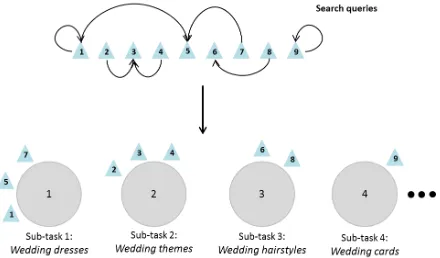
Figure 1: Visual formulation of the proposed approach. The ta-bles represent the different sub-tasks while each triangle represents the search queries. Query assignment leads to sub-task assignments.
wherein we iteratively draw from the conditional distribution of each latent variable, given the other latent variables and observations.
The Gibbs sampler iteratively draws from
p(znewi |z−i, x)∝p(zinew|D, α)
p(x|t(z−i∪zinew), G0) (2)
The first term is the dd-CRP prior and the second is the likelihood of observations (x) under the parti-tion, andt(z)is the sub-task formed from the assign-ments z. We employ a Dirichlet-Multinomial con-jugate distribution to model the likelihood of query terms.
Queries are assigned to sub-tasks by considering sets of queries that are reachable from each other through the query assignments. Notice that many configurations of query assignments might lead to the same sub-task assignment. Finally, query as-signments can produce a cycle, e.g., query 1 linking with 2 and query 2 linking with 1. This still deter-mines a valid sub-task assignment: all queries linked in a cycle are assigned to the same sub-task. Figure
1provides a pictorial representation of the sub-task assignment process.
4 Experimental Evaluation
In this section, we evaluate the robustness of the pro-posed sub-task extraction framework. In addition to qualitative analysis of the extracted sub-tasks, we perform a user judgment study to evaluate the qual-ity of the extracted sub-tasks.
4.1 Dataset & Baselines
We make use of the AOL log dataset which consists of 20M web queries collected over three months (Pass et al., 2006). The dataset comprises of five fields viz. the search query string, the query time stamp, the rank of the selected item (if any), the domain of the selected items URL (if any), and a unique user identifier. We augment on-task queries extracted from the AOL logs with the re-lated searches output from different search engines by making use of their APIs.
To compare the performance of the proposed sub-task extraction algorithm, we baseline against a number of methods including state-of-the-art task extraction systems, in addition to parametric and non-parametric clustering approaches:
1 QC-HTC(Lucchese et al., 2011): a frequently used search task identification method.
2 LDA(Blei et al., 2003): a topic model based baseline which aggregates queries (similar to tweet aggregation as proposed in (Mehrotra et al., 2013)) in a session to form a document and learns an LDA model on top of it.
3 vanilla-CRP: a vanilla non-parametric CRP model (Wang and Blei, 2009).
4 Proposed Approach: the proposed embedding based dd-CRP model.
4.2 Qualitative Evaluation
Proposed Approach LDA
sub-task 1 sub-task 2 sub-task 3 sub-task 1 sub-task 2 sub-task 3
wedding hairstyles used wedding dresses wedding card holders wedding insurance christian wedding vows make wedding invitations wedding hair dos colorful bridal gowns indian wedding program destination wedding brides wedding cakes pictures curly wedding hairstyles preowned wedding dresses wedding program wedding planning book cheap wedding dresses planners pictures of wedding hair wedding attire regency wedding cards party supply stores tea length wedding dresses wedding colors
CRP QC-HTC
sub-task 1 sub-task 2 sub-task 3 sub-task 1 sub-task 2 sub-task 3
wedding planning kit wedding theme wedding insurance wedding insurance christian wedding vows cheap dresses destination wedding wedding guide weddings in vegas destination wedding plus size bridesmaid wedding cakes pictures wedding table decorations save the date ideas wedding cakes pictures financing wedding rings wedding colors pricing weddings
[image:5.612.74.540.60.173.2]1930s wedding pictures wedding vacation planning a wedding party supply stores tea length wedding dresses wedding dresses discounts
Table 1: Qualitative Analysis of Sub-Tasks extracted by different approaches.
a single sub-task. Our proposed method, however, demonstrated remarkably good discriminant valid-ity, as is clear from Table1.
4.3 User Study
Evaluation of tasks and sub-tasks is an open research question. Owing to the absence of ground truth data on sub-task classification, we resort to user judg-ments in order to validate the quality of sub-tasks extracted. We select a sub-task at random and then choose a randomly selected pair of queries from that sub-task. Next, we ask the judges, recruited via AMT1, to affirm or deny if the two queries should
be assigned to the same sub-task category. We repeat this process for a total of 100 iterations and compare the results with the ones predicted by our proposed approach, as well as with the ones predicted by the baselines.
We report the proportion of correct matches (i.e. proportion of times our predicted sub-task classifica-tions matched the expert judgments) in Fig. 2. The label agreement among the judges was 85.4% and the performance differences were statistically sig-nificant. It is clear that our proposed method out-performs both, task extraction & topic model based baselines in making correct sub-task classifications.
5 Results & Discussion
Web search tasks are often complex and comprise several constituent sub-tasks. In this paper we of-fer a non-parametric Bayesian approach to identi-fying sub-tasks by grouping search queries using an embedding based dd-CRP approach. The pro-posed model combines insights from Bayesian non-parametrics and distributional semantics to extract
1https://www.mturk.com/mturk/welcome
Figure 2: Judgments results for sub-task validity across compared approaches.
sub-tasks which are not only meaningful but are also coherent. We evaluate our proposed method on the popular AOL search log dataset augmented with related search queries and demonstrate supe-riority over comparable approaches such as LDA and CRP. Further, we contend that our proposed ap-proach is significantly more useful in online environ-ments where the number of sub-tasks is never known apriori and impossible to ascertain or approximate.
In future work, we intend to consider hierarchi-cal extensions for extracting hierarchies of tasks-subtasks. Further, using an embedding based dis-tancing scheme, we offer an improvement in em-pirical performance over prior clustering approaches that have used either a bag-of-words or TF-IDF based solution. Our method offers search engine providers with a novel method to identify and an-alyze user task-behavior, and better support task de-cisions on their platforms.
Acknowledgments
[image:5.612.314.542.207.344.2]References
[Agichtein et al.2012] Eugene Agichtein, Ryen W White, Susan T Dumais, and Paul N Bennet. 2012. Search, interrupted: understanding and predicting search task continuation. InProceedings of the 35th international ACM SIGIR conference on Research and development in information retrieval, pages 315–324. ACM. [Blei and Frazier2011] David M Blei and Peter I Frazier.
2011. Distance dependent chinese restaurant pro-cesses. The Journal of Machine Learning Research, 12:2461–2488.
[Blei et al.2003] David M Blei, Andrew Y Ng, and Michael I Jordan. 2003. Latent dirichlet allocation.
the Journal of machine Learning research, 3:993– 1022.
[Donato et al.2010] Debora Donato, Francesco Bonchi, Tom Chi, and Yoelle Maarek. 2010. Do you want to take notes?: identifying research missions in yahoo! search pad. In Proceedings of the 19th international conference on World wide web, pages 321–330. ACM. [Hagen et al.2013] Matthias Hagen, Jakob Gomoll, Anna Beyer, and Benno Stein. 2013. From search session detection to search mission detection. InProceedings of the 10th Conference on Open Research Areas in In-formation Retrieval, pages 85–92.
[Jones and Klinkner2008] Rosie Jones and Kristina Lisa Klinkner. 2008. Beyond the session timeout: au-tomatic hierarchical segmentation of search topics in query logs. In Proceedings of the 17th ACM con-ference on Information and knowledge management, pages 699–708. ACM.
[Kelly et al.2013] Diane Kelly, Jaime Arguello, and Robert Capra. 2013. Nsf workshop on task-based information search systems. In ACM SIGIR Forum, volume 47, pages 116–127. ACM.
[Kotov et al.2011] Alexander Kotov, Paul N Bennett, Ryen W White, Susan T Dumais, and Jaime Teevan. 2011. Modeling and analysis of cross-session search tasks. InProceedings of the 34th international ACM SIGIR conference on Research and development in In-formation Retrieval, pages 5–14. ACM.
[Kusner et al.2015] M. J. Kusner, Y. Sun, N. I. Kolkin, and K. Q. Weinberger. 2015. From word embeddings to document distances. InICML.
[Li et al.2014] Liangda Li, Hongbo Deng, Anlei Dong, Yi Chang, and Hongyuan Zha. 2014. Identifying and labeling search tasks via query-based hawkes pro-cesses. InProceedings of the 20th ACM SIGKDD in-ternational conference on Knowledge discovery and data mining, pages 731–740. ACM.
[Liao et al.2012] Zhen Liao, Yang Song, Li-wei He, and Yalou Huang. 2012. Evaluating the effectiveness of
search task trails. InProceedings of the 21st interna-tional conference on World Wide Web, pages 489–498. ACM.
[Lucchese et al.2011] Claudio Lucchese, Salvatore Or-lando, Raffaele Perego, Fabrizio Silvestri, and Gabriele Tolomei. 2011. Identifying task-based ses-sions in search engine query logs. In Proceedings of the fourth ACM international conference on Web search and data mining, pages 277–286. ACM. [Mehrotra and Yilmaz2015a] Rishabh Mehrotra and
Em-ine Yilmaz. 2015a. Terms, topics & tasks: Enhanced user modelling for better personalization. In Proceed-ings of the 2015 International Conference on The The-ory of Information Retrieval, pages 131–140. ACM. [Mehrotra and Yilmaz2015b] Rishabh Mehrotra and
Em-ine Yilmaz. 2015b. Towards hierarchies of search tasks & subtasks. In Proceedings of the 24th Inter-national Conference on World Wide Web Companion, pages 73–74. International World Wide Web Confer-ences Steering Committee.
[Mehrotra et al.2013] Rishabh Mehrotra, Scott Sanner, Wray Buntine, and Lexing Xie. 2013. Improving lda topic models for microblogs via tweet pooling and automatic labeling. In Proceedings of the 36th in-ternational ACM SIGIR conference on Research and development in information retrieval, pages 889–892. ACM.
[Mehrotra et al.2014] Rishabh Mehrotra, Emine Yilmaz, and Manisha Verma. 2014. Task-based user mod-elling for personalization via probabilistic matrix fac-torization. InRecSys Posters.
[Mehrotra et al.2016] Rishabh Mehrotra, Prasanta Bhat-tacharya, and Emine Yilmaz. 2016. Characteriz-ing users’ multi-taskCharacteriz-ing behavior in web search. In
Proceedings of the 2016 ACM on Conference on Hu-man Information Interaction and Retrieval, CHIIR ’16, pages 297–300, New York, NY, USA. ACM. [Mikolov et al.2013] Tomas Mikolov, Ilya Sutskever, Kai
Chen, Greg S Corrado, and Jeff Dean. 2013. Dis-tributed representations of words and phrases and their compositionality. In Advances in neural information processing systems, pages 3111–3119.
[Morris et al.2008] Dan Morris, Meredith Ringel Morris, and Gina Venolia. 2008. Searchbar: a search-centric web history for task resumption and information re-finding. InProceedings of the SIGCHI Conference on Human Factors in Computing Systems, pages 1207– 1216. ACM.
[Pass et al.2006] Greg Pass, Abdur Chowdhury, and Cay-ley Torgeson. 2006. A picture of search. InInfoScale, volume 152, page 1.
Multitasking web search on vivisimo. com. In In-formation Technology: Coding and Computing, 2005. ITCC 2005. International Conference on, volume 2, pages 486–490. IEEE.
[Sun et al.2015] Ming Sun, Yun-Nung Chen, and Alexan-der I Rudnicky. 2015. UnAlexan-derstanding users cross-domain intentions in spoken dialog systems. InNIPS Workshop on Machine Learning for SLU and Interac-tion.
[Verma and Yilmaz2014] Manisha Verma and Emine Yil-maz. 2014. Entity oriented task extraction from query logs. In Proceedings of the 23rd ACM International Conference on Conference on Information and Knowl-edge Management, pages 1975–1978. ACM.
[Wang and Blei2009] Chong Wang and David M Blei. 2009. Variational inference for the nested chinese restaurant process. InAdvances in Neural Information Processing Systems, pages 1990–1998.