Response-based Learning for Machine Translation
of Open-domain Database Queries
Carolin Haas
Computational Linguistics Heidelberg University 69120 Heidelberg, Germany
Stefan Riezler
Computational Linguistics Heidelberg University 69120 Heidelberg, Germany
Abstract
Response-based learning allows to adapt a sta-tistical machine translation (SMT) system to an extrinsic task by extracting supervision sig-nals from task-specific feedback. In this pa-per, we elicit response signals for SMT adap-tation by executing semantic parses of trans-lated queries against the Freebase database. The challenge of our work lies in scaling se-mantic parsers to the lexical diversity of open-domain databases. We find that parser perfor-mance on incorrect English sentences, which is standardly ignored in parser evaluation, is key in model selection. In our experiments, the biggest improvements in F1-score for re-turning the correct answer from a semantic parse for a translated query are achieved by selecting a parser that is carefully enhanced by paraphrases and synonyms.
1 Introduction
In response-based learning for SMT, supervision signals are extracted from an extrinsic response to a machine translation, in contrast to using human-generated reference translations for supervision. We apply this framework to a scenario in which a se-mantic parse of a translated database query is exe-cuted against the Freebase database. We view learn-ing from such task-specific feedback as adaptation of SMT parameters to the task of translating open-domain database queries, thereby grounding SMT in the task of multilingual database access. The success criterion for this task is F1-score in returning the cor-rect answer from a semantic parse of the translated query, rather than BLEU. Since the semantic parser
provides feedback to the response-based learner and defines the final evaluation criterion, the challenge of the presented work lies in scaling the seman-tic parser to the lexical diversity of open-domain databases such as Freebase. Riezler et al. (2014) showed how to use response-based learning to adapt an SMT system to a semantic parser for the Geo-query domain. The state-of-the-art in semantic pars-ing on Geoquery achieves a parspars-ing accuracy of over 82% (see Andreas et al. (2013) for an overview), while the state-of-the-art in semantic parsing on the Free917 data (Cai and Yates, 2013) achieves 68.5% accuracy (Berant and Liang, 2014). This is due to the lexical variability of Free917 (2,036 word types) compared to Geoquery (279 word types).
glish queries needs to be taken into account, which is standardly ignored in parser evaluation. That is, for the purpose of parsing translated queries, a parser should retrieve correct answers for correct English queries (true positives), and must not retrieve cor-rect answers for incorcor-rect translations (false posi-tives). In order to measure false discovery rate, we prepare a test set of manually verified incorrect glish in addition to a standard test set of original En-glish queries. We show that if false discovery rate on incorrect English queries is taken into account in model selection, the semantic parser that yields best results for response-based learning in SMT can be found reliably.
2 Related Work
Our work is most closely related to Riezler et al. (2014). We extend their application of response-based learning for SMT to a larger and lexically more diverse dataset and show how to perform model selection in the environment from which re-sponse signals are obtained. In contrast to their work where a monolingual SMT-based approach (Andreas et al., 2013) is used as semantic parser, our work builds on existing parsers for Freebase, with a focus on exploiting paraphrasing and synonym ex-tension for scaling semantic parsers to open-domain database queries.
Response-based learning has been applied in pre-vious work to semantic parsing itself (Kwiatowski et al. (2013), Berant et al. (2013), Goldwasser and Roth (2013),inter alia). In these works, extrinsic re-sponses in form of correct answers from a database are used to alleviate the problem of manual data an-notation in semantic parsing. Saluja et al. (2012) in-tegrate human binary feedback on the quality of an SMT system output into a discriminative learner.
Further work on learning from weak supervision signals has been presented in the machine learning community, e.g., in form of coactive learning (Shiv-aswamy and Joachims, 2012), reinforcement learn-ing (Sutton and Barto, 1998), or online learnlearn-ing with limited feedback (Cesa-Bianchi and Lugosi, 2006). 3 Response-based Online SMT Learning We denote by φ(x, y) a joint feature representa-tion of input sentences x and output translations
Algorithm 1Response-based Online Learning repeat
fori= 1, . . . , ndo
Receive input stringx(i) Predict translationyˆ
Receive task feedback e(ˆy)∈ {1,0}
ife(ˆy) = 1then y+ ←yˆ
Storeyˆas referencey(i)forx(i) Computey−
else
y− ←yˆ
Receive referencey(i) Computey+
end if
w←w+η(φ(x(i), y+)−φ(x(i), y−))
end for untilConvergence
y ∈ Y(x), and bys(x, y;w) = hw, φ(x, y)i a lin-ear scoring function for predicting a translation y.ˆ
A response signal is denoted by a binary function e(y)∈ {1,0}that executes a semantic parse against the database and checks whether it receives the same answer as the gold standard parse. Furthermore, a cost function c(y(i), y) = (1−BLEU(y(i), y))based on sentence-wise BLEU (Nakov et al., 2012) is used. Algorithm 1, called “Response-based Online Learn-ing” in Riezler et al. (2014), is based on contrast-ing a “positive” translationy+that receives positive feedback, has a high model score, and a low cost of predictingyinstead ofy(i), with a “negative” trans-lationy−that leads to negative feedback, has a high
model score, and a high cost: y+ = arg max
y∈Y(x(i)):e(y)=1
s(x(i), y;w)−c(y(i), y), y− = arg max
y∈Y(x(i)):e(y)=0
s(x(i), y;w) +c(y(i), y).
The central algorithm operates as follows: The SMT system predicts translationy, and in case of positiveˆ
task feedback, the prediction is accepted and stored as positive example by setting y+ ← y. In thatˆ case,y− needs to be computed in order to perform
vector. If the feedback is negative, the prediction is treated asy− andy+ needs to be computed for the update. If eithery+ory−cannot be computed, the
example is skipped.
4 Scaling Semantic Parsing to Open-domain Database Queries
The main challenge of grounding SMT in tic parsing for Freebase lies in scaling the seman-tic parser to the lexical diversity of the open-domain database. Our baseline system is the parser of Berant et al. (2013), calledSEMPRE. We first consider the approach presented by Berant and Liang (2014) to scale the baseline to open-domain database queries: In their system, called PARASEMPRE, pairs of logi-cal forms and utterances are generated from a given query and the database, and the pair whose utterance best paraphrases the input query is selected. These new pairs of queries and logical forms are added as ambiguous labels in training a model from query-answer pairs.
Following a similar idea of extending parser cov-erage by paraphrases, we extend the training set with synonyms from WordNet. This is done by iterat-ing over the queries in the FREE917 dataset. To ensure that the replacement is sensible, each sen-tence is first POS tagged (Toutanova et al., 2003) and WordNet lookups are restricted to matching POS be-tween synonym and query words, for nouns, verbs, adjectives and adverbs. Lastly, in order to limit the number of retrieved words, a WordNet lookup is performed by carefully choosing from the first three synsets which are ordered from most common to least frequently used sense. Within a synset all words are taken. The new training queries are ap-pended to the training portion of FREE917.
5 Model Selection
The most straightforward strategy to perform model selection for the task of response-based learning for SMT is to rely on parsing evaluation scores that are standardly reported in the literature. However, as we will show experimentally, if precision is taken as the percentage of correct answers out of instances for which a parse could be produced, recall as the percentage of total examples for which a correct an-swer could be found, and F1 score as their harmonic
mean, the metrics are not appropriate for model se-lection in our case. This is because for our goal of learning the language of correct English database queries from positive and negative parsing feedback, the semantic parser needs to be able to parse and re-trieve correct answers for correct database queries, but it must not do so for incorrect queries.
However, information about incorrect queries is ignored in the definition of the metrics given above. In fact, retrieving correct answers for incorrect database queries hurts response-based learning for SMT. The problem lies in the incomplete nature of semantic parsing databases, where terms that are not parsed into logical forms in one context make a crucial difference in another context. For exam-ple in Geoquery, the gold standard queries “Peo-ple in Boulder?” and “Number of peo“Peo-ple in Boul-der?” parse into the same logical form, however, the queries “Give me the cities in Virginia” and “Give me the number of cities in Virginia” have dif-ferent parses and difdif-ferent answers. While in the first case, for example in German-to-English transla-tion of database queries, the German “Anzahl” may be translated incorrectly without consequences, it is crucial to translate the term into “number” in the second case. On an example from Free917, the SMT system translates the German “Steinformatio-nen” into “kind of stone”, which is incorrect in the geological context, where it should be “rock forma-tions”. If during response-based learning, the error slips through because of an incomplete parse lead-ing to the correct answer, it might hurt on the test data. Negative parser feedback for incorrect transla-tions is thus crucial for learning how to avoid these cases in response-based SMT.
In order to evaluate parsing performance on in-correct translations, we need to extend standard evaluation data of correct English database queries with evaluation data of incorrect English database queries. For this purpose, we took translations of an out-of-domain SMT system that were judged ei-ther grammatically or semantically incorrect by the authors to create a dataset of negative examples. On this dataset, we can definetrue positives (TP)as cor-rect English queries that were given a corcor-rect an-swer by the semantic parser, andfalse positives (FP)
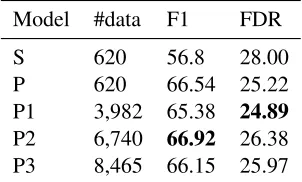
Model #data F1 FDR
S 620 56.8 28.00
P 620 66.54 25.22
[image:4.612.110.261.61.152.2]P1 3,982 65.38 24.89 P2 6,740 66.92 26.38 P3 8,465 66.15 25.97
Table 1: Parsing F1 scores and False Discovery Rate (FDR) for SEMPRE (S), PARASEMPRE (P), and exten-sions of the latter with synonyms from first one (P1), first two (P2) and first three (P3) synsets, evaluated on the FREE917 test set of correct database queries for F1
and including the test set of incorrect database queries for FDR, and trained on #data training queries. Best results are indicated inbold face.
discovery rate (FDR) (Murphy, 2012), defined as
FP/FP+TP, i.e., as the ratio of false positives out of all positive answer retrieval events.
6 Experiments
We use a data dump of Freebase1 which was has
been indexed by the Virtuoso SPARQL engine2 as
our knowledge base. The corpus used in the ex-periments is the FREE917 corpus as assembled by Cai and Yates (2013) and consists of 614 training and 276 test queries in English and corresponding logical forms.3 The dataset of negative examples,
i.e., incorrect English database queries that should receive incorrect answers, consists of 166 examples that were judged either grammatically or semanti-cally incorrect by the authors.
The translation of the English queries in FREE917 into German, in order to provide a set of source sentences for SMT, was done by the au-thors. The SMT framework used is CDEC (Dyer et al., 2010) with standard dense features and ad-ditional sparse features as described in Simianer et al. (2012)4. Training of the baseline SMT system
was performed on the COMMON CRAWL5 (Smith
1http://www.freebase.com/
2http://virtuoso.openlinksw.com/
3Note that we filtered out 33 questions (21 from the training
set and 12 from the test set) because their logical forms only returned an empty string as an answer.
4https://github.com/pks/cdec-dtrain 5http://www.statmt.org/wmt13/
training-parallel-commoncrawl.tgz
et al., 2013) dataset consisting of 7.5M parallel English-German segments extracted from the web. Response-based learning for SMT uses the code de-scribed in Riezler et al. (2014)6.
For semantic parsing we use the SEMPRE and PARASEMPREtools of Berant et al. (2013) and Be-rant and Liang (2014) which were trained on the training portion of the FREE917 corpus7. Further models use the training data enhanced with syn-onyms from WordNet as described in Section 4. Fol-lowing Jones et al. (2012), we evaluate semantic parsers according to precision, defined as the per-centage of correctly answered examples out of those for which a parse could be produced,recall, defined as the percentage of total examples answered cor-rectly, and F1-score, defined as harmonic mean of precision and recall. Furthermore, we report false discovery rate (FDR) on the combined set of 276 correct and 166 incorrect database queries.
Table 1 reports standard parsing evaluation metrics for the different parsers SEMPRE (S), PARASEMPRE(P), and extensions of the latter with synonyms from the first one (P1), first two (P2) and first three (P3) synsets which are ordered according to frequency of use of the sense. As shown in the second column, the size of the training data is in-creased up to 10 times by using various synonym ex-tensions. As shown in the third column, PARASEM -PREimproves F1 by nearly 10 points over SEMPRE. Another 0.5 points are added by extending the train-ing data ustrain-ing two synsets. The third column shows that the system P1 that scored second-worst in terms of F1 score, scores best under the FDR metric8.
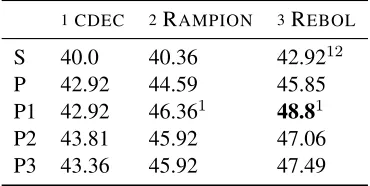
Table 2 shows an evaluation of the use of differ-ent parsing models to retrieve correct answers from the FREE917 test set of correct database queries. The systems are applied to translated queries, but evaluated in terms of standard parsing metrics. Sta-tistical significance is measured using an Approxi-mate Randomization test (Noreen, 1989; Riezler and Maxwell, 2005). The baseline system isCDECas de-scribed above. It never sees the FREE917 data dur-ing traindur-ing. As a second baseline method we use a stochastic (sub)gradient descent variant of RAM -PION (Gimpel and Smith, 2012). This system is
6https://github.com/pks/rebol
1CDEC 2RAMPION 3REBOL
S 40.0 40.36 42.9212
P 42.92 44.59 45.85
P1 42.92 46.361 48.81
P2 43.81 45.92 47.06
[image:5.612.93.278.61.154.2]P3 43.36 45.92 47.49
Table 2: Parsing F1 score on FREE917 test set of trans-lated database queries using different parser models to provide response for translated queries. Best results are indicated inbold face. Statistical significance of result differences atp < 0.05are indicated by algorithm num-ber in superscript.
CDEC RAMPION REBOL
F1 0.85 0.29 0.1
[image:5.612.99.272.252.302.2]FDR -0.21 -0.58 -0.7
Table 3: Spearman correlation between F1 / FDR from Table 1 andCDEC/ RAMPION/ REBOLF1 from Table 2.
trained by using the correct English queries in the FREE917 training data as references. NeitherCDEC norRAMPION use parser feedback in training. RE -BOL (Response-based Online Learning) is an im-plementation of Algorithm 1 described in Section 3. This algorithm makes use of positive parser feed-back to convert predicted translation into references, in addition to using the original English queries as references. Training for bothRAMPIONandREBOL is performed for 10 epochs over the FREE917 train-ing set, ustrain-ing a constant learntrain-ing rate η that was chosen via cross-validation. All methods then pro-ceed to translate the FREE917 test set. Best results in Table 2 are obtained by using an extension of PARASEMPREwith one synset as parser in response-based learning with REBOL. This parsing system scored best under the FDR metric in Table 1.
Table 3 shows the Spearman rank correlation (Siegel and Castellan, 1988) between the F1 / FDR ranking of semantic parsers from Table 1 and their contribution to F1 scores in Table 2 for parsing query translations of CDEC, RAMPION or REBOL. The system CDEC cannot learn from parser perfor-mance based on query translations, thus best results on translated queries correlate positively with good parsing F1 score per se. RAMPION can implicitly
take advantage of parsers with good FDR score since learning to move away from translations dissimilar to the reference is helpful if they do not lead to correct answers. REBOL can make the best use of parsers with low FDR score since it can learn to pre-vent incorrect translations from hurting parsing per-formance at test time.
7 Conclusion
We presented an adaptation of SMT to translating open-domain database queries by using feedback of a semantic parser to guide learning. Our work high-lights an important aspect that is often overlooked in parser evaluation, namely that parser model selec-tion in real-world applicaselec-tions needs to take the pos-sibility of parsing incorrect language into account. We found that for our application of response-based learning for SMT, the key is to learn to prevent cases where the correct answer is retrieved despite the translation being incorrect. This can be avoided by performing model selection on semantic parsers that parse and retrieve correct answers for correct database queries, but do not do retrieve correct an-swers for incorrect queries.
In our experiments, we found that the parser that contributes most to response-based learning in SMT is one that is carefully extended by paraphrases and synonyms. In future work, we would like to investi-gate additional techniques for paraphrasing and syn-onym extension. For example, a good fit for our task of response-based learning for SMT might be Ban-nard and Callison-Burch (2005)’s approach to para-phrasing via pivoting on SMT phrase tables. Acknowledgments
This research was supported in part by DFG grant RI-2221/2-1 “Grounding Statistical Machine Trans-lation in Perception and Action”.
References
Jacob Andreas, Andreas Vlachos, and Stephen Clark. 2013. Semantic parsing as machine translation. In
Proceedings of the 51st Annual Meeting of the Associ-ation for ComputAssoci-ational Linguistics (ACL’13), Sofia, Bulgaria.
Proceed-ings of the 43rd Annual Meeting of the Association for Computational Linguistics (ACL’05), Ann Arbor, MI. Jonathan Berant and Percy Liang. 2014. Semantic
pars-ing via paraphraspars-ing. InProceedings of the 52nd An-nual Meeting of the Association for Computational Linguistics (ACL 2014), Baltimore, MD.
Jonathan Berant, Andrew Chou, Roy Frostig, and Percy Liang. 2013. Semantic parsing on freebase from question-answer pairs. In Proceedings of the 2013 Conference on Empirical Methods in Natural Lan-guage Processing (EMNLP’13), Seattle, WA.
Qingqing Cai and Alexander Yates. 2013. Large-scale semantic parsing via schema matching and lexicon ex-tenstion. In Proceedings of the 51st Annual Meet-ing of the Association for Computational LMeet-inguistics (ACL’13), Sofia, Bulgaria.
Nicol`o Cesa-Bianchi and G`abor Lugosi. 2006. Predic-tion, Learning, and Games. Cambridge University Press.
Chris Dyer, Adam Lopez, Juri Ganitkevitch, Johnathan Weese, Ferhan Ture, Phil Blunsom, Hendra Setiawan, Vladimir Eidelman, and Philip Resnik. 2010. cdec: A decoder, alignment, and learning framework for finite-state and context-free translation models. In Proceed-ings of the 48th Annual Meeting of the Association for Computational Linguistics (ACL’10), Uppsala, Swe-den.
Kevin Gimpel and Noah A. Smith. 2012. Structured ramp loss minimization for machine translation. In
Proceedings of the 2012 Conference of the North American Chapter of the Association for Computa-tional Linguistics: Human Language Technologies (HLT-NAACL’12), Stroudsburg, PA.
Dan Goldwasser and Dan Roth. 2013. Learning from natural instructions. Machine Learning, 94(2):205– 232.
Bevan K. Jones, Mark Johnson, and Sharon Goldwater. 2012. Semantic parsing with bayesion tree transduc-ers. InProceedings of the 50th Annual Meeting of the Association for Computational Linguistics (ACL’12), Jeju Island, Korea.
Tom Kwiatowski, Eunsol Choi, Yoav Artzi, and Luke Zettlemoyer. 2013. Scaling semantic parsers with on-the-fly ontology matching. In Proceedings of the 2013 Conference on Empirical Methods in Natural Language Processing (EMNLP’13), Seattle, WA. George A. Miller. 1995. Wordnet: A lexical database for
english. Communications of the ACM, 38(11):39–41. Kevin P. Murphy. 2012. Machine Learning. A
Proba-bilistic Perspective. The MIT Press.
Preslav Nakov, Francisco Guzm´an, and Stephan Vogel. 2012. Optimizing for sentence-level bleu+1 yields
short translations. In Proceedings of the 24th In-ternational Conference on Computational Linguistics (COLING 2012), Bombay, India.
Eric W. Noreen. 1989. Computer Intensive Methods for Testing Hypotheses: An Introduction. Wiley, New York.
Stefan Riezler and John Maxwell. 2005. On some pit-falls in automatic evaluation and significance testing for MT. InProceedings of the ACL-05 Workshop on Intrinsic and Extrinsic Evaluation Measures for MT and/or Summarization, Ann Arbor, MI.
Stefan Riezler, Patrick Simianer, and Carolin Haas. 2014. Response-based learning for grounded machine trans-lation. In Proceedings of the 52nd Annual Meeting of the Association for Computational Linguistics (ACL 2014), Baltimore, MD.
Avneesh Saluja, Ian Lane, and Ying Zhang. 2012. Machine translation with binary feedback: A large-margin approach. InProceedings of the 10th Biennial Conference of the Association for Machine Translation in the Americas (AMTA’12), San Diego, CA.
Pannaga Shivaswamy and Thorsten Joachims. 2012. On-line structured prediction via coactive learning. In
Proceedings of the 29th International Conference on Machine Learning (ICML’12), Scotland, UK.
Sidney Siegel and John Castellan. 1988. Nonparametric Statistics for the Behavioral Sciences. Second Edition. MacGraw-Hill, Boston, MA.
Patrick Simianer, Stefan Riezler, and Chris Dyer. 2012. Joint feature selection in distributed stochastic learn-ing for large-scale discriminative trainlearn-ing in SMT. In
Proceedings of the 50th Annual Meeting of the Asso-ciation for Computational Linguistics (ACL’12), Jeju Island, South Korea.
Jason Smith, Herve Saint-Amand, Magdalena Plamada, Philipp Koehn, Chris Callison-Burch, and Adam Lopez. 2013. Dirt cheap web-scale parallel text from the Common Crawl. InProceedings of the 51st Annual Meeting of the Association for Computational Linguis-tics (ACL’13), Sofia, Bulgaria.