Data-driven, PCFG-based and Pseudo-PCFG-based Models for Chinese
Dependency Parsing
Weiwei Sun and Xiaojun Wan
Institute of Computer Science and Technology, Peking University The MOE Key Laboratory of Computational Linguistics, Peking University
{ws,wanxiaojun}@pku.edu.cn
Abstract
We present a comparative study of transition-, graph- and PCFG-based models aimed at il-luminating more precisely the likely contri-bution of CFGs in improving Chinese depen-dency parsing accuracy, especially by com-bining heterogeneous models. Inspired by the impact of a constituency grammar on de-pendency parsing, we propose several strate-gies to acquire pseudo CFGs only from de-pendency annotations. Compared to linguistic grammars learned from rich phrase-structure treebanks, well designed pseudo grammars achieve similar parsing accuracy and have equivalent contributions to parser ensemble. Moreover, pseudo grammars increase the di-versity of base models; therefore, together with all other models, further improve sys-tem combination. Based on automatic POS tagging, our final model achieves a UAS of 87.23%, resulting in a significant improve-ment of the state of the art.
1 Introduction
Popular approaches to dependency parsing can be divided into two classes: grammar-free and grammar-based. Data-driven, grammar-free ap-proaches make essential use of machine learning from linguistic annotations in order to parse new sentences. Such approaches, e.g. transition-based (Nivre, 2008) and graph-based (McDonald, 2006; Torres Martins et al.,2009) have attracted the most attention in recent years. In contrast, grammar-based approaches rely on linguistic grammars (in either dependency or constituency formalisms) to shape the search space for possible syntactic anal-ysis. In particular, CFG-based dependency parsing
exploits a mapping between dependency and con-stituency representations and reuses parsing algo-rithms developed for CFG to produce dependency structures. In previous work, data-driven, discrim-inative approaches have been widely discussed for Chinese dependency parsing. On the other hand, various PCFG-based constituent parsing methods have been applied to obtain phrase-structures as well. With rich linguistic rules, phrase-structures of Chinese sentences can be well transformed to their corresponding dependency structures (Xue, 2007). Therefore, PCFG parsers with such conversion rules can be taken as another type of dependency parser. We call them PCFG-based parsers, in this paper.
Explicitly defining linguistic rules to express precisely generic grammatical regularities, a con-stituency grammar can be applied to arrange sen-tences into a hierarchy of nested phrases, which de-termines constructions between larger phrases and their smaller component phrases. This type of infor-mation is different from, but highly related to, the information captured by a dependency representa-tion. A constituency grammar, thus, has great possi-ble contributions to dependency parsing. In order to pave the way for new and better methods, we study the impact of CFGs on Chinese dependency parsing. A series of empirical analysis of state-of-the-art graph-, transition-and PCFG-based parsers is presented to illuminate more precisely the properties of heterogeneous models. We show that CFGs have a great impact on dependency parsing and PCFG-based models have complementary predictive pow-ers to data-driven models.
System ensemble is an effective and important technique to build more accurate parsers based on multiple, diverse, weaker models. Exploiting
ent data-driven models, e.g. transition- and graph-based models, has received the most attention in dependency parser ensemble (Nivre and McDon-ald, 2008; Torres Martins et al., 2008; Sagae and Lavie, 2006). Only a few works investigate inte-grating data-driven and PCFG-based models (Mc-Donald,2006). We argue that grammars can signif-icantly increase the diversity of base models, which plays a central role in parser ensemble, and therefore lead to better and more promising hybrid systems.
We introduce a general classifier enhancing tech-nique, i.e. bootstrap aggregating(Bagging), to im-prove dependency parsing accuracy. This technique can be applied to enhance a single-view parser, or to combine multiple heterogeneous parsers. Exper-iments on the CoNLL 09 shared task data demon-strate its effectiveness: (1) Bagging can improve in-dividual single-view parsers, especially the PCFG-based one; (2) Bagging is more effective than pre-viously introduced ensemble methods to combine multi-view parsers; (3) Integrating data-driven and PCFG-based models is more useful than combining different data-driven models.
Although PCFG-based models have a big con-tribution to data-driven dependency parsing, they have a serious limitation: There are no corre-sponding constituency annotations for some depen-dency treebanks, e.g. Chinese Dependepen-dency Tree-bank (LDC2012T05). To overcome this limita-tion, we propose several strategies to acquire pseudo grammars only from dependency annotations. In particular, dependency trees are converted to pseudo constituency trees and PCFGs can be extracted from such trees. Another motivation of this study is to in-crease the diversity of candidate models for parser ensemble. Experiments show that pseudo-PCFG-based models are very competitive: (1) Pseudo grammars achieve similar or even better parsing re-sults than linguistic grammars learned from rich constituency annotations; (2) Compared to linguistic grammars, well designed, single-view pseudo gram-mars have an equivalent contribution to parser en-semble; (3) Combining different pseudo grammars even work better for ensemble than linguistic gram-mars; (4) Pseudo-PCFG-based models increase the diversity of base models, and therefore lead to fur-ther improvements for ensemble.
Based on automatic POS tagging, our final model
achieves a UAS of 87.23% on the CoNLL data and 84.65% on CTB5, which yield relative error reduc-tions of 18-24% over the best published results in the literature.
2 Background and related work
2.1 Data-driven dependency parsing
The mainstream work on recent dependency pars-ing focuses on data-driven approaches that automat-ically learn to produce dependency graphs for sen-tences solely from a hand-crafted dependency tree-bank. The advantage of such models is that they are easily ported to any language in which labeled linguistic resources exist. Practically all statisti-cal models that have been proposed in recent years can be mainly described as either graph-based or
transition-based(McDonald and Nivre,2007). Both models have been adopted to learn Chinese depen-dency structures (Zhang and Clark, 2011; Zhang and Nivre, 2011; Huang and Sagae, 2010; Hatori et al., 2011; Li et al., 2011, 2012). According to published results, graph-based and transition-based parsers achieve similar accuracy.
In the graph-based framework, informative evalu-ation results have been presented in (Li et al.,2011). First, second and third order projective parsing mod-els are well evaluated. In the transition-based frame-work, two advanced techniques have been stud-ied. First, developing features has been shown crucial to advancing parsing accuracy and a very rich feature set is carefully evaluated byZhang and Nivre(2011). Second, beyond deterministic greedy search, principled dynamic programming strategies can be employed to explore more possible hypothe-ses (Huang and Sagae,2010). Both techniques have been examined and shown helpful for Chinese de-pendency parsing. Furthermore,Hatori et al.(2011) combined both and obtained a state-of-the-art super-vised parsing result.
2.2 PCFG-based dependency parsing
of dependencies from phrase structures. The ad-vantage of constituency-grammar-based approach is that all the well-studied parsing methods for such grammars can be used for dependency parsing as well. Two language-specific properties essentially make PCFG-based approaches easy to be applied to Chinese dependency parsing: (1) Chinese gram-maticians favor using projective structures;1(2) Chi-nese phrase-structure annotations normally contain richer information and thus are reliable for tree con-version.
2.2.1 Constituency parsing
Compared to many other languages, statistical constituent parsing for Chinese has reached early success, due to the fact that the language has rela-tively fixed word order and extremely poor inflec-tional morphology. Both facts allow PCFG-based statistical modeling to perform well. For the con-stituent parsing, the majority of the state-of-the-art parsers are based on generative PCFG learn-ing. For example, the well-known and success-ful Collins and Charniak&Johnson parsers (Collins, 2003;Charniak,2000;Charniak and Johnson,2005) implement generative lexicalized statistical models. Apart from lexicalized PCFG parsing, unlex-icalized parsing with latent variable grammars (PCFGLA) can also produce comparable accuracy (Matsuzaki et al.,2005;Petrov et al.,2006). Latent variable grammars model an observed treebank of coarse parse trees with a model over more refined, but unobserved, derivation trees that represent much more complex syntactic processes. Rather than attempting to manually specify fine-grained cate-gories, previous work shows that automatically in-ducing the sub-categories from data can work quite well. A PCFGLA parser leverages on an automatic procedure to learn refined grammars and are there-fore more robust to parse non-English languages that are not well studied. For Chinese, such a parser achieves the state-of-the-art performance and de-feats many other types of parsers, including Collins as well as Charniak parser (Che et al., 2012) and
1For example, as two popular dependency treebanks, the
CoNLL 2009 data and the Chinese Dependency Treebank both excluede non-projective annotations. It is worth noting that the former one is converted from a constituency treebank while the latter one is directly annotated by lingusitics.
discriminative transition-based models (Zhang and Clark,2009).
2.2.2 CS to DS conversion
In the absence of dependency and constituency structures for a particular treebank, treebank-guided parser developers normally apply rich linguistic rules to convert one representation formalism to an-other to get necessary data to train parsers. Xue (2007) examines the linguistic adequacy of depen-dency structure annotation automatically converted from phrase structure treebanks with rule-based ap-proaches. A structural approach is introduced for the constituency structure (CS) to dependency struc-ture (DS) conversion for the Chinese Treebank data, which is the basis of the CoNLL 2009 shared task data. By applying this conversion procedure on the outputs of an automatic phrase structure parser, we can build a PCFG-based dependency parser.
2.3 Parser ensemble
NLP systems built on particular single views nor-mally capture different properties of an original problem, and therefore differ in predictive powers. As a result, NLP systems can take advantage of com-plementary strengths of multiple views. Combining the outputs of several systems has been shown in the past to improve parsing performance significantly, including integrating phrase-structure parsers (Hen-derson and Brill,1999), dependency parsers (Nivre and McDonald, 2008), or both (McDonald, 2006). Several ensemble models have been proposed for the parsing of syntactic constituents and dependen-cies, including learning-based stacking (Nivre and McDonald, 2008;Torres Martins et al., 2008) and learning-free post-inference (Henderson and Brill, 1999;Sagae and Lavie,2006). Surdeanu and Man-ning (2010) present a systematic analysis of these ensemble methods and find several non-obvious facts:
• the diversity of base parsers is more important than complex models for learning, and
3 A comparative analysis of heterogeneous parsers
The information encoded in a dependency repre-sentation is different from the information captured in a constituency representation. While the depen-dency structure represents head-dependent relations between words, the constituency structure repre-sents the grouping of words into phrases, classified by structural categories. These differences concern what is explicitly encoded in the respective represen-tations, and affects data-driven and PCFG-based de-pendency parsing models substantially. In this sec-tion, we give a comparative analysis of transition-, graph- and PCFG-based models aimed at illuminat-ing more precisely the likely contribution of CFGs in dependency parsing.
3.1 Experimental setup
Penn Chinese TreeBank (CTB) is a segmented, POS tagged, and fully bracketed corpus in the con-stituency formalism, and very popular to evaluate fundamental NLP tasks, including word segmenta-tion, POS tagging, constituent parsing as well as de-pendency parsing. We use CTB 6 as our main corpus and define the training, development and test sets ac-cording to the CoNLL 2009 shared task. To evaluate and analyze dependency parsers, we directly use the CoNLL data. CTB’s syntactic annotations also in-cludes functional information and empty categories. Modern parsers, e.g. Collins and Berkeley parsers, ignore these types of linguistic knowledge. To train a constituent parser, we perform a heuristic proce-dure on the treebank data to delete function tags and empty categories as well as its associated redundant ancestors. Many papers reported parsing results of an older version CTB (namely CTB 5). To compare with systems introduced in these papers, we evaluate our final ensemble model on CTB5 in Section5.4.
For dependency parsing, we choose a second order graph-based parser2 (Bohnet, 2010) and a transition-based parser (Hatori et al., 2011), for experiments. For constituent parsing, we choose Berkeley parser,3 a well known implementation of the unlexicalized PCFGLA model and Bikel parser,4
2code.google.com/p/mate-tools/ 3code.google.com/p/berkeleyparser/ 4cis.upenn.edu/˜dbikel/software.html
a well known implementation of Collins’ lexical-ized model, for experiments. In data-driven pars-ing, features consisting of POS tags are very effec-tive, so typically POS tagging is performed as a pre-processing. We use the baseline sequential tagger described in (Sun and Uszkoreit, 2012) to provide such lexical information to the graph-based parser. Note that the transition-based parser performs a joint inference to acquire POS and dependency informa-tion simultaneously, so there is no need to offer extra tagging results to it.
3.2 Overall performance
Table1(Column 2-6) summarizes the overall accu-racy of different parsers. Two transition-based pars-ing results are presented: The first one employ a simple feature set (Zhang and Clark, 2008) and a small beam (16); the second one employ rich fea-tures (Zhang and Nivre, 2011) and a larger beam (32). Two graph-based parsing results are reported; the difference between them is whether integrate re-lation labels into the parsing procedure. Roughly speaking, currently state-of-the-art data-driven mod-els achieves slightly better precision than unlexical-ized PCFG-based models with regard to unlabeled dependency prediction.
There is a big gap between lexicalized and unlexi-calized parsing. The same phenomenon has been ob-served by (Che et al.,2012) and (Zhuang and Zong, 2010). In addition to dependency parsing,Zhuang and Zong (2010) found that Berkeley parser pro-duce much more accurate syntactic analyses to assist a Chinese semantic role labeler than Bikel parser. Charniak and Stanford parsers are two other well-known and frequently used tools that can provide lexicalized parsing results. According to (Che et al., 2012), they perform even worse than Bikel parser, at least for Stanford dependencies. Due to the poor parsing performance, we only concentrate on the un-lexicalized model in the remainder of this paper.
Devel. UAS LAS Compl. Fsib Fgrd
Tran[b=16,Z08] 82.80 N/A 29.00 66.55 79.74
Tran[b=32,Z11] 83.80 N/A 31.61 68.58 80.87
Graph[-lab] 83.66 N/A 29.28 67.96 80.82
Graph[+lab] 84.24 80.55 30.99 69.11 81.38
Unlex 82.86 67.44 27.98 69.07 81.22
Lex 70.38 58.10 - - - -
-Bagging(15)
Tran[b=16,Z08] 83.25 N/A 28.66 67.17 78.89
Tran[b=32,Z11] 84.25 N/A 31.21 69.14 81.49
Graph[-lab] 83.81 N/A 29.68 68.00 80.62
Graph[+lab] 84.50 N/A 31.44 69.48 81.10
Unlex 84.92 N/A 32.35 71.08 83.66
Bagging(8)
[image:5.612.73.299.52.225.2]Unlex 84.35 N/A 31.16 70.49 83.57
Table 1: Accuracy of different parsers. The first block presents baseline parsers; the last two blocks present Bagging-enhanced parsers, wheremis respectively set to 15and8. Z08andZ11distinguish different feature sets; b=16andb=32are beam sizes.+/-labmeans whether to incorporate relation labels to a model.
structures, and an extra statistical classifier can be employed to label automatically recognized depen-dencies with a high accuracy. Although this issue is not well studied for Chinese dependency parsing, previous research on function tag labeling (Sun and Sui,2009) and semantic role labeling (Sun,2010a) gives us some clues. Their research shows that both functional and predicate-argument structural infor-mation is relatively easy to predict if high-quality syntactic parses are available. We mainly focus on the UAS metric in the following experiments.
3.3 Constraints
A grammar-based model utilizes an explicitly de-fined formal grammar to shape the search space for possible syntactic hypotheses. Parameters of a sta-tistical grammar-based model are related to a gram-mar rule, and as a result specific language construc-tions are constrained by each other. For example, parameters are assigned to rewrite rules for a CFG-based model. Since the PCFG-CFG-based model lever-ages rewrite rules to locally constrain several possi-ble dependents for one head word, it doesrelatively
better for locally connected dependencies. The tra-ditional evaluation metrics, i.e. UAS and LAS, only consider bi-lexical (first order) dependencies, which are smallest pieces of a dependency structure. Be-sides bi-lexical dependencies, we report the
predic-tion accuracy of grandparent and sibling dependen-cies, i.e. second order dependencies. The metrics are defined as follows.
• For every worddwhose parent is not the root, we consider the word triplehd, p, gi among d and its parent p and grandparent g. A word triplehd, p, gi from a predicted tree is consid-ered as correct if it also apprears in the corre-sponding gold tree. Based on this definition, precison, recall and f-score of grandparent de-pendency can be defined in anormalsense. All punctuations are excluded for calculation.
• For every wordhthat governs at least two chil-dren (d1, ..., dn), we consider every word triple
hh, di, di+1i, among h and its sibling depen-dentsdi as well asdi+1 (0 ≤ i < n). Similar to the grandparent dependencies, we can define evaluation metrics for sibling dependencies. From Table1, we can see that the grammar-based model parses relatively better for slightly larger frag-ments. For example, the UAS of the graph-based model is significantly higher than the grammar-based one, but their sibling and grandparent scores are similar. In the next section, we will introduce a general parser enhancement technique and present more discussions based on enhanced parsing results (Column 7-14).
3.4 Endocentric and exocentric constructions
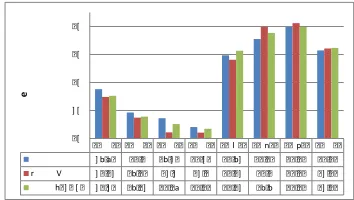
<-N N <- <-N R<- <-N T<- <-PN <- <-VA <- <-VC<- <-VE<- <-VV<-U nlex 2 7.61 19.3 17.2 5 14.0 9 39.72 45.51 49.83 41.44 G raph[+lab] 2 4.82 17.45 12 .2 12 .1 38.12 49.9 51.18 42 .14 Tran[b=32 ,Z0 8] 2 5.2 5 17.82 15.16 13.48 41.32 47.7 49.83 42 .34
10 2 0 30 40 50
E
r
r
o
r
r
a
t
e
Figure 1: Nominal vs. verbal constructions.
[image:5.612.337.514.500.600.2]endocentric constructions are structurally dispens-able parts that provide auxiliary information and taken to be optional and not selected by their heads. An important annotation policy of the CTB is “one grammatical relation per bracket”, which means each constituent falls into one of the three primitive grammatical relations: (1) head-complementation, (2) head-adjunction and (3) coordination. Addi-tionally, the argument is attached at a level that is “closer” to the head than the adjuncts. Due to the linguistic properties of different dependents and the annotation strategies, a grammar-based model can capture more syntactic preference properties of ar-guments via hard constraints, i.e. grammar rules, and are therefore more suitable to analyze exocen-tric constructions.
Figure1is the error rate of unlabeled dependen-cies considering different construction. A construc-tion “← X ←” is considered as correctly predicted if and only if all dependent words and head word of X are completely correctly found. The error rate in terms of this metric seems rather high because the units we consider are normally much larger than word pairs. From this figure, we can clearly see that the data-driven parser does better for the prediction of nominal constructions (NN/NR/NT/PN5), which relate more on optional adjuncts or modifiers; the grammar-based parser performs better for the pre-diction of verbal constructions (VC/VE/VV), which relate more on obligatory arguments. The evalua-tion of the nominal and verbal construcevalua-tions roughly confirms the strength of grammar-based model to predict verbal constructions.
4 Bagging parsers
The comparative analysis highlights the fundamen-tal diversity between data-driven and PCFG-based models. In order to exploit the diversity gain, we ad-dress the issue of parser combination. We employ a general ensemble learning technique, i.e. Bag-ging, to enhance a single-view parser and to com-bine multi-view parsers.
5For the definition and illustration of these tags, please refer
to the annotation guidelines (http://www.cis.upenn.
edu/˜chinese/posguide.3rd.ch.pdf).
4.1 Applying Bagging to dependency parsing
Bagging is a machine learning ensemble meta-algorithm to improve classification and regression models in terms of stability and classification accu-racy (Breiman,1996). It also reduces variance and helps to avoid overfitting. Given a training setDof size n, Bagging generates m new training sets Di of sizen′ ≤ n, by sampling examples fromD. m models are separately learned on them new train-ing sets and combined by vottrain-ing (for classification) or averaging the output (for regression). Hender-son and Brill (2000) successfully applied Bagging to enhance a constituent parser. Moreover, Bagging has been applied to combine multiple solutions for Chinese lexical processing (Sun, 2010b; Sun and Uszkoreit, 2012). In this paper, we apply Bagging to dependency parsing. Since training even one sin-gle parser takes hours (if not days), experiments on Bagging is time-consuming. To save time, we con-duct data-driven parsing experiments based on sim-pleconfiguration. More specifically, the beam size of the transition-based parser is set to 16, and the simple feature set is utilized; dependency relations are not incorporated for the graph-based parser.
Bootrapping step. In the training phase, given a training setDof sizen, our model generatesmnew training sets Di of size λn by sampling uniformly without replacement. EachDi can be used to train a single-view parser or multiple parsers according to different views. Using this strategy, we can getm
weakparsers orkmparsers if multiple views are im-plemented. In the parsing phase, for each sentence, the (k)m models output (k)m candidate analyses that are combined in a post-inference procedure.
node. We then create weighted directed edges be-tween the nodes corresponding to words for which dependencies are obtained from each of the initial structures. The weights are the word-by-word voting results of sub-models. Based on this graph, the sen-tence can be reparsed by a graph-based algorithm. Taking Chinese as a projective language, we use Eis-ner’s algorithm (Eisner, 1996) to combine multiple dependency parses. Surdeanu and Manning (2010) indicates that reparsing performs essentially as well as other simpler or more complex models.
4.2 Parameter tuning
We evaluate our combination model on the same data set used in the last section. The two hyper-parameters (λ and m) of our Bagging model are tuned on the development (validation) set. On one hand, with the increase of the size of sub-samples, i.e. λ, the performance of sub-models is improved. However, since the sub-models overlap more, the di-versity of base models for ensemble will decrease and the final prediction accuracy may go down. To evaluate the effect ofλ, we separately sample 50%, 60%, 70% and 80% sentences from the original training data 5 times, train 5 sub-models for each
parser, and combine them together. The beam size of the transition-based parser is set to 16. Table 2
shows the influence of the choice ofλ’s. For all fol-lowing experiments, we setλ= 0.7.
λ 50% 60% 70% 80%
Tran+Graph[-lab]+Unlex 83.50 85.96 86.15 85.60
Table 2: UAS of Bagging(5) models with differentλ.
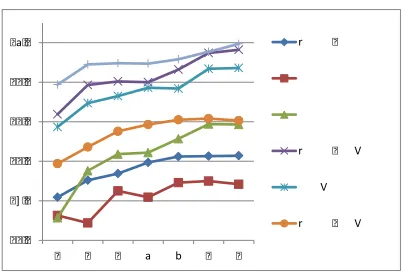
The second parameter for Bagging is the number of sub-models to be used for combination. Figure2
summarizes the Bagging performance when differ-ent models are employed and differdiffer-ent number (i.e. m) of subsamples are used. From this figure, we can learn the influence of the number of sub-models.
4.3 Bagging single-view parsers 4.3.1 Results
Table 1 indicates that Bagging can improve in-dividual single-view parsers, especially Berkeley parser. If we take Bagging as a general parser en-hancement technique and still consider a Bagging-enhanced parser as a single view, we conclude
81.5 82 .5 83.5 84.5 85.5 86.5
3 4 5 6 7 8 9
G raph[-lab]
Tran
U nlex
G raph[-lab]+U nlex
Tran+U nlex
[image:7.612.326.528.65.203.2]G raph[-lab]+Tran
Figure 2: Averaged UAS of different Bagging models with different numbers of sampling data sets.
that Bagging-enhanced PCFG-based method works best among state-of-the-art approaches. For the transition-based parser, though the score over single words goes up, the score over sentences goes down. The main reason is that the reparsing algorithm is a graph-based one, which performs worse with regard to the prediction of a whole sentence. The improve-ment for the graph-based parser is very modest.
We train a Bagging(8)-enhanced Berkeley parser, which achieves equivalent overall UAS to data-driven parsers, and compare their parsing abilities of second order dependencies. Now we can more clearly see that the Bagging-enhanced PCFG-based model performs better in the prediction of second order dependencies.
4.3.2 Related experiments on sequence models
Bagging has been applied to enhance discrimina-tive sequence models for Chinese word segmenta-tion (Sun,2010b) and POS tagging (Sun and Uszko-reit, 2012). For word segmentation, experiments on discriminative Markov and semi-Markov tagging models are reported. Their experiments showed that Bagging can consistently enhance a semi-Markov model but not the Markov one. Experiments on POS tagging indicated that Bagging Markov models hurts tagging performance. It seems that the relationships among basic processing units affect Bagging.
anno-tations can also achieve good performance for Chi-nese POS tagging. Huang et al. (2009) described and evaluated a bi-gram HMM tagger that utilizes latent annotations. Different from negative results of Bagging discriminative models, our auxiliary exper-iment shows that Bagging Huang et al.’s tagger can help Chinese POS tagging. In other words, Bagging substantially improves both HMMLA and PCFGLA models, at least for Chinese POS tagging and con-stituency parsing. It seems that Bagging favors the use of latent variables.
4.4 Bagging multi-view parsers 4.4.1 Results
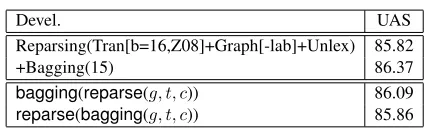
Figure 2 clearly shows that the Bagging model taking both data-driven and PCFG-based models as basic systems outperform the Bagging model taking either model in isolation as basic systems. The com-bination of a PCFG-based model and a data-driven model (either graph-based or transition-based) is more effective than the combination of two data-driven models, which has received the most atten-tion in dependency parser ensemble. Table 3 is the performance of reparsing on the development data. From this table, we can see by utilizing more parsers, Bagging can enhance reparsing. According toSurdeanu and Manning(2010)’s findings, repars-ing performs as well as other combination mod-els. Our auxiliary experiments confirm this finding: Learning-based stacking cannot achieve better per-formance. Limited to the document length, we do not give descriptions of these experiments.
Devel. UAS
Reparsing(Tran[b=16,Z08]+Graph[-lab]+Unlex) 85.82
+Bagging(15) 86.37
bagging(reparse(g, t, c)) 86.09
[image:8.612.78.290.502.567.2]reparse(bagging(g, t, c)) 85.86
Table 3: UAS of reparsing and Bagging.
4.4.2 Analysis
In our proposed model, Bagging has a two-fold effect: One is as a system combination technique and the other as a general parser enhancing tech-nique. Two additional experiments are performed to evaluate these two effects. To illustrate the differ-ences between these two experiments, respectively
denote graph-based, transition-based and PCFG-based parsers as g, t and c; denote the reparsing procedure asreparseand the Bagging procedure as bagging. The two experiments are as follows.
• Bagging a hybrid parser. In this experiment, for each sub-sample Di, we first train three parsers: gi, ti andci. Then we combine these three parsers by reparsing and construct a hy-bridparser reparse(gi, ti, ci). Finally, all hy-brid parsers are collected to build the final parser:bagging(reparse(g, t, c)).
• Combining Bagging-enhanced parsers. In this experiment, for each model, we first train threeBagging-enhanced parsers: bagging(g), bagging(t) and bagging(c). Then these three Bagging-enhanced parsers are com-bined by reparsing to build the final parser: reparse(bagging(g, t, c)).
Evaluation results are presented in Table3.
5 Pseudo-grammar-based models
Although the combination of data-driven and grammar-based models is very effective, it has a serious limitation: It is only applicable when con-stituency annotations are available to learning a grammar. However, many treebanks, e.g. Chinese Dependency Treebank (LDC2012T05), do not have such linguistically rich structures. Our experiments also suggest that a constituency grammar can sig-nificantly increase the diversity of base models for parser ensemble, which plays a major role in boost-ing prediction accuracy.
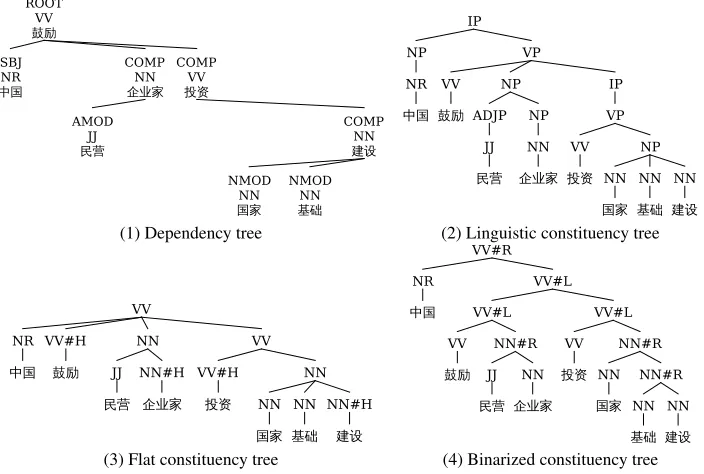
(1) Dependency tree (2) Linguistic constituency tree
[image:9.612.132.484.56.293.2](3) Flat constituency tree (4) Binarized constituency tree
Figure 3: An example:China encourages private entrepreneurs to invest in national infrastructure.
The basic idea of our method is to use parsing models in one formalism for parsing in another for-malism. In previous work, PCFGs are used to solve parsing problems in many other formalisms, includ-ing dependency (Collins et al.,1999),CCG(Fowler and Penn,2010),LFG(Cahill et al.,2004) andHPSG
(Zhang and Krieger,2011) parsing.
5.1 Strategies for DS to CS conversion
The conversion from DS to CS is a non-trivial prob-lem. One main issue in the conversion is the indeter-minancy in the choice of a phrasal category given a dependency relation, the level and position of attach-ment of a dependent in the constituency structure, as dependency relations typically do not encode such information. To convert a DS to a CS, especially for dependency parsing, we should consider (1) how to transform between the topological structures, (2) how to induce a syntactic category, and (3) how to easily recover dependency trees from pseudo con-stituency trees. From these three aspects, we present the following strategies.
5.1.1 Topological structure
The topological structures represent the boundary information of constituents in a given sentence. De-pendency structures do not directly represent such
boundary information. Nevertheless, a complete subtree in a projective dependency tree should be considered as a constituent. We can construct a very flat constituent tree, of which nodes are associated with complete subtrees of a dependency parse. The third tree in Figure3is an example of such conver-sion.
Right-to-left binarization According to the study in (Sun, 2010a), head words of most phrases in Chinese are located at the first or the last position. That means for binarizing most phrases, we only need sequentially combine the rightorleft parts to-gether with their head phrases. Main exceptions are clauses, of which the head predicate locates inside, since Chinese is an SVO language. To deal with these exceptions, we split each phrase whose head child is inside itself into three parts: left child(ren), head and right child(ren). We first sequentially com-bine the head and its right child(ren) that are usu-ally objects as intermediate phrases, then sequen-tially combine the left child(ren) until reach the orig-inal parent node. For example, the first rewrite rule in follows should be transferred into the second and third types of rules.
2. X′p→Xi,Xi+1;Xp′′ →Xp′,Xi+2; ...
3. X∗p →Xi−1,Xp′...′;X∗∗p →Xi−2,X∗p; ...
This right-to-left binarization strategy is consistent with most Chinese treebank annotation schemes. The fourth tree in Figure3 is an example of bina-rized pseudo tree.
5.1.2 Phrasal category
Projection principle is introduced by Chomsky to link together the levels of syntactic description. It connects syntactic structures with lexical entries: Lexical structure must be represented categorically at every syntactic level, and representations at each level of syntax are projected from the lexicon in that they observe the subcategorisation properties of lex-ical items. According to this principle, it is reason-able to use the lexical category (POS) of the head word as the phrasal category of a phrase.
5.1.3 Auxiliary symbol
We can use auxiliary symbols to denote the head phrase position in a CFG rule. In other words, some categories may be splitted into subcategories accord-ing to if they are head phrases of their parent nodes or which children are their head phrases. Auxiliary symbols could be either assigned to one of the right hand side or the left hand side. The first choice is to conveniently use aHsymbol to indicate that current phrase is the head of its parent node. The second choice is to practically use anLorRsymbol to indi-cate the head of current node is itsleftorrightchild, in a binarized tree. The following table gives an ex-ample of different rules with auxiliary symbols.
With head symbol With left/right symbol
Xl→Xl#H,Xr Xl#L→Xl,Xr
Xr→Xl,Xr#H Xr#R→Xl,Xr
5.2 Three conversions
Taking into account the above strategies, we propose three concrete DS to CS conversions:
Flat conversion withHauxiliary symbol (FlatH).
Just as shown as the third tree in Figure3, we can learn a grammar from very flat constituency trees where the auxiliary symbolHis used for extracting dependencies.
Right-to-left binarizing withHauxiliary symbol (BinH). Different from the flat conversion, we bi-narize a tree according to the right-to-left principle. Auxiliary symbolHis chosen.
Right-to-left binarizing with LR auxiliary sym-bol (BinLR). Different from the second type of conversion, we use auxiliaryL/Rsymbols to denote head phrases. See the fourth tree in Figure3for in-stance.
Practically, every constituency parse that is pro-duced by parsers trained with binarized trees exactly maps to one dependency tree. However, the parser trained with flat trees may produce very bad con-stituency results. Sometimes, one parent node may have zero child that is assigned withHor more than one children that are are assignedH. In the first case, we select the right most child as the head of such parent, while in the second case, we select the right most one from the children that are assignedH.
5.3 Evaluation
5.3.1 Equivalent parsing accuracy
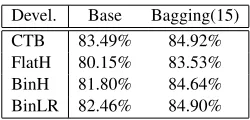
Devel. Base Bagging(15)
CTB 83.49% 84.92%
FlatH 80.15% 83.53%
BinH 81.80% 84.64%
[image:10.612.364.489.373.433.2]BinLR 82.46% 84.90%
Table 4: UAS of pseudo-grammar-based models.
Table 4 summarizes the performance of differ-ent pseudo-grammar-based models. Compared to the linguistic grammar learned from CTB, we can see that pseudo grammars are very competitive. Not that, the FlatH/BinH/BinLR trees are derived from the CoNLL data, rather than the original CTB. Among different DS to CS conversion strategies, the
BinLR conversion works best. More interestingly, when we enhance the PCFGLA method by using Bagging, the BinLR model performs as well as the
real-grammar-based model.
5.3.2 Better contribution to ensemble
Devel. UAS
Tran+Graph+CTB 86.37%
Tran+Graph+FlatH 86.14%
Tran+Graph+BinH 86.29%
Tran+Graph+BinLR 86.28%
Tran+Graph+flat+BinH+BinLR 87.03%
Tran+Graph+CTB+FlatH 86.96%
Tran+Graph+CTB+BinH 87.10%
Tran+Graph+CTB+BinLR 87.15%
Tran+Graph+CTB+BinH+BinLR 87.38%
[image:11.612.342.511.51.148.2]Tran+Graph+CTB+FlatH+BinH+BinLR 87.35%
Table 5: UAS of different Bagging(15) models.
binLR grammars have equivalent contributions to parser ensemble. Table 5 presents the ensem-ble performance on the development data. By Bagging, the data-driven models together with ei-therrealgrammar-based or pseudo-grammar-based model reach a similar UAS.
5.3.3 Increased parser diversity
Since pseudo grammars are very different from real grammars that are induced from large-scale lin-guistic annotations. Pseudo-grammar-based parsing models behave very differently with grammar-based models. In other words, they increase the diver-sity of model candidates for parser ensemble. As a result, pseudo-grammar-based models lead to fur-ther improvements for parser combination. Table5
shows that the combination of data-driven, PCFG-based and binarized pseudo-grammar-PCFG-based models is significantly better than the combination of data-driven and PCFG-based models.
5.4 Comparison to the state-of-the-art
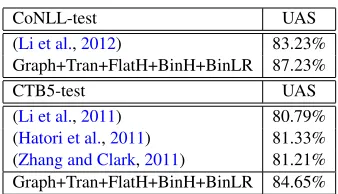
Table6summarizes the parsing performance on the test data set, as well as the best published result re-ported inLi et al.(2012). To fairly compare the per-formance of our parser and other systems which are built without linguistic constituency trees, we only use pseudo-PCFGs in this experiment. Based on automatic POS tagging, our final model achieves a UAS of 87.23%, which yields a relative error reduc-tion of 24% over the best published result. Table
6 also presents the results evaluated on the CTB5 data that is more widely used for previous research. Li et al. (2011) and Hatori et al. (2011) respec-tively evaluated their graph-based and transition-based parsers; Zhang and Clark (2011) evaluated
CoNLL-test UAS
(Li et al.,2012) 83.23% Graph+Tran+FlatH+BinH+BinLR 87.23%
CTB5-test UAS
(Li et al.,2011) 80.79% (Hatori et al.,2011) 81.33% (Zhang and Clark,2011) 81.21% Graph+Tran+FlatH+BinH+BinLR 84.65%
Table 6: UAS of different models on the test data.
a hybrid data-driven parser. Our model is signifi-cantly better than these systems: It achieves a UAS of 84.65%, which obtains an error reduction of 18% over the best system in the literature.
6 Conclusion and Future Work
There have been several attempts to develop high accuracy parsers in both constituency and depen-dency formalisms for Chinese, and many successful parsing algorithms designed for English have been applied. However, the state-of-the-art still falls far short when compared to English. This paper stud-ies data-driven and PCFG-based models for Chinese dependency parsing. We present a comparative anal-ysis of transition-, graph-, and PCFG-based parsers, which highlights the systematic differences between data-driven and PCFG-based models. Our analysis may benefit parser ensemble, parser co-training, ac-tive learning for treebank construction, and so on. In order to exploit the diversity gain, we address the issue of parser combination. To overcome the limitation of the lack of constituency treebanks, we study pseudo-grammar-based models. Experimental results show that combining various data-driven and PCFG-based models significantly advance the state-of-the-art, and by converting parse trees, we can still take advantages of the constituency representation even without constituency annotations.
Acknowledgement
We would like to thank thank all anonymous review-ers whose valuable comments led to signilicant re-visions. The first author would like to thank Prof. Hans Uszkoreit for discussion and feedback of an early version of this work.
[image:11.612.88.283.53.182.2]References
Bernd Bohnet. 2010. Top accuracy and fast de-pendency parsing is not a contradiction. In Pro-ceedings of the 23rd International Conference on Computational Linguistics (Coling 2010), pages 89–97. Coling 2010 Organizing Committee, Bei-jing, China. URL http://www.aclweb. org/anthology/C10-1011.
Leo Breiman. 1996. Bagging predictors. Machine Learning, 24(2):123–140.
Aoife Cahill, Michael Burke, Ruth O’Donovan, Josef Van Genabith, and Andy Way. 2004. Long-distance dependency resolution in automatically acquired wide-coverage pcfg-based lfg approx-imations. In Proceedings of the 42nd Meet-ing of the Association for Computational Lin-guistics (ACL’04), Main Volume, pages 319– 326. Barcelona, Spain. URL http://www. aclweb.org/anthology/P04-1041. Eugene Charniak. 2000. A
maximum-entropy-inspired parser. In Proceedings of the first con-ference on North American chapter of the Associ-ation for ComputAssoci-ational Linguistics.
Eugene Charniak and Mark Johnson. 2005. Coarse-to-fine n-best parsing and maxent discriminative reranking. In Proceedings of the 43rd Annual Meeting of the Association for Computational Linguistics (ACL’05), pages 173–180. Associa-tion for ComputaAssocia-tional Linguistics, Ann Arbor, Michigan.
Wanxiang Che, Valentin Spitkovsky, and Ting Liu. 2012. A comparison of chinese parsers for stanford dependencies. In Proceedings of the 50th Annual Meeting of the Associ-ation for ComputAssoci-ational Linguistics (Volume
2: Short Papers), pages 11–16.
Associa-tion for ComputaAssocia-tional Linguistics, Jeju Island, Korea. URL http://www.aclweb.org/ anthology/P12-2003.
Michael Collins. 2003. Head-driven statistical mod-els for natural language parsing. Computational Linguistics, 29(4):589–637.
Michael Collins, Jan Hajic, Lance Ramshaw, and Christoph Tillmann. 1999. A statistical parser for czech. In Proceedings of the 37th Annual
Meet-ing of the Association for Computational Lin-guistics, pages 505–512. Association for Com-putational Linguistics, College Park, Maryland, USA. URL http://www.aclweb.org/ anthology/P99-1065.
Jason M. Eisner. 1996. Three new probabilis-tic models for dependency parsing: an ex-ploration. In Proceedings of the 16th con-ference on Computational linguistics - Vol-ume 1, COLING ’96, pages 340–345. Associa-tion for ComputaAssocia-tional Linguistics, Stroudsburg, PA, USA. URL http://dx.doi.org/10. 3115/992628.992688.
Timothy A. D. Fowler and Gerald Penn. 2010. Ac-curate context-free parsing with combinatory cat-egorial grammar. In Proceedings of the 48th Annual Meeting of the Association for Com-putational Linguistics, pages 335–344. Associ-ation for ComputAssoci-ational Linguistics, Uppsala, Sweden. URL http://www.aclweb.org/ anthology/P10-1035.
Jun Hatori, Takuya Matsuzaki, Yusuke Miyao, and Jun’ichi Tsujii. 2011. Incremental joint pos tag-ging and dependency parsing in chinese. In Pro-ceedings of 5th International Joint Conference on Natural Language Processing, pages 1216–1224. Asian Federation of Natural Language Process-ing, Chiang Mai, Thailand. URLhttp://www. aclweb.org/anthology/I11-1136. John Henderson and Eric Brill. 1999. Exploiting
di-versity in natural language processing: Combin-ing parsers. InIn Proceedings of the Fourth Con-ference on Empirical Methods in Natural Lan-guage Processing, pages 187–194.
John C. Henderson and Eric Brill. 2000. Bag-ging and boosting a treebank parser. In Pro-ceedings of the 1st North American chapter of the Association for Computational Linguistics conference, NAACL 2000, pages 34–41. Asso-ciation for Computational Linguistics, Strouds-burg, PA, USA. URLhttp://dl.acm.org/ citation.cfm?id=974305.974310. Liang Huang and Kenji Sagae. 2010. Dynamic
pro-gramming for linear-time incremental parsing. In
1077–1086. Association for Computational Lin-guistics, Uppsala, Sweden. URLhttp://www. aclweb.org/anthology/P10-1110. Zhongqiang Huang, Vladimir Eidelman, and Mary
Harper. 2009. Improving a simple bigram hmm part-of-speech tagger by latent annotation and self-training. In Proceedings of Human Lan-guage Technologies: The 2009 Annual Confer-ence of the North American Chapter of the Asso-ciation for Computational Linguistics, Compan-ion Volume: Short Papers, pages 213–216. As-sociation for Computational Linguistics, Boulder, Colorado. URLhttp://www.aclweb.org/ anthology/N/N09/N09-2054.
Zhenghua Li, Ting Liu, and Wanxiang Che. 2012. Exploiting multiple treebanks for pars-ing with quasi-synchronous grammars. In Pro-ceedings of the 50th Annual Meeting of the Association for Computational Linguistics (Vol-ume 1: Long Papers), pages 675–684. Associa-tion for ComputaAssocia-tional Linguistics, Jeju Island, Korea. URL http://www.aclweb.org/ anthology/P12-1071.
Zhenghua Li, Min Zhang, Wanxiang Che, Ting Liu, Wenliang Chen, and Haizhou Li. 2011. Joint models for Chinese pos tagging and depen-dency parsing. InProceedings of the 2011 Con-ference on Empirical Methods in Natural Lan-guage Processing, pages 1180–1191. Association for Computational Linguistics, Edinburgh, Scot-land, UK. URLhttp://www.aclweb.org/ anthology/D11-1109.
Takuya Matsuzaki, Yusuke Miyao, and Jun’ichi Tsujii. 2005. Probabilistic cfg with latent an-notations. In Proceedings of the 43rd An-nual Meeting on Association for Computational Linguistics, ACL ’05, pages 75–82. Associa-tion for ComputaAssocia-tional Linguistics, Stroudsburg, PA, USA. URL http://dx.doi.org/10. 3115/1219840.1219850.
Ryan McDonald. 2006.Discriminative learning and spanning tree algorithms for dependency pars-ing. Ph.D. thesis, University of Pennsylvania, Philadelphia, PA, USA. AAI3225503.
Ryan McDonald and Joakim Nivre. 2007. Char-acterizing the errors of data-driven dependency
parsing models. In Proceedings of the 2007 Joint Conference on Empirical Methods in Natural Language Processing and Computa-tional Natural Language Learning (EMNLP-CoNLL), pages 122–131. Association for Com-putational Linguistics, Prague, Czech Repub-lic. URL http://www.aclweb.org/ anthology/D/D07/D07-1013.
Joakim Nivre. 2008. Algorithms for de-terministic incremental dependency
pars-ing. Comput. Linguist., 34:513–553. URL
http://dx.doi.org/10.1162/coli. 07-056-R1-07-027.
Joakim Nivre and Ryan McDonald. 2008. In-tegrating graph-based and transition-based dependency parsers. In Proceedings of ACL-08: HLT, pages 950–958. Association for Compu-tational Linguistics, Columbus, Ohio. URL http://www.aclweb.org/anthology/ P/P08/P08-1108.
Slav Petrov, Leon Barrett, Romain Thibaux, and Dan Klein. 2006. Learning accurate, compact, and interpretable tree annotation. InProceedings of the 21st International Conference on Computa-tional Linguistics and 44th Annual Meeting of the Association for Computational Linguistics, pages 433–440. Association for Computational Linguis-tics, Sydney, Australia.
Kenji Sagae and Alon Lavie. 2006. Parser com-bination by reparsing. In Proceedings of the Human Language Technology Conference of the
NAACL, Companion Volume: Short Papers,
NAACL-Short ’06, pages 129–132. Association for Computational Linguistics, Stroudsburg, PA, USA. URL http://portal.acm.org/ citation.cfm?id=1614049.1614082. Weiwei Sun. 2010a. Improving Chinese
se-mantic role labeling with rich syntactic fea-tures. In Proceedings of the ACL 2010 Con-ference Short Papers, pages 168–172. Associ-ation for ComputAssoci-ational Linguistics, Uppsala, Sweden. URL http://www.aclweb.org/ anthology/P10-2031.
23rd International Conference on Computational Linguistics (Coling 2010), pages 1211–1219. Coling 2010 Organizing Committee, Beijing, China. URL http://www.aclweb.org/ anthology/C10-2139.
Weiwei Sun and Zhifang Sui. 2009. Chinese func-tion tag labeling. InProceedings of the 23rd Pa-cific Asia Conference on Language, Information and Computation. Hong Kong.
Weiwei Sun and Hans Uszkoreit. 2012. Capturing paradigmatic and syntagmatic lexical relations: Towards accurate Chinese part-of-speech tagging. InProceedings of the 50th Annual Meeting of the Association for Computational Linguistics. Asso-ciation for Computational Linguistics.
Mihai Surdeanu and Christopher D. Manning. 2010. Ensemble models for dependency parsing: Cheap and good? In Human Language Technologies: The 2010 Annual Conference of the North Amer-ican Chapter of the Association for Computa-tional Linguistics, pages 649–652. Association for Computational Linguistics, Los Angeles, Cal-ifornia. URL http://www.aclweb.org/ anthology/N10-1091.
Andre Torres Martins, Noah Smith, and Eric Xing. 2009. Concise integer linear programming for-mulations for dependency parsing. In Proceed-ings of the Joint Conference of the 47th Annual Meeting of the ACL and the 4th International Joint Conference on Natural Language
Process-ing of the AFNLP, pages 342–350.
Associa-tion for ComputaAssocia-tional Linguistics, Suntec, Sin-gapore. URL http://www.aclweb.org/ anthology/P/P09/P09-1039.
Andr´e Filipe Torres Martins, Dipanjan Das, Noah A. Smith, and Eric P. Xing. 2008. Stacking de-pendency parsers. In Proceedings of the 2008 Conference on Empirical Methods in Natural Language Processing, pages 157–166. Associ-ation for ComputAssoci-ational Linguistics, Honolulu, Hawaii. URL http://www.aclweb.org/ anthology/D08-1017.
Nianwen Xue. 2007. Tapping the implicit infor-mation for the PS to DS conversion of the Chi-nese treebank. InProceedings of the Sixth
Inter-national Workshop on Treebanks and Linguistics Theories.
Yi Zhang and Hans-Ulrich Krieger. 2011. Large-scale corpus-driven pcfg approximation of an hpsg. In Proceedings of the 12th International Conference on Parsing Technologies, pages 198– 208. Association for Computational Linguistics, Dublin, Ireland. URLhttp://www.aclweb. org/anthology/W11-2923.
Yue Zhang and Stephen Clark. 2008. A tale of two parsers: Investigating and combining graph-based and transition-based dependency parsing. In Pro-ceedings of the 2008 Conference on Empirical Methods in Natural Language Processing, pages 562–571. Association for Computational Linguis-tics, Honolulu, Hawaii. URL http://www. aclweb.org/anthology/D08-1059. Yue Zhang and Stephen Clark. 2009.
Transition-based parsing of the Chinese treebank using a global discriminative model. In Proceedings of the 11th International Conference on Pars-ing Technologies (IWPT’09), pages 162–171. As-sociation for Computational Linguistics, Paris, France. URL http://www.aclweb.org/ anthology/W09-3825.
Yue Zhang and Stephen Clark. 2011. Syntac-tic processing using the generalized perceptron and beam search. Comput. Linguist., 37(1):105– 151. URLhttp://dx.doi.org/10.1162/ coli_a_00037.
Yue Zhang and Joakim Nivre. 2011. Transition-based dependency parsing with rich non-local fea-tures. In Proceedings of the 49th Annual Meet-ing of the Association for Computational LMeet-inguis- Linguis-tics: Human Language Technologies, pages 188– 193. Association for Computational Linguistics, Portland, Oregon, USA. URL http://www. aclweb.org/anthology/P11-2033. Tao Zhuang and Chengqing Zong. 2010. A