Unsupervised Learning of Cross-Lingual Symbol Embeddings Without
Parallel Data
Mark Granroth-Wilding University of Helsinki mark.granroth-wilding@
helsinki.fi
Hannu Toivonen University of Helsinki
Abstract
We present a new method for unsupervised learning of multilingual symbol (e.g. char-acter) embeddings, without any parallel data or prior knowledge about correspondences be-tween languages. It is able to exploit similari-ties across languages between the distributions over symbols’ contexts of use within their lan-guage, even in the absence of any symbols in common to the two languages. In experiments with an artificially corrupted text corpus, we show that the method can retrieve character correspondences obscured by noise. We then present encouraging results of applying the method to real linguistic data, including for low-resourced languages. The learned repre-sentations open the possibility of fully unsu-pervised comparative studies of text or speech corpora in low-resourced languages with no prior knowledge regarding their symbol sets.
1 Introduction
Linguistic typology aims to map connections and similarities between different languages or di-alects along multiple dimensions of comparison. A large proportion of languages spoken today have few speakers and little data annotated with lin-guistic analyses such as syntactic parses or part-of-speech tags. This makes mapping their typol-ogy difficult, but doing so could help in develop-ing just such resources, for example by language transfer. There may exist digital text in these lan-guages (e.g. forum posts or newspapers), or field recordings of speech. We attempt to learn about a language’s typology purely from its surface form. We focus on languages known to be fairly closely related (e.g. in the same language fam-ily), but where knowing more about the precise na-ture of the typology (e.g. regular sound correspon-dences in cognate words or differences in mor-phology) could help with resource development.
One example is the Uralic family, which contains many low-resourced languages and dialects.
To compare languages’ surface forms, we must first address how to compare their basic units, characters in the case of text (List, 2014). Even closely related languages may use different writ-ing systems, conventions, or transcription prac-tices, as well as having systematic linguistic dif-ferences. These considerations mean that, with-out prior knowledge of a correspondence between two languages, it may not make sense to assume that, say, the letterain one is directly comparable toa in the other. For example, Swedishå typi-cally corresponds Finnisho, and loanwords from Swedish to Finnish replace the former with the latter. Whilst such direct and well known corre-spondences can easily be written down by some-one familiar with the language pair, capturing less clear-cut or systematic correspondences, and do-ing so for a large number of low-resourced lan-guage pairs, is labour intensive.
In an extreme case, two corpora may use com-pletely distinct symbol sets, e.g. different scripts. There may be systematic linguistic differences that create a close correspondence between different symbols across languages (List, 2014), such as the phonological correspondence between Frisian
f and Danish v(Fenna et al.,2014). It may also be desirable to find correspondences between se-quences of symbols, e.g. Spanish ñ and Por-tuguesenh.
We tackle this problem using unsupervised learning of vector representations (embeddings) of symbols, learning purely from unannotated, un-aligned linguistic corpora. Here, we apply our method to text, learning representations of charac-ters, but it is equally applicable to other sequences, such as phonetic sequences from speech. To be ap-plicable to extreme cases of very little overlap be-tween symbol vocabularies (e.g. different scripts,
or types of phonological transcription), it does not assume a correspondence even between common symbols. E.g., if both use a, it treats a in the two languages as distinct symbols (1:aand2:a). This means that, where such correspondencesare
found, we know that they are motivated by statisti-cal regularities in their usages, rather than any ini-tial bias. It may learn that1:acorresponds to2:a, or to2:ä, or that it has a weak correspondence to multiple characters. This makes for a challenging learning task, since it becomes impossible to ex-ploit the idea behind typical distributional meth-ods – that similar symbols can be recognized by similarities between their contexts of occurrences – since the contexts across languages consist of symbols from distinct sets.
We present a method that is able to discover similarities between inter-lingual symbol pairs by exploiting similarities between their respective in-tra-lingual distributions over contexts of occur-rence. It must recognize that1:aplays a role in relation toother symbols in language 1that is sim-ilar to, say,2:ä’s role in relation toother symbols in language 2. It does not rely on parallel or com-parable corpora, so is robust to use on whatever corpora are available for the languages of interest. In this paper, we describe our learning method, XSYM (§3). Then we present two sets of
exper-iments. In the first (§4), we use artificially cor-rupted linguistic data, allowing us to observe how well the technique recovers known mappings be-tween character pairs obscured by the corruption. In the second (§5), we demonstrate encouraging initial results of applying the method to real lin-guistic data, including several low-resourced pairs, which show that it is able to build a coherent space of characters, for example placing the majority of identical characters in two related languages close to each other. This demonstrates its potential to recover correspondences between symbol pairs on the basis of distributional statistics without any other connection between the observed corpora.
Code for data preprocessing and model train-ing, as well as trained embeddings, are available online1.
2 Related work
Like us,Tsvetkov et al.(2016) employ a language modeling objective with neural networks to learn
1https://mark.granroth-wilding.co.uk/
papers/unsup_symbol/
multilingual embeddings for symbols (phones). They supply typological information to improve the representations. We believe that the present method is better suited to direct cross-lingual com-parison of symbols and, since we aim to discover typological information, do not incorporate this in the input. Östling and Tiedemann(2016) use a character-level, multilingual language model to learn vectors to represent languages. Whilst their model shares information between languages, we focus on modeling commonalities at the level of symbol embeddings. We expect the cross-lingual information our method captures to be comple-mentary to that in the language vectors.
A particular area where symbol alignment is re-quired iscognate discovery– finding words with a common linguistic origin. List(2014) describes uses of string alignment methods, the predomi-nant approach in the literature. He distinguishes
Most methods depend to some degree on lin-guistic resources. Many require a list of known cognate pairs (Mulloni and Pekar,2006;Mulloni, 2007;Delmestri and Cristianini,2010;Gomes and Lopes,2011;Ciobanu and Dinu,2014), or a man-ually aligned corpus (Navlea and Todirascu,2011; List, 2012), others language-specific knowledge about symbols (Kondrak, 2000) or NLP tools, such as part-of-speech taggers (Brew et al.,1996; Navlea and Todirascu, 2011). Hall and Klein (2010) require a phylogeny of the input languages. We avoid reliance on any language-specific re-sources.
The issue of cross-lingual symbol alignment also arises in other tasks and similar approaches are used. For example, methods for computing language similarity from the surface form fall into the same categories described above for cognate identification (Batagelj et al., 1992; Kita, 1999; Petroni and Serva,2008;Gamallo et al.,2017).
Unsupervised or semi-supervised learning of multilingual representations has been addressed at other levels of analysis (e.g. Kuhn, 2004; Sny-der et al.,2009;Christodoulopoulos et al.,2012). Many could be applied to unsupervised typology, since linguistic typology concerns all levels of analysis, so are complementary to that we present. Conneau et al.(2017) present unsupervised learn-ing of multillearn-ingual word embeddlearn-ings. This could be applied to low-resourced languages and com-bined with our method to identify words that are related in both etymology and meaning (the Spe-cific Homologue Detection Problem,List,2014).
Conneau et al.’s learning problem is similar to ours, applied to word meaning rather than sym-bol correspondence. Whilst a similar technique could perhaps be applied to the present task, our method focuses specifically on similarities in lo-cal contexts of symbol use, rather than similarities in the structure of embedding spaces, which are less informative in the case of small vocabularies of characters or phonemes.
3 Method
We describe a model that assigns language model-type scores to short sequences of symbols. We train the model and use the learned embeddings and n-gram composition function. We are not ulti-mately interested in the predictive model, only the derived representations. The learning technique follows other representation learning algorithms
p o h j a n
L-ngram R-ngram
L-vec
R-vec tanh
Pos/neg?P sig
[image:3.612.315.515.57.154.2]Predictor
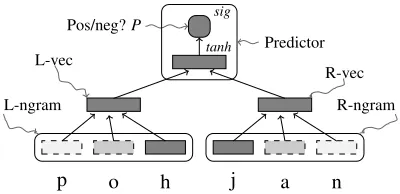
Figure 1: Structure of the neural network used to learn cross-lingual embeddings. The embeddings are used in the bottom layer. The output is a value between 0 and 1 that is used in the BPR objective function, with either positive or negative examples provided at the inputs.
(such asMikolov et al.,2013) in using negative sampling. However, these methods cannot be ap-plied directly, since the fact that the vocabularies of observed contexts are distinct for the two lan-guages means they are unable to discover similar-ities between characters across languages.
In each sample seen at training time (pohjanin Fig.1), all characters are from the same language, so the vectors for a Finnish character are affected only by other Finnish characters surrounding it. It is therefore possible that the resulting embeddings are grouped by language, effectively learning an independent predictor for each language. Training a high-capacity model (like an RNN) on multilin-gual data tends to result in this outcome. However, limiting the capacity of the network can force the model to share information between the languages at the level of embeddings. It then benefits the model to learn embeddings that exploit similarities across languages in the relationships between ad-jacent character sequences within a language. For example, ifais often followed by bin both lan-guages, and there are also similarities between us-age of1:band2:b, the model can exploit this by learning similar vectors for 1:aand 2:a, and si-multaneously1:band2:b.
3.1 Model
Our unsupervised representation learning method, XSYM, consists of a feedforward neural network
The length of the input sequence is variable. Each side (L-ngram and R-ngram) may be a single symbol, represented by the symbol’s embedding (which becomes L-vec/R-vec), or a bi- or tri-gram, whose embeddings are concatenated and projected by a linear transformation to get a vector for the n-gram, L-vec or R-vec. Separate transformations are learned for bi-grams and tri-grams. The same embeddings are used in each input position and the same composition function on both sides. L-vec and R-vec have the same size as the embeddings learned for individual characters.
The outputs of the two compositions are passed to a predictor function: a tanh layer and a sigmoid activation for the final output node, P. Varying the size of the two ngrams (L- and R-ngram) inde-pendently, so that a bigram is sometimes observed beside a unigram, sometimes a bigram, etc, causes the composed representations to reside in the same vector space, since they are inputs to the same pre-dictor function.
In the experiments, we use an embedding (and composed n-gram representation) size of 30. The hidden layer in the predictor also has 30 nodes.
3.2 Learning
Positive samples are taken by passing a sliding window over the text, alternating corpora. Each positive sample is accompanied by a randomly generated negative. The positive and negative out-put values are used with aBayesian Personalized Rank(BPR) objective function for training. BPR has been successfully used for similar represen-tation learning tasks, where negative data is not directly available: it encourages negative samples to be ranked lower than corresponding positives (Riedel et al.,2013).
The sizes of the L- and R-ngrams are drawn in-dependently at random. Each negative sample re-places either the L- or R-ngram of its correspond-ing positive (randomly, eitherpohorjanin Fig.1) with characters drawn independently from the un-igram distribution of the language of the sample.
All parameters, including embeddings, are ini-tialized randomly. Dropout is applied to the em-beddings and composed n-grams and a unit norm constraint is placed on the embeddings. We train using stochastic gradient descent with Adam learning rate adaptation, batch size 1000.
3.3 Validation criterion
The learned embeddings are affected by random initialization. As is typical in unsupervised learn-ing, there is no simple way to select the best model, since we cannot evaluate the learned rep-resentations on a validation set. Conneau et al. (2017) define anunsupervised validation criterion
to handle this problem in unsupervised alignment of word embeddings, which they use for model se-lection, as a proxy for word translation accuracy.
Eqn.1defines a validation criterion for a trained set of embeddings,nn-sim. To the extent that it correlates with the accuracy of correspondences found in the embeddings, it is suitable for model selection. To the extent that this holds throughout training, it can also be used for early stopping. We test these correlations in the next section. Given embeddings for languages A and B, we compute for each character in A the cosine similarity to its nearest neighbour from B, and take the mean over A’s characters.
nn-sim= 1
|A|
X
a2A min
b2Bcos(a, b) (1)
Eqn. 2 defines an evaluation metric pair-rank
that can be computed where the desired pair cor-respondences (a, b) 2 C are known. It mea-sures how well the correspondences are retrieved by the embeddings. For each(a, b), we compute
the rank, by cosine distance froma, of bamong all characters in B, normalized by the size of B. We compute the same in the opposite direction and take the average of all values. A lower value re-flects a better retrieval of correspondences.
pair-rank= 1 2|C|
X
(a,b)2C
rankb(cos(a, B))
|B|
+ranka(cos(b, A))
|A| (2)
4 Experiments with artificial data 4.1 Motivation
(a)Kaiken tämän lisäksi saan hellyyttä ja lämpöä sekä saan antaa sitä . (b)Kêikei ëämän o?tänsi nêên hssGööëëä êê HämÞ?ä sÆiä sêën onë?ê siëä a
Figure 2: Example sentence from the YLILAUTAcorpus in its original form(a)and with the highest level of all three types of corruption(b). The model is trained on an uncorrupted portion of the corpus as one language and a
distinct subsetto which this corruption has been applied.
We begin by testing XSYMon artificial datasets. We apply several types of corruption to real lin-guistic data, replacing some characters at random and combining or splitting others, then treat the corrupted data as a new language, with a distinct character set. The result is in some respects super-ficially similar to the relationship between related languages and presents similar challenges to the learning method. Crucially, having corrupted the data by known processes, we know which corre-spondences a successful method should recover.
First, we use corrupted data to measure how well the validation criterionnn-simcorrelates with retrieval of known correspondences, measured by
pair-rank. Then we analyze how robust the method is to the different types of corruption to get some insight into how it behaves.
4.2 Corruptions
We apply three different types of corruption. The input data has a character vocabularyVi, the
cor-rupted dataVowhich may be different, since some
corruptions add or remove characters. Corruptions are applied in the order presented. An example of the resulting text is given in Fig.2.
Random noise: Randomly sample a given pro-portion pnoise of character tokens and, for each, sample a character at random to replace it with from the unigram distribution overVi.
Systematic mapping: Systematically substitute a charactera (randomly chosen from Vi) with b
(randomly chosen fromVo). The resultingbs are
indistinguishable from those that werebs in the in-put.ais now not inVo, since it never occurs in the
corrupted data. Characters are chosen for mapping until the expected proportion of tokens affected is >pmap. Since characters are sampled greedily to preserve randomness, the actual proportion,pˆmap, may be greater thanpmap.
Systematic splitting: Randomly choose a char-acterafromVo after the previous step, add new
character b and randomly map half of as to b. Choose a number of characters in the same way
Metric PCC Slope pnoise 0.35 0.22
ˆ
pmap 0.67 0.36
ˆ
psplit -0.12 -0.06 sum 0.52 0.11
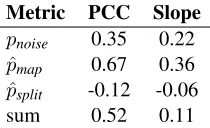
Table 1: Pearson correlation coefficient and regression slope between the level of each type of corruption and thepair-rankevaluation metric.
as for mapping, until the expected proportion af-fected is>psplit. The actual proportion ispˆsplit.
We train embeddings using XSYMwith two
cor-pora, as if they represented different languages. The first is a randomly chosen subset of 95k doc-uments from the YLILAUTAcorpus of Finnish
fo-rum posts2. The second is a distinct subset of the same size, to which the corruptions have been ap-plied. We run the training under different levels of each type of corruption, applying all 27 com-binations ofp = 0,0.15,0.3forpnoise,pmap and psplit.
In the first experiment, we measure the correla-tion betweennn-simandpair-rank. We train each model once for exactly 10 corpus iterations, out-putting both metrics every 500k samples, result-ing in 70 measures per model. In the second, we train all models again, usingnn-simas an unsuper-vised criterion for early stopping and model selec-tion over 5 random intializaselec-tions.
4.3 Results
Testing validation criterion nn-sim. We find a Pearson correlation coefficient (PCC) of r = 0.79betweennn-simandpair-rankfrom the 1,890
measurements taken during training. The high correlation suggests thatnn-simis a good criterion to use for early stopping. Furthermore, measur-ing only at the end of trainmeasur-ing, we getr = 0.83, supporting the use of nn-sim to choose between embeddings from alternative initializations. We can expect that embeddings that maximizenn-sim
2http://urn.fi/urn:nbn:fi:
would also have maximized (or close)pair-rank, had we been able to measure it using known cor-respondences.
Testing effect of corruptions. Training all mod-els with early stopping and model selection, we measured the correlation between the level of each corruption (and the sum of the three) and the pair-rankof the final embeddings (Table 1). We also report the slope of the regression between the cor-ruption levels andpair-rank. Values ofpair-rank
range from 6%, for a low level of corruption, to 37% for a high level, with a mean of 16% over all 27 tests.
There is a high correlation for character map-ping: the more characters are conflated with oth-ers in the vocabulary, the harder it is to identify the correspondences. This is unsurprising: to main-tain the same level of accuracy after a mapping a ) b, the method must recognize the similarity in the contexts of2:bin the corrupted data to those of both1:aand1:bin the uncorrupted data. The contextual distribution of2:b’s usage is in effect the average of those of1:aand1:b, so becomes hard to identify with either.
There is a relatively low correlation for random noise. The method is robust to this corruption, which obscures the regularities in the data, but has no systematic effect on the contextual distributions of any of the symbols.
There is no correlation for character splitting. When1:ais split at random so that it appears as either2:aor the newly added2:b, both2:aand2:b
can be expected to have similar contextual distri-butions to1:a. The splitting reduces the amount of data from which to infer the distributions, but does not prevent the model from discovering the simi-larity, even under high levels of other corruptions. These results suggest promisingly that XSYMis
effective at recovering correspondences between symbols in two datasets where there are similar-ities in the symbols’ contexts of use. It is impos-sible to know how these different types and lev-els of corruption correspond to the difficulties the method faces dealing with real data. However, this experiment confirms that the model is discovering and exploiting the sort of distributional similari-ties that we would hope, even where the contextual distributions are not directly comparable.
5 Experiments with linguistic corpora We now apply XSYM to real linguistic data. To ensure that the method is not exploiting similari-ties between two corpora due to a shared domain (e.g., prevalence of particular cognate words pe-culiar to that domain), we apply it to corpora from unrelated domains, as well as in-domain pairs.
We first compare Finnish and Estonian. Whilst not low-resourced languages, it is easier to inter-pret results from these well-studied, closely re-lated languages, and they are a good starting point for studying low-resourced Uralic languages. For Finnish, we use the YLILAUTAcorpus again. For
Estonian, we use the newspaper portion of the Estonian Reference Corpus, balanced subcorpus (Kaalep et al.,2010, henceforth EST-REF-NEWS). We use only the first 190k documents in Ylilauta, to match the size of EST-REF-NEWS (⇠5.8M
to-kens). We lower-case the text to simplify analysis and treat very rare characters (<500occurrences)
as a single out-of-vocabulary token. We also run on a single-domain corpus pair, to see how the outcome is affected by comparable versus non-comparable corpora. We train on YLILAUTA to-gether with the forum portion of the Estonian Ref-erence Corpus (⇠6.4M tokens, henceforth EST
-REF-FORUM). Training parameters are identical
to the previous section andnn-simis used for early stopping and model selection.
We also apply the method to several combina-tions of low-resourced Uralic (North Finnic) lan-guages: two dialects of Karelian (Olonets and North Karelian) and the severely endangered In-grian language (⇠130 speakers). All corpora are Bible translations from the University of Helsinki Corpus Server3, with ⇠150k, 200k and 30k to-kens respectively. We report metrics for some pairs within low-resourced languages and also for Ingrian–Finnish, since many applications will in-volve comparing a low-resourced language to a better-resourced one.
5.1 Results
Since this is an unsupervised learning task and there is no gold-standard set of correspondences, we cannot directly evaluate the embeddings quan-titatively. Ultimately, their value will be tested by their usefulness in a downstream task, such as cog-nate discovery, but we leave this to future work.
Figure 3: MDS reductions of mixed-domain embed-dings for Finnish (blue) and Estonian (green). Plot of individual characters (top) and most frequent character bigrams and trigrams (bottom). ‘7!’ represents space.
Fig. 3 shows reductions to 2D using multi-dimensional scaling (MDS) of the embeddings trained on Finnish and Estonian with mixed do-mains. We show a plot of the embeddings for all individual characters and another including the most frequent character bigrams and trigrams in each language. Fig.4shows single-character em-beddings for single-domain corpora.
The plots give a broad notion of the layout of the space, but poorly reflect proximity between in-dividual pairs. We also present statistics about the proximity of common characters with frequency
0.5%in both corpora (e.g.fi:t–et:t) in Table2.
We measure whereet:tappears in a ranking of all Estonian characters by proximity tofi:t, and av-erage over all pairs, in both directions. We also report the percentage of cases where the identical character is the nearest (R@1) and within the near-est 3 characters (R@3) in the other language.
[image:7.612.311.518.58.217.2]Importantly, this isnot an evaluation metric, but
Figure 4: MDS reduction of single-domain, forum post embeddings for Finnish (b) and Estonian (g).
rather a sanity check: a lower value does not nec-essarily reflect better embeddings, since there may be good reasons to map non-identical characters close to each other. (Indeed, this is one of the motivations for our approach.) However, the fact that the ranking is typically low is an encourag-ing sign that the method is succeedencourag-ing in discover-ing meandiscover-ingful correspondences between the lan-guages. Moreover, we see no clear difference in this respect between cross-domain and in-domain learning. The results for Uralic languages demon-strate the applicability of the method to small datasets for low-resourced languages.
To give further insight into what is being cap-tured, in Table 3 we present, for two language pairs, nearest neighbours across languages for all cases where the nearest was not the identical char-acter. Of particular interest here are the discovered close correspondencesš–sandy–übetween North Karelian and Olonets. Table4shows, for one pair in one direction, other near neighbours where the nearestisthe same character.
6 Future work
[image:7.612.96.298.60.378.2]Corpus 1 Corpus 2 Chars 1 Chars 2 Common MPR R@1 R@3 YLILAUTA EST-REF-NEWS 23 26 22 2.32 55% 82%
YLILAUTA EST-REF-FORUM 23 25 25 2.11 57% 84% NORTHKARELIAN OLONETSKARELIAN 24 26 22 1.20 89% 95%
INGRIAN OLONETSKARELIAN 22 26 21 1.74 64% 90%
[image:8.612.108.507.61.136.2]INGRIAN YLILAUTA 22 23 22 1.73 80% 89%
Table 2: Correspondence between common characters for cross-domain and in-domain models, as a sanity check. Chars 1and2are the number of characters in each language’s vocabulary after the frequency filter. Mean pair rank (MPR): mean rank of a character by cosine similarity to its identical character in the other language.R@1 is the proportion that are nearest neighbours,R@3the proportion that are within the three closest.
Ing Fi
h v h r h v m r , n , . n , s i ä .
Fi Ing
d k j v ... t k t . , o s .
NK Olonets
š k s p ... s l z g s y ü ä e ... , . ,
Olonets NK
d j t l ...
ä e ä
g l j s ... s š k p s z l j r ... ü y ä e ...
[image:8.612.108.286.215.387.2], . ,
Table 3: Nearest neighbours across Finnish (Ylilauta)– Ingrian and North Karelian–Olonets, where the closest is not the same.Boldare not in the other language.
NK Olonets
a a o u ü e
v v j p m r k t
ä ä ö e ü a
e e ä o a ü
i i ü
h h n
k k s p m v j t
j j v m p d k r z
m m v r p j
l l z g n r
o o a u e
n n h l
p p v m r j k
r r v m p h j
u u o a
t t j d k
ö ö ä
Table 4: Nearest Olonets neighbours to North Kare-lian, where the nearest is identical, down to a cosine similarity of 0.5.
providing perhaps a particularly suitable way to use them. It remains an open question how n-gram similarities can be used here. Another possible plication is spelling translation, for example ap-plying the method ofPirkola et al.(2003) without requiring translation dictionaries.
A potential benefit of this method is its ability to capture correspondences between different lengths of n-grams, not just individual symbols. In our analysis (Fig.3) we have used this by including a language’s most common n-grams in projections, but other ways to select pertinent correspondences are possible, for example taking into account sim-ilarities or the structure of the vector space as well as frequency.
XSYM is similar to Polyglot language models
(Tsvetkov et al.,2016). We have suggested, but not demonstrated here, that it is better suited to di-rect comparison of symbols. Investigation of the properties of representations learned by the two methods is required and we will test XSYMon the
tasks reported byTsvetkov et al.(2016).
We plan to apply XSYM to other symbol
se-quences, in particular, to sequences of phonetic symbols from speech (likeList,2014). It may be possible to use automatic transcriptions that do not require language-specific transcribers, since the symbols need not correspond to linguistically mo-tivated systems, such as IPA. Although designed for learning about linguistic sequences, XSYM
could potentially also be applied also to non-linguistic data to discover links between sequences that use distinct vocabularies. We will investigate what characteristics of sequences are essential in finding useful abstractions (e.g. vocabulary size).
7 Conclusion
[image:8.612.97.257.442.674.2]representa-tions of symbols and short n-grams on the basis of their contexts observed in sequences. It is able to learn comparable representations of symbols from multiple languages that use distinct symbol sets, learning to exploit similarities in the context dis-tributions of the symbols across languages, even though the symbols in the contexts are also drawn from distinct vocabularies.
We have demonstrated the method’s ability to recover mappings between vocabularies, even when they are obscured by ambiguity in the map-pings and noise, provided that the noise does not obscure the distributions over the symbols’ con-texts too much. We then showed some results of applying the method to real linguistic data, focus-ing here on characters in text and several Uralic language pairs. We found that it was able to rec-ognize many characters that are common to the corpus pairs as being closely related by their con-texts of use. An even closer correspondence was found between closely related, low-resourced di-alects, despite a much smaller training set.
The learned similarities between symbols pro-vide a way to bootstrap discovery of other lin-guistic similarities, such as morphology or cog-nate words. We leave testing on these applica-tions to future work and have presented here some analysis of the learned representations, which ap-pear highly promising. We suggest that the results have great potential as a first step in fully unsuper-vised linguistic typology. Discovered correspon-dences may also be able to tell us about typol-ogy in themselves. For example, some measures of orthographic difference and sound correspon-dences correlate with geographic factors in lan-guage development (Heeringa et al.,2013;Proki´c and Cysouw, 2013). Discovered strong symbol correspondences (especially if the method is ap-plied to phonetic sequences) could also be of ty-pological interest in themselves.
The method presented is a generic representa-tion learning technique for symbol sequences. As well as text, it could also be applied to other lin-guistic sequences, such a phonetic transcriptions, and potentially even to non-linguistic sequences. On the basis of the encouraging initial results pre-sented here, we suggest that it warrants further in-vestigation, including linguistic applications, such as unsupervised cognate discovery, and other as-pects of linguistic typology.
8 Acknowledgements
This work was funded by the Academy of Fin-land Digital Language Typology project (no. 12933481).
References
Vladimir Batagelj, Tomaž Pisanski, and Damijana Keržiˇc. 1992. Automatic clustering of languages.
Computational Linguistics, 18(3):339–352.
Chris Brew, David McKelvie, et al. 1996. Word-pair extraction for lexicography. InProceedings of the 2nd International Conference on New Methods in Language Processing, pages 45–55.
Christos Christodoulopoulos, Sharon Goldwater, and Mark Steedman. 2012. Turning the pipeline into a loop: Iterated unsupervised dependency parsing and PoS induction. InProceedings of the NAACL-HLT Workshop on the Induction of Linguistic Structure, pages 96–99.
Alina Maria Ciobanu and Liviu P Dinu. 2014. Au-tomatic detection of cognates using orthographic alignment. InProceedings of the 52nd Annual Meet-ing of the ACL, volume 2, pages 99–105.
Alexis Conneau, Guillaume Lample, Marc’Aurelio Ranzato, Ludovic Denoyer, and Hervé Jégou. 2017. Word translation without parallel data. CoRR, abs/1710.04087.
Antonella Delmestri and Nello Cristianini. 2010. String similarity measures and PAM-like matrices for cognate identification. Bucharest Working Pa-pers in Linguistics.
Grzegorz Kondrak Diana Inkpen, Oana Frunza. 2005. Automatic identification of cognates and false friends in French and English. InProceedings of the International Conference Recent Advances in Natu-ral Language Processing, pages 251–257.
Bergsma Fenna, Swarte Femke, and Gooskens Char-lotte. 2014. Does instruction about phonological correspondences contribute to the intelligibility of a related language? Dutch Journal of Applied Lin-guistics, 3(1):45–61.
Pablo Gamallo, José Ramom Pichel, and Iñaki Alegria. 2017. From language identification to language dis-tance. Physica A: Statistical Mechanics and its Ap-plications, 484:152–162.
Luís Gomes and José Gabriel Pereira Lopes. 2011. Measuring spelling similarity for cognate identifica-tion. InProceedings of the Portuguese Conference on Artificial Intelligence, pages 624–633.
Wilbert Heeringa, Jelena Golubovic, Charlotte Gooskens, Anja Schüppert, Femke Swarte, and Stefanie Voigt. 2013. Lexical and orthographic distances between Germanic, Romance and Slavic languages and their relationship to geographic distance. Phonetics in Europe: Perception and Production, pages 99–137.
Heiki-Jaan Kaalep, Kadri Muischnek, Kristel Uiboaed, and Kaarel Veskis. 2010. The Estonian Reference Corpus: Its composition and morphology-aware user interface. InProceedings of the 4th Interna-tional Conference Baltic HLT, pages 143–146. Kenji Kita. 1999. Automatic clustering of languages
based on probabilistic models.Journal of Quantita-tive Linguistics, 6(2):167–171.
Grzegorz Kondrak. 2000. A new algorithm for the alignment of phonetic sequences. InProceedings of the 1st NAACL, pages 288–295.
Grzegorz Kondrak. 2009. Identification of cognates and recurrent sound correspondences in word lists.
TAL, 50:201–235.
Grzegorz Kondrak and Graeme Hirst. 2002. Algo-rithms for language reconstruction. Ph.D. thesis, University of Toronto.
Jonas Kuhn. 2004. Experiments in parallel-text based grammar induction. InProceedings of the 42nd An-nual Meeting of the ACL.
Johann-Mattis List. 2012. Lexstat: Automatic de-tection of cognates in multilingual wordlists. In
Proceedings of the EACL 2012 Joint Workshop of LINGVIS & UNCLH, pages 117–125.
Johann-Mattis List. 2014. Sequence comparison in historical linguistics. Ph.D. thesis, Heinrich-Heine-Universität Düsseldorf. Dissertations in Language and Cognition, 1.
Richard T. McCoy and Robert Frank. 2018. Phono-logically informed edit distance algorithms for word alignment with low-resource languages. In Proceed-ings of the Society for Computation in Linguistics (SCiL) 2018, pages 102–112.
Tomas Mikolov, Kai Chen, Greg Corrado, and Jeffrey Dean. 2013. Efficient estimation of word represen-tations in vector space.CoRR, abs/1301.3781. Andrea Mulloni. 2007. Automatic prediction of
cog-nate orthography using support vector machines. In
Proceedings of the 45th Annual Meeting of the ACL: Student Research Workshop, pages 25–30.
Andrea Mulloni and Viktor Pekar. 2006. Automatic de-tection of orthographic cues for cognate recognition.
Proceedings of LREC’06.
Mirabela Navlea and Amalia Todirascu. 2011. Using cognates in a French-Romanian lexical alignment system: A comparative study. InProceedings of the International Conference Recent Advances in Natu-ral Language Processing, pages 247–253.
Robert Östling and Jörg Tiedemann. 2016. Continu-ous multilinguality with language vectors. CoRR, abs/1612.07486.
Filippo Petroni and Maurizio Serva. 2008. Lan-guage distance and tree reconstruction. Journal of Statistical Mechanics: Theory and Experiment, 2008(08):P08012.
Ari Pirkola, Jarmo Toivonen, Heikki Keskustalo, Kari Visala, and Kalervo Järvelin. 2003. Fuzzy transla-tion of cross-lingual spelling variants. In Proceed-ings of the 26th Annual International ACM SIGIR Conference, pages 345–352.
Jelena Proki´c and Michael Cysouw. 2013. Combin-ing regular sound correspondences and geographic spread.Language Dynamics and Change, 3(2):147– 168.
Jelena Proki´c, Martijn Wieling, and John Nerbonne. 2009. Multiple sequence alignments in linguistics. InProceedings of the EACL 2009 Workshop on Lan-guage Technology and Resources for Cultural Her-itage, Social Sciences, Humanities, and Education, LaTeCH-SHELT&R ’09, pages 18–25.
Sebastian Riedel, Limin Yao, Andrew McCallum, and Benjamin M Marlin. 2013. Relation extraction with matrix factorization and universal schemas. In Pro-ceedings of NAACL HLT 2013, pages 74–84. Benjamin Snyder, Tahira Naseem, and Regina
Barzi-lay. 2009. Unsupervised multilingual grammar in-duction. InProceedings of the Joint Conference of the 47th Annual Meeting of the ACL and the 4th In-ternational Joint Conference on Natural Language Processing of the AFNLP, pages 73–81.