Ambiguity in Explicit Discourse Connectives
Bonnie Webber University of Edinburgh [email protected]
Rashmi Prasad Interactions LLC.
Alan Lee
University of Pennsylvania [email protected]
Abstract
Discourse connectives are known to be subject to bothusageandsenseambiguity, as has already been discussed in the literature. But discourse connectives are no different from other linguistic expressions in being subject to other types of ambiguity as well. Four are illustrated and discussed here.
1
Introduction
Discourse connectives, like other linguistic expressions, are subject to ambiguity. Two types of ambiguity —usage ambiguity, whether or not a given token is serving as a discourse connective in its context, and
sense ambiguity, what discourse relation(s) a given token is signalling — were the subject of a study by Pitler and Nenkova (2009), who showed how syntactic features could help resolve them both.
But discourse connectives are no different from other linguistic expressions in being subject to other types of ambiguity as well. Four of them are discussed here, as a way of encouraging researchers to de-termine whether existing disambiguation methods suffice to handle them or whether the methods need to be extended. Ignoring the full range of ambiguity of discourse connectives can lead to discourse relations being mis-labelled both manually (during annotation) and automatically (during discourse parsing).
As background to presenting these ambiguities, Section 2 briefly reviews the original Penn Discourse TreeBank (the 2), the findings of Pitler and Nenkova (2009), and how the recently released PDTB-3 extends and, in some cases corrects, annotation in the PDTB-2. We then turn to four additional types of discourse connective ambiguity that have been discussed in the context of other linguistic forms. Sec-tion 3 discussespart-of-speech ambiguity, which can affect how a given token functions as a discourse connective. Section 4 discussesmulti-word ambiguity, where a sequence of tokens can be ambiguous be-tween a sequence of separate elements and a singlemulti-worddiscourse connective. Section 5 discusses ascope ambiguitythat affects the sense of discourse connectives. Finally, Section 6 discussessemantic role ambiguityinvolving the arguments of certainCONCESSIONrelations.
2
Background
2.1 PDTB-2
to a level-2 (or in some cases, a top-level) sense. Discourse relations consisted of two arguments labelled
Arg1andArg2, with each relation anchored by either an explicit discourse connective or adjacency. In the latter case, annotators inserted one or moreimplicit connectivesthat signalled the sense(s) they in-ferred to hold between the arguments. The approach in the PDTB-2 is agnostic about any higher-level discourse structure, and as such, made no attempt to build a tree or graph structure of relations over the text as a whole. The size and availability of the PDTB-2 spawned the field ofshallow discourse parsing, as in the 2015 and 2016 CoNLL shared tasks (Xue et al., 2015, 2016), as well as the development of similar resources for other languages, including Chinese, Hindi, and Turkish. An in-depth discussion of the PDTB-2 can be found in (Prasad et al., 2014).
2.2 Pitler & Nenkova (2009)
Pitler and Nenkova (2009) showed how syntactic features could be used in disambiguating both usage ambiguityandsense ambiguity. To understand these types of ambiguity, consider the wordsince. Ex. 1 illustrates its non-discourse usage, wheresinceis simply a temporal preposition. Both Ex. 2 and Ex. 3 illustrate discourse usages and also thesense ambiguityofsince, signalling a purely temporal relation in Ex. 2 and a purely causal relation in Ex. 3.
(1) She has been up since 5am.
(2) There have been over 100 mergers since the most recent wave of friendly takeovers ended.
(3) It was a far safer deal since the company has a healthier cash flow.
Using data in the PDTB-2, Pitler and Nenkova (2009) showed thatusage ambiguitycan be resolved with high accuracy, as can sense ambiguitywith respect to the four top-level sense classes (cf. Sec-tion 2.1). (N.B. They took multi-labelled tokens to be classified correctly if at least one of the senses was correctly identified.) They showed how high accuracy could be achieved in both disambiguation tasks by using both the token itself and its syntactic features in classification. Features included the syntactic category of the node dominating all and only the token itself, the category of its immediate parent, and the categories of its siblings. When they added interactions between connectives and syntactic features, and interactions between the features themselves, accuracy increased over 10 points and f-score, nearly 20 points.
Since Pitler & Nenkova’s results are not incompatible with other types of discourse connective am-biguity, their work is a good jumping off point for experimenting with the additional types of discourse connective ambiguity we discuss here.
2.3 PDTB-3
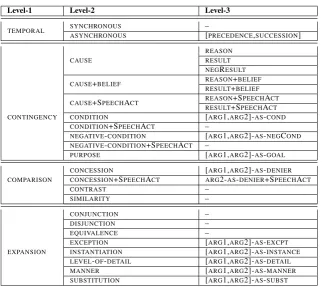
The PDTB-31contains∼12.5K more intra-sentential relations (i.e., ones that lie wholly within the pro-jection of a top-level S-node) and∼1K more inter-sentential relations than the PDTB-2 (Webber et al., 2019). New senses have been added to the sense hierarchy (Table 1) and used for annotating new tokens, as well as for re-annotating existing tokens.
Newly annotated intra-sentential relations include ones between the conjuncts of conjoined verb phrases and conjoined clauses; ones between free or headed adjuncts and the clauses they adjoin to; ones associated with subordinators such as in order, prepositions such as with, for, and in; and ones between infinitival clauses (or other subordinating structures) and their matrix clause. New annota-tion also includes explicitly marked quesannota-tion-response pairs, and lexico-syntactic construcannota-tions that are
unambiguous signals of particular discourse relations, such as theso-construction, signalling RESULT
(Ex. 4), thetoo-construction, signallingNEGATIVE-RESULT(Ex. 5), andauxiliary inversion, signalling aCONDITIONALrelation (Ex. 6).2
1https://catalog.ldc.upenn.edu/LDC2019T05 2
Level-1 Level-2 Level-3
TEMPORAL SYNCHRONOUS –
ASYNCHRONOUS [PRECEDENCE,SUCCESSION]
REASON
CAUSE RESULT
NEGRESULT CAUSE+BELIEF REASON+BELIEF
RESULT+BELIEF CAUSE+SPEECHACT REASON+SPEECHACT
RESULT+SPEECHACT CONTINGENCY CONDITION [ARG1,ARG2]-AS-COND
CONDITION+SPEECHACT –
NEGATIVE-CONDITION [ARG1,ARG2]-AS-NEGCOND NEGATIVE-CONDITION+SPEECHACT –
PURPOSE [ARG1,ARG2]-AS-GOAL CONCESSION [ARG1,ARG2]-AS-DENIER COMPARISON CONCESSION+SPEECHACT ARG2-AS-DENIER+SPEECHACT
CONTRAST –
SIMILARITY –
CONJUNCTION –
DISJUNCTION –
EQUIVALENCE –
EXCEPTION [ARG1,ARG2]-AS-EXCPT EXPANSION INSTANTIATION [ARG1,ARG2]-AS-INSTANCE
[image:3.595.137.460.65.352.2]LEVEL-OF-DETAIL [ARG1,ARG2]-AS-DETAIL MANNER [ARG1,ARG2]-AS-MANNER SUBSTITUTION [ARG1,ARG2]-AS-SUBST
Table 1: PDTB-3 Sense Hierarchy. Only asymmetric senses extend to Level-3.
(4) The fit is so good,we see this as a time of opportunity. [wsj 0317]
(5) Things have gone too farfor the government to stop them now[wsj 2454]
(6) . . .but would have climbed 0.6%,had it not been for the storm[wsj 0573]
Differences in how discourse relations are annotated in the PDTB-2 and the PDTB-3 reflect (1) changes and/or additions to the sense hierarchy; (2) different criteria for choosing one sense label over another; and (3) rigorous attention tosemantic consistency(Hollenstein et al., 2016), checking that sim-ilar tokens have been annotated in a simsim-ilar way, thereby reducing annotation noise and improving what can be induced from the corpus.
Note that additions to the sense hierarchy have introduced newsense ambiguitiesthat weren’t present in the PDTB-2. A case in point is the discourse adverbial as well, all of whose tokens were sense-annotated EXPANSION.CONJUNCTIONin the PDTB-2 (cf. Ex. 7 and Ex. 8). With the new sense COM
-PARISON.SIMILARITY, as well is now ambiguous between conveying EXPANSION.CONJUNCTION, which Ex. 7 is still taken to do, and COMPARISON.SIMILARITY, which Ex. 8 was re-annotated as.
(7) There is speculation that property/casualty firms will sell even more munisas they scramble to raise cash to pay claims related to Hurricane Hugo and the Northern California earthquake.Fundamental factors are at workas well. [wsj 0671]
(8) “They continue to pay their bills and will do so,” says Ms. Sanger. “We’re confidentwe’ll be paying our bills for spring merchandiseas well.” [wsj 1002]
The PDTB-3 records theprovenanceof each token. This shows that, of the∼53600 tokens annotated in the PDTB-3,∼57% are unchanged from the PDTB-2,∼19% (∼9900 tokens) have been changed in some way from their earlier annotation, and the remaining 24% are new to the PDTB-3. Provenance allows us to compare the use of new senses in annotating new tokens and in re-annotating existing tokens. For example, the new sense COMPARISON.SIMILARITYwas used in annotating 135 new tokens and in re-annotating 68 tokens, of which 41 were associated with explicit connectives. Of the 41, 18 involved the discourse adverbialsimilarly; 10, the subordinating conjunctionas if; while the rest involved tokens of
3
Part-of-Speech Ambiguity
Part-of-Speech (PoS) affects how three items function as discourse connectives: since,before, and how-ever. Sinceis ambiguous between a subordinating conjunction (PoS=IN), as in Ex. 9, and an adverbial (PoS=RB), as in Ex. 10.
(9) However, sinceEastern first filed for Chapter 11 protection March 9,it has consistently promised to pay creditors 100 cents on the dollar. [wsj 0475]
(10) His company, Misa Manufacturing Inc.,was forced to seek protection from creditors under federal bankruptcy law in 1987and hassincebeen liquidated. [wsj 1830]
This ambiguity also affects the sense ofsince. As a subordinating conjunction,sincesignals either REASONor (temporal) SUCCESSION(cf. Ex 9), while as a discourse adverbial, its temporal sense is the reverse — PRECEDENCE(cf. Ex. 10).
The same holds forbefore, which is also ambiguous between a subordinating conjunction (PoS=IN) and an adverbial (PoS=RB). As a subordinating conjunction, it conveys PRECEDENCE(cf. Ex. 11), while as a discourse adverbial, it conveys the reverse —SUCCESSION(cf. Ex. 12).
(11) They said they wantedto wait for the outcome of any government investigationbeforedeciding what to do. [wsj 0357]
(12) The Japanese are in the early stage right now,” said Thomas Kenney, . . . . “Before,they were interested in hard assets and they saw magazines as soft. [wsj 1650]
Finally,howeveris ambiguous between a simple adverbial (PoS=RB) and aWH-Adverbsubordinator (Pos=WRB). The latter is shown in Ex. 13.
(13) The 1987 crash was ”a false alarmhoweveryou view it,” says University of Chicago economist Victor Zarnowitz. [wsj 2397]
As a simple discourse adverbial, the most common sense ofhoweveris COMPARISON.CONCESSION.ARG 2-AS-DENIER. As a subordinator, the most common sense ofhoweveris the reverse,
COMPARISON.CONCESSION.ARG1-AS-DENIER.3
As for resolving these ambiguities, reliable disambiguation of theirusageas discourse connectives only requires correct PoS-tagging to disambiguate how they are functioning as discourse connectives.
4
Multi-word Expression Ambiguity
Another ambiguity arises when a multi-word sequence can be analyzed either as a sequence of separate elements or as a single multi-word connective. Four sequences (but then,only to,or otherwiseandbut also) are ambiguous in this way.
Take but then: It can be interpreted as as a sequence of connectives, with but conveying COM
-PARISON.CONTRASTor COMPARISON.CONCESSION.ARG2-AS-DENIERandthenconveying TEMPO
-RAL.ASYNCHRONOUS.PRECEDENCE, as in
(14) Small businesses say a recent trend is like a dream come true: more-affordable rates for employee-health insurance, initially at least. But then they wake up to a nightmare. [wsj 0518]
Alternatively, it can be interpreted as a single multi-word connective that expresses COMPARISON.CONCESSION.ARG2-AS-DENIER, as in
(15) To many, it was a ceremony more befitting a king than a rural judge seated in the isolated foothills of the southern Allegheny Mountains. But thenJudge O’Kicki often behaved like a man who would be king – and, some say, an arrogant and abusive one. [wsj 0267]
3
(N.B. The CONCESSION label corresponds to a paraphrase with even though – e.g. “Even though it was a ceremony more befitting a king than a rural judge seated in the isolated foothills of the southern Allegheny Mountains, Judge O’Kicki often behaved like a man who would be king . . . ”. Multi-wordbut then also implies that “you shouldn’t be surprised at this because”, but this is not something that was annotated in the PDTB-3.)
Another ambiguous sequence isonly to. On the one hand,onlycan be interpreted as modifyingto, as it does inonly because,only when, etc., indicating that Arg2 is the only thing in the given relation with Arg1, cf.
(16) Tax-exempt airport and street-corner solicitations were intendedonly to provide start-up funds. [wsj 0282]
On the other hand,only tocan be interpreted as a single multi-word connective conveying that Arg2 is a surprising, unexpected situation that follows Arg1, as in
(17) Two former secretaries told the grand jury they were summoned to the judge’s chambers on separate occa-sions to take dictation, only tofind the judge in his bikini underwear. [wsj 0267]
This is indicated byonly tobeing labelled both PRECEDENCEand CONCESSION.ARG2-AS-DENIER. A third ambiguous sequence isor otherwise. It can be analyzed as two separate connectives, with
otherwiseexpressing CONTINGENCY.NEGATIVE-CONDITION.ARG1-AS-NEGCOND, as in Example 18 (paraphrasable as “if you don’t stay in the center of the path, you might trip and fall.”), or as a single multi-word connective, withor otherwise conveying that the disjuncts are mutually exclusiveandthat their union covers the full set, as in Example 19.
(18) Walk down the center of the path, or otherwise,you might trip and fall.
(19) A new Maryland law frees store owners of liability if a customertripsor otherwisegets hurton the way to the restroom. [wsj 1270]
The final ambiguous sequence that we note here, but also (or in some cases, just the word but), sometimes appears as part of the paired connective not only . . . but also (cf. Ex. 20), usually sense-annotated as CONJUNCTION.
(20) Market participants sayinvestors arenot onlylicking their wounds following the turbulence last week, but they havealsobeen made nervous by two events in West Germany. [wsj 1187]
Alternatively, the sequence can be analyzed as two distinct connectives —but, signalling CONTRAST
or CONCESSION.ARG2-AS-DENIER, andalso, signalling CONJUNCTION. This is how they have been labelled in wsj 0044 (Ex. 21).
(21) a. Editorials in the Greenville newspaperallowed that Mrs. Yeargin was wrong, butalso said the case showed how testing was being overused. [wsj 0044]
b. Editorials in the Greenville newspaperallowed that Mrs. Yeargin was wrong,but alsosaid the case showed how testing was being overused. [wsj 0044]
As with both usage and sense ambiguity, it would be useful to determine whether syntactic features might help distinguish whether a particular multi-word span should be analyzed as a single connective or separate elements.
5
Scope Ambiguity
Scope was only an issue in the PDTB-2 with respect to attribution, where a verb of attribution such assay
orthinkmight be superficially negated, while having the negation actually work to reverse the polarity of the attributed argument or relation (The PDTB Research Group, 2008). But scope is also a source of ambiguity in the PDTB-3, where it can affect the sense ofto-clauseconstructions.
Absent modality or negation, ato-clauseconstruction has a simple sense ambiguity. The to-clause
can beArg2of either a CONTINGENCY.PURPOSE.ARG2-AS-GOALrelation (Ex. 22), or of a CONTIN
(22) The Galileo project started in 1977, anda number of project veterans were on handto watch the launch. [wsj 1817]
(23) Georgia Gulf stock rose$1.75 a share yesterdayto close at $51.25 a share. [wsj 0080]
(By definition, PURPOSE requires a volitional agent, and generally can be paraphrased by insertingin order, while with RESULT, insertingthereforeleads to a more appropriate paraphrase.)
However, in the context of a modal (e.g.,need,have to,must,require. etc.) or future tense (or present tense used as future), an additional ambiguity appears, whose disambiguation depends on whether the scope of the modal or future tense includes just Arg1 or both arguments. Specifically, if the scope includes just Arg1, annotators have taken the sense as being conditional (ARG2-AS-COND), because
while the situation specified in the to-clause(Arg2) might be the agent’s purpose, there is no assertion that it is so. This can be seen in the use ofif as an appropriate paraphrase, as in Ex. 24–25
(24) Banks need a competitive edgeto sell their products. [wsj 0238]
paraphrase: Banks need a competitive edge if they are to sell their products.
(25) He saidthe index would have to be in the low 40% range for several monthsto be considered a forecast of recession. [wsj 0036]
paraphrase: He said the index would have to be in the low 40% range for several months if it is to be considered a forecast of recession.
In contrast, if the modal or future operator seems best interpreted as scoping both arguments, as in
(26) The two companies have been discussing a transactionunder which Fresenius would buy Delmed stock for cash to bring its beneficial ownership to between 70% and 80% of Delmed’s fully diluted common stock. [wsj 1066]
paraphrase: . . . under which itwouldbe the case that Fresenius buys Delmed stock for cash to bring its beneficial ownership to . . .
then we are back to the original sense ambiguity between PURPOSE.ARG2-AS-GOALand RESULT. This sameCONDITIONALsense ambiguity also arises when there is negation or a question inArg1, because its scope is again ambiguous between being just overArg1or over both arguments. This can be manually disambiguated by seeing whetherif can be appropriately inserted in a positive paraphrase of
Arg1(in the case of negation) or a non-question paraphrase ofArg1(in a question context). If so, scope only extends overArg1, and the sense is CONDITION.ARG2-AS-COND, as in
(27) . . . which, unlike utilities, aren’t regulatedand therefore don’t need government approvalto construct new plants. [wsj 0560]
paraphrase: . . . and therefore they need government approval if they are to construct new plants
In the case of the question in Ex. 28,
(28) Do you really need this much moneyto put up these investments? [wsj 0629]
“You really need this much money if you are to put up these investments” was not considered an ap-propriate non-question paraphrase of the original: The question was taken to scope both arguments. As such, one is back to the original sense ambiguity ofto-clauseconstructions between PURPOSE.ARG
2-AS-GOAL and RESULT. Since here, an appropriate paraphrase involves in order — “You really need this much money in order to put up these investments” — PURPOSE.ARG2-AS-GOALwas taken to be an
appropriate sense label. In all, of over 1600 relations whoseArg2 was ato-clauseconstruction, about 9% were sense-labelled CONDITION.ARG2-AS-COND.
While scope cannot be disambiguated by purely syntactic means, disambiguating these cases may require methods that go beyond the purely syntax-based approach of Pitler and Nenkova (2009).
6
Semantic Role Ambiguity
(29) a. The horse raced past the barn . . .
b. The man served the potatoes . . .
there is an ambiguity as to whetherthe horse(the man) is in the agent role of main verbraced(served) or the patient role ofraced (served) as head of a reduced relative clause. Where listeners consistently make the wrong choice, it is considered a “garden path” sentence.
A few verbs in English such asshamedemonstratesemantic role ambiguityeven without considering reduced relative clauses. As shown in Ex. 30, even after processing the direct object ofshame(i.e.,me), there is still an ambiguity as to who plays the role of shamer and who, the shamee.
(30) My son shamed me . . .
a. into giving some of our cookies to the other children.
paraphrase: My son made me feel ashamed of myself (causing me to do something) b. by keeping all the cookies for himself.
paraphrase: My son made me feel ashamed of him (by keeping the cookies for himself)
With discourse connectives, four subordinating conjunctions that can signal a CONCESSIONrelation
—although,though,even though, andwhile— show a similar ambiguity when they head a postposed subordinate clause. The ambiguity here is which clause raises the causal inference and which denies it. It is an ambiguity that does not appear with preposed subordinate clauses.
More specifically, we noted in Section 2.3 that some senses are asymmetric, meaning that the relation is directional. To capture this directionality, each asymmetric relation has two Level-3 senses, in one of whichArg1plays the specified role, while in the other case,Arg2does so (cf. Table 1).
In general, an explicit connective that signals an asymmetric sense does so unambiguously. For example, when otherwisesignals exception, the exception is Arg1 (EXPANSION.EXCEPTION.ARG
1-AS-EXCPT), as in Ex. 31. In contrast, whenexceptsignals exception, the exception isArg2
(EXPANSION.EXCEPTION.ARG2-AS-EXCPT), as in Ex. 32.
(31) Twenty-five years ago the poet Richard Wilbur modernized this 17th-century comedy merely by avoiding ”the zounds sort of thing,” as he wrote in his introduction. Otherwise, the scene remained Celimene’s house in 1666. [wsj 0936]
(32) Boston Co. officials declined to comment on Moody’s action on the unit’s financial performance this year except to deny a published report that outside accountants had discovered evidence of significant accounting errors in the first three quarters’ results.
While CONCESSION relations are asymmetric, the subordinating conjunctions although, though,
even though andwhile are not always unambiguous signals. That is, when they head a preposed sub-ordinate clause (402 tokens in the PDTB-3), they were taken as unambiguously signalling the relation COMPARISON.CONCESSION.ARG1-AS-DENIER, where the matrix clause (Arg1) denies the causal in-ference raised by the subordinate clause,Arg2, as in Ex. 33.
(33) The documents also saidthatalthoughthe 64-year-old Mr. Cray has been working on the project for more than six years,the Cray-3 machine is at least another year away from a fully operational prototype. [wsj 0018]
However, when postposed with respect to its matrix clause, there is an ambiguity as to whether the matrix clause (Arg1) plays the role of denying the causal inference raised in Arg2, as in Ex. 34, or whether the subordinate clause (Arg2) plays the role of denying the causal inference raised inArg1, as in Ex. 35.
(34) The company’s research suggeststhat its name recognition among most consumers remains unusually low, although (CONCESSION.ARG1-AS-DENIER)]its array of brands – including Maxwell House coffee, Jell-O, Cheez Whiz, and Miller beer – blanket supermarket shelves. [wsj 0326]
(35) Unemployment still is officially recorded at 16.5%, the highest rate in Europe,
In the PDTB-3, there are 324 tokens of postposed CONCESSIONrelations with one of these four con-nectives. Of these, 260 have been labelled CONCESSION.ARG1-AS-DENIER, as with comparable pre-posed subordinate clauses, while the remaining 64 have been labelled CONCESSION.ARG2-AS-DENIER.
The only differences between the four connectives is their relative frequency with which they appear in post-position and the degree of ambiguity when they do.
Conn total labelled Proportion in ARG1-AS-DENIER ARG2-AS-DENIER
CONCESSION post-position
even though 95 0.74 44 26
though 219 0.60 7 125
although 311 0.37 11 103
while 237 0.03 2 6
While further analysis should identify features that will help disambiguate the sense of post-posed CON
-CESSIVES, it is nevertheless worth establishing that semantic role ambiguity is not limited to verbs.
7
Conclusion
We hope to have shown that discourse connectives are no different from other linguistic expressions in being subject to many types of ambiguity. Besides usage ambiguity andsense ambiguity (Pitler and Nenkova, 2009), we hope to have shown that discourse connectives are subject to ambiguities associated withparts-of-speech,multi-word expressions,scopeandsemantic roles. We hope this will now encour-age researchers to explore whether existing disambiguation methods suffice to handle this larger range of discourse connective ambiguities or whether such methods need to be extended.
References
Hollenstein, N., N. Schneider, and B. Webber (2016). Inconsistency detection in semantic annotation. In
Proceedings, Language Resources and Evaluation Conference (LREC 2016), Potoroz, Slovenia.
Konstas, I., F. Keller, V. Demberg, and M. Lapata (2014). Incremental semantic role labeling with tree adjoining grammar. InProceedings, Empirical Methods in Natural Language Processing.
Pitler, E. and A. Nenkova (2009). Using syntax to disambiguate explicit discourse connectives in text. In
ACL-IJCNLP ’09: Proceedings of the 47th Meeting of the Association for Computational Linguistics and the 4th International Joint Conference on Natural Language Processing.
Prasad, R., N. Dinesh, A. Lee, E. Miltsakaki, L. Robaldo, A. Joshi, and B. Webber (2008). The Penn Discourse TreeBank 2.0. InProceedings, 6th International Conference on Language Resources and Evaluation, Marrakech, Morocco.
Prasad, R., B. Webber, and A. Joshi (2014). Reflections on the Penn Discourse Treebank, comparable corpora and complementary annotation.Computational Linguistics 40(4), 921–950.
The PDTB Research Group (2008). The Penn Discourse TreeBank 2.0 Annotation Manual. Available at http://www.seas.upenn.edu/˜pdtb/, or as part of the download of LDC2008T05.
Webber, B., R. Prasad, A. Lee, and A. Joshi (2019). The Penn Discourse Treebank 3.0 Annotation Manual. Technical report, University of Pennsylvania. Available at https://catalog.ldc.upenn.edu/docs/LDC2019T05/PDTB3-Annotation-Manual.pdf.
Xue, N., H. T. Ng, S. Pradhan, R. Prasad, C. Bryant, and A. Rutherford (2015). The CoNLL-2015 shared task on shallow discourse parsing. InProc 19th Conference on Computational Natural Language Learning – Shared Task, Beijing, pp. 1–16.