Original Article
Association between LncRNA
HOTAIR rs4759314 A > G polymorphism
and cancer risk: a meta-analysis based on
5525 cases and 6657 controls in Chinese populations
Tao Tao1,2*, Guifang Li3*, Xiaowen Zhang1,2, Han Guan1,2, Yeqing Huang1,2, Ming Chen1,2,4
1Department of Urology, Zhongda Hospital, School of Medicine, Southeast University, Nanjing 210009, China; 2Institute of Urology, Southeast University, Nanjing 210009, China; 3Department of Geriatrics, Binhu Hospital, The
First People’s Hospital of Hefei, Hefei 230001, China; 4Surgical Research Center, School of Medicine, Southeast
University, Nanjing 210009, China. *Equal contributors.
Received December 22, 2015; Accepted March 21, 2016; Epub July 15, 2016; Published July 30, 2016
Abstract: Emerging evidence shows that long non-coding RNA (LncRNA) function as tumor suppressors or onco-genes in human carcinoonco-genesis. Single nucleotide polymorphism (SNP) causes the amino acid alteration of LncRNA
HOTAIR and might have a physiologic effect on cancer development. However, previous studies showed conflicting
results regarding the association of HOTAIR rs4759314 A > G polymorphism with cancer. A computerized search of PubMed, Web of Science, and Chinese National Knowledge Infrastructure (CNKI) for publications on HOTAIR rs4759314 A > G polymorphism and cancer risk was performed and the genotype data were analyzed in a
meta-analysis. Odds ratios (ORs) with 95% confidence intervals (CIs) were estimated to assess the association. There was no significant association between HOTAIR rs4759314 A > G polymorphism and overall cancer risk in the compari -son models. Moreover, subgroup analysis revealed that the variant AG (OR=1.29, 95% CI=1.06-1.57) and AG/GG (OR=1.28, 95% CI: 1.06-1.55) genotypes were associated with an increased risk of gastric cancer (GC) compared with wild-type AA genotype. The results suggest that HOTAIR rs4759314 polymorphism may play a role in gastric cancer susceptibility in Chinese populations based on current studies. Further large-scale studies and functional studies between this polymorphism and cancer risk are warranted.
Keywords: LncRNA, HOTAIR, polymorphism, cancer, meta-analysis
Introduction
Over the last decades, researchers have been exploring novel, long noncoding RNAs (LncRNAs) to characterize their potential roles in cancer development and biological processes [1-3]. Noncoding RNAs (ncRNAs) are emerging as new regulators in the cancer paradigm. It has been demonstrated that potential roles in both oncogenic and tumor suppressive pathways [4, 5]. LncRNAs play a crucial role in various key biological processes that include alternative splicing, genomic imprinting, gene regulation, and chromatin organization. The dysregulation of LncRNAs can lead to poor patient outcome, prognosis and cancer metastasis [6].
Although LncRNAs appear to be critical for vari-ous biological processes, their mechanism of
are inconclusive. Here, we performed a meta-analysis to precisely characterize whether or not HOTAIR polymorphism is associated with human cancer risk.
Materials and methods
Publication search
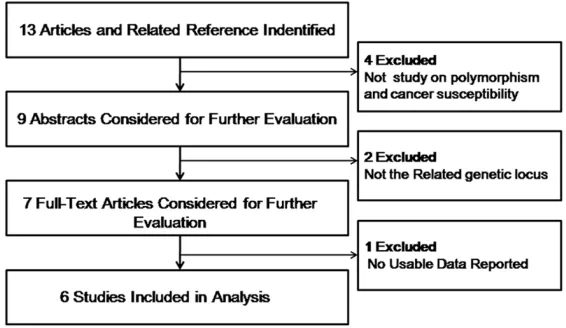
We searched the PubMed, Web of Science, and Chinese National Knowledge Infrastructure databases (last updated on Dec 1th, 2015) for published studies on the relationship of HOTAIR polymorphism with cancer risk. The following keywords were used either separate- ly or together: “HOTAIR”, “polymorphism or mutation”, and “cancer or tumor.” The refer-ences of related studies were reviewed to search other potentially related articles manu-ally. All of the selected studies in our meta-anal-ysis should also match the following inclusion criteria: (1) human case-control study (2); evalu-ation of HOTAIR rs4759314 polymorphism and cancer risk; and (3) availability of genotype fre-quencies in the study. We also restricted our search to studies published in English and Chinese. The procedures of database search are shown in Figure 1.
Data extraction
Two investigators independently obtained the following information from each study: (1) name of the first author; (2) year of publication; (3) country of origin; (4) ethnicity; (5) cancer type; (6) total number of control subjects and cases; (7) genotype frequencies for cases and control subjects; and (8) Hardy-Weinberg equilibrium
sided. The OR and 95% confidence interval (CI) were used to evaluate the strength of the asso-ciation between the HOTAIR polymorphism and cancer risk. We determined the relationship between SNP and cancer susceptibility by using the following genetic models: homozygote model (GG/AA); heterozygote model (AG/AA); the dominant genetic model (AGGG/AA); and recessive genetic model (GG/AAAG). Subgroup analyses were also conducted according to cancer type. The Z test was used to determine the significance of the pooled OR, in which the results were considered statistically significant at P<0.05. The heterogeneity among studies was determined by using a Chi-square-based Q test. The fixed-effect model (Mantel-Haenszel model) was used when homogeneity was con-sidered significant (P > 0.05); otherwise, the random-effect model (DerSimonian and Laird method) was used. In addition, publication bias was assessed using Begg’s funnel plot and Egger’s test (P<0.05 was considered a signifi -cant publication bias). These procedures were conducted twice in our meta-analysis.
Result
Characteristics of the studies
[image:2.612.91.374.75.239.2]After an extensive search was conducted, a total of 6 studies (with 5525 cancer patients and 6657 control subjects) satisfied our criteria [21-25, 28]. The details of each study are shown in Table 1. Among these studies, three focused on gastric cancer (GC), and the other two focused on esophageal squamous cell carcino-ma (EC) and colorectal cancer (CRC). The geno-Figure 1. Studies identified with criteria of inclusion and exclusion.
(HWE) of control subjects. Differences in the findings of the investigators were resolved by discussion.
Statistical analysis
two-typic distributions in the control populations were consistent with HWE in the selected studies.
Quantitative synthesis and heterogeneity analysis
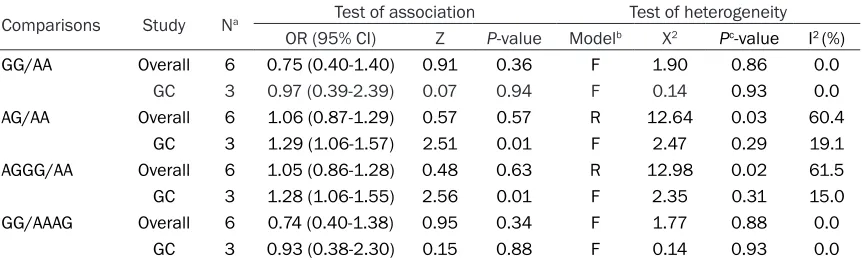
As shown in Table 2, for the HOTAIR rs4759314 polymorphism, all studies combined (5525 cases and 6657 controls) were pooled into the meta-analysis. Overall, no significant associa -tion between the HOTAIR rs4759314 polymor-phism and cancer risk was observed in any genetic model (homozygote model: OR=0.75, 95% CI=0.40-1.40; heterozygote model: OR= 1.06, 95% CI=0.87-1.29; dominant genetic model: OR=1.05, 95% CI=0.86-1.28; and re- cessive genetic model: OR=0.74, 95% CI= 0.40-1.38). Intriguingly, the HOTAIR rs4759314 polymorphism showed evidence of an associa-tion with an increased risk for gastric cancer (heterozygote model: OR=1.29, 95% CI=1.06-1.57; dominant genetic model: OR = 1.28, 95% CI=1.06-1.55) (Figure 2).
There was significant heterogeneity in the het -erozygote model (AG versus AA: I2=60.4%), and
dominant model (AG/GG versus AA: I2=61.5%). However, heterogeneity was not found in the homozygote and recessive model (GG versus AA: I2=0.0%; GG versus AA/AG: I2=0.0%). Next, the analysis stratified by tumor type was per -formed. Base on the lower I2 values in subgroup (AG versus AA: I2=19.1%; AG/GG versus AA: I2=15.0%), we thought that tumor type was the main origin of heterogeneity.
Publication bias
Publication bias was assessed by Begg’s fun-nel plot and Egger’s test (Figure 3). We found that the graphical funnel plots were symmetri-cal for the comparison of the genetic models. Egger’s test results did not indicate any evi-dence of publication bias in our meta-analysis (P > 0.05).
Sensitivity analysis
[image:3.612.90.523.86.189.2]Sensitivity analyses were performed after sequential removal of each eligible study. No single study changed the pooled overall ORs qualitatively, suggesting that the results were
Table 1. characteristics of studies included in the meta-analysis
First autor Years Country Ethnicity Cancer Cases Controls Case Control PWHE
AA AG GG AA AG GG
Zhang 2014 China Asian EC 1000 1000 917 81 2 910 89 1 0.44
Pan 2015 China Asian GC 500 1000 451 48 1 914 83 3 0.45
Wei 2015 China Asian GC 515 654 461 53 1 589 64 1 0.59
Du 2015 China Asian GC 1275 1644 1083 186 6 1464 172 8 0.23 Xue 2015 China Asian CRC 1733 1855 1528 200 5 1608 236 11 0.61
Yan 2015 China Asian BC 502 504 451 50 1 448 54 2 0.79
Abbreviations: HWE, Hard-Weinberg equilibrium; EC, Esophageal squamous cell carcinoma; GC, Gastric cancer; CRC, Colorectal cancer; BC, Breast cancer.
Table 2. Meta-analysis of LncRNA HOTAIR rs4759314 A > G polymorphism and cancer risk
Comparisons Study Na Test of association Test of heterogeneity
OR (95% CI) Z P-value Modelb X2 Pc-value I2 (%)
GG/AA Overall 6 0.75 (0.40-1.40) 0.91 0.36 F 1.90 0.86 0.0
GC 3 0.97 (0.39-2.39) 0.07 0.94 F 0.14 0.93 0.0
AG/AA Overall 6 1.06 (0.87-1.29) 0.57 0.57 R 12.64 0.03 60.4 GC 3 1.29 (1.06-1.57) 2.51 0.01 F 2.47 0.29 19.1 AGGG/AA Overall 6 1.05 (0.86-1.28) 0.48 0.63 R 12.98 0.02 61.5 GC 3 1.28 (1.06-1.55) 2.56 0.01 F 2.35 0.31 15.0 GG/AAAG Overall 6 0.74 (0.40-1.38) 0.95 0.34 F 1.77 0.88 0.0
GC 3 0.93 (0.38-2.30) 0.15 0.88 F 0.14 0.93 0.0
[image:3.612.92.523.249.379.2]stable (Figure 4). The significance of the ORs in the analysis stratified by tumor type was also not influenced by exclusion of any single study.
Discussion
It is well known that single nucleotide polymor-phisms (SNPs) are the most common sources
[image:6.612.93.374.115.300.2]gene (rs12826786 C > T, rs4759314 A > G, and rs10783618 C > T). Zhang and Pan et al also found that the HOTAIR rs4759314 A > G had no association with ESCC and GC risk in Chinese populations. However, Du et al identified that HOTAIR rs4759314 was significantly associat -ed with the increas-ed GC risk with an odds ratio (OR) of 1.39 (P=0.002). In our meta-analysis, Figure 2. Forest plot showing the stratified analysis performed according to cancer type. (A) GG/AA (B) AG/AA (C)
[image:6.612.89.378.362.555.2]AGGG/AA (D) GG/AAAG.
Figure 3. Begg’s funnel plot for publication bias test. Each point represents a separate study for the indicated association. Log (OR): nature logarithm of OR. Horizontal line represents size of effect.
Figure 4. Sensitive analysis for the overall meta-analysis. This figure shows the influence of individual studies on the summary OR. The middle vertical
axis indicates the overall OR and the two vertical axes indicate the 95% CI. Open circles indicate the pooled OR when the study indicated on the left is omitted from the meta-analysis. The lines indicate the 95% CI values when the study indicated is omitted from the meta-analysis.
of human genetic variation, which may lead to an indi- vidual’s susceptibility to can-cer [29]. Some of these SNPs caused the amino acid al- teration and might have a physiologic effect on cancer development which was in- volved in the non-synony-mous variants. LncRNAs are emerging as a novel class of non-coding RNAs. Several lncRNAs have been identifi-ed as being linkidentifi-ed to human disease and exerting specific functions [30]. Recent years, the number of studies inve- stigating the relationship be- tween LncRNA-HOTAIR poly-morphism and the risk of human cancer has increased, while the interpretations of the phenotypic effects of this polymorphism are confusing and complicated. That means the results which have report-ed are confounding rather than conclusive.
lack of association was found between the HOTAIR rs4759314 polymorphism and cancer susceptibility based on five case-control stud -ies including 5,525 cancer patients and 6,657 control subjects. Subgroup analysis revealed that the variant AG and AG/GG genotypes were associated with an increased risk of GC com-pared with wild-type AA genotype.
Several possible limitations of the present meta-analysis should be acknowledged and taken into consideration. First, although the funnel plot and Egger’s test showed no publica-tion bias and although a exhaustive literature search was done, the numbers of published studies were not sufficiently enough for a com -prehensive analysis on different types of can-cer. Meanwhile, some publications and unpub-lished data were overlooked. Selection bias for the meta-analysis might have occurred. Secondly, detailed information was not avail-able in all of the selected studies. A more pre-cise analysis would be achieved if more detailed individual data were available, such as sex, mean age, control populations and expo-sure. Thirdly, in the subgroup analysis by can-cer type, the number of studies and subjects analyzed for rs4759314 was small, and the statistical power was so weak that caution should be taken to interpret these results. A further investigation with much larger sample sizes is needed. In spite of these potential limi-tations, our meta-analysis also has some advantages. Firstly, The well-designed search and selection method significantly increased the statistical power of this meta-analysis. Secondly, studies included in our meta-analy-sis contained the distribution of the genotypes and available genotype frequency in the control population of all the studies were consistent with Hardy-Weinberg equilibrium. Thirdly, the stratified analysis reduced the heterogeneity found and the main origin of heterogeneity. Fourthly, no publication bias was detected among the pooled results. All in all, this mata-analysis indicated that the HOTAIR rs4759314 A > G variant was associated with an increased risk of GC. To confirm our results, we recom -mend that future well-designed studies and large sample size should consider diverse eth-nic populations and cancer types.
Acknowledgements
This study was supported by National Natural Science Foundation of China (81572517, 81-
370849, 81300472, and 81202034), Natural Science Foundation of Jiangsu Province (BL- 2013032 and BK2012336) and Nanjing City (201201053) and Southeast University (329- 0002402), Science Foundation of Ministry of Education of China (20120092120071).
Disclosure of conflict of interest
None.
Address correspondence to: Ming Chen, Depart-
ment of Urology, Affiliated Zhongda Hospital of
Southeast University, 87 Dingjia Bridge Hunan Road, Nanjing 210009, China. Tel: +86 139-130-09977; E-mail: [email protected]
References
[1] Huang K, Zhang JX, Han L, You YP, Jiang T, Pu PY, Kang CS. MicroRNA roles in beta-catenin pathway. Mol Cancer 2010; 9: 252.
[2] Sana J, Faltejskova P, Svoboda M and Slaby O. Novel classes of non-coding RNAs and cancer. J Transl Med 2012; 10: 103.
[3] Cano A and Nieto MA. Non-coding RNAs take centre stage in epithelial-to-mesenchymal transition. Trends Cell Biol 2008; 18: 357-359. [4] Malone CD and Hannon GJ. Small RNAs as
guardians of the genome. Cell 2009; 136: 656-668.
[5] Moazed D. Small RNAs in transcriptional gene silencing and genome defence. Nature 2009; 457: 413-420.
[6] Gupta RA, Shah N and Wang KC, Kim J, Horlings HM, Wong DJ, Tsai MC, Hung T, Argani P, Rinn JL, Wang Y, Brzoska P, Kong B, Li R, West RB, van de Vijver MJ, Sukumar S, Chang HY. Long non-coding RNA HOTAIR reprograms chromatin state to promote cancer metastasis. Nature 2010; 464: 1071-1076.
[7] Mercer TR, Dinger ME and Mattick JS. Long non-coding RNAs: insights into functions. Nat Rev Genet 2009; 10: 155-159.
[8] Zhang J, Zhang A, Wang Y, Liu N, You Y, Kang C, Pu P. New insights into the roles of ncRNA in the STAT3 pathway. Future Oncol 2012; 8: 723-730.
[9] Kim K, Jutooru I, Chadalapaka G, Johnson G, Frank J, Burghardt R, Kim S, Safe S. HOTAIR is a negative prognostic factor and exhibits pro-oncogenic activity in pancreatic cancer. Oncogene 2013; 32: 1616-1625.
[10] Geng YJ, Xie SL, Li Q, Ma J and Wang GY. Large intervening non-coding RNA HOTAIR is associ-ated with hepatocellular carcinoma progres-sion. J Int Med Res 2011; 39: 2119-2128. [11] Niinuma T, Suzuki H, Nojima M, Nosho K,
Maruyama R, Nobuoka T, Miyazaki Y, Nishida T, Bamba T,Kanda T, Ajioka Y, Taguchi T, Okahara S, Takahashi H, Nishida Y, Hosokawa M, Hasegawa T, Tokino T, Hirata K, Imai K, Toyota M, Shinomura Y. Upregulation of miR-196a and HOTAIR drive malignant character in gas-trointestinal stromal tumors. Cancer Res 2012; 72: 1126-1136.
[12] Hajjari M, Behmanesh M, Sadeghizadeh M and Zeinoddini M. Up-regulation of HOTAIR long non-coding RNA in human gastric adeno-carcinoma tissues. Med Oncol 2013; 30: 670. [13] Li X, Wu Z, Mei Q, Li X, Guo M, Fu X, Han W.
Long non-coding RNA HOTAIR, a driver of ma-lignancy, predicts negative prognosis and ex-hibits oncogenic activity in oesophageal squa-mous cell carcinoma. Br J Cancer 2013; 109: 2266-2278.
[14] Chen FJ, Sun M, Li SQ, Wu QQ, Ji L, Liu ZL, Zhou GZ, Cao G, Jin L, Xie HW, Wang CM, Lv J, De W, Wu M, Cao XF. Upregulation of the long non-coding RNA HOTAIR promotes eso- phageal squamous cell carcinoma meta- stasis and poor prognosis. Mol Carcinog 2013; 52: 908-915.
[15] Chisholm KM, Wan Y, Li R, Montgomery KD, Chang HY and West RB. Detection of long non-coding RNA in archival tissue: correlation with polycomb protein expression in primary and metastatic breast carcinoma. PLoS One 2012; 7: e47998,.
[16] Kogo R, Shimamura T, Mimori K, Kawahara K, Imoto S, Sudo T, Tanaka F, Shibata K, Suzuki A, Komune S, Miyano S, Mori M. Long noncoding RNA HOTAIR regulates polycomb-dependent
chromatin modification and is associated with
poor prognosis in colorectal cancers. Cancer Res 2011; 71: 6320-6326.
[17] Nakagawa T, Endo H, Yokoyama M, Abe J, Tamai K, Tanaka N, Sato I, Takahashi S, Kondo T, Satoh K. Large noncoding RNA HOTAIR en-hances aggressive biological behavior and is associated with short disease-free survival in human non-small cell lung cancer. Biochem Biophys Res Commun 2013; 436: 319-324. [18] Liu XH, Liu ZL, Sun M, Liu J, Wang ZX and De W.
The long non-coding RNA HOTAIR indicates a poor prognosis and promotes metastasis in non-small cell lung cancer. BMC Cancer 2013; 13: 464.
[19] Li D, Feng J, Wu T, Wang Y, Sun Y, Ren J, Liu M. Long intergenic noncoding RNA HOTAIR is over-expressed and regulates PTEN methylation in laryngeal squamous cell carcinoma. Am J Pathol 2013; 182: 64-70.
[20] Nie Y, Liu X, Qu S, Song E, Zou H and Gong C. Long non-coding RNA HOTAIR is an indepen-dent prognostic marker for nasopharyngeal carcinoma progression and survival. Cancer Sci 2013; 104: 458-464.
[21] Guo W, Dong Z, Bai Y, Guo Y, Shen S, Kuang G, Xu J. Associations between polymorphisms of HOTAIR and risk of gastric cardia adenocarci-noma in a population of north China. Tumour Biol 2015; 36: 2845-2854.
[22] Zhang X, Zhou L, Fu G, Sun F, Shi J, Wei J, Lu
C, Zhou C, Yuan Q, Yang M. The identification
of an ESCC susceptibility SNP rs920778 that regulates the expression of lncRNA HOTAIR via a novel intronic enhancer. Carcinogenesis 2014; 35: 2062-2067.
[23] Pan W, Liu L, Wei J, Ge Y, Zhang J, Chen H, Zhou L, Yuan Q, Zhou C, Yang M. A functional lncRNA HOTAIR genetic variant contributes to gastric cancer susceptibility. Mol Carcinog 2016; 55: 90-6.
[24] Du M, Wang W, Jin H, Wang Q, Ge Y, Lu J, Ma G, Chu H, Tong N, Zhu H, Wang M, Qiang F, Zhang Z. The association analysis of lncRNA HOTAIR genetic variants and gastric cancer risk in a Chinese population. Oncotarget 2015; 6: 31255-62.
[25] Xue Y, Gu D, Ma G, Zhu L, Hua Q, Chu H, Tong N, Chen J, Zhang Z, Wang M. Genetic variants in lncRNA HOTAIR are associated with risk of colorectal cancer. Mutagenesis 2015; 30: 303-310.
[26] Bayram S, Ulger Y, Sumbul AT, Kaya BY,
Rencüzoğulları A, Genç A, Sevgiler Y, Bozkurt O, Rencüzoğulları E. A functional HOTAIR
rs920778 polymorphism does not contributes to gastric cancer in a Turkish population: a case-control study. Fam Cancer 2015; 14: 561-7.
[27] Bayram S, Sumbul AT, Batmaci CY and Genc A. Effect of HOTAIR rs920778 polymorphism on breast cancer susceptibility and clinicopatho-logic features in a Turkish population. Tumour Biol 2015; 36: 3863-3870.
[28] Yan R, Cao J, Song C, Chen Y, Wu Z, Wang K, Dai L. Polymorphisms in lncRNA HOTAIR and susceptibility to breast cancer in a Chinese population. Cancer Epidemiol 2015; 39: 978-985.
[29] Wu GY, Hasenberg T, Magdeburg R, Bonning- hoff R, Sturm JW and Keese M. Association between EGF, TGF-beta1, VEGF gene polymor-phism and colorectal cancer. World J Surg 2009; 33: 124-129.