Proceedings of the First Workshop on Linguistic Resources for Natural Language Processing, pages 83–90 83
Parallel Corpora for bi-Directional Statistical Machine Translation for
Seven Ethiopian Language Pairs
Solomon Teferra Abate Addis Ababa University,
Addis Ababa, Ethiopia
Michael Melese Woldeyohannis Addis Ababa University,
Addis Ababa, Ethiopia [email protected]
Martha Yifiru Tachbelie Addis Ababa University,
Addis Ababa, Ethiopia [email protected]
Million Meshesha Addis Ababa University,
Addis Ababa, Ethiopia [email protected]
Solomon Atinafu Addis Ababa University,
Addis Ababa, Ethiopia [email protected]
Wondwossen Mulugeta Addis Ababa University,
Addis Ababa, Ethiopia
Yaregal Assabie Addis Ababa University,
Addis Ababa, Ethiopia [email protected]
Hafte Abera Addis Ababa University,
Addis Ababa, Ethiopia [email protected]
Biniyam Ephrem Addis Ababa University,
Addis Ababa, Ethiopia [email protected]
Tewodros Abebe Addis Ababa University,
Addis Ababa, Ethiopia [email protected]
Wondimagegnhue Tsegaye Bahir Dar University,
Bahir Dar, Ethiopia [email protected]
Amanuel Lemma Aksum University,
Axum, Ethiopia
Tsegaye Andargie Wolkite University,
Wolkite, Ethiopia [email protected]
Seifedin Shifaw Wolkite University,
Wolkite, Ethiopia [email protected]
Abstract*
In this paper, we describe the development of parallel corpora for Ethiopian Languages: Am-haric, Tigrigna, Afan-Oromo, Wolaytta and Ge’ez. To check the usability of all the corpora we conducted baseline bi-directional statistical machine translation (SMT) experiments for seven language pairs. The performance of the bi-directional SMT systems shows that all the corpora can be used for further investigations. We have also shown that the morphological complexity of the Ethio-Semitic languages has a negative impact on the performance of the SMT especially when they are target languages. Based on the results we obtained, we are currently working towards handling the morphological complexities to improve the performance of statistical ma-chine translation among the Ethiopian languages.
* This work is licenced under a Creative Commons Attribution 4.0 International License. Page numbers and proceedings
1 Introduction
The advancement of technology and the rise of the internet as a means of communication led to an ever-increasing demand for Natural Language Processing (NLP) Applications. NLP applications are useful in facilitating human-human communication via computing systems. One of the NLP applications which facilitate human-human communication is Machine Translation. Machine Translation (MT) refers to a process by which computer software is used to translate a text from one language to another (Koehn, 2009). In the presence of high volume digital text, the ideal aim of machine translation systems is to produce the best possible translation with minimal human intervention (Hutchins, 2005).
The translation of natural language by machine becomes a reality, for technologically favored languages, in the late 20th century although it is dreamt since the seventieth century (Hutchins, 1995). Various approaches to MT have been and are being used in the research community. These approaches are broadly classified into rule based and corpus-b a se d MT (Koehn, 2009). The rule-based machine translation demands various kinds of linguistic re- sources such as morphological analyzer and synthesizer, syntactic parsers, semantic analyzers and so on. On the other hand, corpus-based approaches (as the name implies) require parallel and monolingual corpora. Since corpus-corpus-based ap-proaches do not require deep linguistic analysis of the source and target languages, it is the preferred approach for under-resourced languages of the world, including Ethiopian languages.
1.1 Machine Translation for Ethiopian Languages
Research in the development of MT has been conducted for technologically favored and economically as well as politically important languages of the world since the 17th century. As a result, notable pro-gress towards the development and use of MT systems has been made for these languages. However, research in the area of MT for Ethiopian languages, which are under-resourced as well as economically and technologically disadvantaged, has started very recently. Most of the researches on MT for Ethiopian
languages are conducted by graduate students (Tariku, 2004; Sisay, 2009; Eleni, 2013; Jabesa, 2013;
Akubazgi, 2017), including two PhD works: one that tried to integrate Amharic into a unification-based machine translation system (Sisay, 2004) and the other that investigated English-Amharic Statistical Machine translation (Mulu, 2017). Beside this, Michael and Million (Michael and Million, 2017) exper-imented a bi-directional Amharic-Tigrigna SMT system using word and morpheme as a unit.
Due to unavailability of linguistic resources and since the most widely used MT approach is statistical, most of these researches have been conducted using statistical machine translation (SMT), which requires large bilingual and monolingual corpora. However, as there were no such corpora for SMT experiments for Ethiopian languages, the researchers had to prepare their own small size corpora for their experiment. This in turn, affects the results that they obtain.
In addition, since there are no standard corpora for conducting replicable and consistent experi-ments for performance evaluation, it is difficult to know the progress made in the area for local languages. Moreover, since the researchers had to spend their time on corpora preparation, they usually have limited time for experimentation, exploration and development of MT systems.
1.2 Motivation of this Paper
African languages, which contribute around 30% (2139) of the world language highly suffer from the lack of sufficient language resources (Simons and Fennig, 2017). This is true for Ethiopian languages. On the other hand, Ethiopia being a multilingual and multi-ethnic country, its constitution decrees that each citizen has the right to speak, write and develop in his/her own language. However, there is still a need to share information among citizens who speak different languages. For example, Amharic is the regional language of the Amhara and Southern Nations and Nationalities regions, Afan-Oromo is that of the Oromia region while the Tigray region uses Tigrigna. All these regions produce a lot of infor-mation that need to be shared among the other regions of the nation. There is, therefore, a lot of transla-tion demands among the different language communities of the federal government of Ethiopia.
resource required for SMT is parallel corpora, which are not available for Ethiopian languages. The collection and preparation of parallel corpora for Ethiopian languages is, therefore, an im-portant endeavour to facilitate future MT research and development.
We have, therefore, collected and prepared parallel corpora for seven Ethiopian Language pairs taking representatives from the Semitic, Cushitic and Omotic language families. We have consid-ered Amharic, Tigrigna and Ge’ez from the Semitic, Afan-Oromo from the Cushitic and Wolaytta from Omotic language families. This paper, therefore, describes the parallel corpora we collected and prepared for these Ethiopian languages and the SMT experiments conducted using the corpora as a way of verifying their usability.
2 Nature of the Language Pairs
The language pairs in the corpora belong to Semitic (Ge’ez, Amharic and Tigrigna), Cushitic (Afan-Oromo) and Omotic (Wolaytta) language families. Except Ge’ez, these languages have native speakers. Ge’ez serves as a liturgical language of Ethiopian Orthodox Church. It is thought as a second language in the traditional schools of the church and given as a course in different Universities. There is a rich body of literature in Ge’ez, including philosophical, medical and astrological writings. Because of this, there is a big initiative in translating the documents written in Ge’ez to other widely used languages. On the other hand, Amharic is spoken by more than 27 million people which makes it the second most spoken Semitic language in the world. Tigrigna is spoken by 9 million people. Afan-Oromo and Wolaytta are spoken by more than 34 million and 2 million speakers, respectively (Simons and Fennig, 2017).
The writing systems of these language pairs are Ge’ez or Ethiopic script and Latin alphabet. Ge’ez, Amharic and Tigrigna are written in Ge’ez script whereas both Afan-Oromo and Wolaytta are written in Latin alphabet. It is believed that the earliest known writing in the Ge’ez script date back to the 5th century BC. The Ge’ez script is syllabary in which each character represents a consonant and a vowel. Each character gets its basic shape from the consonant of the syllable, and the vowel is represented through systematic modifications of the basic shape. The script is also used to write other languages like Argobba, Harari, Gurage, etc.
The language pairs have got different functions in the country. Amharic for instance is the work-ing language of the Federal Government of Ethiopia. It also serves as regional workwork-ing language of some other regional states. It facilitates inter-regional communication. Tigrigna and Afan-Oromo are working languages in Tigray and Oromia regional administrations, respectively. Apart from this, they serve as medium of instructions in primary and secondary schools. These languages are also used widely in the electronic media like news, blogs and social media. Some of the gov-ernmental websites are available in Amharic, Tigrigna and Afan-Oromo. Currently, Google offers a searching capability using these Ethiopian languages. Further, Google also included Amharic in its translation service recently.
2.1 Morphological Features
Like other Semitic languages, Ge’ez (Dillmann and Bezold, 1907), Amharic (Leslau, 2000;
Anbessa and Hudson, 2007) and Tigrigna (Mason, 1996; Yohannes, 2002), make use of the root
and pattern system. In these languages, a root (which is called a radical) is a set of consonants which bears the basic meaning of the lexical item whereas a pattern is composed of a set of vowels inserted between the consonants of the root. These vowel patterns together with affixes results in derived words. Such derivational process makes these languages morphologically complex.
In addition to the morphological information, some syntactic information are also expressed at word level. Furthermore, an orthographic word may attach some syntactic words like prepositions,
conjunctions, negation, etc. which create various word forms (Gasser, 2010; Gasser, 2011). In
these languages, nominals are inflected for number, gender, definiteness and case whereas verbs are inflected for person, number, gender, tense, aspect, and mood (Griefenow-Mewis, 2001).
Wolaytta like Afan-Oromo is a suffixing language in which words can be generated from root words recursively by adding suffixes only. Wolaytta nouns are inflected for number, gender and case whereas verbs are inflected for person, number, gender, aspect and mood (Wakasa, 2008).
2.2 Syntactic Features
Ethiopian languages that are under our consideration follow Subject-Object-Verb (SOV) word- order except Ge’ez which allows the verb to come first. In Ge’ez, the basic word-order is Verb- Subject-Object (VSO).
3 Challenges of SMT
Statistical Machine Translation is greatly impacted by the linguistic features of the target languages. The challenges range from the writing system to that of word ordering and morphological complex-ity.
3.1 Writing System
The Ge’ez writing system, which is used by Amharic, Tigrigna and Ge’ez languages, uses different characters in words that convey the same meaning, especially in Amharic. For example, peace can
be written as: ሰላም or ሠላም. Such character variations affect probability values that have direct
impact on the performance of SMTs.
3.2 Word Ordering
Most of the languages under consideration have same word order. With this respect, Amharic, Afan-Oromo, Tigrigna and Wolaytta have SOV, while only Ge’ez has VSO. This might challenge machine translation system where Ge’ez is in the pair. Another challenge is the existence of flexibility in word order. For instance, even though Afan-Oromo follows SOV word order, nouns can be changed based on their role in a sentence which makes the word order to be flexible. Such flexibility will pose a challenge for translation from a source to Afan-Oromo.
3.3 Morphological Complexity
While word alignment could be done automatically or with supervision, morphological agreement between words in the source and target are crucial. For instance, Amharic and Geez have subject agreement, object agreement and genitive (possessive) agreement. Each of which is expressed as
bound morphemes. In Amharic, for the word ገ ድ ል ክ/you killed/ the subject “you” is represented by
the suffix “+ክ” while the same subject is represented as “+” in the Geez ቀተልከ/you killed/). Most
of the morphemes in the considered Ethiopian languages are bound ones.
4 Parallel Corpora Preparation
The development of machine translation more often uses statistical approach because it requires very limited computational linguistic resources compared to the rule based approach. Nevertheless, the statistical approach relies to a great extent on parallel corpora of the source and target languages.
The research team has applied different techniques to collect parallel corpora for the selected Ethiopian language pairs. The domain of the collected data is only religious for which we have data for all the considered language pairs. It includes Holy Bible and different documents written in
spiritual theme and collected from Jehovah’s Witnesses (JW1), Ethiopicbible2, Ebible3 and Geez
experience4 which are freely accessible websites.
A simple web crawler was used to extract parallel text from the websites. Python libraries such as requests, and BeautifulSoup were used to analyse the structure of the websites, extract texts
1 available at https://www.jw.org
2 available at https://www.ethiopicbible.com 3 available at http://ebible.org
and combine into a single text file. To collect the bible data, we have generated the structure of the URL so that it shows the book names, chapters and verses of the Bible in each language.
For the “daily text” which is published at JW.org, we tried to use the date information to generate URL for each language. Finally, we extracted the data based on the generated URL information and merged to a single UTF-8 text file for each language.
4.1 Pre-processing
Data preprocessing is an important and basic step in preparing bilingual and multilingual parallel corpora. Since the collected parallel data have different formats and characteristics, it is very difficult and time-consuming to prepare usable parallel corpora manually because it needs to analyse the struc-ture of the collected raw data by applying different linguistic methods. We have, therefore, applied
different automatic methods of text pre-processing that requires minimalhuman interference. As
part of the pre-processing unnecessary links numbers, symbols and foreign texts in each language have been removed. During pre-processing the following tasks have been performed: character nor-malization, sentence tokenization and sentence level alignment.
4.1.1 Character Normalization
As it is indicated in Section 3.1, there are characters in Amharic that have similar roles and are
redundant. For example the character (ሀ) can be written as (ሐ, ሓ, ኃ, ኅ and ሃ). Though they used to
possess semantic differences in the traditional writings, currently these characters are mostly used interchangeably. To avoid words with same meaning from being taken as different words due to these variations we have replaced a set of characters with similar function into a single most frequently used character.
4.1.2 Sentence Tokenization and Alignment
Lines that contain multiple sentences in both source and target languages are tokenized. The team has set two criteria to check whether the aligned sentences are correct or not. The first criterion is counting and matching the number of sentences in the source language and the target language. In the parallel corpora of the language pairs in which Ge’ez is the target, the source language contains multiple verses in a single line. While on the Ge’ez side, each line contains a single verse. In such cases, we merged different verses of Ge’ez to produce the line that is aligned with that of the source language.
4.2 Corpus Size and Distribution of Words
The corpora have been analysed to see the relationship between languages in the language pairs. As it has been revealed in different literature, the Ethio-Semitic languages have more complex morphology than the other Ethiopian languages. Due to this difference, the same number of sentences in these language pairs is tokenized into significantly different number of tokens and word types. Table 1 clearly shows that the vocabulary of the languages in the Ethio-Semitic language family is much more than the vocabulary of the other two language families.
Sentences Languages Token Type Average sentence Length
34,349
Amharic 521,035 98,841 15
Tigrigna 546,570 87,649 15
11,546
Amharic 148,084 38,097 12
Ge’ez 158,003 33,386 13
11,457
Amharic 163,816 37,283 14
Afan-Oromo 214,335 24,005 18
10,987
Tigrigna 162,508 32,953 14
Afan-Oromo 206,844 23,536 18
9,400
Amharic 119,262 32,780 12
Wolaytta 137,869 25,331 14
Sentences Languages Token Type Average sentence Length
2,923 Wolaytta 33,828 8,786 11
2,504
Tigrigna 34,780 9,864 13
[image:6.595.144.450.70.134.2]Wolaytta 29,458 7,989 11
Table 1: Sentence and Word Distribution of the Parallel Corpora
On the contrary the token of the non-Semitic languages is significantly higher than the tokens of the Ethio-Semitic languages. This is because syntactic words like preposition, conjunction, negation, etc are bound in the Ethio-Semitic language group. It is clear, therefore, that such differences between the lan-guages in a language pair makes SMT difficult because it aggravates data sparsity and results into a weakly trained translation model. Although the size of the data we have is much less to draw conclu-sions, we could also see that the Ethio-Cushitic and Ethio-Omotic languages are morphologically more similar with each other than their similarity with the Ethio-Semitic languages.
We have also observed morphological differences among the Ethio-Semitic languages that is revealed by the difference in the number of token and word type in the same corpus we have for Amharic-Tigrigna and Amharic-Ge’ez language pairs. The data revealed that Amharic is the most morphologically complex language of the family.
5 SMT Experiments and Results
To check the usability of the collected parallel corpora for seven Ethiopian language pairs, we have conducted bi-directional SMT experiments.
5.1 Experimental Setup
To conduct SMT experiments, each parallel corpus has been divided into three sets: 80% for the training, 10% for tuning and 10% for test sets. Moses (Koehn, 2009) has been used along with Giza++ alignment tool (Och and Ney, 2003) for aligning words and phrases. SRILM toolkit (Stolcke, 2002) has been used to develop the language models using target language sentences from the training and tuning sets of parallel corpora. Bilingual Evaluation Under Study (BLEU) is used for automatic scoring.
5.2 Experimental Results
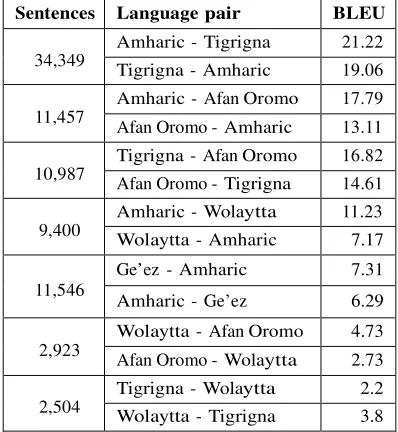
Table 2 presents the experimental results of bi-directional SMT systems developed for the seven Ethiopian language pairs. The Table shows the difference in the performance of the systems devel-oped for the same language pair in different directions.
Sentences Language pair BLEU
34,349
Amharic - Tigrigna 21.22
Tigrigna - Amharic 19.06
11,457
Amharic - AfanOromo 17.79
AfanOromo- Amharic 13.11
10,987
Tigrigna - AfanOromo 16.82
AfanOromo- Tigrigna 14.61
9,400
Amharic - Wolaytta 11.23
Wolaytta - Amharic 7.17
11,546
Ge’ez - Amharic 7.31
Amharic - Ge’ez 6.29
2,923
Wolaytta - AfanOromo 4.73
AfanOromo- Wolaytta 2.73
2,504
Tigrigna - Wolaytta 2.2
Wolaytta - Tigrigna 3.8
[image:6.595.203.402.536.752.2]The performance of SMT systems decreases when Ethio-Semitic languages are on the target side. This confirms that Ethio-Semitic languages (when they are targets) are more challenging to SMT than the other language families. The only exception being Tigrigna and Wolaytta language pair, where the performance is high when Tigrigna is a target. This could be attributed to the small data we have for this language pair.
The results in the Table 2 also show the effect of data size on the performance of SMT systems. That means as the data increases, the performance also increases. In this view again we have an exceptionally lower BLUE score for the Amharic-Ge’ez language pair than the score we achieved for Amharic-Afan Oromo language pair although the data size used is almost equal. The performances of the Amharic-Wolaytta-Amharic translation systems are better than Amharic- Ge’ez-Amharic systems although the data size used in the former is less than the data size used in the latter. The results confirm that the morphological complexity of the languages severely affect SMT performance than the amount of data. From the difference in results achieved for the Amharic-Ge’ez (6.29) and Ge’ez-Amharic (7.31) language pairs, it is possible to understand that syntactic differences affect the performance of SMT more than the difference in their morphological features. We have seen from their number of word types that Amharic has more complex morphology than Ge’ez which, however, has flexible syntactic structure.
Despite the size of the data, the performance registered in translation towards the Ethio- Semitic languages has less BLEU score than the translations from them. This is because of the fact that, when the Ethio-Semitic languages, specially Amharic, are used as a target language, the transla-tion from other languages with less morphological complexity as a source languages is challenged by one-to-many alignment. On the other hand, better performance is registered the other direction since the alignment is many-to-one. Beside this, the word-based language model favours the non-Semitic languages than non-Semitic ones due to the complexity of the morphology of the latter language family.
6 Conclusions and Future Work
This paper presents the attempt made in the preparation of usable parallel corpora for Ethiopian languages. The corpora have been collected from the web in the religious domain. Then, they are further pre-processed and normalized. We have now usable parallel corpora for seven Ethiopian language pairs. Using the corpora, bi-directional statistical machine translation experiments have been conducted. The results show that translation systems from Ethio-Semitic languages to either Omotic or Cushitic language families achieve better BLEU score than those in the other directions. That leads us to conclude that the Ethio-Semitic language family has the most complex morphol-ogy which greatly affects the performance of SMT.
Finding solutions that minimize the negative effect of morphological complexity of the Ethio- Semitic languages on the performance of SMT is therefore a future endeavour. We considered a previous work by (Mulu, 2017) who gained a significant improvement by the application of mor-phological segmentations to guide us in utilizing the use of morphemes instead of words as units for both the translation and the statistical language models. The most attractive solution to the problems of machine translation that is the trend of the time is the use of ANN modelling, which however, requires more data than what we have. So we will use our experience of corpus preparation and work towards the application of the state of the art technologies to develop usable machine translation systems for the Ethiopian languages.
As it is well known, domain is the most important factor on the performance of SMT. Thus, we are also working on the development and organization of parallel corpora for the Ethiopian languages in different domains.
Acknowledgement
References
Gebremariam Akubazgi. 2017. Amharic-Tigrigna machine translation using hybrid approach. Master’s the-sis, Addis Ababa University.
Teferra Anbessa and Grover Hudson. 2007. Essentials of Amharic. Rüdiger Köppe, Verlag, Köln.
August Dillmann and Carl Bezold. 1907. Ethiopic grammar, enlarged and improved by c. Bezold. Translated by JA Crichton. London: Williams & Norgate.
Teshome Eleni. 2013. Bidirectional English-Amharic machine translation: An experiment using con- strained
corpus. Master’s thesis, Addis Ababa University.
Michael Gasser. 2010. A dependency grammar for Amharic. In Proceedings of the Workshop on Language
Resources and Human Language Technologies for Semitic Languages, Valletta, Malta.
ftp://html.soic.indiana.edu/pub/gasser/sem_ws10.pdf
Michael Gasser. 2011. Hornmorpho: a system for morphological processing of Amharic, Oromo, and Tigrinya.
In Conference on Human Language Technology for Development, pages 94-99, Alexandria, Egypt.
Catherine Griefenow-Mewis. 2001. A grammatical sketch of written Oromo, volume 16. Rüdiger Köppe.
John Hutchins. 1995. Machine translation: A brief history. In Concise history of the language sciences, pages 431–445. Elsevier.
John Hutchins. 2005. The history of machine translation in a nutshell, http://www.hutchinsweb.me.uk/Nutshell-2005.pdf.
Daba Jabesa. 2013. Bi-directional English-Afaan oromo machine translation using hybrid approach. Mas-ter’s thesis, Addis Ababa University.
Philipp Koehn. 2009. Statistical machine translation. Cambridge University Press.
Wolf Leslau. 2000. Introductory grammar of Amharic, volume 21. Otto Harrassowitz Verlag.
John S Mason. 1996. Tigrinya grammar. Red Sea Press (NJ).
Melese Michael and Meshesha Million. 2017. Experimenting Statistical Machine Translation for Ethiopic Semitic Languages : The case of Amharic-Tigrigna. In LNICST. EAI International Conference on ICT
for Development for Africa, pages 140-149, Springer.
Gebreegziabher Teshome Mulu. 2017. English-Amharic Statistical Machine Translation. PhD Dissertation, IT Doctoral Program, Addis Ababa University, Addis Ababa, Ethiopia.
Franz Josef Och and Hermann Ney. 2003. A systematic comparison of various statistical alignment models.
Computational linguistics, 29(1):19–51.
Gary F Simons and Charles D Fennig. 2017. Ethnologue: Languages of the world. SIL, Dallas, Texas.
Adugna Sisay. 2009. English–Afan Oromo machine translation: An experiment using statistical Approach. Mas-ter’s thesis, Addis Ababa University.
Fissaha Sisay. 2004. Adding Amharic to a Unification-based Machine Translation System: An Experiment. Peter Lang.
Andreas Stolcke. 2002. SRILM-an extensible language modeling toolkit. In Seventh international conference
on spoken language processing,
https://www.isca-speech.org/ar-chive/icslp_2002/i02_0901.html
Tsegaye Tariku. 2004. English-Tigrigna factored statistical machine translation. Master’s thesis, Addis Ab-aba University.
Motomichi Wakasa. 2008. A descriptive study of the modern Wolaytta language. Unpublished PhD thesis, University of Tokyo.