AmritaCEN at SemEval-2016 Task 11: Complex Word Identification using
Word Embedding
Sanjay S.P and Anand Kumar M and Soman K P Centre for Computational Engineering & Networking (CEN)
Amrita School of Engineering, Coimbatore Amrita Vishwa Vidyapeetham
Amrita University India
[email protected], m [email protected], kp [email protected]
Abstract
Complex word identification task focuses on identifying the difficult word from English sentence for a Native speakers. Non-Native speakers are those who don’t have En-glish as their native language. It is a sub-task for lexical simplification. We have ex-perimented with word embedding features, or-thographic word features, similarity features and POS tag features which improves the per-formance of the classification. In addition to the SemEval 2016 results we have evaluated the training data by varying the vector dimen-sion size and obtained the best possible size for producing better performance. The SVM learning algorithm will attains constant and maximum accuracy through linear classifier. We achieve a G-score of 0.43 and 0.54 on computing complex words for two systems.
1 Introduction
Complex Word Identification (CWI) is the task of identifying difficult words for a Non-Native speaker. The main objective of Complex Word Identification is to simplify and enhance the perplexing words in the sentences for Non-Native speakers. Complex Word Identification is used in Lexical Simplifica-tion (LS). The Lexical SimplificaSimplifica-tion is important for all Text Simplification (Gustavo Henrique Paet-zold, 2006). The perspective of each user is dif-ferent therefore the task Complex Word Identifica-tion have been demanding one. For distinguish com-plex words for individual user will be a tedious task, therefore the CWI task is a difficult one, so we are identifying the complex words for a group of users.
CWI could be used in summarization of sto-ries or generate abstract of a book. Shortening a paragraph would be difficult without removing the complex words, since the shortened text with complex words would be very difficult or confus-ing for non-native users to read and understand. We can make a story more simple for kids to read by replacing complex words with most common words (Tomoyuki Kajiwara et al., 2013). The main ways to identify the complex words are Threshold-based and Classification-Threshold-based approches (Gustavo Henrique Paetzold, 2006). In Threshold-based ap-proach, length, number of syllables, count of ambi-guity and word frequency are considered as features. If the values are above the threshold, then the word is said to be a complex word. In the Classifier-based approach, the word features are trained and the word features which are similar to the trained word fea-tures are considered to be a complex word.
2 Complex Word Identification (CWI) -Task Description
The SemEval-2016 organizers have released three files cwi training, cwi training allannotations, and cwi testing. The first two files are training files and the third file is a testing file. Our task is to find the words in the testing file and label each one as 1 if the given word is a complex word, or 0 if the word is not a complex word.
The training allannotations file contains tags of 20 authors for given sentences. The training file con-tains a single tag for the sentences representing the group of 20 authors in allannotations file. Each word is tagged complex if any of the author tagged it as 1.
If the all authors tagged it as non-complex then it is tagged as 0. We trained a binary classifier on the cwi training data to identify the complex words in the testing data.
3 Neural word embedding
From the given sentences, unique words are con-verted into a more meaningful mathematical vec-tor representation called a Neural word embedding (Tomas Mikolov et al., 2013). For a given word, the vector formed by the word is related to the semantic and syntactic contexts of the word, and also related to the the neighboring occurrence of the word. To produce the maximum vector of given size. Thew0
is the given word where the conditional probability is given in the Figure 1, where j is the index of actual output in the output layer.
3.1 Gensim - Implementation
The Gensim word2vec uses skip-gram and CBOW models. The word2vec run two passes to the training data. The first pass will collect the required unique words and build the tree structure. The second pass will train the neural model (Tomas Mikolov et al., 2013). We can vary the dimensions of the vector space model.
4 Methodology
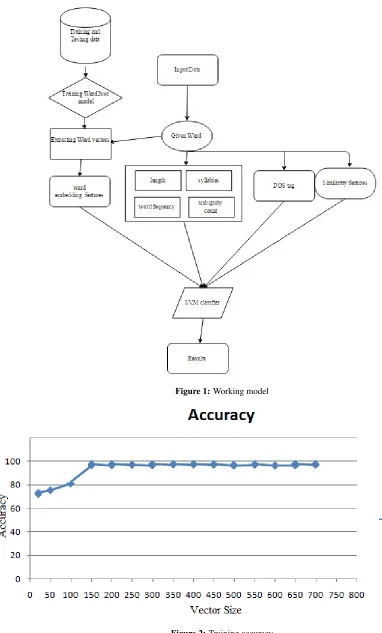
The input data to our system is in the form of sen-tences but the output requires only word to tagged, so we cannot train the classifier with sentence fea-tures. The sentence with the word to be identified are tokenized. We have given the tokenized data into a word embedding models, it produced vectors for each words. we have acquired similarity features with nearby words. The other features like POS tag-ging and orthographic word features are obtained from the word and these features does not depend on the sentence. All the features are incorporated and saved in a text file. The text file is given to a SVM classifier which compares with the trained model and generates the result. The working pro-cess is given in Figure 1.
5 Feature Extraction
The features, are extracted from the given word in the testing data. We have extracted four types of
tures, namely orthographic features, similarity tures, word embedding features and POS tag fea-tures. In these four types of features the ortho-graphic feature based on the word itself, it pro-vides the shape features of the word. The other two features namely similarity features and word em-bedding features are extracted from the word2vec model which is mentioned above. The Part Of Speech (POS) tag features is obtained with the help of NLTK tool kit and all the features are incorpo-rated for training.
5.1 Orthographic features
Orthographic word features do not depend on the sentence. They are generic features of a given word like length of the word, number of syllables, ambi-guity count and frequency. The count of the char-acters in the corresponding target word which pro-vides the length of the word. The syllable feature gives the number of syllables present in the word, using the pyhyphen package we have retrieved the features. We used NLTK WordNet synsets (Steven Bird, 2006) for obtaining the ambiguity of the word. WordNet has an built-in dictionary from which num-ber of ambiguity present for the word is obtained (George A. Miller, 1995; ?). The ambiguity is de-fined as the number of words that have similar mean-ing. A word is said to be more familiar if the word has more meaning. In the frequency feature, we count occurrences of the word in both training and testing data. These word features improve the accu-racy.
5.2 Similarity features
These features represent how similar the word oc-curs to the neighboring words. We have derived four similarity values. Let us assume that the given word is represented as w0 then the similarity values are
attained as [w0&w−2][w0&w−1][w0&w1][w0&w2].
The similarity values are acquired from the word2vec model using Gensim.
5.3 Word embedding features
Figure 1:Working model
vector representation model. We have obtained vari-ous results by varying the vector size. We varied the vector size, getting good accuracy after a vector size of 150, as shown in Figure 3. Finally concluded the best vector size as 500 at which we have obtained reasonable results for all other features. The curve tends to decrease after vector size of 500.
5.4 POS tag features
The Part Of Speech tag is taken for five words, by assuming the current word asw0, then the POS
tag-ging is taken forw−2, w−1, w0, w1, w2. We are
us-ing NLTK (Natural Language Tool Kit) for POS tagging. The NLTK is an open source tool kit for python[3]. We implemented 2 systems. The first system trained an SVM without including the POS tagging. In the second system, POS tagging with other features has been included. The POS tag in-creases the accuracy of the data but it might reduce the recall.
6 Classifier
The SVM classifier is used for classification. The data is classified based on the features of the test data. For a given training point (xi, yi) it finds
out the hyper plane wt(x) + b = 0. Here we
have used LIBSVM (Chang and Lin, 2011), which is integrated tool for Support Vector Classification (SVC) with regression and distributed estimation [1]. Python LIBSVM supports cross-validation. It is built on the C/C++ core SVM performance.
7 Data set:
We were provided with 2,237 training words and 88,221 testing words. In the training data there are 706 (31.56%) complex words and 1531 (68.4%) non complex words. The training file is in the format of
<sentences> <word> <position> <1 or 0>. 1
in-dicates if the word is complex and 0 inin-dicates if the word is not complex. The test data is in the format of<sentences> <word> <position>.
8 Experimental results
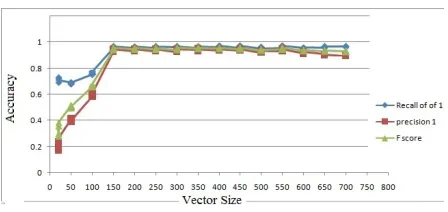
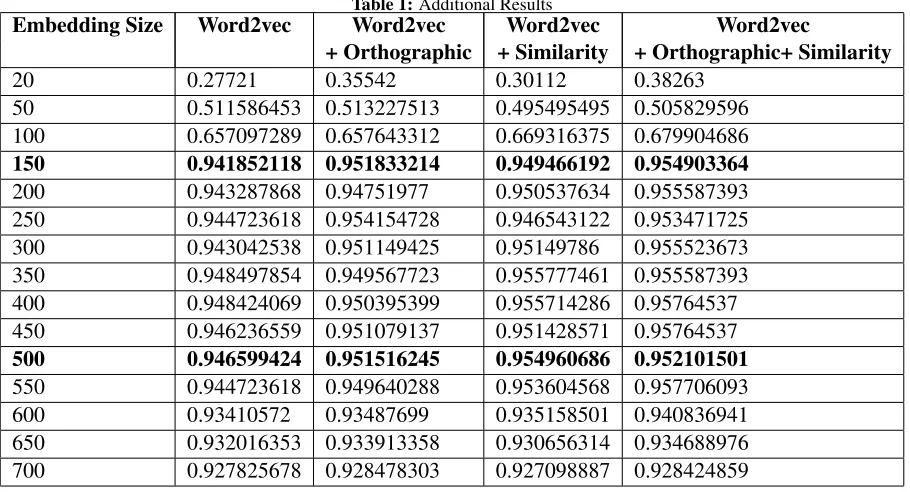
[image:4.612.314.538.54.160.2]The Figure 3 gives our system’s precision, recall, and F-score on the CWI training data. We tried vary-ing the vector size in the word2vec model. Word fea-tures include length, number of syllables, ambiguity
Figure 3:F-score accuracy
count, and frequency. We have four possible com-binations and the test results are been tabled in Ta-ble 1. The first combination includes word2vec fea-tures. The second combination includes word2vec and word features. The third combination includes word2vec and similarity features. The fourth combi-nation includes word2vec, similarity and word fea-tures. By varying the size and features the precision and recall tend to combine at a point called break though point. After the break though point the F-score becomes steady. The break through point for data is 150. Above which the accuracy tends to be linear, After the break through point the curve tends to decrease after 500. Therefore, we have concluded at a vector size of 500 and including all the features we have achieved the maximum accuracy. From the Figure 3 we can clearly see the F-score gradually decreasing at 550.
The accuracy graph steadily increases and reaches a maximum at 500 then accuracy tends to steadily decreases. Table 1, provides the additional results experimented by us.
8.1 SemEval Results:
ac-Table 1:Additional Results
Embedding Size Word2vec Word2vec Word2vec Word2vec
+ Orthographic + Similarity + Orthographic+ Similarity
20 0.27721 0.35542 0.30112 0.38263
50 0.511586453 0.513227513 0.495495495 0.505829596
100 0.657097289 0.657643312 0.669316375 0.679904686
150 0.941852118 0.951833214 0.949466192 0.954903364
200 0.943287868 0.94751977 0.950537634 0.955587393
250 0.944723618 0.954154728 0.946543122 0.953471725
300 0.943042538 0.951149425 0.95149786 0.955523673
350 0.948497854 0.949567723 0.955777461 0.955587393
400 0.948424069 0.950395399 0.955714286 0.95764537
450 0.946236559 0.951079137 0.951428571 0.95764537
500 0.946599424 0.951516245 0.954960686 0.952101501
550 0.944723618 0.949640288 0.953604568 0.957706093
600 0.93410572 0.93487699 0.935158501 0.940836941
650 0.932016353 0.933913358 0.930656314 0.934688976
700 0.927825678 0.928478303 0.927098887 0.928424859
[image:5.612.80.535.62.308.2]curacy is improved but the recall is decreased there-fore G-score is also decreased.
Table 2:SemEval Results.
System W2VecSimPos W2VecSim
Accuracy 0.743 0.627
Precision 0.060 0.061
Recall 0.306 0.486
F-Score 0.100 0.109
G-Score 0.434 0.547
9 Conclusion
The proposed model with features specially derived for identifying complex words produced good re-sults. The word embedding features played a ma-jor role compared with other features. By increas-ing the size of vectors our accuracy increased con-stantly. We tried all possible combinations with the four features mentioned in the Table 1 and conclude that the word embedding features alone also have a good accuracy. Our systems have generated a good precision compared with the baseline. Among 45 systems, we ranked 27th position for G-score evalu-ation. Although, the frequency counts and embed-ding features are reasonable for a given resource-constraint task, if we have provided for English lan-guage in general it might have provide with better accuracy.
References
Chih-Chung Chang and Chih-Jen Lin. (2011). LIB-SVM: a library for support vector machines. ACM Transactions on Intelligent Systems and Technology (TIST).2(3), p.27.
Christiane Fellbaum. (1998). WordNet: An Electronic Lexical Database. Cambridge, MA: MIT Press. Daniel Ferres, Montserrat Marimon, Horacio Saggion.
(2015). A Web-based Text Simplification System for English. Procesamiento del Lenguaje Natural, 55, 191-194.
Dany Amiot. (2004). Between compounding and derivation Elements of word-formation corresponding. Morphology and its demarcations: Selected papers from the 11th Morphology meeting, Vienna, Vol. 264. George A. Miller. (1995). WordNet: A Lexical Database for English.Communications of the ACM Vol. 38, No. 11: 39-41.
Gustavo Henrique Paetzold. (2015). Reliable Lexical Simplification for Non-Native Speakers. NAACL-HLT 2015 Student Research Workshop (SRW).
La Pointe, Linda B and Randall W. Engle. (1990). Sim-ple and comSim-plex word spans as measures of working memory capacity. Journal of Experimental Psychol-ogy: Learning, Memory, and Cognition 16.6 (1990): 1118.
Lucia Specia, Dhwaj Raj, Marco Turchi. (2010). Ma-chine translation evaluation versus quality estimation. Machine translation, 24(1), pp.39-50.
[image:5.612.81.533.64.307.2]simplification. Proceedings of the 49th Annual Meet-ing of the Association for Computational LMeet-inguistics: Human Language Technologies: short papers-Volume 2. Association for Computational Linguistics. Radim Rehurek and Petr Sojra. (2010). Software
frame-work for topic modelling with large corpora. Proceed-ings of the LREC 2010 Workshop on New Challenges for NLP Frameworks, ELRA, p.45-50
Edward Loper and Steven Bird. (2006). NLTK: the natural language toolkit. Proceedings of the ACL-02 Workshop on Effective tools and methodologies for teaching natural language processing and compu-tational linguistics-Volume 1. Association for Compu-tational Linguistics, 2002.
Tomas Mikolov, Kai Chen, Greg Corrado, Jeffrey Dean. (2010).Efficient estimation of word representations in vector space.rXiv preprint arXiv:1301.3781.
Tomoyuki Kajiwara, Hiroshi Matsumoto, Kazuhide Ya-mamoto. (2013). Selecting Proper Lexical Para-phrase for Children. Proceedings of the Twenty-Fifth Conference on Computational Linguistics and Speech Processing (ROCLING 2013).