Proceedings of the Fourth Joint Conference on Lexical and Computational Semantics (*SEM 2015), pages 137–146,
Ideological Perspective Detection Using Semantic Features
Heba Elfardy Columbia University
New York, NY
Mona Diab
George Washington University Washington, DC
Chris Callison-Burch University of Pennsylvania
Philadelphia, PA [email protected]
Abstract
In this paper, we propose the use of word sense disambiguation and latent semantic features to automatically identify a person’s perspective from his/her written text. We run an Ama-zon Mechanical Turk experiment where we ask Turkers to answer a set of constrained and open-ended political questions drawn from the American National Election Studies (ANES). We then extract the proposed features from the answers to the open-ended questions and use them to predict the answer to one of the constrained questions, namely, their pre-ferred Presidential Candidate. In addition to this newly created dataset, we also evaluate our proposed approach on a second standard dataset of “Ideological-Debates”. This lat-ter dataset contains topics from four domains: Abortion, Creationism, Gun Rights and Gay-Rights. Experimental results show that us-ing word sense disambiguation and latent-semantics, whether separately or combined, beats the majority and random baselines on the cross-validation and held-out-test sets for both the ANES and the four domains of the “Ideo-logical Debates” datasets. Moreover combin-ing both feature sets outperforms a stronger unigram-only classification system.
1 Introduction
With the pervasiveness of social media and online discussion fora, there has been a significant increase in documented political and ideological discussions. Automatically predicting the perspective or stance of users in such media is a challenging research
problem that has a wide variety of applications in-cluding recommendation systems, targeted advertis-ing, political polladvertis-ing, product reviews and even pre-dicting possible future events. Ideology refers to the beliefs that influence an individual’s goals, ex-pectations and views of the world (Van Dijk, 1998; Ahmed and Xing, 2010). The ideological perspec-tive of a person is often expressed in his/her choice of discussed topics. People with opposing per-spectives will choose to make different topics more salient. (Entman, 1993).
From a social-science viewpoint, the notion of “perspective” is related to the concept of “framing”. Framing involves making some topics (or some as-pects of the discussed topics) more prominent in or-der to promote the views and interpretations of the writer (communicator). The communicator makes these framing decisions either consciously or uncon-sciously (Entman, 1993). These decisions are often expressed in the lexical choice. For example, a per-son who holds anti-abortion views, is more likely to use the terms “life” and “kill” whereas a person who is pro a woman having an option to go for an abor-tion will often stress on “choice”.
to change. Most of the current perspective-detection work focuses on “Ideological Perspective” by try-ing to predict a person’s stance on controversial top-ics such as the Palestinian-Israeli conflict, abortion, gay-rights, gun-rights, etc.
In this paper, we are interested in identifying the “Ideological Perspective” of a person using seman-tic features derived from his/her written text. We use two different sets of semantic features to train sev-eral supervised systems that predict different aspects of a person’s ideological stance toward specific top-ics.
We explore the use of Word Sense Disambigua-tion from the high dimensional space and Latent Se-mantic models from the low dimensional space on two datasets. We find that explicitly modeling the lexical and contextual semantics to predict a per-son’s perspective outperforms a strong-baseline sys-tem trained on standard unigram features.
2 Related Work
Current computational linguistics research on auto-matic perspective detection uses both supervised and unsupervised techniques. The main task handled by supervised approaches is to perform document (or post) level perspective (or stance) classification, whether binary or multiclass labeling. Unsupervised approaches on the other hand, mainly try to cluster users in a discussion. One of the early works on binary perspective identification is that of Lin et al. (2006) which uses articles from the Bitter-Lemons website –a website that discusses the Palestinian-Israeli conflict from each side’s point of view– to train a system for performing automatic perspective detection on the sentence and document levels. On the website, an Israeli editor and a Palestinian edi-tor, together with invited guests, contribute articles to the website on a weekly basis. Lin et al. (2006) use bag-of-words features. They run different ex-periments where they vary the training and test sets between: (a) editors’ articles and (b) guests’ arti-cles. The accuracies of the different experimental conditions vary between 86% and 99%. As one might expect the highest accuracy (99%) is that of the system that is trained and tested on the editors’ articles. For this system, the classifier is not only capturing the perspective but also the editors’
writ-ing styles. In Klebanov et al. (2010), the authors tackle the same problem of binary-perspective de-tection and experiment with four corpora; Bitter-Lemons, Bitter-Lemons-International, Partial-Birth-Abortion and Death-Penalty. They show that using term-frequencies does not improve over using bi-nary bag-of-words features and that using only the best 1-4.9% features is sufficient to achieve high ac-curacy. They achieve the highest accuracy (97%) on the Partial-Birth-Abortion dataset and the lowest ac-curacy (73%) on the Death-Penalty dataset.
Hasan and Ng (2012) also tackle the problem of binary perspective detection but using Integer Linear Programming (ILP) to perform joint inference over the predictions made by a post-stance classifier and several topic-stance classifiers. The authors use n-grams, sentence-type and opinion-dependencies as features to train their classifiers. They collect de-bate posts discussing Abortion and Gun-Rights and achieve an Fβ=1 score of 61.1% on the Abortion
dataset and 57.8% on the Gun-Rights dataset. In Hasan and Ng (2013), they extend their previous work by incorporating two soft-constraints that treat the task of post-stance classification as a sequence-labeling problem and ensure that the topic-stance of each author is consistent across all posts.
Somasundaran and Wiebe (2010) employ the no-tion of“arguing”to identify a person’s stance (sup-porting or opposing) towards a topic. Arguing can be indicated by using either positive lexical cues such as “actually” or negative ones such as “cer-tainly not”. They construct an arguing lexicon and use it to derive features for their classifier. They ex-periment with both arguing and sentiment features on four datasets; Abortion, Creationism, Gun-Rights and Gay-Rights. They show that combining argu-ing and sentiment features outperforms a unigram baseline on Abortion, Gay-Rights and Gun-Rights datasets while the unigram system performs best on the Creationism dataset.
PCC
Obama Romney Neither
Train 62.9 25.3 11.8
[image:3.612.336.515.68.188.2]Test 67.6 18.5 13.9
Table 1: Class Distribution of Presidential Candi-date Choice (PCC) in the ANES dataset
point of view between each article-pair.
For unsupervised approaches, two of the most re-cent works are those of Abu-Jbara et al. (2012) and Dasigi et al. (2012). In Abu-Jbara et al. (2012), the authors perform subgroup detection by cluster-ing authors accordcluster-ing to their sentiment towards top-ics, Named-Entities as well as other discussants. Dasigi et al. (2012) extend the previous work by in-troducing the notion of implicit attitude which mod-els the similarity between the topics discussed by a pair of people. They note that people that share the same opinion tend to discuss similar topics, thereby their texts tend to have a high semantic similarity. By adding implicit attitude, namely by explicitly modeling latent sentential semantics, they achieve an Fβ=1 score improvement of 3.83% and 2.12%
on “Wikipedia-Discussions” and “Online-Debates” datasets, respectively.
Yano et al. (2010) study the linguistic cues for bias in political blogs. The authors draw sentences from American political blogs and annotate them for bias on Amazon Mechanical Turk. They explore whether the Turkers’ decisions are influenced by their perspectives, for example whether a self pro-claimed liberal Turker is more likely to view sen-tences written by a conservative as biased and vice versa.
3 Datasets
We use two datasets to evaluate our approach.
3.1 ANES Dataset
We create this dataset by drawing a set of questions from the American National Election Studies (ANES) survey questions.1 ANES conducts various surveys in order to provide better explanations and analysis of the outcomes of USA Presidential elections. While the officially administered ANES survey contains both constrained multiple choice
1electionstudies.org/studypages/2010_2012EGSS/2010_2012EGSS
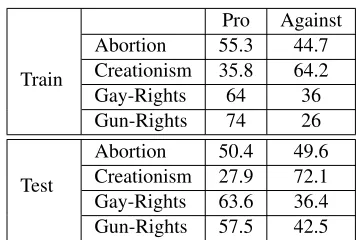
Pro Against
Train
Abortion 55.3 44.7
Creationism 35.8 64.2
Gay-Rights 64 36
Gun-Rights 74 26
Test
Abortion 50.4 49.6
Creationism 27.9 72.1
Gay-Rights 63.6 36.4
[image:3.612.80.293.71.118.2]Gun-Rights 57.5 42.5
Table 2: Class Distribution across the four domains of the Online Debates Dataset
questions and open-ended (free form essay style) questions, the answers to the open-ended questions, which are more interesting from an NLP perspec-tive, are not made publicly available in order to protect the privacy of respondents. In this work, we run an Amazon Mechanical Turk annotation experiment where we ask Amazon Mechanical Turk annotators (aka Turkers) to answer a large set of constrained and open-ended questions drawn from ANES.2 The constrained questions may be considered a form of self labeling indicating the respondent/Turker’s background or perspective on specific issues. All Turkers participating in the experiment were required to be from the US. Moreover, we added seven quality-control questions with a correct (and obvious) answer in order to identify spam Turkers. All submissions that ren-dered more than one of these questions wrong were automatically rejected.
The first set of questions that required constrained answers, such as multiple choice or binary responses as true or false can be binned into the following cat-egories:
• Background Questions: A person’s age, gender, educational level, income, marital-status, social-status, how often he/she follows the news, what news sources he/she follows, etc.;
• Opinion of Political Parties: Democratic and Re-publican parties and their respective public figure representatives;
• Opinion on major economic and political prob-lems facing the USA;
Q1 I approve of Obama’s and the Democrats’ position on abortion and gay marriage and their tendency tofavor programs that help the poor and working class. They seem more compassionate and more socially progressive.
Q2 Neither Obama nor the Democrats seems able to get a hold on spending, the deficit or help the economyand unemployment. They seem to spend too much time criticizing their opponents rather than work toward viable solutions and seem to distort facts against the other party more.
Q3 I think Mitt Romney and the republicans in general would do a better job at lowering the deficit and stim-ulating the economy and reducing unemployment. I also agree with their position of less government involvement in some areas.
Q4 I dislike Mitt Romney’s plans to eliminate funding for Planned Parenthood and the republicans stand onsocial issues such as abortion and gay rights, especially gay marriage. I feel Republicans have been taken over by the religious right and are socially regressive.
Table 3: Sample answers provided by one Turker to the first four essay questions in the ANES dataset.
• Ideology Questions: Importance of religion, political-party-affiliation, presidential candidate choice, etc.;
• Opinion on contentious issues: Such as Race (White, Black, Asian and Hispanic Americans), same-sex marriage, gun-control, universal health-care, etc.
The second set of questions ask about a person’s opinion of certain ideological topics. The responses are not constrained in any manner.
Since our main objective is to study whether a per-son’s perspective can be automatically identified us-ing NLP techniques applied to his/her written text, we choose to predict the answer to one of the con-strained ideological questions, “Presidential Candi-date Choice” (PCC), based on the answers to the fol-lowing open ended questions: (Table 1 shows the distribution of PCC in the training and test sets)
• Q1: Is there something that would make you vote for a Democratic presidential candidate?
• Q2: Is there something that would make you vote against a Democratic presidential candidate? • Q3: Is there something that would make you vote
for a Republican presidential candidate?
• Q4: Is there something that would make you vote against a Republican presidential candidate? • Q5: If you said there is something you like about
the Democratic Party: What is that?
• Q6: If you said there is something you dislike about the Democratic Party: What is that? • Q7: If you said there is something you like about
the Republican Party: What is that?
• Q8: If you said there is something you dislike about the Republican Party: What is that?
• Q9: What has been the most important issue to you personally in this election?
• Q10: What has been the second most important issue to you personally in this election?
• Q11: What do you think is the most important political problem facing the United States today? • Q12: What do you think is the second most
im-portant political problem facing the United States today?
• Q13: What do you think the terrorists were trying to accomplish by September 11thattacks?
Table 3 shows the answers provided by a Turker to the first four of these questions.
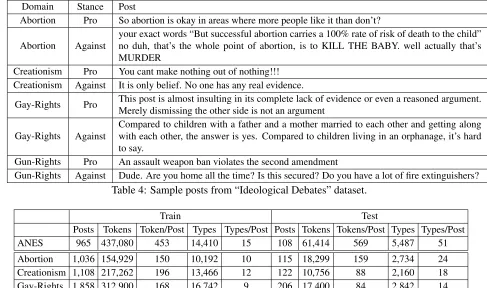
Domain Stance Post
Abortion Pro So abortion is okay in areas where more people like it than don’t?
Abortion Against your exact words “But successful abortion carries a 100% rate of risk of death to the child”no duh, that’s the whole point of abortion, is to KILL THE BABY. well actually that’s MURDER
Creationism Pro You cant make nothing out of nothing!!! Creationism Against It is only belief. No one has any real evidence.
Gay-Rights Pro This post is almost insulting in its complete lack of evidence or even a reasoned argument.Merely dismissing the other side is not an argument
Gay-Rights Against Compared to children with a father and a mother married to each other and getting alongwith each other, the answer is yes. Compared to children living in an orphanage, it’s hard to say.
Gun-Rights Pro An assault weapon ban violates the second amendment
[image:5.612.65.552.72.360.2]Gun-Rights Against Dude. Are you home all the time? Is this secured? Do you have a lot of fire extinguishers?
Table 4: Sample posts from “Ideological Debates” dataset.
Train Test
Posts Tokens Token/Post Types Types/Post Posts Tokens Tokens/Post Types Types/Post
ANES 965 437,080 453 14,410 15 108 61,414 569 5,487 51
Abortion 1,036 154,929 150 10,192 10 115 18,299 159 2,734 24
Creationism 1,108 217,262 196 13,466 12 122 10,756 88 2,160 18
Gay-Rights 1,858 312,900 168 16,742 9 206 17,400 84 2,842 14
Gun-Rights 963 146,886 153 10,969 11 106 7,142 67 1,588 15
Table 5: Statistics of the training and test sets for both the ANES and the four domains of the Ideological-Debates datasets.
debt.”, we replace “They” with “Republicans”.
3.2 Ideological Debates Dataset
This dataset was collected by Somasundaran and Wiebe (2010) . It contains debate posts from six domains; (a) Abortion, (b) Creationism, (c) Gay-Rights, (d) Gun-Gay-Rights, (e) Healthcare and (f) Ex-istence of God. Each domain represents an ideo-logical topic with two possible perspectives, pro and against. Similar to the work of (Somasundaran and Wiebe, 2010), we use the first four domains to eval-uate our approach. Table 2 shows the class distri-bution in each of these four domains while table 4 lists some sample posts. It should be noted that our results are not comparable to those obtained by (Somasundaran and Wiebe, 2010), since they used a subset of the posts in each domain and the split was not publicized.
Table 5 shows the size of the training and test data in the ANES and Ideological-Debates datasets.
4 Approach
Our goal is to determine whether semantic features help in identifying a person’s ideological perspec-tive as determined by his/her answer to the PCC con-strained question in the “ANES” dataset and his/her stance towards the ideological-topics discussed in the “Ideological-Debates” dataset independently.
4.1 Preprocessing
4.2 Word Sense Disambiguation (WSD)
We use WN-Sense-Relate (Patwardhan et al., 2005) to perform word sense disambiguation. Sense-Relate uses WordNet (Miller, 1995) to tag each word with the part-of-speech and sense-id. The only parts of speech that are handled by WN-Sense-Relate are adjectives (a), adverbs (r), verbs (v) and nouns (n). In addition to the part-of-speech and sense-id, WN-Sense-Relate also identifies and tags compounds. The word sense tagging process can be either con-textual or can rely on the most frequent sense. We experiment with both variants.
4.2.1 Contextual WSD (WSD-CXT)
In this variant of WSD, in addition to tagging compounds, we contextually disambiguate each word and tag it with its sense-id and part-of-speech. We use the default setting of SenseRelate which employs a modified version of the Lesk algorithm (Banerjee and Pedersen, 2002) to perform the disambiguation. This version of the Lesk algorithm measures the similarity between the WordNet gloss of each sense of the target word and those of its surrounding context words in the text. It then chooses the sense whose gloss is most similar to the surrounding words. We use a window of size three which uses one word before and one word after the target word.
ex.
“The Democratic Party supports women ’s equality , including equal pay , access to health care and other issues .”
becomes:
“the#ND democratic_party#n#1 supports#n#10 women#n#1 ’s#ND equality#n#1 includ-ing#v#3 equal#a#1 pay#v#1 access#n#2 to#ND health_care#n#1 and#ND other#a#1 issues#n#7”3
We then use the tagged-words to retrieve the Synonym-Set (Synset) of this sense of the word us-ing WN-QueryData (Pedersen et al., 2004). We as-sign each Synset an ID and whenever any of the words in the retrieved Synset is seen in the input text, we replace it with this Synset-ID.
For example, the Synset of “issues#n#7” is iden-tified as “issue#n#7, consequence#n#1, effect#n#1,
3#ND indicates a non-defined word
outcome#n#2, result#n#1, event#n#4, issue#n#7, upshot#n#1”. We assign this Synset a unique ID, for example “Synset-100”, and any occurrence of any of “issue#n#7, consequence#n#1, effect#n#1, out-come#n#2, result#n#1, event#n#4, issue#n#7, and upshot#n#1” is replaced by“Synset-100”.
4.2.2 Most Frequent Sense WSD (WSD-MFS)
In this variant of WSD, instead of perform-ing the disambiguation contextually, we rely on the most frequent sense. Using this scheme, “issues” is tagged as “issues#n#1” whose Synset is “issue#n#1”, while “support” is tagged as “support#v#1” whose Synset is support#v#1’, back_up#v#1.
4.3 Latent Semantics
The next set of features relies on “Latent Semantics” which maps text from a high-dimensional space such as unigrams to a low-dimensional one such as topics. Most of these models assign a semantic pro-file to each given sentence (or document) by con-sidering the observed words and assuming that each given document has a distribution over “K” top-ics. We apply (1) Latent Dirichlet Allocation (LDA) (Blei et al., 2003) as implemented in MALLET toolkit (McCallum, 2002), and (2) Weighted Tex-tual Matrix Factorization (WTMF) (Guo and Diab, 2012) to each post. In addition to observed words, WTMF also models missing ones namely explicitly modeling what the post is not about. WTMF de-fines missing words as the whole vocabulary of the training data minus the ones observed in the given document.
4.3.1 Number of Topics
PCCFβ=1score
Train 74.65
Test 74.81
[image:7.612.117.256.70.124.2]All 74.69
Table 6: Performance of human annotators in pre-dicting “PCC” of a person from his/her responses to ANES essay questions.
4.3.2 Training Data
We collected our training data for topic model-ing from Facebook comments of renowned Amer-ican politicians such as Joe-Biden, Chris-Christie, George W. Bush, Michelle-Obama, etc. We trained LDA and WTMF using a subset of 100,000 com-ments (corresponding to ~5,000,000 tokens and ~265,000 types.
4.4 Classifier Training
Using WEKA toolkit (Hall et al., 2009) and the derived features, we train Sequential Minimal Op-timization (SMO) SVM classifiers (Platt, 1998) for each of “ANES” and the four domains of “Ideological-Debates” datasets. We use a normal-ized quadratic kernel, set the parameter C to 100 and apply a 10-fold cross validation on the training sets.
5 Experiments 5.1 Baselines
We compare our approach to three baselines;
• Majority Baseline(MAJ-BL): which assigns all posts to the most frequent class-label;
• Random Baseline(RAND-BL): which randomly chooses the class-label;
• Unigram Baseline (UNI-BL): a strong baseline that uses standard unigram features.
In addition to these three baselines, we do a human-evaluation for the ANES dataset in order to assess the difficulty of the task and in order to get an upper-bound on how well we can do in predict-ing PCC. We run an Amazon Mechanical Turk ex-periment where we ask Turkers to read each post (constructed by combining the answers to the open-ended questions of each record) and ask them to guess the PCC of the person who wrote that text along with the reason for their answer. We found
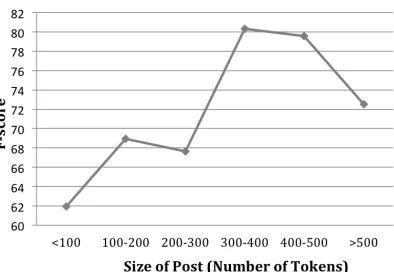
Figure 1: Fβ=1 score of human judgments in
pre-dicting “PCC” from the answers to the essay ques-tions in the ANES dataset across different post-sizes
that Turkers were able to predict the PCC with an average Fβ=1 score of ~75% on both the
cross-validation and test-sets. We also found that the task is particularly difficult for very short (<100 words) documents. Table 6 and Figure 1 show the results of this qualitative assessment.
5.2 Experimental Setup
We first evaluate each variant of the proposed fea-tures separately and then we combine the latent-semantics features with unigram-features and the two variants of WSD.
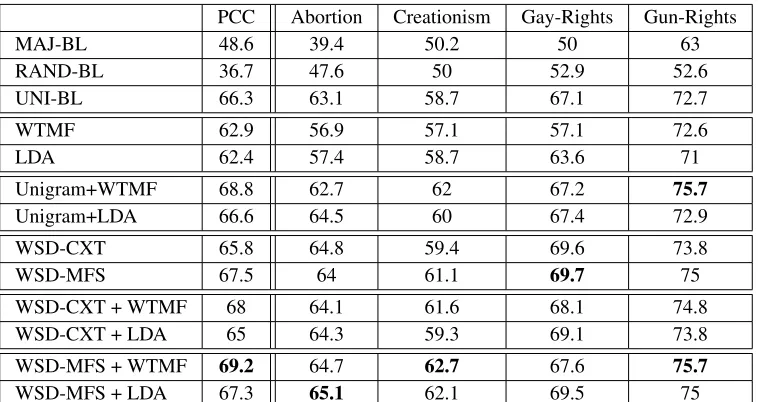
Tables 7 and 8 show the cross-validation results on the training data and the results on the held-out test sets respectively.
6 Discussion
6.1 Cross Validation Results
For the cross-validation results, all configurations of the proposed features outperform the majority and random baselines. Moreover using WSD-MFS, ei-ther separately or combined with LDA or WTMF, outperforms the unigram-baseline. Overall WSD-MFS performs better than WSD-CXT, except on the Abortion dataset.
[image:7.612.319.516.71.207.2]out-PCC Abortion Creationism Gay-Rights Gun-Rights
MAJ-BL 48.6 39.4 50.2 50 63
RAND-BL 36.7 47.6 50 52.9 52.6
UNI-BL 66.3 63.1 58.7 67.1 72.7
WTMF 62.9 56.9 57.1 57.1 72.6
LDA 62.4 57.4 58.7 63.6 71
Unigram+WTMF 68.8 62.7 62 67.2 75.7
Unigram+LDA 66.6 64.5 60 67.4 72.9
WSD-CXT 65.8 64.8 59.4 69.6 73.8
WSD-MFS 67.5 64 61.1 69.7 75
WSD-CXT + WTMF 68 64.1 61.6 68.1 74.8
WSD-CXT + LDA 65 64.3 59.3 69.1 73.8
WSD-MFS + WTMF 69.2 64.7 62.7 67.6 75.7
[image:8.612.118.497.70.271.2]WSD-MFS + LDA 67.3 65.1 62.1 69.5 75
Table 7: 10-fold cross-validation results (measured in Fβ=1 score) of using WSD and Latent-Semantics
against the baselines.
PCC Abortion Creationism Gay-Rights Gun-Rights
MAJ-BL 54.5 33.8 60.5 49.4 42
RAND-BL 46.6 47.3 54.9 41.9 45.5
UNI-BL 68 54.3 67.1 52.4 48.1
WTMF 69.1 58.1 60.1 49.2 43.7
LDA 60.4 55.3 58.7 58.1 62.4
Unigram+WTMF 68.9 54.2 71.2 56.8 58.7
Unigram+LDA 68 58.9 70.7 56.4 48.1
WSD-CXT 66.8 52.8 66.2 53.4 44.1
WSD-MFS 64.2 54.6 69.8 56.3 46.2
WSD-CXT + WTMF 66.1 52.9 71 55.1 53.7
WSD-CXT + LDA 67.6 57 68.5 55.6 46.2
WSD-MFS + WTMF 71.6 55.7 69.1 56.7 52.7
[image:8.612.116.498.313.516.2]WSD-MFS + LDA 65.3 62.6 69.6 56.4 44.1
Table 8: Held-out test-set results (measured inFβ=1score) of using WSD and Latent-Semantics against the
baselines.
performs WTMF on the other two datasets. Com-bining WSD-MFS with LDA for Abortion and Gay-Rights and with WTMF for PCC, Creationism and Gun-Rights yields the best (or close to the best) re-sults.
6.2 Held-out Test-Sets Results
Unlike the cross-validation results, using latent-semantics features separately improves over the un-igram baseline for four out of the five datasets and in some cases adding unigrams to latent-semantics
features actually hurts the performance. This sug-gests that latent-semantics are less likely to overfit the training data.
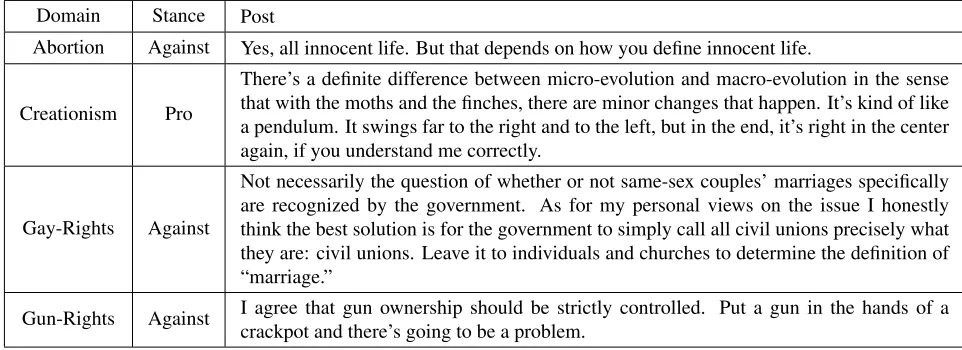
Table 9 shows examples of the posts that were misclassified by the majority and unigram baselines and correctly classified by the best semantic model for each dataset.
6.3 General Observations
Domain Stance Post
Abortion Against Yes, all innocent life. But that depends on how you define innocent life.
Creationism Pro
There’s a definite difference between micro-evolution and macro-evolution in the sense that with the moths and the finches, there are minor changes that happen. It’s kind of like a pendulum. It swings far to the right and to the left, but in the end, it’s right in the center again, if you understand me correctly.
Gay-Rights Against
Not necessarily the question of whether or not same-sex couples’ marriages specifically are recognized by the government. As for my personal views on the issue I honestly think the best solution is for the government to simply call all civil unions precisely what they are: civil unions. Leave it to individuals and churches to determine the definition of “marriage.”
[image:9.612.70.551.72.247.2]Gun-Rights Against I agree that gun ownership should be strictly controlled. Put a gun in the hands of acrackpot and there’s going to be a problem.
Table 9: Examples of the posts that were misclassified by the unigram baseline and were correctly classified by the right semantic model.
perspective and found the following:
1. In ANES dataset, due to the structure of the ques-tions, some Turkers were trying to be objective which makes it difficult even for a human evalu-ator to identify the political leaning of the person who wrote the text. The example in Table 3 illus-trates such a case where it is not easy to detect the PCC of the Turker from the provided answers. 2. The use of sarcasm, which can be easily detected
by human evaluators but not by an automated sys-tem. For example, in Abortion dataset, a partici-pant who does not oppose abortion wrote “Why should people use reason and logic to discover right and wrong when a priest can decide for them?”
3. Misspelled words such as writing “Romeny” in-stead of“Romney”
4. In each domain of the Ideological Debates dataset, the posts were collected from different discus-sion fora pertaining to the domain of interest. For example, in the Abortion dataset, posts were collected from “Can Catholics Vote For Pro-Choice Politicians”, “Should South Dakota pass the Abortion Ban”, “Should abortion be legal” and other fora. For some of the posts, the partici-pants provided very short answers such as“Once they take the booth who they vote for is supposed to be secret.” which makes it almost impossible to identify their stance without knowing the exact question the forum posed.
7 Conclusion
In this paper, we explore the use of semantic fea-tures to perform automatic detection of ideological-perspective from written text. Using Word Sense Disambiguation and Latent Semantics features, we trained several SVM classifiers that predict differ-ent aspects of the ideological-perspective of a per-son. We evaluated the presented approach on two datasets. The first of which comprises answers to questions about American politics collected from an Amazon Mechanical Turk experiment while the second one consists of four subsets of a standard dataset, discussing Abortion, Creationism, Gay-Rights and Gun-Gay-Rights. Results show that using the proposed features outperforms a system that relies on standard unigram features on all datasets. On the cross-validation sets, combining word sense disam-biguation with latent semantics performs best while on the held-out test sets, the best configuration vari-ous across the different domains.
We plan to explore other methods for perform-ing word sense disambiguation in addition to usperform-ing semantic-role-labeling and modeling sarcasm.
8 Acknowledgment
We thank the three anonymous reviewers for their useful comments and suggestions.
References
Amjad Abu-Jbara, Mona Diab, Pradeep Dasigi, and Dragomir Radev. 2012. Subgroup detection in ideo-logical discussions. InProceedings of the 50th Annual Meeting of the Association for Computational Linguis-tics: Long Papers-Volume 1, pages 399–409. Associa-tion for ComputaAssocia-tional Linguistics.
Amr Ahmed and Eric P Xing. 2010. Staying in-formed: supervised and semi-supervised multi-view topical analysis of ideological perspective. In Pro-ceedings of the 2010 Conference on Empirical Meth-ods in Natural Language Processing, pages 1140– 1150. Association for Computational Linguistics. Khalid Al Khatib, Hinrich Schütze, and Cathleen
Kant-ner. 2012. Automatic detection of point of view dif-ferences in wikipedia. InCOLING, pages 33–50. Satanjeev Banerjee and Ted Pedersen. 2002. An adapted
lesk algorithm for word sense disambiguation using wordnet. InComputational linguistics and intelligent text processing, pages 136–145. Springer.
David M Blei, Andrew Y Ng, and Michael I Jordan. 2003. Latent dirichlet allocation. the Journal of ma-chine Learning research, 3:993–1022.
Pradeep Dasigi, Weiwei Guo, and Mona Diab. 2012. Genre independent subgroup detection in online dis-cussion threads: a pilot study of implicit attitude using latent textual semantics. In Proceedings of the 50th Annual Meeting of the Association for Computational Linguistics: Short Papers-Volume 2, pages 65–69. As-sociation for Computational Linguistics.
Robert M Entman. 1993. Framing: Toward clarification of a fractured paradigm. Journal of communication, 43(4):51–58.
Weiwei Guo and Mona Diab. 2012. Modeling sentences in the latent space. InProceedings of the 50th Annual Meeting of the Association for Computational Linguis-tics: Long Papers-Volume 1, pages 864–872. Associa-tion for ComputaAssocia-tional Linguistics.
Mark Hall, Eibe Frank, Geoffrey Holmes, Bernhard Pfahringer, Peter Reutemann, and Ian H Witten. 2009. The weka data mining software: an update. ACM SIGKDD Explorations Newsletter, 11(1):10–18. Kazi Saidul Hasan and Vincent Ng. 2012. Predicting
stance in ideological debate with rich linguistic knowl-edge. InProceedings of the 24th International Confer-ence on Computational Linguistics.
Kazi Saidul Hasan and Vincent Ng. 2013. Extra-linguistic constraints on stance recognition in ideolog-ical debates. InProceedings of the 51st Annual Meet-ing of the Association for Computational LMeet-inguistics. Association for Computational Linguistics.
Beata Beigman Klebanov, Eyal Beigman, and Daniel Diermeier. 2010. Vocabulary choice as an indicator
of perspective. InACL, pages 253–257. Association for Computational Linguistics.
Wei-Hao Lin, Theresa Wilson, Janyce Wiebe, and Alexander Hauptmann. 2006. Which side are you on?: identifying perspectives at the document and sen-tence levels. InProceedings of the Tenth Conference on Computational Natural Language Learning, pages 109–116. Association for Computational Linguistics.
Andrew Kachites McCallum. 2002.
Mal-let: A machine learning for language toolkit. http://mallet.cs.umass.edu.
George A Miller. 1995. Wordnet: a lexical database for english.Communications of the ACM, 38(11):39–41. Siddharth Patwardhan, Satanjeev Banerjee, and Ted
Ped-ersen. 2005. Senserelate:: Targetword: a generalized framework for word sense disambiguation. In Pro-ceedings of the ACL 2005 on Interactive poster and demonstration sessions, pages 73–76. Association for Computational Linguistics.
Ted Pedersen, Siddharth Patwardhan, and Jason Miche-lizzi. 2004. Wordnet:: Similarity: measuring the relat-edness of concepts. InDemonstration Papers at HLT-NAACL 2004. Association for Computational Linguis-tics.
John C. Platt. 1998. Sequential minimal optimization: A fast algorithm for training support vector machines.
Technical Report MSR-TR-98-14, Microsoft Research. Swapna Somasundaran and Janyce Wiebe. 2010. Rec-ognizing stances in ideological online debates. In Pro-ceedings of the NAACL HLT 2010 Workshop on Com-putational Approaches to Analysis and Generation of Emotion in Text, pages 116–124. Association for Com-putational Linguistics.
Teun A Van Dijk. 1998. Ideology: A multidisciplinary approach. Sage.