SemEval-2014 Task 4: Aspect Based Sentiment Analysis
Maria Pontiki
Institute for Language and Speech Processing, “Athena” Research Center
Haris Papageorgiou
Institute for Language and Speech Processing, “Athena” Research Center
Dimitrios Galanis
Institute for Language and Speech Processing, “Athena” Research Center
Ion Androutsopoulos
Dept. of Informatics Athens University of Economics and Business
John Pavlopoulos
Dept. of Informatics, Athens University of Economics and Business
Suresh Manandhar
Dept. of Computer Science, University of York
Abstract
Sentiment analysis is increasingly viewed as a vital task both from an academic and a commercial standpoint. The majority of current approaches, however, attempt to detect the overall polarity of a sentence, paragraph, or text span, irrespective of the entities mentioned (e.g., laptops) and their aspects (e.g., battery, screen). SemEval-2014 Task 4 aimed to foster research in the field of aspect-based sentiment analysis, where the goal is to identify the aspects of given target entities and the sentiment expressed for each aspect. The task pro-vided datasets containing manually anno-tated reviews of restaurants and laptops, as well as a common evaluation procedure. It attracted 163 submissions from 32 teams.
1 Introduction
With the proliferation of user-generated content on the web, interest in mining sentiment and opinions in text has grown rapidly, both in academia and business. Early work in sentiment analysis mainly aimed to detect the overall polarity (e.g., positive or negative) of a given text or text span (Pang et al., 2002; Turney, 2002). However, the need for a more fine-grained approach, such as aspect-based (or ‘feature-based’) sentiment analysis (ABSA), soon became apparent (Liu, 2012). For example, laptop reviews not only express the overall senti-ment about a specific model (e.g.,“This is a great This work is licensed under a Creative Commons At-tribution 4.0 International Licence. Page numbers and pro-ceedings footer are added by the organisers. Licence details: http://creativecommons.org/licenses/by/4.0/
laptop”), but also sentiments relating to its spe-cific aspects, such as the hardware, software, price, etc. Subsequently, a review may convey opposing sentiments (e.g.,“Its performance is ideal, I wish I could say the same about the price”) or objective information (e.g.,“This one still has the CD slot”) for different aspects of an entity.
ABSA is critical in mining and summarizing opinions from on-line reviews (Gamon et al., 2005; Titov and McDonald, 2008; Hu and Liu, 2004a; Popescu and Etzioni, 2005). In this set-ting, ABSA aims to identify the aspects of the en-tities being reviewed and to determine the senti-ment the reviewers express for each aspect. Within the last decade, several ABSA systems of this kind have been developed for movie reviews (Thet et al., 2010), customer reviews of electronic products like digital cameras (Hu and Liu, 2004a) or net-book computers (Brody and Elhadad, 2010), ser-vices (Long et al., 2010), and restaurants (Ganu et al., 2009; Brody and Elhadad, 2010).
Previous publicly available ABSA benchmark datasets adopt different annotation schemes within different tasks. The restaurant reviews dataset of Ganu et al. (2009) uses six coarse-grained aspects (e.g., FOOD, PRICE, SERVICE) and four overall
sentence polarity labels (positive, negative, con-flict, neutral). Each sentence is assigned one or more aspects together with a polarity label for each aspect; for example, “The restaurant was ex-pensive, but the menu was great.” would be as-signed the aspectPRICEwith negative polarity and FOOD with positive polarity. In the product
re-views dataset of Hu and Liu (2004a; 2004b), as-pect terms, i.e., terms naming aspects (e.g., ‘ra-dio’, ‘voice dialing’) together with strength scores (e.g., ‘radio’: +2, ‘voice dialing’: −3) are
vided. No predefined inventory of aspects is pro-vided, unlike the dataset of Ganu et al.
The SemEval-2014 ABSA Task is based on lap-top and restaurant reviews and consists of four subtasks (see Section 2). Participants were free to participate in a subset of subtasks and the domains (laptops or restaurants) of their choice.
2 Task Description
For the first two subtasks (SB1, SB2), datasets on both domains (restaurants, laptops) were provided. For the last two subtasks (SB3, SB4), datasets only for the restaurant reviews were provided.
Aspect term extraction (SB1): Given a set of review sentences, the task is to identify all as-pect terms present in each sentence (e.g., ‘wine’, ‘waiter’, ‘appetizer’, ‘price’, ‘food’). We require all the aspect terms to be identified, including as-pect terms for which no sentiment is expressed (neutral polarity). These will be useful for con-structing an ontology of aspect terms and to iden-tify frequently discussed aspects.
Aspect term polarity (SB2): In this subtask, we assume that the aspect terms are given (as de-scribed in SB1) and the task is to determine the po-larity of each aspect term (positive, negative, con-flict, or neutral). The conflict label applies when both positive and negative sentiment is expressed about an aspect term (e.g., “Certainly not the best sushi in New York, however, it is always fresh”). An alternative would have been to tag the aspect term in these cases with the dominant polarity, but this in turn would be difficult to agree on.
Aspect category detection (SB3): Given a predefined set of aspect categories (e.g., PRICE, FOOD) and a set of review sentences (but without
any annotations of aspect terms and their polari-ties), the task is to identify the aspect categories discussed in each sentence. Aspect categories are typically coarser than the aspect terms as defined in SB1, and they do not necessarily occur as terms in the sentences. For example, in “Delicious but expensive”, the aspect categoriesFOODandPRICE
are not instantiated through specific aspect terms, but are only inferred through the adjectives ‘deli-cious’ and ‘expensive’. SB1 and SB3 were treated as separate subtasks, thus no information linking aspect terms to aspect categories was provided.
Aspect category polarity (SB4): For this sub-task, aspect categories for each review sentence are provided. The goal is to determine the
polar-ity (positive, negative, conflict, or neutral) of each aspect category discussed in each sentence.
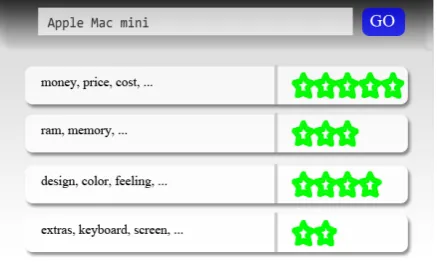
[image:2.595.308.527.252.384.2]Subtasks SB1 and SB2 are useful in cases where no predefined inventory of aspect categories is available. In these cases, frequently discussed as-pect terms of the entity can be identified together with their overall sentiment polarities. We hope to include an additionalaspect term aggregation sub-task in future (Pavlopoulos and Androutsopoulos, 2014b) to cluster near-synonymous (e.g., ‘money’, ‘price’, ‘cost’) or related aspect terms (e.g., ‘de-sign’, ‘color’, ‘feeling’) together with their aver-aged sentiment scores as shown in Fig. 1.
Figure 1: Aggregated aspect terms and average sentiment polarities for a target entity.
Subtasks SB3 and SB4 are useful when a pre-defined inventory of (coarse) aspect categories is available. A table like the one of Fig. 1 can then also be generated, but this time using the most frequent aspect categories to label the rows, with stars showing the proportion of reviews express-ing positive vs. negative opinions for each aspect category.
3 Datasets
3.1 Data Collection
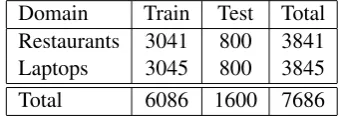
sentences extracted from laptop custumer reviews. Human annotators tagged the aspect terms (SB1) and their polarities (SB2); 3045 sentences were used for training and 800 for testing (evaluation).
[image:3.595.95.265.128.187.2]Domain Train Test Total Restaurants 3041 800 3841 Laptops 3045 800 3845 Total 6086 1600 7686 Table 1: Sizes (sentences) of the datasets.
3.2 Annotation Process
For a given target entity (a restaurant or a lap-top) being reviewed, the annotators were asked to provide two types of information: aspect terms (SB1) and aspect term polarities (SB2). For the restaurants dataset, two additional annotation lay-ers were added: aspect category (SB3) and aspect category polarity (SB4).
The annotators used BRAT (Stenetorp et al., 2012), a web-based annotation tool, which was configured appropriately for the needs of the ABSA task.1 Figure 2 shows an annotated sen-tence in BRAT, as viewed by the annotators. Stage 1: Aspect terms and polarities. During a first annotation stage, the annotators tagged all the single or multiword terms that named par-ticular aspects of the target entity (e.g., “I liked the service and the staff, but not the food” → {‘service’, ‘staff’, ‘food’},“The hard disk is very noisy”→ {‘hard disk’}). They were asked to tag only aspect terms explicitly naming particular as-pects (e.g., “everything about it” or“it’s expen-sive” do not name particular aspects). The as-pect terms were annotated as they appeared, even if misspelled (e.g., ‘warrenty’ instead of ‘war-ranty’). Each identified aspect term also had to be assigned a polarity label (positive, negative, neu-tral, conflict). For example,“I hated their fajitas, but their salads were great” → {‘fajitas’: nega-tive, ‘salads’: positive}, “The hard disk is very noisy”→ {‘hard disk’: negative}.
Each sentence of the two datasets was anno-tated by two annotators, a graduate student (an-notator A) and an expert linguist (annotator B). Initially, two subsets of sentences (300 from each dataset) were tagged by annotatorAand the anno-tations were inspected and validated by annotator 1Consulthttp://brat.nlplab.org/for more in-formation about BRAT.
B. The disagreements between the two annotators were confined to borderline cases. Taking into ac-count the types of these disagreements (discussed below), annotatorAwas provided with additional guidelines and tagged the remainder of the sen-tences in both datasets.2 When Awas not confi-dent, a decision was made collaboratively withB. When A andB disagreed, a decision was made collaboratively by them and a third expert annota-tor. Most disagreements fall into one of the fol-lowing three types:
Polarity ambiguity: In several sentences, it was unclear if the reviewer expressed positive or neg-ative opinion, or no opinion at all (just reporting a fact), due to lack of context. For example, in
“12.44 seconds boot time”it is unclear if the re-viewer expresses a positive, negative, or no opin-ion about the aspect term ‘boot time’. In future challenges, it would be better to allow the annota-tors (and the participating systems) to consider the entire review instead of each sentence in isolation. Multi-word aspect term boundaries: In sev-eral cases, the annotators disagreed on the exact boundaries of multi-word aspect terms when they appeared in conjunctions or disjunctions (e.g.,
“selection of meats and seafoods”, “noodle and rices dishes”, “school or office use”). In such cases, we asked the annotators to tag as a sin-gle aspect term the maximal noun phrase (the en-tire conjunction or disjunction). Other disagree-ments concerned the extent of the aspect terms when adjectives that may or may not have a sub-jective meaning were also present. For example, if ‘large’ in “large whole shrimp” is part of the dish name, then the guidelines require the adjec-tive to be included in the aspect term; otherwise (e.g., in“large portions”) ‘large’ is a subjectivity indicator not to be included in the aspect term. De-spite the guidelines, in some cases it was difficult to isolate and tag the exact aspect term, because of intervening words, punctuation, or long-term de-pendencies.
Aspect term vs. reference to target entity: In some cases, it was unclear if a noun or noun phrase was used as the aspect term or if it referred to the entity being reviewed as whole. In “This place is awesome”, for example, ‘place’ most probably refers to the restaurant as a whole (hence, it should not be tagged as an aspect term), but in “Cozy
2The guidelines are available at:http://alt.qcri.
Figure 2: A sentence in the BRAT tool, annotated with four aspect terms (‘appetizers’, ‘salads’, ‘steak’, ‘pasta’) and one aspect category (FOOD). For aspect categories, the whole sentence is tagged.
place and good pizza” it probably refers to the am-bience of the restaurant. A broader context would again help in some of these cases.
We note that laptop reviews often evaluate each laptop as a whole, rather than expressing opinions about particular aspects. Furthermore, when they express opinions about particular aspects, they of-ten do so by using adjectives that refer implicitly to aspects (e.g., ‘expensive’, ‘heavy’), rather than using explicit aspect terms (e.g., ‘cost’, ‘weight’); the annotators were instructed to tag only explicit aspect terms, not adjectives implicitly referring to aspects. By contrast, restaurant reviews contain many more aspect terms (Table 2, last column).3
Dataset Pos. Neg. Con. Neu. Tot. LPT-TR 987 866 45 460 2358
LPT-TE 341 128 16 169 654
[image:4.595.67.529.61.118.2]RST-TR 2164 805 91 633 3693 RST-TE 728 196 14 196 1134 Table 2: Aspect terms and their polarities per do-main. LPT and RST indicate laptop and restau-rant reviews, respectively. TR and TE indicate the training and test set.
Another difference between the two datasets is that the neutral class is much more frequent in (the aspect terms of) laptops, since laptop re-views often mention features without expressing any (clear) sentiment (e.g., “the latest version does not have a disc drive”). Nevertheless, the positive class is the majority in both datasets, but it is much more frequent in restaurants (Table 2). The ma-jority of the aspect terms are single-words in both datasets (2148 in laptops, 4827 in restaurants, out of 3012 and 4827 total aspect terms, respectively). Stage 2: Aspect categories and polarities. In this task, each sentence needs to be tagged with the aspect categories discussed in the sentence. The aspect categories areFOOD,SERVICE,PRICE, AMBIENCE (the atmosphere and environment of
3We count aspect termoccurrences, not distinct terms.
a restaurant), andANECDOTES/MISCELLANEOUS
(sentences not belonging in any of the previous aspect categories). 4 For example, “The restau-rant was expensive, but the menu was great” is assigned the aspect categories PRICE and FOOD.
Additionally, a polarity (positive, negative, con-flict, neutral) for each aspect category should be provided (e.g.,“The restaurant was expensive, but the menu was great”→ {PRICE: negative,FOOD:
positive}.
One annotator validated the existing aspect cat-egory annotations of the corpus of Ganu et al. (2009). The agreement with the existing anno-tations was 92% measured as average F1. Most
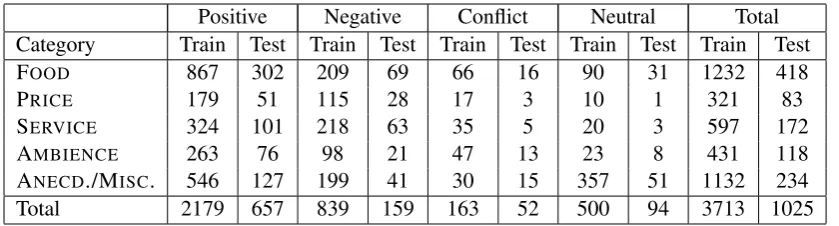
disagreements concerned additions of missing as-pect category annotations. Furthermore, the same annotator validated and corrected (if needed) the existing polarity labels per aspect category anno-tation. The agreement for the polarity labels was 87% in terms of accuracy and it was measured only on the common aspect category annotations. The additional 800 sentences (not present in Ganu et al.’s dataset) were used for testing and were an-notated from scratch in the same manner. The dis-tribution of the polarity classes per category is pre-sented in Table 3. Again, ‘positive’ is the majority polarity class while the dominant aspect category is FOOD in both the training and test restaurant
sentences.
Determining the aspect categories of the sen-tences and their polarities (Stage 2) was an easier task compared to detecting aspect terms and their polarities (Stage 1). The annotators needed less time in Stage 2 and it was easier to reach agree-ment. Exceptions were some sentences where it was difficult to decide if the categoriesAMBIENCE
or ANECDOTES/MISCELLANEOUS applied (e.g., “One of my Fav spots in the city”). We instructed the annotators to classify those sentences only in
ANECDOTES/MISCELLANEOUS, if they conveyed
Positive Negative Conflict Neutral Total Category Train Test Train Test Train Test Train Test Train Test
FOOD 867 302 209 69 66 16 90 31 1232 418
PRICE 179 51 115 28 17 3 10 1 321 83
SERVICE 324 101 218 63 35 5 20 3 597 172
AMBIENCE 263 76 98 21 47 13 23 8 431 118
ANECD./MISC. 546 127 199 41 30 15 357 51 1132 234
[image:5.595.91.511.61.174.2]Total 2179 657 839 159 163 52 500 94 3713 1025
Table 3: Aspect categories distribution per sentiment class.
general views about a restaurant, without explic-itly referring to its atmosphere or environment.
3.3 Format and Availability of the Datasets The datasets of the ABSA task were provided in an XML format (see Fig. 3). They are avail-able with a non commercial, no redistribution li-cense through META-SHARE, a repository de-voted to the sharing and dissemination of language resources (Piperidis, 2012).5
4 Evaluation Measures and Baselines The evaluation of the ABSA task ran in two phases. In Phase A, the participants were asked to return the aspect terms (SB1) and aspect cate-gories (SB3) for the provided test datasets. Subse-quently, in Phase B, the participants were given the gold aspect terms and aspect categories (as in Fig. 3) for the sentences of Phase A and they were asked to return the polarities of the aspect terms (SB2) and the polarities of the aspect cate-gories of each sentence (SB4).6 Each participat-ing team was allowed to submit up to two runs per subtask and domain (restaurants, laptops) in each phase; one constrained (C), where only the provided training data and other resources (e.g., publicly available lexica) excluding additional an-notated sentences could be used, and one uncon-strained (U), where additional data of any kind could be used for training. In the latter case, the teams had to report the resources they used.
To evaluate aspect term extraction (SB1) and as-pect category detection (SB3) in Phase A, we used 5The datasets can be downloaded from http://
metashare.ilsp.gr:8080/. META-SHARE (http: //www.meta-share.org/) was implemented in the framework of the META-NET Network of Excellence (http://www.meta-net.eu/).
6Phase A ran from 9:00 GMT, March 24 to 21:00 GMT, March 25, 2014. Phase B ran from 9:00 GMT, March 27 to 17:00 GMT, March 29, 2014.
theF1measure, defined as usually:
F1 = 2P·P+·RR (1)
where precision (P) and recall (R) are defined as:
P = |S|∩S|G|, R= |S|∩G|G| (2)
HereSis the set of aspect term or aspect category annotations (in SB1 and SB3, respectively) that a system returned for all the test sentences (of a do-main), andGis the set of the gold (correct) aspect term or aspect category annotations.
To evaluate aspect term polarity (SB2) and as-pect category polarity (SB4) detection in Phase B, we calculated the accuracy of each system, defined as the number of correctly predicted aspect term or aspect category polarity labels, respectively, di-vided by the total number of aspect term or aspect category annotations. Recall that we used the gold aspect term and category annotations in Phase B.
We provided four baselines, one per subtask:7 Aspect term extraction (SB1) baseline: A se-quence of tokens is tagged as an aspect term in a test sentence (of a domain), if it is listed in a dictionary that contains all the aspect terms of the training sentences (of the same domain).
Aspect term polarity (SB2) baseline: For each aspect term t in a test sentence s (of a particu-lar domain), this baseline checks if t had been encountered in the training sentences (of the do-main). If so, it retrieves the k most similar to s
<sentence id="11351725#582163#9">
<text>Our waiter was friendly and it is a shame that he didnt have a supportive staff to work with.</text>
<aspectTerms>
<aspectTerm term="waiter" polarity="positive" from="4" to="10"/> <aspectTerm term="staff" polarity="negative" from="74" to="79"/> </aspectTerms>
<aspectCategories>
<aspectCategory category="service" polarity="conflict"/> </aspectCategories>
[image:6.595.315.520.220.649.2]</sentence>
Figure 3: An XML snippet that corresponds to the annotated sentence of Fig. 2.
training set. The similarity between two sentences is measured as the Dice coefficient of the sets of (distinct) words of the two sentences. For exam-ple, the similarity between “this is a demo” and “that is yet another demo” is 2·2
4+5 = 0.44.
Aspect category extraction (SB3) baseline: For every test sentences, thekmost similar tos train-ing sentences are retrieved (as in the SB2 base-line). Then,sis assigned themmost frequent as-pect category labels of the kretrieved sentences;
mis the most frequent number of aspect category labels per sentence among theksentences. Aspect category polarity (SB4): This baseline assigns to each aspect categorycof a test sentence
sthe most frequent polarity label thatchad in the
kmost similar tostraining sentences (of the same domain), considering only training sentences that have the aspect category labelc. Sentence similar-ity is computed as in the SB2 baseline.
For subtasks SB2 and SB4, we also use a major-ity baseline that assigns the most frequent polarmajor-ity (in the training data) to all the aspect terms and as-pect categories. The scores of all the baselines and systems are presented in Tables 4–6.
5 Evaluation Results
The ABSA task attracted 32 teams in total and 165 submissions (systems), 76 for phase A and 89 for phase B. Based on the human-annotation experi-ence, the expectations were that systems would perform better in Phase B (SB3, SB4, involving aspect categories) than in Phase A (SB1, SB2, in-volving aspect terms). The evaluation results con-firmed our expectations (Tables 4–6).
5.1 Results of Phase A
The aspect term extraction subtask (SB1) attracted 24 teams for the laptops dataset and 24 teams for the restaurants dataset; consult Table 4.
Laptops Restaurants
Team F1 Team F1
IHS RD. 74.55† DLIREC 84.01* DLIREC 73.78* XRCE 83.98 DLIREC 70.4 NRC-Can. 80.18 NRC-Can. 68.56 UNITOR 80.09 UNITOR 67.95* UNITOR 79.96* XRCE 67.24 IHS RD. 79.62†
SAP RI 66.6 UWB 79.35*
IITP 66.55 SeemGo 78.61
UNITOR 66.08 DLIREC 78.34
SeemGo 65.99 ECNU 78.24
ECNU 65.88 SAP RI 77.88
SNAP 62.4 UWB 76.23
DMIS 60.59 IITP 74.94
UWB 60.39 DMIS 72.73
JU CSE. 59.37 JU CSE. 72.34 lsis lif 56.97 Blinov 71.21* USF 52.58 lsis lif 71.09
Blinov 52.07* USF 70.69
UFAL 48.98 EBDG 69.28*
UBham 47.49 UBham 68.63*
UBham 47.26* UBham 68.51
SINAI 45.28 SINAI 65.41
EBDG 41.52* V3 60.43*
V3 36.62* UFAL 58.88
COMMIT. 25.19 COMMIT. 54.38 NILCUSP 25.19 NILCUSP 49.04
iTac 23.92 SNAP 46.46
iTac 38.29
Restaurants Restaurants
Team F1 Team Acc.
NRC-Can. 88.57 NRC-Can. 82.92 UNITOR 85.26* XRCE 78.14
XRCE 82.28 UNITOR 76.29*
UWB 81.55* SAP RI 75.6
UWB 81.04 SeemGo 74.63
UNITOR 80.76 SA-UZH 73.07 SAP RI 79.04 UNITOR 73.07
SNAP 78.22 UWB 72.78
Blinov 75.27* UWB 72.78*
UBham 74.79* lsis lif 72.09
UBham 74.24 UBham 71.9
EBDG 73.98* EBDG 69.75
SeemGo 73.75 SNAP 69.56
SINAI 73.67 COMMIT. 67.7 JU CSE. 70.46 Blinov 65.65* lsis lif 68.27 Ualberta. 65.46 ECNU 67.29 JU CSE. 64.09
UFAL 64.51 ECNU 63.41
V3 60.20* UFAL 63.21
COMMIT. 59.3 iTac 62.73*
iTac 56.95 ECNU 60.39*
SINAI 60.29
V3 47.21
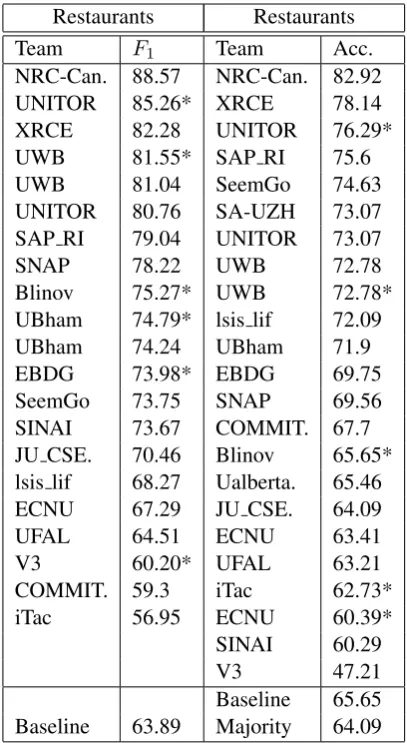
Baseline 65.65 Baseline 63.89 Majority 64.09 Table 5: Results for aspect category detection (SB3) and aspect category polarity (SB4). Stars indicate unconstrained systems.
Overall, the systems achieved significantly higher scores (+10%) in the restaurants domain, compared to laptops. The bestF1 score (74.55%)
for laptops was achieved by the IHS RD. team, which relied on Conditional Random Fields (CRF) with features extracted using named entity recog-nition, POS tagging, parsing, and semantic anal-ysis. The IHS RD. team used additional reviews from Amazon and Epinions (without annotated terms) to learn the sentiment orientation of words and they trained their CRF on the union of the restaurant and laptop training data that we pro-vided; the same trained CRF classifier was then used in both domains.
The second system, the unconstrained system of DLIREC, also uses a CRF, along with POS and dependency tree based features. It also uses fea-tures derived from the aspect terms of the train-ing data and clusters created from additional
re-views from YELP and Amazon. In the restaurants domain, the unconstrained system of DLIREC ranked first with an F1 of 84.01%, but the best
unconstrained system, that of XRCE, was very close (83.98%). The XRCE system relies on a parser to extract syntactic/semantic dependencies (e.g., ‘dissapointed’–‘food’). For aspect term ex-traction, the parser’s vocabulary was enriched with the aspect terms of the training data and a term list extracted from Wikipedia and Wordnet. A set of grammar rules was also added to detect multi-word terms and associate them with the corre-sponding aspect category (e.g.,FOOD,PRICE).
The aspect category extraction subtask (SB3) attracted 18 teams. As shown in Table 5, the best score was achieved by the system of NRC-Canada (88.57%), which relied on five binary (one-vs-all) SVMs, one for each aspect category. The SVMs used features based on various types of n-grams (e.g., stemmed) and information from a lexicon learnt from YELP data, which associates aspect terms with aspect categories. The latter lexicon significantly improvedF1. The constrained
UN-ITOR system uses five SVMs with bag-of-words (BoW) features, which in the unconstrained sub-mission are generalized using distributional vec-tors learnt from Opinosis and TripAdvisor data. Similarly, UWB uses a binary MaxEnt classifier for each aspect category with BoW and TF-IDF features. The unconstrained submission of UWB also uses word clusters learnt using various meth-ods (e.g., LDA); additional features indicate which clusters the words of the sentence being classi-fied come from. XRCE uses information identi-fied by its syntactic parser as well as BoW features to train a logistic regression model that assigns to the sentence probabilities of belonging to each as-pect category. A probability threshold, tuned on the training data, is then used to determine which categories will be assigned to the sentence.
5.2 Results of Phase B
[image:7.595.79.283.61.433.2]mainly based on n-grams, parse trees, and sev-eral out-of-domain, publicly available sentiment lexica (e.g., MPQA, SentiWordnet and Bing Liu’s Opinion Lexicon). NRC-Canada also used two automatically compiled polarity lexica for restau-rants and laptops, obtained from YELP and Ama-zon data, respectively. Furthermore, NRC-Canada showed by ablation experiments that the most use-ful features are those derived from the sentiment lexica. On the other hand, DCU used only publicly available lexica, which were manually adapted by filtering words that do not express sentiment in laptop and restaurant reviews (e.g., ‘really’) and by adding others that were missing and do express sentiment (e.g., ‘mouthwatering’).
The aspect category polarity detection subtask (SB4) attracted 20 teams. NRC-Canada again had the best score (82.92%) using an SVM classifier. The same feature set as in SB2 was used, but it was further enriched to capture information re-lated to each specific aspect category. The second team, XRCE, used information from its syntactic parser, BoW features, and an out-of-domain senti-ment lexicon to train an SVM model that predicts the polarity of each given aspect category.
6 Conclusions and Future Work
We provided an overview of Task 4 of SemEval-2014. The task aimed to foster research in aspect-based sentiment analysis (ABSA). We constructed and released ABSA benchmark datasets contain-ing manually annotated reviews from two domains (restaurants, laptops). The task attracted 163 sub-missions from 32 teams that were evaluated in four subtasks centered around aspect terms (detecting aspect terms and their polarities) and coarser as-pect categories (assigning asas-pect categories and aspect category polarities to sentences). The task will be repeated in SemEval-2015 with additional datasets and a domain-adaptation subtask.8 In the future, we hope to add an aspect term aggrega-tion subtask (Pavlopoulos and Androutsopoulos, 2014a).
Acknowledgements
We thank Ioanna Lazari, who provided an ini-tial version of the laptops dataset, Konstantina Pa-panikolaou, who carried out a critical part of the
8Consulthttp://alt.qcri.org/semeval2015/
task12/.
Laptops Restaurants
Team Acc. Team Acc.
DCU 70.48 DCU 80.95
NRC-Can. 70.48 NRC-Can. 80.15†
SZTE-NLP 66.97 UWB 77.68*
UBham 66.66 XRCE 77.68
UWB 66.66* SZTE-NLP 75.22 lsis lif 64.52 UNITOR 74.95*
USF 64.52 UBham 74.6
SNAP 64.06 USF 73.19
UNITOR 62.99 UNITOR 72.48
UWB 62.53 SeemGo 72.31
IHS RD. 61.62 lsis lif 72.13
SeemGo 61.31 UWB 71.95
ECNU 61.16 SA-UZH 70.98
ECNU 61.16* IHS RD. 70.81
SINAI 58.71 SNAP 70.81
SAP RI 58.56 ECNU 70.72
UNITOR 58.56* ECNU 70.72* SA-UZH 58.25 INSIGHT. 70.72 COMMIT 57.03 SAP RI 69.92 INSIGHT. 57.03 EBDG 68.6 UMCC. 57.03* UMCC. 66.84*
UFAL 56.88 UFAL 66.57
UMCC. 56.11 UMCC. 66.57
EBDG 55.96 COMMIT 65.96
JU CSE. 55.65 JU CSE. 65.52 UO UA 55.19* Blinov 63.58*
V3 53.82 iTac 62.25*
Blinov 52.29* V3 59.78
iTac 51.83* SINAI 58.73
DLIREC 36.54 DLIREC 42.32* DLIREC 36.54* DLIREC 41.71
IITP 66.97 IITP 67.37
[image:8.595.312.521.66.559.2]Baseline 51.37 Baseline 64.28 Majority 52.14 Majority 64.19 Table 6: Results for the aspect term polarity sub-task (SB2). Stars indicate unconstrained systems. The†indicates a constrained system that was not trained on the in-domain training dataset (unlike the rest of the constrained systems), but on the union of the two training datasets. IITP’s original submission files were corrupted; they were resent and scored after the end of the evaluation period.
(09-72-922) and the POLYTROPON (KRIPIS-GSRT, MIS: 448306) projects.
References
Samuel Brody and Noemie Elhadad. 2010. An unsu-pervised aspect-sentiment model for online reviews.
InProceedings of NAACL, pages 804–812, Los
An-geles, California.
Michael Gamon, Anthony Aue, Simon Corston-Oliver, and Eric K. Ringger. 2005. Pulse: Mining customer
opinions from free text. In IDA, pages 121–132,
Madrid, Spain.
Gayatree Ganu, Noemie Elhadad, and Am´elie Marian. 2009. Beyond the stars: Improving rating
predic-tions using review text content. In Proceedings of
WebDB, Providence, Rhode Island, USA.
Minqing Hu and Bing Liu. 2004a. Mining and
sum-marizing customer reviews. InProceedings of KDD,
pages 168–177, Seattle, WA, USA.
Minqing Hu and Bing Liu. 2004b. Mining opinion fea-tures in customer reviews. InProceedings of AAAI, pages 755–760, San Jose, California.
Bing Liu. 2012.Sentiment Analysis and Opinion
Min-ing. Synthesis Lectures on Human Language
Tech-nologies. Morgan & Claypool Publishers.
Chong Long, Jie Zhang, and Xiaoyan Zhu. 2010. A review selection approach for accurate feature rating
estimation. In Proceedings of COLING (Posters),
pages 766–774, Beijing, China.
Bo Pang, Lillian Lee, and Shivakumar Vaithyanathan. 2002. Thumbs up? sentiment classification
us-ing machine learnus-ing techniques. InProceedings of
EMNLP, pages 79–86, Philadelphia, Pennsylvania,
USA.
John Pavlopoulos and Ion Androutsopoulos. 2014a. Aspect term extraction for sentiment analysis: New datasets, new evaluation measures and an improved
unsupervised method. In Proceedings of
LASM-EACL, pages 44–52, Gothenburg, Sweden.
John Pavlopoulos and Ion Androutsopoulos. 2014b. Multi-granular aspect aggregation in aspect-based
sentiment analysis. InProceedings of EACL, pages
78–87, Gothenburg, Sweden.
Stelios Piperidis. 2012. The META-SHARE language resources sharing infrastructure: Principles,
chal-lenges, solutions. In Proceedings of LREC-2012,
pages 36–42, Istanbul, Turkey.
Ana-Maria Popescu and Oren Etzioni. 2005. Extract-ing product features and opinions from reviews. In
Proceedings of HLT/EMNLP, pages 339–346,
Van-couver, British Columbia, Canada.
Pontus Stenetorp, Sampo Pyysalo, Goran Topi´c, Tomoko Ohta, Sophia Ananiadou, and Jun’ichi Tsu-jii. 2012. BRAT: a web-based tool for NLP-assisted
text annotation. In Proceedings of EACL, pages
102–107, Avignon, France.
Tun Thura Thet, Jin-Cheon Na, and Christopher S. G. Khoo. 2010. Aspect-based sentiment analysis of
movie reviews on discussion boards. J. Information
Science, 36(6):823–848.
Ivan Titov and Ryan T. McDonald. 2008. A joint model of text and aspect ratings for sentiment
sum-marization. InProceedings of ACL, pages 308–316,
Columbus, Ohio, USA.
Peter Turney. 2002. Thumbs up or thumbs down? se-mantic orientation applied to unsupervised
classifi-cation of reviews. In Proceedings of ACL, pages