Proceedings of the BioNLP 2017 workshop, pages 99–106,
Vancouver, Canada, August 4, 2017. c2017 Association for Computational Linguistics
Representation of complex terms in a vector space structured by an
ontology for a normalization task
Arnaud Ferré
1,2, Pierre Zweigenbaum
2, Claire Nédellec
11
MaIAGE, INRA, Université Paris-Saclay, 78350 Jouy-en-Josas, France
2LIMSI, CNRS, Université Paris-Saclay, 91405 Orsay, France
[email protected]
Abstract
We propose in this paper a semi-supervised method for labeling terms of texts with concepts of a domain ontology. The method generates continuous vector representations of complex terms in a se-mantic space structured by the ontology. The proposed method relies on a distribu-tional semantics approach, which gener-ates initial vectors for each of the extracted terms. Then these vectors are embedded in the vector space constructed from the structure of the ontology. This embedding is carried out by training a linear model. Finally, we apply a cosine similarity to de-termine the proximity between vectors of terms and vectors of concepts and thus to assign ontology labels to terms. We have evaluated the quality of these representa-tions for a normalization task by using the concepts of an ontology as semantic la-bels. Normalization of terms is an im-portant step to extract a part of the infor-mation contained in texts, but the vector space generated might find other applica-tions. The performance of this method is comparable to that of the state of the art for this task of standardization, opening up encouraging prospects.
1
Introduction
A lot of biomedical or biological knowledge is in a non-structured form, such as that expressed in scientific articles (Kang et al., 2013). For ex-perts from these fields, the substantial increase in the specialized literature has created a significant need for automatic methods of information ex-traction (Ananiadou and McNaught, 2006). The task of normalization is one of the main tasks to respond to this need.
Normalization consists in standardizing terms (single- or multi-word) extracted from texts by linking them to non-ambiguous references, such
as entries from existing knowledge bases. Con-cepts from an ontology can be used to represent these references in a formal and structured way. Term and their relationships carry a lot of the knowledge contained in texts, thus successful term identification is a key to getting access to the information (Krauthammer and Nenadic, 2004).
Standardization encounters several difficulties, such as the significant variability of the form of the terms, whether they are represented by one word (e.g. “child” / “kid” or “accommodation” / ”home”, etc.) or by several (e.g. “child” / ”little boy” or “accommodation” / ”dwelling place”, etc.) (Nazarenko et al., 2006). Multiword terms, which have varied morphosyntactic structures and complex imbrications (mainly complex noun phrases), are particularly difficult to normalize (e.g. only with a different syntactic organization: “breast cancer” / “cancer of the breast”). In the literature, such as scientific articles in life sci-ences, complex noun groups are abundant (Ma-niez, 2007). An approach based on the similarity of form between term and semantic label appears limited to perform this task (Golik et al., 2011), because the form of the labels of the concepts is not necessarily close to the form of the terms to be annotated. Another difficulty arises from the large number of ontology concepts, making a su-pervised classification approach costly in manual annotation (e.g. over 2,000 categories for exam-ple in the ontology of bacterial habitats OntoBi-otope (Bossy et al., 2015)).
An alternative approach is to calculate the se-mantic proximity between terms by distributional semantics. It is an approach based on the correla-tion between the similarity of meaning and the distribution similarity of semantic units (word, combination of words, sentence, documents, ...) (Firth, 1957; Harris, 1954). A semantic unit can then be represented by a vector: it is constructed from the context information in which the se-mantic unit is found. The proximity of vectors in
this space can be transposed to a semantic prox-imity (Fabre and Lenci, 2015). Today, there are many methods for generating such vector spaces, such as Word2Vec (Mikolov et al., 2013), but they usually focus on massive data sets (Fabre et al., 2014) in which information is often repeated. The question is: how to use distributional se-mantics to normalize terms by an ontology? In other words how to relate distributional infor-mation to the categories of ontology? In the con-text of specialized literature, we often deal with relatively small corpora and a large number of semantic categories.
We propose an original method in which we represent complex terms based on word embed-ding, embed the ontology in a vector space, and learn a transformation from term vectors to con-cept vectors. Then, this transformation is used to determine the most suitable concept for an input term.
2
Material
The data used are those of the Bacteria Biotope categorization task (Task 3) of the 2016 BioNLP Shared Task (Deléger et al., 2016). The documents are references from MEDLINE, composed of ti-tles and abstracts of scientific articles in the field of biology. The task consists in assigning a cate-gory from the OntoBiotope ontology to given cor-pus terms related to bacterial habitats. The corcor-pus is divided into three subparts: the training corpus, the development corpus and the test corpus. In the training and development corpus, the categories of terms are given: they have been used to train our method. The terms from the test corpus are those which categories have to be predicted: it is the corpus used to evaluate our method for the task of normalization. The entities of each of these corpo-ra have been manually annotated. Table 1 pro-vides a summary of their characteristics:
Train Dev. Test Total
Documents 71 36 54 161
Words 16,295 8,890 13,797 38,982
Entities 747 454 720 1,921
Distinct entities
476 267 478 1,125
Semantic cat. 825 535 861 2,221
[image:2.595.309.528.274.327.2]Distinct cat. 210 122 177 329
Table 1: Descriptive statistics for the Bacteria Bi-otope corpus (“cat.” = categories, “Dev.” =
devel-opment corpus)
In addition to this corpus, an extended corpus of the same domain is used to generate vector representations of each word. It is composed of approximately 100,000 sentences (4,800,000 words) from titles and abstracts of scientific arti-cles in the field of biology available on PubMed. This represents a relatively small size corpus, which contains a majority of words with a low frequency of occurrence (cf. Table 2). Other cor-pus, larger and/or more general could be used, also direct words embedding as the one released by BioASQ (Pavlopoulos et al., 2014). Neverthe-less, the very accurate domain of the used ex-tended corpus and its desired small size seemed to be more adapted.
[image:2.595.306.512.361.650.2]Repeated >2 72,412 35% Repeated 2 times 31,569 15% Not repeated 105,364 50% Words (without stopwords) 209,345 100%
Table 2: Descriptive statistics of extended corpus
3
Method
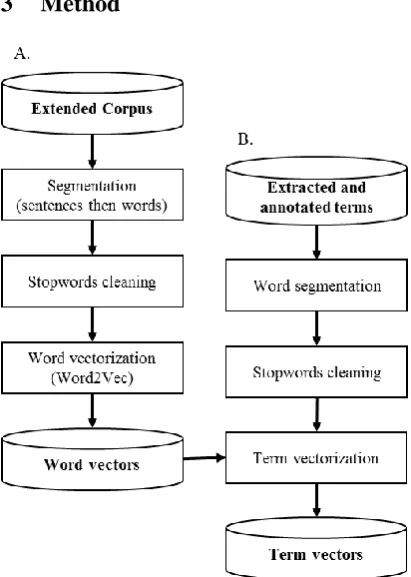
Figure 1: A. Process to create word vectors. B. Process to create term vectors.
3.1 Word vectors
The vector space of the terms (VST) is ob-tained by generating a vector for each word of the extended corpus and the Bacteria Biotope corpus. For this, we used the Word2Vec tool
[image:2.595.71.294.598.729.2](Mikolov et al., 2013), taking as context of a word, a list containing all the words of their sen-tence. To have enough training data for the gen-eration of meaningful word vectors, and also to avoid taking into account typos or errors, it is usually advisable to use Word2Vec without the infrequent words appearing only once or twice throughout the corpus. But our corpus contains many words of interest with a low frequency, so we choose not to apply this frequency threshold. After some performance tests, the dimension 200 was selected for the output vectors (cf. Figure 1A), which is of the same order of magnitude as what is usually advised (Mikolov et al., 2013).
3.2 Term vectors
To compute the vector representations of the multiword terms (cf. Figure 1B), segmenting them into words is the first step. For each word, which is not a stopword, the vector calculated by Word2Vec is used. Then the vector of the multi-word term is obtained by averaging the vectors of the words which compose it:
𝑣𝑡𝑘 = ∑ 𝑣𝑚𝑖𝑘 𝑛𝑘
𝑖=1 ⁄𝑛𝑘 (1)
where 𝑣𝑡𝑘 is the associated vector of the term 𝑡𝑘,
𝑛𝑘 is the number of words (without stopwords) of
the term 𝑡𝑘, 𝑣𝑚𝑖𝑘 is the vector of the word 𝑚𝑖𝑘
from our Word2Vec computation, and the term 𝑡𝑘
is such that :
∀𝑖 ∈ [1, 𝑛𝑘], 𝑚𝑖𝑘 ∈ 𝑡𝑘 (2)
Even if it is not the aim of this paper, future works could test other methods.
[image:3.595.306.526.369.464.2]3.3 Concept vectors
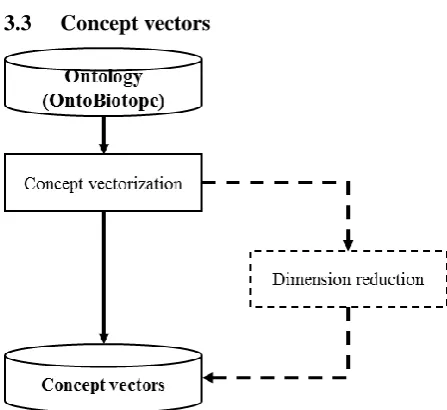
Figure 2: Process to create concept vector
To construct the concept vectors and thus a vec-tor space of an ontology (VSO), null vecvec-tors with as many dimensions as the number of concepts in the ontology are initialized. Each value of the vec-tor is thus related to one of the concepts of the on-tology, which is set to 1 for the considered con-cept. The value is also 1 if the current axis is relat-ed to a concept which is an ancestor of the consid-ered concept, and 0 otherwise:
𝑣𝑐𝑘= ( 𝑤𝑐k
0, … , 𝑤
𝑐𝑖𝑘, … , 𝑤𝑐𝑛𝑘) (3)
where 𝑣𝑐𝑘 is the vector related to the concept 𝑐𝑘, n is the number of concepts in the ontology and 𝑤𝑐𝑖𝑘
is the value of vector 𝑣𝑐𝑘 for the axis i, such as:
𝑤𝑐𝑖𝑘= {
1, 𝑖𝑓 𝑖 = 𝑘 1, 𝑖𝑓 𝑐𝑖 𝑝𝑎𝑟𝑒𝑛𝑡 𝑜𝑓 𝑐𝑘
0, otherwise (4)
[image:3.595.69.293.517.722.2]This representation has the advantage of pre-serving the similarity arrangement (with cosine distance) expected between the concepts (cf. Fig-ure 3 and Table 3): a concept is more similar to his children and his parents.
Figure 3: Abstract ontology representation (dis-played by Protégé)
Concept 02 Similarity
Concept 02 1,0000
Concept 021 0,8165
Concept 022 0,8165
Concept 0 0,7071
Concept 01 0,5000
Concept 011 0,4082
Table 3: Cosine distances between concepts of an abstract ontology (cf. Figure 3)
We can notice that the dimension of the gener-ated VSO is the number of concepts of the ontol-ogy (e.g. more than 2,000 for the OntoBiotope on-tology). It is a high dimension in comparison to the VST but concept vectors are very sparse (with a maximum of 13 non-zero values in a vector) and they only contain binary values. Therefore, to make them more comparable to term vectors, we experimented with reducing the VSO to denser
representations in a lower-dimension space (cf. Figure 2). Two methods have been tested: Princi-pal Component Analysis (PCA) and Multi-Dimensional Scaling (MDS).
[image:4.595.70.296.131.291.2]3.4 Training with general linear model
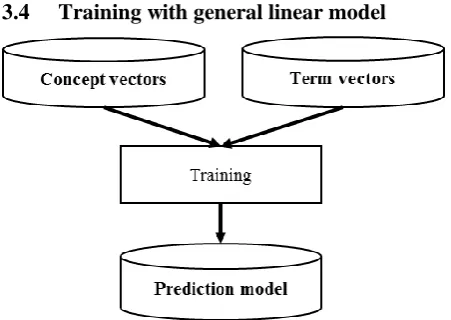
Figure 4: Training process to determine a trans-formation VST to VSO
The objective of the training step is to deter-mine a transformation from VST to VSO, which minimizes all the distances between the vectors of terms resulting from this transformation and the vectors of the associated concepts. In this paper, a linear transformation is studied with the aim of keeping a strong similarity between the tion of term vectors in the VST and the distribu-tion of the projecdistribu-tions in the VSO. Indeed, a non-linear transformation could strongly distort the re-sulting distribution to fit better to training data.
This training aims to obtain the best parameters to approximate this matrix equation:
𝑌 = 𝑋. 𝐵 + 𝑈 (5)
where Y is a matrix resulting in a series of concept vectors, X is a matrix resulting in a series of term vectors (where the ith line of X is the vector of a term which has for category a concept which has for vector the ith line of Y), B is a matrix contain-ing parameters that are usually to be estimated and U is a matrix containing noise following a multi-variate Gaussian distribution. This training is per-formed on the training and development corpora (cf. Figure 4).
The obtained matrix enables us to design a lin-ear transformation function then make it possible to predict new vectors associated with the terms of the test corpus expressed in the VSO:
𝑓: (𝑣 𝑉𝑆𝑇 → 𝑉𝑆𝑂
term → 𝑣term′ = 𝑓(𝑣term)) (6) where 𝑣term is a vector of term in the VST and
𝑣term′ is the resulting vector of the same term
pro-jected in the VSO. To satisfy the requirements of
the evaluation task, the concept vector nearest to
𝑣term′ (as determined by cosine distance) is
cho-sen as category for the annotated term (cf. Figure 5).
Figure 5: Process of predicting semantic catego-ries associated with extracted terms
3.5 Evaluation
We evaluate the performance of our ization method on the Bacteria Biotope normal-ization task of the BioNLP Shared Task 2016. The dataset was presented in Section 2. The predicted concepts identifiers are compared to the gold standard concepts according to the similarity measure of (Wang et al., 2007), with the weight parameter set to 0.65. The evaluation was per-formed by submitting our results to the evaluation server run at the BioNLP-ST 2016 challenge site.
4
Results
4.1 Normalization
Team Similarity score
BOUN 0.6200
CONTES 0.5968
LIMSI 0.4380
[image:4.595.306.519.131.309.2]Baseline 0.3217
Table 4: Results on the normalization task of BioNLP-ST 2016
We applied our concept normalization method to the test dataset of the Bacteria Biotope 2017 Task 3. We computed baseline results by assigning all terms to the concept "bacteria habitat", which is the root of the OntoBiotope ontology hierarchy. We also compared these results to those of the two teams who participated in this task of BioNLP-ST 2016. We report all results in Table 4. The base-line obtains a score of 0.3217. Our method
[image:4.595.306.526.532.619.2](CONTES - CONcept-TErm System) obtained a score of 59.68%, much higher than the baseline, and close to that of the top team (Tiftikci et al., 2016). This score is also significantly above the method of LIMSI (Grouin, 2016), which is based on a morphological approach.
4.2
Term vectors
In spite of the low frequency of occurrence of the words of the extended corpus (cf. Table 2), the resulting word vectors seem to have relatively sat-isfactory proximities, from the point of view of the semantic similarity of the associated terms. Moreover, the method used to compute vectors for complex terms also seems satisfactory, as illus-trated Table 5.
cell Similarity
HCE cell 0.9999
13C-labeled cell 0.9998
parietal cell 0.9989
Schwann cell 0.9965
CD8+ T cell 0.9770
PMN cell 0.9669
[image:5.595.310.525.68.327.2]macrophage cell 0.9473
Table 5: Terms nearest to the term “cell”
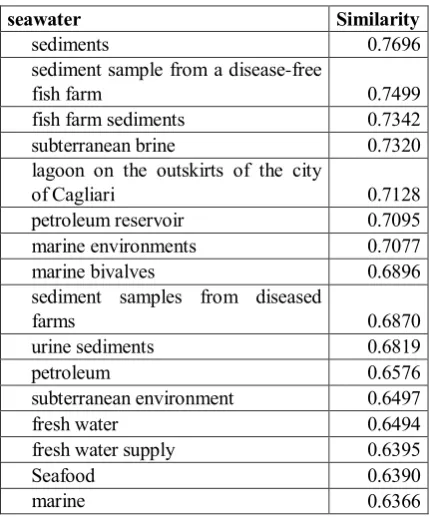
It also appears that lexical variation can be overcome (cf. Table 6 and Table 7), which was one of the desired properties. Although more gen-erally, it seems that terms with similar lexical forms are closer (Table 5).
Nevertheless, the co-occurrence of some words seems to cluster certain terms from different cate-gories: two words appearing frequently in com-mon contexts are then found close. This similarity persists when calculating multiword term vectors. This applies, for example, to the terms relating to fish and those relating to fish farms (cf. Table 8). These cases are less satisfactory because they do not differentiate between terms which should be annotated with different semantic categories (e.g. “fish” and “healthy fish” should be annotated by <OBT:001902: fish>, “fish farm” and “disease-free fish farm” by <OBT:000295: fish farm> and “fish
farm sediments” by <OBT:000704: sediment>).
younger ones Similarity
children less than five years of age 0.8087 children less than 2 years of age 0.8060 children less than two years of age 0.7995
Table 6: Terms nearest to the term ‘younger ones’
seawater Similarity
sediments 0.7696
sediment sample from a disease-free
fish farm 0.7499
fish farm sediments 0.7342 subterranean brine 0.7320 lagoon on the outskirts of the city
of Cagliari 0.7128
petroleum reservoir 0.7095 marine environments 0.7077
marine bivalves 0.6896
sediment samples from diseased
farms 0.6870
urine sediments 0.6819
petroleum 0.6576
subterranean environment 0.6497
fresh water 0.6494
fresh water supply 0.6395
Seafood 0.6390
marine 0.6366
Table 7: Terms nearest to the term ‘seawater’
fish Similarity
fish farming 0.9875
fish farm 0.9170
disease-free fish farm 0.9124 fish farm sediments 0.8683
healthy fish 0.8145
Table 8: Terms nearest to the term ‘fish’
4.3
Concept vectors
<OBT:001922: algae> sans ACP Similarity
<OBT:001777: aquatic plant> 0.9258 <OBT:001895: submersed aquatic
plant> 0.8571
<OBT:001967: seaweed> 0.8018
Table 9: Concepts nearest to the concept <OBT:001922: algae>
We can estimate the quality of the created con-cept vectors by observing the consistency between the proximity of two vectors and the similarity of their meanings. Table 9 and Figure 6 show the example of the 'algae' concept: the nearest neigh-bors of its vector are its father in the ontology, its sibling and the immediate descendant of its sib-ling.
[image:5.595.72.292.289.402.2]Figure 6: Taxonomy of concepts around concept "algae" (displayed by Protégé)
By comparing several examples, it seems that PCA does not modify the order of proximity of the concepts, but an increase in vector density can be observed (cf. comparison between Table 9 and Table 10).
<OBT:001922: algae> avec ACP Similarity
<OBT:001777: aquatic plant> 0.9990 <OBT:001895: submersed aquatic
plant> 0.9982
<OBT:001967: seaweed> 0.9943 <OBT:000372: sponge> 0.9303 <OBT:000269: marine eukaryotic
spe-cies> 0.9303
Table 10: Concepts nearest to the concept <OBT:001922: algae> after a PCA with a final
dimension of 100
[image:6.595.309.521.152.333.2]4.4 Impact of the size of the VST
Figure 7: Comparison between CBOW and Skip-Gram architectures for the VST
Word2Vec allows the use of 2 different archi-tectures to generate word vectors from a corpus: Continuous Bag Of Words (CBOW) and Skip-Gram. We tested the 2 architectures on different output vector sizes (cf. Figure 7). For vector spac-es generated with a dimension between 100 and
250, the final scores appear to be relatively stable, especially with CBOW. Similarly, the score dif-ference between the two architectures remains be-low 3%. Above a dimension of 250, there is a de-crease in the score for the 2 architectures, with a greater slope for CBOW.
4.5 Impact of a dimension reduction on the VSO
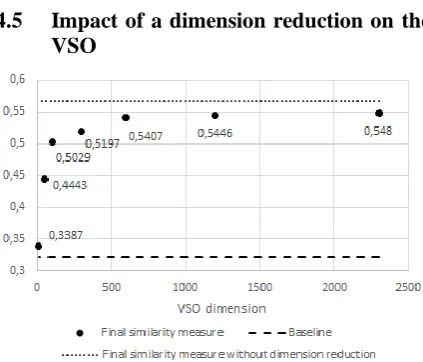
Figure 8: Evolution of performance depending on the final size of the VSO after reduction
(here with a VST with 100 dimensions)
The VSO has a large dimension compared to the specific information that it contains (i.e. the ontology structure). This may present combinato-rial but also theoretical difficulties: a linear projec-tion of the VST on the VSO (with a higher dimen-sion than the VST) should then only be performed on a subspace of the VSO. Thus, it theoretically limits the results. It was therefore interesting to study the impact of a reduction of the VSO size on the final score. We can then observe that a reduc-tion PCA (with similar results with MDS) system-atically decreases the score obtained when using a non-reduced VSO (cf. Figure 8).
Nevertheless, there is a level with relatively high performance (less than 3% below the score without reduction) which collapses below a cer-tain dimension. This threshold might have a link with the number of concepts that have at least 2 distinct parents.
5
Discussion
To extend the interpretations derived from ex-amples, it would be interesting to evaluate the overall quality of the generated vector spaces: vector spaces of words, terms, concepts as well as the final space containing the transformations of the vectors of the terms. We plan to perform this in further work.
[image:6.595.71.289.463.651.2]One of the difficulties of the task is that in this normalization task, a term can be annotated by several distinct concepts of the ontology (e.g. "school age children with wheezing illness" should be annotated by the concept <OBT: 002307: pediatric patient> as well as the concept <OBT: 002187: patient with disease>). This diffi-culty is linked to the ontology of interest. In 2016, all participating systems of the task skip this diffi-culty, which is not anecdotal among the extracted terms.
6
Future work
For future work, it would be relevant to apply methods of global evaluation of the quality of the generated vector spaces. In particular, this would make it possible to evaluate the intermediate pro-cesses more thoroughly and to observe the impact of the modifications on their internal parameters more precisely. New methods could then be con-sidered to improve outcomes. For example, it would certainly be positive to use a method of vector representation of an ontology that would generate a space with a smaller dimension while retaining the possibility of discerning the initial structure of the ontology. Similarly, the method used here to generate the VST vectors could be improved to take into account the syntactic con-text of the terms. This could solve the semantic similarity problems between "fish" and "fish farm" (cf. Table 8).
In the Bacteria Biotope normalization task, terms often have to be annotated with several con-cepts of the target ontology (for example, "chil-dren greater than 9 years of age who had lower respiratory illness" should be annotated by the concept <OBT: 002307: pediatric patient> and by the concept <OBT: 002187: patient with dis-ease>). Having a completely defined ontology (i.e. containing all the concepts sufficient to anno-tate uniquely each possible extracted term - for example, a concept 'pediatric patient with disease' which is a subset of <OBT: 002307: pediatric pa-tient> and of <OBT: 002187: patient with dis-ease>) should improve the results. If such ontolo-gies seem to be relatively rare in the biological domain, it might be interesting to start by auto-matically generating all the concepts equivalent to the intersection of the non-disjoint concepts to an-swer this problem. Nevertheless, if the concepts share many intersections between them or the dis-joint property has not been formalized, the size of the generated ontology may pose combinatorial difficulties.
We addressed a task in which entities have al-ready been detected in text. Since entity detection and terminology extraction methods have relative-ly acceptable performance, it would be useful to use them to extend the current task to an end-to-end concept detection and normalization system.
Finally, despite the inherent limitation of nor-malization methods based on word form similari-ty, these could nevertheless be used to carry out a pre-normalization of the corpus. As a result, one might consider using these annotations to drive the training part of the method (cf. 3.4 Training with general linear model) instead of using a
manu-al annotation (i.e. a test corpora). Thus, this would transform this method into a fully unsupervised method.
7
Conclusion
The aim of this article was to propose an ap-proach for the creation of vector representations for (complex or non-complex) terms in a semantic space. In addition, it aimed to propose a method capable of adapting to a small specialized corpus where the interest terms appear with a relatively low frequency. The most widely used methods currently generate vector spaces which meaning is difficult to interpret other than in terms of spatial proximity / semantic similarity. Our method seems to show that by combining relatively clas-sical approaches, it is possible to use an ontology to generate vectors in a more interpretable vector space. The results are comparable to those of the state of the art, which seems to open up encourag-ing prospects. Beyond the standardization task, new efficient methods of generating interpretable vector spaces could apply to a number of further tasks.
Acknowledgments
This work is supported by the "IDI 2015" pro-ject funded by the IDEX Paris-Saclay, ANR-11-IDEX-0003-02.
References
Sophia Ananiadou and John McNaught, editors. 2006. Text mining for biology and biomedicine. Artech House, Boston.
Robert Bossy, Wiktoria Golik, Zorana Ratkovic, Di-alekti Valsamou, Philippe Bessières, and Claire Nédellec. 2015. Overview of the gene regulation network and the bacteria biotope tasks in Bi-oNLP’13 shared task. BMC bioinformatics, 16(10):S1.
Louise Deléger, Estelle Chaix, Mouhamadou Ba, Ar-naud Ferré, Philippe Bessières, and Claire Nédel-lec. 2016. Overview of the Bacteria Biotope Task at BioNLP Shared Task 2016.
Cécile Fabre, Nabil Hathout, Franck Sajous, and Lu-dovic Tanguy. 2014. Ajuster l’analyse distribution-nelle à un corpus spécialisé de petite taille. In 21e Conférence sur le Traitement Automatique des Langues Naturelles (TALN 2014), pages 266–279. Cécile Fabre and Alessandro Lenci. 2015.
Distribu-tional Semantics Today Introduction to the special issue. Traitement Automatique des Langues, 56(2):7–20.
J. R. Firth. 1957. The technique of semantics.
Wiktoria Golik, Pierre Warnier, and Claire Nédellec. 2011. Corpus-based extension of termino-ontology by linguistic analysis: a use case in biomedical event extraction. In WS 2 Workshop Extended Ab-stracts, 9th International Conference on Terminol-ogy and Artificial Intelligence, pages 37–39. Cyril Grouin. 2016. Identification of Mentions and
Relations between Bacteria and Biotope from PubMed Abstracts. ACL 2016:64.
Zellig S. Harris. 1954. Distributional Structure. WORD, 10(2–3):146–162, August.
Ning Kang, Bharat Singh, Zubair Afzal, Erik M van Mulligen, and Jan A Kors. 2013. Using rule-based natural language processing to improve disease normalization in biomedical text. Journal of the American Medical Informatics Association, 20(5):876–881, September.
Michael Krauthammer and Goran Nenadic. 2004. Term identification in the biomedical literature. Journal of Biomedical Informatics, 37(6):512–526, December.
François Maniez. 2007. Prémodification et coordina-tion : quelques problèmes de traduction des groupes nominaux complexes en anglais médical. ASp(51–52):71–94, December.
Tomas Mikolov, Kai Chen, Greg Corrado, and Jeffrey Dean. 2013. Efficient estimation of word represen-tations in vector space. arXiv preprint arXiv:1301.3781.
Adeline Nazarenko, Claire Nédellec, Erick Alphonse, Sophie Aubin, Thierry Hamon, and Alain-Pierre Manine. 2006. Semantic annotation in the alvis project. In International Workshop on Intelligent Information Access (IIIA), page 5–pages.
Ioannis Pavlopoulos, Aris Kosmopoulos, and Ion An-droutsopoulos. 2014. Continuous Space Word Vec-tors Obtained by Applying Word2Vec to Abstracts of Biomedical Articles. March.
Mert Tiftikci, Hakan Sahin, Berfu Büyüköz, Alper Yayıkçı, and Arzucan Ozgür. 2016. Ontology-based Categorization of Bacteria and Habitat Enti-ties using Information Retrieval Techniques. ACL 2016:56.
J. Z. Wang, Z. Du, R. Payattakool, P. S. Yu, and C.-F. Chen. 2007. A new method to measure the seman-tic similarity of GO terms. Bioinformatics, 23(10):1274–1281, May.