Modeling Large-Scale Structured Relationships with Shared Memory for
Knowledge Base Completion
Yelong Shen∗and Po-Sen Huang∗and Ming-Wei Chang and Jianfeng Gao Microsoft Research, Redmond, WA, USA
{yeshen,pshuang,minchang,jfgao}@microsoft.com
Abstract
Recent studies on knowledge base comple-tion, the task of recovering missing relation-ships based on recorded relations, demon-strate the importance of learning embed-dings from multi-step relations. However, due to the size of knowledge bases, learn-ing multi-step relations directly on top of observed triplets could be costly. Hence, a manually designed procedure is often used when training the models. In this paper, we propose Implicit ReasoNets (IRNs), which is designed to perform multi-step inference
implicitlythrough a controller and shared memory. Without a human-designed infer-ence procedure,IRNsuse training data to
learnto perform multi-step inference in an embedding neural space through the shared memory and controller. While the infer-ence procedure does not explicitly operate on top of observed triplets, our proposed model outperforms all previous approaches on the popular FB15k benchmark by more than 5.7%.
1 Introduction
Knowledge bases such as WordNet (Fellbaum,
1998), Freebase (Bollacker et al., 2008), or Yago (Suchanek et al.,2007) contain many real-world facts expressed as triples, e.g., (Bill Gates, FOUNDEROF, Microsoft). These
knowledge bases are useful for many downstream applications such as question answering (Berant et al.,2013;Yih et al.,2015) and information ex-traction (Mintz et al.,2009). However, despite the formidable size of knowledge bases, many impor-tant facts are still missing. For example,West et al.
(2014) showed that 21% of the 100K most frequent
∗These authors contributed equally.
PERSON entities have no recorded nationality in a recent version of Freebase. We seek to infer unknown entities based on the observed entities and relations. Thus, the knowledge base comple-tion (KBC) task has emerged an important open research problem (Nickel et al.,2011).
Neural-network based methods have been very popular for solving the KBC task. Following Bor-des et al. (2013), one of the most popular ap-proaches for KBC is to learn vector-space repre-sentations of entities and relations during training, and then apply linear or bi-linear operations to in-fer the missing relations at test time. However, several recent papers demonstrate limitations of prior approaches relying upon vector-space models alone (Guu et al.,2015;Toutanova et al.,2016;Lin et al.,2015a). By themselves, there is no straight-forward way to capture the structured relationships between multiple triples adequately. For example, assume that we want to fill in the missing rela-tion for the triple (Obama, NATIONALITY, ?), a
multi-step search procedure might be needed to discover the evidence in the observed triples such as (Obama, BORNIN, Hawaii) and (Hawaii,
PARTOF,U.S.A). To address this issue,Guu et al.
(2015);Toutanova et al.(2016);Neelakantan et al.
(2015); Das et al.(2016);Lin et al.(2015a) pro-pose different approaches of injecting structured information based on the human-designed infer-ence procedure (e.g., random walk) that directly operates on the observed triplets. Unfortunately, due to the size of knowledge bases, these newly proposed approaches suffer from some limitations, as most paths are not informative for inferring miss-ing relations, and it is prohibitive to consider all possible paths during the training time.
In this paper, we propose Implicit ReasoNets (IRNs) that take a different approach from prior work on KBC by addressing the challenges of per-forming multi-step inference through the design of
Training Samples from Knowledge Graph (Obama, BornIn, ?) -> (Hawaii) (Hawaii, PartOf, ?) -> (USA)
(Obama, Citizenship, ?)
Target: (USA)
Share Memory
Controller st
Decoder Encoder
Encoder
P(stop|st)
[image:2.595.74.298.64.136.2]1- P(stop|st)
Figure 1:An overview of theIRNfor KBC tasks.
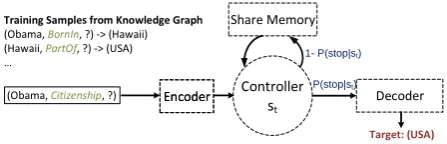
controllerandshared memory. We design a shared memory component to store KB information im-plicitly. That is, the model needs to determine what information it should store. Moreover, instead of explicitly manipulating the observed triples based on the human-designed inference procedure, the proposed model learns the multi-step inference pro-cedure implicitly, i.e., without human intervention. Specifically, our model makes the prediction sev-eral times while forming different intermediate rep-resentations along the way. The controller deter-mines how many steps the model should proceed given an input. At each step, a new representation is formed by taking the current representation and a context vector generated by accessing the shared memory. The detailed process is introduced in Sec-tion3.3and an overview of the model is shown in Figure1.
The main contributions of our paper are as fol-lows:
• We propose Implicit ReasoNets (IRNs), which use a shared memory guided by a con-troller to model multi-step structured relation-ships implicitly.
• We evaluateIRNsand demonstrate that our proposed model achieves the state-of-the-art results on the popular FB15k benchmark, sur-passing prior approaches by more than 5.7%.
• Our analysis shows that the multi-step in-ference is crucial to the performance of our model.
2 Knowledge Base Completion Task
The goal of Knowledge Base Completion (KBC) tasks is to predict a head or a tail entity given the relation type and the other entity, i.e. predicting the head entityhgiven a triplet(?,R,t)with
re-lation R and tail entity t, or predicting the tail
entitytgiven a triplet(h,R,?)with head entityh
and relationR, where?denotes the missing entity.
Early work on KBC focuses on learning symbolic rules. Schoenmackers et al.(2010) learns infer-ence rules from a sequinfer-ence of triplets, e.g., (X, COUNTRYOFHEADQUARTERS,Y) is implied by
(X, ISBASEDIN,A) and (A, STATELOCATEDIN,B)
and (B, COUNTRYLOCATEDIN,Y). However,
enu-merating all possible relations is intractable when the knowledge base is large, since the number of distinct sequences of triplets increases rapidly with the number of relation types. Also, the rules-based methods cannot be generalized to paraphrase alter-nations.
Recent approaches (Bordes et al.,2013;Socher et al.,2013) achieve better generalization by operat-ing on embeddoperat-ing representations, where the vector similarity can be regarded as semantic similarity.
In the evaluation, models compute the similar-ity between the output prediction and all entities. Mean rank and precision of the target entity are used as metrics for evaluation.
3 Proposed Model
Our proposed model uses the same setup as in the embedding type of approaches (Bordes et al.,2013;
Socher et al., 2013), i.e., the model first takes a triplet with a missing entity, (h,R,?), as input,
then maps the input into the neural space through embeddings, and finally outputs a prediction vector of the missing entity. Given that our model is a neu-ral model, we use theencodermodule to transform the input triplet(h,R,?)to a continuous
represen-tation. For generating the prediction results, the
decodermodule takes the generated continuous rep-resentation and outputs a predicted vector, which can be used to find the nearest entity embedding. Basically, we use encoder and decoder modules to convert the tasks between symbolic space and neural space.
Controller
St St+1 St+2
Xt
P(stop|St) False
fatt(St,M) fatt(St+1,M) Xt+1
False
Shared Memory
Attention
Termination
Decoder fo(St+2)
Ot+2 M
(USA)
Encoder (Obama, Citizenship, ?)
[image:3.595.52.293.61.257.2]True P(stop|St+1) P(stop|St+1)
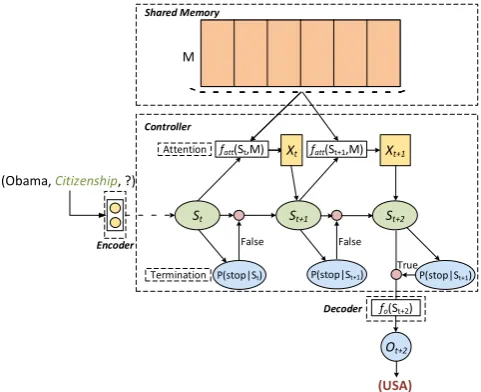
Figure 2:A running example of theIRNarchitecture. Given the input(Obama,CITIZENSHIP,?), the model iteratively
re-formulates the input vector via the current input vector and the attention vector over the shared memory, and determines to stop when an answer is found.
the controller, and the whole process is performed repeatedly until the controller stops the process. Note that the number of steps varies according to the complexity of each example.
3.1 Inference
Encoder/Decoder Given an input(h,R,?), the
encoder module retrieves the entityhand relation
Rembeddings from an embedding matrix, and then
concatenates the two vectors as the intermediate representations1.
The decoder module outputs a prediction vector fo(st) =tanh(Wost+bo)based on the interme-diate representationst, which is a nonlinear projec-tion from the controller hidden state andWoandbo are the weight matrix and bias vector, respectively. Wo is ak-by-nmatrix, wherekis the number of the possible entities, andnis the dimension of the hidden vectorst.
Shared Memory The shared memory is denoted
asM ={mi}|iM=1|, which consists of a list of
vec-tors. During training, the shared memory, which is shared across all training instances, is first ran-domly initialized and then is jointed learned with the controller on training data.
Controller The controller has two roles in our
model. First, it needs to judge if the process should be stopped. If yes, the output will be generated. Otherwise, it needs to generate a new
represen-tation based on previous represenrepresen-tation and the context vector generated from shared memory. The controller is a recurrent neural network and controls the process by keeping internal state sequences to track the current search process and history. The controller uses an attention mechanism to fetch in-formation from relevant memory vectors inM, and decides if the model should output the prediction or continue to update the input vector in the next step.
To judge the process should be continued or not, the model estimates P(stop|st) by a logistical regression module:sigmoid(Wcst+bc), where the weight matrixWcand bias vectorbcare learned during training. With probabilityP(stop|st), the process will be stopped, and the decoder will be called to generate the output.
With probability1−P(stop|st), the controller needs to generate the next representationst+1 =
RNN(st, xt). The attention vectorxtatt-th step is generated based on the current internal statestand the shared memoryM. Specifically, the attention scoreat,ion a memory vectormigiven a statest is computed as
at,i ∝λcos(W1mi, W2st),
where λis set to 10 in our experiments and the weight matrices W1 and W2 are learned during
training. The attention vectorxtcan be written as
xt=fatt(st, M) =P|iM|at,imi.
Overall Process The inference process is
for-mally described in Algorithm 1. Given input (Obama, NATIONALITY, ?), the encoder
mod-ule converts it to a vector s1 by concatenating
entity/relation embedding lookup. Second, at step t, with probability P(stop|st), model out-puts the prediction vector oi. With probability
1−P(stop|st), the statesi+1 is updated based
on the previous statesiand the vectorxtgenerated by performing attention over the shared memory.
We iterate the process till a predefined maximum stepTmax. At test time, the model outputs a
Algorithm 1Inference Process ofIRNs
Lookup entity and relation embeddings,handr. Sets1 = [h,r] .Encoder
whileTruedo
u∼[0,1]
ifu > P(stop|st)then
xt=fatt(st, M) .Access Memory
st+1=RNN(st, xt),t←t+ 1
else
Generate outputot=fo(st) .Decoder
break .Stop
end if end while
3.2 Training Objectives
In this section, we introduce the training objectives to train our model. While our process is stochastic, the model mainly needs to decide the number of steps for generating the intermediate representa-tions for each example. Since the number of steps the model should take for each example is unknown in the training data, we optimize the expected re-ward directly, motivated by the REINFORCE algo-rithm (Williams,1992).
The expected reward at steptcan be obtained as follows. At t-step, given the representation vector st, the model generates the output score
ot as fo(st). We convert the output score to a probability by the following steps. The probabil-ity of selecting a prediction yˆ ∈ D is approxi-mated asp(ˆy|ot) = P exp(−γd(ot,yˆ))
yk∈Dexp(−γd(ot,yk)), where
d(o, y) =ko−yk1is theL1distance between the
outputoand the target entityy, andDis the set of all possible entities. In our experiments, we setγto 5 and sample 20 negative examples inDto speed up training. Assume that ground truth target entity embedding isy∗, the expected reward at timetis:
J(st|θ) = X
ˆ
y
R(ˆy)Pexp(−γd(ot,y))ˆ
¯
y∈Dexp(−γd(o,y))¯
=Pexp(−γd(ot, y∗))
¯
y∈Dexp(−γd(o,y))¯ ,
whereRis the reward function, and we assign the reward to be1when we make a correct prediction on the target entity, and0otherwise.
Next, we can calculate the reward by summing them over each step. The overall probability of model terminated at timetisΠti−=11(1−vi)vt, where
vi =P(stop|si, θ). Therefore, the overall
objec-tive function can be written as
J(θ) =TXmax
t=1 Πt−1
i=1(1−vi)vtJ(st|θ). (1)
Then, the parameters can be updated through back-propagation.
3.3 Motivating Examples
We now describe the motivating examples to ex-plain the design of shared memory that implicitly stores KB information and the design of the con-troller that implicitly learns the inference proce-dure.
Shared Memory Suppose, in a KBC task, the
input is (Obama, NATIONALITY, ?) and the
model is required to answer the missing entity (an-swer:U.S.A). Our model can learn to utilize and store information in the shared memory through the controller. When a new information from a new instance is received (e.g., (Obama, BORNIN, Hawaii)), the model first uses its controller to find relevant information (e.g., (Hawaii, PARTOF, U.S.A)). If the relevant information is not found, the model learns to store the information to mem-ory vectors by gradient update in order to answer the missing entity correctly. Due to the limited size of the shared memory, the model cannot store all new information explicitly. Thus, the model needs to learn to utilize the shared memory efficiently to lower the training loss. If a related information from a new instance is received, the model learns to do inference by utilizing the controller to go over existing memory vectors iteratively. In this way, the model could learn to do inference and corre-late training instances via memory cells without explicitly storing new information.
Controller The design of the controller allows
Table 1: The knowledge base completion (link prediction) results on WN18 and FB15k.
Model Additional Information WN18 FB15k
Hits@10 (%) MR Hits@10 (%) MR
SE (Bordes et al.,2011) NO 80.5 985 39.8 162
Unstructured (Bordes et al.,2014) NO 38.2 304 6.3 979
TransE (Bordes et al.,2013) NO 89.2 251 47.1 125
TransH (Wang et al.,2014) NO 86.7 303 64.4 87
TransR (Lin et al.,2015b) NO 92.0 225 68.7 77
CTransR (Lin et al.,2015b) NO 92.3 218 70.2 75
KG2E (He et al.,2015) NO 93.2 348 74.0 59
TransD (Ji et al.,2015) NO 92.2 212 77.3 91
TATEC (García-Durán et al.,2015) NO - - 76.7 58
NTN (Socher et al.,2013) NO 66.1 - 41.4
-DISTMULT (Yang et al.,2014) NO 94.2 - 57.7
-STransE (Nguyen et al.,2016) NO 94.7 (93) 244 (206) 79.7 69
RTransE (García-Durán et al.,2015) Path - - 76.2 50
PTransE (Lin et al.,2015a) Path - - 84.6 58
NLFeat (Toutanova et al.,2015) Node + Link Features 94.3 - 87.0
-Random Walk (Wei et al.,2016) Path 94.8 - 74.7
-IRN NO 95.3 249 92.7 38
Table 2: The performance ofIRNswith different memory sizes and inference steps on FB15k, where
|M|and Tmax represent the number of memory vectors and the maximum inference step, respec-tively.
|M| Tmax FB15k
Hits@10 (%) MR
64 1 80.7 55.7
64 2 87.4 49.2
64 5 92.7 38.0
64 8 88.8 32.9
32 5 90.1 38.7
64 5 92.7 38.0
128 5 92.2 36.1
512 5 90.0 35.3
4096 5 88.7 34.7
4 Experimental Results
In this section, we evaluate the performance of our model on the benchmark FB15k and WN18 datasets for KBC (Bordes et al., 2013). These datasets contain multi-relations between head and tail entities. Given a head entity and a relation, the model produces a ranked list of the entities accord-ing to the score of the entity beaccord-ing the tail entity of this triple. To evaluate the ranking, we report
mean rank (MR), the mean of rank of the correct
entity across the test examples, andhits@10, the proportion of correct entities ranked in the top-10 predictions. Lower MR or higher hits@10 indi-cates a better prediction performance. We follow the evaluation protocol inBordes et al.(2013) to re-port filtered results, where negative examplesNare
removed from the dataset. In this case, we avoid some negative examples being valid and ranked above the target triplet.
We use the same hyper-parameters of our model for both FB15k and WN18 datasets. Entity em-beddings (which are not shared between input and output modules) and relation embedding are both 100-dimensions. We use the encoder module and decoder module to encode input entities and rela-tions, and output entities, respectively. There are 64 memory vectors with 200 dimensions each, initial-ized by random vectors with unitL2-norm. We use
single-layer GRU with 200 cells as the search con-troller. We set the maximum inference stepTmax of theIRNto 5. We randomly initialize all model parameters, and use SGD as the training algorithm with mini-batch size of 64. We set the learning rate to a constant number, 0.01. To prevent the model from learning a trivial solution by increasing entity embeddings norms, we followBordes et al.(2013) to enforce theL2-norm of the entity embeddings
as 1. We use hits@10 as the validation metric for theIRN. Following the work (Lin et al.,2015a), we add reverse relations into the training triplet set to increase the training data.
[image:5.595.105.256.398.522.2]Table 3: Hits@10 (%) in the relation category on FB15k. (Mstands forMany)
Model 1-1Predicting head1-M M-1 hM-M 1-1 Predicting tail1-M M-1t M-M
SE (Bordes et al.,2011) 35.6 62.6 17.2 37.5 34.9 14.6 68.3 41.3
Unstructured (Bordes et al.,2014) 34.5 2.5 6.1 6.6 34.3 4.2 1.9 6.6 TransE (Bordes et al.,2013) 43.7 65.7 18.2 47.2 43.7 19.7 66.7 50.0 TransH (Wang et al.,2014) 66.8 87.6 28.7 64.5 65.5 39.8 83.3 67.2 TransR (Lin et al.,2015b) 78.8 89.2 34.1 69.2 79.2 37.4 90.4 72.1 CTransR (Lin et al.,2015b) 81.5 89.0 34.7 71.2 80.8 38.6 90.1 73.8 KG2E (He et al.,2015) 92.3 94.6 66.0 69.6 92.6 67.9 94.4 73.4 TransD (Ji et al.,2015) 86.1 95.5 39.8 78.5 85.4 50.6 94.4 81.2 TATEC (García-Durán et al.,2015) 79.3 93.2 42.3 77.2 78.5 51.5 92.7 80.7 STransE (Nguyen et al.,2016) 82.8 94.2 50.4 80.1 82.4 56.9 93.4 83.1 PTransE (Lin et al.,2015a) 91.0 92.8 60.9 83.8 91.2 74.0 88.9 86.4
IRN 87.2 96.1 84.8 92.9 86.9 90.5 95.3 94.1
(Lin et al., 2015a) models are extensions of the TransE (Bordes et al.,2013) model by explicitly ex-ploring multi-step relations in the knowledge base to regularize the trained embeddings. The NLFeat model (Toutanova et al.,2015) is a log-linear model that makes use of simple node and link features.
Table1 presents the experimental results. Ac-cording to the table, our model significantly out-performs previous baselines, regardless of whether previous approaches use additional information or not. Specifically, on FB15k, the MR of our model surpasses all previous results by 12, and our hit@10 outperforms others by 5.7%. On WN18, theIRN
obtains the highest hit@10 while maintaining simi-lar MR results compared to previous work.∗
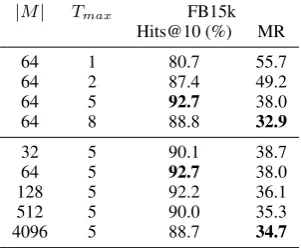
To better understand the behavior ofIRNs, we report the results ofIRNswith different memory sizes and differentTmaxon FB15k in Table2. We find the performance of IRNs increases signifi-cantly if the number of inference step increases. Note that anIRNwithTmax = 1 is the case that anIRNwithout the shared memory. Interestingly, givenTmax = 5,IRNs are not sensitive to mem-ory sizes. In particular, larger memmem-ory always im-proves the MR score, but the best hit@10 is ob-tained by|M|=64 memory vectors. A possible reason is that the best memory size is determined by the complexity of the tasks.
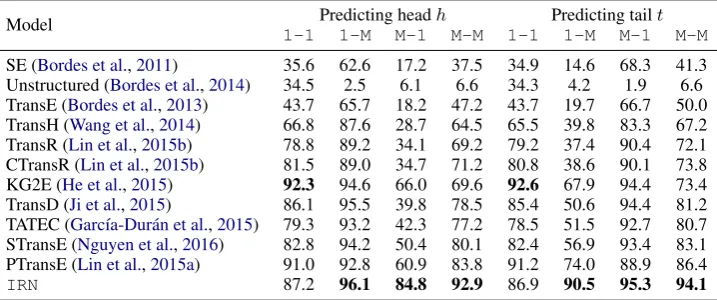
We evaluate hits@10 results on FB15k with re-spect to the relation categories. Following the eval-uation inBordes et al.(2013), we categorize the relations according to the cardinalities of their as-sociated head and tail entities in four types: 1-1,
∗Nguyen et al. (2016) reported two results on WN18, where the first one is obtained by choosing to optimize hits@10 on the validation set, and second one is obtained by choosing to optimize MR on the validation set. We list both of them in Table1.
1-Many,Many-1, andMany-Many. A given re-lation is 1-1if a head entity can appear with at most one tail entity,1-Manyif a head entity can appear with many tail entities,Many-1if multi-ple heads can appear with the same tail entity, and
Many-Manyif multiple head entities can appear with multiple tail entities. The detailed results are shown in Table3. TheIRNsignificantly improves the hits@10 results in the Many-1 category on predicting the head entity (18.8%), the1-Many
category on predicting the tail entity (16.5%), and theMany-Manycategory (over8%in average).
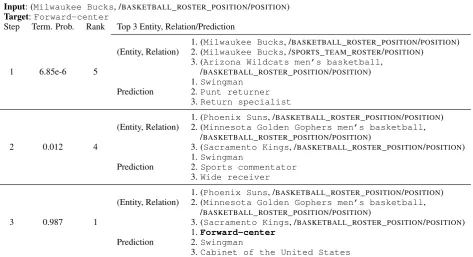
In order to show the inference procedure deter-mined byIRNs, we map the representationstback to human-interpretable entity and relation names in the KB. In Table4, we show a randomly sam-pled example with its top-3 closest triplets (h, R, ?) in terms ofL2-distance, and top-3 answer
pre-dictions along with the termination probability at each step. Throughout our observation, the in-ference procedure is quite different from the tra-ditional inference chain that people designed in the symbolic space (Schoenmackers et al.,2010). The potential reason is that IRNsoperate in the neural space. Instead of connecting triplets that share exactly the same entity as in the symbolic space,IRNs update the representations and con-nects other triplets in the semantic space instead. As we can observe in the examples of Table4, the model reformulates the representationst at each step and gradually increases the ranking score of the correct tail entity with higher termination prob-ability during the inference process. In the last step of Table 4, the closest tuple (Phoenix Suns, /BASKETBALL_ROSTER_POSITION/POSITION) is
actually within the training set with a tail entity
tar-Table 4: Interpret the statestin each step via finding the closest (entity, relation) tuple, and the corre-sponding the top-3 predictions and termination probability. “Rank” stands for the rank of the target entity and “Term. Prob.” stands for termination probability.
Input: (Milwaukee Bucks, /BASKETBALL_ROSTER_POSITION/POSITION)
Target:Forward-center
Step Term. Prob. Rank Top 3 Entity, Relation/Prediction
1 6.85e-6 5
(Entity, Relation) 1. (2. (Milwaukee BucksMilwaukee Bucks, /, /BASKETBALLSPORTS_TEAM_ROSTER_ROSTER_/POSITIONPOSITION/)POSITION)
3. (Arizona Wildcats men’s basketball, /BASKETBALL_ROSTER_POSITION/POSITION)
Prediction 1.2.SwingmanPunt returner
3.Return specialist
2 0.012 4
(Entity, Relation) 1. (2. (Phoenix SunsMinnesota Golden Gophers men’s basketball, /BASKETBALL_ROSTER_POSITION/POSITION, ) /BASKETBALL_ROSTER_POSITION/POSITION)
3. (Sacramento Kings, /BASKETBALL_ROSTER_POSITION/POSITION) Prediction 1.2.SwingmanSports commentator
3.Wide receiver
3 0.987 1
(Entity, Relation) 1. (2. (Phoenix SunsMinnesota Golden Gophers men’s basketball, /BASKETBALL_ROSTER_POSITION/POSITION, ) /BASKETBALL_ROSTER_POSITION/POSITION)
3. (Sacramento Kings, /BASKETBALL_ROSTER_POSITION/POSITION) Prediction 1.2.Forward-centerSwingman
3.Cabinet of the United States
get entity. Hence, the whole inference process can be thought as the model iteratively reformulates the representations in order to minimize its distance to the target entity in neural space.
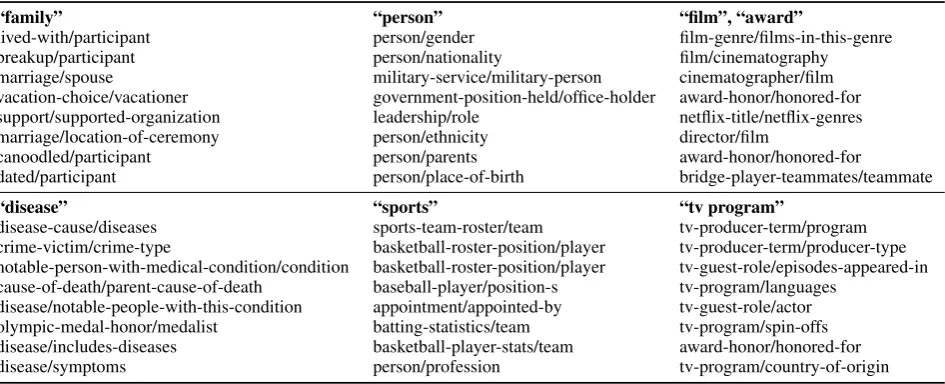
To understand what the model has learned in the shared memory in the KBC tasks, in Table5, we visualize the shared memory in anIRNtrained from FB15k. We compute the average attention scores of each relation type on each memory cell. In the table, we show the top 8 relations, ranked by the average attention scores, of some memory cells. These memory cells are activated by certain semantic patterns within the knowledge graph. It suggests that the shared memory can efficiently capture the relationships implicitly. We can still see a few noisy relations in each clustered memory cell, e.g., “bridge-player-teammates/teammate” relation in the “film” memory cell, and “olympic-medal-honor/medalist” in the “disease” memory cell.
We provide some moreIRNprediction examples at each step from FB15k as shown in Appendix
A. In addition to the KBC tasks, we construct a synthetic task, shortest path synthesis, to evaluate the inference capability over a shared memory as shown in the AppendixB.
5 Related Work
Link Prediction and Knowledge Base Comple-tionGiven thatRis a relation,his the head entity,
andtis the tail entity, most of the embedding mod-els for link prediction focus on finding the scoring functionfr(h,t)that represents the implausibility of a triple. (Bordes et al.,2011,2014,2013;Wang et al.,2014;Ji et al.,2015;Nguyen et al.,2016). In many studies, the scoring functionfr(h,t)is linear or bi-linear. For example, in TransE ( Bor-des et al.,2013), the function is implemented as fr(h,t) =kh+r−tk, whereh,randtare the corresponding vector representations.
Recently, different studies (Guu et al.,2015;Lin et al.,2015a;Neelakantan et al.,2015;Das et al.,
[image:7.595.66.540.112.369.2]Table 5: Shared memory visualization in anIRNtrained on FB15k, where we show the top 8 relations, ranked by the average attention scores, of some memory cells. The first row in each column represents the interpreted relation.
“family” “person” “film”, “award”
lived-with/participant person/gender film-genre/films-in-this-genre
breakup/participant person/nationality film/cinematography
marriage/spouse military-service/military-person cinematographer/film vacation-choice/vacationer government-position-held/office-holder award-honor/honored-for support/supported-organization leadership/role netflix-title/netflix-genres marriage/location-of-ceremony person/ethnicity director/film
canoodled/participant person/parents award-honor/honored-for
dated/participant person/place-of-birth bridge-player-teammates/teammate “disease” “sports” “tv program”
disease-cause/diseases sports-team-roster/team tv-producer-term/program crime-victim/crime-type basketball-roster-position/player tv-producer-term/producer-type notable-person-with-medical-condition/condition basketball-roster-position/player tv-guest-role/episodes-appeared-in cause-of-death/parent-cause-of-death baseball-player/position-s tv-program/languages
disease/notable-people-with-this-condition appointment/appointed-by tv-guest-role/actor olympic-medal-honor/medalist batting-statistics/team tv-program/spin-offs disease/includes-diseases basketball-player-stats/team award-honor/honored-for
disease/symptoms person/profession tv-program/country-of-origin
(2015) andDas et al.(2016) use an RNN to model the multi-step relationships over a set of random walk paths on the observed triplets. Toutanova and Chen(2015) shows the effectiveness of using sim-ple node and link features that encode structured information on FB15k and WN18. In our work, theIRNoutperforms prior results and shows that similar information can be captured by the model without explicitly designing inference procedures on the observed triplets. Our model can be regarded as a recursive function that iteratively update the representation in such a way that its distance to the target entity in the neural space is minimized, i.e.,
kfIRN(h,r)−tk.
Studies such as (Riedel et al.,2013) show that incorporating textual information can further im-prove the KBC tasks. It would be interesting to incorporate the information outside the knowledge bases in our model in the future.
Neural Frameworks Sequence-to-sequence
models (Sutskever et al.,2014;Cho et al., 2014) have shown to be successful in many applications such as machine translation and conversation mod-eling (Sordoni et al.,2015). While sequence-to-sequence models are powerful, recent work has shown the necessity of incorporating an external memory to perform inference in simple algorithmic tasks (Graves et al.,2014,2016).
Compared IRNs to Memory Networks (MemNN) (Weston et al.,2014;Sukhbaatar et al.,
2015; Miller et al., 2016) and Neural Turing Machines (NTM) (Graves et al.,2014,2016), the
biggest difference between our model and the existing frameworks is the controller and the use of the shared memory. We followShen et al.(2017) for using a controller module to dynamically perform a multi-step inference depending on the complexity of the instance. MemNN and NTM explicitly store inputs (such as graph definition, supporting facts) in the memory. In contrast, in
IRNs, we do not explicitly store all the observed inputs in the shared memory. Instead, we directly operate on the shared memory, which modeling the structured relationships implicitly. During training, we randomly initialize the memory and update the memory jointly with the controller with respect to task-specific objectives via back-propagation, instead of explicitly defining memory write operations as in NTM.
6 Conclusion
In this paper, we propose Implicit ReasoNets (IRNs), which perform inference over a shared memory that stores large-scale structured relation-ships implicitly. The inference process is guided by a controller to access the memory that is shared across instances. We demonstrate and analyze the multi-step inference capability ofIRNsin the knowledge base completion tasks. Our model, with-out using any explicit knowledge base information in the inference procedure, outperforms all prior approaches on the popular FB15k benchmark by more than 5.7%.
in two ways. First, inspired from Ribeiro et al.
(2016), we would like to develop techniques to exploit ways to generate human understandable reasoning interpretation from the shared memory. Second, we plan to applyIRNsto infer the relation-ships in unstructured data such as natural language. For example, given a natural language query such as “are rabbits animals?”, the model can infer a natural language answer implicitly in the shared memory without performing inference directly on top of huge amounts of observed sentences such as “all mammals are animals” and “rabbits are ani-mals”. We believe that the ability to perform infer-ence implicitly is crucial for modeling large-scale structured relationships.
References
Jonathan Berant, Andrew Chou, Roy Frostig, and Percy Liang. 2013. Semantic parsing on Freebase from question-answer pairs. InProceedings of EMNLP.
Kurt Bollacker, Colin Evans, Praveen Paritosh, Tim Sturge, and Jamie Taylor. 2008. Freebase: A col-laboratively created graph database for structuring human knowledge. InProceedings of SIGMOD-08. pages 1247–1250.
Antoine Bordes, Xavier Glorot, Jason Weston, and Yoshua Bengio. 2014. A semantic matching energy function for learning with multi-relational data. Ma-chine Learning94(2):233–259.
Antoine Bordes, Nicolas Usunier, Alberto Garcia-Duran, Jason Weston, and Oksana Yakhnenko. 2013. Translating embeddings for modeling multi-relational data. InAdvances in Neural Information Processing Systems. pages 2787–2795.
Antoine Bordes, Jason Weston, Ronan Collobert, and Yoshua Bengio. 2011. Learning structured embed-dings of knowledge bases. In Proceedings of the Twenty-Fifth AAAI Conference on Artificial Intelli-gence. pages 301–306.
Kyunghyun Cho, Bart Van Merriënboer, Caglar Gul-cehre, Dzmitry Bahdanau, Fethi Bougares, Holger Schwenk, and Yoshua Bengio. 2014. Learning phrase representations using rnn encoder-decoder for statistical machine translation. arXiv preprint arXiv:1406.1078.
Rajarshi Das, Arvind Neelakantan, David Belanger, and Andrew McCallum. 2016. Chains of reasoning over entities, relations, and text using recurrent neu-ral networks. arXiv preprint arXiv:1607.01426.
C. Fellbaum. 1998. WordNet: An Electronic Lexical Database. MIT Press.
Alberto García-Durán, Antoine Bordes, and Nicolas Usunier. 2015. Composing relationships with trans-lations. InEMNLP. pages 286–290.
Alberto García-Durán, Antoine Bordes, Nicolas Usunier, and Yves Grandvalet. 2015. Combining two and three-way embeddings models for link pre-diction in knowledge bases.CoRRabs/1506.00999. Alex Graves, Greg Wayne, and Ivo Danihelka.
2014. Neural turing machines. arXiv preprint arXiv:1410.5401.
Alex Graves, Greg Wayne, Malcolm Reynolds, Tim Harley, Ivo Danihelka, Agnieszka Grabska-Barwi´nska, Sergio Gómez Colmenarejo, Edward Grefenstette, Tiago Ramalho, John Agapiou, et al. 2016. Hybrid computing using a neural network with dynamic external memory.Nature.
Kelvin Guu, John Miller, and Percy Liang. 2015. Traversing knowledge graphs in vector space.arXiv preprint arXiv:1506.01094.
Shizhu He, Kang Liu, Guoliang Ji, and Jun Zhao. 2015. Learning to represent knowledge graphs with gaussian embedding. In Proceedings of the 24th ACM International on Conference on Information and Knowledge Management. pages 623–632. Guoliang Ji, Shizhu He, Liheng Xu, Kang Liu, and Jun
Zhao. 2015. Knowledge graph embedding via dy-namic mapping matrix. InACL. pages 687–696. Yankai Lin, Zhiyuan Liu, Huanbo Luan, Maosong Sun,
Siwei Rao, and Song Liu. 2015a. Modeling rela-tion paths for representarela-tion learning of knowledge bases. In Proceedings of the Conference on Em-pirical Methods for Natural Language Processing (EMNLP).
Yankai Lin, Zhiyuan Liu, Maosong Sun, Yang Liu, and Xuan Zhu. 2015b. Learning entity and relation em-beddings for knowledge graph completion. In Pro-ceedings of the Twenty-Ninth AAAI Conference on Artificial Intelligence. AAAI’15, pages 2181–2187. Alexander Miller, Adam Fisch, Jesse Dodge,
Amir-Hossein Karimi, Antoine Bordes, and Jason Weston. 2016. Key-value memory networks for directly read-ing documents. InEMNLP.
Mike Mintz, Steven Bills, Rion Snow, and Daniel Ju-rafsky. 2009. Distant supervision for relation extrac-tion without labeled data. InProceedings of ACL-IJCNLP-09. pages 1003–1011.
Arvind Neelakantan, Benjamin Roth, and Andrew Mc-Callum. 2015. Compositional vector space mod-els for knowledge base completion. arXiv preprint arXiv:1504.06662.
Maximilian Nickel, Volker Tresp, and Hans-Peter Kriegel. 2011. A three-way model for collective learning on multi-relational data. In Proceedings of the 28th International Conference on Machine Learning. pages 809–816.
Marco Tulio Ribeiro, Sameer Singh, and Carlos Guestrin. 2016. “Why Should I Trust You?”: Ex-plaining the Predictions of Any Classifier. InKDD. Sebastian Riedel, Limin Yao, Andrew McCallum, and
Benjamin M. Marlin. 2013. Relation extraction with matrix factorization and universal schemas. In HLT-NAACL. pages 74–84.
Stefan Schoenmackers, Oren Etzioni, Daniel S Weld, and Jesse Davis. 2010. Learning first-order horn clauses from web text. InProceedings of the 2010 Conference on Empirical Methods in Natural Lan-guage Processing. Association for Computational Linguistics, pages 1088–1098.
Yelong Shen, Po-Sen Huang, Jianfeng Gao, and Weizhu Chen. 2017. ReasoNet: Learning to stop reading in machine comprehension. InKDD. Richard Socher, Danqi Chen, Christopher D. Manning,
and Andrew Y. Ng. 2013. Reasoning With Neural Tensor Networks For Knowledge Base Completion. In Advances in Neural Information Processing Sys-tems.
Alessandro Sordoni, Michel Galley, Michael Auli, Chris Brockett, Yangfeng Ji, Margaret Mitchell, Jian-Yun Nie, Jianfeng Gao, and Bill Dolan. 2015. A neural network approach to context-sensitive gen-eration of conversational responses. arXiv preprint arXiv:1506.06714.
F. M. Suchanek, G. Kasneci, and G. Weikum. 2007. Yago: A Core of Semantic Knowledge. InWWW. Sainbayar Sukhbaatar, Jason Weston, Rob Fergus, et al.
2015. End-to-end memory networks. InAdvances in Neural Information Processing Systems. pages 2440–2448.
Ilya Sutskever, Oriol Vinyals, and Quoc V Le. 2014. Sequence to sequence learning with neural networks. In Advances in Neural Information Processing Sys-tems. pages 3104–3112.
Kristina Toutanova and Danqi Chen. 2015. Observed versus latent features for knowledge base and text inference. InProceedings of the 3rd Workshop on Continuous Vector Space Models and their Compo-sitionality. pages 57–66.
Kristina Toutanova, Danqi Chen, Patrick Pantel, Hoi-fung Poon, Pallavi Choudhury, and Michael Gamon. 2015. Representing text for joint embedding of text and knowledge bases. InEMNLP.
Kristina Toutanova, Xi Victoria Lin, Scott Wen tau Yih, Hoifung Poon, and Chris Quirk. 2016. Composi-tional learning of embeddings for relation paths in knowledge bases and text. InACL.
Zhen Wang, Jianwen Zhang, Jianlin Feng, and Zheng Chen. 2014. Knowledge graph embedding by trans-lating on hyperplanes. InProceedings of the Twenty-Eighth AAAI Conference on Artificial Intelligence. pages 1112–1119.
Zhuoyu Wei, Jun Zhao, and Kang Liu. 2016. Mining inference formulas by goal-directed random walks. InEMNLP.
Robert West, Evgeniy Gabrilovich, Kevin Murphy, Shaohua Sun, Rahul Gupta, and Dekang Lin. 2014. Knowledge base completion via search-based ques-tion answering. InProceedings of the 23rd Interna-tional Conference on World Wide Web. ACM, pages 515–526.
Jason Weston, Sumit Chopra, and Antoine Bor-des. 2014. Memory networks. arXiv preprint arXiv:1410.3916.
Ronald J. Williams. 1992. Simple statistical gradient-following algorithms for connectionist reinforce-ment learning. Machine Learning8:229–256. Bishan Yang, Wen-tau Yih, Xiaodong He, Jianfeng
Gao, and Li Deng. 2014. Embedding entities and relations for learning and inference in knowledge bases. CoRRabs/1412.6575.
A Inference Steps in KBC
To analyze the behavior ofIRNsin each inference step, we further pick some examples for the tail entity prediction in Table6. Interestingly, we ob-served that the model can gradually increase the ranking score of the correct tail entity during the inference process.
B Analysis: ApplyingIRNsto a Shortest Path Synthesis Task
To further understand the inference procedure of
IRNs, we construct a synthetic task, shortest path synthesis, to evaluate the inference capability over a shared memory. The motivations of applying our model to this task are as follows. First, we want to evaluateIRNson another task requiring multi-step inference. Second, we select the sequence generationtask so that we are able to analyze the inference capability ofIRNsin details.
In the shortest path synthesis task, as illustrated in Figure3, a training instance consists of a start node and an end node (e.g.,215;493) of an un-derlying weighted directed graph that is unknown to models. The output of each instance is the short-est path between the given start and end nodes of the underlying graph (e.g.,215 → 101 → 493). Specifically, models can only observe the start-end node pairs as input and their shortest path as output. The whole graph is unknown to the models and the edge weights are not revealed in the training data. At test time, a path sequence is considered correct if it connects the start node and the end node of the underlying graph, and the cost of the predicted path is the same as the optimal path.
We construct the underlying graph as follows: on a three-dimensional unit-sphere, we randomly generate a set of nodes. For each node, we con-nect itsK-nearest neighbors and use the euclidean distance between two nodes to construct a graph. We randomly sample two nodes and compute its shortest path if it is connected between these two nodes. Given the fact that all the sub-paths within a shortest path are shortest paths, we incrementally create the dataset and remove the instances which are a sub-path of previously selected paths or are super-set of previous selected paths. In this case, all the shortest paths can not be answered through directly copying from another instance. In addi-tion, all the weights in the graph are hidden and not shown in the training data, which increases the difficulty of the tasks. We setk= 50as a default
value.
Note that the task is very difficult andcannotbe solved by dynamic programming algorithms since the weights on the edges are not revealed to the algorithms or the models. To recover some of the shortest paths at the test time, the model needs to infer the correct path from the observed instances. For example, assume that we observe two instances in the training data, “A;D:A→B →G→D” and “B ; E: B → C → E”. In order to an-swer the shortest path betweenAandE, the model needs to infer that “A→ B →C →E” is a pos-sible path betweenAandE. If there are multiple possible paths, the model has to decide which one is the shortest one using statistical information.
In the experiments, we construct a graph with 500 nodes and we randomly assign two nodes to form an edge. We split 20,000 instances for train-ing, 10,000 instances for validation, and 10,000 instances for testing. We create the training and testing instances carefully so that the model needs to perform inference to recover the correct path. We describe the details of the graph and data con-struction parts in the appendix section. A sub-graph of the data is shown in Figure3.
For the settings of theIRN, we switch the output module to a GRU decoder for a sequence genera-tion task. We assign rewardrT = 1if all the pre-diction symbols are correct and0otherwise. We use a64-dimensional embedding vector for input symbols, a GRU controller with128cells, and a GRU decoder with128cells. We set the maximum inference stepTmaxto5.
We compare the IRN with two baseline ap-proaches: dynamic programming without edge-weight information and a standard sequence-to-sequence model (Sutskever et al., 2014) using a similar parameter size to our model. Without knowing the edge weights, dynamic programming only recovers 589 correct paths at test time. The sequence-to-sequence model recovers 904 correct paths. The IRN outperforms both baselines, re-covering 1,319 paths. Furthermore, 76.9% of the predicted paths fromIRN arevalidpaths, where a path is valid if the path connects the start and end node nodes of the underlying graph. In con-trast, only 69.1% of the predicted paths from the sequence-to-sequence model are valid.
pre-Table 6: An inference example of FB15k dataset. Given a head entity and a relation, the predictions of
IRNin different steps associated with the corresponding termination probabilities.
Input: (Dean Koontz, /PEOPLE/PERSON/PROFESSION)
Target:Film Producer
Step Termination Prob. Answer Rank Predict top-3 entities
1 0.018 9 Author TV. Director Songwriter
2 0.052 7 Actor Singer Songwriter
3 0.095 4 Actor Singer Songwriter
4 0.132 4 Actor Singer Songwriter
5 0.702 3 Actor Singer Film Producer
Input: (War and Peace, /FILM/FILM/PRODUCED_BY) Target:Carlo Ponti
Step Termination Prob. Answer Rank Predict top-3 entities
1 0.001 13 Scott Rudin Stephen Woolley Hal B. Wallis
2 5.8E-13 7 Billy Wilder William Wyler Elia Kazan
3 0.997 1 Carlo Ponti King Vidor Hal B. Wallis
Step Termination Distance Predictions Probability
1 0.001 N/A 215→158→89→458→493
2 ∼0 N/A 215→479→277→353→493
3 ∼0 N/A 215→49→493
4 ∼0 0.77 215→140→493
5 0.999 0.70 215→101→493
Figure 3:An example of the shortest path synthesis dataset, given an input “215;493” (Answer:215→101→493). Note that we only show the nodes that are related to this example here. The corresponding termination probability and prediction results are shown in the table. The model terminates at step5.
diction on this instance, the model has to perform a fairly complicated inference.† We observe that
the model cannot find a connected path in the first three steps. Finally, the model finds a valid path at the forth step and predict the correct shortest path sequence at the fifth step.
[image:12.595.81.500.95.423.2]