Merging knowledge bases in different languages
Jer´onimo Hern´andez-Gonz´alez
University of the Basque Country, Donostia, GI, Spain
Estevam R. Hruschka Jr.
Federal University of Sao Carlos, S˜ao Carlos, SP, Brazil
Tom M. Mitchell
Carnegie Mellon University, Pittsburgh, PA, USA
Abstract
Recently, different systems which learn to populate and extend a knowledge base (KB) from the web in different languages have been presented. Although a large set of concepts should be learnt independently from the language used to read, there are facts which are expected to be more eas-ily gathered in local language (e.g., cul-ture or geography). A system that merges KBs learnt in different languages will ben-efit from the complementary information as long as common beliefs are identified, as well as from redundancy present in web pages written in different languages. In this paper, we deal with the problem of identifying equivalent beliefs (or con-cepts) across language specific KBs, as-suming that they share the same ontol-ogy of categories and relations. In a case study with two KBs independently learnt from different inputs, namely web pages written in English and web pages writ-ten in Portuguese respectively, we report on the results of two methodologies: an approach based on personalized PageR-ank and an inference technique to find out common relevant paths through the KBs. The proposed inference technique efficiently identifies relevant paths, outper-forming the baseline (a dictionary-based classifier) in the vast majority of tested cat-egories.
1 Introduction
In the last few decades, the machine learning com-munity has launched different research projects to take advantage of the massive source of infor-mation which has become the web, and of the
people who build it up. Among others, informa-tion extracinforma-tion systems (IES) which use the text found in webpages to extract, validate and incor-porate beliefs to a structured knowledge base have been developed (e.g., YAGO (Suchanek et al., 2008), NELL (Mitchell et al.,2015) or Knowledge Vault (Dong et al.,2014)). Such knowledge bases (KBs) store facts about the real world, which are represented as entities and relationship among en-tities. The reliability of a fact, inferred from the web, is at first questionable due to the noisy in-formation available on the Web. This difficulty is usually overcome by relying on data redundancy from multiple Web pages. Requiring higher de-grees of redundancy to incorporate beliefs to the KB help to improve the quality of the learnt KB.
In the long run, having two such IES, run-ning independently, tend to generate equivalent KBs, even if they gather information from differ-ent webpages, in differdiffer-ent time or using differdiffer-ent terminology. However, if those two systems ex-tract (and store) facts from Web pages written in different languages, it can be hard to automatically identify redundant facts, or to automatically merge such KBs. Let us assume an English KB contain-ing the concept of the city ofSao Carlosas a be-lief and, also, a Portuguese KB with the equivalent concept represented in Portuguese asS˜ao Carlos. Let us assume also that, in the Portuguese KB,S˜ao Carlosis linked to the conceptPaulo Altomani, the major of the city. Combining both KBs and iden-tifying the equivalence between Sao Carlos (en) andS˜ao Carlos(pt) can help to automatically pop-ulate the English KB adding the fact thatPaulo Al-tomaniis the mayor ofSao Carlos(en).
In this paper we deal with the problem of merging KBs learnt in different languages. This task consists of ontology alignment and equivalent concept matching. We use graph-based inference techniques to deal with the problem of identifying
equivalent entities in different KBs assuming that, in spite of being learnt independently, they share a common ontology. The contributions of this work are as follows:
• An approach to multi-lingual KB merging based on Personalized PageRank
• A path-based graph inference approach that shows promising results when compared to Personalized PageRank.
• An empirical analysis by means of a case study. When graph connectivity is enhanced by means of a SVO corpus, results stand out. In the remainder of this paper we first provide a formal description of the problem, which is for-mulated as an inference problem. Then, the pro-posed solutions are presented. In Section 4, the different approaches are tested in a case study with two KBs independently learnt by NELL (Mitchell et al., 2015) from English and Portuguese web-pages respectively. Next, their behavior is dis-cussed. The paper finishes with conclusions and ideas for future work.
2 Framework
Consider a Knowledge Base (KB) K as a tuple (O, Ic, Ir, S). The ontology O is represented by
a4-tuple(C, HC, R, HR), whereHC codifies the
hierarchy among categoriesc ∈C (e.g., the cate-gorycityis a specification of the category place) and, similarly, HR codifies the hierarchy among
relation-typesr(c1, c2)∈Rwithc1, c2∈C(e.g.,
locatedAt(city,country) is more general than cap-italOf(city,country)).IcandIrare the sets of
en-tities and relationships, respectively, that populate the KB. Thus, an instance(e, c) ∈ Icassigns
en-tityeto categoryc∈C(e.g., (Pittsburgh,city) or (USA,country)) and each instance(e1, r, e2) ∈Ir
is a relation of typerwhich associates two entities,
e1 ande2, with (e1, c1) ∈ Ic, (e2, c2) ∈ Ic and
r(c1, c2)∈R(e.g., (Pittsburgh,locatedAt,USA)).
Sinvolves the literal strings which are used to re-fer to the entities. Two —or more— literal strings
s1ands2 (s1 6= s2) can refer to the same entitye ((s1, e) ∈ S ∧(s2, e) ∈ S), and the same literal stringscan refer to two different entitiese1ande2 as well ((s, e1)∈ S∧(s, e2) ∈S withe1 6=e2). For example, the literal strings “Steal City” and “Pittsburgh” can refer to the concept Pittsburgh, whereas “New York” could refer to bothNYCand
New York State.
Graph representation. In this paper, a graph representation of the KB is used and the prob-lem of merging KBs in different languages is han-dled as a graph inference problem. Each entitye
is represented as a node. Each relation instance (e1, r, e2)∈Iris represented by an edge of typer
between the nodes representing entitiese1 ande2. Similarly, for each (s, e) ∈ S, string sis repre-sented as a node and an edge of typecanReferTo
links it to entitye. In the remaining of the paper, the terms “nodes” and “entities”, on the one hand, and “relation” and “edge types”, on the other, are interchangeably used.
2.1 Inferring entity-equivalence across KBs in different languages
For the sake of simplicity, let us follow the ex-ample of our case study to describe the problem of merging two KBs which share the same ontol-ogy structure (categories and relation types) but which have been learnt (populated) in different languages. Given both KBs,Ken= (O, Ien
c , Iren)
and Kpt = (O, Ipt
c , Irpt), in English and
Por-tuguese respectively, the merging process K∗ = merge(Ken, Kpt)consists mainly of the union of
both sets of entities I∗
c = Icpt∪Icen, where only
an instance of the equivalent entities across lan-guages (e.g., New YorkorNova Iorque) remains. As a consequence of this first step, the sets of relation instances I∗
r = Irpt ∪ Iren is similarly
merged: two relation instances in different lan-guages, (een
1 , r, een2 ) and (ept1, r, ept2 ), are equiva-lent if their relation type r ∈ R is the same and the associated entities are fused inI∗
c (een1 ∼ ept1 and een
2 ∼ ept2). To avoid losing information, per-language literal string sets (Sen, Spt) are kept
linked to the corresponding entities inI∗
c.
The key step is, therefore, the identification of equivalent entities across languages. Let us in-troduce the relation types(een,equivalentTo, ept),
which connects two entities in different language specific KBs, and(sen,canBeTranslatedAs, spt),
3 Methods
In this study, we make use of inference techniques over graphs to find equivalent entities in different language KBs: a Personalized PageRank (PPR) (Haveliwala, 2002) based approach and another one based on Path Ranking Algorithm (PRA) (Lao and Cohen,2010). Both techniques produce clas-sification models which, given a new pair of enti-ties, predict whether or not anequivalentTo rela-tionship is suitable among them.
3.1 Personalized PageRank based approach
In the context of webpage ranking, Personalized PageRank (Haveliwala, 2002) was designed to bias the result of the original PageRank algo-rithm (Page et al.,1999) to make it topic-sensitive. It can be seen as a similarity measure that charac-terizes the neighborhood of a nodeX in a graph. Formally, it estimates a probability distribution over the nodes of the graph. Considering X as the source node of a random walk, it estimates the probability of reaching node Y after w ran-dom steps. At timet, the next step follows one of the out-edges of current nodeXtwith equal
prob-ability(1−α)· 1
|Xt|(where|Xt|is the out-degree of nodeXt) or jumps back to the source nodeX
with probabilityα. The stationary probability dis-tribution is usually approximated by sampling a numbernof random walks with probabilityα of restarting at source node X. The probability as-signed to nodeY is the proportion of walks which finish atY.
In the context of this work, PPR has been used to measure similarity between nodes. Assuming that two equivalent entities in different language subgraphs (L1 andL2) will be highly connected through a number of different paths, the equiva-lent entity eL2
t is expected to be assigned a high
probability by a PPR with origin at entity eL1 o .
Using PPR to estimate the probability distribution
p(·|eL1
o ), a classification model is built by
impos-ing three conditions: (1) the predicted equivalent entity belongs to a different language subgraph (eL2
t : L1 6= L2), (2) the category of both the source and target entities is the same or compat-ible (both are in the same hierarchical line inHC):
(eL1
o , co)∈IcL1∧(etL2, ct)∈IcL2 :
co, ct∈C∧(co =ct∨co−−)H−−*C ct)
and (3) the probability of the predicted entity ex-ceeds thresholdh≤p(eL2
t |eLo1).
3.2 Path Ranking algorithm based approach
The Path Ranking algorithm (Lao and Cohen, 2010) transforms the task of inferring new rela-tionships of typerbetween pairs of entities into a binary classification problem: given a new pair of nodes, is a relationship of typer suitable between them? To do so, it generates, in two steps, a train-ing matrix from which any type of classifier can be learnt. The pairs of nodes already connected by a relationship of type r are positive pairs or examples in this approach. During the first step, paths (sequence of relation types, r1, r2, . . . , rp)
commonly connecting the nodes of the positive pairs are identified by running a number of ran-dom walks of limited length. In the second step, a training matrix is built such that each identified path constitutes a feature (column) and each pair is a positive example (row). Each cell(i, j)of the matrix is assigned the probability of reaching the target nodeei
tof the i-th pair using a random walk
that follows the sequence of relation types of the j-th path with origin at nodeei
o.
Departing from the original design, the genera-tion of paths has been adapted to take advantage of the particularities of our application. First of all, note that every path which connects two nodes in different language subgraphs, een andept,
in-cludes anequivalentTo orcanBeTranslatedAs re-lation type. Note also that, assuming a common ontology for both KBs, the relation types and cat-egories are the same in both languages. The idea behind the original PRA —i.e., certain relation-ships (or paths) can be particularly relevant for de-termining the equivalence of entities of a specific category— is extended to the multi-language con-text by looking for relevant paths which appear replicated in both language subgraphs. Suppose that there is aDi Blassioentity in both languages and anequivalentTorelationship links them. Sup-pose also that there are (Di Blassio, isMayorOf,
New York City) and (Di Blassio, isPrefeitoDe,
Our search for relevant paths starts, for each positive pair, with a breadth-first search from the source node eL1
o looking for nodes eLb1 with an
across-language edge (edge type equivalentTo or
canBeTranslatedAs). For each of these nodes, the node eL2
b at the other extreme of the
across-language relationship is taken. Then, the path fol-lowed to reach eL1
b from eLo1 is reversed. If the
reversed path connectseL2
b to the target nodeeLt2
of the corresponding positive pair, the whole path from eL1
o to eLt2 is kept for evaluation. The
rel-evance of a path (r1, r2, . . . , rp) is measured as
the probability of reaching the target node follow-ing a random walk (through relationships of types
r1, r2, . . .) starting at source node, or in the oppo-site direction. Thus, the most relevant path always leads to the opposite node of the pair, and only to it. Uninformative paths, those whose rates are below the average, are filtered out. With the re-maining relevant paths, a training matrix is built in the same way as the original PRA.
4 Experiments
A complete set of experiments has been designed to test the performance of both approaches in the task of identifying equivalent concepts across lan-guages. A baseline based on dictionary transla-tions is used to put these results in context.
4.1 Knowledge bases
The knowledge bases used in these experiments correspond to the 970th and 110th iterations of the English and Portuguese versions of NELL, re-spectively. As aforementioned, a graph is obtained from each KB drawing a node for each entity and literal string and a labeled edge for each relation-ship among entities. Moreover, edges of type can-ReferTolink each entity with its literal strings. We found out that many entities in both KBs are iso-lated, i.e., they have no relationship. For these ex-periments, all the isolated nodes have been pruned from the graphs as our techniques cannot deal with them: both presented techniques make use of the relationships among entities to perform. The re-sulting graph is used below in a first set of experi-ments.
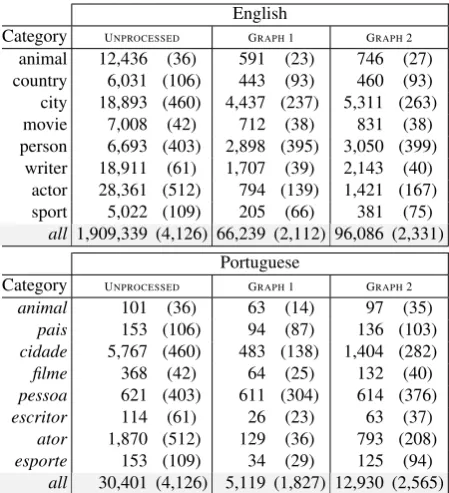
As previously mentioned, both PPR and PRA-based techniques make use of relationships and, in fact, they need well connected graphs to per-form correctly. However, the graphs obtained from NELL KBs are quite sparse (see Table1for
English Category GRAPH1 GRAPH2
animal 13.32±47.12 392.02±1859.43 country 22.65±68.60 289.97±970.55
city 5.00±22.31 134.72±1176.05 movie 1.60±1.69 88.95±891.37 person 2.99±6.76 244.10±1394.07
writer 2.72±4.75 43.50±419.41 actor 2.19±2.12 77.21±819.10 sport 19.94±132.71 256.49±1430.06
all 4.48±28.95 275.49±1715.53 Portuguese
Category GRAPH1 GRAPH2
animal 1.57±1.17 27.23±58.58 pais 5.04±15.99 180.79±820.71 cidade 1.71±4.33 32.03±135.13 filme 1.33±0.79 34.77±177.64 pessoa 1.18±0.66 16.62±101.67 escritor 1.15±0.46 6.40±12.04
ator 1.67±1.41 6.96±11.40 esporte 3.88±6.31 26.98±83.30 all 1.81±3.93 51.26±199.03 Table 1: For each language and category, mean out-degree value and associated standard deviation of the nodes of that category in the (first) graph, without isolated nodes, and in the (second) graph, fed with SVO-inferred relationships before prun-ing. The last row sums up all the categories.
its mean out-degree). An enhanced connectivity among entities is achieved considering a SVO cor-pus. A SVO consists of statistics about the pres-ence of a tripletsubject-verb-object in a text cor-pus usually crawled from the Web. In this study, Wijaya and Mitchell(2016) method to map verbs found in a corpus to relationships of a given struc-tured KB has been used. It explores a SVO corpus looking for verbs which can be used to represent the different relation typesr ∈ R of an ontology
O. Given the returned set of representative verbs for a specific relation typer, pairs of literal strings
s1, s2∈Swhich appear linked by means of one or more representative verbs in the SVO corpus can be considered as evidence of ar relationship. In practice, all the entities which can be referred to by s1 ands2 are connected by means of an edge of typer. As can be observed in Table1, connec-tivity is largely enhanced. On average, the num-ber of edges connecting each node has increased although, according to the related standard devia-tions, the behavior is not uniform. The graph re-sulting from this enhancing process is used in a second set of experiments.
[image:4.595.323.506.59.309.2]English
Category UNPROCESSED GRAPH1 GRAPH2 animal 12,436 (36) 591 (23) 746 (27) country 6,031 (106) 443 (93) 460 (93) city 18,893 (460) 4,437 (237) 5,311 (263) movie 7,008 (42) 712 (38) 831 (38) person 6,693 (403) 2,898 (395) 3,050 (399)
writer 18,911 (61) 1,707 (39) 2,143 (40) actor 28,361 (512) 794 (139) 1,421 (167) sport 5,022 (109) 205 (66) 381 (75)
all 1,909,339 (4,126) 66,239 (2,112) 96,086 (2,331) Portuguese
Category UNPROCESSED GRAPH1 GRAPH2
animal 101 (36) 63 (14) 97 (35) pais 153 (106) 94 (87) 136 (103) cidade 5,767 (460) 483 (138) 1,404 (282) filme 368 (42) 64 (25) 132 (40) pessoa 621 (403) 611 (304) 614 (376) escritor 114 (61) 26 (23) 63 (37)
ator 1,870 (512) 129 (36) 793 (208) esporte 153 (109) 34 (29) 125 (94)
all 30,401 (4,126) 5,119 (1,827) 12,930 (2,565)
Table 2: For each language subgraph and cate-gory, the number of entities and, from these, the number of entities contained in a positive pair are shown. The three columns show counts, from left to right, for (1) the unprocessed graph, (2) the first graph, without isolated nodes, and (3) the second graph, fed with SVO-inferred relationships before pruning. The last row sums up all the categories.
relationships reduces the number of isolated nodes and, therefore, the number of pruned entities de-creases. Table2reflects the effect of this enhance-ment, in terms of the number of remaining entities, on the pruning process. In the case of English, the second graph (with SVO-inferred relationships) is almost a 50% larger than the first graph. The Por-tuguese subgraph, in turn, grows2.5times.
4.2 Bridges among both language-specific KBs
Two different strategies have been carried out in this study to generate an initial set ofequivalentTo
relationships. On the one hand, a costly man-ual introduction of equivalence relationships was carried out. This procedure, although costly, pro-vides highly reliable instances of the relationship. Around400fully reliable relationships were thus generated. On the other hand, entities which have the same name (simple matching), in spite of hav-ing been learnt in different languages, and belong to compatible categories have been considered as equivalent pairs. Both conditions are fulfilled by
up to4,000pairs of entities, among which equiv-alentToedges have been added. Although the evi-dence may be strong, this automatically generated set of equivalentTo edges could involve mislead-ing information. For example, usmislead-ing this approach a hypothetical entity referring to the renowned ma-chine learning researcher (Michael Jordan, pes-soa) in Portuguese could be connected to the for-mer basketball player (Michael Jordan,athlete) in English. The pruning process explained above af-fects these entities too, as shown in Table2.
Connectivity among language subgraphs at the level of literal strings (relation type canBeTrans-latedAs) is achieved by means of a dictionary. A list of string translations has been generated combining terms found in WordNet (de Paiva and Rademaker, 2012; Fellbaum, 1998) and transla-tions on demand making use of the Google Trans-late API1. In total,1.4million string translations
have been obtained. These translations are used to connect nodes representing literal strings in both language subgraphs by means of edges of type
canBeTranslatedAs.
4.3 Training examples
Standard supervised classification takes advantage of a fully labeled dataset with examples of all the classes. They are necessary to train the classifica-tion models as well as to evaluate them. The sification task at hand is a weakly supervised clas-sification problem (Hern´andez-Gonz´alez et al., 2016); specifically, a positive-unlabeled classifi-cation problem (Calvo et al., 2007) where only positive examples are available for training: the pairs of entities related by aequivalentTo relation-ship. No negative example, understood as a pair of nodes in different language subgraphs which are not suitable to hold an equivalentTorelationship, is available.
However, in this context, safe procedures for generating negative examples can be figured out. Figure1 graphically describes the procedure fol-lowed in this study, which is based on the as-sumption that an entity has only one equiva-lent entity in the opposite language KB. Thus, the source node of a positive pair is not equiv-alent to any node in the opposite subgraph dif-ferent from the corresponding target node. For-mally, each (eL1
o ,equivalentTo, eLt2) relationship
already present in the KB is individually
[image:5.595.71.296.61.308.2]c:country: USA
c:pais: EUA equiva
lentTo
c:language: english c:country:
UK
c:country: mexico
speaks speaks border
With
c:veiculo: carro c:pais:
brasil
exporta
exporta notEquivalentTo
[image:6.595.73.292.62.151.2]notEquivalentTo
Figure 1: Generation of negative examples: given a positive pair, (USA, EUA), a walk is launched until an entity with the same category is reached: e.g., (Mexico,Country) by (USA,borderWith, Mex-ico). Obtained negative example: (Mexico,EUA).
ered. For entity eL2
t , other entities eLt02 with the
same or a compatible category are identified in the same language subgraph L2. A negative exam-ple(eL1
o ,notEquivalentTo, eLt02)is then built using
the original entityeL1
o and any compatible
neigh-bor eL2
t0 . For instance, as displayed in Fig. 1,
knowing thatUSAis equivalent to the Portuguese
EUA, Mexicois reached from nodeUSAthrough their common relationship (borderWith), thus gen-erating a negative example (Mexico, notEquiva-lentTo,EUA). The same procedure can be carried out in the opposite direction: fixingeL2
t and
look-ing for compatible entities eL1
o0 in the
neighbor-hood ofeL1
o . For each positive pair, up to2
nega-tive pairs among all the neganega-tive examples gener-ated in both directions are randomly selected.
4.4 Experimental settings
In addition to both described techniques, a classi-fier exclusively based on a dictionary is also con-sidered. It predicts an equivalence if the nodes of the query pair represent entities with literal strings which are the translation of each other. Given that a dictionary is probably the simplest solution to deal with this problem, it has been used in this pa-per as a baseline.
The PPR method has been configured for these experiments with 2,000 random walks of length 5 to estimate the probability distribution, using a probability of restart equal to 0.01. Regarding our PRA-based technique, the breadth-first search is carried out to a depth of 2. These values have been selected within a20×5-fold cross validation. PPR and the baseline do not need a training step and the results are calculated over the whole training set. For each category, PRA learns a logistic regres-sion classifier (its implementation in Weka (Frank
et al.,2016)), which is evaluated in a10×5-fold cross validation. Remember that positive pairs are
equivalentTo relationships, which are also repre-sented in the graph. The edges of the graph cor-responding to training examples are removed for training and testing.
The PPR and PRA-based approaches, together with the baseline, have been applied over graphs 1 and 2 (without and with SVO-inferred rela-tionships, respectively). As our PRA-based ap-proach learns a classifier per category, a diverse set of eight categories has been selected to test the proposals and report their performance: animal,
country, city, movie, person, writer, actor and
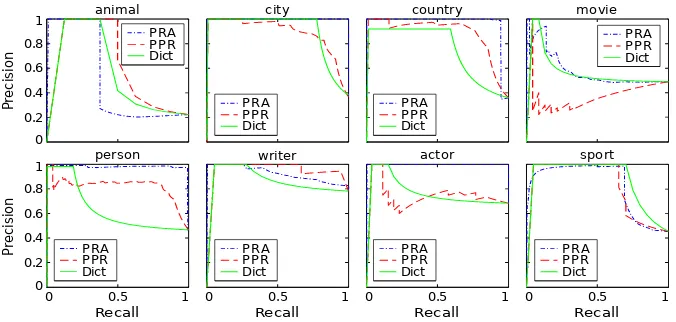
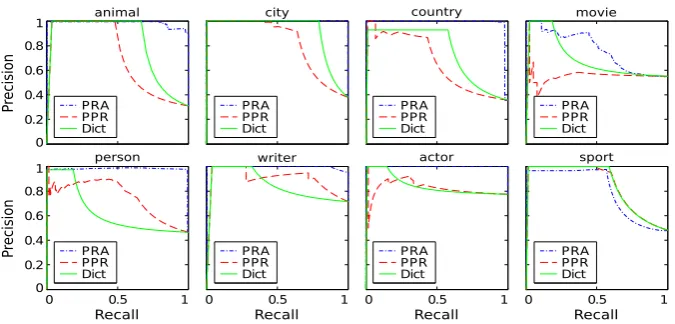
sport. In Figure 2, precision-recall (PR) curves are used to describe the results in the first graph. Each subfigure displays the results for one of the selected categories. Following the same layout, Figure 3 shows the results in the second graph. Note that results in figures2and3are not directly comparable as they have been obtained from train-ing sets of different sizes (see in Table2the num-ber of positive entities remaining after pruning in graphs 1 and 2).
5 Discussion
The performance of the different techniques has been assessed for eight categories using two graphs of different sparsity. Results show the com-petitiveness of the solution based exclusively on a dictionary as well as the outstanding performance of our PRA-based proposal. As expected for an inference technique that intensively explores the graph looking for relevant paths, the use of the more dense SVO+pruned graph enhances the per-formance of the PRA-based proposal. The behav-ior of PPR is less regular and changes considerably among categories.
0 0.2 0.4 0.6 0.8 1
country
0 0.5 1
0 0.2 0.4 0.6 0.8 1
0 0.5 1 0 0.5 1 0 0.5 1
PRA PPR Dict
movie city
animal
person writer actor sport
PRA PPR Dict PRA
PPR Dict PRA
PPR Dict
P
re
ci
si
o
n
P
re
ci
si
o
n
Recall Recall Recall Recall
PRA PPR Dict
PRA PPR Dict PRA
PPR Dict PRA
[image:7.595.131.469.63.224.2]PPR Dict
Figure 2: PR curves comparing both proposals with the dictionary as a baseline. Each figure displays the results of the three approaches with the examples of a specific category using the first graph.
maximum recall that this classifier can show be-fore a sharp drop in precision. Thus, this approach is very competitive in categories where our dic-tionary translates many of the pairs (e.g., sport), its performance is limited in categories where few pairs are translated (e.g.,movie).
The results of the PPR approach are difficult to interpret; no clear pattern is observed. The inporation of new relationships from the SVO cor-pus does not enhance its results. Quite the op-posite, it seems to harm the results in categories such ascountry orwriter. This incorporation in-creases the number of edges among entities of the same language subgraph (see Table1), while the across language connections remain the same. In-tuitively, the probability of a random walk mov-ing across language subgraphs decreases. And this crossing movement is indispensable for the PPR approach to succeed. In categories such as ani-mal or sport, the behavior of the PPR approach matches that of the dictionary. The short path
canReferTo+canBeTranslatedAs+canReferTo usu-ally has few instantiations, easily leading from source to target node. Only in a few categories is the PPR approach able to overcome the base-line and, in these cases, the PRA-based approach usually outperforms it. Our PRA-based technique also imitates the dictionary approach. Intuitively, the translation path is usually considered as rel-evant by this technique. However, even a more complete dictionary would still lack precision in certain cases. According to its unquestionable enhanced performance, our PRA-based technique solves this problem probably relying on both the dictionary and other relevant paths. Specifically, it
is able to overcome the baseline when the dictio-nary is not completely precise (categoriescountry
and person). Finally, only the PRA-based tech-nique clearly improves with the new SVO-inferred edges (categoriesanimal,writerandmovie).
A strategy for generating the initial equiva-lentTo relationships (Section 4.2) is the simple matching of entity names in the different lan-guages. This already covers 403 out of 621 en-tities of categorypersonin Portuguese. This rate is lower in categorywriter, although the same be-havior would be expected since in both categories proper nouns, which are rarely translated, are used to name entities. There are two possibilities for the remaining entities: they are represented in En-glish with a different name or they do not overlap. We carried out a manual inspection of these enti-ties (219 in the case ofperson) to gain insight, re-vealing that the majority of them have Portuguese names, and those with English names do not ap-pear in the English KB. Only a few cases have been found where a possible equivalence is present in the KBs with a slightly different name (e.g.,
Max Nicholson in English and Dr. Max Nichol-sonin Portuguese). This observation supports the idea that entities in this kind of categories, which use proper nouns, are usually complementary if an equivalence with exactly the same name is not found. In this context, the recall of the simple matching approach is expected to stand out. Our PRA-based solution would still be competitive in these categories assessing equivalences for entities with slightly different names.
0 0.2 0.4 0.6 0.8 1
country
0 0.5 1
0 0.2 0.4 0.6 0.8 1
0 0.5 1 0 0.5 1 0 0.5 1
PRA PPR Dict
movie city
animal
person writer actor sport
PRA PPR Dict PRA
PPR Dict PRA
PPR Dict
P
re
ci
si
o
n
P
re
ci
si
o
n
Recall Recall Recall Recall
PRA PPR Dict PRA
PPR Dict PRA
PPR Dict PRA
[image:8.595.131.469.62.224.2]PPR Dict
Figure 3: PR curves comparing both proposals with the dictionary as a baseline. Each figure displays the results of the three approaches with the examples of a specific category using the (second) graph pruned after populating it with new relationships inferred from a SVO corpus.
the PRA-based technique (see results foranimal,
movie,writerandsport). The inclusion of the rela-tionships derived from the SVO corpus involves a considerably larger number of positive pairs in all the categories. The performance gain is notewor-thy in three of them: animal, movie and writer. However, a larger number of examples does not explain the enhanced performance shown by the PRA-based approach, for example, in theanimal
category. A more densely connected graph is ex-pected to benefit our PRA-based approach, al-though a larger set of edges does not directly im-ply a better performance. For example, despite the fact that the categorysport shows one of the largest out-degree averages (see Tab.1), the PRA-based classifier can neither overcome the base-line nor the PPR approach (even using the SVO-enlarged graph). Not only does the PRA-based ap-proach require a large number of relationships, it also requires relevant paths. However, it is more likely to find a relevant path in densely connected graphs, such as that obtained after the massive in-corporation of relationships from the SVO corpus. That explains the enhanced performance of our PRA-based method in categories writer, animal
andmovie regarding the results in the first graph without SVO-inferred relationships.
It can be agreed that the larger the number of merged KBs, the more the information which such a multi-lingual system can take advantage of. The approaches proposed in this study are designed to deal with two language subgraphs. However, applying the proposed methodology by means of pairwise comparisons, along with the
transitive property, a larger set of equivalent en-tities will probably be found. For example, ifNew York Cityis equivalent toCidade de Nova Iorque
(pt) andCidade de Nova Iorque(pt) is equivalent to Ciudad de Nueva York (es), New York Cityis equivalent toCiudad de Nueva York (es). When-ever the KBs learnt in the different languages are diverse enough —although partial intersection is necessary—, the probability of finding this type of triangulations rises with the number of KBs.
6 Conclusions
In this paper, we deal with the problem of merg-ing two knowledge bases learnt from text writ-ten in different languages. Two strategies have been designed and compared with a baseline ex-clusively based on a dictionary. The proposed so-lution based on the path ranking algorithm outper-forms the baseline and a second proposal based on personalized PageRank.
The PRA-based approach efficiently finds rele-vant paths between positive pairs of entities. The relevance of a path between two nodes is measured according to the number of entities reached fol-lowing the path, in both directions. According to the experimental results, it identifies relevant paths in the majority of tested categories, specifically when a more densely connected graph is used.
these are not coincident. If this proposal is inte-grated into the iterative learning process of NELL, it will benefit from new entities and relationships at each new iteration, possibly leading to the dis-covery of new relevant paths. Before, as NELL currently allows its ontology to evolve, these pro-posals should be adapted to deal with unaligned ontologies, similar to whatDelli Bovi et al.(2015) orDutta et al.(2014) do.
Acknowledgments
This work was partially supported by the Basque Government, the Spanish Ministry of Econ-omy and Competitiveness and the University of the Basque Country (IT609-13, Elkartek BID3A, TIN2016-78365-R, University-Society Project 15/19).
References
Borja Calvo, Pedro Larra˜naga, and Jose A. Lozano. 2007. Learning Bayesian classifiers from positive and unlabeled examples. Pattern Recognit. Lett.
28(16):2375–2384.
Valeria de Paiva and Alexandre Rademaker. 2012. Re-visiting a Brazilian WordNet. InProc. 6th Global WordNet Conf. (GWC). Matsue.
Claudio Delli Bovi, Luis Espinosa-Anke, and Roberto Navigli. 2015. Knowledge base unification via sense embeddings and disambiguation. In Conf. on Empirical Methods in Natural Language. ACL, pages 726–736.
Xin Dong, Evgeniy Gabrilovich, Geremy Heitz, Wilko Horn, Ni Lao, Kevin Murphy, Thomas Strohmann, Shaohua Sun, and Wei Zhang. 2014. Knowledge vault: A web-scale approach to probabilistic knowl-edge fusion. InProc. 20th ACM SIGKDD Int. Conf. on Knowledge Discovery and Data Mining. ACM, pages 601–610.
Arnab Dutta, Christian Meilicke, and Simone Paolo Ponzetto. 2014. A probabilistic approach for inte-grating heterogeneous knowledge sources. In Euro-pean Semantic Web Conf.. Springer, pages 286–301. Christiane Fellbaum, editor. 1998. WordNet: An Elec-tronic Lexical Database. MIT Press, Cambridge, MA.
Eibe Frank, Mark A. Hall, and Ian H. Witten. 2016.
Data Mining: Practical Machine Learning Tools and Techniques, Morgan Kaufmann, chapter The WEKA Workbench. 4th edition.
Taher H Haveliwala. 2002. Topic-sensitive pagerank. In Proc. 11th int. World Wide Web Conf.. ACM, pages 517–526.
Jer´onimo Hern´andez-Gonz´alez, I˜naki Inza, and Jose A. Lozano. 2016. Weak supervision and other non-standard classification problems: a taxonomy. Pat-tern Recognit. Lett.69:49–55.
Ni Lao and William W. Cohen. 2010. Relational re-trieval using a combination of path-constrained ran-dom walks.Mach. Learn.81(1):53–67.
T. Mitchell, W. Cohen, E. Hruschka, P. Talukdar, J. Bet-teridge, A. Carlson, B. Dalvi, M. Gardner, B. Kisiel, J. Krishnamurthy, N. Lao, K. Mazaitis, T. Mohamed, N. Nakashole, E. Platanios, A. Ritter, M. Samadi, B. Settles, R. Wang, D. Wijaya, A. Gupta, X. Chen, A. Saparov, M. Greaves, and J. Welling. 2015. Never-ending learning. In Proc. 29th AAAI Conf. Artificial Intelligence (AAAI).
Lawrence Page, Sergey Brin, Rajeev Motwani, and Terry Winograd. 1999. The pagerank citation rank-ing: Bringing order to the web. Tech. Report 1999-66, Stanford InfoLab.
Fabian M Suchanek, Gjergji Kasneci, and Gerhard Weikum. 2008. Yago: A large ontology from wikipedia and wordnet. J. Web Semant.6(3):203– 217.