S
c
h
o
o
l
o
f
E
c
o
n
o
m
ic
s
&
F
in
a
n
c
e
D
is
c
u
s
s
io
n
P
a
p
e
r
s
School of Economics & Finance Online Discussion Paper Series issn 2055-303X
Consumer Behaviour in a Social
Context: Implications for
Environmental Policy
Partha Dasgupta, Dale Southerton, Alistair Ulph and David Ulph
School of Economics and Finance Discussion Paper No. 1407 1 Jan 2014
JEL Classification: D1, D6, H2, Q5, Z1
Consumer Behaviour in a Social Context: Implications for
Environmental Policy
Partha Dasgupta
(University of Cambridge and University of Manchester)
Dale Southerton
(University of Manchester)
Alistair Ulph
(University of Manchester)
and
David Ulph
(University of St. Andrews)
Abstract
In this paper we summarise some of our recent work on consumer behaviour, drawing on recent developments in behavioural economics, in which consumers are embedded in a social context, so their behaviour is shaped by their interactions with other consumers. For the purpose of this paper we also allow consumption to cause environmental damage. Analysing the social context of consumption naturally lends itself to the use of game theoretic tools, and indicates that we seek to develop links between economics and sociology rather than economics and psychology, which has been the more predominant field for work in behavioural economics. We shall be concerned with three sets of issues: conspicuous consumption, consumption norms and altruistic behaviour. Our aim is to show that building links between sociological and economic approaches to the study of consumer behaviour can lead to significant and surprising implications for conventional economic policy prescriptions, especially with respect to environmental policy.
Key words: consumer behaviour, social context, environmental policy, game theory, competitive consumption, consumption norms, altruism, moral behaviour, Kantian calculus
JEL Codes: D1, D6, H2, Q5, Z1
1. Introduction
Much of the economics literature on game theory and the environment has focussed on issues such as the extent of collaboration between national governments in tackling global environmental problems, for example, climate change, a literature to which Professor Alfred Endres has made significant contributions – see Endres (1997), Endres and Finus (1998, 1999, 2002) and Endres and Ohl (2002, 2003) or on the interactions between firms or firms and governments, for example in the literature on trade and environment (see for example Rauscher (1997), Copeland and Taylor (2005), Ulph and Ulph (2007)). In this paper we review work which has remained a relatively neglected area by economists (in particular environmental economists), namely the behaviour in market settings of consumers with interdependent preferences1.
There are three motivations for our interest in this topic. First, in regard to global climate change, it has been estimated that if one analyses the supply chains of commodities, then some 75% of UK emissions of greenhouse gases depend on choices made by the household sector, through their purchases of goods and services and practices which govern their use of energy for activities such as heating or washing, and the disposal of products (Bows at al (2012)). To tackle climate change it is therefore important to understand what might influence consumer behaviour.
This brings us to our second motivation. While standard environmental economics arguments concerning the use of environmental taxes or emissions trading undoubtedly have an important role to play in changing consumer behaviour, it can be argued, as does Croson (2014) in her Keynote address at the 2013 EAERE Conference, that the conventional economic model of consumers as rational individuals concerned solely with their own well-being does not account for many aspects of consumer behaviour. An immediate implication is that we should draw on some of the insights from other social science disciplines to help enrich economists’ analyses and policy advice. The now well-established field of behavioural economics seeks to provide such a broader perspective (for excellent summaries see Tirole (2002), Camerer, Lowenstein and Rabin (2004), Sobel (2005) and Bernheim and Rangel (2007)). But Croson went on to note that within the field of behavioural economics much, though not all, of the cross-fertilisation has been between psychology and economics (for example, prospect theory, sunk cost fallacy, biases in memory); she argued that it is now timely to seek to build closer links between economics and sociology by studying the behaviour of individual consumers embedded in a social context with other consumers. This provides the second motivation for this paper and explains why we study market environments. In tackling this issue we do not challenge the basic economic assumption that individual consumers are rational (in the sense of having a preference ordering satisfying standard assumption and choosing in line with those orderings) but rather we question the notion that consumers are narrowly concerned just with their own consumption rather than with their own consumption in relation to those of others in society.
Finally we note that in analysing how individual consumers respond to the consumption of other individual consumers in market settings, it is natural to draw on the tools of game
1
theory for our analysis. Our aim is not to develop new results in game theory itself, but rather to apply standard results in game theory to inter-personal consumer behaviour. We believe our approach yields a number of useful insights in economic analysis, its application to environmental issues and its policy recommendations2.
In thinking about how game theory and economics might link to sociology’s account of consumption we draw upon a useful conceptualisation of the field by one of the UK’s leading sociologists of consumption in Warde (1997). Warde noted first that the sociology of consumption had originally been closely linked to sociologists’ concern with class that draws on studies of production (see, for example, Bourdieu (1984)). In those formulations the individual’s habitus shapes her tastes; which means that an individual’s lifestyle or consumption pattern is an expression of her class position, involving both attempts to distinguish herself from some groups and to align her tastes with a peer group or class (see also Granovetter (1978))3. Warde argues that such analysis leaves little scope for individual choice in consumption, and he contrasts this with accounts such as Bauman (1988) which emphasises the decline of class and the rise of individualism and informalism (the dissolution of rigid and conformist patterns of consumption).
Warde goes on to distinguish four trends based on where they locate according to two dimensions: informalisation vs stylisation (extent to which individual tastes are influenced by what others do), and individualisation vs communification (extent to which individuals act in their own interests as opposed to the interests of a broader group). His four trends are: (a) individual diversity (individualisation and informalisation) - see for example Featherstone (1987,2007); (b) market segmentation (stylisation combined with individualism) which leads to the emergence of niche markets – see for example Bauman (1988); (c) massification (stylisation and communification) in which mass advertising leads to the emergence of global brands like McDonalds – see for example Ritzer (1993); and (d) structural division, in which some social differentiating principal such as class, ethnicity or nationality becomes more pronounced (as noted above, this is essentially the trend emphasised in Bourdieu (1984)).
We shall draw on aspects of Warde’s analysis in setting out the issues discussed in this paper. We identify four aspects.
(i) Individual diversity. We start from the same basis as Warde (1997) in that his concept of individual diversity comes close to the standard neo-classical economic model of consumption in which individuals seek to pursue their own self-interest and are only minimally (since self-interests are, to some extent, shared with others) influenced by the tastes of others.4 However since this is the standard model we do not analyse this any further in this paper.
(ii) Competitive or conspicuous consumption. This dates back to Veblen (1924) combining individualisation and stylisation but in a competitive way whereby
2
Another illustration of our interest in this topic derives from a conference on Sustainable Consumption: Multi-Disciplinary Perspectives, held by the Sustainable Consumption Institute at University of Manchester in 2012. The proceedings are forthcoming in Southerton and Ulph (2014) and include an Introductory chapter which summarises the different disciplinary approaches to consumption.
3
This is also related to an analysis of consumption which focuses on habits and practices of consumption – see Bourdieu(1990), Warde and Southerton (2012).
4
individuals lose esteem if their consumption of some good(s) which signal their status is below some average of the reference/peer group and gain esteem if their consumption exceeds the average. This is often held to lead to ‘overconsumption’, with potentially damaging implications for the use of environmental resources (see, for example, Schor (2010)).
(iii) Consumption norms. This can be thought of as combining stylisation with an aspect of communification in the sense that individuals use consumption of some goods to signal their wish to belong to a particular social group or to conform to the norms of the groups with whom they identify.5 Unlike competitive consumption this can lead some individuals to consume more than might otherwise have done, but others to consume less.
(iv) Altruistic consumption which can be thought of as combining informalisation and communification in the sense that consumers are not influenced by what other consumers do with respect to private consumption, but they recognise the potential environmental harm done by some forms of consumption, and, contrary to the usual free rider assumption in neo-classical economics, voluntarily reduce their consumption of environmentally harmful goods.
We can think of these four models of consumption behaviour as increasingly pro-social and decreasingly self-interested.
This paper will be concerned principally with the broad conceptual analysis of these issues, rather than with applications to any specific good. Nevertheless, it is important to consider what features of commodities or behaviours might make them relevant for our analysis. We believe the key characteristics, particularly for competitive consumption or consumption norms, include: (a) the consumption of these goods needs to be visible to other consumers; (b) they should be goods whose consumption almost all relevant individuals might engage in; (c) they are goods which can provide some form of coordination of individual actions (e.g. common times at which consumption or activities take place); (d) there are implicit social sanctions for deviating from some pattern of consumption – loss of face in the case of competitive consumption or exclusion from a group in the case of consumption norms. For specific issues related to the environment it is obviously important for the consumption of these goods to have a significant detrimental effect on the environment.
Now there may be many goods which have the characteristics noted above, and we want to emphasise that our analysis does not seek to explain which commodities emerge as being significant for any particular form of social interaction for any particular group6. As a related point we will not construct an explicit repeated game formulation of the issues we study, but view our analyses as short cut versions, even reduced forms, of a more explicit analysis. For example, our analysis suggests that, as in most repeated games, there may be multiple equilibria7, and it is not possible using game theory itself to determine which of these multiple equilibria will be selected. We look to more detailed anthropological or sociological
5
It is worth noting that consumption norms are not entirely elective as, even in cases where an individual wishes to belong to a group, belonging requires that members of the group recognize and accept that consumption norms are being performed competently (Warde (1994)).
6
For example, conspicuous consumption might be more pertinent to young people, perhaps because their own preferences have not been fully developed.
7
analyses to address such issues. This relates to a much broader debate in game theory (Mailath and Samuelson (2006))
As noted this paper is concerned mainly with the theoretical analysis of the issues (ii) – (iv), and in particular with identifying the extent to which the results derived would conflict with standard results from consumer theory. But we will also offer some comments on the empirical implications of the work (how would we identify whether the effects we allow for are really present) and the policy implications.
The structure of the paper is as follows: Section 2 will summarise our results on competitive consumption, Section 3 our results on consumption norms and Section 4 our results on altruism. In Section 5 we draw together some broad themes, consider some of the empirical and policy implications, and suggest directions for future work. We note that in Sections 2-4 we will just sketch the models we have developed, in some cases using specific functional forms, and refer readers to our papers for the more detailed analyses.
2 Competitive Consumption
The central idea in this section is that people care about their status in society – whether they have done well or badly in comparison to some relevant group of peers. There are clearly many factors that might determine status, but it is hard to convey this detail to others, so a short-hand way of signalling status is through the consumption of one or more of a number of status goods – cars, houses, exotic holidays, jewellery etc - that are used as litmus tests of success. For these to work as status goods their consumption has to be clearly observable by others, which is why such consumption is often referred to as conspicuous consumption – a term introduced by Veblen (1924).
As explained above, in this section we don’t try to explain why some goods play this role. Rather we take the existence of such goods as given and critically examine one of the main implications of the existence of such status goods – that they lead to a ‘rat race8’ in which individuals over-consume in order to gain status relative to their peer group and to distinguish themselves from others, with a consequent need to fund this extra consumption by either working harder or saving less (see, for example, Frank (1985), Schor (1998)). This is particularly important given that some of the goods that play this role may also be associated with high levels of pollution, which leads us to examine the implications for environmental policy.
Conspicuous consumption finds expression in any model in which a household's utility, or felicity, is a function not only of its own consumption of goods and services but also its own consumptions relative to the consumption of goods and services by its peer group. A standard economic argument is that because the consumption of other people has a negative effect on an individual’s utility or felicity, this is a form of externality which should be corrected by a tax on goods whose consumption is deemed conspicuous9. This would be in addition to any Pigovian tax imposed to reduce the damage to the environment.
8
Sometimes referred to as “Keeping up with the Jones”. 9
However, as noted by Arrow and Dasgupta (2009), the empirical evidence in support of the Veblen effect is rather mixed (Maurer and Meier (2008), Kapteyn et al (2007)). Arrow and Dasgupta developed an inter-temporal10 model of consumer behaviour in which, depending on what is assumed about how many goods (including leisure) are subject to a conspicuous consumption effect and the precise form of individuals’ utility functions, the existence of a conspicuous consumption effect may lead to no market distortion. However their basic argument does not depend on the inter-temporal structure, and in the next section we set out a simple atemporal model which captures their key insight.
2.1 A Simple Model
We consider a timeless economy, and, for the moment, ignore any issues to do with environmental externalities. There is a continuum of households, indexed by i, who are distributed uniformly in the unit interval. We normalise by setting population size at 1.
Initially we assume that: (i) households are identical; (ii) each household supplies a unit of labour inelastically; and (iii) labour is numeraire – so its price is normalised to 1.
There are two consumption goods, labelled by k (= 1, 2). Let
c
kh denote household h'sconsumption of k. A general formulation would postulate the existence of a set of, possibly overlapping, peer groups - one peer group for each household and one set of peer groups across households for each consumption good.11 To begin we simplify by imagining that each household's peer group is the entire population (ecologists call this extreme case a "mean field" model).
So define:
1
0
,
1, 2
h
k k
c
=
∫
c dh
k
=
. (1)to be the average consumption of k in the population. Let
,
1, 2
h
h k
k k
c
r
k
c
=
=
be householdh’s consumption of commodity k relative to that of its peers. If consumption of k is
conspicuous/competitive, rkh enters positively in each household's felicity function. So
people feel good about themselves if they consume more than their peers, and bad about themselves if they consume less than their peers.
Production of each consumption good requires only labour, at constant returns to scale. The market for both goods is competitive. If a unit of labour produces 1/pk units of good k, the competitive market price of good k is pk. We start by assuming that only the first of the two goods is a status good.
Queen effect’ whereby everybody increases consumption to try to do better than their peers, but in the end this is self-defeating because everyone’s consumption increases.
10. Cowan, Cowan and Swann (1997) present a simple model of the dynamics of how consumption might evolve as people seek to make their consumption more like those of an aspiration group and differentiate it from those in a distinctive group. But their model does not allow for welfare analysis.
2.2 Single Status Good
With just good 1 acting as status good, we may express household h's felicity function as
(
)
11 2 1 1 2
1
,
,
,
,
h
h h h h h
c
u c
c
r
u c
c
c
=
(2)
We assume that u(.) is strictly increasing in all three arguments12 and is also strictly concave13.
The Market Economy
In a market economy each household takes the average consumption of good 1 as given.
The problem facing household h is to choose 1
and
2h h
c
c
so as to maximize 11 2 1
,
,
h h h
c
u c
c
c
subject to the budget constraint:
p c
1 1h+
p c
2 2h≤
1
Throughout the analysis that follows wewill consider only interior solutions where the consumption of both goods is positive and the budget constraint holds with equality, so
1 1 2 2
1
h hp c
+
p c
=
(3)The first order conditions of the maximization problem are
(
)
(
)
1 1 2 1 1 1 2 1 1
1
1
,
,
,
,
h h h h h h h
c r
u
c c r
u
c c r
p
c
µ
+
=
(4)and
(
)
2 1
,
2,
1 2h h h h
c
u
c c r
=
µ
p
(5)where
µ
h>
0
is the Lagrange multiplier associated with the budget constraint in (3).Expressions (3) (4) and (5) characterise the consumption choices of a typical household,
taking as given the average consumption of good 1 across all households, c1. To complete
the analysis we have to determine this average level of consumption.
Since each household’s consumption depends on the consumption of other households, and since, in making their consumption choices, each household takes as given the consumption of others, in order to move from individual household consumption to the simultaneous determination of the equilibrium consumption of all households, the relevant equilibrium concept is that of a non-cooperative Nash equilibrium. Because, by assumption, households are identical, in the non-cooperative Nash equilibrium the consumption of each of the two goods will be the same across all households. In particular this implies that for all h
1
1 1
1
h h
c
=
c
⇒
r
≡
. Moreoverµ
h is independent of h.
12
Notice that this implies that utility is a decreasing function of the average consumption of good 1 by i’s peers. 13
Let the super-script M denote an equilibrium market allocation. Given our assumptions,
there is a unique market equilibrium
c
kM,
k
=
1, 2
characterised by:(
)
(
)
1 1 2 1 1 2 1
1
1
,
,1
,
,1
M M M M
c M r
u
c
c
u
c
c
p
c
µ
+
=
(6)and
(
)
2 1
,
2,1
2M M c
u
c
c
=
µ
p
(7)and the budget constraint
1 1 2 2
1
M M
p c
+
p c
=
(8)An important difference between individual behaviour as characterised by (3)-(5) and market behaviour as characterised by (6)-(8) is that the latter will be subject to multiplier effects. So a change in some exogenous factor – such as price – that could cause the consumption of good 1 by a particular household, h, to change will cause others to react both to the change in the factor and the change in consumption of good 1 by household h. But this change in consumption of good 1 by other households will cause a further change in consumption by household h – and so on.
The Socially Optimizing Economy
Now consider the socially optimal allocation. Because households are identical and utility is strictly concave, the social planner will want everyone to consume the same amount of each of the two goods. That is the social planner will enforce the condition that for all h
1
1 1
1
h h
c
=
c
⇒
r
≡
. The social planner's problem is therefore to choose the common level ofconsumption of each of the two goods
c
k,
k
=
1, 2
in order to maximiseu c
(
1,
c
2,1
)
, subjectto the budget constraint
p c
1 1+
p c
2 2=
1
. Let the super-script "S" denote "social optimum". The social optimum allocation(
c
1S,
c
2S)
is the unique solution of equations(
)
1 1
,
2,1
1S S c
u
c c
=
ρ
p
(9)and
(
)
2 1
,
2,1
2S S c
u
c c
=
ρ
p
(10)and the budget constraint
1 1 2 2
1
S S
p c
+
p c
=
(11)where ρ (> 0) is the Lagrange multiplier associated with the budget constraint.
concern over status – relative consumption – increases their marginal value of an additional unit of consumption of good 1 above the direct enjoyment that this will bring. This is a consideration that is ignored by the social planner, so giving rise to the phenomenon of over-consumption.
Example: Consider the Cobb-Douglas case where:
(
)
(1 )1
, ,
2 1 1 2 1, 0
1;
0,
0;
1
u c c
r
=
c
αθc
−α θ ϕr
<
α
<
θ
>
ϕ
>
θ ϕ
+
<
.Standard properties of Cobb-Douglas utility functions imply: 1 1
1 1
;
M S
c
c
p
p
αθ ϕ
θ ϕ
α
+
+
=
=
. It iseasy to see that
αθ ϕ
α
c
1Mc
1Sθ ϕ
+
>
⇒
>
+
so there is indeed excessive consumption of thestatus good.
To correct this externality what is required is a tax 1
0
Sτ
>
such that(
)
1 1 1 1
M S S
c
p
+
τ
=
c
(12)Proposition 1. When there is a single status good then the market outcome results in excessive consumption of this good. This externality can be corrected through the imposition of a tax on the status good.
2.3 Extension to Labour Supply
One application of this single status good model that has been widely studied is that where the two commodities are consumption and leisure and the concern over status arises in
connection with income/consumption. So utility can be expressed as
u c
(
, ,
l
r
)
where c > 0is individual household consumption,
l
,
0
≤ ≤
l
1
is individual household leisure and r > 0is a household’s consumption relative to that of their peers.
Now, in the context of labour supply it is no longer possible to assume that everyone is identical, because, even if one continues to assume that preferences and hence felicity functions are identical, it is important to recognise that, for any given amount of work, individual earnings will differ because of differences in productivity etc. This raises the question as to which is the relevant comparator group that people use when thinking about their relative income/consumption. Consistent with the approach taken above one possible assumption is that individuals compare themselves with others who are like them – i.e. have the same productivity. This implies that, in the Market allocation the consumption/income of each household relative to that of their peers is 1.
should be higher than would arise were such status concerns absent – see, for example, Boskin and Sheshinski (1978) for an early analysis14.
As noted in Ulph (2014), there is however an interesting further implication Suppose that some tax/benefit system is in place whereby there is some universal benefit, B, that is available to everyone and that any income earned on top of that is taxed at some constant marginal rate
t
,
0
< <
t
1
. For every level of the (net) wage rate, ω, we can calculate the Nash equilibrium levels of consumption and leisure as set out above, and substitute these into the utility function to obtain household well-being - indirect utility, v - as a function of the net wage.As is standard there will be a range of net wage rates
[
0,
ω
]
over which households willchoose to do no work and so have a level of income/consumption equal to the universal
benefit. For all these households indirect utility will be constant and equal to
v
0=
u B
(
,1,1
)
. Consider now a household whose net wage rate is sufficiently high that it chooses to supply a positive amount of labour, and consider the marginal impact on that household’s indirect utility of a unit increase in the net wage rate. There will be two effects.(a) The first is the standard effect that a higher net wage will make the household better off - increase indirect utility - at a rate that is proportional to the amount of labour supplied by the household. This is the conventional result captured by Roy’s Identity.
(b) The second is that the increase in the net wage will induce the household to work harder, but, because of the multiplier effect identified above, this will lead all households with the same net wage rate to over-supply labour. So the increase in the wage rate will exacerbate the distortion caused by the Veblen effect and this will lower utility.
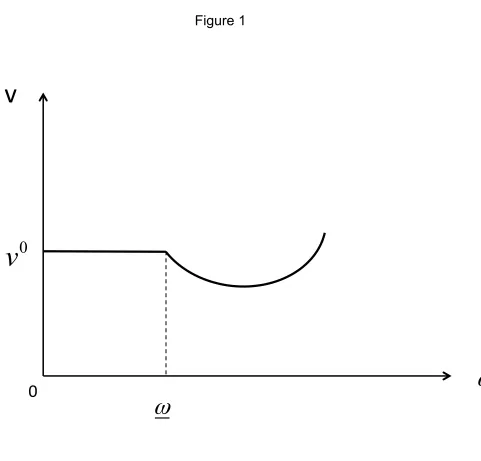
Taken together these results imply that for households with a positive but low level of labour supply the second effect dominates the first and well-being will actually fall as the net wage increases. So the relationship between well-being and the net wage rate is as illustrated in Figure 1. So we have:
Proposition 2 When the status good is income/consumption then the household that has the lowest level of well-being is no longer the household with the lowest (net) wage. The worst-off household will have a high enough wage to make it worth working, but will be supplying a relatively small amount of labour.
2.4 Multiple Status Goods
Suppose now that both goods are status goods. A simple observation is that, with a fixed budget constraint, it cannot be the case that households over-consume both goods. While this set-up may seem implausible in the a-temporal framework employed here, it has greater resonance in the inter-temporal setting employed by Arrow and Dasgupta (2009) where there is an inter-temporal budget constraint that ties together behaviour in different periods. So the question is what can be said about which, if any, of the two goods is over-consumed.
14
The felicity of household h is now given by:
(
)
1 21 2 1 2 1 2
1 2
,
,
,
,
,
,
h h h h h h h h
c
c
u c
c
r
r
u c
c
c
c
=
. (13)
Maximising this with respect to the budget constraint (3) gives first-order conditions:
(
1 2 1 2)
(
1 2 1 2)
1
,
,
,
,
,
,
,
1, 2
k k
h h h h h h h h h
c r k
k
u
c c r r
u
c c r r
p
k
c
µ
+
=
=
(14)Given that households are identical, in the non-cooperative Nash equilibrium it must be the
case that for all h
c
kh=
c
k⇒
r
kh≡
1,
k
=
1, 2;
µ
h=
µ
. Once again there is a unique marketequilibrium
c
kM,
k
=
1, 2
characterised by:(
1 2)
(
1 2)
1
,
,1,1
,
,1,1
1, 2
k k
M M M M
c M r k
k
u
c
c
u
c
c
p
k
c
µ
+
=
=
(15)and the budget constraint (8).
In the social optimum the social planner will once again want to enforce the condition that for
all h
c
kh=
c
k⇒
r
kh≡
1,
k
=
1, 2
. The social planner's problem is therefore to choose thecommon level of consumption of each of the two goods
c
k,
k
=
1, 2
in order to maximise(
1,
2,1,1
)
u c
c
, subject to the budget constraintp c
1 1+
p c
2 2=
1
. Let the super-script "S" denote "social optimum". The social optimum allocation(
c
1S,
c
2S)
is the unique solution of equations(
1,
2,1,1
)
,
1, 2
kS S
c k
u
c c
=
ρ
p
k
=
(16)and the budget constraint (11).
Comparing (15) and (16) it is clear that whether or not a commodity is over-consumed is going to depend on the relative marginal utility it confers as a status good compared to the
marginal utility from the direct enjoyment it confers. Specifically if we define
α
k,
k
=
1, 2
by(
1 2)
(
1 2)
1
,
,1,1
,
,1,1 ,
1, 2
k k
M M M M
r k c
M k
u
c
c
u
c
c
k
c
=
α
=
, then (15) can be re-written as(
1,
2,1,1
)
1, 2
1
k
M M k
c
k
p
u
c
c
µ
k
α
=
=
+
(17)And if we compare this with (16) then we have:
Proposition 3 If
1 2
α
=
α
then the market equilibrium coincides with the social optimum. If(
)
1 2
resp.
1 2α
>
α
α
<
α
then, in the market equilibrium there is an over- (resp. under-)Example: Consider the Cobb-Douglas case15 where:
(
)
(1 ) (1 )1
, ,
2 1 1 2 1 2, 0
1; 0
1;
0,
0;
1
u c c
r
=
c
αθc
−α θr
βϕr
−β ϕ<
α
<
<
β
<
θ
>
ϕ
>
θ ϕ
+
<
.Standard properties of Cobb-Douglas utility functions imply: 1 1
1 1
;
M Sc
c
p
p
αθ βϕ
θ ϕ
α
+
+
=
=
. Itis easy to see that
αθ
βϕ
α
β
α
, and so
c
1Mc
1Sβ
α
θ ϕ
+
>
⇔
>
>
⇔
>
+
.2.5 Environmental Externalities
Now suppose that there is environmental harm
D
k( )
c
k,
k
=
1, 2
caused by theaggregate/average consumption of good k, where these damage functions are strictly increasing and convex.
Given our assumption that, in making their consumption decisions, households treat the average level of consumption as given, it follows that individuals will ignore these environmental externalities and so the market equilibrium will be characterised by (15) and the budget constraint (8).
However the social planner will see the connection between the consumption of every household and average consumption and so will choose the common level of consumption
of each of the two goods
c
k,
k
=
1, 2
in order to maximise(
)
( )
2
1 2
1
,
,1,1
k kk
u c
c
D
c
=−
∑
,subject to the budget constraint
1 1 2 2
1
p c
+
p c
=
. The social optimum allocation(
c
1S,
c
2S)
is the unique solution of equations(
1,
2,1,1
)
( )
,
1, 2
k
S S S
c k k k
u
c c
−
D
′
c
=
ρ
p
k
=
(18)and the budget constraint (11).
If, by analogy with the analysis in the previous sub-section we now define
α
k,
k
=
1, 2
by(
1 2)
( )
(
1 2)
1
,
,1,1
,
,1,1 ,
1, 2
k k
M M M M M
r k k k c
M k
u
c
c
D
c
u
c
c
k
c
−
′
=
α
=
, then we have:Proposition 4 If
1 2
α
=
α
then the market equilibrium coincides with the social optimum. If(
)
1 2
resp.
1 2α
>
α
α
<
α
then, in the market equilibrium there is an over- (resp. under-)consumption of good 1 relative to the social optimum.
15
So it is conceivable that even though there are both consumption and environmental externalities the market outcome is the same as the social optimum and there is no need for any corrective taxes. No doubt this is empirically unbelievable. We draw attention to this knife-edge case only because it says the market bias in competitive consumption is not self-evident.
Finally, return to another extreme case - that of a single status good - where the bias is easily obtained. Here we imagine that good 2 is inconspicuous and is pollution-free, whereas good 1 suffers from competitive consumption and has adverse environmental consequences. That competitive consumption may well also be resource intensive (conspicuous consumption in automobiles and air travel) should not surprise. The gap between the market price and social worth of environmental resources has meant that technological innovations are biased against nature. Entrepreneurs, understandably, seek innovations that economize on expensive factors of production, not those that are cheap. It should be no surprise, then, that modern technology is rapacious in its use of nature's services.
Clearly there will be over-consumption of good 1, and a consumption tax on good 1, based on both consumption and environmental externalities, is the obvious public policy. The analysis however suggests an intriguing possibility for nudging social norms. Imagine households were able to coordinate their socially competitive urge on good 2 (the environmentally friendly commodity). In that case culturally defined competition for good 2 could in some sense dilute environmental pollution on good 1 and lead towards a socially optimal allocation.
3. Consumption Norms
In the previous section consumption decisions of individuals were influenced by those of others in a competitive manner as individuals sought to match their consumption to that of an aspirational group (and differentiate it from that of a distinction group). Such forms of externality can sustain overconsumption and a market distortion that needs to be corrected by a policy such as a tax on goods prone to conspicuous consumption. In this section we consider a different route by which individuals’ consumption decisions may be influenced by those of others, namely through a desire to be seen to belong to a group of similar-minded individuals, thereby establishing consumption norms16. A key difference between this section and the last is that the proclivity to conform to a consumption norm can lead some individuals to reduce their consumption of a good relative to what they would have consumed in the standard economists’ model where consumers take no account of the consumption of others.
There are a number of potential direct benefits that consumers might derive from adhering to a consumption norm (see for example Hargreaves-Heap (2013), Hargreaves-Heap and Zizzo (2009)). These include: (a) observing members of a norm group consuming a product an individual has not experienced can give implicit information about the quality of that
16
product; (b) in a related manner, giving people information about what similar people achieve in saving energy, or retirement savings can significantly increase levels of savings (Allcott (2011))17; (c) by developing trust between members of a norm group it can reduce transactions costs18; (d) for a number of consumption activities, such as reading a book or attending a concert, the benefits are not just the private experience but the subsequent opportunity to share thoughts about such experiences (the ‘water cooler’ effect) and this requires individuals to have overlapping sets of cultural interests; (e) for activities like provision of public goods, voting, or charitable giving evidence suggests that individuals are more willing to contribute if they know members of their norm group have contributed (Frey and Meier (2004), Tan and Bolle (2007), Gerber and Rogers (2009), Bucholz, Falkinger and Rubbelke (2012)).
Over and above such direct benefits, however, Akerlof and Kranton (2000) have argued that an ability to identify with a group of people is a key part of self-identity and yields an important psychological benefit of belonging to a group, what Adam Smith referred to as the ‘special pleasure of mutual sympathy’19. In the model of Ulph and Ulph (2014), which we summarise in this section, it is this pure psychological benefit of belonging to a group that we have in mind.
Much of the literature on consumption norms does not provide a formal model of how consumption norms might emerge. The paper that is closest to the model reported here is the study by Bernheim (1994) of conformity. In his model people differ in terms of their types (measured by a single index distributed over some interval). Society has a pre-specified notion of an ideal type and people suffer a loss of self-esteem the further their type is from the ideal. Individual’s well-being depends on the utility they get from their actions, and the esteem in which they are held by others. If an individual’s type was public information, all an individual could do is to act to maximise utility. But an individual’s type is private information, and has to be inferred from one’s actions, so individuals have an incentive to bias their actions towards that which an ideal person would perform; this leads some individuals to do more than they would do to maximise utility and others to do less. There are two possible equilibria: a fully-revealing equilibrium and a pooling equilibrium in which a group of individuals whose types are closer to the ideal type carry out the same level of action – so the equilibrium specifies a common action norm and the group of people who adhere to this common norm.
In Ulph and Ulph (2014) we focus directly on consumption behaviour and consumption norms, and we examine how behaviour influenced by such norms relates to traditional analysis of consumer demand captured by Marshallian demand curves. Like Bernheim we want to explain endogenously how consumption norms change individual consumer
17
See Bennett et al (2009) for a comprehensive analysis of the clustering of consumption activities based on overlapping cultural interests in the UK.
18
This is linked to notions of social capital. It is important to distinguish between group membership developing greater trust between insiders – a positive social benefit – and developing a greater distrust of outsiders – a reduction in social benefit (see Putnam (2000) and Dasgupta (2000) for a recognition that social capital may have negative as well as positive effects) . Hargreaves‐Heap and Zizzo (2009) construct a measure to test this distinction, and in their experiments they find it is the negative effect which predominates.
19
Hargreaves‐Heap and Zizzo (2009) also develop a test to measure this psychological benefit of belonging to a group; they find that it balances out the negative effect of group membership noted in the previous
behaviour, which consumption norms can emerge as equilibrium norms, and how many norms there might be. All behaviour is assumed to be individual – there is no process for communication or coordination.
Unlike Bernheim all information is public. In particular, to rule out other channels of interactions, we assume consumers are perfectly informed about the quality of the commodities being consumed and consumption is a private good. The crucial difference is that there is no concept of an ideal type of consumption, and the motivation to belong to a group is the pure psychological benefit discussed above. We also develop the welfare analysis of the model and use it to draw policy conclusions, including environmental policy.
In this section we set out a special case of the more general model in Ulph and Ulph (2014).
3.1 A Model of Consumption Norms
There are 2 goods: good 1 which is the potential norm good20 and good 2 which is expenditure on all other consumption. For good 1 the unit cost of production is γ and each unit generates pollution with damage cost δ; we assume that in the absence of any policy the market for good is competitive and so market price p will equal unit cost of production, γ.
For good 2 the unit cost of production is 1, it generates no pollution and its market price is 1.
Individuals can choose whether or not to adhere to a norm. If an individual chooses not to adhere to a norm, a typical consumer with income M has utility function:
U(c, M – pc) = Ac-0.5c2 +M-pc (19)
with corresponding Marshallian demand: c0(p,A) = A – p. In this model income M plays no role in behaviour so there is no loss of generality in assuming it is the same for all consumers.
If instead the consumer has chosen to adhere to some consumption norm c* then the utility of the typical consumer is now:
2
( ,
, , )
0.5
*
U c M
−
pc
α ϕ
=
Ac
−
c
+
M
−
pc
−
α
c c
−
+
ϕ
(20)where α measure the individual’s strength of adherence to the norm21, or the utility cost per unit of consumption that differs from the norm, and φ measures the strength of the desire for conformity - the pure psychological benefit the individual experiences from adhering to a norm, as discussed above. We emphasise that the norm c* is not chosen by any individual or group of individuals – it has emerged from past custom and practice.
For the special case we shall assume there are just two types of consumers; a fraction θ
have low demand for good 1, so A takes the value
0
L
A
>
γ
>
while the remaining fraction (1
20
We need to interpret the concept of a good acting as consumption norm broadly, to encompass not just the characteristics of the good but also the practices in which the good is deployed; so hosting a dinner party involves more than just the food and wine served but how it is served, the conversation that takes place etc.
21
– θ) of consumers have high demand where A takes the value AH > AL; the average value of
A is
A
=
θ
A
L+
(1
−
θ
)
A
H.There is a four-stage game. In stage 1 the government sets policy. In stage 2 the consumer decides whether to adhere to the prevailing norm or go it alone and choose the Marshallian demand. In stage 3 we determine which norms could serve as equilibrium norms. Finally in stage 4 the consumer chooses what to consume. We work backwards.
3.1.1 Stage 4
The solution to maximising (2) can be expressed as follows: there is a norm-consistent
interval of consumption
[
c
α( , , ),
p A
c
α( , )]
p A
where:0
0
( , )
( , )
( , )
( , )
c
p A
c
p A
c
p A
c
p A
α
α
α
α
=
−
=
+
(21)
such that the consumption choice of the individual is
( , , *)
*
( , )
*
( , )
( , , *)
( , )
*
( , )
( , , *)
( , )
*
( , )
c
p A c
c
c
p A
c
c
p A
c
p A c
c
p A
c
c
p A
c
p A c
c
p A
c
c
p A
α α α
α α α
α α α
=
⇔
≤
≤
=
⇔
<
=
⇔
>
(22)
(21) shows that the norm-consistent interval is a symmetric interval around the Marshallian demand whose width, 2α, depends on the strength of adherence to a norm. (22) shows that if the norm lies within the norm-consistent interval then the consumer adheres to the norm; if the norm lies below the norm-consistent interval the consumer adheres to the lower bound of the interval, and conversely if the norm lies above the norm-consistent interval. The intuition is that the consumer is willing to adjust consumption away from the Marshallian level as long as the marginal loss of utility from deviating from the utility maximising level is lower than the marginal loss of utility from deviating from the norm; thereafter the consumer sticks at the bound of the interval.
3.1.2 Stage 3
In stage 3 we consider what could be equilibrium norms in our simple example of two groups of consumers. Consistent with the idea that norms just emerge from individual decisions and have no normative content, we use a very weak notion of equilibrium. So a norm is an equilibrium if it is the average consumption of all those who choose to adhere to it. We consider first the case where there is a single norm.
(i) Single Norm: There are two sub- cases.
A:
α
≤
0.5(
A
H−
A
L)
⇒
c
α( ,
p A
L)
<
c
α( ,
p A
H)
⇒
c
*
=
θ
c
α( ,
p A
L) (1
+
−
θ
)
c
α( ,
p A
H)
(23a)B:
α
>
0.5(
A
H−
A
L)
⇒
c
α( ,
p A
L)
>
c
α( ,
p A
H)
⇒
c
* [
∈
c
α( ,
p A
H),
c
α( ,
p A
L)]
(23b)the low-demand group and the lower-bound of the norm-consistent interval of the high-demand group, where the weights are the proportions of the two groups in the total population. In Case B the norm-consistent intervals of the two groups do overlap, in which case any norm that lies in that interval is an equilibrium norm. Note that there are two
possibilities: if
0.5(
A
H−
A
L)
<
α
<
(
A
H−
A
L)
then the interval[
c
α( ,
p A
H),
c
α( ,
p A
L)]
is relatively narrow, and does not contain the Marshallian demands of either group; if(
A
HA
L)
α
≥
−
then the interval[
c
α( ,
p A
H),
c
α( ,
p A
L)]
will contain the Marshallian demands of both groups.(ii) Two Norms: Again we consider the two sub-cases set out above.
In Case A the low demand group could adhere to any norm below the upper bound of its norm-consistent interval, with the opposite for the high demand group. In Case B the same is true as for Case A except that the norms cannot lie in the overlap area.
3.1.3 Stage 2.
Turning to stage 2, note that adhering to a norm reduces consumers’ direct utility from consumption relative to just following their utility-maximising Marshallian demands. We now take account of the utility benefit of belonging to a group, φ, and as long as this exceeds the difference in utility between what consumers derive from adhering to the norm and what they would have got by going it alone and resorting to their Marshallian demands.
3.1.4 Stage 1
The above analysis explains why consumers may choose to adhere to consumption norms. We now turn to policy analysis. The government is concerned to maximise welfare defined by:
2
2
( ,
*)
[
0.5
*
]
(1
)[
0.5
*
]
[
(1
)
]
L H L L L L
H H H H L H
W c
c
c
A
c
c
c
c
A
c
c
c
c
c
c
θ
γ
α
ϕ
θ
γ
α
ϕ
δ θ
θ
=
−
−
−
−
+
+
−
−
−
−
−
+
−
+
−
(24)
There are essentially two ‘distortions’ in this model – the environmental externality and the fact that consumers are not consuming their Marshallian demands, though they are deriving benefits from adhering to a norm.
We begin by ignoring the environmental externality. Note from (23a) that in Case A, the equilibrium norm is sensitive to price, so it is possible to shift the norm closer to the level of demand that would arise under Marshallian demand, which will raise welfare while preserving the benefits of adhering to the norm. Now we know that low demand consumers are consuming more than their Marshallian demand by an amount α while high demand consumers are underconsuming by a similar amount. So it is straightforward to show that if the government imposes a tax
ˆ
(2
1)
τ
=
α θ
−
(25)the optimal policy is a subsidy to boost demand; finally if θ = 0.5 the two effects cancel out and there is nothing the government needs to do.
In Case B, it is clear from (23b) that the norm is not sensitive to modest changes in price. In this case, absent any environmental considerations, the best the government can do to align individual decisions with the optimum is to ensure that the Marshallian demand lies in the overlap of the norm-consistent intervals of norms. This can be achieved by any tax/subsidy in the interval:
(
a
Ha
L)
ˆ
(1
)
(
a
Ha
L)
θ
−
−
α τ
≤ ≤
α
−
−
θ
−
(26)In a wide range of circumstances this could be consistent with a zero tax.
Whether implementing such a tax/subsidy policy will achieve the optimum is problematic, for large changes in price (through either a tax or a subsidy) could shift the interval
[
c
α( ,
p A
H),
c
α( ,
p A
L)]
sufficiently that the equilibrium norm c* no longer lies in this interval.In that case c* would no longer be an equilibrium norm and consumers would revert to their Marshallian demands.
Now consider environmental policy. The standard prescription from environmental
economics would be to impose a Pigovian tax
t
ˆ
=
δ
. In Case A the optimal policy will be to impose the Pigovian tax in addition to the tax/subsidy derived from (25). So the overall policywill be to impose a tax
τ
ˆ
+ =
t
ˆ
α θ
(2
−
1)
+
δ
, which could be negative.In Case B again if δ is relatively small the Pigovian tax will have no effect on consumption or pollution, while if it is large it could shift down the interval of consumption so that it no longer contains the norm, and consumers revert to their Marshallian demands. Of course these Marshallian demands with the Pigovian tax will be lower than they would be without the tax.
Moreover, if
0.5(
A
H−
A
L)
<
α
<
(
A
H−
A
L)
low demand consumers will revert to Marshallian demands which are for sure lower than the lower bound of the interval[
c
α( ,
p A
H),
c
α( ,
p A
L)]
and hence lower than the norm. On the other hand high demandconsumers will revert to their Marshallian demands which are for sure higher than the upper
bound of the interval
[
c
α( ,
p A
H),
c
α( ,
p A
L)]
and hence higher than the norm22. Could thelatter effect outweigh the first two effects? The following example shows that there are parameter values for which this could be the case.
3. 2 Example
Suppose AL =30, AH = 40, α =6, θ = .1, γ =10, and environmental damage cost per unit of consumption is δ = 3. There is a fixed benefit of adhering to a norm, φ, of 15.
The standard environmental economics story if consumers had no norms would be as follows:
22
(i) Prior to policy intervention P0 = 10, Marshallian consumption of the two groups is: cL = 20, cH =30, total consumption c=0.1*CL+0.9*CH =29, consumer benefits are BL =200, BH = 450 so aggregate consumer benefits are B = 0.1*BL+ 0.9*BH = 425. Damage costs are 87, so net welfare is: 425-87=338.
(ii) After policy intervention the new price is P1 = γ + δ = 13, so consumption of the
two groups is cL =17, cH = 27, total consumption is c=0.1*cL+0.9*cH =26 consumer benefits are BL = 195.5, BH =445.5 so total consumer benefits are B =
0.1*BL+ 0.9*BH = 420.5. Damage costs are 78, so net welfare is 342.5.
As usual in the conventional story, implementing environmental policy causes total consumption and hence direct consumer benefits to fall; the fall in consumption leads to lower pollution and lower damage costs, which more than offsets the reduction in direct consumer benefits.
Now allow for norms.
(iii) In the pre-policy equilibrium cH =24, cL =26 so the interval in which the
equilibrium norm must lie is [24,26]. Suppose the norm is c* =25, to which both groups adhere. Consumer benefits are: BL = 187.5, BH = 437.5, so total consumer benefits are B = 0.1*BL+ 0.9*BH = 412.5 and damage costs are 75, so net welfare is 412.5 – 75 = 337.5. Total consumer benefits are less than in the Marshallian equilibrium in (i), so if we allow for a fixed benefit of adhering to a norm of 15 then consumer benefits are 427.5, which is higher than consumer benefits of 425 in (i), which justifies consumers adhering to the norm. Welfare including the benefit of adhering to the norm is 427.5-75= 352.5
(iv) After the policy intervention,
C
H=
21,
C
L=
23
so the norm of C* = 25 is nolonger in the norm-consistent interval. So the outcome is as in (ii) above.
So comparing (iii) and (iv) the implementation of conventional environmental policy, by making the previous norm infeasible, has caused total consumption to rise from 25 to 26, and total consumer benefits to rise from 412.5 to 420.5; this is made up of two elements; the increase in consumption and the fact that consumers are moving to their Marshallian demands. The rise in consumption causes pollution and hence environmental damage costs to rise from 75 to 78. Overall, welfare falls from 352.5 to 342.5. This reduction in welfare is made up of three elements: direct consumer benefits have risen by 8, environmental damage costs have worsened by 3, but the benefit of adhering to a norm of 15 has been lost, so there is a net welfare loss of 10.