METHODS
Consequences of grouped data for testing for departure
from circular uniformity
Rosalind K. Humphreys1&Graeme D. Ruxton1
Received: 3 July 2017 / Revised: 4 October 2017 / Accepted: 6 October 2017 #The Author(s) 2017. This article is an open access publication
Abstract Limits to the precision of circular data often cause grouping of data points into discrete categories, but the effects of grouping on tests for circular uniformity have been little explored. The Rayleigh test is often applied to grouped circu-lar data, despite it being designed for continuous data and the statistical literature recommending a suite of alternative tests specifically designed for grouped data. Here, we investigated the performance of the Rayleigh test relative to four alterna-tives for testing the null hypothesis of uniformity in grouped circular data. We employed simulation, grouping data into a discrete number of same-sized categories and with samples drawn from a range of different distributions. We found that grouping had little effect on the type I error rate or the power of the Rayleigh test, and that the power of the Rayleigh test was very similar to that of the previously recommended alter-native tests designed specifically for grouped circular data. It may thus be appropriate to apply the Rayleigh test to grouped data, provided the situation is one in which the test has sub-stantial statistical power.
Keywords Chi-squared test . Kolmogorov-Smirnov test . Ordered categories . Periodic data . Rayleigh test
Introduction
Circular data is characterised by an inherent periodicity absent from measurements made on a linear scale (such as mass or length). Such data is generated by a range of common mea-surements across scientific disciplines. The most obvious sit-uation involves angles, compass bearings or orientations. However, also common are measurements over time where an inherent periodicity is relevant: e.g. time of day, seasonality and point in the lunar cycle. Recent articles in Behavioral Ecology and Sociology(BES) have used circular statistics to explore issues as diverse as daily variation in mammalian activity (Fancourt2016), orientation of sandhoppers with re-spect to the moon as part of their navigation (Ugolini2016), search strategies of desert ants (Schultheiss et al.2016) and the directions with respect to a threat adopted by fleeing deer (Obleser et al. 2016). In the first 6 months of 2017, BES published four papers utilising circular statistics investigating the relative positioning of individuals in an orb-weaving spi-der colony (Yip et al. 2017), navigation in ants (Amador-Vargas and Mueller 2017), avian navigation by the stars (Pakhomov et al.2017) and integration of magnetic and visual navigational cues in shorebirds (Vanni et al.2017).
Circular data needs special treatment in data analysis, and a range of texts has been dedicated to describing this: e.g. Batschelet 1981; Fisher 1995; Mardia and Jupp 2000; Jammalamadaka and SenGupta 2001; Pewsey et al. 2013; Ley and Verdebout2017. The most common statistical explo-ration of circular data involves testing to see if there is a bias in the distribution around the circle or whether the null hypoth-esis that the underlying population involves a uniform spread around the circle is supported. For example, one might test whether the compass directions of the initial flights of released homing pigeons are random or show a bias. In this situation, one might expect that a bias would exist towards the direction Communicated by L. Z. Garamszegi
Electronic supplementary materialThe online version of this article (https://doi.org/10.1007/s00265-017-2393-2) contains supplementary material, which is available to authorized users.
* Rosalind K. Humphreys [email protected]
1 School of Biology, University of St Andrews, Dyer’s Brae House, St
of the home lofts of the pigeons. However, a lowpvalue in a Rayleigh test would only provide support for rejection of the null hypothesis of a lack of bias leading to a uniform spread of directions around the circle. Exploration of the nature of any suggested bias might be performed by visual inspection and/or calculation of (for example) the mean direction. Provided the number of groups is at least eight, texts such as Jammalamadaka and SenGupta (2001) and Pewsey et al. (2013) recommend that summary statistics (and confidence intervals) be calculated making the assumption that each data point in a group takes the value of the midpoint of the relevant segment of the circle (see Pewsey et al.2013for details). For very course grouping into fewer than eight segments, Pewsey et al. (2013) present an alternate approach by Mardia (1972). Just like linear measurements, circular measurements can be continuous or discrete. We surveyed recent papers in the top 20 ecological journals (based on citation rates) by searching for papers including the term ‘circular’ or ‘Rayleigh test’and investigating what type of data the test was used on and how precisely the data measurements were taken in the most recent 60 relevant papers. We found that discrete data is commonplace, generally with the circular data being divided intokequally spaced ordered categories, with values ofk= 4 (e.g. N, E, S or W), 8 (e.g. N, NE,…NW) or 12 (e.g. Jan, Feb,…Dec). Orientation or heading angles—of up to 360°—are sometimes split into eight sectors of 45° (Chittka et al.1999; Davoren et al.2003). Where orientation is relative to a structure or location, an angle of 180° may indicate an individual facing in the opposite direction, and orientation can be estimated to the nearest category, such as 12 sections of 15° (McLaughlin2001). Twelve categories are also a common grouping for months of the year (Proença et al.
2012; Hirsch et al. 2016), but directional preferences and headings are commonly grouped by a greater number of equally spaced categories (Wiltschko et al. 2003, 2006,
2009; Kullberg et al.2007; Winklhofer et al.2013; Wystrach et al.2015). There is no reason to expect that grouping in circular data would not also be commonplace in other fields. In recent BES papers, we found that it was not always possible to identify precision of measurements from the provided in-formation, but we found examples of discrete data, with the circle being divided into equal-sized arcs numbering 48 (Fuchikawa et al. 2014), 36 (Obleser et al. 2016) and 8 (Villarreal and Gilbert2014).
Our literature review also found a strong discrepancy be-tween how the statistical literature recommends testing the null hypothesis of circular uniformity and the practice in em-pirical science. We found that in the ecological literature, cir-cular uniformity is almost invariably tested using the Rayleigh test (introduced by Lord Rayleigh in1880, but also defined in the monographs listed above). This is also true of recent BES papers (see references previously given). The Rayleigh test was designed to be applied to continuous data, and its
application to discrete grouped data does not have a theoreti-cal or empiritheoreti-cal basis in the statistitheoreti-cal literature. Instead, cir-cular statistic texts recommend a suite of tests designed spe-cifically for grouped circular data. Tests for unordered catego-ries such as the chi-squared orGtests could be applied but, because these tests essentially leave unused information about the ordering of categories, they are not as powerful as purpose-designed tests for circular grouped data (Reijneveld
1990; Steele and Chaseling2006; Watkins and Di Stefano
2013).
The most recent textbooks on circular statistics (Mardia and Jupp2000; Pewsey et al.2013) recommend three alterna-tive tests for deviation from uniformity in grouped circular data: a modified Watson test by Choulakian et al. (1994), another modification of this test by Brown (1994) and a mod-ification of the Kolmogorov-Smirnov test by Freedman (1979). Fisher (1995) recommends the first and the last of these tests. None of these texts offers advice on selecting one of these alternatives over another. The earlier text of Batschelet (1981) recommends the chi-squared test or the Rayleigh test only after a correction factor for grouping has been applied. Here, we explore the performance of the un-modified Rayleigh test in comparison to these four alterna-tives for testing the null hypothesis of uniformity in grouped circular data. BES authors regularly generate circular data, often in discrete rather than continuous form, and the Rayleigh test is the most commonly used statistical treatment of that data. Thus, this work should significantly enhance the statistical treatment of such data in the future and allow readers to draw more reliable inferences from previously pub-lished papers.
Methods
provided by the packagecircular(Agostinelli and Lund2013) in R (R Core Team2016). When data were grouped intok equal-length categories, each data point was rounded down to the nearest value in the list: 0, 2π/k,…(k−1) × 2π/k.
Power and type I error rates of the unmodified Rayleigh test were evaluated over 100,000 stochastic simulations. Only the unmodified Rayleigh test was available in an R package, and therayleigh.testfunction in the packagecircularwas used for this. For all other tests, thepvalue was evaluated by sim-ulation, as the fraction of 1000 samples drawn from a uniform distribution which produced a test statistic at least as great as the observed one. Test statistics for the various tests were defined as follows: Throughout, we assumekequal-sized or-dered categories, indexed byj= 1,…k, with observed values Ojand expected values under the null hypothesis of uniformi-tyEj.The total sample size is defined asn, so that eachEjisn/ k, and
∑k
j¼1Oj¼n ð1Þ
For the modified Watson test introduced by Choulakian et al. (1994), we first define
Sj¼∑ij¼1ðOi−EiÞ: ð2Þ
Then, the test statistic is given by
U2G¼ 1 nk∑
k j¼1 Sj−
1 k∑
k i¼1Si
2
: ð3Þ
For the alternative version proposed by Brown (1994), we first definepj=Ej/n,Yj= 0.5(Oj−Ej) whenj= 1; otherwise,
Yj¼∑ij¼¼11ðOi−EiÞ þ0:5 Oj−Ej
: ð4Þ
Then, the test statistic is given by
U2d¼1 n ∑
k
j¼1pjY2j− ∑ k
j¼1pjYj
2
þ16∑k j¼1p
2
j 1−0:5pj
þ121n∑k
j¼1pj Oj−Ej
2
:
ð5Þ
The method of Freedman (1979) first involves defining
Fj¼∑ij¼1 Ei
n F
n
j¼∑
j i¼1
oi
n: ð6Þ
Then, the test statistic is found from the maximum and minimum values of the differences between these two series, specifically
VN ¼max FN−F
þmin FN−F ð7Þ
For continuous data, the test statistic for the Rayleigh test is the mean vector lengthr. Forn measurements M1,
…Mnrecorded as radians on in the interval [0, 2π], this is defined as
r¼1
n ∑
n
i¼1sin Mð Þi
2þ ∑n
i¼1cos Mð Þi
2
: ð8Þ
If, as in our case, data has been grouped to take one ofk discrete values, then, Batschelet (1981) recommends multi-plying the test statisticrin the Rayleigh test by a correction factorc:
c¼ π k sin π
k
: ð9Þ
Results
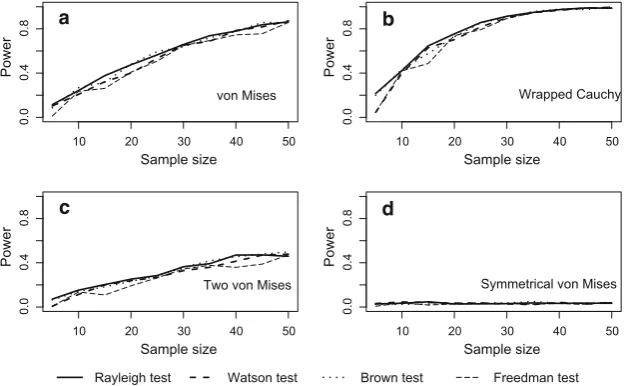
The Rayleigh test appears to maintain type I error rate at close to the nominal 5% level regardless of how strongly grouped the data are (Fig.1a). Similarly, although grouping the data leads to a reduction in power, this effect is relatively slight (Fig. 1b). Turning to comparison with the three non-parametric tests designed for grouped data, Fig.2shows that there is relatively little difference in power between all four tests, for a broad range of sample sizes and for different types of underlying distribution. All four tests show a good ability to detect unimodal departures from uniformity; their power is reduced for potentially bimodal distributions and is very low indeed if the departure involves two symmetrical distributions at opposite points on the circle. Figure 2 uses extremely grouped data, organised into only 4 categories, but changing to 12 categories makes very little difference (see Fig.3). In supplementary Figs.S1andS2, we present analogous results for two further shapes of underlying distribution: a symmetric Jones-Pewsey distribution with parameters chosen to give a smooth broad distribution and an additional skewed version of the symmetric Jones-Pewsey distribution (the sine-skewed Jones-Pewsey). Using the correction suggested by Batschelet (1981) does not seem to offer any significant improvement to the power of the Rayleigh test, even in the extreme case of grouping data into four categories (see Fig.4). In Fig.S3, we again demonstrate essentially similar observations for two ad-ditional distributions.
Examples
quarters are 0.17 for the Rayleigh test, 0.06 for Watson’s test, 0.24 for Brown’s test, 0.06 for Freedman’s test and 0.16 for the corrected Rayleigh test. Thus, although there is consider-able variation in thep values, all tests give no grounds for rejecting the null hypothesis of uniform frequency of marriage across the four quarters, using the criterion ofα= 0.05.
Bell (1983) recorded the distribution of house martin (Delichon urbica) nests in relation to the compass aspect of the wall of the dwelling they were attached to. These were grouped into eight quadrants (N, NE, E, SE, S, SW, W,
NW). The observed counts were N = 36, NE = 53, E = 38, SE = 31, S = 26, SW = 21, W = 13, and NW = 35. From visual inspection, it appears that the birds show a preference for NE and E and against SW and W. Testing the hypothesis of no-preference (uniformity) yielded pvalues of < 0.001 for the Rayleigh test, Watson’s test, Brown’s test, Freedman’s test and for the corrected Rayleigh test. Using the criterion of
α= 0.05, all tests suggest rejection of the null hypothesis of uniform frequency of nest distribution across the eight quad-rants of compass aspect. Full code for this example is given in thesupplementary material.
Discussion
Future developments and broader implications
We can envisage some useful extensions to the results present-ed here. We have only explorpresent-ed a limitpresent-ed number of different underlying circular distributions here. The Rayleigh test is the most powerful invariant test for continuous data from a von Mises distribution (e.g. Mardia and Jupp 2000). Whilst no longer guaranteed to be optimal, it is known to offer reason-able performance when applied to many other unimodal dis-tributions (Bogdan et al.2002and references therein), a con-clusion further supported in our simulations. Further, our mixed distribution covered both asymmetric and bimodal dis-tributions. In these situations, the power of the Rayleigh test was reduced compared to symmetric unimodal distributions, but this performance still compared well to alternative tests. Finally, we explored the situation of symmetrical distributions where for continuous data, the Rayleigh test is known to per-form poorly (Bogdan et al.2002). Here, all the tests we con-sidered had similarly very low power. Despite this broad array
10 20 30 40 50
0.0
0.4
0.8
Sample size
Power
a
von Mises
10 20 30 40 50
0.0
0.4
0.8
Sample size
Power
b
Wrapped Cauchy
10 20 30 40 50
0.0
0
.4
0.8
Sample size
Power
c
Two von Mises
10 20 30 40 50
0.0
0.4
0.8
Sample size
Power
d
Symmetrical von Mises
Rayleigh test Watson test Brown test Freedman test Fig. 2 The statistical power of
the four tests defined in the BMethods^section for detecting departures from uniformity in circular data grouped into four categories for sample sizes 5, 10, …50 drawn from four different types of distribution described in full in theBMethods^section. Estimates were based on 1000 replicate samples
10 20 30 40 50
0.00
0.02
0.04
0.06
0.08
0.10
Sample size
T
ype I error rate
a
10 20 30 40 50
0.0
0
.2
0.4
0.6
0.8
1.0
Sample size
Po
we
r
b
4 categories 8 categories 12 categories 360 categories
[image:4.595.53.289.51.246.2] [image:4.595.233.548.509.702.2]of underlying distributions, it is possible to imagine alterna-tives that we have not considered. The most obvious addition-al distribution to consider is the sinusoid, but a range of other circular distributions is available (see Pewsey et al.2013for an overview). Even for the distributions used here, different parameter values could be explored. Lastly, we have only considered equal-sized categories, but there are circumstances (e.g. months of the year) where researchers may be interested in unequal-sized categories. We see no reason to expect that these situations will generate significantly different patterns from those seen here, but such explorations would still be valuable. Pending such investigations, we consider that our work here is a considerable step towards offering hitherto
missing empirical support for the widespread use of the Rayleigh test to grouped circular data. Ley and Verdebout (2017) provide the most up-to-date summary of recent re-search on this test when applied to ungrouped data.
Another logical extension to the investigations here would be extension to another commonly explored situation in cir-cular statistics—investigating the support for two or more samples which have been drawn from the same underlying distribution. For example, researchers might want to test whether there are any differences in seasonal variation of whale strandings on the eastern and western Atlantic coast-lines. If the data here is grouped (e.g. into 12 months), then, Pewsey et al. (2013) recommend comparing via a chi-squared
10 20 30 40 50
0.0
0.4
0.8
Sample size
Po
w
e
r
a
von Mises
10 20 30 40 50
0.0
0.4
0.8
Sample size
Po
w
e
r b
Wrapped Cauchy
10 20 30 40 50
0.0
0.4
0.8
Sample size
Po
w
e
r
c
Two von Mises
10 20 30 40 50
0.0
0.4
0.8
Sample size
Po
w
e
r d
Symmetrical von Mises
Rayleigh test Watson test Brown test Freedman test Fig. 3 The statistical power of
the four tests defined in the BMethods^section for detecting departures from uniformity in circular data grouped into 12 categories for sample sizes 5, 10, …50 drawn from four different types of distribution described in full in theBMethods^section. Estimates were based on 1000 replicate samples
10 20 30 40 50
0.0
0.2
0.4
0.6
0.8
1.0
Sample size
Po
w
e
r
Rayleigh von Mises Corrected von Mises
Rayleigh wrapped Cauchy Corrected wrapped Cauchy
Rayleigh two von Mises Corrected two von Mises Fig. 4 The statistical power of
[image:5.595.232.546.50.236.2] [image:5.595.235.526.481.681.2]approach to a contingency table. However, since this test takes no account of the ordering of months, it may be fruitful to explore if more powerful alternatives for the use of grouped data in this context can be developed.
Advice to researchers stemming from our study
Here, we found that grouping data into a discrete number of same-sized categories had little effect on either the type I error rate or the power of the Rayleigh test, even for as few as four categories. Further, the power of the Rayleigh test was very similar to that of recommended goodness-of-fit tests designed especially for grouped circular data. On this basis, the appli-cation of the Rayleigh test to grouped data might sometimes be appropriate. However, our exploration of grouped data echoes the well-known observation of continuous data that the Rayleigh test can have reduced power when the underly-ing distribution has multiple peaks. Further, if these peaks are regularly spaced around the circle, then, this reduction in pow-er can be vpow-ery substantial. Similar loss of powpow-er can be seen for the alternative tests for grouped data. Thus, researchers should visually inspect their data before interpreting the out-come of any formal test of the null hypothesis of uniformity. Such inspection could inform both the situation where the null is rejected and the situation where it is not rejected. In the latter case, failure to reject may be related to the issue of low power against some distributions just discussed. As our simulations demonstrate, grouping data leads to a reduction in power, so there are certainly no circumstances where the Rayleigh test can be recommended for grouped data when it would not be recommended for analogous ungrouped data. There are cir-cumstances where the Rayleigh test (and all the tests consid-ered here) has very low power. If researchers have reason to suspect that they are in such a situation, then, they should not apply any of these tests or at the very least treat the results with caution (see Button et al.2013for a general discussion of the problems associated with low power).
We have not seen a previous exploration of the grouping correction for the Rayleigh test recommended by Batschelet (1981), although he states (p. 38) that it has minimal effect for k> 12. In fact, we find that it has very little effect on the power of the Rayleigh test, even ifk= 4, so we do not recommend the use of this correction factor when applying the Rayleigh test. Our suggestion that the Rayleigh test could sometimes ap-propriately be applied to grouped data is based on its empirical performance in our simulations, ease of use and familiarity; it does not have a theoretical justification. For those researchers who would rather use a method for which there is theoretical justification (rather than just the simulation support provided here), we can offer comparison between three commonly rec-ommended methods based on the existing literature and our investigations. There has been relatively little previous comparison of tests for patterns in grouped circular data.
Reijneveld (1990) found that the test of Freedman (1979) gave better or equivalent power to detect sinusoidal deviations from uniformity, compared to a number of tests specifically de-signed to detect such deviations, and warned that these other tests are unreliable if there is a deviation from uniformity, but it is not sinusoidal. Similar conclusions had been reached pre-viously by Marrero (1983). Here, we found very strong sim-ilarity between the three methods tested. None of these methods is currently implemented in software packages that we know of; however, an R code for each of them is provided in the context of the house martin nest distribution example outlined above (seesupplementary material). In terms of ease of calculation and speed of implementation, there is little to choose between the three methods. The calculations of Brown’s test are more involved than those of Watson’s but offer no clear performance benefit in our simulations. Freedman’s test offers conceptual similarity to the Kolmogorov-Smirnov test, the modified Watson’s test and the range of other tests commonly used in circular statistics originally developed by Watson. Pending further research, selection can be based on which of these similarities resonates most with the individual researcher.
Acknowledgements We thank three anonymous reviewers for thought-ful comments on a previous version.
Compliance with ethical standards
Conflict of interest The authors declare that they have no conflict of interest.
Open AccessThis article is distributed under the terms of the Creative C o m m o n s A t t r i b u t i o n 4 . 0 I n t e r n a t i o n a l L i c e n s e ( h t t p : / / creativecommons.org/licenses/by/4.0/), which permits unrestricted use, distribution, and reproduction in any medium, provided you give appropriate credit to the original author(s) and the source, provide a link to the Creative Commons license, and indicate if changes were made.
References
Agostinelli C, Lund U (2013) R package‘circular’: circular statistics (version 0.4–7),https://r-forge.r-project.org/projects/circular/
Amador-Vargas S, Mueller UG (2017) Ability to reorient is weakly cor-related with central-place versus non-central-place foraging in aca-cia ants. Behav Ecol Sociobiol 71:43
Batschelet E (1981) Circular statistics in biology. Academic press, London
Bell C (1983) Factors influencing nest-site selection in house martins. Bird Study 30:233–237
Bogdan M, Bogdan K, Futschik A (2002) A data driven smooth test for circular uniformity. Ann Inst Statist Math 54:29–44
Brown BM (1994) Grouping corrections for circular goodness-of-fit tests. J R Stat Soc B 56:275–283
Chittka L, Williams NM, Rasmussen H, Thomson JD (1999) Navigation without vision: bumblebee orientation in complete darkness. Proc R Soc Lond B 266:45–50
Choulakian V, Lockhart RA, Stephens MA (1994) Cramér-von Mises statistics for discrete distributions. Can J Stat 22:125–137 Core Team R (2016) R: a language and environment for statistical
com-puting. R Foundation for Statistical Computing, Viennahttps:// www.R-project.org/
Davoren GK, Montevecchi WA, Anderson JT (2003) Search strategies of a pursuit-diving marine bird and the persistence of prey patches. Ecol Monogr 73:463–481
Fancourt BA (2016) Avoiding the subject: the implications of avoidance behaviour for detecting predators. Behav Ecol Sociobiol 70:1535– 1546
Fisher NI (1995) Statistical analysis of circular data. Cambridge University Press, Cambridge
Freedman LS (1979) The use of a Kolmogorov-Smirnov type statistic in testing hypotheses about seasonal variation. J Epidemiol Community Health 33:223–228
Fuchikawa T, Okada Y, Miyatake T, Tsuji K (2014) Social dominance modifies behavioral rhythm in a queenless ant. Behav Ecol Sociobiol 68:1843–1850
Hirsch BT, Reynolds JJH, Gehrt SD, Craft ME (2016) Which mecha-nisms drive seasonal rabies outbreaks in raccoons? A test using dynamic social network models. J Appl Ecol 53:804–813 Jammalamadaka SR, SenGupta A (2001) Topics in circular statistics.
World Scientific, Singapore
Kullberg C, Henshaw I, Jakobsson S, Johansson P, Fransson T (2007) Fuelling decisions in migratory birds: geomagnetic cues override the seasonal effect. Proc R Soc Lond B 274:2145–2152
Ley C, Verdebout T (2017) Modern directional statistics. Chapman & Hall/CRC Press, Boca Raton
Mardia KV (1972) Statistics of directional data. Academic Press, London Mardia KV, Jupp PE (2000) Directional statistics, vol 494. Wiley,
Chichester
Marrero O (1983) The performance of several statistical tests for season-ality in monthly data. J Stat Comput Simul 17:275–296
McLaughlin RL (2001) Behavioural diversification in brook charr: adap-tive responses to local conditions. J Anim Ecol 70:325–337 Obleser P, Hart V, Malkemper EP, Begall S, Holál M, Painter MS,
Červený J, Burda H (2016) Compass-controlled escape behavior in roe deer. Behav Ecol Sociobiol 70:1345–1355
Pakhomov A, Anashina A, Chernetsov N (2017) Further evidence of a time-independent stellar compass in a night-migrating songbird. Behav Ecol Sociobiol 71:48
Pewsey A, Neuhäuser M, Ruxton GD (2013) Circular statistics in R. Oxford University Press, Oxford
Proença CEB, Filer DL, Lenza E, Silva JS, Harris SA (2012) Phenological predictability index in BRAHMS: a tool for herbarium-based phenological studies. Ecography 35:289–293 Rayleigh L (1880) On the resultant of a large number of vibrations of the
same pitch and of arbitrary phase. Phil Mag 10:73–78
Reijneveld SA (1990) The choice of a statistic for testing hypotheses regarding seasonality. Am J Phys Anthropol 83:181–184 Schultheiss P, Stannard T, Pereira S, Reynolds AM, Wehner R, Cheng K
(2016) Similarities and differences in path integration and search in two species of desert ants inhabiting a visually rich and a visually barren habitat. Behav Ecol Sociobiol 70:1319–1329
Steele M, Chaseling J (2006) Powers of discrete goodness-of-fit test sta-tistics for a uniform null against a selection of alternative distribu-tions. Commun Stat Simul 35:1067–1075
Ugolini A (2016) The moon orientation of the equatorial sandhopper Talorchestia martensiiWeber. Behav Ecol Sociobiol 70:1699–1706 Vanni L, Baldaccini NE, Giunchi D (2017) Cue-conflict experiments between magnetic and visual cues in dunlinCalidris alpinaand curlew sandpiperCalidris ferruginea. Behav Ecol Sociobiol 71:61 Villarreal SM, Gilbert C (2014) MaleScudderia pistillatakatydids defend
their acoustic duet against eavesdroppers. Behav Ecol Sociobiol 68: 1669–1675
Watkins E, Di Stefano J (2013) Quantifying annual patterns in the fre-quency of mammalian births: do goodness-of-fit tests provide ade-quate inferences? Aust J Zool 60:381–387
Wiltschko W, Munro U, Ford H, Wiltschko R (2003) Magnetic orienta-tion in birds: non-compass responses under monochromatic light of increased intensity. Proc R Soc Lond B 270:2133–2140
Wiltschko W, Munro U, Ford H, Wilschko R (2006) Bird navigation: what type of information does the magnetite-based receptor pro-vide? Proc R Soc Lond B 273:2815–2820
Wiltschko W, Munro U, Ford H, Wiltschko R (2009) Avian orientation: the pulse effect is mediated by the magnetite receptors in the upper beak. Proc R Soc Lond B 276:2227–2232
Winklhofer M, Dylda E, Thalau P, Wiltschko W, Wiltschko R (2013) Avian magnetic compass can be tuned to anomalously low magnetic intensities. Proc R Soc Lond B 280:20130853
Wystrach A, Mangan M, Webb B (2015) Optimal cue integration in ants. Proc R Soc B 282:20151484