Original Article/Research
Application of environmental performance analysis for urban
design with Computational Fluid Dynamics (CFD) and EcoTect
tools: The case of Cao Fei Dian eco-city, China
Ali Cheshmehzangi
a,⇑, Yan Zhu
b, Bo Li
baDepartment of Architecture and Built Environment, The University of Nottingham Ningbo China bDepartment of Architecture and Built Environment, The University of Nottingham, UK
Received 3 September 2015; accepted 31 January 2017
Abstract
This paper suggests a type of quantitative research method with the application of Computational Fluid Dynamics (CFD) and Eco-Tect tools for a sustainable urban design project. This paper is part of a funded research study and was completed in 2010. This study is part of the larger project for planning and development of Cao Fei Dian eco-city development in North-Eastern China; one of the first eco-city development projects in the first batch of pilot eco-cities in China. The research programme addresses the main aspects of good practice in terms of eco-design and sustainability. These aspects include wind flow analysis around buildings, insolation analysis of open spaces, pollutant dispersion in water systems and noise control on urban highways. This study aims to explore a range of research meth-ods in order to enhance the performance of integrated design with a comprehensive planning stage. The integration in evaluation across professions and subject boundaries is emphasised to identify the key gaps between sustainability and design. The main method of this study is the application of CFD and EcoTect tools for environmental performance of a larger urban area than the common use for archi-tectural interventions or immediate outdoor spaces of a project. This study suggests an integrated urban design model with the appli-cation of computational tools (i.e. CFD and EcoTect in here) and how these could inform, from a technical dimension, a more comprehensive approach to executing best practice in design and planning. The paper concludes by suggesting an integrated model of urban design to achieve urban sustainability.
Ó2017 The Gulf Organisation for Research and Development. Production and hosting by Elsevier B.V. All rights reserved.
Keywords: Sustainability; Urban design; CFD; Optimisation; Environmental performance
1. Introduction
In the past few decades, the need to responsibly tackle global warming and exhaustion of fossil fuel has increased the importance of sustainability in the fields of built envi-ronment and architectural design. This field of study has been explored in various ways in both practice and acade-mia. The purpose of this study is also to explore methods
http://dx.doi.org/10.1016/j.ijsbe.2017.01.004
2212-6090/Ó2017 The Gulf Organisation for Research and Development. Production and hosting by Elsevier B.V. All rights reserved. ⇑ Corresponding author.
E-mail address: [email protected] (A. Cheshmehzangi).
Peer review under responsibility of The Gulf Organisation for Research and Development.
H O S T E D BY
Gulf Organisation for Research and Development
International Journal of Sustainable Built Environment
of environmental performance evaluation models and their application into a design thinking model for the sole enhancement of urban sustainability. In this research paper, the intention is to also link research outputs with contemporary urban design practices; one of which is the environmental performance analysis and how it affects the process of design development in practice. In the later sections, this study describes a design-led project which was hugely benefitted from such method of design think-ing; a method that is precisely described as an ‘Integrated Design Approach (IDA)’. This includes a thorough devel-opment of an integrated design proposal, taking into account key aspects of transportation, environmental per-formance, mixed-used development and pollutant disper-sion, which are all interlocked in the whole design process. In order to relate this approach into a design-led method and achieving a sustainable urban model, com-puter prediction models and assessment tools are used to predict, test and evaluate the environmental performance of the proposal. Later on, such techniques can be applied for the purpose of modification and necessary adjustments of the design proposal. This study primarily focuses on two factors of the wind environment analysis (based on CFD simulations) and solar performance (based on EcoTect analysis) in the urban context. These are mainly considered for the optimisation of the proposed built environment and to suggest for design enhancement solutions. The proposed model is derived from the overall concept of urban sustain-ability agenda, in order to be holistic in nature and appli-cable in practice.
Urban sustainability is no longer a new norm in the field of built environment, yet it has a variation of applications in practice. It is seen as a multi-perspective understanding and evaluation of cities, which initially included the ronmental, economic and social aspects of the built envi-ronment. It is also very much dependant on the context in which the new development is proposed for construction and operation. The contextual aspect is precisely impor-tant, as it can play a major role in defining and refining the concept of urban sustainability. This is particularly importance as the fourth pillar of governance may adapt, change or differ from one context to another. The multi-scalar and multi-dimensional nature of urban sustainability provides us with a range of opportunities to undertake var-ious approaches in achieving it in research and practice. Recent studies include various factors and recognition of urban sustainability in practice, some of which include the management perspective (Madu et al., 2017), multi-scalar city analysis (Dor and Kissinger, 2017), associated with sustainability indicators (Dawodu et al., 2017; Pupphachai and Zuidema, 2017) and modelling of the built environment (Cheshmehzangi, 2016). The latter is what we consider for this particular study, as an approach to reali-sation of various available tools and programmes that can be utilised in the built environment practice. In a later sec-tion of this paper, this factor is discussed as part of the
Integrated Design Approach (IDA) or purely the
integrated thinking in design development and modelling of the built environment.
When it comes to the context of urban sustainability (i.e. as an approach in urbanism), architects and urban design-ers have a larger share of responsibility for the world’s con-sumption of fossil fuel, global warming and gas production than any other professional groups (Edwards, 1999). Yet, exploring and optimising buildings alone cannot provide significant impact on developing sustainable urban forms, microclimatic design and efficient urban patterns that are by far more effective than building-level solutions. This reflects on the fact regarding the growing demand and increase usage of urban energy, considering the built envi-ronment as a major CO2producer (i.e. more than 35% of the whole energy consumption globally). Different studies indicator various figures for the total amount of energy consumption by the built environment, but we can cer-tainly argue that the built environment has become a major driver of change for environmental degradation, global warming as well as the increase of CO2 emissions and energy consumption in the past few decades. This factor alone indicates a lack of concern from the sector of the built environment at a larger scale which has resulted in major issues of Urban Heat Island Effect (UHIE) and urban over-densification in many cities around the world. Some of the global scenarios have significant impacts on energy planning from policy and polity dimensions, as well as the increase of urban density and infill development that have altered the discourse of harmonious living in the urban environments. In fact, some of these major issues that are we are currently facing are not necessarily new. For instance, UHIE was discussed and analysed as early as 1818, when Luke Howard introduced the phenomenon that was causing climate change in the City of London, UK. The only major difference is the extent in which we have now urbanised or expanded our city environments, which are now causing severe effects globally. Particularly in the global south, this is now a major concern as the approach or concept of urban sustainability is yet to become a major factor in their development agenda. There-fore, suggestions on urban sustainability models are very effective in the field of research and are important for potential policy development and best practice examples.
in both policy and practice. As a result of these, the importance of urban environment became ever important in achieving sustainable goals and target plans.
It is important to emphasise that urban sustainability does not (and should not) only concern about energy and resource efficiency, but should rather aim to identify how urban spaces could respond to community requirements in a more inclusive and integrated approach. Key studies of urban sustainability through environmental design con-siderations conducted by Thwaites and Porta (2007), and the analysis of sustainable urban forms by de Schiller (2004) suggest methods of environment and climate responsive design that are yet to be addressed in many practice projects. As a result, this paper aims to bring out one of these approaches in practice and elaborate on the impacts on making a sustainable urban design model that is hugely benefitted from the overarching approach of envi-ronmental performance evaluation.
Moreover, we can argue that urban sustainability is becoming a complex term; and it requires integration of multiple dimensions and multiple levels of design. In this paper, the argument is in the context of environmental per-formance analysis and how it can support achieving low-carbon and/or eco-friendly design at both macro and meso scales. This study was conducted in 2009, when a newly developed method was introduced (by the authors) to pro-mote optimisation of the built environment and planning strategies. This developed model is regarded as an inte-grated urban design approach/model. This research paper uses a case study to: (a) propose an integrated urban design approach; (b) discuss benefits and advantages of environ-mental performance analysis for optimisation of the built environment; and (c) promotes the role of such integrated method in achieving sustainable design.
1.1. Integrated Design Approach (IDA) and environmental performance
The concept of sustainability in the urban context differs from the general term of sustainability in the other sectors. Sustainability in the urban context could be divided into three major interlocking categories of dimensions: social, environmental, and economic (Elkin et al., 1991; Philips, 2003). Often we tend to include the cultural dimension as the fourth pillar of sustainability. However, the combina-tion of social and cultural may form into one singular dimension of ‘social’ (which is often the case). In this respect, ‘governance’ can be highlighted as a more defined and effective dimension of sustainability, namely the fourth dimension of sustainability. While this paper does not nec-essarily elaborate on individual dimensions of sustainabil-ity, the focus is mainly remained on the environmental dimension which is assessed through design thinking pro-cess. This paper suggests the importance of environmental performance analysis for urban design thinking as one of the main design generators for detailed urban design and comprehensive planning. Nevertheless, the consideration
of all dimensions is fundamental to achieving a genuinely sustainable development.
Sustainability as an integrated approach proposes to create physically-enhanced and socio-economically viable urban environments. An integrated approach that could therefore determine the urban form in many ways; for example, less travel to promote more walking and cycling, creating dense urban fabric to create more open spaces and providing opportunities to enhance the socio-economic base of a city/development (The English Partnerships, Vol. 2, 2007). The urban form can also play a significant role in climate change, global warming (e.g. Urban Heat Island Effect), CO2 emission reduction and eco-friendly design. These factors should therefore be considered and holistically address design solutions at larger scales of macro (city or district) and meso (neighbourhood/commu-nity or an urban area) before any architectural design
inter-ventions. The efficiency of design would therefore
determine potentials of how we may shape our built envi-ronment. Therefore, the improvement and optimisation of the built environment would require an integrated approach, allowing designers and planners to find alterna-tive ways of achieving sustainable design.
However, in most – but not all – earlier academic and research studies that were associated with the concept of sustainable urban design, the environmental performance has mainly been discussed within an architectural design context (Farr, 2008; Ritchie and Thomas, 2009). This often includes the building and its immediate environment of micro scale (rather than meso) which is regarded as the plot or site level. However, in recent years, we can witness sig-nificant improvement in such studies, and particularly since 2010, there are more emphasis on environmental analysis of larger scale areas, such as city level or the neighbour-hood scale. This approach was first introduced as a mod-elling technique to environmental design (Mochida et al., 2002; Shirasawa et al., 2003; Yoshie et al., 2005) and was later brought into the sector of urban design and planning (Cheshmehzangi et al., 2010; Chung and Choo, 2011), which was then explored further in practice at multi-spatial levels of the built environment (Cheshmehzangi, 2016).
et al., 2004). A comfortable urban space can be regarded as an urban environment with reasonably well-designed spa-tial configuration that address the key factors of density, wind environment, solar and other environmental factors. Only a pleasing physical environment can invite, encourage and facilitate people’s activities in an urban context, and consequently vitalise the local community. The environ-mental performance of a particular urban environment is a major indicator to achieving sustainable design. This fac-tor is mainly highlighted in this research study as means of achieving an integrated urban design model; a model that can holistically include environmental performance of the area into design consideration and application.
In this respect, the research scope focuses on importance of the urban environmental performance in collaboration with the major aspects of urban sustainability. This paper introduces the design methodology and quantitative design tools used in the design process. It also demonstrates how the Integrated Design Approach can help urban designers, planners and policy makers to deliver high quality living environments, which responds genuinely to the demands of local community.
2. Methodology: application of the design approach and associated techniques
This paper summarises the outcomes of a project that was conducted and documented in an eight-day design pro-cess using the Integrated Design Approach that was sug-gested later for the sustainable urban development proposal of the Cao Fei Dian eco-city in China. The CBD of this specific eco-city project was used for the appli-cation of this method in practice. In this process, the design team developed design strategies and an integrated design proposal, which first followed the original framework of the project and then integrated the environmental perfor-mance stages into the overall design process. The actual environmental performance study and pollutant dispersion were then suggested as technical parts of the overall plan that also included other aspects of transportation and mixed-use development. These elements were interlocked in the proposed design process, and conducted to initially form the city volumes. At the later stage, they were inte-grated into the design development process, and later influ-enced each other to shape up the design proposal. The
transportation and mixed-use development aspects
included social and economic considerations of the pro-posal, whilst the environmental performance and pollutant dispersion were conducted to fulfil the requirements of the environmental design considerations. Computer prediction and assessment tools were used to predict, test and evaluate the environmental performance of the proposal.
AsFig. 2shows, each single aspect has been integrated into design consideration throughout the design process. For every single development of design proposal, the con-straints responding to these aspects were included. For this project, the use of Computational Fluid Dynamics (CFD)
and EcoTect tools was introduced as a holistic approach towards optimisation of the built environment. In the design process, the concept design development benefitted from computer prediction and assessment tools. This quan-titative method offered a valuable dimension to the overall masterplan and design proposal.
To summarise the methodologies that support this case study project, this paper highlights how IDA was intro-duced based on technical and planning aspects of the pro-ject. For the first part of the environmental performance evaluation, the CFD tools were used and particularly focused on the key aspect of wind environment. In here, the major element of ‘pollutant dispersion’ was analysed based on the contextual configurations. The climatic data of the local context was used for this part of the analysis. A new set of data was produced based on this simulation study, which was then utilised for the design development at the later stage of the project. For the second part of the environmental performance evaluation, EcoTect analy-sis was used as a prediction simulation analyanaly-sis of the solar and overshadowing analysis. The solar performance is uti-lised as the main focus for this research paper. Similar to the wind environment analysis, the climatic data of the local context was used for the analysis of solar radiation hours and insolation.
By putting the above simulation analysis into the right context, the project was divided into three phases. It was first initiated by modelling a unified urban block pattern as a simplified model of evaluating the larger context of the new eco-city and its immediate surroundings. At this stage, no detailed design was proposed as the main inten-tion was to evaluate the overall analysis of wind environ-ment and pollutant dispersion from neighbouring areas. Such study needs to be considered at macro level and often consider the regional situation as well. The second phase mainly included the analysis of the propose design based on the given data on solar performance and wind environ-ment, both of which are simulated by CFD and EcoTect tools. In this phase of the study, the computational toolkits are utilised for both purposes of predicting and testing; i.e. (a) predicting the scenarios based on the new built environ-ments, with given massing, height and block patterns; and (b) testing the scenarios based on the evaluation of the impacts from the environmental performance analysis. These simulation models were then utilised for the final phase of the study, in which the modifications and adjust-ments were introduced. In this final phase, detailed plan-ning and design suggestions are provided as part of the Integrated Design Approach model suggested by the pro-ject team. The suggestions were provided at the meso scale of the CBD area, where design considerations are more visible.
This was firstly done in parallel with other planning aspects of the project and was later integrated as part of the design thinking process (i.e. the suggested IDA), shaping the urban form and models that were then suggested as design improvement scenarios.
2.1. Case study – Cao Fei Dian eco-city, China
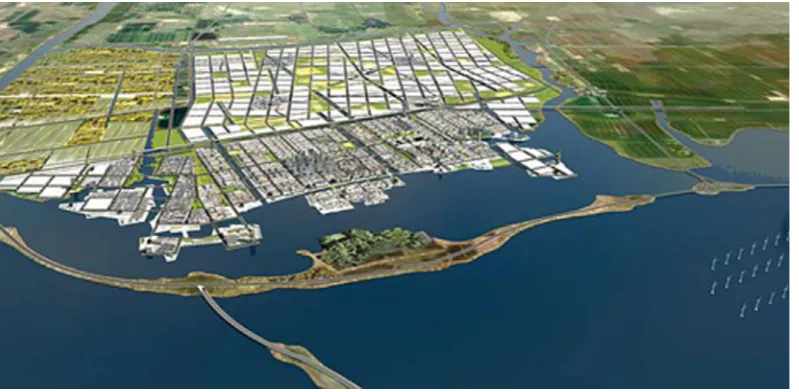
The selected case study of this research paper is part of a major eco-city development – Cao Fei Dian eco-city (dur-ing 2009–10), which is based in Hebei Province, China. In 2009, the local authorities came to decision of initiating a planning project to build a new eco-city in the coastal area of Tangshan Bay (Fig. 1). The Cao Fei Dian eco-city’s planning is mainly based on reclaimed land and the spatial configuration is organised horizontally alongside the coast, stretching from East to West and divided into three main central districts. The masterplan has been initially devel-oped by Beijing Tsinghua Urban Planning and Design Institute (based at the Tsinghua University in Beijing, China). For the project development stage, funded by RCUK China Office, a collaborative research programme was carried out jointly with Beijing Tsinghua Urban ning and Design Institute and the Institute of Urban Plan-ning at The University of Nottingham, UK. This research was conducted during a collaborative and technical work-shop based in Beijing, in September 2009, during which the design team applied knowledge-based and integrated thinking towards later stages of planning strategies and master-planning proposal. To test the overall concept of IDA in practice, the Central Business District (CBD) of the eco-city was selected. This was also to provide a techni-cal base for detailed urban design and masterplan pro-posal. This particular area was identified as a key area of this new eco-city proposal.
As proposed by SWECO, the leading engineering and design firm for the project, Cao Fei Dian eco-city (also
known as Tangshan eco-city in various literature and reports) was proposed to be a completed carbon–neutral city. The newly developed area, which is located about 200 km far from the Capital City of Beijing, is a coastal development in a very strategic location. The Cao Fei Dian eco-city, a development on Tangshan’s bay represents one of the many eco-developments of China. It is one of the first eight eco-city development projects from the first batch of eco-city pilot city projects across China. It is also one of the two located in the cold climatic zone of China (beside Sino-German eco-city project in Qingdao, Shan-dong Province of China). Although not very successful in the past one or two years, the project signifies a major demand in designing low-carbon and energy efficient pro-gress at both the construction and operational levels.
3. Environmental performance and the urban environmental design
[image:5.595.305.554.71.191.2]The urban environment involves several aspects, includ-ing, wind environment, solar performance, pollution, tem-perature and humidity. The last two aspects are very much
Fig. 1. Cao Fei Dian eco-city masterplan proposal by SWECO, Sustainable Energy and Design Section (Source:www.Swecogroup.com). Urban Design Brief
Concept Design
Transportation
Mixed-Use Development
Environmental Performance
Pollutant Dispersion
Urban Design Proposal
Computer Prediction and Assessment Tools
[image:5.595.94.494.536.732.2]Computer Prediction and Assessment Tools
embedded in the overall aspect of ‘comfort’, which is also often regarded as ‘thermal comfort’. For this study, this is particularly considered for the outdoor comfort analysis. Furthermore, these aspects are crucial to the comfort level of the physical urban environment. These considerations follow the analysis for the overall prediction of wind envi-ronment at pedestrian level of urban areas (Mochida and Lun, 2008) that address the issue of comfort for users. The study also elaborates on wind climate analysis from human scale perspective that can be utilised for urban scale studies (Murakami et al., 1999) and particularly for urban spaces and their design layout configuration for the users. This approach is significantly benefitted by CFD simula-tion studies that address the issue of environmental design at a larger scale of city planning and design (Murakami, 2006). The relationship between environmental perfor-mance and urban environmental design is, therefore, main-tained for the overall design thinking process.
In this project, the design team has focused primarily on the wind environment and solar performance of the urban context. These two factors are identified as two main ele-ments of environmental performance analysis for the case of Cao Fei Dian eco-city. As part of this analytical process, the local climatic data is used for setting up the model for conducted CFD and EcoTect simulation studies. Consider-ing the two main aspects for optimisation of the proposed built environment, it is evident that the environmental per-formance of the urban environment (i.e. including both planning and design) can play a significant role in making a development more energy efficient and/or low-carbon. This can be achieved through development of urban design forms, urban block patterns and enhanced spatial planning approaches that should directly address the environmental performance of our urban environments; most of which that can be simply neglected in practice by giving the way to morphological and functional aspects of the urban envi-ronments. The following sub-sections explore these in detail to discuss how the optimisation process and design proposal are supported by the use of CFD and EcoTect tools. In these sections, two factors of the wind environ-ment and solar performance are explored, before emphasis-ing on the Integrated Design Approach (IDA) in further detail.
3.1. The wind environment
With respect to the location of the eco-city, the prevail-ing wind direction is mainly from the southwest. This is based on the coastal geographical context of the Cao Fei Dian eco-city. It also is located in a cold climatic zone of China, which indicates a very windy and cold condition in between months of October to March. The maximum wind velocity is 5–6 m/s and is estimated to be constant for most of the covered area of Cao Fei Dian eco-city. This is conducted for the analysis of the wind environment for the outdoor spaces in the urban environments. This situa-tion makes wind the primary considerasitua-tion of the
environ-mental design for the public open spaces particularly that there are two key factors that need to be considered. First, the new eco-city is in a cold climatic zone and therefore high velocity wind environment can lead into uncomfort-able and undesiruncomfort-able (i.e. for the users) urban environ-ments. Second is the main issue of pollution dispersion from nearby oil industries towards the South-Western coastal side of the Cao Fei Dian eco-city. This immediately indicates a major threat of pollution coming from the region into the urban areas of new eco-city. As a result, the combined effect of such dispersion and high speed wind environment would again maximise discomfort and poor quality air in the urban environments. As a result, the wind environment is considered as the main factor for this par-ticular case study. Nevertheless, this is not always the case and would certainly depend on climatic conditions of the area/development. For instance, in hot climatic zones, the assessment is expected to be more towards enhancement and utilisation of the wind environment for better air circu-lation and cooling performance. Some of these factors can also address impacts of Urban Heat Island Effect (UHIE) on urban environments.
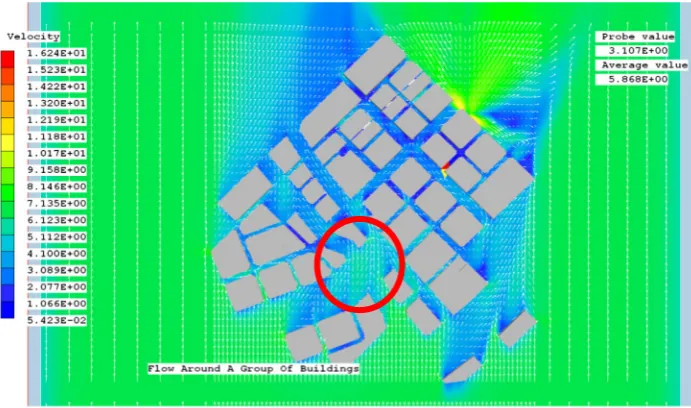
In the process of detailed development and design of an urban district, the wind environment and its influence on public open spaces have been well studied. Firstly, the design team simulated the wind environment in the street blocks context. This is conducted based on information from local planning data including the crucial climatic data as well as forming a unified urban pattern of the built envi-ronment at urban block scale. The local wind speed was ascertained from data supplied by the local meteorological station and the maximum wind speed throughout the year was estimated at 6 m/s. Based on this data, the worst case scenario could be found and assessed. As a result, the pre-dictive simulation for the core commercial area indicated that wind velocity could reach 7 m/s. Therefore, high wind velocity could also occur in the proposed main commercial street. As the wind speed of more than 5 m/s is considered ‘uncomfortable’ or out of the comfort zone for users, some treatment at urban design level is needed in order to reduce the wind speed (China Architecture and Building Press, 2009).
commercial area and the major pedestrianised shopping street. By creating a buffer zone, either through the use of more – and higher – plantation or the new built areas (i.e. proposed pavilions in here), it is suggested to deviate some of the south-westerly wind, which directly comes from an oil industry area, over the bay and into the open areas of the new eco-city zone. This is then connected to the main commercial area of the CBD area, which is not suggested at detailed design level. In order to avoid such direct wind environment connecting with the CBD area, the pavilions or alternatively more physicality into the open areas before the CBD commercial zone can play a major role in reducing the wind velocity in the outer zones. As a result, based on this effective solution, the wind veloc-ity in the main commercial street of the CBD area was reduced from around 7 m/s (i.e. as estimated based on the possible maximum constant wind velocity) to around
[image:7.595.118.464.69.273.2]3 m/s, which is considered as a suitable maximum wind speed for users/pedestrians. By reducing the wind velocity by almost 60%, this approach provides a computational simulation of the environmental performance to enhance the quality of the outdoor spaces. This can reduce further by providing more massing and heights to the context but this may also have a negative effect of reducing the air circulation which is not encouraged. Furthermore, the proposal not only satisfied the spatial design requirement, but also improved the wind environment in the local area. The impact of the better environmental performance is therefore visible through such optimisation that is signifi-cantly beneficial from the analysis of the wind environment at multiple scales. This means that the analysis conducted to identify the challenges of the area in a wider context in regard to the main issue of pollution dispersion is in fact more important that the meso scale analysis. At the smaller Fig. 3. Wind environment prediction for the street with the use of CFD tools for assessment as part of the design and optimisation process for the CBD of Cao Fei Dian eco-city (Source: Authors’ Own).
[image:7.595.132.450.320.510.2]neighbourhood scale analysis of the CBD area, the given data can then assess the scenarios under the given condi-tions of the wind environment at a regional level, which are not adjustable as such. Yet, when this comes to smaller scale, both planning and design can provide adjustments to refine the context accordingly.
3.2. The solar performance
In this project, a major concern was the solar insolation hours in the pedestrianised shopping street. The solar per-formance is essential to vitalise the outdoor spaces in the urban environment. Within the design process, the solar performance of the streets was constantly assessed. As a result, the street orientation was designed according to the annual sun path. The northeast-southwest orientation could allow the street to receive the maximum sunlight dur-ing the day. This is essential for such context in a cold cli-matic zone. But it is important to note that this is not always the case. Therefore, the consideration of climatic an contextual data is key to determine this pre-assessment stage of environmental performance analysis. For instance, in a hot climatic condition, the treatment should be the reverse to the Cao Fei Dian eco-city case and should aim be aimed to reduce the solar radiation at the street level. Therefore, the Cao Fei Dian eco-city case indicates the need to gain the solar insolation in order to guide the planning and detailed design of the urban environments.
After the initial proposal was made, the EcoTect tool was used to evaluate the solar performance. Only with slight differences with CFD tools, EcoTect simulations also provide environmental analyses that can utilised for the
stage of conceptual design or planning modifications. The analytical results acquired from the simulations enable to have better overview of solar performance of the urban environments. Previously (i.e. prior to 2010), most applica-tions of EcoTect focused on building models in the sector of the built environment. Nowadays the application is more widespread and EcoTect has improved to a more integrated simulation toolkit.
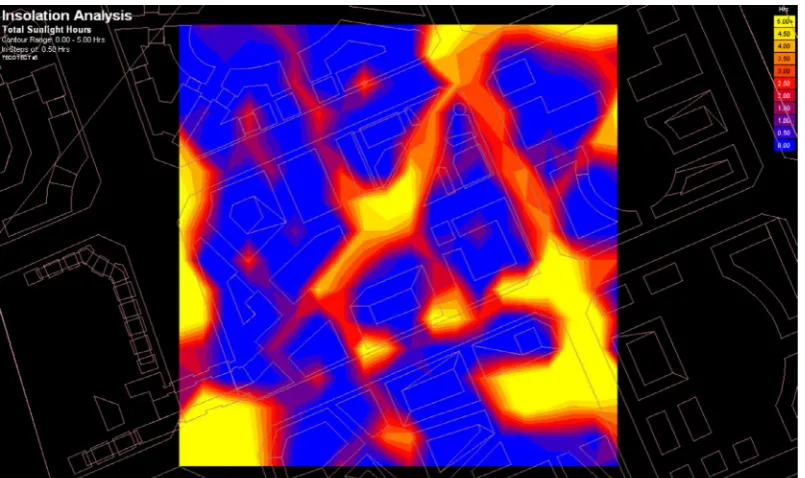
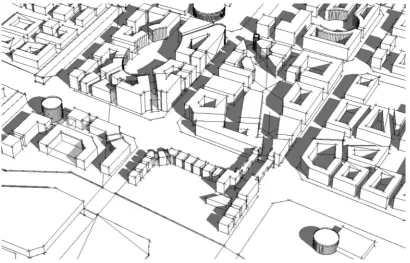
Fig. 5shows the solar insolation hour distribution dur-ing the winter solstice day, which is the worst situation throughout the year (e.g. in terms of the insolation hours). The objective of this analysis is to allow more possibilities of solar radiation (i.e. both direct and indirect – but mainly focused on direct to increase the heat gain in colder sea-sons) to reach the activity level of the street - which in this project is defined at 1.5 m above the ground level. This is the estimated level for users to interact in the street level and where activities are expected to occur throughout the day (and the year). In a way, this is to avoid extreme over-shadowing to increase solar insolation for the open spaces of the blocks. As the assessment demonstrates, most of the street could receive more than three hours of direct solar radiation in the worst occasion(s) throughout the year. This assessment could direct the design team to deliver a good solar performance in the proposed design solution (Fig. 6).
[image:8.595.102.505.491.730.2]This is particularly required for the winter days when the increase of solar radiation on the activity level of the street could improve the performance and comfort of these urban environments. The combined effect of both the wind environment and solar performance analysis provides the multi-layered approach to defining urban forms and micro-climatic urban design models.
3.3. Benefits and advantages of Integrated Design Approach (IDA)
There are many advantages of the IDA comparing to the traditional design approach. A traditional method nor-mally does not integrate the environmental performance analysis as part of the design thinking process or merely uses such analyses as part of the assessment of the final design. However, IDA corresponds to a holistic process which also emphasises on the environmental design consid-eration into the design process, which then enables design-ers to modify, adjust and amend their design interventions. It fully engages with social, economic and environmental aspects to attain a sustainable design; an approach that
[image:9.595.94.490.71.237.2]can increase the footfall opportunities for social interac-tions and design of quality public place. This significantly responds to how an urban setting can benefit from assess-ing the environmental performance which can then be uti-lised for design development. More importantly, IDA introduces the quantitative assessment and further evalua-tions into the design process. Traditionally environmental consideration was only qualitatively evaluated and was mostly based on the assumptions and estimations. There-fore, IDA involves quantitative design tools in order to provide accurate evidence (i.e. based on simulation mod-elling) to support or challenge the existing design solution. For the Cao Fei Dian’s project, IDA explores the incon-sistent factors within the existing proposal/masterplan in Fig. 6. Annual overshadowing analysis of the selected point in the street (Source: Authors’ Own).
[image:9.595.88.499.461.724.2]order to provide coherent solutions. The use of IDA is not to criticise the existing masterplan, but rather to articulate the whole design approach in a sustainable way; an approach that can lead to multi-dimensional information modelling of an urban environment prior to planning and design. This leads to achieving a more sustainable and low-carbon design development process by supporting the optimisation of wind environment and solar performance; both of which have impact on energy-use at some point. To some extent, the existing proposal’s lack of strategy in environmental performance, social cohesion, and well-organised transportation system dictates a weak design in terms of urban sustainability. The proposed approach for design and planning the CBD of Cao Fai Dian eco-city addresses a technical approach through the assessment of environmental performance, which could strengthen the quality of urban environments as well as stepping closer to the concept of urban sustainability. Therefore, the sug-gested knowledge-based proposal – by implementing the measures and mechanisms of IDA - has introduced a more comprehensive approach to create sustainable and efficient urban environments (Fig. 7).
The rapid development of the Cao Fei Dian eco-city represents one of China’s many major eco-city projects that are partly operational by now. Through energy efficiency and low carbon strategies, the application of low-carbon cities or eco-cities, like Cao Fei Dian, should be regarded as a process (Yu, 2014). The use of available computational tools in optimisation of design and the built environment would certainly help designers and planners to consider an environmental-friendly approach towards a more per-formative design. This can lead to methods with which we can develop low-carbon and energy efficient solutions for such major design projects.
4. Conclusions and suggestions
Urban design is a multidisciplinary practice of urbanism and urban development. It achieves sustainable and sus-taining urban development only with full considerations of social, environmental, and economic dimensions. Addressing these under one unified model remains a major challenge in research and practice. The common disparities between economic sustainability and environmental sus-tainability often propose challenges of how a sustainable model can be achieved through urban design practice. The traditional working practice of mainstream urban design involves social and economic considerations in the design process, but only includes insignificant knowledge of environmental design. The Cao Feidian eco-city project has enabled us to evaluate the ‘Integrated Design Approach’, which has helped urban designers and planners to include all considerations in the design process. Since its inception in 2010, this model has been utilised in practice and has become widespread in developing an information modelling technique. The team not only delivered a design solution that worked well in social, environmental and
eco-nomic terms, but also delivered pleasant outdoor urban environments. The pleasing public open spaces are able to encourage people to engage in activities that will vitalise the urban environment and community. Therefore the environmental consideration is also decisive in enabling the achievement of a sustainable and sustaining urban development. To achieve this, one can only look out of the traditional approach and incorporate new techniques of design thinking.
The ‘Integrated Design Approach’ enables professions from the built environment sector to synthesise comprehen-sive considerations in the design process. In this paper, although environmental design considerations were inte-grated into the design process, there are also many other aspects that should be integrated into the design process. For instance, pollutant dispersion was discussed briefly in the paper, but it could be a key consideration in many pro-jects of similar scale and condition. Along with the devel-opment of design tools and design technologies, the optimisation of the built environment will involve and inte-grate more design considerations and consequently achieve a genuine multi-disciplinary success in terms of urban sustainability.
Acknowledgements
We would like to thank the RCUK China Office for funding the project in 2009. We would also like to thank our collaborators for their support in completing this research project.
References
Cheshmehzangi, A., 2016. Multi-spatial environmental performance evaluation towards integrated urban design: a procedural approach with computational simulations. J. Cleaner Prod. 139, 1085–1093. Cheshmehzangi, A., Zhu, Y., Li, B., 2010. Integrated urban design
approach: sustainability for urban design. In: Proceedings for ICRM 2010, 5th International Conference for Responsive Manufacturing in China, January 2010.
China Architecture and Building Press. 2009. Urban Wind-Design of energy-saving buildings in hot summer and cold winter climate, Beijing.
Chuang, C.M., 2008. The Research of Outdoor Thermal Comfortableness in Summer – Tainan Country, Tainan City and Kaohsiung City Outdoor Spaces as Case Studies. Master Dissertation of Department of Architecture, NCKU.
Chung, D.H.J., Choo, M.L., 2011. Computational fluid dynamics for urban design: the prospects for greater integration. Int. J. Architect. Comput. 9 (1), 33–54.
Dawodu, A., Akinwolemiwa, B., Cheshmehzangi, A., 2017. A conceptual re-visualization of the adoption and utilization of the Pillars of Sustainability in the development of Neighbourhood Sustainability Assessment Tools. Sustainable Cities Soc. 28, 398–410.
de Schiller, S., 2004. Sustainable Urban Form: Environment and Climate Responsive Design. Oxford Brookes University Publishers, Oxford. Dor, A., Kissinger, M., 2017. A multi-year, multi-scale analysis of urban
sustainability. Environ. Impact Assess. Rev. 62, 115–121.
Elkin, T., McLaren, D., Hillman, M., 1991. Reviving the City: Towards Sustainable Urban Development. Friends of the Earth, London. Farr, D., 2008. Sustainable Urbanism. John Wiley and Sons, New Jersey. Madu, C.N., Kuei, C., Lee, P., 2017. Urban sustainability management: A
deep learning perspective. Sustainable Cities Soc. 30, 1–17.
Mochida, A., Lun, I.Y.F., 2008. Prediction of wind environment and thermal comfort at pedestrian level in urban area. J. Wind Eng. Ind. Aerodyn. 96 (10–11), 1498–1527.
Mochida, A., Tominaga, Y., Murakami, S., Yoshie, R., Ishihara, T., Ooka, R., 2002. Comparison of various k-emodel and DSM applied to flow around a high-rise building - report on AIJ cooperative project for CFD prediction of wind environment. Wind Struct. 5 (2-4), 227–244. Murakami, S., 2006. Environmental design of outdoor climate based on
CFD. Fluid Dyn. Res. 38, 108–126.
Murakami, S., Ooka, R., Mochida, A., Yoshida, S., Kim, S., 1999. (1999) CFD analysis of wind climate from human scale to urban scale. J. Wind Eng. Ind. Aerodyn. 81 (1–3), 57–81.
Nikolopoulou, M., Lykoudis, M., Kikira, M. 2004. Centre for Renewable Energy Source, Greece.
Philips, C., 2003. Sustainable Place: A Place of Sustainable Development. Wiley-Academy, Chichester.
Pupphachai, U., Zuidema, C., 2017. Sustainability indicators: a tool to generate learning and adaptation in sustainable urban development. Ecol. Ind. 72, 784–793.
Register, R., 1987. Ecocity Berkeley: building cities for a healthy future. In: North Atlantic Books.
Ritchie, A., Thomas, R., 2009. Sustainable Urban Design: An Environ-mental Approach. Taylor and Francis, Oxon.
Shirasawa, T., Tominaga, T., Yoshie, R., Mochida, A., Yoshino, H., Kataoka, H., Nozu, T., 2003. Development of CFD method for predicting wind environment around a high-rise building Part 2: the cross comparison of CFD results using various k-models for the flowfield around a building model with 4:4:1 shape. AIJ J. Technol. Des. 18, 169–174.
Spagnolo, J., de Dear, R., 2003. A field study of thermal comfort in outdoor and semi-outdoor environments in subtropical Sydney Aus-tralia. Build. Environ. 38, 721–738.
The English Partnerships, 2007. Urban Design Compendium, Vol. 2. The English Partnerships, London.
Thwaites, K., Porta, K., 2007. Urban Sustainability Through Environ-mental Design: Approaches to Time-People-Place Responsive Urban Spaces. Routledge, Oxon.
Yoshie, R., Mochida, A., Tominaga, Y., Kataoka, H., Harimoto, K., Nozu, T., Shirasawa, T., 2005. Cooperative project for CFD predic-tion of pedestrian wind environment in the Architectural Institute of Japan. J. Wind Eng. Ind. Aerodyn. 95 (9–11), 1551–1578.