Closing the gap: Ef
fi
cacy of a tablet intervention to support
the development of early mathematical skills in UK primary
school children
Laura A. Outhwaite, Anthea Gulliford, Nicola J. Pitchford
*School of Psychology, University of Nottingham, UK
a r t i c l e i n f o
Article history: Received 7 January 2016
Received in revised form 16 December 2016 Accepted 20 January 2017
Available online 23 January 2017
Keywords:
Evaluation of CAL systems Elementary education Improving classroom teaching Interactive learning environments
a b s t r a c t
The efficacy of a hand-held tablet technology intervention with learner-centred interactive software aimed at supporting the development of early maths skills was evaluated in four studies conducted in three UK primary schools. Immediate and sustained gains in mathematics were determined by comparing maths performance before, immediately after, and 5-months after the intervention. The impact of the child'sfirst language, socio-economic status and basic cognitive skills (non-verbal intelligence, memory, processing speed and receptive vocabulary) on learning gains was also explored. In total, 133 pupils aged 4e7 years took part. Class teachers implemented the maths intervention for a specified period of time. Results showed significant immediate and sustained learning gains following the intervention, particularly for children identified as low-achievers. No significant effect of child'sfirst language or socio-economic status was found but children with weaker memory skills demonstrated stronger learning gains. Overall, thesefindings indicate that tablet technology can provide a form of individualised effective support for early maths development, when software is age appropriate and grounded in a well-designed curriculum. Apps that incorporate repetitive and interactive features might help to reduce cognitive task demands, which could be particularly beneficial to low-achievers and could help to close the gap in early maths attainment from the start of primary school.
©2017 The Authors. Published by Elsevier Ltd. This is an open access article under the CC BY license (http://creativecommons.org/licenses/by/4.0/).
1. Introduction
Raising standards in mathematics education in the United Kingdom is an issue of national importance. In the latest PISA assessment of 15-year olds' maths ability, the UK ranked 27th out of 34 participating countries (Organisation for Economic Co-Operation and Development [OECD], 2016). Furthermore, a ‘stubborn-tail of underachievement’ is evident amongst
disproportionate groups of underachieving pupils in the UK (Tymms&Merrell, 2007). Research shows children with low
socio-economic status (SES), which considers the levels of income, employment and deprivation in an area, and children who
have English as an additional language (EAL), have significantly lower mathematics ability levels compared to their peers
(Anders et al., 2012; Denton&West, 2002).
*Corresponding author. School of Psychology, University of Nottingham, University Park, Nottingham, UK.
E-mail addresses:[email protected](L.A. Outhwaite),[email protected](A. Gulliford),nicola.pitchford@nottingham. ac.uk(N.J. Pitchford).
Contents lists available atScienceDirect
Computers & Education
j o u r n a l h o m e p a g e : w w w . e l s e v i e r . c o m / l o c a t e / c o m p e d u
http://dx.doi.org/10.1016/j.compedu.2017.01.011
To address underachievement in mathematics potential solutions need to engage children from a young age. Research
shows early learning experiences are a significant predictor of attainment at the end of primary school (Sylva, Melhuish,
Sammons, Siraj-Blatchford,&Taggart, 2010). Children considered to have developed well through thefirst year of primary school, known in the UK as the Early Years Foundation Stage (EYFS), exceed expected numeracy and literacy levels three years later (Department for Education [DfE], 2010). Conversely, children who progress slowly and exhibit low attainment levels at
the end of the EYFS are six times more likely than children who progress at a typical rate to be in the lowestfifth of achievers
three years later, at the end of the early primary years (Department for Children, Schools and Families [DCSF], 2008). Therefore, it is vital for all children to develop a strong early foundation in mathematics, particularly those vulnerable to underachievement.
A potential pedagogical approach to support the development of early mathematical skills in thefirst years of primary
school is combining play and technology. Technology-based educational games have the potential to have a positive impact on early education through their capacity to address the differing abilities of individual children. Software features
including multiple representations of information, such as pictures, video, and animation, varying levels of task difficulty,
clear goals and rules, learner control, task feedback and repetition, serve to create an individualised learning environment,
placing the child in active control of their learning (Condie&Munro, 2007; see also;Rose, Meyer,&Hitchcock, 2005).
Furthermore, hand-held tablet technology devices are light-weight, eliminate the need for dexterity reliant additional devices (e.g. keyboard and mouse), and have the capacity to store multiple child-friendly educational applications (Kucirkova, 2014). Coupled with well-designed, curriculum-based, child-centred software, tablet technology interventions have the potential to embed learning through play and thus could provide a useful classroom aid to supplement early years teaching.
In this study, we evaluated the use of hand-held tablet technology with learner-centred software in supporting children's
early maths skill development. The software is based on the UK maths curriculum for thefirst year of primary school and is
designed for use with hand-held devices, such as Apple iPads or Android tablets. Such advances in hand-held technology have the potential to offer learner-centred support in developing early mathematical skills during the early years of primary school
but require formal evaluation for their efficacy to be shown.
The current evidence base surrounding the use of tablets in schools is limited and fragmented (Ha
b
ler, Major,&Hennessy,2016), particularly in mathematics (Cheung&Slavin, 2013) and early education. To date, four studies have been published,
which have examined the use of technology-based educational mathematics games with children in thefirst 3 years of
primary school (EYFS to year 2) or equivalent, which are reported in sufficient detail to allow objective comparison using
effect sizes (Cohen, 1988). The studies compared technology-based educational maths games either to normal practice
(Pitchford, 2015; Praet&Desoete, 2014; R€as€anen, Salminen, Wilson, Aunio,&Dehaene, 2009) or a non-technology based
maths game (Shin, Sutherland, Norris,&Soloway, 2012). For each of these studies we calculated within-group effect sizes
across the intervention period and found size of effect to range from large (Cohen'sd>0.8,Pitchford, 2015; Praet&Desoete,
2014), to medium (Cohen'sd>0.5,Shin et al., 2012) to small-medium (Cohen'sd>0.4,R€as€anen et al., 2009). It is noteworthy that the study with the largest effect size (Pitchford, 2015) also implemented the intervention for the longest duration (20 h), suggesting that time-on-task is a contributing factor on the extent of learning gains observed. Whilst effect sizes vary across studies, overall, these studies demonstrate the positive impact of technology-based educational games in supporting
mathematical development in young children, particularly in low-achieving pupils (R€as€anen et al., 2009; Praet&Desoete,
2014). However, no study to date has investigated how additional factors known to influence scholastic progression, such as, SES and EAL status and basic cognitive skills, impact on the effectiveness of technology-based maths interventions implemented in early education.
This study reports thefirst UK evaluation of a tablet-based maths intervention for pupils in thefirst years of primary
school. The intervention consists of learner-centred progressive software delivered via hand-held tablet technology. The intervention has been shown to be effective in supporting early mathematical skills in primary school children in Malawi (Pitchford, 2015), a low-income country in sub-Sahara Africa. The Malawi evaluation study used the same set of interactive apps evaluated here, but adapted for an African context and delivered in the local language of Chichewa. Whilst this inter-vention has been shown to be effective in Malawi, it is not yet clear if it will be effective in a high-income country, such as the UK, where hand-held tablets are ubiquitous and children receive structured tuition in maths from the start of primary school. Here, we report a series of four studies that evaluated the intervention with UK primary school children, as implemented by class teachers and delivered in English. Together these studies address key questions that are needed to provide proof of
concept that this intervention can be effective at supporting the development of early maths skills in children aged 4e7 years
old in an UK educational setting. First, to determine if the intervention works in a UK context, we examined immediate and sustained learning gains in maths for children across variable periods of intervention by comparing maths performance before, immediately, and 5-months, after the intervention. Second, to determine the suitability of this intervention for
children from different backgrounds we explored the impact of the child'sfirst language, socio-economic status, and basic
2. Study 1
The purpose of this study was to determine immediate and sustained benefits of using the maths tablet intervention when
implemented over a 6 week period and to establish if the child's EAL or SES status influences their progress in maths in
response to the intervention.
2.1. Material and methods
2.1.1. Design
The School of Psychology ethics committee at the University of Nottingham granted ethical approval for the study. Opt-in informed parental consent was obtained for all participating pupils in line with the British Psychological Society ethical guidelines.
The study was conducted in a large mixed gender primary school with two campuses (site A and site B) in low SES areas of Nottingham. The proportion of pupils with EAL status was above the national average (Ofsted, 2012). Following a
within-subject design, EYFS pupils, aged 4e5 years, received the intervention for 6 weeks. The intervention was implemented
independently at each campus at different times (seeTable 1). EYFS pupils were assessed on two experimental measures of
maths skills before (pre-test), immediately after (post-test) and 5 months after (delayed post-test) the 6-week intervention period. To enable all children to have access to intervention, the intervention was implemented across the Foundation Year. Hence, it was not possible to compare performance changes after the intervention to an age-matched control group. So to
provide a broad comparison between the intervention and normal pedagogical practice, older pupils, aged 5e7 years from
Years 1 and 2 (referred to as Key Stage 1 in the UK), were assessed on the two experimental measures of maths ability before
the intervention periods (seeTable 1).
2.1.2. Participants
In total, 61 EYFS pupils across the two campuses (site A n¼26, site B n¼35) received the maths tablet intervention. 23
EYFS pupils from site A were present at the delayed post-test. A further 22 Key Stage 1 pupils formed an older comparison
group.Table 2summaries the sample structure.
2.1.3. Maths tablet intervention
The intervention consisted of four learner-centred apps developed by an education publishing non-profit organisation.
The apps offer child-centred tuition focusing on the core mathematical concepts of Number, Shape, Space and Measure covered in the UK national curriculum. Each app presents a series of topics that are focused on particular skills, such as, Patterns and Shape, Counting 1 to10, and Add and Take Away. Each topic has a detailed set of activities designed to introduce children progressively to a particular mathematical concept. A virtual teacher scaffolds children's learning with clear
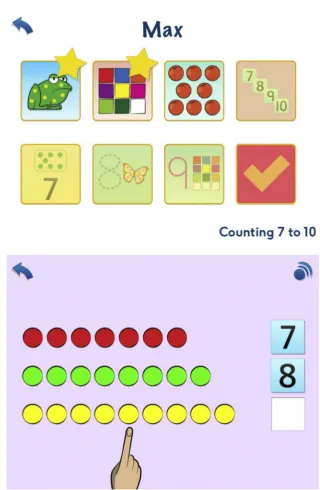
in-structions and demonstrations.Fig. 1displays examples of screenshots taken from the apps (courtesy ofonebillion). Pupils
work individually through the app at their own pace and can repeat and practice activities as often as they desire. Pupil
progress is saved in the child's profile within the apps. To progress to the next topic, pupils need to achieve a 100% pass rate on
an end of topic quiz included in the software. The quizzes are designed to assess knowledge acquired through the topic activities. The apps are designed to be child-centred with content presented in attractive picture, audio and animation for-mats with interactive instructions, clear objectives and immediate formative feedback, consistent for all users. Children used the software on hand-held tablet devices, such as Apple iPad minis with headphones. Teachers monitored individual pupil progress with achievement charts, in which a star sticker was awarded to each pupil as they passed a particular quiz.
2.1.4. Maths assessments
Two experimental measures of maths skills were used to assess performance. A measure of maths curriculum knowledge
consisted of 50 quiz items taken from the apps and assessed curriculum knowledge specific to the maths intervention,
[image:3.544.37.504.619.688.2]including sorting and matching, counting, pattern and shape recognition, addition and subtraction and telling the time. A measure of maths concepts consisted of 48 questions assessing conceptual understanding of mathematics, similar to the Numerical Operations sub-test of the WIAT-II (Wechsler, 2005). Concepts assessed in this task included symbolic under-standing, number sense, simple and complex addition, simple and complex subtraction and multiplication and division. Items
Table 1
Summary of research design for Study 1.
Age Group
Assessment Phase
Intervention Period 1
Assessment Phase
Intervention Period 2
Assessment Phase
EYFS Site A Pre-test Maths apps
(6 weeks)
Immediate Post-test Normal Practice Delayed Post-test
EYFS Site B None Normal Practice Pre-test Maths apps
(6 weeks)
Immediate Post-test
Table 2
Sample structure for Study 1.
Age Group (n)
Age M (SD) (months)
Age Range (months)
Gender (F:M) SES
(IDACI score Range)
Language (EAL: Non-EAL)
EYFS (61)
60.52 (5.10) 50e69 26:35 1e69 36:25
Key Stage 1 (22)
73.45 (6.62) 65e85 7:15 0e69 12:1
[image:4.544.111.432.166.657.2]from both measures were presented in a set order that increased with difficulty over successful trials. A discontinue rule of three unsuccessful trials was applied to prevent children becoming disengaged by answering questions above their ability.
Thefirst author delivered the maths assessments to small groups of pupils using the tablet technology.
2.1.5. Demographic data
Demographic data including date of birth, post-code andfirst language was collected for each pupil using a pre-study
questionnaire completed by parents at the time of consent or through school records. The child's post-code was used as an indicator of SES, using the Income Deprivation Affecting Children Index (IDACI). IDACI scores measure neighbourhood
deprivation based on the proportion of local children under the age of 16 living with families receiving means tested benefits
(McLennan et al., 2011).
2.1.6. Procedure
EYFS pupils participated in the intervention for 30 min, every day for 6 weeks in small groups of up to 15 at a time, under
the supervision of the teaching staff. At the same time, the pupils received standard maths practice as defined by the UK
national curriculum. Normal practice consisted of standard teacher-led maths activities relevant to the appropriate year group. Formal instruction in mathematics does not take place in the EYFS in UK primary schools and begins only when pupils
enter Key Stage 1, at 5e6 years. Before then, EYFS class teachers support maths education through everyday play activities or
short (20e30 min) whole-class activities. For example, the concept of‘division’might be explained through a sandpit activity
in which pupils learn to make two small sandcastles out of one larger sandcastle. The maths tablet intervention was implemented during free play or topic work, so pupils did not miss out on core subject activities, such as numeracy and phonics. The older comparison group of Key Stage 1 pupils did not receive the maths tablet intervention during the EYFS. They followed the standard teacher-led national curriculum for maths that is implemented across the UK and thus act as a standard practice control group.
Teaching staff were trained in how to use the tablets and apps prior to intervention implementation. Pupils were allocated an individual iPad mini with headphones for the duration of the intervention period. Teaching staff tracked pupil
partici-pation and progress during the intervention using a specifically designed register and star chart.
Before and after the intervention EYFS pupils were assessed on the two experimental measures of maths ability (cur-riculum knowledge and maths concepts) delivered using tablet technology in small groups of approximately 15 children. Maths assessments were conducted at pre-test only for Key Stage 1 pupils. All assessments were conducted in a quiet area free from distraction, in the child's familiar school environment. Pupils were assigned an individual tablet and headset installed
with the maths assessments. Pupils sat on thefloor to carry out the assessments. Thefirst author demonstrated each of the
maths tasks to the pupils using a separate tablet.
2.1.7. Data analysis
Mean performance was calculated for each child from both maths tasks given at pre-test, post-test and delayed post-test. A composite measure of maths ability was also calculated for individual pupils by averaging the curriculum knowledge and
maths concepts scores (maximum score¼49). Results are reported at a whole-sample level. To address the aims of Study 1
the following analyses were conducted1
1) To evaluate immediate maths learning gains for the whole sample, two separate paired-samples t-tests were conducted comparing EYFS pupil's maths curriculum knowledge and maths concept scores at pre-test and post-test. To further evaluate the strength of the intervention effects and allow comparison with previous research, we conducted an effect size
analysis using Cohen'sd. Within-subject effect sizes were calculated for learning gains over the duration of the
inter-vention using the mean and standard deviation of the change scores over time. An effect size of 0.2 is considered small, 0.5 is medium and 0.8 or above is large (Cohen, 1988).
2) To evaluate the sustainability of the observed learning gains for the participating sub-sample, two separate repeated measures ANOVAs were conducted comparing maths curriculum and maths concept scores at pre-test, post-test and delayed post-test.
3) To compare the intervention learning gains to normal practice, a series of separate independent-samples t-tests was conducted between EYFS maths curriculum knowledge and maths concepts performance at each of the three assessment points and Key Stage 1 curriculum knowledge and maths concepts performance at pre-test.
4) To assess the impact of EAL status on intervention learning gains, an independent-samplest-test was conducted between
EAL status (EAL pupils and non-EAL pupils) and maths composite difference scores. Difference scores were calculated by subtracting immediate post-test performance from pre-test performance.
5) To assess the impact of SES on intervention learning gains, a Pearson's correlation was conducted between IDACI scores and maths composite difference scores.
1 Kolmogorov-Smirnov tests identified some measures (i.e. pre-test maths concepts, post-test curriculum knowledge, both maths measures at delayed
2.2. Results
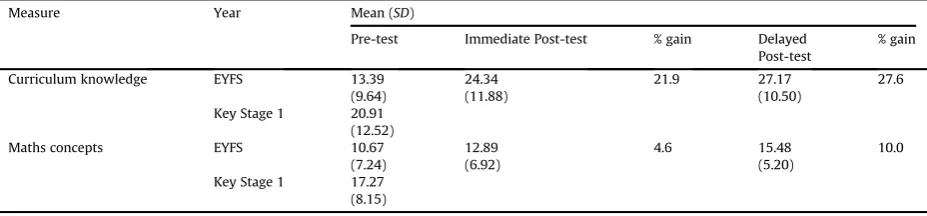
Table 3shows the mean performance at pre-test, post-test and delayed post-test for EYFS pupils receiving the intervention and the Key Stage 1 pupils receiving normal practice on the two experimental measures of maths ability (curriculum knowledge and maths concepts).
For the whole sample, paired-sample t-tests showed that following the 6-week maths tablet intervention EYFS pupils
demonstrated significant learning gains in curriculum knowledge,t(60)¼9.63,p<0.001 with a large within-subjects effect
size,d¼1.0, and maths concepts,t(60)¼2.73,p¼0.008 with a small within-subjects effect sizes,d¼0.3.
For the sub-sample of pupils included in the delayed post-test, a repeated measures ANOVA showed a significant main
effect of time for curriculum knowledge,F(2, 44)¼45.59,p<0.001. Post hoc tests using the Bonferroni correction showed
significant curriculum knowledge learning gains from pre-test to immediate and delayed post-test (p<0.001). Improvements
from immediate to delayed post-test approached significance (p¼0.079). For maths concepts, a repeated measures ANOVA
showed a significant main effect of time,F(2, 44)¼9.35,p<0.001. Bonferroni corrected post hoc tests showed learning gains
from pre-test to immediate post-test were not significant (p¼0.486) but learning gains from immediate to delayed post-test
were significant (p¼0.015).
At pre-test, as expected, independent-samples t-tests showed a significant difference between EYFS and Key Stage 1 pupils
in curriculum knowledge (t(81)¼2.89,p¼0.005) and maths concepts (t(81)¼3.54,p¼0.001) with the older Key Stage 1
pupils outperforming the younger EYFS pupils. However, following the maths tablet intervention, this age-related
achieve-ment gap was narrowed. Further independent-samples t-tests at immediate post-test revealed no significant difference
between Key Stage 1 and EYFS in curriculum knowledge (t(81)¼1.15,p¼0.255) and this was sustained at delayed post-test (t
(43)¼1.82,p¼0.076). For the maths concepts measure, a significant difference was still observed at immediate post-test as
Key Stage 1 pupils outperformed EYFS pupils (t(81)¼2.43,p¼0.017), but at delayed post-test there was no significant
difference between these two groups (t(43)¼0.89,p¼0.381).
Descriptive data showed that over the intervention period EAL pupils made similar levels of progress (M¼6.26,SD¼6.38)
to their non-EAL peers (M¼7.04,SD¼5.58). An independent-samplest-test confirmed there was no significant difference in
the progress of EAL and non-EAL pupils (t(59)¼0.49,p¼0.625).
Pearson's correlational analysis showed no significant relationship between the child's IDACI score and their maths
composite difference score (r¼ 0.04,p¼0.763).
2.3. Discussion
Study 1 examined the immediate and sustained effectiveness of the use of the hand-held tablet technology with learner-centred software in supporting the development of early maths skills in UK EYFS pupils. In total, 61 pupils received the intervention for 6 weeks under teaching staff supervision. Comparisons to normal practice were made by comparing per-formance of younger EYFS pupils across the intervention period to that of older Key Stage 1 pupils taken at pre-test. The impact of EAL status and SES background on children's learning gains was also investigated.
Immediately following the intervention, EYFS pupils demonstrated significant learning gains in specific maths curriculum
knowledge that was trained in the intervention. This generalised to conceptual maths knowledge that was not specifically
trained in the maths apps. The size of effects was similar to that reported in previous research and ranged from small (for maths concepts) to large (for curriculum knowledge). Learning gains were sustained when re-assessed after 5 months and large effect sizes were found for both maths measures. These within-subject level analyses suggest that hand-held tablet technology with learner-centred software is an effective means of supporting early maths development.
Further comparisons to normal practice showed that before implementing the maths tablet intervention, maths ability of
the older Key Stage 1 pupils was significantly higher than that of the younger EYFS pupils, as expected. However, immediately
following and 5-months after implementing the tablet intervention, EYFS pupils achieved a mean curriculum knowledge
score that was higher than their older Key Stage 1 peers, although this difference did not reach statistical significance. These
Table 3
Study 1: Group mean performance in curriculum knowledge and maths concepts at pre-test, immediate post-test and delayed post-test and percentage (%) gains following the 6-week intervention period with the maths apps.
Measure Year Mean (SD)
Pre-test Immediate Post-test % gain Delayed
Post-test
% gain
Curriculum knowledge EYFS 13.39
(9.64)
24.34 (11.88)
21.9 27.17
(10.50)
27.6
Key Stage 1 20.91
(12.52)
Maths concepts EYFS 10.67
(7.24)
12.89 (6.92)
4.6 15.48
(5.20)
10.0
Key Stage 1 17.27
results demonstrate significant improvements in curriculum knowledge that is above the expected trajectory obtained through normal classroom practice.
No effect of EAL status and SES were found on learning gains following the tablet intervention. This suggests the maths
apps are accessible to all children. In particular, children whosefirst language was not English made on average similar levels
of progress (mean learning gain¼12.8%) to their non-EAL peers (mean learning gain¼14.4%). The multi-sensory nature of
the maths apps and clear and simple instructions with multiple representations of information (such as, pictures and
interactive animations), might provide additional support to pupils whosefirst language is not English.
Whilst this study provides proof of concept for the efficacy of the maths tablet intervention, there are two key limitations.
First, the experimental maths assessments were delivered using the same tablet technology format as the maths intervention and the content of the curriculum knowledge assessment included the same characters and layout as the intervention
materials. Therefore, the observed learning gains could be attributed, in part, to pupils’familiarity with the intervention
materials. Second, the maths tablet intervention was implemented for a relatively short time period of time (just 6 weeks). It is recommended that interventions should be implemented for a minimum of 12 weeks in evaluation research to ascertain
the full intervention benefits (Higgins, Xiao,&Katsipataki, 2012). As outlined above, extent of learning gains observed on
previous research related to the duration of implementation of the intervention. Hence, taking these limitations into consideration, the results from Study 1 need to be corroborated with additional studies using standardised and non-tablet based maths assessments. Furthermore, to understand why this intervention is effective at supporting the development of early mathematical skills, additional studies need to examine underlying cognitive skills (such as non-verbal IQ, processing speed, receptive vocabulary, verbal memory, and non-verbal memory) that may account for the observed learning gains. These issues were addressed in Study 2 and 3.
3. Study 2 and 3
To address the limitations with the assessment materials that were evident in Study 1, we conducted two further studies, each of which employed standardised measures of maths ability. We also investigated the effectiveness the maths tablet
intervention when implemented over a longer duration (13 weeks) than in Study 1 (6 weeks) and the influence of basic
cognitive skills on observed learning gains in different groups of children (Study 2: 4e5 year olds; Study 3: low-achieving
children aged 5e7 years).
3.1. Materials and methods
3.1.1. Design
The School of Psychology ethics committee at the University of Nottingham granted ethical approval for these studies. As in Study 1, opt-in informed parental consent was obtained for all participating pupils.
Studies 2 and 3 also adopted a within-subject design and were conducted in a large mixed gender primary school in a low SES area of Doncaster where the proportion of pupils eligible for free school meals is above the national average (Ofsted, 2013). EYFS pupils (Study 2) and low-achieving Key Stage 1 pupils (Study 3) received the same hand-held tablet technol-ogy with learner-centred software intervention as was evaluated in Study 1 but for a longer duration of 13 weeks as opposed to 6 weeks in Study 1. Pupils were assessed on both experimental and standardised measures of maths ability and stand-ardised measures of cognitive skills before (pre-test) and immediately after (post-test) the 13-week intervention period.
3.1.2. Participants
The maths tablet intervention was given to 18 EYFS pupils in Study 2 and 27 low-achieving Key Stage 1 pupils in Study 3.
Low-achieving Key Stage 1 pupils were identified based on teacher's assessments of children's maths ability at pre-test.Table
4summaries the sample structure in each study.
3.1.3. Maths assessments
[image:7.544.36.503.621.689.2]Three measures of maths skill were used to assess children's maths ability. A new experimental, paper-and-pen based, assessment of curriculum knowledge was developed which included 50 novel items based on the concepts taught in the maths apps. Basic maths skills assessed in this test included counting, understanding and using numbers, simple addition
Table 4
Sample structure for Study 2 and 3.
Age Group (n)
Age M (SD) (months)
Age Range (months)
Gender (F:M) SES
(IDACI score Range)
Language (EAL: Non-EAL)
Study 2 EYFS
(18)
60.00 (3.96)
54e65 14:4 18e41 0:18
Study 3 Key Stage 1
(27)
71.30 (5.14)
and subtraction and shape, space and measure recognition. Items increased in difficulty in line with progression through the apps. No discontinuation rule was applied as all questions were administered. To control for the possibility of practice effects over repeated administration of the test, two versions of the assessment were created. In each version, questions were designed to assess the same basic skills but included different numbers and/or stimuli. This paper-and-pen based assessment thus measured generalisation of curriculum knowledge gained throughout the tablet intervention to new
items and a different format. Thefirst author administered the test to pupils on an individual basis by reading out each of
the questions aloud and then asking the child to respond. A raw score of number correct/50 was determined for each pupil.
In addition, two standardised tests of maths ability were administered. These were the Mathematical Reasoning and Numerical Operations sub-tests from the WIAT-II (Wechsler, 2005). These age-adjusted sub-tests are suitable for use with children age 4 years and above. Mathematical Reasoning assessed ability to reason mathematically, including tasks such as, counting, identifying geometric shapes, problem solving and graph interpretation. Numerical Operations assessed ability to
identify and write numbers and solve basic calculations. Thefirst author administered both sub-tests to individual pupils in
accordance with the test manual. Discontinue rules are applied after six consecutive fails. For each of these sub-tests, number of correct trials was determined for each pupil.
3.1.4. Non-verbal intelligence
The Block Design sub-test from the Wechsler Preschool and Primary Scale of Intelligence-Third Edition (WPPSI-III; Wechsler, 2002) was used to measure non-verbal IQ. Using one or two coloured blocks, children were required to recreate
block patterns presented as either a constructed model and or picture (as the task difficulty increased) within a specific time
limit. The test discontinued after three incorrect trials. The number of correct trials completed was determined for each pupil.
3.1.5. Processing speed
The Symbol Search sub-test from the WPPSI-III (Wechsler, 2002) was used to assess processing speed. Children were required to identify the presence or absence of target symbols within an array of other distracter symbols. Children drew a line through the target symbol if it was present in the array or through a question mark if the target symbol was absent from the array within a 120 s time limit. Raw scores (number of correct responses minus the number of incorrect responses) were calculated for each pupil.
3.1.6. Receptive vocabulary
The Receptive Vocabulary sub-test from the WPPSI-III (Wechsler, 2002) was used to assess basic vocabulary skills. Using the stimulus booklet, the researcher named a target object aloud and the child was required to point to it from a choice of four
pictures. This test thus measured comprehension of spoken words. The test discontinued afterfive incorrect trials. The
number of correct trials completed was determined for each pupil.
3.1.7. Memory
The Number Recall and Word Recall sub-tests from the Kaufman Assessment Battery for Children Second Edition (KABC-II; Kaufman&Kaufman, 2004) were used to assess memory ability. In the Number Recall sub-test children were required to repeat verbally a series of one digit, one syllable numbers presented verbally by the researcher. Sequences of digits ranging
from two to nine were administered with increasing difficulty. The test discontinued after three incorrect trials. In the Word
Recall sub-test children were required to touch a series of common object silhouettes in the same order as said by the
researcher. Task difficulty increased progressively and a discontinue rule was applied after three consecutive fails. For both
tasks the number of correct trials completed was determined for each pupil and then averaged to give a composite memory score.
3.1.8. Procedure
EYFS pupils (Study 2) and low-achieving Key Stage 1 pupils (Study 3) participated in the intervention for 30 min, every school day, for 13 weeks. The same intervention implementation procedure was followed as described in Study 1. Children
used the hand-held maths intervention in addition to standard maths lessons as defined by the UK national curriculum for the
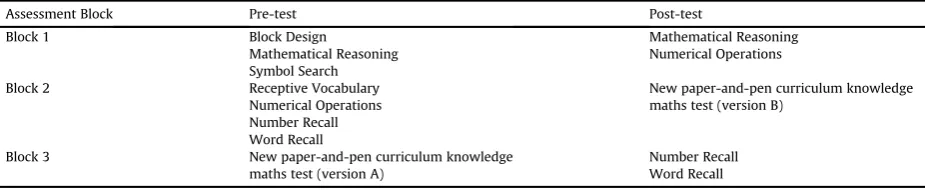
appropriate year group. Before and after the intervention pupils were assessed individually on the maths and cognitive measures described above. Assessments were administered in the same order in three short blocks. Each assessment block
lasted approximately 20 min and was administered over consecutive school days.Table 5describes the assessment protocol
for both studies. Post-test memory assessments were conducted with a sub-sample of pupils due to school absence of some
pupils on the assessment day (EYFS n¼16; Key Stage 1 n¼20). All of the assessments were administered in a quiet area, free
from distraction, in the child's familiar school environment.
3.1.9. Data analysis
pre-test and post-test on the new measure of curriculum knowledge, Mathematical Reasoning and Numerical Operations (based percentage of correct answers). Results are reported at a whole-sample level. The following analyses were conducted.
1) Similar to Study 1, to evaluate the immediate effectiveness of the maths tablet intervention, a paired-sample t-test was conducted comparing maths curriculum knowledge scores at pre-test and post-test. The generalisation of these learning gains was assessed using a separate paired-sample t-test comparing maths concepts performance at pre-test and
post-test. Within-group effect size analyses using Cohen's d were conducted to assess the strength of the intervention
learning gains and allow for comparison with Study 1.
2) To further examine the effectiveness of the intervention with EYFS pupils, a sub-sample of low-achieving EYFS pupils
(n¼4) were identified based on their composite maths performance at pre-test. These pupils performed at a level that was
1 SD or more below the group mean. A between-groups t-test was conducted to compare learning gains of these low-achieving EYFS pupils (using difference scores for the maths composite measure) compared to typically-developing EYFS peers.
3) To assess the impact of SES on learning gains observed across the intervention period a Pearson's correlation was calculated between IDACI scores and the maths composite difference scores.
4) To examine the relationship between learning gains and basic cognitive skills, a series of Pearson's correlations were conducted using the composite maths difference scores and raw scores for each of the four cognitive measures.
Furthermore, for significant relationships, a paired-sample t-test was conducted to examine whether cognitive
perfor-mance had increased over the 13-week intervention period.
3.2. Results
Table 6reports the mean performance at pre-test and immediate post-test for EYFS pupils receiving the maths tablet intervention on the two measures of maths ability (new curriculum knowledge and composite maths concepts) in Study 2.
Following the 13-week intervention with the maths apps, paired-sample t-tests revealed significant learning gains by EYFS
pupils in both curriculum knowledge (t(17)¼6.57,p<0.001; large effect sized¼1.3) and maths concepts (t(17)¼8.06,
p<0.001; large effect sized¼1.0). Furthermore, following 13-weeks of intervention with the maths apps, the sub-group of
four low-achieving EYFS pupils in Study 2 made significantly more progress on the composite maths measure (M¼17.48,
SD¼7.09) than their typically-developing EYFS peers (M¼9.58,SD¼4.49), as established by an independent-samples
t-test (t(16)¼2.74,p¼0.014). Similarly, significant gains in maths ability were found in Study 3 for the group of
low-achieving Key Stage 1 pupils following intervention with the maths apps. Paired-samples t-tests showed significant
learning gains on the new curriculum knowledge test (t(26)¼10.23,p<0.001; large effect sized¼1.8) and the composite
measure of maths concepts (t(26)¼7.47,p<0.001; large effect sized¼1.2) for this group of low-achieving Key Stage 1
pupils.
Pearson's correlations showed no significant relationship between SES (as measured by IDACI score) and gains in maths
ability (as measured by the composite maths score) across the intervention period in either Study 2, with EYFS pupils
(r¼ 0.41,p¼0.095) or in Study 3, with low-achieving Key Stage 1 pupils (r¼0.04,p¼0.861).
Table 7reports mean learning gains achieved with the composite measure of maths ability over the 13-week intervention period with the maths apps and mean cognitive performance measured at pre-test for the group of EYFS pupils in Study 2 and
low-achieving Key Stage 1 pupils in Study 3. For EYFS pupils (Study 2) there was no significant relationship between learning
gains in maths and any of the cognitive performance measures (Pearson's correlations allp>0.05). Likewise, for the group of
low-achieving Key Stage 1 pupils (Study 3) no significant associations were found between maths learning gains and
pro-cessing speed, receptive vocabulary and non-verbal IQ (Pearson's correlations allp> 0.05). However, results revealed a
significant negative relationship between maths learning gains and pre-test composite memory scores for low-achieving Key
Stage 1 pupils (r¼ 0.38,p¼0.048) but the strength of this relationship was not maintained with post-test composite
memory scores (r¼ 0.32,p¼0.170). A paired-samplest-test showed children's composite memory scores did not
[image:9.544.40.503.71.166.2]signif-icantly improve over time,t(19)¼1.85,p¼0.079.
Table 5
Assessment protocol used in Study 2 and 3.
Assessment Block Pre-test Post-test
Block 1 Block Design
Mathematical Reasoning Symbol Search
Mathematical Reasoning Numerical Operations
Block 2 Receptive Vocabulary
Numerical Operations Number Recall Word Recall
New paper-and-pen curriculum knowledge maths test (version B)
Block 3 New paper-and-pen curriculum knowledge
maths test (version A)
3.3. Discussion
Studies 2 and 3 addressed the limitations identified of Study 1 by repeating the maths tablet intervention for a longer
period of time (13 weeks) and by using a non-tablet based paper-and-pen assessment of curriculum knowledge and
standardised assessments of mathematical concepts. Furthermore, Studies 2 and 3 considered the efficacy of the maths tablet
intervention in supporting low-achieving pupils and examined some of the underlying basic cognitive process that may be associated with observed learning gains.
Results were similar to Study 1, in that both EYFS and low-achieving Key Stage 1 pupils demonstrated significant learning
gains in curriculum and conceptual maths knowledge following the maths tablet intervention. In general, effect sizes were
larger in Study 2 and 3 than in Study 1, most likely reflecting the longer duration of implementation of the maths intervention
in Study 2 and 3 (13 weeks) compared to Study 1 (6 weeks). Consistent with Study 1, learning gains were not associated with SES, suggesting the maths tablet intervention is equally effective for pupils from different socio-economic backgrounds.
Interestingly, the maths tablet intervention was shown to be particularly beneficial for low-achieving pupils.
Specif-ically, in Study 2, a small sub-sample of low-achieving EYFS pupils made almost twice as much progress in maths ability following the 13-week tablet intervention than their typically-developing peers. In addition, Study 3 revealed that low-achieving Key Stage 1 pupils with poorer memory skills (at pre-test) made greater learning gains following the maths
tablet intervention than their low-achieving peers with better memory skills. This suggests that specific features of the
maths tablet intervention are particularly beneficial to pupils with poor memory skills in supporting their development of
early mathematical abilities.
While these two studies build on the limitations of Study 1 and provide further evidence for the efficacy of the maths
tablet intervention, particularly for low-achieving pupils, there are still important limitations that need to be addressed.
Specifically, the lack of an age-matched control group receiving time equivalent maths exposure is evident in all three studies
reported so far. Although the within-group effect sizes found in Studies 1e3 are comparable to the results observed in the
Malawi study which included an matched normal practice control group (Pitchford, 2015), the inclusion of an
age-matched control group is necessary to demonstrate more convincing the efficacy of using the maths tablet intervention in
UK primary schools. We address this issue in Study 4, by comparing a group of 4e5 year old children identified at pre-test as
being low-achievers in maths and comparing their performance to relatively high-achieving age-matched controls. In
addition, Studies 1e3 reported above implemented the maths tablet intervention‘in addition to’daily maths practice. These
three studies thus serve to establish the efficacy of using the maths tablet intervention as a supplementary teaching aid to
standard pedagogical practice. In contrast, in Study 4, we examine the efficacy of using the maths tablet intervention‘instead
of’a normal maths practice activity. Thus, Study 4 also allowed for exploration of the extent to which the impact of the maths
tablet intervention can be differentiated from normal practice, both in terms of typical maths development and overall exposure to maths teaching input.
4. Study 4
To address the main limitations of the previous three studies, which lacked an age-matched control group, and to explore
[image:10.544.42.507.90.153.2]different methods of implementing the tablet-based maths intervention into daily practice, we conducted afinal study. Study
Table 6
Study 2 and 3: Group mean performance on the new curriculum knowledge test and the composite measure of maths concepts (% correct Mathematical Reasoning and Numerical Operations) at pre-test and immediate post-test and percentage (%) gains for pupils after receiving the maths tablet intervention for 13 weeks.
Year Mean (SD)
Pre-test Post-test % gain
Study 2 New curriculum knowledge EYFS 27.17 (10.87) 39.11 (6.72) 23.9
Composite maths concepts EYFS 14.22 (4.46) 19.27 (5.19) 5.1
Study 3 New curriculum knowledge Key Stage 1 29.41 (7.30) 40.37 (4.52) 21.9
[image:10.544.40.508.195.265.2]Composite maths concepts Key Stage 1 16.22 (2.70) 20.08 (3.53) 3.9
Table 7
Study 2 and 3: Group mean composite maths learning gains following the 13-week intervention with the maths apps and cognitive performance at pre-test.
Mean (SD)
% gain
(Composite maths measure)
Memory (Pre-test) Memory (Post-test) Non-verbal IQ Processing Speed Receptive Vocabulary
Study 2 11.33 (5.98)
10.17 (2.67)
11.25 (2.07)
19.61 (4.46)
16.17 (8.56)
24.39 (3.68) Study 3 9.88
(4.23)
11.35 (2.34)
12.05 (1.98)
19.37 (2.59)
20.37 (6.39)
4 examined if the maths tablet intervention is particularly beneficial for low-achieving pupils aged 4e5 years, in comparison to relatively high-achieving aged-matched controls drawn from the same class who received standard maths practice. It also explored if the maths tablet intervention could be effective when time learning maths was equated across the intervention and control children.
4.1. Materials and method
4.1.1. Design
The School of Psychology ethics committee at the University of Nottingham granted ethical approval for this study. As with the previous studies, opt-in parental consent was obtained for all participating pupils.
Study 4 adopted a between-groups design with a group of low-achieving pupils receiving the hand-held tablet inter-vention over a period of 16-weeks with 50% exposure time (equivalent to 8 week of full time exposure, as in the previous studies) and a control group of typically-developing pupils in the same EYFS class. Study 4 was conducted in an average sized mixed gender primary school in a middle class SES area of Nottingham. Similar to Studies 2 and 3, pupils were assessed on the paper-and-pen assessment of maths curriculum knowledge, the Mathematical Reasoning sub-test from the WIAT-II
(Wechsler, 2005) and the verbal and non-verbal memory measures from the KABC-II (Kaufman&Kaufman, 2004).
4.1.2. Participants
A group of 12 low-achieving pupils received the maths tablet intervention. Their performance was compared to that of 15
typically-developing age-matched controls. Low-achieving and typically-developing pupils were identified based on
teacher's assessments of children's number, shape, space and measure abilities at the start of the school year.Table 8
sum-maries the sample structure.
4.1.3. Procedure
Similar to the previous three studies, children took part in the maths tablet intervention for 30 min sessions. Due to practical reasons associated with the accessibility of the iPad hardware, each of the low-achieving pupils used the maths apps for 50% of the time over the 16-week intervention period (equivalent to 8 weeks of full-time intervention implementation). The maths tablet intervention was embedded into the everyday classroom routine and the group of low-achieving pupils used the maths tablet intervention instead of one of their usual daily maths activities. The daily maths activity that the maths tablet intervention replaced consisted of a group-based maths activity delivered using the interactive white board, which focused on similar topics to those covered in the maths apps. Children in the typically-developing control group received this group-based interactive white-board activity to ensure that overall exposure to maths teaching input was equivalent for both groups.
Before and after the 16-week intervention period, children were assessed on the two measures of maths ability (curric-ulum knowledge and Maths Reasoning) and the two measures of memory ability (number recall and word recall). The same
assessment administration procedures were followed as described in Study 2 and 3 above (see section3.1.8).
4.1.4. Data analysis
Test performance was calculated for individual pupils for each of the maths and memory measures given at pre-test and post-test. Memory scores at each time point were mean-averaged to give an overall composite memory score. In addition, an overall composite measure of maths ability was calculated for each pupil by averaging their difference score at pre-test and post-test on the paper-and-pen measure of curriculum knowledge and Mathematical Reasoning (based on percentage of correct answers). The following analyses were conducted.
1) To examine the immediate learning gains following the 16-week intervention period, two separate 2 (Time: pre-test, post-test) x 2 (Group: maths tablet, normal practice) mixed ANOVAs were conducted for curriculum knowledge and
maths concepts. Within-group and between-group effect size analyses using Cohen'sdwere conducted to assess the
strength of the intervention learning gains and allow comparison with the previous studies.
[image:11.544.36.504.621.688.2]2) To assess the impact of SES on learning gains observed across the intervention period Pearson's correlations were conducted between IDACI scores and the maths composite difference scores for each group.
Table 8
Sample structure for Study 4.
Age Group (n)
Age M (SD) (months)
Age Range (months)
Gender (F:M) SES
(IDACI score Range)
Language (EAL: Non-EAL)
Low-achievers EYFS
(12)
53.92 (3.70) 50e60 7:5 1e36 0:12
Typically-developing controls EYFS (15)
57.60 (3.54)
4). To examine the relationship between learning gains and memory ability, following the results of Study 3, Pearson's correlations were conducted using the composite maths difference scores and the raw memory composite scores taken at pre-test and post-test.
4.2. Results
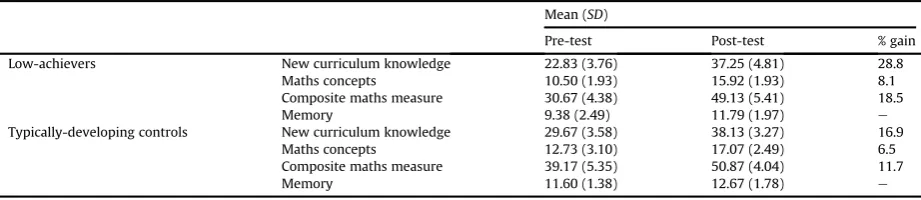
Mean performance for the group of low-achievers and typically-developing age-matched controls over the 16-week
intervention period is reported inTable 9.
For immediate learning gains in curriculum knowledge, a 2 (Time: pre-test, post-test) x 2 (Group: maths tablet, normal
practice) mixed ANOVA revealed significant main effects of Time,F(1, 25)¼256.20,p<0.001 and Group,F(1, 25)¼8.73,p¼
0.007 and a significant interaction between Time and Group was observed,F(1, 25)¼17.32,p<0.001. Post-hoc
paired-samples t-tests revealed that both groups made significant progress in maths curriculum knowledge over time, although
the effect size was greater for the maths tablet group than the control group; maths tablet (t(11)¼12.18,p<0.001,
within-groups effect size¼3.3), normal practice (t(14)¼9.83,p<0.001, within-groups effect size¼2.5). However, independent
t-tests showed that at pre-test, the normal practice group significantly outperformed their lower achieving peers (t(25)¼4.82,
p<0.001, between-groups effect size¼1.9). This is to be expected as the group that received normal practice were identified
at pre-test as being of relatively higher maths ability than the group of low-achievers that received the maths tablet
inter-vention. Importantly, at post-test no significant difference between groups was found (t(25)¼0.57,p¼0.576,
between-groups effects size¼0.2).
For immediate learning gains in the test of maths concept knowledge a 2 (Time: pre-test, post-test) x 2 (Group: maths
tablet, normal practice) mixed ANOVA showed a significant main effect of Time, F(1, 25)¼112.55,p<0.001 but not
Group,F(1, 25)¼4.03,p¼0.056, and the interaction between Time and Group was not significant,F(1.25)¼1.46,p¼
0.239. Collapsed across groups, pupils' performance on the measure of maths concepts knowledge increased significantly
over the intervention period and the relatively high-achieving control group significantly outperformed the group of
low-achieving pupils that received the maths tablet intervention. However, as reported in the Appendix, effect sizes calcu-lated for each group across time illustrate that the maths tablet intervention with the low-achieving pupils generated a
larger effect (Cohen'sd¼2.8) than normal practice received by the group of typically-developing controls (Cohen'sd¼
1.5).
Consistent with the previous studies, there was no significant relationship between children's SES and difference
com-posite maths scores for either the low-achiever group that received the maths tablet intervention (r¼ 0.13,p¼0.679) or the
typically-developing control group that received normal practice (r¼ 0.19,p¼0.493).
Correlation analysis examining the relationship between memory capacity at pre-test and maths progress over the intervention period for the group of low-achieving pupils that received the maths tablet intervention revealed a negative
correlation which failed to reach significance (r ¼ 0.20, p¼0.536). At post-test no significant correlation was found
(r¼ 0.05,p¼0.887).
4.3. Discussion
Study 4 builds on from the previous three studies by focusing on the efficacy of using the maths tablet intervention with
low-achieving EYFS pupils and the role of memory in learning with the apps. Through the inclusion of an age-matched control group that were matched in exposure to maths activities, this study addresses the main limitation of the previous studies.
Furthermore, it adds to the overall evidence base concerning the efficacy of the hand-held tablet intervention to support the
development of early mathematical skills in UK primary school children.
Similar to the previous studies, Study 4 showed that low-achieving children who had used the tablet intervention
[image:12.544.43.504.582.682.2]made significant improvements in maths curriculum knowledge and that this knowledge generalised to new content in
Table 9
Study 4: Group mean performance on the new curriculum knowledge test, maths concepts test, overall maths composite score and memory performance at pre-test and immediate post-test. Percentage (%) gains for pupils after receiving the maths tablet intervention and normal practice for 16 weeks are also provided.
Mean (SD)
Pre-test Post-test % gain
Low-achievers New curriculum knowledge 22.83 (3.76) 37.25 (4.81) 28.8
Maths concepts 10.50 (1.93) 15.92 (1.93) 8.1
Composite maths measure 30.67 (4.38) 49.13 (5.41) 18.5
Memory 9.38 (2.49) 11.79 (1.97) e
Typically-developing controls New curriculum knowledge 29.67 (3.58) 38.13 (3.27) 16.9
Maths concepts 12.73 (3.10) 17.07 (2.49) 6.5
Composite maths measure 39.17 (5.35) 50.87 (4.04) 11.7
the assessment of maths concepts. The progress in curriculum knowledge made by the low-achievers over the 16-week
intervention period was significantly greater (Cohen'sd¼3.3) than that made by their relatively high-achieving peers
who received normal maths practice only (Cohen'sd¼2.5). Furthermore, the significant gap in achievement that was
evident at pre-test closed following the 16-week intervention period. At pre-test the performance of the typically-developing controls was 13.7% higher than that of the group of low-achievers on the curriculum knowledge test. In contrast, at post-test, the performance levels were similar across groups. At post-test, the mean performance of the group of typically-developing controls was only 1.8% higher than that of the low-achieving group. For the standardised
measure of maths concepts, although the interaction between Group and Time was not significant, effect sizes
calculated per group across the intervention period were greater for the low-achieving pupils that received the maths
tablet intervention (Cohen's d ¼2.8) than the typically-developing controls that received normal practice (Cohen's
d ¼1.5).
Consistent with the previous three studies, SES was shown to have no significant influence on children's progress in maths
over the duration of the intervention period for either group. Similar to Study 3, a negative relationship was found between memory scores at pre-test and overall progress in maths in low-achieving pupils. Both studies showed that low-achievers with weaker memory capacity made more progress in maths over the duration of the tablet intervention than low-achievers with relatively higher memory capacity. However, for the EYFS pupils reported in Study 4 this relationship did
not reach significance (r¼ 0.20,p¼0.536), whereas in Study 3 with older low-achieving Key Stage 1 pupils this relationship
was significant (r¼ 0.38,p¼0.048). The difference in strength and significance of this relationship across studies could be
due to a relative lack of power in Study 4 compared to Study 3 as sample size differed across studies (Study 4 low-achievers
n¼12; Study 3 low-achievers n¼27) as did the duration of intervention (Study 4 16 weeks of intervention at 50% exposure
equivalent to 8-weeks full-time intervention; Study 3 13 weeks of intervention at 100% exposure). However, the negative relationship found across both studies suggests that the maths tablet intervention is particularly suited for use with low-achieving pupils with poor memory capacity. Taken together, these results suggests that the maths tablet intervention can
be an effective aid for closing the gap in early maths attainment that is evident even within thefirst year of compulsory
education.
5. General discussion
Together, these four studies report an in-depth evaluation of the efficacy of hand-held tablet technology with
learner-centred software in supporting the development of early maths skills of primary school children in the UK. In Studies 1e3
the intervention was implemented in addition to standard practice whereas in Study 4 the intervention was implemented instead of a component of normal practice, thus enabling direct comparisons to be made with normal practice through the inclusion of an age-matched and time-matched control group.
Despite differences across studies in the methodologies used (summarised in the Appendix), overall, results showed large
and significant learning gains in early maths skills following the tablet intervention. Additional comparisons with older Key
Stage 1 children and age-matched typically-developing controls, who had not received the tablet intervention, showed these improvements were above the level expected for the typical development trajectory obtained through normal teaching
practice. Furthermore, within our studies learning gains did not appear to be influenced by EAL status or SES background.
Finally, low-achieving pupils with poor memory skills showed the largest improvements over time. These results suggest that hand-held tablet technology with learner-centred software is accessible to all learners and offers an effective means to supplement standard early years pedagogical practice, which could help primary schools to address the crisis in under-achievement in maths that a currently a major concern within the UK.
The main limitation with Studies 1e3 was the lack of an age-matched control group receiving normal teaching practice
only.Cheung and Slavin (2013)argue intervention studies without a control group typically report much larger effect sizes
than studies with adequate controls. However, thefindings from these studies are consistent with Study 4 and with previous
research evaluating the same tablet intervention in a different educational context, using a randomised control trial design. In Malawi, learning gains were compared across pupils who received the maths tablet intervention compared to two age-matched control groups, a normal practice control group and a tablet control group who used the hand-held tablets with interactive apps that supported art and design but not mathematical skills (Pitchford, 2015). The large effect sizes observed in
the current UK studies (all>1, except two, see Appendix) are similar to or greater than those found byPitchford (2015)in
Malawi (Cohen'sd>0.8).
In general, as shown in the Appendix, the studies with typically-developing children found greater effect sizes with a longer implementation period of 13 weeks (Studies 2 and 3, where effect sizes ranged from 1.0 to 1.8 immediately post intervention) than 6 weeks (Study 1, where effect sizes ranged from 0.31 to 1.01 immediately post intervention). This
supports previous literature that suggests time-on-task impacts on learning gains (Cheung&Slavin, 2013). It also
ad-dresses potential novelty effects typically observed in brief intervention studies (less than 12 weeks) with large effect
sizes (Cheung&Slavin, 2013). The consistently large effect sizes observed in our studies of varied duration suggest that
weeks of full time exposure) achieved effects sizes of 3.3 on the curriculum knowledge assessment and 2.8 on the
assessment of maths concepts. This suggests that the maths tablet intervention is particularly beneficial for
low-achieving pupils.
Together with the study that was conducted with primary school children in Malawi with the same learner-centred maths apps using the local language of Chichewa (Pitchford, 2015), these four studies with UK primary children provide strong
evidence to suggest that hand-held technology with learner-centred software can be a universally accessible and beneficial
learning tool. Furthermore, thesefindings are consistent with recent research from the US demonstrating improved
math-ematics performance in young children following tablet technology-based educational interventions delivered at preschool
(Schacter&Jo, 2016) or at home (Berkowitz, Schaeffer, Maloney, Peterson, Gregor, Levin&Beilock, 2015).
These educational technologies are considered complex interventions (Ha
b
ler et al., 2016) making it difficult todisentangle the exact features of the software and hardware that make the intervention successful. However, it is possible
to highlight certain features that may contribute to the learning gains found here. In particular, the specific design
features, including immediate feedback, continuous assessment and task and instruction repetition, which are embedded in the learner-centred software, might contribute to the observed learning gains after using this tablet intervention. This allows children to regulate their own learning activities and serves to create an individualised learning environment that
is not characteristic of normal classroom practice (Condie&Munro, 2007; Rose et al., 2005). Learner control has been
shown to be an important influence on improved learning outcomes (Morrison, Ross,&Baldwin, 1992) and may create a
sense of learning autonomy. This might be particularly important for children struggling with conventional instructional
practice, which could perhaps account for thefindings from Studies 2e4 that showed greater learning gains in
low-achieving pupils.
First, the software includes immediate feedback and continuous assessment. The immediate and personalised feedback (positive or negative) after every interaction with the software encourages individual pupils to engage actively with the learning activity, which is not necessarily possible within the normal classroom environment. This individualised nature of the intervention draws upon evidence-based direct instructional practices and allows for the differing needs of individual
pupils to be addressed (Gulliford&Miller, 2015). The continuous assessment, which also includes feedback through the end of
topic quizzes, ensures staged progression, as pupils cannot progress until they have achieved a 100% pass rate. These two features embody retrieval-based learning, which has been shown to improve the encoding and application of new
infor-mation (e.g.Grimaldi&Karpicke, 2014). Furthermore, the staged progression of the delivery of the apps content ensures
pupils are working on activities that are just beyond their current ability level and more challenging than their previous
accomplishments; characteristics that are known to facilitate learning (Inal&Cagiltay, 2007; Shin et al., 2012; Vygotsky,
1978).
Second, the maths apps evaluated here allow for tasks and instructions to be repeated as often as desired by individual pupils. The ability to repeat tasks allows children to employ trial-and-error strategies and encourages them to persevere
with difficult tasks, which has been shown to improve student achievement (Garris, Ahlers, &Driskell, 2002; R€as€anen
et al., 2009; Thomas&Macredie, 1994). Moreover, the repetition features are particularly beneficial for low-achieving pupils, especially if they also have poor memory skills. Previous research has shown memory is an important
predic-tor of early maths skills (e.g.Mulder, Pitchford,&Marlow, 2010). More specifically,Passolunghi and Siegel (2004)found
that memory storage capacity in low-achieving pupils is used less efficiently than in their peers. It is possible that the
repetitive nature of the maths tablet intervention evaluated here might serve to reduce memory demands during the different activities built into the apps and thus makes learning accessible for all pupils. This suggests that hand-held technology with learner-centred software can be used effectively to foster an inclusive learning environment as the apps support child-centred learning and adapt to the pace of individual pupils so can be used in the same setting with
children of different abilities. Overall, these findings support Kucirkova’s (2014) assertion that well-designed,
age-appropriate, software grounded in an evidence-based curriculum can provide a beneficial classroom tool to support the
acquisition of basic skills.
While the initial cumulative evidence from these four relatively small-scale studies is valuable in establishing the efficacy
of the hand-held tablet intervention for early maths skills, further larger scale research is needed, including a greater number of schools and pupils, to establish the effectiveness of this intervention when implemented at scale. The way in which the intervention is implemented at scale also needs to be investigated in terms of whether the intervention is best suited as a supplementary aid to maths classroom teaching or whether it should be fully embedded as part of the standard maths curriculum. We are currently addressing these questions regarding scaling up the intervention in a randomised control trial that is taking place in schools across Nottingham and Nottinghamshire.
6. Conclusion
Collectively, the four studies reported here show clear immediate and sustained learning benefits of the hand-held
tablet-technology intervention with learner-centred software in supporting the development of early mathematical
skills, particularly for children identified as low-achievers. No significant effect of EAL status and SES background on
individualised child-centred learning environment that is effective in supporting early maths development and can foster inclusive learning. Moreover, software that includes repetitive and interactive features can help to reduce cognitive task
demands, which seems to be particularly beneficial for low-achieving pupils with poor memory skills. Seemingly,
inter-active tablet-based interventions that incorporate these features can be effective at reducing the gap in maths attainment
that, unless treated early in the primary years, can evolve over time to represent significant levels of underachievement in
the later school years.
7. Implications
The evidence from these four studies provides‘proof of concept’of the benefits of this maths tablet intervention for
supporting the development of early mathematical skills with children aged 4e7 years old. These results have important
practical and theoretical implications. For teaching professionals these studies demonstrate that this intervention can be an effective tool in raising maths attainment for children in the early primary school years. The intervention appears to be
particularly beneficial for achievers as we have shown it can help to narrow the attainment gap between high- and
low-achievers. The results of our studies also have theoretical important implications. In particular, our data demonstrate an important association between early maths ability and short-term memory as children with weak memory skills made the most progress in maths with this intervention. This shows that even children with poor memory skills can acquire basic mathematical knowledge when given an intervention, such as the one evaluated here, which reduced the cognitive demands that are present in traditional classroom settings. We have shown that this tablet-based maths intervention can be effectively targeted to support children with weak memory skills, ensuring no child is left behind. Now proof of concept has been
demonstrated, an efficacy trial is needed to examine the scalability of this intervention, prior to recommending it becomes
embedded within daily teaching practice.
Acknowledgements
This work was supported the Economic and Social Research Council [No. ES/J500100/1]. We would like to thank the staff, children and parents at Dunkirk Primary School (Study 1), Thorne King Edward Primary School (Study 2 and 3), and
Burton Joyce Primary School (Study 4) for participating in this research. We also thank Andrew Ashe (CEO ofonebillion)
and Michal Safier (Programmer at onebillion) for their assistance with Study 1, Selena Falcone for her help with data
collection for Study 2 and 3, and Sarah Roberts for her illustrations in the new paper-and-pen curriculum knowledge assessment.
Appendix. Summary of methodologies used andfindings from each of the four studies.
Study 1 Study 2 Study 3 Study 4
Participants 61 EYFS pupils 18 EYFS pupils 27 low-achieving
Key Stage 1 pupils
12 low-achieving EYFS pupils and 15 typically-developing EYFS pupils Implementation Teaching staff in a quiet classroom area in small groups
in addition to daily maths practice
Teaching staff in a quiet classroom area in small groups instead of one daily maths practice activity
Design Within-subject across three time periods: pre-test, immediate post-test and delayed post-test
Within-subject across two time periods: pre-test and immediate post-test
Between group across two time periods: pre-test and immediate post-test
Duration 6 weeks (with intervention being given for 100% of the time)
13 weeks (with intervention being given for 100% of the time)
16 weeks (with intervention being given for 50% of the time; equivalent to 8 weeks at 100% exposure)
Assessments Tablet-based curriculum knowledge and maths concepts developed byPitchford (2015)
New paper-and-pen based curriculum knowledge and standardised tests of Mathematical Reasoning and Numerical Operations
New paper-and-pen based curriculum knowledge and standardised tests of Mathematical Reasoning
% gain Curriculum knowledge
Immediate: 21.9 Sustained: 27.6
Immediate: 23.9 Immediate: 21.9 Immediate: 28.8
Maths concepts
Immediate: 4.6 Sustained: 10.0
Immediate: 5.1 Immediate: 3.9 Immediate: 8.1
Effect size
Curriculum knowledge
Immediate: 1.0 Sustained: 1.4
Immediate: 1.3 Immediate: 1.8 Low-achievers: Immediate: 3.3 Typically-developing controls: Immediate: 2.5
Maths concepts
Immediate: 0.3 Sustained: 0.8