This is a post-peer-review, pre-copyedit version of an article published in International Journal of Computer-Supported Collaborative Learning (ijCSCL). The final authenticated version is available online at:
http://dx.doi.org/10.1007/s11412-017-9260-z
Please cite this article as:
Schwaighofer, M., Vogel, F., Kollar, I., Ufer, S., Strohmaier, A., Terwedow, I., Ottinger, S., Reiss, K., & Fischer, F. (2017). How to combine collaboration scripts and heuristic worked examples to foster mathematical argumentation – when working memory matters.
How to combine collaboration scripts and heuristic worked examples to foster mathematical argumentation – when working memory matters
Matthias Schwaighofer1, Freydis Vogel2, Ingo Kollar3, Stefan Ufer4, Anselm Strohmaier2, Ilka Terwedow1, Sarah Ottinger4, Kristina Reiss2, & Frank Fischer1
1LMU Munich,
Chair of Education and Educational Psychology, Leopoldstr. 13, 80802 Munich, Germany
2Technical University of Munich, School of Education,
Arcisstr. 21, 80333 Munich, Germany
3University of Augsburg,
Universitätsstr. 10, 86159 Augsburg, Germany
4LMU Munich,
Chair of Mathematics Education, Theresienstr. 39, 80333 Munich, Germany
Corresponding author:
Abstract Mathematical argumentation skills (MAS) are considered an important outcome of mathematics learning, particularly in secondary and tertiary education. As MAS are complex, an effective way of supporting their acquisition may require combining different scaffolds. However, how to combine different scaffolds is a delicate issue, as providing learners with more than one scaffold may be overwhelming, especially when these scaffolds are presented at the same time in the learning process and when learners’ individual learning prerequisites are suboptimal. The present study therefore investigated the effects of the presentation sequence of introducing two scaffolds (collaboration script first vs. heuristic worked examples first) and the fading of the primarily presented scaffold (fading vs. no fading) on the acquisition of dialogic and dialectic MAS of participants of a preparatory mathematics course at university. In addition, we explored how prior knowledge and working memory capacity moderated the effects. Overall, 108 university freshmen worked in dyads on mathematical proof tasks in four treatment sessions. Results showed no effects of the presentation sequence of the collaboration script and heuristic worked examples on dialogic and dialectic MAS. Yet, fading of the initially introduced scaffold had a positive main effect on dialogic MAS. Concerning dialectic MAS, fading the collaboration script when it was presented first was most effective for learners with low working memory capacity. The collaboration script might be appropriate to initially support dialectic MAS, but might be overwhelming for learners with lower working memory capacity when combined with heuristic worked examples later on.
Keywords Mathematical argumentation skills * Collaboration scripts * Heuristic worked examples * Working memory capacity
Mathematical argumentations skills as an educational goal
Mathematical argumentation skills (MAS) include not only domain-specific, i.e. genuine mathematical skills (e.g., Yackel & Cobb, 1998), but also knowledge and skills regarding social-discursive aspects of argumentation (Kollar et al., 2014). Social-discursive MAS are necessary, for instance, when different steps of a mathematical proof process are discussed, when an individual proof idea is explained, or when two learners try to jointly find solution steps for a proof. That way, social-discursive MAS serve two purposes: On the one hand, social-discursive argumentative activities may lead to cognitive elaboration of mathematical concepts that are required to solve proof tasks and thus optimally help learners acquire domain-specific skills (“arguing to learn”; Andriessen, Baker & Suthers, 2003). For instance, one learner may have to deeply elaborate on what the learning partner has formulated in order to be able to understand and criticize the other position. On the other hand, engaging in social-discursive argumentative activities may also help students acquire social-discursive MAS, as the repeated engagement in such activities should yield a practice effect (“learning to argue”; Andriessen et al., 2003). In the study at hand we focus on that “learning to argue” objective: We study to what extent students’ social-discursive MAS can be enhanced by different scaffolds.
Within social-discursive argumentation, two different types of activities can be distinguished, namely dialogic activities and dialectic activities (Wegerif, 2008; Schwarz & Shahar, 2017). Dialogic activities are characterized by a joint conversation on the same arguments based on exchanging differences in a participatory way without overcoming these differences
(Wegerif, 2008). I.e. two learners, while trying to find a solution for a task, work together to improve the joint argument by finding better reasons, explanations, further clarification, etc. In contrast, dialectic activities comprise counterarguments (e.g., challenges to arguments) and the integration of different arguments to arrive at a joint solution by explicating conflicting arguments, and by linking and weighing these arguments (e.g., by accepting parts of each learners’ arguments; Schwarz, 2009).
Difficulties in mathematical argumentation
Even though the importance of engaging in both dialogic and dialectic argumentation as an important motor for learning has often been acknowledged, learners often experience difficulties during mathematical argumentation. For example, they are often not able to produce logical chains of more than one argument (Heinze, Reiss, & Rudolph, 2005). Also, concerning dialectic activities, they often fail to engage in a comprehensive argumentative discourse cycle with counterarguments and integration of argumentation (Leitão, 2000), or they leave out important parts in their argumentation, such as justifications for their claims or responses to counterarguments (Jiménez-Aleixandre, Rodrígues, & Duschl, 2000; Sadler, 2004).
The transition to a university mathematics program poses specific challenges in this respect, since it includes the transition from the application-oriented school subject “mathematics” towards the scientific discipline “mathematics” (Rach & Heinze, 2016; Vollstedt, Heinze, Gojdka, & Rach, 2014), with its own values and norms regarding mathematical proof and argumentation (Dawkins & Weber, 2016). During their university studies, students are requested not only to find consistent lines of deductive arguments from a framing theory to validate specific hypotheses, but also to communicate these arguments according to
mathematical standards (Vogel et al., 2016a). This transition is challenging (e.g., Hodds, Alcock, & Inglis, 2014). Therefore, supporting prospective university mathematics students to facilitate a successful transition to their study programs seems to be warranted. Preparatory courses and transition-to-proof courses are common to support students MAS in these
settings (e.g., Bausch et al., 2014; Selden, Benkhalti, & Selden, 2014). However, the effectiveness of integrating promising scaffolds to foster MAS in preparatory courses has rarely been investigated systematically.
Fostering mathematical argumentation skills
Past research (Kollar et al., 2014) has shown that two promising candidates for fostering MAS are collaboration scripts and heuristic worked examples. Both scaffolds are
subsequently described.
Collaboration scripts
may prompt learners to provide arguments for their positions and share them with their learning partner(s) (Kollar et al., 2014). That way, collaboration scripts specify and sequence learning activities and distribute them among the learners of a small group.
Optimally, the design of collaboration scripts is based on empirical research that
demonstrated what collaborative activities go along with in-depth knowledge acquisition (e.g., explaining ideas and concepts, argumentation, resolving conceptual discrepancies). Since learners often do not spontaneously use the most beneficial strategies in collaborative learning (e.g., King, 2007), external support by means of collaboration scripts seems to be warranted.
Several studies in contexts other than mathematics have shown that learning with
collaboration scripts may foster the acquisition of rather general collaboration skills, such as argumentation skills (e.g., Rummel, Mullins, & Spada, 2012; Schellens, Van Keer, De Wever, & Valcke, 2007; Weinberger, Stegmann, & Fischer, 2010). Collaboration scripts are also a promising scaffold to support the social-discursive aspects of MAS (Kollar et al., 2014, Vogel et al., 2016), as they may prompt learners to provide arguments, counterarguments and to integrate different arguments of learning partners. Thereby, they may especially facilitate dialectic activities. Dialogic activities may however also be induced when learners try to expand the arguments provided by a learning partner. However, the possibility of using collaboration scripts to foster dialogic and dialectic activities in the context of mathematical argumentation has not yet been systematically investigated. Due to their in principle content-independent nature, such collaboration scripts may however become even more effective when they are coupled with content-specific scaffolds such as heuristic worked examples (Reiss & Renkl, 2002).
Heuristic worked examples
In a collaborative learning process, heuristic worked examples may elicit both dialogic and dialectic activities. Heuristic worked examples rarely contain explicit debates about
strategies. Rather, one or two fictitious learners argue along a consistent line of thought, modeling strategies that can be applied in the argumentation process. These strategies may support real learners to formulate arguments and to extend ideas of their learning partners. Thus, the heuristic worked examples include information that can be used for dialogic activities. In addition to dialogic MAS, they may also address dialectic activities in collaborative scenarios, e.g. when contrasting heuristic worked examples are distributed among the learners of a small group in order to increase the likelihood of socio-cognitive conflicts to emerge (Clark, D’Angelo, Meneske, 2009). Overcoming different viewpoints conveyed by contrasting heuristic worked examples may involve exchanging of arguments and counterarguments and attempts to come to an integration of the different viewpoints. Studies in the mathematical context (especially in geometry) have shown positive effects of learning with heuristic worked examples on mathematical argumentation and proof (e.g., Reiss, Heinze, Renkl, & Große, 2008) and social-discursive MAS (Kollar et al., 2014).
How to combine collaboration scripts and heuristic worked examples: Presentation sequence, fading, and the role of individual learner characteristics
A straightforward idea to supplement collaboration scripts with heuristic worked examples would be the simple combination of the two scaffolds. This combination might lead to synergistic scaffolding effects when both scaffolds mutually increase their effectiveness concerning a joint outcome (Tabak, 2004). However, prior research by Kollar et al. (2014) did yield evidence for a synergistic scaffolding effect, as learners who worked both with collaboration scripts and heuristic worked examples did not outperform students who had only received one of the two scaffolds.
learner characteristics for the effectiveness of combining collaboration scripts with heuristic worked examples (role of individual learner characteristics)? In the following, these three questions are considered in more detail.
Presentation sequence of scaffolds
The temporal sequence by which scaffolds are presented may substantially influence learning outcomes (Renkl & Atkinson, 2007). Concerning collaboration scripts and heuristic worked examples, it though is not clear what scaffold should be presented first, and it seems possible to find arguments for both possible options (either presenting collaboration scripts first or presenting heuristic worked examples first). On the one hand, one might assume that it is more important to first receive content-specific support by heuristic worked examples in order to first help students construct content knowledge which in turn is a necessary basis for further argumentation processes. On the other hand, it may also be easier for learners to first learn about the general, cross-domain strategy of dialectic argumentation with a content-independent collaboration script before they apply that strategy in learning about the domain. The results of a study by Clarke, Ayres, and Sweller (2005) seem to be in accordance with this latter line of reasoning. The authors investigated whether spreadsheets (as a content-independent scaffold) to assist mathematics learning should be introduced before or
concurrent with content-specific mathematical guidance. Introducing the content-independent scaffold first was superior – at least for learners with low prior knowledge regarding
spreadsheets. Whether these results can be transferred to the combination of collaboration scripts and heuristic worked examples to foster students’ dialogic and dialectic MAS is an open question.
Fading of scaffolds
easily refer to the strategies conveyed by the previous heuristic worked examples for their argumentation about new examples. Also, taking away the previously presented scaffold may come too early for learners because they have to self-regulate their performance immediately with little previous practice (Wecker & Fischer, 2011). Especially learners with less favorable learning prerequisites (e.g., low prior knowledge concerning social-discursive MAS) may lack the skill of self-regulating dialogic and dialectic activities during the learning process. On the other hand, fading has been considered an important part of scaffolding (Pea, 2004) that affords learners to increasingly take control of their own learning activities. Further, knowledge about regulating the execution of skills can be acquired by repeatedly applying them in multiple contexts (e.g., Spiro, Coulson, Feltovich, & Anderson, 1988). Fading that scaffold that was presented first once the second one is introduced may thus enable learners to practice skills and thereby strengthen their dialogic and dialectic MAS.
The role of individual learner characteristics
The effectiveness of different scaffolds, especially when combined in one learning
environment, may depend on specific individual learner characteristics. We specifically focus on two variables: prior knowledge and working memory capacity.
Prior knowledge. Prior knowledge has repeatedly been shown to be one of the most important factors influencing learning (Kalyuga, 2013). For example, it is predictive for learning in statistics (Leppink, Broers, Imbos, van der Vleuten, & Berger 2012), and performance in physics and mathematics (e.g., Hailikari, Nevgi, & Komulainen, 2008; Hudson & Rottmann, 1981).
Furthermore, prior knowledge is considered to be a potential moderator of the effectiveness of various kinds of scaffolds. However, whether high or low knowledgeable learners benefit most from instructional support seems to be unclear. Research using more general measures of prior knowledge (e.g., grade point average) has found that highly knowledgeable learners may benefit most from instruction. This finding has been termed Matthew effect (e.g.,
increasing prior knowledge. This finding has been termed expertise reversal effect (e.g., Kalyuga, Rikers, & Paas, 2012). The explanation for the expertise reversal effect
predominantly comes from cognitive load theory (e.g., Sweller, 2011). Accordingly, learners with high levels of prior knowledge have schemas which can be represented as single
elements in working memory. Thus, these learners are likely to experience a low intrinsic cognitive load in working memory (i.e., working memory load due to the interacting elements in the learning material; Sweller, 2011). Contrary, for beginners, problem solving may induce a high cognitive load that is irrelevant for schema construction. This kind of cognitive load is called extraneous cognitive load. Worked examples may reduce extraneous cognitive load. Thereby, enough working memory capacity can be devoted to schema construction (Renkl, 2014). In contrast, supporting expert learners with information they already have in long-term memory may be redundant and cause additional extraneous cognitive load (e.g., Kalyuga, 2007). Applied to heuristic worked examples, the heuristics provided by the examples may interfere with learners’ existing strategies (Reiss et al., 2008) so that students with low prior knowledge may not be able to use the support to engage in processes associated with schema construction (germane load), but instead be overwhelmed by having to coordinate the
different kinds of support they are confronted with.
Working memory capacity. Working memory serves the function of temporarily storing and manipulating information (Baddeley, Allen, & Hitch, 2011). Several cognitive achievements depend on working memory such as problem solving performance (Bühner, Kröner, & Ziegler, 2008), math achievement (e.g., Peng, Namkung, Barnes, & Sun, 2016), and reading comprehension (Daneman & Merikle, 1996). Furthermore, working memory capacity is moderately correlated with fluid intelligence (e.g., Redick, Unsworth, Kelly, & Engle, 2012). Although working memory capacity presumably plays an important role for learning within cognitive load theory (e.g., Sweller, 2011), few studies investigating the effectiveness of worked examples have used objective and reliable measures of working memory capacity (for exceptions see de Jong, 2010; Schwaighofer et al., 2016) and instead relied on a subjective rating scale of cognitive load. However, concerns regarding the validity of the subjective rating scale exist (de Jong, 2010; Schwaighofer et al., 2016). For instance,
Schwaighofer et al. (2016) found that the subjective rating of cognitive load did not correlate with working memory capacity measured with three reliable and valid tasks. Examples for such tasks are complex span tasks. In an operation span task, for example, participants
to hit “TRUE” or “FALSE” on a computer keyboard. After each task, the participant receives a letter she is asked to remember until the end of the trial. Working memory span is then operationalized via the number of the correctly remembered letters in serial order.
Concerning the combination of collaboration scripts with heuristic worked examples, learners with low working memory capacity might be overwhelmed when the two scaffolds are
presented at the same time. Learners with high working memory capacity, in contrast, may be better able to integrate information from scaffolds that are presented simultaneously.
Therefore, these learners might benefit from the simultaneous presentation of collaboration scripts and heuristic worked examples.
When the second scaffold is introduced, the availability of the first scaffold may induce a high extraneous cognitive load in working memory when information coming from the first scaffold is redundant to some extent. Again, especially learners with low working memory capacity may struggle with the high demand on working memory and not have enough working memory capacity to deal with information from the second scaffold. In addition, these learners might not be able to integrate relevant information from the two scaffolds. Therefore, fading of the initially presented scaffold could be effective particularly for learners with low working memory capacity.
Research Questions
Against the background of these considerations, this study investigates the effects of different step-wise combinations of collaboration scripts and heuristic worked examples on dialectic and dialogic MAS. The scaffolds were used for mathematical proof tasks that students were asked to solve in dyads in the context of a two-week preparatory course for mathematics freshmen at a German university. We asked the following research questions:
RQ1: What is the effect of the presentation sequence of the two scaffolds (collaboration script first vs. heuristic worked examples first), the fading of the primarily presented scaffold
could either enhance learners’ development of the faded components or fading could
overwhelm learners. Therefore, we hypothesize effects of both the presentation sequence and the fading, but cannot determine the direction of the effects a-priori.
RQ2: To what extent is the effect of the presentation sequence of the two scaffolds
(collaboration script first vs. heuristic worked examples first) and the fading of the initially introduced scaffold (fading vs. no fading) on learners’ acquisition of dialogic and dialectic MAS moderated by learners’ prior knowledge (RQ2a) and working memory capacity (RQ2b)?
For the moderation of the effects of the presentation sequence and the fading of the scaffolds on dialogic and dialectic MAS by learners’ prior knowledge we argue that the Matthew effect would speak for learners with higher prior knowledge would benefit from no fading of either presentation sequence. In contrast, the expertise reversal effect would rather speak for learners with higher prior knowledge would benefit from fading of either presentation sequence. Therefore, we expect a moderation effect without a specific direction. For the moderation of the effects of the presentation sequence and the fading by learners’ working memory capacity, we hypothesize that learners with higher working memory capacity might be less affected by the presentation sequence and fading while learners with lower working memory capacity might be affected by the presentation sequence and might benefit from fading either scaffold.
Method
Setting and sample
included in the analyses as they completed the course and took part in all treatment and test sessions.
Learning material
During the four treatment sessions, learners were seated in dyads collaborating on one mathematical proof task per session. The tasks were presented on a shared worksheet which also contained a coarse structure of the task process. Learners wrote down their ideas using Livescribe Smartpens with integrated microphones. The Smartpens recorded the dyad’s talk in a digital video file, as well as their writing on the shared worksheet. Afterwards, each learner was asked to develop an individual solution based on the results of the collaboration. All dyads were provided with lecture notes that contained content from all lectures taught in the preparatory course. The collaboration script and the heuristic worked examples were presented depending on the experimental condition. Heuristic worked examples were
provided in printed form. The collaboration script was implemented in the shared worksheet (see the description in the section about the operationalization of the collaboration script and heuristic worked examples below).
Design
[image:13.595.88.507.575.686.2]The learners were randomly assigned to one of four experimental conditions of a 2 x 2 factorial design with the independent variables presentation sequence of the scaffolds (collaboration script first vs. heuristic worked examples first) and fading of the initially introduced scaffold (fading vs. no fading; see Table 1).
Table 1 Experimental conditions
Presentation sequence of the scaffolds Collaboration
script first
Heuristic worked examples first Fading of the initially
introduced scaffold
Fading n = 31 n = 26
No fading n = 24 n = 27
received heuristic worked examples in the first and second treatment session and the collaboration script in the third and fourth treatment session.
Whether the initially introduced scaffold was still available in the third and fourth treatment session (i.e., when the second scaffold was presented) was determined by the second
independent variable, fading of the initially introduced scaffold: The fading conditions did not receive the initially introduced scaffold in the third and fourth treatment session, while the no fading conditions received the initially introduced scaffold in the third and fourth treatment session in addition to the scaffold that was presented second.
Operationalization of the collaboration script and heuristic worked examples
Collaboration script. Before learners started to work on the mathematical proof tasks, the experimenter informed them about the structure of argumentation prompted by the
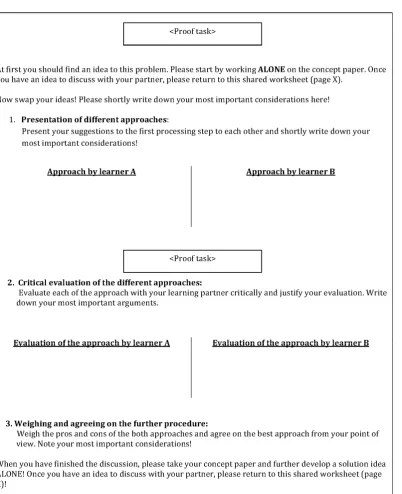
collaboration script. This was to make sure that all learners understood how to use the collaboration script. Figure 1 shows the prompts of the collaboration script in the shared worksheets, which were intended to structure the discussion between the learning partners according to the three phases of argumentation proposed by Leitão (2000). These phases were adapted for the present study. Phase 1: presentation of arguments for a step in solving the problem (a step presented by the learner him- or herself when no heuristic worked example was simultaneously presented; or a step that was prestented by the fictitious learner the was described in the heuristic worked example when a heuristic worked example was
simultaneously presented (see the description of the heuristic worked examples in the section below). Phase 2: critical evaluation of the arguments for the step in solving the problem (i.e., answering with a counterargument). Phase 3: building a synthesis for the arguments raised before. For example, in the condition with collaboration script and heuristic worked
collaboratively. Yet, there was no further structure given for the collaborative exchange of ideas.
Figure 1 Prompts of the collaboration script at the first page of the shared worksheets when students did not have a heuristic worked example.
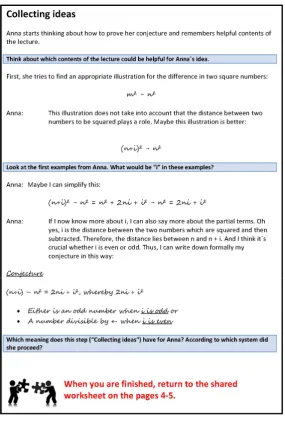
numbers and take differences of two square numbers. What do you notice? Formulate a conjecture and prove it!” To ensure that the learners understood how to work with heuristic worked examples, at the beginning of each treatment session the experimenter informed about the structure of a heuristic worked example, to track the solution processes in the examples, and to alternately work individually and collaboratively on the task. Figure 2 shows the third of six solution steps of a heuristic worked example related to the problem from elementary number theory described above.
The two learning partners in each dyad received heuristic worked examples on the same problem with different fictitious learners. The heuristic strategies of the fictitious learners in the worked examples differed to increase the need for discussion between the learning
partners. Each solution step of a heuristic worked example contained prompts to reflect about the solution steps. For instance, learners were prompted to judge in which way the approach to the problem chosen by the fictitious learner might be beneficial to solve this and other problems, and to compare this strategy with that of the fictitious learner in the partner’s worked example. After the first, the third, and the sixth solution step, participants were prompted to switch to the shared worksheet. These worksheets contained prompts to exchange ideas from the fictitious learners in the heuristic worked examples between the learning partners and to record the most important considerations on the sheet (either supported by the collaboration script or not). In addition, the worksheets contained prompts to return to the heuristic worked examples and work on the next solution steps after finishing the discussion. When no heuristic worked example was present, the learners were alternately asked to work individually on their idea for a step to come to a solution of the problem and collaboratively exchange their ideas
Procedure
The study contained two pretests, four treatment sessions, and a posttest during six
Dependent variables
Dialogic and dialectic MAS. During pre- and posttest, participants worked on a test to measure their dialogic and dialectic MAS. The test asked them to describe phases and activities that appear in a prototypical talk between two individuals who have different positions regarding the question on how to best support learning motivation (pretest) and to what extent talent or practice accounts for a person’s development of mathematical expertise. These questions were chosen in a way that should trigger the participants to describe the dialog, debate or discussion they would expect to appear. The students usually described a sequence of phases titled as “beginning of the talk”, “stating arguments”, “evidence”, “discussion”, “counterarguments”, “critic”, “conclusion”, “compromise”, “end of the talk”, etc. Answers of participants were analyzed with respect to dialogic and dialectic activities. Dialogic activities included (1) agreements and (2) extensions of the other arguments, while dialectic activities comprised (1) critique, (2) counterarguments and (3) integrations of arguments and counterarguments. Concerning dialogic MAS, learners received one point each when they mentioned agreements or extensions of arguments. With respect to dialectic MAS, one point was awarded each when learners mentioned critique, counterarguments or integrations of arguments and counterarguments. Table 2 shows some examples of students’ answers that were either rated with high or low values for dialogic and dialectic MAS. For both kinds of MAS, we only rated if the single items appeared at all with one point for each and summed up the entries of dialogic and dialectic activities. This resulted in a range of 0 to 2 points for dialogic MAS and a range of 0 to 3 points for dialogic MAS. Two student assistants were trained to rate learners’ answers for mentioning dialogic and dialectic activities with data that was not included in the study at hand. The rater training took four rounds of rating, discussing and adapting the coding scheme by including new examples etc. Each round took about one week to complete. After finishing the fourth round and
consolidating the coding scheme, the two student assistants rated a random sample from the actual data of 26 pre-test answers and 25 post-test answers separately to calculate inter-rater reliability. Sufficient values of inter-rater reliability were reached for the about 23% of the ratings of the students’ answers (Cohen’s κ for dialogic MAS: M = .71, range = .68-.75; Cohen’s κ for dialectic MAS: M = .74, range: .67-.83). Then, the data was evenly distributed between the two raters and each data set was rated by one of the two raters.
Student’s answer Dialogic activities
Dialectic activities “The first interlocutor explains his arguments.
The second interlocutor listens carefully and repeats the arguments of the first interlocutor in his own words to make sure he understood. He also adds his own ideas.”
high
(agreement, extension)
low (-)
“The first interlocutor poses his argument and an example. He states a hypothesis and tries to prove it with reasons. The second interlocutor poses a counterargument and an example. He shows his disagreement with an own hypothesis and proves it with reasons.”
low (-)
medium (counter-argument)
“The first interlocutor collects the most important arguments. The second interlocutor extends the collection.”
medium (extension)
low (-)
“The first interlocutor poses his hypothesis and arguments. The second interlocutor tries to find weaknesses in the argumentation of the first interlocutor and criticizes it. Then he poses counterarguments (…) in the end both
interlocutors balance the different arguments and try to find a joint solution.”
low (-) high (critique, counter-argument, integration)
Control and moderator variables
Prior knowledge (dialogic and dialectic MAS). As described, we measured dialogic and dialectic MAS also during pretest (see section about the dependent varibale). The pretest scores were used as covariates in subsequent analyses.
complete the automated operation span task on a laptop computer (Unsworth, Heitz, Schrock, & Engle, 2005). In this task, participants have to alternately solve simple mathematical equations and memorize letters which have to be recalled at the end of a sequence. The sum of letters recalled in all sequences divided by all trials serves as an estimate of the
participant’s working memory capacity (Unsworth et al., 2005). The internal consistency (Cronbach’s alpha) of the automated operation span was calculated by using the method of Kane et al. (2004) and yielded a value of α = .63.
Fluid intelligence. We assessed fluid intelligence at the second pretest using the sum score of the short version of the Culture Fair Intelligence scale (CFT 20-R; Weiß, 2006). The short version comprised four subtests with 56 items in total. The reliability of the test was α = .74.
Statistical analyses
The effects of the presentation sequence and fading of the two scaffolds on dialogic and dialectic MAS were analyzed using analyses of covariance controlling for prior dialogic or dialectic MAS, respectively.
Moderation analyses were conducted for prior knowledge and working memory capacity moderating the effects of the presentation sequence and fading of the scaffolds on the post test values of dialogic and dialectic MAS. These analyses were conducted with the SPSS macro PROCESS (Hayes, 2013). As proposed by Hayes (2012), heteroscedasticity-consistent standard errors were estimated. The influence of prior knowledge on the moderator and the dependent variable was controlled for when necessary. Applying the Johnson-Neyman technique (see Hayes, 2013) allowed us to quantify the effect of the independent variables on the dependent variables for different values of the respective moderator (prior knowledge or working memory capacity).
An alpha-level of 5% was used for all analyses.
Results
Preliminary analyses
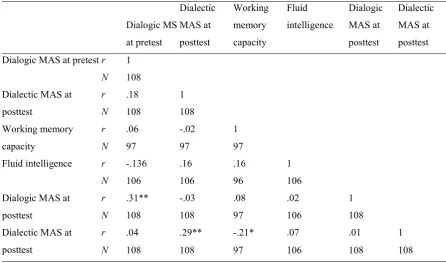
the other variables. The working memory only correlated significantly negatively with the dialectic MAS at posttest. In the subsequent analyses only for the prior knowledge significant effects on the dependent variables were found but not for fluid intelligence or working
[image:21.595.70.517.257.520.2]memory capacity. Therefore, in all subsequent analyses, prior knowledge concerning the respective dependent variable (i.e., dialogic or dialectic MAS) was included as covariate (if not already included as moderator). Neither fluid intelligence nor working memory capacity were included as covariate in the subsequent analyses.
Table 3 Correlations among moderator, control and dependent variables.
Dialogic MS at pretest Dialectic MAS at posttest Working memory capacity Fluid intelligence Dialogic MAS at posttest Dialectic MAS at posttest Dialogic MAS at pretestr 1
N 108 Dialectic MAS at
posttest
r .18 1
N 108 108 Working memory
capacity
r .06 -.02 1
N 97 97 97
Fluid intelligence r -.136 .16 .16 1
N 106 106 96 106
Dialogic MAS at posttest
r .31** -.03 .08 .02 1
N 108 108 97 106 108
Dialectic MAS at posttest
r .04 .29** -.21* .07 .01 1
N 108 108 97 106 108 108
**p < .01, *p < .05 (two-tailed).
RQ1a: Effects of the presentation sequence and fading of scaffolds on the acquisition of dialogic MAS
Descriptively, the condition that was first presented with the collaboration script that was faded afterwards performed best in dialogic MAS, while the condition that was first presented with the heuristic worked examples that were not faded afterwards performed worst in
dialogic MAS. Table 4 shows means and standard deviations for dialogic MAS for each experimental condition at posttest.
Presentation sequence of the two scaffolds Collaboration
script first
Heuristic worked examples first Fading of the
initially introduced scaffold
Fading 0.35 (0.49) 0.23 (0.51) No fading 0.21 (0.42) 0.04 (0.19)
The results of the ANCOVA with the pretest dialogic MAS as covariate showed that overall there was no significant main effect of the presentation sequence of the two scaffolds on the acquisition of dialogic MAS (F(1,103) = 1.81, p = .18, partial η2 = .02). In contrast, fading of
the initially introduced scaffold had a significant positive effect on the acquisition of dialogic MAS, F(1,103) = 6.63, p = .01, partial η2 = .06. No interaction effect between presentation
sequence and fading of the two scaffolds occurred for the dialogic MAS (F(1,103) = 0.19, p = .67, partial η2 < .01).
RQ1b: Effects of the presentation sequence and fading of the scaffolds on the acquisition of dialectic MAS
[image:22.595.97.500.598.722.2]In line with the results for the dialogic MAS, descriptively the condition that was first presented with the collaboration script that was faded afterwards performed best in dialectic MAS. The condition that was first presented with the heuristic worked examples that were not faded afterwards performed worst in dialogic MAS. Table 5 shows means and standard deviations for dialectic MAS for each experimental condition at posttest.
Table 5 Means and standard deviations (in parentheses) for the sum of dialectic activities mentioned by the learners in the individual posttest on dialectic MAS.
Presentation sequence of the two scaffolds Collaboration
script first
Heuristic worked examples first Fading of the
initially introduced scaffold
An ANCOVA with the pretest dialectic MAS as covariate revealed no significant main effect on the acquisition of dialectic MAS, neither for the presentation sequence of the two
scaffolds, (F(1,103) = 1.92, p = .17, partial η2 = .02) nor for the fading of the initially
introduced scaffold, F(1,103) = 0.77, p = .38, partial η2 = .01. Also, no interaction effect was
found, (F(1,103) = 0.04, p = .84, partial η2 < .01).
RQ2a: Prior knowledge as moderator for the effects of the presentation sequence and fading of scaffolds on the acquisition of dialogic and dialectic MAS
Prior knowledge did not significantly moderate the effect of the presentation sequence of the scaffolds on dialogic MAS (b = 0.06, 95% CI [-0.39,0.51], p = .78), and neither the effect of fading of the initially introduced scaffold on dialogic MAS (b = -0.05, 95% CI [-0.38,0.28], p = .75).
Concerning dialectic MAS, prior knowledge did not significantly moderate the effect of the presentation sequence of scaffolds (b = -0.18, 95% CI [-0.49, 0.14], p = .27) and neither the effect of fading of the initially introduced scaffold (b = 0.14, 95% CI [-0.18, 0.45], p = .40).
RQ2b: Working memory capacity as moderator for the effects of the presentation sequence and fading of scaffolds on the acquisition of dialogic and dialectic MAS
The moderator analyses with prior knowledge as covariate revealed that working memory capacity did not significantly moderate the effect of the presentation sequence of the two scaffolds on dialogic MAS (b = -0.03, 95% CI [-1.56, 1.50], p = .97), and neither the effect of fading of the initially introduced scaffold on dialogic MAS (b = 0.30, 95% CI [-0.82, 1.43], p = .59).
Regarding dialectic MAS, the moderator analyses with prior knowledge as covariate showed that the working memory capacity was no significant moderator for the effect of the
presentation sequence (b = -0.26, 95% CI[-2.92, 2.41], p = .85). Yet, the effect of fading of the initially introduced scaffold was significantly moderated by the working memory capacity (b = 3.64, 95% CI[1.30, 5.98], p < .01, increase in R2 due to interaction = .08.).
p < .001, increase in R2 due to interaction = .26). Post-hoc power-analysis revealed a power of 1 –β = .98. Applying the Johnson-Neyman technique indicated that learners with low working memory capacity benefitted most from fading of the collaboration script. In contrast, learners with very high working memory capacity benefitted from the simultaneous
availability of to the two scaffolds (see Appendix). For learners who were initially presented with the heuristic worked examples, their working memory capacity did not significantly moderate the effect of fading the heuristic worked examples (b = 1.04, 95% CI [-2.97, 5.05], p = .60, increase in R2 due to interaction = .01).
Discussion
The aim of this study was to investigate the effects of the sequence and the fading of a collaboration script and heuristic worked examples on learners’ development of dialogic and dialectic social-discursive MAS during a preparatory course for mathematics students at the transition from secondary to tertiary education. Furthermore, we were interested in the role that prior knowledge and working memory capacity played for learners’ benefit from learning with the differently sequenced and faded scaffolds. We conceived dialogic MAS as activities that build on the learning partner’s contribution in a concordant way such as expanding ideas of the learning partner. In contrast, dialectic activities of MAS were conceived as activities involving controversial discussions between learning partners. Our measures of dialogic and dialectic MAS were not correlated indicating that dialogic and dialectic activities can be separated as proposed by other authors (e.g., Schwarz & Shahar, 2017; Wegerif, 2008).
No indication for a general effect of the presentation sequence of scaffolds on dialogic and dialectic MAS
The findings of this study indicate that the sequence of introducing the collaboration script and heuristic worked examples had no effect on students’ acquisition of dialogic and dialectic MAS. In contrast to the findings of previous studies (Clarke et al., 2005), presenting content-specific scaffolds (heuristic worked examples) first or content-independent scaffolds
two presentation sequences were more beneficial. This might be uncovered by learners’ different pre-requisites and will be discussed in the subsequent sections.
The general effect of fading of scaffolds on dialogic MAS
Moreover, the findings show that the fading of the initially introduced scaffold had a positive effect on dialogic MAS. This replicates existing findings that fading is an important
mechanism of scaffolding for learning (Pea, 2004) yet, in another way as it might be expected. Because both scaffolds predominantly addressed dialectic activities, fading the initially introduced scaffold might have reduced the amount of irrelevant information for acquiring dialogic MAS. In addition, the collaboration script and heuristic worked examples may have fostered dialogic MAS to a similar extent when they were introduced as first scaffold. Therefore, introducing the second scaffold might have been redundant with respect to dialogic MAS (see Kalyuga, 2007). In accordance with this interpretation, both the collaboration script and heuristic worked examples involved prompts to foster the extension of arguments. For example, collaboration scripts prompted learners to integrate different arguments which could have involved at least in parts extending the views of the learning partner. Heuristic worked examples prompted participants to build upon the ideas of a fictitious learner. This line of reasoning is further corroborated by the finding that the effect of fading of the primarily introduced scaffold on dialogic MAS was not moderated by learning prerequisites. Regardless of their prior knowledge and working memory capacity, the availability of the initially introduced scaffold seems to be redundant for learners when the second scaffold is introduced.
A further explanation for the effect of fading on dialogic MAS might be that learners prefer to use dialogic activities. In contrast to dialectic activities, dialogic activities might be
The effect of fading for different presentation sequences on dialectic MAS – working memory capacity matters
Regarding the effects of fading of the initially introduced scaffold on the dialectic activities of MAS, varying results occurred for learners with different learning pre-requisites. The learners’ existing knowledge structures concerning dialectic activities might have been activated in the collaboration script first condition when the collaboration script was introduced as first scaffold (Fischer et al., 2013). Due to the learners’ experience with dialectic activities during the time the initially introduced collaboration script was present, the script might have become increasingly irrelevant in later learning phases. When in the second phase heuristic worked examples were introduced, the components of the
collaboration script may have already been internalized and subsequently activated. But, if they were then still externally present (i.e. when the collaboration script was still present, after the heuristic worked example was introduced), the support provided by the collaboration script may have been redundant and possibly have overwhelmed learners with low working memory capacity. Therefore, when introducing heuristic worked examples in the second phase and simultaneously fading the collaboration script, particularly learners with low working memory capacity may benefit from a reduction of the interacting elements (i.e., components of the script; e.g., Sweller, 2010) in working memory.
Applying the Johnson Neyman technique further indicated that learners with very high working memory capacity benefitted from the simultaneous availability of both scaffolds. It seems that these learners can handle the high demands on working memory capacity and focus their attention on the not yet internalized parts of the collaboration script and heuristic worked examples for acquiring dialectic MAS. In line with this suggestion, research indicates that control of attention is an important aspect of working memory capacity to maintain information in a short-term storage and retrieving information from long-term memory (Shipstead, Lindsey, Marshall, & Engle, 2014).
which may cause overload in working memory, one of which might be a high motivation to work on complex tasks.
Nevertheless, working memory capacity was not a moderator concerning the fading of the heuristic worked examples in the heuristic worked examples first conditions. Apparently, the availability of the heuristic worked examples induced no detrimental demands on working memory when the collaboration script was introduced. Heuristic worked examples reduced problem-solving demands considerably by providing relevant information regarding
processes to solve mathematical problems in all treatment sessions. Some learners might have found this information more useful for gaining knowledge about dialectic activities, while others might have found it less useful. However, this information did not seem to induce too much irrelevant working memory load for learners with low working memory capacity. Also, learners with high working memory capacity might not have been able to benefit from the continued availability of heuristic worked examples. This might explain the nonsignificant main effect of fading of the heuristic worked examples on dialectic activities.
Finally, the finding that prior knowledge had no moderating influence stands in contrast to research about the Matthew effect (e.g., Stanovich, 1986) and the expertise reversal effect (e.g., Kalyuga et al., 2012). Neither learners with high prior knowledge nor learners with low prior knowledge benefitted more from fading of the collaboration script or heuristic worked examples. At least for the effect of the fading of the collaboration script on dialectic MAS, working memory capacity seems to be the more important moderator. However, the variance in the lower range of values of prior dialogic and dialectic MAS was low, probably due to the small range of possible values (only integer values were achievable). Thus, the moderating role of prior knowledge might not have been established across a broad range of values in prior knowledge.
Limitations and directions for future research
Fischer, 2011). Future research should investigate the effects of a more gradual fading of one or both scaffolds when they are combined depending on individual knowledge or demands on working memory capacity. Additionally, future studies may investigate the role of peer monitoring when fading one of the two scaffolds.
Also, differences in the effects on dialogic and dialectic activities between the two types of presentation sequences of scaffolds might have been reduced by the design of the study and therefore hard to find. Even though the two scaffolds mainly were designed to trigger dialectic activities, they also involved characteristics that may have triggered dialogic activities. The collaboration script, although mainly focusing on dialectic sequence of argumentation, also included dialogic aspects that were supposed to help learners construct joint arguments (e.g., when asked to develop syntheses). Likewise, the heuristic worked examples for learning partners in a dyad were slightly different from each other and might thus easily trigger dialectic activities. Despite that, from what we observed they often led learners to a convergent understanding in the end. Thus, also dialogic activities might have been supported by these scaffolds. Against this background, finding similar patterns of effects for the two outcome measures may not have been very surprising. In addition, since all
learners received both scaffolds (although at different time points), the overall differences between the four conditions might have been too small to cause detectable effects on social-discursive MAS.
The low variance of prior knowledge due to a small range of possible values is a further limitation of the present study. Future studies may include tests that assess dialogic and dialectic MAS in a more differentiated way with more items. Furthermore, the tests to assess dialogic and dialectic MAS assessed rather declarative knowledge because participants were asked to describe phases and activities that appear in a prototypical discussion about a question. Further investigations should explore the effects of collaboration scripts and heuristic worked examples on social-discursive MAS by aid of more procedural measures.
Another limitation concerns the measurement of working memory capacity with only one
task. Therefore, task-specific influences due to the context or material of the task could not be
Yet, despite the relatively low reliability of the operation span task measuring working memory capacity, the reliability allowed to identify a large moderation effect with sufficient power. However, with respect to the moderation analyses, a limitation lies in the relatively small sample sizes for the comparisons of the conditions with or without fading of the initially introduced scaffold. Accordingly, the statistical power to detect small effects in addition to the large effect of working memory capacity might have been insufficient. Also, since participation in the preparatory course was voluntary, it may well be that self-selection may have influenced our sample. In other words, we cannot rule out that our learners had particular cognitive abilities (e.g., a higher working memory capacity) or motivational preconditions (e.g., a higher interest in mathematics or different goal
orientations) than students who did not choose to participate in the course. It might thus be fruitful to replicate our study in a context that leaves fewer opportunities for a self-selection bias.
Finally, as many other studies on CSCL scripts, we did not check how exactly the students understood the different script prompts. It may well be that different learners “appropriate” (Tchounikine, 2017) the script differently and these differences may yield differential effects on learning outcomes afterwards. It would be extremely interesting if future research would yield insights into how exactly such appropriation processes emerge during collaboration with a script.
Conclusion
The findings of this study reveal little support for the assumption that one specific sequence of introducing heuristic worked examples in addition to collaboration scripts in the context of mathematical argumentation and proof would be superior to another sequence. For designers of CSCL and non-CSCL environments, this finding might be welcome since it implies that pondering about the sequence of how different scaffolds are presented might be not
script is presented first and faded out when the more content related scaffold heuristic worked examples is presented in a second phase.
As a practical consequence, in order to individualize learning environments and adapt the environments to the learners’ prerequisites, it would make sense to measure not only content-related learning prerequisites such as domain-specific prior knowledge, but also more
Appendix
Conditional effect of the fading of the collaboration script on dialectic MAS for different values of working memory capacity
Working memory capacity (raw score)
Effect of the fading of the collaboration script
SE t p 95% CI LL UL
.3421 -4.5289 1.1811 -3.8344 .0004 -6.911 -0.5593
.3743 -4.2284 1.1066 -3.821 .0004 -6.4601 -0.5173
.466 -3.9279 1.0322 -3.8052 .0004 -6.0096 -0.475
.4388 -3.6273 0.958 -3.7862 .0005 -5.5594 -0.4323
.4711 -3.3268 0.8841 -3.763 .0005 -5.1097 -0.3891
.533 -3.0262 0.8104 -3.7341 .0005 -4.6606 -0.3453
.5355 -2.7257 0.7372 -3.6975 .0006 -4.2123 -0.3006
.5678 -2.4251 0.6644 -3.6499 .0007 -3.7651 -0.2548
.6 -2.1246 0.5924 -3.5863 .0009 -3.3193 -0.2076
.6322 -1.824 0.5214 -3.4983 .0011 -2.8756 -0.1582
.6645 -1.5235 0.4519 -3.3713 .0016 -2.4349 -0.1058
.6967 -1.223 0.3847 -3.1791 .0027 -1.9988 -0.0489
.7289 -0.9224 0.3212 -2.8716 .0063 -1.5702 0
.7612 -0.6219 0.2642 -2.3537 .0232 -1.1547 0.0148
.7755 -0.4884 0.2422 -2.0167 .05 -0.9768 0.0889
.7934 -0.3213 0.2188 -1.4687 .1492 -0.7625 0.1784
.8257 -0.0208 0.1933 -0.1075 .9149 -0.4105 0.2876
.8579 0.2798 0.1956 1.4302 .1599 -0.1147 0.4181
.8724 0.4153 0.2059 2.0167 .05 0 0.5669
.891 0.5803 0.225 2.5797 .0134 0.1266 0.7035
.9224 0.8809 0.2727 3.2299 .0024 0.3309 0.7289
.9546 1.1814 0.331 3.569 .0009 0.5138 0.8998
References
Asterhan, C. S. C. & Schwarz, B. B. (2007). The effects of monological and dialogical argumentation on concept learning in evolutionary theory. Journal of Educational Psychology, 99, 626–639. doi: 10.1037/0022-0663.99.3.626
Asterhan, C. S. C., & Schwarz, B. B. (2009). Argumentation and explanation in conceptual change: Indications from protocol analyses of peer-to-peer dialog. Cognitive Science, 33(3), 374–400. doi:10.1111/j.1551-6709.2009.01017.x.
Alexander, P. A., & Jetton, T. L. (2003). Learning from traditional and alternative texts: new conceptualization for an information age. In A. Graesser, M. Gernsbacher, & S. Goldman (Eds.), Handbook of discourse processes (pp. 199–241). Mahwah, NJ: Erlbaum.
Baddeley, A. D., Allen, R. J., & Hitch, G. J. (2011). Binding in visual working memory: The role of the episodic buffer. Neuropsychologia, 49, 1393–1400. doi:
10.1016/j.neuropsychologia.2010.12.042
Bausch, I., Biehler, R., Bruder, R., Fischer, P. R., Hochmuth, R., Koepf, W., … Wassong, T. (Eds.). (2014). Mathematische Vor- und Brückenkurse [Mathematical preparatory and bridging courses]. Wiesbaden: Springer Fachmedien Wiesbaden.
Boero, P. (1999). Argumentation and mathematical proof: a complex, productive,
unavoidable relationship in mathematics and mathematics education. International Newsletter on the Teaching and Learning of Mathematical Proof, 7(8).
Bühner, M., Kröner, S., & Ziegler, M. (2008). Working memory, visual–spatial-intelligence and their relationship to problem-solving. Intelligence, 36(6), 672–680.
doi:10.1016/j.intell.2008.03.008
Chi, M. T. H. & Wylie, R. (2014). The ICAP framework: Linking cognitive engagement to active learning outcomes. Educational Psychologist, 49 (4), 219–243. doi:
10.1080/00461520.2014.965823.
Clark, D. B., D’Angelo, C. M., & Menekse, M. (2009). Initial Structuring of Online
Discussions to Improve Learning and Argumentation: Incorporating Students’ Own Explanations as Seed Comments Versus an Augmented-Preset Approach to Seeding Discussions. Journal of Educational Science and Technology, 18, 321–333.
Clarke, T., Ayres, P., & Sweller, J. (2005). The impact of sequencing and prior knowledge on learning mathematics through spreadsheet applications. Educational Technology Research and Development, 53(3), 15–24. doi:10.1007/BF02504794
CCSSI. (2017). Common Core State Standards for Mathematics. Retrieved from http://www.corestandards.org/Math/Practice/#CCSS.Math.Practice.MP1
Collins, A., Brown, J. S., & Holum, A. (1991). Cognitive apprenticeship: Making thinking visible. American educator, 15(3), 6-11. doi:10.1.1.124.8616
Daneman, M., & Merikle, P. M. (1996). Working memory and language comprehension: A meta-analysis. Psychonomic Bulletin & Review, 3(4), 422–433.
http://doi.org/10.3758/BF03214546
Dawkins, P. C., & Weber, K. (2016). Values and norms of proof for mathematicians and students. Educational Studies in Mathematics. https://doi.org/10.1007/s10649-016-9740-5
Deiglmayr, A. & Spada, H. (2010). Developing adaptive collaboration support: the example of an effective training for collaborative inferences. Educational Psychology Review, 22(1), 103-113. doi: 10.1007/s10648-010-9119-6
de Jong, T. (2010). Cognitive load theory, educational research, and instructional design: some food for thought. Instructional Science, 38(2), 105–134.
https://doi.org/10.1007/s11251-009-9110-0
Dillenbourg, P. & Jermann, P. (2007). Designing integrative scripts. In F. Fischer, I. Kollar, H. Mandl, & J. M. Haake (Eds.), Scripting computer-supported collaborative learning. Cognitive, computational and educational Perspectives. (Vol. 6, pp. 275–301). New York, NY: Springer.
Dochy, F., Segers, M., & Buehl, M. M. (1999). The relation between assessment practices and outcomes of studies: The case of research on prior knowledge. Review of Educational Research, 69(2), 145–186. doi:10.2307/1170673
Fischer, F., Kollar, I., Stegmann, K., & Wecker, C. (2013). Toward a Script Theory of Guidance in Computer-Supported Collaborative Learning. Educational Psychologist, 48(1), 56–66. doi:10.1080/00461520.2012.748005
Hailikari, T., Nevgi, A., & Komulainen, E. (2008). Academic self-beliefs and prior
knowledge as predictors of student achievement in mathematics: a structural model. Educational Psychology, 28(1), 59–71. https://doi.org/10.1080/01443410701413753 Hanna, G. (2000). Proof, explanation and exploration: an overview. Educational Studies in
Hayes, A. F. (2012). PROCESS: A versatile computational tool for observed variable mediation, moderation, and conditional process modeling [White paper]. Retrieved from http://www.afhayes.com/public/ process2012.pdf
Hayes, A. F. (2013). Introduction to mediation, moderation, and conditional process analysis: A regression-based approach. New York, NY: Guilford Press.
Heinze, A., Reiss, K., & Rudolph, F. (2005). Mathematics achievement and interest from a differential perspective. Zentralblatt für Didaktik der Mathematik, 37(3), 212–220. http://dx.doi.org/10.1007/s11858-005-0011-7.
Hodds, M., Alcock, L., & Inglis, M. (2014). Self-explanation training improves proof comprehension. Journal for Research in Mathematics Education, 45(1), 62–101. doi:10.5951/jresematheduc.45.1.0062
Hudson, H. T. & Rottmann, R. M. (1981). Correlation between performance in physics and prior mathematics knowledge. Journal of Research in Science Teaching, 18(4), 291– 294. doi:10.1002/tea.3660180403
Jahnke, H. N., & Ufer, S. (2015). Argumentieren und Beweisen. In R. Bruder, L. Hefendehl-Hebeker, B. Schmidt-Thieme, & H.-G. Weigand (Eds.), Handbuch der
Mathematikdidaktik (pp. 331–355). Berlin, Heidelberg: Springer Berlin Heidelberg. http://link.springer.com/10.1007/978-3-642-35119-8_12
Jiménez-Aleixandre, M.P., Rodríguez, A.B., & Duschl, R.A. (2000). ‘‘Doing the lesson’’ or ‘‘doing science:’’ Argument in high school genetics. Science Education, 84, 757–792. doi:10.1002/1098-237X(200011)84:6<757::AID-SCE5>3.0.CO;2-F
Jonassen, D. H., & Kim, B. (2010). Arguing to learn and learning to argue: design
justifications and guidelines. Educational Technology Research and Development, 58(4), 439–457. doi: 10.1007/s11423-009-9143-8.
Kalyuga, S. (2007). Expertise reversal effect and its implications for learner-tailored instruction. Educational Psychology Review, 19(4), 509–539. doi: 10.1007/s10648-007-9054-3
Kalyuga, S. (2013). Effects of learner prior knowledge and working memory limitations on multimedia learning. Procedia - Social and Behavioral Sciences, 83, 25–29.
doi:10.1016/j.sbspro.2013.06.005
Kane, M. J., Hambrick, D. Z., Tuholski, S. W., Wilhelm, O., Payne, T. W., & Engle, R. W. (2004). The generality of working memory capacity: A latent-variable approach to verbal and visuospatial memory span and reasoning. Journal of Experimental Psychology: General, 133(2), 189–217. doi:10.1037/0096-3445.133.2.189
King, A. (2007). Scripting collaborative learning processes: a cognitive perspective. In F. Fischer, I. Kollar, H. Mandl, & J. M. Haake (Eds.), Scripting computer-supported collaborative learning: Cognitive, computational, and educational perspectives (pp. 13–37). New York: Springer.
Kollar, I., Fischer, F., & Hesse, F. W. (2006). Collaboration scripts - a conceptual analysis. Educational Psychology Review, 18(2), 159–185. doi:10.1007/s10648-006-9007-2 Kollar, I., Ufer, S., Reichersdorfer, E., Vogel, F., Fischer, F., & Reiss, K. (2014). Effects of
collaboration scripts and heuristic worked examples on the acquisition of
mathematical argumentation skills of teacher students with different levels of prior achievement. Learning and Instruction, 32(1), 22–36.
doi:10.1016/j.learninstruc.2014.01.003
Leitão, S. (2000). The potential of argument in knowledge building. Human Development, 43, 332e360. doi: 10.1159/000022695.
Leppink, J., Broers, N. J., Imbos, T., van der Vleuten, C. P. M., & Berger, M. P. F. (2012). Prior knowledge moderates instructional effects on conceptual understanding of statistics. Educational Research and Evaluation, 18(1), 37–51.
doi:10.1080/13803611.2011.640873
Opfermann, M. (2008). There’s more to it than instructional design: The role of individual learner characteristics for hypermedia learning. Berlin: Logos.
Peng, P., Namkung, J., Barnes, M., & Sun, C. (2016). A meta-analysis of mathematics and working memory: Moderating effects of working memory domain, type of
mathematics skill, and sample characteristics. Journal of Educational Psychology, 108(4), 455–473. /doi: 10.1037/edu0000079
Rach, S. & Heinze, A. (2016). The transition from school to university in mathematics: Which influence do school-related variables have? International Journal of Science and Mathematics Education. doi:10.1007/s10763-016-9744-8.
Redick, T. S., Broadway, J. M., Meier, M. E., Kuriakose, P. S., Unsworth, N., Kane, M. J., & Engle, R. W. (2012). Measuring working memory capacity with automated complex span tasks. European Journal of Psychological Assessment, 28(3), 164–171.
Redick, T. S., Unsworth, N., Kelly, A. J., & Engle, R. W. (2012). Faster, smarter? Working memory capacity and perceptual speed in relation to fluid intelligence. Journal of Cognitive Psychology, 24, 844–854. doi: 10.1080/20445911.2012.704359
Reiss, K., Heinze, A., Renkl, A., & Große, C. (2008). Reasoning and proof in geometry. Effects of a learning environment based on heuristic worked-out examples. ZDM. The International Journal on Mathematics Education, 40(3), 455–467.
doi:10.1007/s11858-008-0105-0.
Reiss, K., & Renkl, A. (2002). Learning to prove: the idea of heuristic examples. Zentralblatt für Didaktik der Mathematik, 34(1), 29–3. doi:10.1007/BF02655690.
Renkl, A. (2014). Toward an instructionally oriented theory of example-based learning. Cognitive Science, 38(1), 1–37. doi:10.1111/cogs.12086
Renkl, A., & Atkinson, R.K. (2007). An example order for cognitive skill acquisition. In F.E. Ritter, J. Nerb, E. Lehtinen & T.M. O’Shea (Eds.), In Order to Learn. How the Sequence of Topics Influences Learning (pp. 95-105). New York: Oxford University Press.
Renkl, A., Hilbert, T., & Schworm, S. (2009). Example-based learning in heuristic domains: a cognitive load theory account. Educational Psychology Review, 21, 67–78. doi: 10.1007/s10648-008-9093-4.
Rummel, N., Mullins, D., & Spada, H. (2012). Scripted collaborative learning with the cognitive tutor algebra. International Journal of Computer-Supported Collaborative Learning, 7(2), 307–339. doi:10. 1007/s11412-012-9146-z
Sadler, T. D. (2004). Informal reasoning regarding socioscientific issues: A critical review of research. Journal of Research in Science Teaching, 41(5), 513–536.
doi:10.1002/tea.20009.
Schwaighofer, M., Bühner, M., & Fischer, F. (2016). Executive functions as moderators of the worked example effect: When shifting is more important than working memory capacity. Journal of Educational Psychology, 108(7), 982–1000.
doi:10.1037/edu0000115
Schwaighofer, M., Bühner, M., & Fischer, F. (2017). Executive functions in the context of complex learning: Malleable moderators? Frontline Learning Research, 5(1), 58-75. doi:10.1037/edu0000115
Schwaighofer, M., Fischer, F., & Bühner, M. (2015). Does Working Memory Training Transfer? A Meta-Analysis Including Training Conditions as Moderators.
Schwarz, B. B. (2009). Argumentation and learning. In Muller-Mirza and A-N. Perret-Clermont (Eds.), Argumentation and Education – Theoretical Foundations and Practices (pp. 91-126). Springer Verlag.
Schwarz, B. B. & Shahar, N. (2017). Combining the dialogic and the dialectic: putting argumentation into practice for classroom talk. Learning, Culture and Social Interaction, 12, 113-132. doi:10.1016/j.lcsi.2016.12.003
Schellens, T., Van Keer, H., De Wever, B., & Valcke, M. (2007). Scripting by assigning roles: Does it improve knowledge construction in asynchronous discussion groups? International Journal of Computer-Supported Collaborative Learning, 2(2–3), 225– 246. doi: 10.1007/s11412-007-9016-2
Selden, J., Benkhalti, A., & Selden, A. (2014). An analysis of transition-to-proof course students’ proof constructions with a view towards course redesign. Proceedings of the 17thAnnual Conference on Research in Undergraduate Mathematics Education. Shipstead, Z., Lindsey, D. R. B., Marshall, R. L., & Engle, R. W. (2014). The mechanisms of
working memory capacity: Primary memory, secondary memory, and attention control. Journal of Memory and Language, 72, 116–141.doi:
10.1016/j.jml.2014.01.004
Sommerhoff, D., Ufer, S., & Kollar, I. (2015). Research on mathematical argumentation: A descriptive review of PME proceedings. In K. Beswick, T. Muir, & J. Wells (Eds.), Proceedings of the 39th Conference of the International Group for the Psychology of Mathematics Education (Vol. 4, pp. 193–200). Hobart, Australia: PME.
Spiro, R. J., Coulson, R. L., Feltovich, P. J., & Anderson, D. K. (1988). Cognitive flexibility theory: Advanced knowledge acquisition in illstructured domains. In Proceedings of the Tenth Annual Conference of the Cognitive Science Society (pp. 375–383). Hillsdale, NJ: Erlbaum.
Stanovich, K. E. (1986). Matthew effects in reading: Some consequences of individual differences in the acquisition of literacy. Reading Research Quarterly, 21(4), 360– 407. doi:10.1598/RRQ.21.4.1
Sweller, J. (2010). Element interactivity and intrinsic, extraneous, and germane cognitive load. Educational Psychology Review, 22(2), 123–138. doi: 10.1007/s10648-010-9128-5
Tabak, I. (2004). Synergy: a complement to emerging patterns of distributed scaffolding. The Journal of the Learning Sciences, 13(3), 305e335. doi: 10.1207/s15327809jls1303_3. Tchounikine, P. (2016). Contribution to a theory of CSCL scripts: taking into account the
appropriation of scripts by learners. International Journal for Computer-Supported Collaborative Learning, 11(3), 349-369. doi: 10.1007/s11412-016-9240-
Teasley, S. D. (1997). Talking about reasoning: How important is the peer in peer collaborations? In C. O’Malley (Ed.), Disourse, Tools, and Reasoning: Situated Cognition and Technologically Supported Environments (pp. 361–384). Berlin: Springer.
Unsworth, N., Heitz, R. P., Schrock, J. C., & Engle, R. W. (2005). An automated version of the operation span task. Behavior Research Methods, 37(3), 498–505.
doi:10.3758/BF03192720
Vogel, F., Kollar, I., Ufer, S., Reichersdorfer, E., Reiss, K., & Fischer, F. (2016a). Developing argumentation skills in mathematics through computer-supported
collaborative learning: the role of transactivity. Instructional Science, 44(5), 477–500. doi:10.1007/s11251-016-9380-2
Vogel, F., Wecker, C., Kollar, I., & Fischer, F. (2016b). Socio-Cognitive Scaffolding with Computer-Supported Collaboration Scripts: a Meta-Analysis. Educational Psychology Review, doi:10.1007/s10648-016-9361-7
Vollstedt, M., Heinze, A., Gojdka, K. & Rach, S. (2014). Framework for examining the transformation of mathematics and mathematics learning in the transition from school to university. In S. Rezat, M. Hattermann & A. Peter-Koop (Hrsg.), Transformation - A Fundamental Idea of Mathematics Education (p. 29-50). New York: Springer. Webb, N. M., Nemer, K. M., & Zuniga, S. (2002). Short circuits or superconductors? Effects
of group composition on high-achieving students’ science assessment performance. American Educational Research Journal, 39(4), 943-989.
doi:10.3102/00028312039004943
Wecker, C., & Fischer, F. (2011). From guided to self-regulated performance of domain-general skills: The role of peer monitoring during the fading of instructional scripts. Learning and Instruction, 21(6), 746–756. doi: 10.1016/j.learninstruc.2011.05.001 Wegerif, R. (2008). Dialogic or dialectic? The significance of ontological assumptions in
Weinberger, A., Stegmann, K., & Fischer, F. (2010). Learning to argue online: Scripted groups surpass individuals (unscripted groups do not). Computers in Human Behavior, 26(4), 506–515. doi:10.1016/j.chb.2009.08.007
Weiß, R.H. (2006). Grundintelligenztest Skala 2 Revision, CFT 20-R. Göttingen: Hogrefe Yackel, E., & Cobb, P. (1996). Sociomathematical norms, argumentation, and autonomy in