CURRENT BIOLOGY
Causes and consequences of tool-shape
variation in New Caledonian crows
Shoko Sugasawa,
1,* Barbara C. Klump,
1James J. H. St Clair,
1Christian Rutz
1,2,*
1
Centre for Biological Diversity, School of Biology, University of St Andrews, Sir
Harold Mitchell Building, St Andrews KY16 9TH, UK 2
Lead Contact
*Correspondence: [email protected] (S.S.),
SUMMARY
Hominins have been making tools for over three million years [1],
yet the earliest known hooked tools appeared as recently as 90,000
years ago [2]. Hook innovation is likely to have boosted our
ancestors’ hunting and fishing efficiency [3], marking a major
transition in human technological evolution. The New Caledonian
crow is the only non-human animal known to craft hooks in the
wild [4, 5]. Crows manufacture hooked stick tools in a multi-stage
process, involving [4, 6, 7]: the detachment of a branch from
suitable vegetation; ‘sculpting’ of a terminal hook from the nodal
joint; and often additional adjustments, such as length-trimming,
shaft-bending, and bark-stripping. While tools made by a given
population share key design features [4, 6, 8], they vary appreciably
in overall shape and hook dimensions. Using wild-caught,
temporarily-captive crows, we experimentally investigated causes
and consequences of variation in hook-tool morphology. We found
that bird age, manufacture method and raw-material properties
influenced tool morphology, and that hook geometry in turn
affected crows’ foraging efficiency. Specifically, hook depth varied
with both detachment technique and plant rigidity, and deeper
hooks enabled faster prey extraction from the provided tasks.
Older crows manufactured tools of distinctive shape, with
pronounced shaft curvature and hooks of intermediate depth.
Future work should explore the interactive effects of extrinsic and
intrinsic factors on tool production and deployment. Our study
provides a quantitative assessment of the drivers, and functional
significance, of tool-shape variation in a non-human animal,
affording valuable comparative insights into early hominin tool
crafting [9].
RESULTS AND DISCUSSION
Tool use is extremely rare across the animal kingdom, and the ability to
make tools from raw materials is rarer still [5]. Tool manufacture usually
involves the detachment of material, and some basic modifications [5].
termite-fishing probes [10], trim the tips of branches to produce pointed
hunting tools [11], or fold and chew leaves into ‘sponge’-like bundles to
soak-up drinking water [12] (for reviews of chimpanzee
tool-manufacture behaviour, see refs [5, 13]). These actions require notable
skill, but they contrast with the precise crafting of pre-determined,
three-dimensional shapes that is characteristic of early hominin tool making
[9]. Interestingly, the New Caledonian (NC) crow provides a non-human
example of such behaviour: in some populations, these birds fashion
hooked foraging tools from branched vegetation in an elaborate,
multi-stage process [4, 6, 7].
To make a hooked tool, NC crows carefully remove a branch
from a suitable plant (often by making cuts just above and below the
joint), snip-off unwanted leaves and trim the shaft, and finally ‘sculpt’ a
neat terminal hook from the wooden material of the nodal joint [4, 6, 7]
(according to our earlier analyses, active hook ‘processing’ occurs in
ca.
80% of tool-manufacture episodes; [7]). Frequently, they add further
design features [4, 7, 14], by vigorously bending the tool shaft (which
induces curvature that may improve tool ‘ergonomics’; [7, 15]), or by
stripping off bark at the functional end (which may alter its mechanical
properties; [4, 7]). During foraging, birds use the hooked tip for snagging
arthropods hiding in deadwood and vegetation [4, 16]. Some animal
species use plant materials that have pre-existing or
coincidentally-formed hooks as tools. NC crows excise foraging tools from the barbed
edges of screwpine leaves [4, 17], woodpecker finches have been
observed to use thorny blackberry twigs to extract embedded prey [18],
and orangutans occasionally reach for vegetation with naturally-hooked
branches [19, 20]. Interestingly, for algae harvesting, chimpanzees not
only select stems with natural barbs/hooks (bends can become more
pronounced as a result of heavy use), but they also produce hooks by
stripping away side branches or leaves (leaving behind stem bases) [21,
22]. But, to the present day, the NC crow remains the only non-human
comparison to our ancestors’ production of fish-hooks [3] and barbed
spears [2].
Despite considerable interest, surprisingly little was known until
recently about the curious hook-tool-making of NC crows. The discovery
of the behaviour in the 1990s was based on the observation of just four
tool-manufacture episodes [4], and it was only years later that two birds
could be lured to a baited feeding table, affording close-up views of the
production of another 10 tools [6]. Over the past few years, our team has
identified three adjacent crow populations – in dry forest, farmland, and a
beachside settlement, respectively – where birds routinely forage with
hooked tools (Figure 1), creating exciting opportunities for systematic
studies [7, 8, 14]. Our work with free-ranging and temporarily-captive
crows has revealed that, although hooked tools generally share certain
design features, they vary appreciably in overall shape (such as the
degree of shaft curvature) and specific dimensional properties (such as
hook depth). For example, while some tools only have a very small
extension at the functional tip, others exhibit well-defined, deep hooks.
This raises questions about the functional significance of tool
morphology: Are some hooked tools more efficient than others, and if so,
what does it take to make such a tool?
In the present study, we investigated experimentally what
extrinsic and intrinsic factors (crow age, manufacture method, and plant
properties) determine the morphology of hooked tools, and how tool
morphology in turn affects crows’ foraging efficiency. Using recently
established protocols [7, 14], we trapped crows in our farmland study site
and held them temporarily in field aviaries – a method that has been
shown to be both scientifically productive [7, 14, 23], and well-tolerated
by this species [24]. During experimental trials, we allowed subjects to
manufacture hooked stick tools from a choice of their preferred plant
material, forked stems of the shrub
Desmanthus virgatus
[8], and
observed how they subsequently used these tools to extract bait from
[7]). Tools were recovered after trials, identified from video footage, and
measured using digital reference photographs.
Adult crows manufactured distinctive tools (adults
vs.
immatures:
Mahalanobis distance [
MD
] = 3.67,
p
< 0.001; adults
vs.
juveniles:
MD
=
2.68,
p
= 0.07; immatures
vs.
juveniles:
MD
= 2.04,
p
= 0.09) – with
pronounced shaft curvature and medium-sized hooks (hook depth, mean
± s.d. – adults: 1.21 ± 0.64 mm; immatures: 1.04 ± 0.92 mm; juveniles:
1.83 ± 1.59 mm; hook depth by itself did not differ significantly between
age classes:
χ
22= 2.33,
p
= 0.31) – that appeared less variable in overall
shape than those made by younger individuals (s.d. of canonical variates
1 and 2 – adults: 0.45, 0.43; immatures: 1.12, 1.07; juveniles: 1.02, 1.12)
(Figure 2A). This suggests that tool-making skills, or preferences for
certain tool shapes, change as birds mature [6]. For example, older
individuals may converge on similar designs through individual
trial-and-error learning (see ref. [25]) and/or the social transmission of tool-related
information (either via observation of other birds, or interaction with
their tools; [26]). Future work should investigate the ontogeny of
hook-tool-making, ideally under controlled experimental conditions [27].
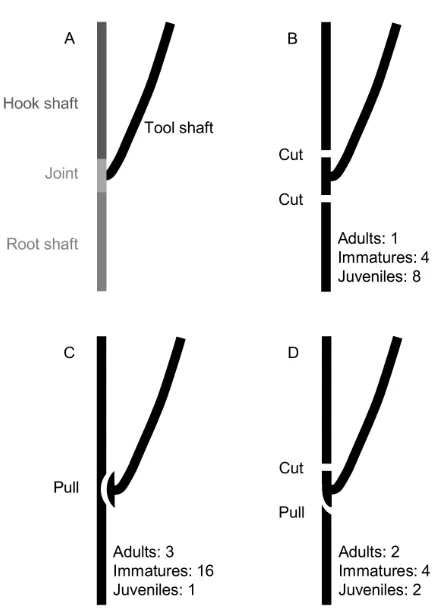
NC crows in our study population use two main methods for
releasing (basic) hooked stick tools from plants – ‘cutting’ and ‘pulling’
(figure S1; for video clips illustrating these actions, see Additional file 1
of ref. [7]). Our main experiment demonstrated that, with relatively
standardised plant materials, cutting (13 cases, only one of which without
subsequent hook processing) enables the production of significantly
deeper hooks (comparison between cut and pull:
t
= –2.21,
p
= 0.03;
trend for longer hooks,
t
= –1.73,
p
= 0.09; Figures 2B and 2D); while
this increases tool efficiency (see below), it necessitates two separate
actions – one cut above and one below a branching joint. In contrast,
pulling (20 cases, two of which without hook processing) leads to
shallower hooks on average, presumably as less material remains at the
tool tip for sculpting after detachment, but it has the advantage that a
with a pull (cut–pull: 6 cases; pull–cut: 2 cases; figure S1), producing
hooks of intermediate depth (Figure 2B). A trade-off between tool
efficiency and manufacture costs provides a potential explanation for the
co-existence of different release techniques in our study population (for
further discussion, see below).
It has been suggested that hooked stick tools have evolved from
basic non-hooked stick tools through a process of ‘cumulative’
modification [7, 23, 28]. In fact, the cost-efficient single-step pulling
method observed in our study population resembles the production of
basic non-hooked stick tools – where crows swiftly snap-off twigs from
nodal joints [29, 30] – and may therefore represent an evolutionary
precursor of more involved multi-step manufacture techniques (as
described in refs [6, 7]). Over time, crows may have gradually improved
tool efficiency further, by processing the hook, stripping the bark off the
functional end, and/or bending the tool shaft (Figure 2D; [4, 7, 14, 15];
cumulative refinement of tool designs has previously been suggested for
the tools NC crows make from screwpine leaves – see ref.
17
).
Interestingly, with some plant species, pulling apparently does not
produce hooks [4], and crows exclusively employ the cutting technique
[6]; similarly, in chimpanzees only some plants appear suitable for the
production of brush-sticks [31]. We suspect that comparable effects of
raw-material properties on manufacture methods, and ultimately on
artefact morphology, are widespread in animal tool-use and construction
behaviour [5, 32, 33].
In a companion experiment using seven NC crows from our main
sample, we found that the properties of plant raw materials influenced
several aspects of hooked tool morphology. After controlling for the
effect of manufacture method, hook depth increased significantly with
stem rigidity (
χ
21= 10.04,
p
= 0.002; Figure 2C). Hook length (
χ
21= 3.63,
p
= 0.06) likewise increased with increasing material score (no effect of
manufacture method), as did overall tool dimensions (tool length:
p
=
= 0.05; Figure 2C). The increase in tool length with increasing material
score may simply be due to the fact that tool shafts of higher rigidity
were difficult to sever close to the joint. Interestingly, the relative
position of the maximum curvature point changed little across material
scores (
p
= 0.62), resulting in a relatively consistent overall tool shape as
tool dimensions increased (see Methods). While this may reflect
allometric properties of the plant material, crows often actively adjust
tool curvature through shaft bending [7, 15], presumably in an effort to
keep the hook centred in the field of binocular vision during deployment
[14, 34]. Although many studies have investigated tool-material
selectivity in primates (e.g., [10, 35]), the effects of material properties
on the morphology of
manufactured
tools remain poorly documented
(e.g., [31, 36]). Our work on NC crows has shown that plant properties
affect aspects of manufacture behaviour [7], as well as the morphology of
the resulting tools (present study). Such research on extant tool-using
animals provides a valuable window into early human tool making where
the relationships between raw materials, crafting techniques, tool
morphology, and tool functionality remain a topic of great interest [9, 37,
38].
Having identified three significant drivers of variation in NC
crow tool morphology – bird age, manufacture method and raw-material
properties – we next examined whether hook geometry in turn affects
foraging efficiency. As a simple performance metric, we measured how
long it took our subjects to extract two types of ‘prey’ (dead spiders, and
worm-like cylinders of meat) from standardised holes drilled into
wooden logs [23] – tasks that resemble foraging scenarios routinely
encountered by wild crows [4, 16]. We found that extraction speed
increased significantly with hook depth (
z
= 2.80,
p
= 0.005; Figure 2E),
with spiders being extracted more quickly on average than vermiform
prey (spider in wide hole
vs
. vermiform prey in wide hole:
z
= 3.67,
p
<
0.001; spider in wide hole
vs
. vermiform prey in narrow hole:
z
= 3.65,
p
Including trials where crows were offered human-made exemplar hooked
tools allowed us to extend the range of hook depths over which
extraction efficiency could be measured, and confirmed the pattern
observed with crow-made tools only (
z
= 2.56,
p
= 0.01). To our
knowledge, this is the first demonstration that variation within a specific
design feature of crafted animal tools can affect foraging performance,
adding to studies that found similar effects for researcher-deployed
replica hominin [39, 40] and chimpanzee tools [41].
Based on the findings from our two experiments, one might
expect that experienced adult crows use the more controlled cutting
technique, to produce deep hooks that enable faster prey extraction. We
found instead that adults frequently used pulling (for details, see figure
S1), yielding hooks of intermediate depth (see above). This may be
because there are yet-to-be-investigated costs associated with deeper
hooks, including increased manufacture effort, high rates of hook
damage, and/or reduced performance in very tight crevices such as
beneath tree bark. Such hidden costs would imply the existence of an
optimal hook depth. Thus, although we still do not know whether
foraging performance with hooked stick tools increases with age (and,
hence, experience; see refs [42, 43]), it is conceivable that older birds
optimise returns from a given tool by trading-off extraction speed against
one or more other factors. In general, it remains an important challenge
for future studies, to assess – with larger sample sizes and dedicated
experimental designs – how different extrinsic and intrinsic factors
interact
to drive variation in tool morphology, and ultimately tool- and
foraging efficiency.
CONCLUDING REMARKS
In human and animal archaeology, our understanding of the
development, form and function of lithic artefacts is substantially greater
than for those made of bone, wood, and other plant materials [44].
at least as frequently as stone by early humans [44, 45], suggesting that
our knowledge of their technologies is based on a biased subset of both
raw materials and tool types. Many extant animal species make tools and
other constructions using organic materials [5, 32, 33, 46], allowing us to
search for general relationships with a wide range of raw materials,
artefacts and construction behaviours. NC crows provide an excellent
model in this regard, given the diversity of plant materials and tool
shapes they use [4], and – perhaps uniquely among non-humans – their
capacity to craft tool types with multiple distinct design features, most
notably the hooked stick tools discussed here [14]. Further research on
these relatively complex tools will contribute to our understanding of
how early hominin technology advanced and diversified.
STAR METHODS
Please see below.
SUPPLEMENTAL INFORMATION
Supplemental information includes one figure.
AUTHOR CONTRIBUTIONS
All authors conceived of, designed and conducted experiments, and planned
analyses; S.S. scored videos, extracted data and performed statistical analyses,
except for the experiment examining the effect of plant properties on tool
morphology, for which B.C.K. collected, extracted and analysed data and
provided draft text sections; S.S. and C.R. wrote the manuscript, which was
edited and approved by all co-authors; and C.R. secured funding and
supervised the project.
ACKNOWLEDGMENTS
We thank: the Province Sud, DENV, SEM Mwe-Ara, the late T. Mennesson, and
B. Chérioux for access to study sites and logistical support; S. Wischnewski, J.
van der Wal, Z. Burns and several field assistants for help with bird trapping and
husbandry, and/or with running trials; C. Higgott for scoring foraging efficiency
from videos; N. Colegrave for advice on proportional hazards modelling; C.
Boesch and A. Kalan for discussing chimpanzee algae-fishing tools with us; and
experiments were approved by institutional ethical review committees, and were
conducted under research permits issued by New Caledonian authorities. This
study was funded through a BBSRC David Phillips Fellowship (BB/G023913/2;
C.R.), and studentships from JASSO (S.S.) and BBSRC/University of St
Andrews (B.C.K.), and a JSPS overseas research fellowship (S.S.).
REFERENCES
1. McPherron, S.P., Alemseged, Z., Marean, C.W., Wynn, J.G., Reed, D.,
Geraads, D., Bobe, R., and Béarat, H.A. (2010). Evidence for
stone-tool-assisted consumption of animal tissues before 3.39 million years ago at
Dikika, Ethiopia. Nature 466, 857–860.
2. Yellen, J.E., Brooks, A.S., Cornelissen, E., Mehlman, M.J., and Stewart, K.
(1995). A middle stone age worked bone industry from Katanda, Upper
Semliki Valley, Zaire. Science 268, 553–556.
3. O’Connor, S., Ono, R., and Clarkson, C. (2011). Pelagic fishing at 42,000
years before the present and the maritime skills of modern humans.
Science 334, 1117–1121.
4. Hunt, G.R. (1996). Manufacture and use of hook-tools by New Caledonian
crows. Nature 379, 249–251.
5. Shumaker, R.W., Walkup, K.R., and Beck, B.B. (2011). Animal tool
behavior: the use and manufacture of tools by animals (Baltimore: Johns
Hopkins University Press).
6. Hunt, G.R., and Gray, R.D. (2004). The crafting of hook tools by wild New
Caledonian crows. Biol. Lett. 271, S88–S90.
7. Klump, B.C., Sugasawa, S., St Clair, J.J.H., and Rutz, C. (2015). Hook tool
manufacture in New Caledonian crows: behavioural variation and the
influence of raw materials. BMC Biol. 13, 97.
8. St Clair, J.J.H., Klump, B.C., van der Wal, J.E.M., Sugasawa, S., and Rutz, C. (2016). Strong between-site variation in New Caledonian crows’ use of
hook-tool-making materials. Biol. J. Linn. Soc. 118, 226–232.
9. Gowlett, J. (2009). Artefacts of apes, humans, and others: towards
comparative assessment and analysis. J. Hum. Evol. 57, 401–410.
10. Sanz, C., Morgan, D., and Gulick, S. (2004). New insights into
chimpanzees, tools, and termites from the Congo Basin. Am. Nat. 164, 567–581.
11. Pruetz, J.D., and Bertolani, P. (2007). Savanna chimpanzees, Pan
12. Gruber, T., Muller, M.N., Strimling, P., Wrangham, R., and Zuberbühler, K.
(2009). Wild chimpanzees rely on cultural knowledge to solve an
experimental honey acquisition task. Curr. Biol. 19, 1806–1810.
13. McGrew, W.C. (2013). Is primate tool use special? Chimpanzee and New
Caledonian crow compared. Phil. Trans. R. Soc. B 368, 20120422.
14. St Clair, J.J.H., and Rutz, C. (2013). New Caledonian crows attend to
multiple functional properties of complex tools. Phil. Trans. R. Soc. B. 368,
20120415.
15. Rutz, C., Sugasawa, S., van der Wal, J.E.M., Klump, B.C., and St Clair,
J.J.H. (2016). Tool bending in New Caledonian crows. R. Soc. Open Sci. 3,
160439.
16. Troscianko, J., and Rutz, C. (2015). Activity profiles and hook-tool use of
New Caledonian crows recorded by bird-borne video cameras. Biol. Lett.
11, 20150777.
17. Hunt, G.R., and Gray, R.D. (2003). Diversification and cumulative evolution
in New Caledonian crow tool manufacture. Proc. R. Soc. B 270, 867–874.
18. Tebbich, S., Teschke, I., Cartmill, E., and Stankewitz, S. (2012). Use of a
barbed tool by an adult and a juvenile woodpecker finch (Cactospiza
pallida). Behav. Processes 89, 166–171.
19. Fox, E.A., and bin’Muhammad, I. (2002). New tool use by wild Sumatran orangutans (Pongo pygmaeus abelii). Am. J. Phys. Anthropol. 119, 186–
188.
20. van Schaik, C.P., Ancrenaz, M., Djojoasmoro, R., Knott, C.D.,
Morrogh-Bernard, H.C., Nuzuar, Odom, K., Atmoko, S.S.U., and van Noordwijk,
M.A. (2009). Orangutan cultures revisited. In Orangutans: Geographic
variation in behavioral ecology and conservation, S.A. Wich, S.S.U.
Atmoko, T.M. Setia, and C.P. van Schaik, eds. (Oxford: Oxford University Press), pp. 299–309.
21. Humle, T., Yamakoshi, G., and Matsuzawa, T. (2011). Algae scooping
remains a puzzle. In The chimpanzees of Bossou and Nimba, T.
Matsuzawa, T. Humle, and Y. Sugiyama, eds. (Tokyo: Springer Japan), pp. 117–122.
22. Boesch, C., Kalan, A.K., Agbor, A., Arandjelovic, M., Dieguez, P., Lapeyre,
V., and Kühl, H.S. (2017). Chimpanzees routinely fish for algae with tools
during the dry season in Bakoun, Guinea. Am. J. Primatol. 79, e22613.
23. St Clair, J.J.H, Klump, B.C., Sugasawa, S., Higgott, C.G., Colegrave, N.,
and Rutz, C. (2018). Hook innovation boosts foraging efficiency in
24. Hunt, G.R. (2016). Social and spatial reintegration success of New
Caledonian crows (Corvus moneduloides) released after aviary
confinement. Wilson J. Ornithol. 128, 168–173.
25. Gruber, T., Zuberbühler, K., Clément, F., and van Schaik, C. (2015). Apes
have culture but may not know that they do. Front. Psychol. 6, 91.
26. Logan, C.J., Breen, A.J., Taylor, A.H., Gray, R.D., and Hoppitt, W.J.E.
(2016). How New Caledonian crows solve novel foraging problems and
what it means for cumulative culture.Learn. Behav. 44, 18–28.
27. Rutz, C., Klump, B.C., Komarczyk, L., Leighton, R., Kramer, J.,
Wischnewski, S., Sugasawa, S., Morrissey, M.B., James, R., St Clair,
J.J.H., et al. (2016). Discovery of species-wide tool use in the Hawaiian
crow. Nature 537, 403–407.
28. Hunt, G.R., and Uomini, N. (2016). A complex adaptive system may be
essential for cumulative modifications in tool design. Jpn. J. Anim. Psychol.
66, 141–159.
29. Hunt, G.R., and Gray, R.D. (2002). Species-wide manufacture of stick-type
tools by New Caledonian crows. Emu 102, 349–353.
30. Holzhaider, J.C., Hunt, G.R., Campbell, V.M., and Gray, R.D. (2008). Do
wild New Caledonian crows (Corvus moneduloides) attend to the functional
properties of their tools?Anim. Cogn. 11, 243–254.
31. Takemoto, H., Hirata, S., and Sugiyama, Y. (2005). The formation of the
brush-sticks: modification of chimpanzees or the by-product of folding?
Primates 46, 183–189.
32. Hansell, M. (2005). Animal architecture (Oxford: Oxford University Press).
33. Hansell, M. and Ruxton, G.D. (2008). Setting tool use within the context of
animal construction behaviour. Trends Ecol. Evol. 23, 73–78.
34. Troscianko, J., von Bayern, A.M.P., Chappell, J., Rutz, C., and Martin, G.R.
(2012). Extreme binocular vision and a straight bill facilitate tool use in New
Caledonian crows. Nat. Commun. 3, 1110.
35. Visalberghi, E., Sirianni, G., Fragaszy, D., and Boesch, C. (2015).
Percussive tool use by Taï Western chimpanzees and Fazenda Boa Vista
bearded capuchin monkeys: a comparison. Phil. Trans. R. Soc. B 370,
20140351.
36. Gaino, E., Cianficconi, F., Rebora, M., and Todini, B. (2002). Case-building
of some Trichoptera larvae in experimental conditions: Selectivity for
calcareous and siliceous grains.Ital. J. Zool. 69, 141–145.
37. Sharon, G. (2008). The impact of raw material on Acheulian large flake
38. Eren, M.I., Roos, C.I., Story, B.A., von Cramon-Taubadel, N., and Lycett,
S.J. (2014). The role of raw material differences in stone tool shape
variation: An experimental assessment. J. Archaeol. Sci. 49, 472–487.
39. Cheshier, J., and Kelly, R.L. (2006). Projectile point shape and durability:
the effect of thickness:length. Am. Antiquity 71, 353–363.
40. Key, A.J.M., and Lycett, S.J. (2014). Are bigger flakes always better? An
experimental assessment of flake size variation on cutting efficiency and
loading. J. Archaeol. Sci. 41, 140–146.
41. Sanz, C., Call, J., and Morgan, D. (2009). Design complexity in
termite-fishing tools of chimpanzees (Pan troglodytes). Biol. Lett. 5, 293–296.
42. Bluff, L.A., Troscianko, J., Weir, A.A.S., Kacelnik, A., and Rutz, C. (2010).
Tool use by wild New Caledonian crows Corvus moneduloides at natural
foraging sites. Proc. R. Soc. B 277, 1377–1385.
43. Holzhaider, J.C., Hunt, G.R., and Gray, R.D. (2010). The development of
pandanus tool manufacture in wild New Caledonian crows. Behaviour 147, 553–586.
44. O’Connor, S., Robertson, G., and Aplin, K.P. (2014). Are osseous artefacts
a window to perishable material culture? Implications of an unusually
complex bone tool from the Late Pleistocene of East Timor.J. Hum. Evol.
67, 108–119.
45. Hurcombe, L. (2008). Organics from inorganics: using experimental
archaeology as a research tool for studying perishable material culture.
World Archaeol.40, 83–115.
46. van Casteren, A., Venkataraman, V., Ennos, A.R., and Lucas, P.W. (2016).
Novel developments in field mechanics.J. Hum. Evol. 98, 5–17.
47. R Development Core Team. (2016). R: A language and environment for
statistical computing (Vienna: R Foundation for Statistical Computing).
48. Bates, D., Mächler, M., Bolker, B., and Walker, S. (2015). Fitting linear
mixed-effects models using lme4. J. Stat. Softw.67, 1–48.
49. Kuznetsova, A., Bruun Brockhoff, P., and Haubo Bojesen Christensen, R.
(2016). lmerTest: tests in linear mixed effects models. (R package version
2.0-33., https://CRAN.R-project.org/package=lmerTest).
50. Fournier, D.A., Skaug, H.J., Ancheta, J., Ianelli, J., Magnusson, A.,
Maunder, M.N., Nielsen, A., and Sibert, J. (2012). AD Model Builder: using
automatic differentiation for statistical inference of highly parameterized
complex nonlinear models. Optim. Methods Softw.27, 233–249.
51. Therneau, T.M. (2015). coxme: mixed effects cox models (R package
52. Therneau, T.M. (2012). survival: survival analysis (R package version
2.38., http://cran.r-project.org/package=survival).
53. Barton, K. (2016). MuMIn: multi-model inference (R package version
1.15.6., http://cran.r-project.org/package=MuMIn).
54. Schneider, C.A., Rasband, W.S., and Eliceiri, K.W. (2012). NIH Image to
ImageJ: 25 years of image analysis. Nat. Methods 9, 671–675.
55. Klingenberg, C.P. (2011). MorphoJ: an integrated software package for
geometric morphometrics. Mol. Ecol. Resources 11, 353–357.
56. Rutz, C., Ryder, T.B., and Fleischer, R.C. (2012). Restricted gene flow and
fine-scale population structuring in tool using New Caledonian crows.
Naturwissenschaften 99, 313–320.
57. Viscosi, V., and Cardini, A. (2011). Leaf morphology, taxonomy and
geometric morphometrics: a simplified protocol for beginners. PLoS One 6,
e25630.
58. Klingenberg, C.P. (2013). Visualizations in geometric morphometrics: how
to read and how to make graphs showing shape changes. Hystrix 24, 15–
24.
59. Holm, S. (1979). A simple sequentially rejective multiple test procedure.
Scand. J. Stat. 6, 65–70.
60. Cade, B.S. (2015). Model averaging and muddled multimodel inferences.
FIGURE CAPTIONS (2)
Figure 1.A wild New Caledonian crow holding a hooked stick tool
Apart from the distinctive terminal hook, which is used for snagging arthropod
prey, the tool exhibits two additional crow-induced design features that are typical for this particular population – pronounced curvature of the tool shaft,
and stripped bark near the functional end. Photo: Pedro Barros da Costa.
Figure 2. Causes and consequences of morphological variation of hooked stick tools crafted by wild-caught New Caledonian crows
(A) Age-dependent variation in tool shape. Points are subject-level averages
(calculated for at least three different tools), with colour-coding indicating bird
age (black, adult; grey, immature; pink, juvenile). Schematic illustrations of tools
were produced from CVA, representing tool shapes at the extremes of
canonical variates 1 and 2. Sample size (main experiment): 117 tools made by
14 crows.
(B) Hook length (blue) and hook depth (red) of tools (mean ± s.e.m. [mm]) manufactured using the ‘cut’ or ‘pull’ method, or a mixed technique (for details,
see text and figure S1). Sample size (main experiment): 41 tools made by 13
crows.
(C) Tool length (green), length to maximum curvature point (orange), hook
length (blue) and hook depth (red) of tools (mean ± s.e.m. [cm or mm]; for
details, see panel D) crafted by crows from plant materials of increasing rigidity (scores 1–8). Sample size (companion experiment): 28 tools made by 7 crows.
(D) Morphological landmarks and measurements superimposed on a
representative crow-made hooked stick tool. Summary statistics of
measurements (mean ± s.d.) for crow-made tools were as follows – tool length: 14.31 ± 4.75 cm; length from the non-hooked end to the maximum curvature
point: 9.29 ± 3.86 cm; hook length: 4.43 ± 2.13 mm; hook depth: 1.26 ± 1.11
mm. Sample size (main experiment): 122 tools made by 17 crows.
(E) Extraction time (natural log-transformed; mean ± s.e.m [sec] per tool) for
dead spiders (left) and vermiform pieces of meat (right; data for wide and
narrow holes pooled) as a function of hook depth (mm). Sample size (main
experiment): 21 tools made and deployed by 11 crows; 13 human-made tools
deployed by 8 crows. While the fitted lines are for linear mixed models that
exclude unsuccessful bait-extraction attempts (16 holes, with 8 tools made by
five crows) (for statistical results, see main text), a corresponding mixed-effect
Cox proportional hazards model including these cases confirmed the significant
STAR METHODS
KEY RESOURCES TABLE
REAGENT or RESOURCE SOURCE IDENTIFIER
Experimental Models: Organisms/Strains
Corvus moneduloides [7, 23] N/A
Software and Algorithms
R version 3.1.2 [47] http://www.R-project.org/
R package ‘lme4’ [48] http://cran.r-project.org/package=lme4 R package ‘lmerTest’ [49] http://cran.r-project.org/package=lmerTest R package ‘glmmADMB’ [50] http://glmmadmb.r-forge.r-project.org/ R package ‘coxme’ [51] http://cran.r-project.org/package=coxme R package ‘survival’ [52] http://cran.r-project.org/package=survival R package ‘MuMIn’ [53] http://cran.r-project.org/package=MuMIn
ImageJ [54] https://imagej.nih.gov/ij/
MorphoJ [55] http://www.flywings.org.uk/morphoj_page.htm
Solomon Coder N/A http://solomoncoder.com
CONTACT FOR REAGENT AND RESOURCE SHARING
Further information and requests for resources and reagents should be directed
to and will be fulfilled by the Lead Contact, Christian Rutz
EXPERIMENTAL MODEL AND SUBJECT DETAILS
From 17 September to 28 November 2012, and from 24 August to 28 October
2013, we trapped 41 NC crows in our farmland study site near Bourail, New
Caledonia (for map, see ref. [56]). We sexed birds based on their body size
(males are bigger than females; five birds were sexed genetically) and assigned
them to rough age categories based on the colouration of their gapes (as birds
mature, gape colouration changes from all-pink, through mottled intermediate
stages, to all-black) [7]. While our ageing technique is known to be imperfect
(there is variation in how fast birds transition from pink to black), it is suitable for
identifying very young birds (which also beg persistently) and old birds (there is
no evidence for reversals, from black to pink), and provides a useful proxy for individuals’ developmental stage. Future studies would ideally conduct experiments with known-age subjects, although achieving sufficient sample
Crows were housed individually in field aviaries (except for dependent
young trapped with adults, which were kept together), and cared for as described in detail elsewhere [7, 14]. To assess birds’ natural tool behaviour, we provided in each housing aviary an extraction task (a log with meat-baited
drilled holes) and locally preferred plant materials for tool manufacture (stems of
the shrub Desmanthus virgatus; [8]); only crows that were confirmed to make
hooked stick tools progressed to the experiments described below (for rationale,
see refs [7, 14, 23]).
METHOD DETAILS
Manufacture and deployment of tools
In our main experiment, wild-caught New Caledonian crows were given
standardised opportunities for hook-tool manufacture (multiple stems of D.
virgatus) anddeployment (prey hidden in drilled holes in wooden logs; see
below). Subjects were tested individually in an experimental chamber, which
was adjacent to, and of the same size as, the housing aviaries. Food was
removed approximately one hour prior to the trial, but birds always had access
to water. We provided two food logs, containing 12 wide and 6 narrow drilled
holes (1.2 cm diameter × 7 cm depth, or 0.9 × 7 cm), baited with a dead spider
or a worm-like prey item (a cylindrical piece of meat drilled out of a beef or pork
heart, of ca. 0.8 × 2.1 cm), a log with 10 stems of the plant material inserted into
drilled holes (material log), and half of a log split lengthwise for the subject to
stand on whilst processing tools (manufacture log) (for details of experimental
set-up and protocol, see ref. [7]). Of 31 trials which provided valid data, 8 trials
also had a choice of non-hooked sticks presented on the material log, but we
collected morphological data only for hooked stick tools.
Each trial was recorded with a Panasonic camcorder (HC-V700 or
HDC-SD 900) by an observer in a hide outside the experimental chamber, and
lasted for 90 minutes or until the subject had extracted all bait. The observer
collected tools in the experimental chamber, labelled them, and took digital
photos under standardised conditions (laid out flat on grid paper; camera perpendicular to tool plane; good lighting). Here, ‘tools’ are considered to be
pieces of material that crows had detached from plant stems, processed and
inserted into a hole. Tools were identified by S.S. (and distinguished from plant
debris that accumulates during routine tool manufacture) based on video footage, observers’ notes taken during trials, and our reference photographs. Of the 163 identified tools, 41 tools were non-hooked stick tools made from D.
virgatus, or damaged, and were not included in morphometric analyses. Overall,
males and 14 females; 5 adults, 8 immatures and 4 juveniles).
The main experiment had two treatments: the ‘crow-made tool’ treatment and the ‘human-made tool’ treatment [23]. The latter, which was a control condition from a companion study [23], was included in our analyses of tool performance (see below), to explore crows’ foraging efficiency over a wider
range of hook depths (crow-made, 1.26 ± 1.11 mm vs. human-made, 1.90 ±
0.68 mm [mean ± s.d.]). The same experimental procedure was used as for the
crow-made tool treatment, except that three experimenter-made hooked stick
tools were presented, instead of raw plant material for manufacture. We ran 8
trials where the subjects readily used the 24 supplied tools (8 trials × 3 tools).
All 8 subjects also participated in the crow-made tool treatment described above
(1 male, 7 females; 3 adults, 4 immatures, 1 juvenile), and the order of trials
was randomised.
Manufacture of tools from plant materials of varying properties
In a companion experiment, we investigated the influence of raw-material
properties on hook-tool morphology. As described in detail elsewhere [7], three
fieldworkers were tasked to independently score the material properties of plant
stems. We opted for an approach based on professional judgement, as it would
have been difficult to take reliable biomechanical measurements [46] either
before trials commenced (measurements result in the destruction of specimens)
or afterwards (crows often flex tools vigorously during manufacture and
deployment; [15]).
Seven crows from the main sample (1 male, 6 females; 3 adults, 4
immatures) were each provided with a choice of eight stems of D. virgatus,
ranging from green and flimsy (material score 1) to woody and rigid (material
score 8), and a food log with a single meat-baited extraction hole (for details,
see ref. [7]). After each tool manufacture (and subsequent bait extraction, or 15
minutes without bait extraction), the tool and any plant debris were removed,
and the extraction hole was rebaited, enabling each subject to produce a series
of tools from stems of different material properties. At the analysis stage, tools
that had been deployed (and not broken) by crows were identified by B.C.K.
from video footage (28 tools manufactured by 7 subjects), and subsequently
measured from digital imagery as described below.
QUANTIFICATION AND STATISTICAL ANALYSIS Factors affecting tool morphology
For each tool, we established the coordinates of five landmarks from our digital
four basic dimensional properties (Figure 2D). We checked error associated
with digitising landmarks by re-analysing 20 tools (14 subjects; >15% of the
entire dataset), and by comparing digitising error and inter-individual variation
(as a reference for biologically meaningful variation) using Procrustes ANOVA
[57]. The digitising error was negligible compared to between-crow variation
(0.01% for centroid size and 0.8% for shape).
To examine tool shape, we first separated shape information from
tool-size and orientation information through Procrustes superimposition, producing
Procrustes coordinates [58]. Using canonical variate analysis (CVA), we then
tested whether the configuration of Procrustes coordinates varied across age
groups (Figure 2A). To achieve this, canonical variates (CV) were calculated
that best separated the tool coordinates from different age groups, and group
centroids were subsequently used to test for age differences. Canonical
variates provided graphical outputs of how tool shape varies between age
groups, and allowed us to draw exemplary tools for the extremes of canonical
variates 1 and 2 (Figure 2A). P-values were adjusted for multiple comparisons using Holm’s method [59], and significance was assessed at α = 0.05.
Additionally, we ran a linear mixed model (LMM; ‘lmer’ function of the ‘lme4’
package in R; [48]) with hook depth (square-root transformed to normalize
errors) as the dependent variable, age class (adult, immature or juvenile) as the
independent variable, and subject identity as a random term (to account for
non-independence of multiple tool manufactures per bird).
We investigated whether crows’ manufacture method influenced tool
morphology (Figure 2B), using tools for which the manufacture method could be
determined from video footage [7]. In particular, we focused on the behavioural
action the subject used to detach a (basic) tool from the plant stem, since this is
a critical step in the production of hooked tools. There are two different actions: ‘cut’ (detachment at the point where the subject was gripping) and ‘pull’
(detachment away from the gripping point) (for video clips illustrating these
actions, see Additional file 1 of ref. [7]), and it has been suggested that the
former may afford crows more control over the resultant shape of hooks. As
illustrated in figure S1, our subjects employed three release techniques, using
two cuts (panel B), a single pull (C), or a combination of a cut and a pull (D) (in an earlier study, the latter two were classed as ‘pulling’ and cases pooled for data analyses due to modest sample sizes; [7]). We ran LMMs (‘lmer’ function of the ‘lmerTest’ package in R; [49]) with hook length or hook depth (square-root transformed to normalize errors) as the dependent variable, the behavioural
action (cut, both or pull) as the independent variable and subject identity as a
hook length and hook depth, since tool length and length to maximum curvature
point were (potentially) determined at other stages in the tool-manufacture
sequence.
To investigate the influence of both manufacture method and
raw-material properties on tool morphology, we ran generalised linear mixed models
(GLMMs) with tool length, length to maximum curvature point, or the relative
position of maximum curvature point (length to maximum curvature point / tool
length) as the dependent variable (gamma error structure with log-link function; ‘glmmadmb’ function of the ‘glmmADMB’ package in R; [50]), and LMMs with
hook length or hook depth as the dependent variable (square-root transformed
to normalize errors). All models had material score as the independent variable
and included subject identity as a random term. LMMs contained the
manufacture method (cut, both or pull) as an additional independent variable,
given its effect on tool morphology (see above). We determined the best model
by dropping (the) main effect(s) (the full model for hook depth, and the
univariate model with material score as independent variable in all other cases).
The significance of main effects in all LMMs and GLMMs was assessed using
likelihood-ratio tests (best model against the null model, except in the case of
hook depth where the p-value refers to the comparison of the best model
against the reduced model). We additionally performed CVA for these tools with
Procrustes coordinates as the response variable and the material score as
independent variable, but found no influence of material properties on overall
tool shape.
All data analyses were carried out in R [47] or MorphoJ software [55].
Effects of tool morphology on foraging performance
From videos of 17 trials with crow-made tools, and all 8 trials with human-made tools (see above), a hypothesis-naïve observer (Caitlin Higgott) scored crows’ probing behaviour using Solomon coder software [23], and S.S. subsequently
established the probing histories of individual tools (see above). Out of a total of
450 extraction holes available to subjects in those trials, 213 were probed by a
single hooked stick tool and therefore used for analyses; the remaining 237
holes were excluded as crows did not probe into them, or probed into them with
two or more tools, unidentifiable tools, and/or non-hooked stick tools.
To assess foraging efficiency, we measured how long a bird probed
was targeted with tools but not extracted (5 crows, 8 tools, 16 holes; of the 8
tools, 5 tools made by 4 crows were used for extractions from other holes), and model assumptions (‘cox.zph’ function with rank transformation in the ‘Survival’ package in R; [52]) were not met for one of two analyses (crow-made tools only). We therefore used LMMs instead (‘lmer’ function of the ‘lme4’ package in
R; [48]), to analyse the sample of successful bait extractions (100 and 97 holes
from crow- and human-made tool treatments, respectively). Models were fitted
with extraction time (log-transformed for normalisation) as the dependent
variable, morphological parameters (tool length, hook length, hook depth and
length to maximum curvature point divided by tool length; see above) and task
type as independent variables, and tool identity and subject identity as random
terms (to account for the non-independence of data from individual crows and
tools); task type was defined based on bait type and the size of the extraction
hole (spider in a wide hole; vermiform prey in a wide hole; vermiform prey in a
narrow hole). In the analysis including human-made tools, we added treatment
(crow- or human-made tools) as an independent variable, and treatment nested
within subject identity as a random term (to account for the fact that birds
engaged with multiple tasks in the two discrete treatment trials). Task type and
treatment were included in models since previous work had demonstrated their
importance [23].
We fitted all possible combinations of explanatory variables, and
compared models based on AICc, delta weight and Akaike weight, and averaged the estimated outputs of models with delta weight <2 (‘dredge function’ and ‘model.avg’ function of the ‘MuMIn’ package in R; [53]). As strong
correlations between predictors result in unreliable estimates in model
averaging [60], and original values of tool length and length to maximum
curvature point were highly correlated (r = 0.92, p < 0.001), we removed the
latter and instead used the ratio of the two (tool length divided by length to
maximum curvature point; r = 0.40, p < 0.001). There was no other combination
Crow made Human made
0 1 2 3 0 1 2 3
Hook depth [mm] Tool performance
E
Length to maximum curvature point
Tool length
Hook length Hook
depth Hook D
1 2 3 4.5 6 7 8 Stem rigidity Cut Both Pull
Release method -3 -2 -1 0 1 2 3
Canonical variate 1 Juveniles
Figure S1. New Caledonian Crows’ Manufacture Methods for Producing Hooked Stick Tools from Forked Plant Stems, Rela-ted to Figure 2B
[image:24.603.192.412.97.402.2]