Document-level Automatic MT Evaluation
based on Discourse Representations
Jes ´us Gim´enez and Llu´ıs M`arquez
TALP UPC Barcelona, Spain
{jgimenez, lluism}
@lsi.upc.edu
Elisabet Comelles and Irene Castell´on
Universitat de Barcelona Barcelona, Spain
{elicomelles, icastellon}@ub.edu
Victoria Arranz
ELDA/ELRA Paris, France [email protected]
Abstract
This paper describes the joint submission of Universitat Polit`ecnica de Catalunya and Uni-versitat de Barcelona to the Metrics MaTr 2010 evaluation challenge, in collaboration with ELDA/ELRA. Our work is aimed at widening the scope of current automatic evaluation measures from sentence to document level. Preliminary ex-periments, based on an extension of the metrics by Gim´enez and M`arquez (2009) operating over dis-course representations, are presented.
1 Introduction
Current automatic similarity measures for Ma-chine Translation (MT) evaluation operate all, without exception, at the segment level. Trans-lations are analyzed on a segment-by-segment1 fashion, ignoring the text structure. Document and system scores are obtained using aggregate statistics over individual segments. This strategy presents the main disadvantage of ignoring cross-sentential/discursive phenomena.
In this work we suggest widening the scope of evaluation methods. We have defined genuine document-level measures which are able to ex-ploit the structure of text to provide more informed evaluation scores. For that purpose we take advan-tage of two coincidental facts. First, test beds em-ployed in recent MT evaluation campaigns include a document structure grouping sentences related to the same event, story or topic (Przybocki et al., 2008; Przybocki et al., 2009; Callison-Burch et al., 2009). Second, we count on automatic linguistic processors which provide very detailed discourse-level representations of text (Curran et al., 2007).
Discourse representations allow us to focus on relevant pieces of information, such as the agent
1A segment typically consists of one or two sentences.
(who), location (where), time (when), and theme (what), which may be spread all over the text. Counting on a means of discerning the events, the individuals taking part in each of them, and their role, is crucial to determine the semantic equiva-lence between a reference document and a candi-date translation.
Moreover, the discourse analysis of a document is not a mere concatenation of the analyses of its individual sentences. There are some phenom-ena which may go beyond the scope of a sen-tence and can only be explained within the con-text of the whole document. For instance, in a newspaper article, facts and entities are progres-sively added to the discourse and then referred to anaphorically later on. The following extract from the development set illustrates the impor-tance of such a phenomenon in the discourse anal-ysis: ‘Among the current or underlying crises in
the Middle East, Rod Larsen mentioned the Arab-Israeli conflict and the Iranian nuclear portfolio, as well as the crisis between Lebanon and Syria. He stated: “All this leads us back to crucial val-ues and opinions, which render the situation prone at any moment to getting out of control, more so than it was in past days.”’. The subject pronoun “he” works as an anaphoric pronoun whose
an-tecedent is the proper noun “Rod Larson”. The anaphoric relation established between these two elements can only be identified by analyzing the text as a whole, thus considering the gender agree-ment between the third person singular masculine subject pronoun “he” and the masculine proper noun “Rod Larson”. However, if the two sen-tences were analyzed separately, the identification of this anaphoric relation would not be feasible due to the lack of connection between the two ele-ments. Discourse representations allow us to trace links across sentences between the different facts and entities appearing in them. Therefore, provid-ing an approach to the text more similar to that of
a human, which implies taking into account the whole text structure instead of considering each sentence separately.
The rest of the paper is organized as follows. Section 2 describes our evaluation methods and the linguistic theory upon which they are based. Experimental results are reported and discussed in Section 3. Section 4 presents the metric submitted to the evaluation challenge. Future work is out-lined in Section 5.
As an additional result, document-level metrics generated in this study have been incorporated to the IQMTpackage for automatic MT evaluation2.
2 Metric Description
This section provides a brief description of our ap-proach. First, in Section 2.1, we describe the un-derlying theory and give examples on its capabili-ties. Then, in Section 2.2, we describe the associ-ated similarity measures.
2.1 Discourse Representations
As previously mentioned in Section 1, a document has some features which need to be analyzed con-sidering it as a whole instead of dividing it up into sentences. The anaphoric relation between a subject pronoun and a proper noun has already been exemplified. However, this is not the only anaphoric relation which can be found inside a text, there are some others which are worth men-tioning:
• the connection between a possessive adjec-tive and a proper noun or a subject pro-noun, as exemplified in the sentences “Maria
bought a new sweater. Her new sweater is blue.”, where the possessive feminine
adjec-tive “her” refers to the proper noun “Maria”.
• the link between a demonstrative pronoun and its referent, which is exemplified in the sentences “He developed a new theory on
grammar. However, this is not the only the-ory he developed”. In the second sentence,
the demonstrative pronoun ”this” refers back to the noun phrase “new theory on grammar” which occurs in the previous sentence.
• the relation between a main verb and an aux-iliary verb in certain contexts, as illustrated in the following pair of sentences “Would you
2
http://www.lsi.upc.edu/˜nlp/IQMT
like more sugar? Yes, I would”. In this
ex-ample, the auxiliary verb “would” used in the short answer substitutes the verb phrase
“would like”.
In addition to anaphoric relations, other features need to be highlighted, such as the use of discourse markers which help to give cohesion to the text, link parts of a discourse and show the relations es-tablished between them. Below, some examples are given:
• “Moreover”, “Furthermore”, “In addition” indicate that the upcoming sentence adds more information.
• “However”, “Nonetheless”, “Nevertheless” show contrast with previous ideas.
• “Therefore”, “As a result”, “Consequently” show a cause and effect relation.
• “For instance”, “For example” clarify or il-lustrate the previous idea.
It is worth noticing that anaphora, as well as dis-course markers, are key features in the interface between syntax, semantics and pragmatics. Thus, when dealing with these phenomena at a text level we are not just looking separately at the different language levels, but we are trying to give a com-plete representation of both the surface and the deep structures of a text.
2.2 Definition of Similarity Measures
In this work, as a first proposal, instead of elabo-rating on novel similarity measures, we have bor-rowed and extended the Discourse Representation
(DR) metrics defined by Gim´enez and M`arquez
(2009). These metrics analyze similarities be-tween automatic and reference translations by comparing their respective discourse representa-tions over individual sentences.
of first-order formulae and the free variables that occur in them.
DRSs are viewed as semantic trees, built through the application of two types of DRS con-ditions:
basic conditions: one-place properties (pred-icates), two-place properties (relations), named entities, time-expressions, cardinal expressions and equalities.
complex conditions: disjunction, implication, negation, question, and propositional attitude operations.
For instance, the DRS representation for the sentence “Every man loves Mary.” is as follows: ∃y named(y, mary, per) ∧ (∀x man(x) → ∃z love(z) ∧ event(z) ∧ agent(z, x) ∧
patient(z, y)). DR integrates three different kinds of metrics:
DR-STM These metrics are similar to the
Syntac-tic Tree Matching metric defined by Liu and
Gildea (2005), in this case applied to DRSs instead of constituent trees. All semantic sub-paths in the candidate and reference trees are retrieved. The fraction of matching subpaths of a given length (l=4 in our experiments) is computed.
DR-Or(⋆) Average lexical overlap between
dis-course representation structures of the same type. Overlap is measured according to the formulae and definitions by Gim´enez and M`arquez (2007).
DR-Orp(⋆) Average morphosyntactic overlap,
i.e., between grammatical categories –parts-of-speech– associated to lexical items, be-tween discourse representation structures of the same type.
We have extended these metrics to operate at document level. For that purpose, instead of run-ning the C&C Tools in a sentence-by-sentence fashion, we run them document by document. This is as simple as introducing a “<META>” tag at the beginning of each document to denote doc-ument boundaries3.
3Details on the advanced use of Boxer are
avail-able at http://svn.ask.it.usyd.edu.au/trac/ candc/wiki/BoxerComplex.
3 Experimental Work
In this section, we analyze the behavior of the new DR metrics operating at document level with re-spect to their sentence-level counterparts.
3.1 Settings
We have used the ‘mt06’ part of the development set provided by the Metrics MaTr 2010 organiza-tion, which corresponds to a subset of 25 docu-ments from the NIST 2006 Open MT Evaluation Campaign Arabic-English translation. The to-tal number of segments is 249. The average num-ber of segments per document is, thus, 9.96. The number of segments per document varies between 2 and 30. For the purpose of automatic evaluation, 4 human reference translations and automatic out-puts by 8 different MT systems are available. In addition, we count on the results of a process of manual evaluation. Each translation segment was assessed by two judges. After independently and completely assessing the entire set, the judges re-viewed their individual assessments together and settled on a single final score. Average system ad-equacy is 5.38.
In our experiments, metrics are evaluated in terms of their correlation with human assess-ments. We have computed Pearson, Spearman and Kendall correlation coefficients between met-ric scores and adequacy assessments. Document-level and system-Document-level assessments have been ob-tained by averaging over segment-level assess-ments. We have computed correlation coefficients and confidence intervals applying bootstrap re-sampling at a 99% statistical significance (Efron and Tibshirani, 1986; Koehn, 2004). Since the cost of exhaustive resampling was prohibitive, we have limited to 1,000 resamplings. Confidence in-tervals, not shown in the tables, are in all cases lower than10−3
.
3.2 Metric Performance
Table 1 shows correlation coefficients at the docu-ment level for several DR metric representatives, and their document-level counterparts (DRdoc).
For the sake of comparison, the performance of the METEOR metric is also reported4.
Contrary to our expectations, DRdoc variants
obtain lower levels of correlation than their DR
4We have used METEOR version 1.0 with default
param-eters optimized by its developers over adequacy and fluency assessments. The METEOR metric is publicly available at
Metric Pearsonρ Spearmanρ Kendallτ
METEOR 0.9182 0.8478 0.6728
DR-Or(⋆) 0.8567 0.8061 0.6193
DR-Orp(⋆) 0.8286 0.7790 0.5875
DR-STM 0.7880 0.7468 0.5554
DRdoc-Or(⋆) 0.7936 0.7784 0.5875
DRdoc-Orp(⋆) 0.7219 0.6737 0.4929
[image:4.595.170.433.62.171.2]DRdoc-STM 0.7553 0.7421 0.5458
Table 1: Meta-evaluation results at document level
Metric Pearsonρ Spearmanρ Kendallτ
METEOR 0.9669 0.9151 0.8533
DR-Or(⋆) 0.9100 0.6549 0.5764
DR-Orp(⋆) 0.9471 0.7918 0.7261
DR-STM 0.9295 0.7676 0.7165
DRdoc-Or(⋆) 0.9534 0.8434 0.7828
DRdoc-Orp(⋆) 0.9595 0.9101 0.8518
DRdoc-STM 0.9676 0.9655 0.9272
DR-Or(⋆)′ 0.9836 0.9594 0.9296
DR-Orp(⋆)′ 0.9959 1.0000 1.0000
DR-STM′ 0.9933 0.9634 0.9307
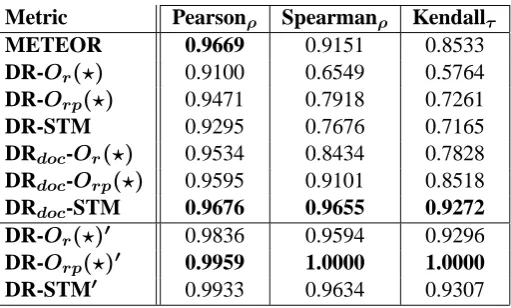
Table 2: Meta-evaluation results at system level
counterparts. There are three different factors which could provide a possible explanation for this negative result. First, the C&C Tools, like any other automatic linguistic processor are not per-fect. Parsing errors could be causing the metric to confer less informed scores. This is especially relevant taking into account that candidate transla-tions are not always well-formed. Secondly, we argue that the way in which we have obtained document-level quality assessments, as an average of segment-level assessments, may be biasing the correlation. Thirdly, perhaps the similarity mea-sures employed are not able to take advantage of the document-level features provided by the dis-course analysis. In the following subsection we show some error analysis we have conducted by inspecting particular cases.
Table 2 shows correlation coefficients at system level. In the case of DR and DRdoc metrics,
sys-tem scores are computed by simple average over individual documents. Interestingly, in this case DRdoc variants seem to obtain higher correlation
than their DR counterparts. The improvement is especially substantial in terms of Spearman and Kendall coefficients, which do not consider ab-solute values but ranking positions. However, it could be the case that it was just an average
ef-fect. While DR metrics compute system scores as an average of segment scores, DRdoc metrics
av-erage directly document scores. In order to clarify this result, we have modified DR metrics so as to compute system scores as an average of document scores (DR′ variants, the last three rows in the ta-ble). It can be observed that DR’ variants out-perform their DRdoccounterparts, thus confirming
our suspicion about the averaging effect.
3.3 Analysis
It is worth noting that DRdoc metrics are able to
detect and deal with several linguistic phenomena related to both syntax and semantics at sentence and document level. Below, several examples il-lustrating the potential of this metric are presented.
Control structures. Control structures (either subject or object control) are always a difficult issue as they mix both syntactic and semantic knowledge. In Example 1 a couple of control structures must be identified and DRdoc metrics deal correctly with the
argument structure of all the verbs involved. Thus, in the first part of the sentence, a subject control verb can be identified being
[image:4.595.173.429.200.354.2]quoted question, the verb “invite” works as an object control verb because its patient
“Chechen representatives” is also the agent
of the verb visit.
Example 1: The minister went on to say,
“What would Moscow say if we were to invite Chechen representatives to visit Jerusalem?”
Anaphora and pronoun resolution. Whenever
there is a pronoun whose antecedent is a named entity (NE), the metric identifies correctly its antecedent. This feature is highly valuable because a relationship be-tween syntax and semantics is established. Moreover, when dealing with Semantic Roles the roles of Agent or Patient are given to the antecedents instead of the pronouns. Thus, in Example 2 the antecedent of the relative pronoun “who” is the NE “Putin” and the patient of the verb “classified” is also the NE “Putin” instead of the relative pronoun “who”.
Example 2: Putin, who was not classified
as his country Hamas as “terrorist organiza-tions”, recently said that the European Union is “a big mistake” if it decided to suspend fi-nancial aid to the Palestinians.
Nevertheless, although Boxer was expected to deal with long-distance anaphoric relations beyond the sentence, after analyzing several cases, results show that it did not succeed in capturing this type of relations as shown in Example 3. In this example, the antecedent of the pronoun “he” in the second sentence is the NE “Roberto Calderoli” which ap-pears in the first sentence. DRdoc metrics
should be capable of showing this connec-tion. However, although the proper noun
“Roberto Calderoli” is identified as a NE, it
does not share the same reference as the third person singular pronoun “he”.
Example 3: Roberto Calderoli does not
in-tend to apologize. The newspaper Corriere Della Sera reported today, Saturday, that he said “I don’t feel responsible for those deaths.”
4 Our Submission
Instead of participating with individual metrics, we have combined them by averaging their scores
as described in (Gim´enez and M`arquez, 2008). This strategy has proven as an effective means of combining the scores conferred by different met-rics (Callison-Burch et al., 2008; Callison-Burch et al., 2009). Metrics submitted are:
DRdoc an arithmetic mean over a
heuristically-defined set of DRdocmetric variants,
respec-tively computing lexical overlap, morphosyn-tactic overlap, and semantic tree match-ing (M={‘DRdoc-Or(⋆)’, ‘DRdoc-Orp(⋆)’, ‘DRdoc
-STM4’}). Since DRdoc metrics do not operate
over individual segments, we have assigned each segment the score of the document in which it is contained.
DR a measure analog to DRdoc but using the de-fault version of DR metrics operating at the segment level (M ={‘DR-Or(⋆)’, ‘DR-Orp(⋆)’, ‘DR-STM4’}).
ULCh an arithmetic mean over a
heuristically-defined set of metrics operating at differ-ent linguistic levels, including lexical met-rics, and measures of overlap between con-stituent parses, dependency parses, seman-tic roles, and discourse representations (M = {‘ROUGEW’, ‘METEOR’, ‘DP-HWCr’, ‘DP-Oc(⋆)’,
‘DP-Ol(⋆)’, ‘DP-Or(⋆)’, ‘CP-STM4’, ‘SR-Or(⋆)’,
‘SR-Orv’, ‘DR-Orp(⋆)’}). This metric corre-sponds exactly to the metric submitted in our previous participation.
The performance of these metrics at the docu-ment and system levels is shown in Table 3.
5 Conclusions and Future Work
We have presented a modified version of the DR metrics by Gim´enez and M`arquez (2009) which, instead of limiting their scope to the segment level, are able to capture and exploit document-level fea-tures. However, results in terms of correlation with human assessments have not reported any im-provement of these metrics over their sentence-level counterparts as document and system quality predictors. It must be clarified whether the prob-lem is on the side of the linguistic tools, in the similarity measure, or in the way in which we have built document-level human assessments.
For future work, we plan to continue the er-ror analysis to clarify why DRdoc metrics do not
Document level System level
Metric Pearsonρ Spearmanρ Kendallτ Pearsonρ Spearmanρ Kendallτ
ULCDR 0.8418 0.8066 0.6135 0.9349 0.7936 0.7145
ULCDRdoc 0.7739 0.7358 0.5474 0.9655 0.9062 0.8435
[image:6.595.92.508.62.132.2]ULCh 0.8963 0.8614 0.6848 0.9842 0.9088 0.8638
Table 3: Meta-evaluation results at document and system level for submitted metrics
may imply defining new metrics possibly using alternative linguistic processors. In addition, we plan to work on the identification and analysis of discourse markers. Finally, we plan to repeat this experiment over other test beds with docu-ment structure, such as those from the 2009 Work-shop on Statistical Machine Translation shared task (Callison-Burch et al., 2009) and the 2009 NIST MT Evaluation Campaign (Przybocki et al., 2009). In the case that document-level assess-ments are not provided, we will also explore the possibility of producing them ourselves.
Acknowledgments
This work has been partially funded by the Spanish Government (projects OpenMT-2, TIN2009-14675-C03, and KNOW, TIN-2009-14715-C0403) and the European Community’s Seventh Framework Programme (FP7/2007-2013) under grant agreement numbers 247762 (FAUST project, FP7-ICT-2009-4-247762) and 247914 (MOLTO project, FP7-ICT-2009-4-247914). We are also thankful to anonymous reviewers for their comments and suggestions.
References
Johan Bos. 2008. Wide-coverage semantic analy-sis with boxer. In Johan Bos and Rodolfo Del-monte, editors, Semantics in Text Processing. STEP 2008 Conference Proceedings, Research in Compu-tational Semantics, pages 277–286. College Publi-cations.
Chris Callison-Burch, Cameron Fordyce, Philipp Koehn, Christof Monz, and Josh Schroeder. 2008. Further meta-evaluation of machine translation. In Proceedings of the Third Workshop on Statistical Machine Translation, pages 70–106.
Chris Callison-Burch, Philipp Koehn, Christof Monz, and Josh Schroeder. 2009. Findings of the 2009 Workshop on Statistical Machine Translation. In Proceedings of the Fourth Workshop on Statistical Machine Translation, pages 1–28.
James Curran, Stephen Clark, and Johan Bos. 2007. Linguistically motivated large-scale nlp with c&c
and boxer. In Proceedings of the 45th Annual Meet-ing of the Association for Computational LMeet-inguistics Companion Volume Proceedings of the Demo and Poster Sessions, pages 33–36.
Bradley Efron and Robert Tibshirani. 1986. Bootstrap Methods for Standard Errors, Confidence Intervals, and Other Measures of Statistical Accuracy. Statis-tical Science, 1(1):54–77.
Jes´us Gim´enez and Llu´ıs M`arquez. 2007. Linguis-tic Features for AutomaLinguis-tic Evaluation of Heteroge-neous MT Systems. In Proceedings of the ACL Workshop on Statistical Machine Translation, pages 256–264.
Jes´us Gim´enez and Llu´ıs M`arquez. 2008. A Smor-gasbord of Features for Automatic MT Evaluation. In Proceedings of the Third Workshop on Statistical Machine Translation, pages 195–198.
Jes´us Gim´enez and Llu´ıs M`arquez. 2009. On the Ro-bustness of Syntactic and Semantic Features for Au-tomatic MT Evaluation. In Proceedings of the 4th Workshop on Statistical Machine Translation (EACL 2009).
Hans Kamp and Uwe Reyle. 1993. From Discourse to Logic: An Introduction to Modeltheoretic Semantics of Natural Language, Formal Logic and Discourse Representation Theory. Dordrecht: Kluwer.
Philipp Koehn. 2004. Statistical Significance Tests for Machine Translation Evaluation. In Proceedings of the Conference on Empirical Methods in Natural Language Processing (EMNLP), pages 388–395.
Ding Liu and Daniel Gildea. 2005. Syntactic Features for Evaluation of Machine Translation. In Proceed-ings of ACL Workshop on Intrinsic and Extrinsic Evaluation Measures for MT and/or Summarization, pages 25–32.
Mark Przybocki, Kay Peterson, and S´ebastien Bron-sart. 2008. NIST Metrics for Machine Translation 2008 Evaluation (MetricsMATR08). Technical re-port, National Institute of Standards and Technol-ogy.