Engineer
Manual
1110-2-3001
Washington, DC 20314-1000
30 April 1995
Engineering and Design
PLANNING AND DESIGN OF
HYDROLECTRIC POWER PLANT
STRUCTURES
Distribution Restriction Statement
Approved for public release; distribution is
CECW-ED
Washington, DC 20314-1000
Manual
No. 1110-2-3001 30 April 1995
Engineering and Design
PLANNING AND DESIGN OF HYDROELECTRIC
POWER PLANT STRUCTURES
1. Purpose. This manual provides guidance for structural planning and design of hydroelectric power plants.
2. Applicability. This manual applies to HQUSACE elements, major subordinate commands, districts, laboratories, and field operating activities having responsibility for design of civil works projects.
CECW-ED
Washington, DC 20314-1000
Manual
No. 1110-2-3001 30 April 1995
Engineering and Design
PLANNING AND DESIGN OF HYDROELECTRIC
POWER PLANT STRUCTURES
Table of Contents
Subject Paragraph Page Subject Paragraph Page
Chapter 1 Introduction
Purpose and Scope . . . 1-1 1-1 Applicability . . . 1-2 1-1 References . . . 1-2 1-1 Codes . . . 1-4 1-1 Criteria . . . 1-5 1-1 Hydroelectric Design Center . . . 1-6 1-1
Chapter 2
General Requirements
Location of Powerhouse . . . 2-1 2-1 Location of Switchyard . . . 2-2 2-1 Highway and Railroad Access . . . 2-3 2-1 Other Site Features . . . 2-4 2-1 Types of Powerhouse
Structures . . . 2-5 2-1 Selection of Type of
Powerhouse . . . 2-6 2-2 General Arrangement of
Powerhouse . . . 2-7 2-2 Location of Main
Transformers . . . 2-8 2-3 Powerhouse and Switchyard
Equipment . . . 2-9 2-3 Powerhouse Auxiliary
Equipment . . . 2-10 2-4
Chapter 3
Architectural Requirements
Exterior Design . . . 3-1 3-1 Exterior Details . . . 3-2 3-1 Interior Design . . . 3-3 3-2
Interior Details . . . 3-4 3-6 Schedule of Finishes . . . 3-5 3-6 Painting . . . 3-6 3-6 Design Memorandum . . . 3-7 3-7 Drawings . . . 3-8 3-7
Chapter 4
Structural Requirements
Design Stresses . . . 4-1 4-1 Design Loads . . . 4-2 4-1 Stability Analysis . . . 4-3 4-3 Subgrade Conditions and
Treatments . . . 4-4 4-5 Foundation Drainage and
Grouting . . . 4-5 4-5 Substructure Functions and
Components . . . 4-6 4-5 Joints . . . 4-7 4-6 Waterstops . . . 4-8 4-8 Draft Tubes . . . 4-9 4-8 Spiral Cases . . . 4-10 4-8 Generator Pedestals . . . 4-11 4-10 Bulb Turbine Supports . . . 4-12 4-10 Types of Superstructures . . . 4-13 4-10 Superstructure-Indoor
Powerhouse . . . 4-14 4-11 Intakes . . . 4-15 4-12 Penstocks and Surge Tanks . . . 4-16 4-14 Switchyard Structures . . . 4-17 4-16 Reinforcing Steel . . . 4-18 4-17 Encasement of Structural
Subject Paragraph Page Subject Paragraph Page
Area Drainage . . . 4-21 4-17 Chamfers, Grooves, and
Rustications . . . 4-22 4-17
Chapter 5
Physical Security
Protection Plan . . . 5-1 5-1
Chapter 6
Retrofitting Existing Projects
General . . . 6-1 6-1 Hydraulic Design
Considerations . . . 6-2 6-1 Geotechnical Considerations . . . 6-3 6-2
Tunnels in Rock Abutments . . . 6-4 6-2 Cut and Cover Conduits . . . 6-5 6-2 Free Standing Penstock Within
Conduits . . . 6-6 6-2
Appendices Appendix A References Appendix B
Chapter 1
Introduction
1-1. Purpose and Scope
This manual presents a discussion of the general, archi-tectural and structural considerations applicable to the design of hydroelectric power plant structures. It is in-tended for the guidance of those elements within the Corps of Engineers responsible for the planning and de-sign of such structures. It should also be used in establishing minimum criteria for the addition of hydro-power facilities at existing Corps of Engineers projects, whether by Corps of Engineers or a non-Federal developer.
1-2. Applicability
This manual applies to HQUSACE elements, major sub-ordinate commands, districts, laboratories, and field oper-ating activities having responsibility for design of civil works projects.
1-3. References
Required and related publications are listed in Appendix A.
1-4. Codes
Portions of the codes, standards, or requirements publish-ed by the associations or agencies listpublish-ed below are appli-cable to the work.
a. American Association of State Highway and
Transportation Officials (AASHTO).
b. Institute of Electrical and Electronics Engineers
(IEEE).
c. American Society of Civil Engineers (ASCE).
d. American Society of Mechanical Engineers (ASME).
e. National Board of Fire Underwriters (NBFU).
f. National Bureau of Standards (NBS).
g. National Electrical Manufacturers Association (NEMA).
h. National Fire Protection Association (NFPA).
1-5. Criteria
The design methods, assumptions, allowable stresses, criteria, typical details, and other provisions covered in this manual should be followed wherever practicable. However, it is expected that judgment and discretion will be used in applying the material contained herein. It is realized that departures from these standards may be necessary in some cases in order to meet the special requirements and conditions of the work under consider-ation. When alternate methods, procedures, and types of equipment are investigated, final selection should not be made solely on first cost but should be based on obtain-ing overall economy and security by givobtain-ing appropriate weight to reliability of service, ease of maintenance, and ability to restore service within a short time in event of blast damage or radiological contamination. Whether architect-engineers or Hydroelectric Design Center per-sonnel design the power plant, the criteria and instruc-tions set out in Appendix A of guide specification CE-4000 should be followed.
1-6. Hydroelectric Design Center
a. Utilizing installations. The engineering of
hydro-electric projects is a highly specialized field, particularly the engineering design and operational activities. In order to assist field operating activities (FOA), the Corps of Engineers has established a Hydroelectric Design Center (HDC), located at Portland, Oregon, for utilization for all hydroelectric installations, including installations at existing dams.
b. FOA services. The FOA will retain complete responsibility and authority for the work, including fund-ing, inspection, testfund-ing, contract management, and admin-istration. The HDC will perform the following engineering and design services in accordance with ER 1110-2-109:
(1) Provide the technical portions of reconnaissance reports and other pre-authorization studies for inclusion by the requesting FOA in the overall report.
(2) Provide the architectural, structural, electrical, and mechanical design for the powerhouse including switchyards, related facilities, and all hydraulic transient studies.
(4) Prepare plans and specifications for supply and construction contracts and supplemental major equipment testing contracts.
(5) Provide technical review of shop drawings.
(6) Provide technical assistance to the Contracting Officer’s representative at model and field tests. The HDC will analyze results and make recommendations.
(7) Assist in preparation of Operation and Mainte-nance Manuals.
(8) Provide necessary engineering and drafting to transfer “as-built” changes to “record” tracings and ensure complete coordination of such changes.
Chapter 2
General Requirements
2-1. Location of Powerhouse
a. Determining location. The location of the
power-house is determined by the overall project development. The factors affecting the location include:
(1) Location of the spillway (when powerhouse is located adjacent to the dam).
(2) Location of navigation locks (on navigation projects).
(3) Foundation conditions.
(4) Valley width.
(5) River channel conditions below dam.
(6) Accessibility.
(7) Location of switchyard and transmission lines.
b. Local conditions. At projects where the power-house is located at the dam adjacent to the spillway, local condition such as width of flood plain, accessibility, and depth of foundations will usually govern the location. On projects which will include a navigation lock, the powerhouse is preferably located at the opposite end of the spillway from the lock. Where the river channel below the dam has an appreciable fall, economic studies should be made to determine whether a remote power-house location downstream from the dam is justifiable.
c. Sub-structures. At low-head projects, the sub-structure of the powerhouse may be wholly or partially incorporated into the design of the intake structure. At medium-head plants, the substructures of the generating units and the upstream generator room wall should be separated from the toe of a concrete dam, and any part of the powerhouse supported thereon, by a formed joint. See paragraph 4.7 for additional joint details. The amount of separation between the powerhouse substruc-ture and the toe of the dam at, or below, the elevation of the generator room floor may be dependent upon the foundation conditions, but the separation is frequently as much as 10 feet or more to provide adequate space to install service facilities.
2-2. Location of Switchyard
The availability of suitable space will, in a great many cases, determine the location of the switchyard. Consid-eration should be given to the number and direction of outgoing transmission lines. The elevation of the switch-yard should be established above design high tailwater. The most desirable and economical location is usually adjacent to or near the powerhouse.
2-3. Highway and Railroad Access
In planning the development of the site, both highway and railroad access to the powerhouse, switchyard, and other structures should be considered. Highway access to the plant should usually be provided. At plants where large generating units are to be installed, an access rail-road should be considered if feasible and economically justified, consideration being given to utilizing the rail-road connection which will usually be required for con-struction of the dam. Trucking costs from the nearest rail point, together with all handling costs should be compared with the cost of constructing and maintaining a railroad to the plant. The location of the highway or railroad access into the powerhouse will be determined by the approach conditions in the valley and the arrange-ment of the powerhouse. The access facilities should, where possible, be located so that their use will not be impaired by design high water. It is not essential that the railroad entrance be located above high water, especially where the flooding period would be of short duration; however, provision for bulkheading of the railroad entrance should be provided, and an access protected from design high-water conditions should be provided for personnel.
2-4. Other Site Features
Area should be provided for both public and employee parking. Sidewalks, guard rails, fences, locked gates, parapets, and other safety features should be included in the general plan. Adequate drainage, a water supply, and lighting should be provided in the areas near the power-house. Landscaping should also be considered in the studies of the site development.
2-5. Types of Powerhouse Structures
a. Indoor type. The generator room is fully enclosed
and of sufficient height to permit transfer of equipment by means of an indoor crane.
b. Semi-outdoor type. The generator room is fully enclosed but the main hoisting and transfer equipment is a gantry located on the roof of the plant and equipment is handled through hatches.
c. Outdoor type. In this type there is no generator room and the generators are housed in individual cubicles or enclosures on, or recessed in, the deck.
2-6. Selection of Type of Powerhouse
This determination will be made on the basis of an eco-nomic analysis which takes into consideration, not only first cost, but operation and maintenance costs. While there is some structural economy inherent in outdoor and semi-outdoor plants, it does not necessarily offset increased equipment costs. An outdoor type of plant may be competitive with an indoor type at a site having low maximum tailwater and where the number of gener-ating units to be provided is sufficient to minimize increased crane costs. The structural economy of a semi-outdoor plant is marginal since the only saving is in wall height, while the roof, which is actually the working deck, must generally sustain higher live loads. It is emphasized, however, that selection of type, for any given site, can only be made after a thorough study.
2-7. General Arrangement of Powerhouse
In general, a powerhouse may be divided into three areas: the main powerhouse structure, housing the ating units and having either separate or combined gener-ator and turbine room, erection bay, and service areas.
a. Main powerhouse structure. The generator room
is the main feature of the powerhouse about which other areas are grouped. It is divided into bays or blocks with one generating unit normally located in each block. The width (upstream-downstream dimensions) of the genera-tor room for the indoor type should provide for a pas-sageway or aisle with a minimum width of 10 feet between the generators and one powerhouse wall. The height of the generator room is governed by the maxi-mum clearance height required for dismantling and/or moving major items of equipment, such as parts of gen-erators and turbines; location of the crane rails due to erection bay requirements; the crane clearance require-ments; and the type of roof framing. All clearances should be adequate to provide convenient working space
but should not be excessive. The elevation of the turbine room floor should be established so as to provide a mini-mum requirement of 3 feet of concrete over a steel spiral case, or a minimum roof thickness of 4 feet for a semi-spiral concrete case. In establishing the distance between the generator and turbine room floors, if they are not combined, the size of equipment to be handled in the turbine room, the head room between platforms in the turbine pit, and the generator room floor construction should be considered.
b. Erection bay. In general, the erection bay should
be located at the end of the generator room, preferably at the same floor elevation and with a length equal to at least one generator bay. The above length should be increased sufficiently to provide adequate working room if railroad access is provided into the erection bay at right angles to the axis of the powerhouse; however, no additional space should be required if the access railroad enters from the end of the powerhouse. In cases where the elevation of the crane rail would be dependent on the requirement that a transformer with bushings in place be brought under the crane girder, consideration should be given to the possible advantages of revising the layout to permit bringing the transformer in at the end of the struc-ture, at the end of the generator room, if the generator room is at a lower elevation than the erection bay, or removing bushings before moving transformer into powerhouse. If the height required for untanking a trans-former appears to be the controlling dimension, a study should be made of the economy of installing a hatchway and pit in the erection bay floor to provide the required height.
c. Service area. Service areas include offices,
con-trol and testing rooms, storage rooms, maintenance shop, auxiliary equipment rooms, and other rooms for special uses. For plants located at the toes of gravity dams, the space available between the generator room and the face of the dam is a logical location for most of the features enumerated above. However, in all cases an economic study, which should include the cost of any added length of penstock required, should be made before deciding to increase the space between the dam and powerhouse to accommodate these features. The offices are frequently located on upper floors, and the control room and other service rooms on lower floors. The most advantageous location for the maintenance shop is usually at the gener-ator room floor level.
d. Space allocations. Space should be provided for
(1) Public areas: main public entrance, reception area, public rest rooms, exhibits, and elevator.
(2) Employee areas: employee entrance, equipment entrance, offices, office storage, rest rooms for office use, control room, rest rooms for control room operators, kitchen for control room operators, repair and test room for instruments, main generator rooms, main turbine rooms, station service or fish water units area, erection and/or service areas.
(3) Shops: machine, electrical, electronic, pipe, welding, sheet metal, carpenter, and paint with spray booth.
(4) Storage and miscellaneous areas: storage battery and battery charger rooms, cable galleries, cable spread-ing room under control room, telephone and carrier current equipment room, oil storage tank room, oil purifi-cation room, storage for paints and miscellaneous lubri-cants, storage rooms, locker rooms with showers and toilet facilities, first aid room, lunch room with kitchen facilities, elevator, heating, ventilation, and air condition-ing equipment rooms, and auxiliary equipment rooms.
2-8. Location of Main Power Transformers
The choice of location of the main power transformers is inter-related with the selection of the type and rating of the transformers. The selection of single-phase or 3-phase type of transformers, the method of cooling, and the kVA rating are also directly related to the basic switching provisions selected for the plant, the number and rating of generators associated with each transformer or transformer bank, and the location of the transformers. In order to determine the most suitable and economical installation, including the type, rating, and location of the main power transformers, adequate studies, including comparative estimates of total installed first cost and total annual cost for each scheme studied, should be made during the preliminary design stage along with studies to determine the basic switching arrangement and general arrangement of the powerplant. Locations at which the main power transformers may be placed are: between the powerhouse and dam, on the draft tube deck, in the switchyard, and near the powerhouse but not in the switchyard. From the viewpoint of electrical efficiency, the power connections between the generators and trans-formers should be as short as practicable. This consider-ation favors the locconsider-ation of the transformers at or near the powerhouse. In deciding between the upstream or downstream location at the powerhouse, consideration should be given to the location of the switchyard and the
nature of the high-voltage connections between it and the transformers. In some cases the location of the trans-formers on the draft tube deck may increase the cost of the powerhouse structure. However, if such a location makes possible a direct overhead connection to the switchyard, this feature may more than balance any increased cost of the structure. At small plants and, where the switchyard can be located close to the power-house, a transformer location in the switchyard may be economical. Where transformers are located between the powerhouse and dam, special high-voltage cable connec-tions to the switchyard may be required. In selecting the location for the transformers, as well as in planning the general plant arrangement, consideration should be given to the requirements for transporting and untanking the transformers.
2-9. Powerhouse and Switchyard Equipment
The connection between items of equipment in the powerhouse and switchyard will require special study in each individual case. The connections fall into three classes described below:
a. Main power connections. In general, when the main power transformers are located in the switchyard, the main power connections between the powerhouse and switchyard should be carried in an underground tunnel or duct bank. When the transformers are at the power-house, consideration should be given to the economy and advantages of overhead connections.
b. Control cables and power supply to switchyard.
The number and types of these connections require that they be run underground. For best protection from dampness and for ease of inspection and replacement, a cable tunnel is usually justifiable in major plants. In small plants, the cables are sometimes run in conduits or duct banks from the powerhouse to a distributing point in the switchyard.
c. Oil piping. It is desirable to concentrate oil
d. Drains. Any drains that may handle a mixture of
oil and water should be connected to an oil/water separator.
2-10. Powerhouse Auxiliary Equipment
In planning the general arrangement of the powerhouse, space must be assigned in all of the auxiliary electrical and mechanical equipment that will be required. The location of the auxiliary equipment must also be consid-ered with respect to the location of the main equipment with which it is associated. The following is a list of auxiliary equipment and systems usually required for powerplants. It is not expected that all items listed will be incorporated in all plants. The size, service, and general requirements of the plant will usually determine which items are necessary: water supply systems for raw, treated, and cooling water, unwatering systems, insulating and lubricating oil transfer, storage and puri-fications systems, compressed air systems, turbine
Chapter 3
Architectural Requirements
3-1. Exterior Design
a. The importance. Exterior design should be con-sidered throughout the design process. In general, the design should receive most attention once the general arrangement of the powerhouse including floor and crane rail elevations and crane clearances is determined. It should utilize scale, proportion, rhythm, and composition to achieve an aesthetically pleasing structure which fits in with its natural surroundings. In achieving these ends economy is important, and, although decoration and complexity are not to be ruled out, simplicity should be the keynote.
b. Aesthetic appearance. The arrangement and dimensions of the various masses is determined by the physical requirements of the powerhouse components. However, in the design of the ensemble of these masses, the architect should be allowed freedom consistent with an efficient and economical plant layout. In addition, some of the devices that may be used to define and com-pose the masses and give scale, proportion, and rhythm are changes in texture and materials, emphasis of hori-zontal pour joints and vertical contraction joints, and placement and sizing of fenestration and openings. The exact size and location of openings should be determined from the standpoint of aesthetics after the structural, mechanical, and functional requirements have been inves-tigated. Windows need not be used, but they may be desirable in order to let in natural light and increase employee morale. When used, their form and location should relate to their function and the aesthetic appear-ance of the structure. In general, large glass areas in operating portions of the powerhouse should be avoided to minimize blast damage, but small windows high in the powerhouse walls may have value in this respect as blast pressure relief openings.
c. Final selection. Selection of the final powerhouse
design should be made after a careful study of at least three designs having basically different exterior treat-ments. Each proposed design should be carefully devel-oped and perspective drawings prepared. The point of vision for the perspectives should be a point from which the general public will view the structure. The sketches, which are to be used for the selection of exterior treat-ment, should include all of the adjacent structures and surroundings.
3-2. Exterior Details
Exterior details are discussed in the following subparagraphs.
a. Roofing. Powerhouse roofs may be pitched (gabled, hipped, vaulted, etc.) or flat (pitch not greater than 1 inch per foot nor flatter than 1/2 inch per foot). Pitched roofs are preferred because of lower maintenance costs (flat roofs must be waterproof, whereas pitched roofs need only be watershedding). Parapets that meet current safety codes should be provided at all roof edges. Cants should be provided at the intersection of roof and all vertical surfaces in order to eliminate sharp angles in the roofing. In designing the roofing system, i.e. insula-tion, roofing, flashing, and expansion joint covers, the most current roofing technology should be utilized. Whenever roofs are exposed to public view from the top of the dam or the abutments, special materials may be used for appearance, e.g. marble chips in place of gravel surfacing.
b. Decks. Exterior concrete decks covering interior spaces should be of watertight construction. Where the deck is covering habitable areas, or areas containing equipment which could be damaged by water, a water-proof membrane with concrete topping shall be added to the structural slab.
Flashing, jamb closures, corner plates, parapet and eave closure plates for insulated metal walls should be of the same material and the same gage as specified for exterior wall plates.
d. Entrances. Entrances should conform to OSHA requirements. Not only should all entrances be located for proper and efficient operation of the plant, but they also should be placed to obtain a pleasing exterior archi-tectural design. The dimensions of the door openings should be governed by the required use and should not be sized for the exterior appearance alone. Doors required for proper operation of the plant should not be of monumental type, but should give the impression that the doors are for plant operation. The public entrance may be more decorative than other plant doorways and, if desired, may be massive when used as a design fea-ture. Doors of structural glass or of glass and aluminum are recommended for public entrances. Large doors should either be hinged at the sides and supported at the top by a trolley for folding-door operation or should be of the motor-operated, vertical-lift or overhead rolling doors type where clearances are adequate and where considered desirable from an operation standpoint. A pilot door should be provided in any large door, when a small entrance door is not nearby.
e. Fenestration. The openings in the exterior walls
of the generator room should be confined to the neces-sary access doors and to ventilation louvers or small windows above the crane rails. All sash, trim, or exposed exterior metal should be of aluminum or corrosion-resisting metal requiring no painting and, in general, should be detailed for standard manufactured products. The use of specially designed sash and trim should be limited to the public entrance. When the main transformers are to be located close to the powerhouse wall on either the upstream or downstream decks, no windows should be planned in the adjacent portion of the wall. Where possible, the use of windows in office areas and lunch rooms is encouraged. They should be operable for ventilation and easy to clean such as tilt-turn win-dows. Glazing should generally be insulating glass. Full-length glass doors and sidelights should be glazed with tempered glass. In certain cases, where the admis-sion of light is desired but a clear view is not necessary, the use of double skin insulating plastics may be consid-ered. Wire glass and glass block will give security and light blast protection. Glass block may be used as a design element.
f. Draft tube deck. The draft tube deck should be wide enough to provide safe clearances for operating the
gantry crane, painting and repairing the crane and gates, and removing and reinstalling the gratings. Hose bibbs of the nonfreeze type should be recessed in the wall of the powerhouse. A concrete parapet, with or without a pipe handrailing on top, should be provided on the down-stream side of the deck and should have an overall height above the deck of three and one-half feet or as required by current safety codes. The design of the lighting sys-tem for the draft tube deck may include provisions in the parapet to accommodate lighting fixtures. Drainage lines from the deck should be as short and direct as possible, but the outlets should be concealed. To avoid a tripping hazard, crane rails should be installed in blockouts with the top of the rail approximately flush with the deck. Blockout should be partially filled with non-shrink grout, and the top remainder of the recess filled with a two-component, cold-applied, self leveling type sealant. The thickness of the sealant is determined by the compressive space required for the crane wheel flange depth.
g. Stairs and railings. Exterior stairs should be provided with safety treads made of a material that will not rust or require painting and may consist of abrasive material troweled into the finish or abrasive strips embedded in the tread and nosing. Handrailings should be made of concrete, concrete and metal, or metal only. The metal railings should be treated or a material speci-fied so that maintenance painting will not be required. All railings should be designed to comply with the most current safety codes.
h. Skylights. Skylights can present leakage and maintenance problems and should therefore be limited to use in visitor’s areas where a special effect is desired. The framing should be aluminum or corrosion-resisting metal. They should be glazed with insulating glass or double-skin insulating plastic. Insulating glass should consist of a top layer of tempered glass and a bottom layer of laminated safety glass or as required by current local codes.
3-3. Interior Design
Interior details are discussed in the following subparagraphs.
a. Visitor’s facilities. All attended power plants will
the employee entrance, and when so located it should be properly marked as a visitors’ entrance. For larger plants, a separate, prominently located visitors’ entrance should be provided. The entrance to the visitors’ area should be as direct as possible from the avenue of public approach and should be accessible to handicapped visi-tors. An entry vestibule is desirable, but not essential. The design of the visitors’ area should take into consider-ation provisions for exhibits, and locconsider-ation of drinking fountains, public toilet rooms, and vertical transportation, e.g. elevators for handicapped access. The visitors’ areas should be arranged so that they are isolated from all other parts of the plant except for access through locked doors. The room finishes should be attractive, service-able, and easily maintained. Some of the materials that should be considered for use are terrazzo, ceramic and quarry tiles, plaster coated with a durable enamel paint, acoustical tile ceilings, etc. Each material should be evaluated on the basis of cost, appearance, durability, and ease of maintenance.
b. Control room facilities. The control room space should be planned for the ultimate development of the powerhouse, regardless of the number of units installed initially. The control room should be planned for con-venience in operation and the equipment should be spaced to permit easy circulation, easy access to equip-ment for repair or replaceequip-ment, and convenient installa-tion of future equipment. A minimum space of 4 feet should be provided between the switchboards and the walls and between switchboards and other major equip-ment. Doors or removable panels of adequate size should be provided to accommodate the installation of future switchboard panels. Items such as specially designed operator’s desks, control consoles, and key and map cases should be considered in planning the control room.
(1) Rooms which should be provided as auxiliaries of the control room at attended power plants usually include a small kitchen, a toilet, a supplyroom, and a clothes closet. These rooms should be directly accessible to the operators without the use of hallways. The toilet room should contain one water closet and a lavatory complete with necessary accessories. The supply room should include shelving for storage of forms and supplies used by the operators. The clothes closet should have a hat shelf and clothes rod.
(2) The control room floor may be carpeted or have resilient floor covering such as rubber or vinyl-plastic tile. The walls should be smooth, e.g. plaster or sheet-rock, and painted. The ceiling should be suspended
acoustical tile. Special thought should be given to sound control. Sound-absorbing wall panels should be consid-ered. They should be covered with perforated vinyl for ease of maintenance. Windows between the control room and the main powerhouse area should have insu-lated glazing and sound absorbing insulation in the frame. The control room will usually have special light-ing, carefully placed to prevent annoying reflections on the instrument panel glass.
(3) The toilet should have ceramic tile floor and walls and painted plaster ceiling. The other small rooms should have the same floor covering as the control room and should have painted plaster or gypsum wallboard walls and ceilings. Cove bases of rubber, vinyl, or ceramic tile should be used in all of the rooms. In some plants, an instrument and relay testing room and a tele-phone and electronic equipment room may be required. Such rooms should be located near the control room. A photographic darkroom should also be provided in this area for plants using oscillographic equipment. In the darkroom, there should be a stainless steel sink and drainboard for developing and washing films, storage space for developing apparatus, and a storage cabinet for films. A workbench with the necessary electrical con-nections and a storage cabinet or closest should be pro-vided in the instrument and relay test room. The telephone and electronic equipment room should also be located convenient to the control room and preferably should be above maximum design tailwater elevation. This room must be kept clean and free from dust and should be located with this in mind.
c. Generator room and auxiliary spaces. The arrangement of the rooms and spaces that will house the electrical and mechanical equipment essential to the operation and maintenance of the plant should be deter-mined on the basis of an over-all study of the require-ments of the functions involved. A workable, convenient, economical arrangement should be developed that is structurally and architecturally sound.
room, the entire space should be treated architecturally as one room. In general, the treatment should be as simple as possible. The floor finish selected should be the eco-nomic one for the plant under consideration. It should be one that will not dust, will resist damage during minor repairs to equipment, and can be satisfactorily repaired if accidentally damaged. Also, a finish shall be used that will clean easily and will not deteriorate with frequent cleaning. Terrazzo is usually justified due to its extreme durability, ease of maintenance, and attractive appear-ance. In certain cases a wainscot of ceramic tile or some other material may be justified, however, concrete walls are usually sufficient. Concrete walls and ceiling should be painted or sealed to prevent dusting. Special con-sideration should be given to the design of the roof fram-ing, as well as any ventilation duct work and piping that must be carried under the roof, in order to obtain as pleasing an appearance as possible.
(2) The allotment of space for a maintenance shop should be determined from a layout of the equipment considered necessary to maintain the plant. This room should be located on the generator room floor level and should adjoin the erection bay if possible. The ceiling height should be adequate to provide for the use of a small overhead crane for handling equipment being repaired. The capacity of the crane must be determined by the weight of equipment to be handled. Where parti-tions form a wall of this room, the partition should be of concrete or concrete masonry units. Partition and walls may be painted or sealed.
(3) The general arrangement of auxiliary equipment is usually determined in making the basic plant layout. An economical and convenient arrangement of this equipment may be achieved only by thorough study of all the requirements and by careful coordination of the vari-ous systems. The auxiliary equipment and services for which space will usually be required are listed under paragraph 2-10.
(a) The spaces allotted for the electrical shop, for sewage disposal, and for oil purification and storage should be enclosed; but it is not essential that separate rooms be provided for all of the other functions. In many cases, open bays housing several functions will be practicable, and such an arrangement will usually be more economical than a layout that provides separate rooms for each function.
(b) Storage battery and charging rooms shall be designed to conform to Corps, OSHA, and NEC safety codes. Storage battery and battery charging rooms
preferably should be located above high tailwater eleva-tion and should be adequately ventilated. A sink con-structed of acid-resistant material should be provided in the battery room. Drainage from the sink and floor drains should flow to an acid neutralization tank, then discharge to the sewer system. All piping to the neutralization tank and floor drain, including the drains themselves, should be acid resistant. The walls and floor of this room should be painted with an acid-resistant enamel. The ceiling may be painted to improve lighting conditions if desired. Access to the rooms should be adequate for easy installation and replacement of equipment.
(c) The floors of the oil purification and storage rooms should be trowel- finished concrete, painted with oil-resistant paint or sealed. The lower 6 feet of the walls should have an oil-resistant painted dado, with the walls above the dado and the ceiling unpainted. All other rooms should receive no special finishes.
d. Personnel facilities. Employee facilities required
for efficient plant operation should be based upon approved design memorandum on plant staffing. These facilities usually include the offices, toilet, shower, locker rooms, employees’ lunchroom, stairways, corridors, and elevator. In the larger plants, it is usually necessary to provide a conference room suitable for employee man-agement meetings.
Ceilings should be suspended acoustical tile. The closets and storage rooms should be finished the same as the offices. The toilet rooms should have ceramic tile floors, tile cove bases, and glazed tile wainscot with painted plastered or concrete masonry walls above. The stalls in toilet rooms should be metal with factory-applied enamel or other durable coating.
(2) A minimum width of 5 feet should be used for all office corridors and a minimum of 6 feet for all corri-dors in work areas where corricorri-dors may be used for handling equipment. In planning corridors and openings, consideration should always be given to the desirability (and in some cases the necessity) of bringing bulky equi-pment into the plant and installing it intact. The corri-dors on the office floor levels will normally be finished similarly to the offices. Floors of corridors on the other levels should be trowel-finished concrete with hardener added. Where floors are likely to remain wet a light brush finish after troweling should be specified to pre-vent slipping. Painted concrete floors should be avoided because of the maintenance involved. Partitions should be concrete or concrete masonry as desired. Unfinished concrete ceilings should be used and may be painted or not as required to improve lighting.
(3) Stairways, aside from entrance steps or stairs, may be classed under three general types: office stairs, work area stairs, and limited-use stairs or ladders. The office stairways should have concrete or masonry walls, painted to match the finish in the adjacent areas; soffits or ceilings may be painted or left unfinished. The finish as described above should extend to the floor levels below and above the office floor. The office stairs should be of the pan type, steel- supported; with concrete safety treads with safety nosings and metal risers. Painted metal, galvanized pipe or extruded aluminum handrails may be used for these areas. Work area stairs should be similar to office stairs or concrete with safety tread nosings, and the walls and ceilings should be unfin-ished concrete. Limited-use stairs and ladders, which provide access to places requiring no regular service, may be of concrete or steel of simple design and provided with adequate protection as required by current safety codes.
(4) Both male and female personnel of the plant should be provided with adjoining locker, shower, and toilet rooms, located near the maintenance shop and erection bay. In large plants, additional toilet rooms should be provided toward the far end of the plant. The locker rooms should have forced ventilation and should contain benches and built-in type metal lockers. The
shower rooms should have gang-type showers for men with one shower head for each ten men to be accommo-dated per day, and individual shower and drying stalls for women with one shower for each ten women to be accommodated per day. In general, an increasing per-centage of female workers should be planned for. The toilet rooms adjoining the locker and shower room should have one water closet, one lavatory and for men, one urinal for each ten personnel to be accommodated per day. The additional toilet rooms shall be limited to one water closet, one lavatory and for men, one urinal. In some cases unisex toilet rooms may be used. A drinking fountain should be located in the corridor adjacent to the area. Walls should be concrete, masonry or gypsum wall board on steel studs. Shower and toilet room walls should have a standard height, glazed tile wainscot, except in the showers, where it should extend to the height of the shower head. Ceilings and concrete portion of the walls of the shower room subject to steam vapors should be given a prime coat of primer-sealer (conform-ing to the latest edition of Federal Specification TT-P-56), one coat of enamel undercoat (conforming to the latest edition of Federal Specification (TT-E-543) fol-lowed by one coat of gloss enamel (conforming to the latest edition of Federal Specification TT-E-506). Con-crete masonry walls should receive one coat of conCon-crete emulsion filler prior to the above treatment. A janitor’s closet should be provided and should have a service sink and shelves for supplies. The walls of the janitor’s closet shall be painted gypsum wall board or unpainted concrete or masonry. The floor shall be trowel-finished concrete with no base.
(6) A first-aid room should be planned adjacent to the control room, if practicable, or otherwise on either the office or locker floor level. This room should con-tain a first-aid cabinet, a cot, and a lavatory and should have rubber or vinyl-plastic tile floor and cove base, painted walls, and ceiling. The door should be wide enough to accommodate a stretcher.
(7) A powerhouse having more than three floor levels should be provided with one or more elevators designed in conformance with the ANSI Safety Code for Elevators and Dumbwaiters, Escalators and Moving Walks, A 17.1. The location should be established to enable omission of a penthouse above the roof of the structure if possible and to reduce corridor travel to a minimum. The elevator should be a passenger type having minimum inside dimensions of five feet by seven feet, and a minimum capacity in conformance with ANSI A 17.1. Car speed should not be less than 200 feet per minute and controls should be of the pushbutton, auto-matic selective, collective type. Car and hoistway doors should be of the horizontal sliding type equipped with automatic, two-speed power operators. In large power-houses, a freight elevator may also be provided.
3-4. Interior Details
In order to obtain reasonable uniformity and to establish a high standard of quality, certain interior details are described in the following paragraphs. However, these details are not mandatory. The designer should use his knowledge of equipment and materials to achieve sim-plicity and first-cost economy consistent with utility, safety, aesthetics, and low maintenance costs.
a. Floor and wall finishes. All floors should be designed for serviceability and appearance and should adjoin all walls with a cove base if practical. These cove bases should be of concrete, ceramic or quarry tile, or rubber or vinyl-plastic material. Where wet walls and floors may be expected because of seepage, condensa-tion, and similar conditions, gutters should be provided around the room at the walls. Cove bases are not required where gutters are used. Floors in rooms where oil or water is stored, processed, or handled should be adequately drained. A floor slope of 1/8-inch per foot is recommended where floor drains are installed. Curbs should not be provided at doors in these rooms except as a last resort. The floors should be recessed below adja-cent floor whenever feasible. Steps should not be located at the immediate entrance. A platform or a ramp with nonslip finish and maximum slope of 1 in 12 should be provided.
b. Acoustical tile ceiling. Where flat acoustical ceilings are required, acoustical tile of suitable design may be supported on steel supports.
c. Door trim. All trim for doors throughout the plant should be of metal. It is recommended that bucks be used for mounting all trim. Poured-in-place, integral jambs, and trim are not desired except in areas where structural shapes are used as the finish trim.
d. Plumbing fixtures. Maintenance of the toilet rooms of the plant will be made easier if the floor area is clear of fixture mountings. For this reason, wall-hung urinals, water-closets, and lavatories should be used throughout the plant. Wall-hung, foot-operated flush valves should be furnished for water closets and urinals. Unit coolers should be provided for drinking water, posi-tioned in such manner as not to unduly restrict passage through corridors. Because of possible damage due to leaks and to facilitate access for repairs, plumbing fix-tures, water supply, or drain piping should not be located above the control room or directly over electrical switch-gear and similar equipment.
3-5. Schedule of Finishes
The finishes of some of the rooms in the plant are described above in detail. The finishes for all rooms in a plant should be shown in the form of schedules to be included in the contract drawings. The schedules should define the “finish” and “color” of the various components of each room, such as floors, walls, ceilings, trim, doors, and equipment and should indicate the number and type of prime and finish coats of paint required. Paint colors should be specified by the numbering system of the paint color chips shown in Federal Standard No. 595, “Colors”.
3-6. Painting
The painting requirements for both the above and below water level portions of the powerhouse are adequately covered, both as to the surface preparation and paint systems to be specified in Guide Specification CW-09940, provisions of which should be followed in preparing the painting portion of the Schedule of Finishes.
b. Aesthetic goals. Paint used to achieve aesthetic goals and super-graphics used to convey information and directions are considered appropriate in areas open to the public.
c. Reasons for painting. With the few exceptions already listed, painting should not be used for decorative purposes but should be confined to preventing corrosion of the surfaces requiring protection, to improving lighting efficiency, and to stopping dusting of concrete. When painting is required for concrete walls, the concrete in area visible to the public should have a sack- rubbed finish before applying the paint.
d. Requirements. Painting requirements should be covered by general provisions in the specifications and detailed information shown on the Schedule of Finishes. Some painting requirements may need to be indicated on the details.
3-7. Design Memorandum
The architectural design of the powerhouse should be thoroughly discussed in a design memorandum. General and specific consideration that influenced the exterior design and type of construction should be given. The reasons for designing a windowless plant or for using windows and also the reasons for using various materials such as precast concrete panels, concrete poured mono-lithically, prefabricated aluminum or stainless steel wall panels for the exterior finishes of the powerhouse should be stated. The method of determining the amount of space allotted for public use and for offices should be explained.
3-8. Drawings
The architectural drawings required for the construction of the powerplant should include the layout of grounds and access roads, exterior and interior elevations of the powerhouse, cross sections through the powerhouse showing all types of construction and floor elevations, detail elevations of all tile work and special interior
treatments, detail sections of stairs, stair and handrail details, window and door schedules and details, plans of all floors and roofs, detail plans of special areas such as public reception room, details of special decorative items, details of dado and tile finishes, details of roofing and flashings, and any other architectural details that will be needed for the construction of the powerhouse. A rec-tangular system of column reference lines should be established and, in general, all dimensions should be tied to these reference lines.
a. General layout. The general layout should be drawn at such a scale as to require only one sheet and should show means of access to the plant, public and employee parking facilities, grading, drainage, lighting, and landscaping. Details of architectural features of the layout, such as floodlighting arrangements and land-scaping, should be shown at a larger scale on other drawings.
b. Elevations. The exterior elevations of the
power-house should be made at a scale that will allow the full length of the powerhouse to be shown on a standard size sheet. These elevations should show all roof and floor elevations, finish grade elevations, all windows, doors, or other openings, V-rustications, surface treatments and special decorations and should make reference to the proper drawings for details. Interior elevations of power-house walls may usually be shown adequately on the cross sections. All tile wainscots should be drawn in elevation at not less than a 1/4-inch scale and should show the vertical and horizontal courses of tile and should give dimensions of the tile and of wall openings. All wainscots, floors, and door openings should be laid out, using the 4-inch modular system as proposed by the American Standards Association.
Chapter 4
Structural Requirements
4-1. Design Stresses
Allowable stresses will depend on the materials involved, the conditions of loading, and severity of exposure.
a. Allowable stresses. Structural steel and welded joints should be designed in accordance with the allow-able stresses outlined in the latest version of the AISC construction manual. Welding details should be as out-lined by the latest version of AWS D1.1 “Structural Welding Code-Steel.” Gates, Bulkheads, Trashracks, and associated guides should be designed using the allowable stresses outlined in EM 1110-1-2102. Steel and aluminum/switchyard structure should be as designed with the loading and allowable stresses contained in NEMA publication SG-6 “Power Switching Equipment,” part 36.
b. Concrete structures. Concrete structures loaded hydraulically should be designed in accordance with the procedures outlined in EM 1110-2-2104 “Strength Design for Reinforced Concrete Hydraulic Structures.” Those portions of a powerhouse that will not have water load-ing, such as the superstructure, may be designed in accordance with the latest version of ACI 318 “Building Code Requirements for Reinforced Concrete.”
4-2. Design Loads
a. General considerations. The structures should be
designed to sustain the maximum dead, live, hydrostatic, wind, or earthquake loads which may be imposed upon them. Where only partial installation is to be made under the initial construction program, consideration should be given to the temporary loading conditions as well as those anticipated for the completed structures. The stability of all powerhouse monoliths should be investigated for all stages of construction; and loads that may be imposed or absent during the construction period should be accounted for in the design memoranda.
b. Dead loads. Dead loads to be considered in the
design consist of the weight of the structure itself, includ-ing the walls, floors, partitions, roofs, and all other permanent construction and fixed equipment. The approximate unit weights of materials commonly used in construction can be found in the AISC Manual. For those materials not included, refer to ASCE (1990). A
check should be made of the actual weights where a variation might affect the adequacy of the design, or in cases where the construction may vary from normal practice.
c. Live loads. In general, floors are designed for an
assumed uniform load per square foot of floor area. However, the floors should be investigated for the effects of any concentrated load, minus the uniform load, over the area occupied. Equipment loads should take into account installation, erection, and maintenance conditions as well as impact and vibration after installation. In most cases, it will be necessary to proceed with the design on the basis of estimated loads and loaded areas until such time as the actual data are available from the manufac-turers. All live loads used in design should be recorded with notations as to whether the loads are actual or assumed. The weights of turbines and generators of Corps of Engineers hydroelectric power projects are tabulated in Appendix B1. However, weights will vary considerably for units of the same capacity. Estimates of the weights of the machines should always be requested from the manufacturers for preliminary use in the design. Assumed loads should be checked later against actual loads, and, where differences are appreciable, the neces-sary modifications in the design should be made.
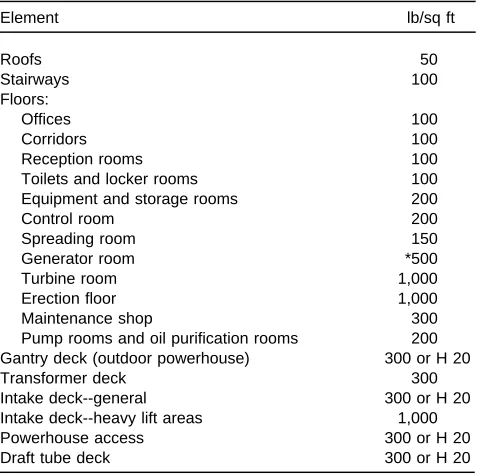
(1) The live loads shown in Table 4-1 are recom-mended for the design of slabs, beams, girders, and col-umns in the area indicated. These loads may be modified, if necessary, to suit the conditions on indi-vidual projects, but will ordinarily be considered mini-mum design loads. These loads may be reduced 20 percent for the design of a girder, truss, column, or footing supporting more than 300 square feet of slab, except that for generator room and erection floors this reduction will be allowed only where the member under consideration supports more than 500 square feet of slab. This differs from ASCE (1990) recommendations for live load reduction because of the loadings historically required in powerhouse floor slabs.
Table 4-1
Minimum Uniformly Distributed Live Loads
Element lb/sq ft
Roofs 50
Stairways 100
Floors:
Offices 100
Corridors 100
Reception rooms 100
Toilets and locker rooms 100 Equipment and storage rooms 200
Control room 200
Spreading room 150
Generator room *500
Turbine room 1,000
Erection floor 1,000
Maintenance shop 300
Pump rooms and oil purification rooms 200 Gantry deck (outdoor powerhouse) 300 or H 20
Transformer deck 300
Intake deck--general 300 or H 20 Intake deck--heavy lift areas 1,000 Powerhouse access 300 or H 20 Draft tube deck 300 or H 20
*300/lb/sq ft should be used for mezzanine floors and 1,000 lb/sq ft for areas which may be used for storage or erection of generator or turbine parts
advisable to post the load limit in all cases where such a load is used in design. Where mobile cranes are in use, the design should include outrigger loads. Where the powerhouse monoliths include the headgate structure and intake deck, moving concentrated loads such as mobile cranes and trucks handling equipment parts and trans-formers should be considered in the design of the deck and supporting structure. In case the deck carries a high-way, it should be designed for standard highway loading also.
(3) Impact factors for vehicle wheel loads are given in AASHTO “Standard Specifications for Highway Bridges.” Impact factors for crane wheel loads on run-ways are given in paragraph 4c(9).
(4) Wind loading should be applied to the structure as outlined in ASCE (1990). Members subject to stresses produced by a combination of wind and other loads listed under group II in EM 1110-2-2105 should be proportioned on the basis of increased allowable stresses. For concrete structures, ACI 318 and EM 1110-2-2104 provide appropriate load factors to be used for wind loading. The design of switchyard and take-off structures
for wind is covered in the reference cited in para-graphs 4-2d and 4-15.
(5) Construction loads should be carefully consid-ered to determine if provision should be made in the design of these temporary loads or whether false work or temporary bracing will suffice. It will be noted that construction loads are classified as Group II loading in EM 1110-2-2105, and should have the applicable load factor combinations for concrete structures.
(6) The possibility of seismic activity should be considered and appropriate forces included in the design. The structural analysis for seismic loading consists of two parts: The traditional overturning and sliding stabil-ity analysis using an appropriate seismic coefficient, and a dynamic internal stress analysis, using either site dependent earthquake ground motions or a static seismic coefficient. The use of the seismic coefficient should be limited to sites where the peak ground acceleration for the maximum credible earthquake is less than 0.2 g. Where a dynamic analysis is involved the powerhouse should be investigated for both the maximum credible earthquake and the operating basic earthquake. Earth-quake motions should be picked by procedures outlined in ETL 1110-2-301 “Interim Procedures for Specifying Earthquake Motions.” General guidance for seismic design and analysis is found in ER 1110-2-1806 “Earth-quake Design and Analysis for Corps of Engineers Proj-ects.” Specific criteria for powerhouses should be as outlined in ETL 1110-2-303 “Earthquake Analysis and Design of Concrete Gravity Dams.” This reference should be followed closely when the powerhouse intake forms a part of the dam. Site-dependent earthquake time histories or response spectra should be carefully chosen through geological and seismological investigation of the powerhouse site.
the tailwater rises above this level. Provisions should also be made for rapid draining of the powerhouse when the tailwater drops. A maximum tailwater elevation (below that selected for flooding the entire powerhouse) should also be chosen for unwatered draft tubes and provisions for automatic flooding of the water passages when that level is exceeded should be considered. It is nearly always advisable to reduce the uplift pressures on the draft-tube floor by means of a drainage system. When “floating” or relatively flexible floor slabs are used, they are not considered in the stability analysis, either as contributing weight or resisting uplift. When the floor slabs must take part of the foundation load, as is sometimes the case when the foundation is soil or poor rock, uplift should be assumed and the slab made an integral part of the draft-tube structure.
(8) Snow loading should be applied to the structure as outlined in ASCE (1990) “Minimum Design Loads for Buildings and other Structures.” Members subject to stresses produced by snow loading should be propor-tioned by treating it as a Group 1 loading in EM 1110-2-2105 or, in the case of concrete structures, as a basic live loading.
(9) Wheel loads should be treated as moving live loads in the design of crane runways. Maximum wheel loads should be computed from the dead load of the crane and trolleys plus the rated live load capacity, with the load in position to produce maximum truck reaction at the side of the runway under consideration. Dimen-sional data, weights, and truck reactions for cranes installed in Corps of Engineers powerhouses are given in EM 1110-2-4203. An impact allowance of 10 percent for cranes over 80-ton capacity, and from 12 percent to 18 percent for smaller cranes, should be added to the static loads. Side thrust at the top of the rail should be taken as 10 percent of the summation of the trolley weight and rated capacity, with three-fourths of this amount distributed equally among the wheels at either side of the runway. This may vary in the case of unequal stiffness of the walls supporting the runway. For instance, if one wall is relatively massive, the entire side thrust may be taken by this wall with little or no thrust taken by the more slender wall. The runway design should provide for longitudinal forces at the top of rail equal to 10 percent of the maximum vertical wheel loads. Crane stops should be designed to safely withstand the impact of the crane traveling at full speed with power off. Only the dead weight of the crane will be con-sidered and the resulting longitudinal forces should be provided for in the design of the crane runway.
d. Load on switchyard structures. Switchyard
struc-tures should be designed for line pull, equipment load, dead load, wind load, snow load, and ice load in accord-ance with the requirements of the NEMA Publication SG-6-Power Switching Equipment. Take off tower line loading should conform to ANSI Standard C2, National Electrical Safety Code, Section 25, and shall include applicable combinations of dead load, and line tension due to wind, ice and temperature changes.
4-3. Stability Analysis
a. Outline of investigation. A stability analysis should be made for each monolith of the powerhouse and all critical levels should be investigated for the most severe combination of horizontal and vertical forces. In the case of a monolith in which the power unit will not be installed with the initial construction, the stability should be investigated for the interim as well as the final condition. Analysis should be made for the applicable cases indicated below and for any other combinations of conditions which might prove critical. Cases S-1, S-2, S-3, and S-4, below are applicable when the powerhouse is separated from the dam, and Cases M-1, M-2, M-3, and M-4 are applicable when the powerhouse and head-works form a part of the dam.
(1) Applicable when powerhouse is separated from dam.
(a) Case S-1: head gates open--headwater at top of flood-control pool, hydraulic thrusts, minimum tailwater, spiral case full, draft tube full, uplift, and wind or earthquake.
(b) Case S-2: head gates open, tailwater at power-house flooding level, spiral case full, draft tube full, uplift, and wind or earthquake.
(c) Case S-3: head gates closed, tailwater at draft-tube flooding level, spiral case empty, draft draft-tube empty, uplift, and wind or earthquake.
(d) Case S-4 (Construction): no tailwater, and no uplift.
(2) Applicable when powerhouse and headworks, form part of dam.
applicable)), draft tube and spiral case open to tailwater (uplift), and wind on upstream side or earthquake.
(b) Case M-2: head gates open, headwater at maxi-mum flood level, tailwater at powerhouse flooding level, spiral case full, draft tube full (uplift), and wind on upstream side or earthquake.
(c) Case M-3: head gates closed, headwater at top of flood-control pool, tailwater at draft-tube flooding level, spiral case empty, draft tube empty, uplift, and wind on upstream side or earthquake.
(d) Case M-4 (Construction): no headwater, no tailwater, no uplift, and wind or earthquake.
(3) In some cases, the maximum overturning moment will occur when tailwater is at some intermedi-ate level between minimum and maximum.
(4) In analyzing monoliths containing draft tubes, the floor of the draft tube should not usually be considered as part of the active base area since it is generally designed to take neither uplift nor foundation pressure. (See paragraph 4-2c(7)).
(5) Monoliths should also be checked for lateral stability under applicable conditions, and the possibility of flotation at high tailwater levels should be borne in mind.
b. Vertical forces. The vertical forces that should be
considered in the stability analysis are the dead weight of the structure, fixed equipment weights, supported weights of earth and water, and uplift. The weights of movable equipment such as cranes and heavily loaded trucks should be included only where such loads will decrease the factor of safety against overturning.
c. Horizontal forces. The horizontal forces that should be considered are those due to headwater, tail-water, ice, earth, and wind or earthquake pressures. Force due to waves should also be included if the fetch is great enough to cause waves of considerable height. The forces resulting from temperature changes in steel penstocks need not be considered, but the pressure of water in the penstocks should be included as hydraulic thrust resulting from wicket gate closure, depending upon the assumed conditions. The application and intensity of wind pressure or earthquake should be as prescribed in paragraphs 4-2c(4) and 4-2c(6).
d. Uplift assumptions. Effective downstream drain-age whether natural or artificial will in general, limit the uplift at the toe of the structure to tailwater. If the powerhouse is separate from the dam, uplift from tail-water should be assumed 100 percent effective on the entire foundation area. If the powerhouse forms part of the dam, uplift assumptions should be the same as those for the dam, as described in EM 1110-2-2200. For those structures founded on soil, uplift should be assumed to vary from headwater to tailwater using the line of seep-age method as outlined in EM 1110-2-2502, “Retaining and Floodwalls.” For a majority of structures, this method is sufficiently accurate, however there may be special situations where the flow net method is required to evaluate uplift.
e. Base pressures and stability. Ordinarily the
maxi-mum base pressures do not govern the design of power-house on sound rock. However, regardless of the foundation material, they should always be checked to make sure they do not exceed the safe working values established as a result of the geological or soils investiga-tions. For conditions that include earthquake, the resul-tant of all forces may fall outside the kern but within the base a sufficient distance so that the allowable foundation pressure is not exceeded. The location of the resultant of all forces, including uplift, acting on the structure should fall within the kern of either a rectangular or irregularly shaped base. In pile foundations, the allowable material, bearing, and tension valves for the piles should not be exceeded. If the foundation at the selected site is entirely soil, or is a combination of soil and rock, special consid-eration should be given to the possibility of unequal settlement. It may be necessary to investigate the shear-ing strength of the foundation or, in case of a hillside location, to investigate the stability of the structure and foundation together by means of one of the methods discussed in EM 1110-2-1902.
f. Sliding factor. EM 1110-2-2200 contains the
4-4. Subgrade Conditions and Treatments
a. Rock foundation. It is very important that the structure rest on sound material, unweathered and unshat-tered by blasting, in order to develop full resistance to shearing and sliding. The character of some rock foun-dations is such that disintegration will take place upon short exposure. In these circumstances it will be neces-sary to preserve, insofar as possible, the natural charac-teristics of the unexposed foundation material. Disintegration may be prevented either by delaying the excavation of the last foot or two of material until just prior to placing concrete, or by excavating to final grade and immediately applying asphalt or a similar waterproof coating to the exposed surface. Another method is to place a light concrete cover immediately upon exposure, which provides a better surface for workmen and equip-ment as well as protection for the foundation. An other-wise sound rock foundation may contain seams of clay or other unsuitable materials which must be excavated and filled with concrete, or areas for broken rock which must be consolidated by pressure grouting.
b. Soil foundation. The design of powerhouse
foun-dation on earth is based on the in situ shear and bearing strength of the underlying soil, with consideration being taken of weak seams at deeper depths below the founda-tion line. Weak materials may require excavation to firmer material or the use of piles as a foundation. A close cooperation between the designer and the founda-tion and materials engineer must exist even in prelimi-nary design. Factors of safety against sliding should be computed using procedures discussed in paragraph 4-3f.
4-5. Foundation Drainage and Grouting
a. Rock foundation. Provisions should be made for
foundation drainage, particularly under the draft-tube floor slabs, to reduce uplift and permit the unwatering of draft tubes. Usually, a network of drains under the draft tubes is all that is required. Holes drilled into the rock connect with these drains, which discharge through weep holes in the slab into the draft tubes. Drain holes should be cleared on a routine basis, perhaps every 5 years, to ensure their functional capability. For unwatering, a drain in each draft tube leads, through a valved connect-ing pipe, to a header which drains to a sump from which the water is pumped outside the powerhouse. Theoreti-cally, the drill holes in the rock should be deep enough so the hydrostatic uplift (due to maximum tailwater with draft tube unwatered) on a horizontal plane at the bottom of the holes will be more than balanced by the weight of the rock above the plane plus the weight of the draft tube
floor slab. A lesser depth will usually be satisfactory, as the rock may be assumed to “arch” to some extent across the end piers of the draft tube. It is recommended that the drain holes extend to a depth at least equal to one-half the monolith width below the floor slab. Drain holes should be spaced about 12 feet to 15 feet on centers with weep holes in the slab 6 feet to 7-1/2 feet on centers. Where the nature of the rock indicates perco-lation of such magnitude as to render the unwatering of draft tubes difficult, perimeter grouting, area grouting, or both may be used within the powerhouse foundation area. Care should be taken that this grouting does not interfere with drainage essential to the dam or the powerhouse. If perimeter grouting is used, a system of relief drains near the upstream side of the monoliths is necessary to pre-vent possible building up of headwater pressure under the structure in case of leakage through or under the upstream grout curtain. Because of the possibility that headwater may enter the area and cause worse unwater-ing and uplift conditions than would have been the case without curtains, it is desirable to avoid perimeter grout-ing if possible. For additional information on the pur-pose, theory, and methods of foundation grouting refer to EM 1110-2-3506.
b. Soil foundations. When powerhouse structures rest on soil, it is necessary to protect the foundation material against scour and piping. The potential for effective drainage and grouting in soil materials is very sensitive to the exact nature of the material. Uplift reduction may be more effective if underlying drainage blankets are used rather than drain holes.
4-6. Substructure Functions and Components