Results of the WNUT16 Named Entity Recognition Shared Task
Benjamin Strauss, Bethany E. Toma, Alan Ritter, Marie-Catherine de Marneffe, Wei Xu The Ohio State University OH, USA
{strauss.105,toma.18,ritter.1492,demarneffe.1,xu.1265}@osu.edu
Abstract
This paper presents the results of the Twitter Named Entity Recognition shared task associated with W-NUT 2016: a named entity tagging task with 10 teams participating. We outline the shared task, annotation process and dataset statistics, and provide a high-level overview of the participating systems for each shared task.
1 Introduction
The increasing flood of user-generated text on social media has created an enormous opportunity for new data analysis techniques to extract and aggregate information about breaking news (Ritter et al., 2012), disease outbreaks (Paul and Dredze, 2011), natural disasters (Neubig et al., 2011), cyber-attacks (Ritter et al., 2015) and more. Named entity recognition is an important first step in most information extraction pipelines. However, performance of state-of-the-art NER on social media still lags behind well edited text genres. This motivates the need for continued research, in addition to new datasets and tools adapted to this noisy text genre.
In this paper, we present the development and evaluation of a shared task on named entity recognition in Twitter, which was held at the 2nd Workshop on Noisy User-generated Text (W-NUT 2016) and attracted 10 participating teams, 7 of which described their approach in peer-reviewed papers. This is a re-run of the NER task from W-NUT 2015, with an updated test set. The new test set consists of tweets annotated with named entities from a later time period than the data from 2015. The new test set developed for the 2016 iteration of the task consists of 3,856 tweets; this roughly doubles the amount of annotated data available for Twitter named entity recognition. We hope this new data will help to advance research on named entity recognition in noisy text.
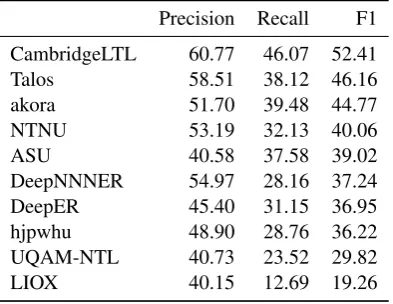
A major development as compared to 2015 is the increased use of neural network methods by partic-ipants. Several teams, including the winning team, CambridgeLTL, used bidirectional LSTMs. Other teams achieved competitive performance by integrating a broad range of linguistic and knowledge-based features using conditional random fields (e.g., NTNU) or learning to search methods (Talos).
Another new development for 2016 was the inclusion of small amounts of domain-specific data into the test set. The motivation was to test whether Twitter named entity taggers targeting general-domain suffer a drop in performance when applied to tweets on specific types of events. For this purpose we annotated 350 tweets related to cyber-attacks and 500 related to mass shooting events. Note that no data from these domains was specifically included in the training or development data.
In the following sections, we describe details of the task including training and development datasets in addition to the newly annotated test data for 2016. We briefly summarize the systems developed by selected teams, and conclude with results.
2 Named Entity Recognition over Twitter
Named entity recognition is a crucial component in many information extraction pipelines. However, the majority of available NER tools were developed for newswire text and these tools perform poorly on informal text genres such as Twitter. While performance on named entity recognition in newswire is
quite high1 (Tjong Kim Sang and De Meulder, 2003), state-of-the-art performance on Twitter data lags far behind.
The diverse and noisy style of user-generated content presents serious challenges. For instance tweets, unlike edited newswire text, contain numerous nonstandard spellings, abbreviations, unreliable capital-ization, etc. Because of these issues, off-the-shelf named entity recognition tools tuned for newswire suffer a severe performance degradation when applied to noisy Twitter data. But tweets often contain more up-to-date information than news, in addition the increased volume of text offers opportunities to exploit redundancy of information which is very beneficial for information extraction (Downey et al., 2005). To exploit the opportunities for information extraction on top of social media, there is a crucial need for in-domain annotated data to train and evaluate named entity recognition systems on this noisy style of text.
Twitter processing has the additional challenge that the language people use on Twitter changes over time (Dredze et al., 2010; Fromreide et al., 2014). The previous edition of this task (Baldwin et al., 2015) addressed this issue by evaluating on a test set collected from a later time period then the training and development data. This year we take a similar approach, providing a new test dataset of tweets gathered from 2016. In addition to enabling research on adapting named entity recognition to new language over time, we hope this new dataset will be useful for adapting future Twitter named entity recognition systems, improving their performance on up-to-date data.
Additionally, this year we address the issue of topic distribution by including evaluation data from two specific domains (cybersecurity events and mass shootings) along with general domain data. Both the time period and topic selection of the evaluation data were not announced to participants until the (unannotated) test data was released at the beginning of the evaluation period. Teams had 7 days to submit their results on the test data, which were subsequently scored and gold annotations were released to participants. Evaluating the NER systems on these domains specific Twitter data provides information about possible system weakness.
2.1 Training and Development Data
The training and development data for our task was taken from prior work on Twitter NER (Ritter et al., 2011; Baldwin et al., 2015), which distinguishes 10 different named entity types (see Table 1 for the set of types). The training data was created from the union of the training and development data from the 2015 task (Baldwin et al., 2015).
The data was split into 2,394 annotated tweets for training and 1,000 as a development set. We also provided an additional 425 annotated tweets from the 2015 development data set (Baldwin et al., 2015).
2.2 Test Data Annotation
The data set we created for testing is new for this shared task. We collected general Twitter data and domain specific Twitter data. In real world situations people want to run taggers on a specific subset of the twitter stream. To simulate these situations we collected and tested on two example domains. The domain specific data sets are mass shooting events and cybersecurity events. General domain test data was randomly sampled from December 2014 through February 2015. Shooting domain data was collected by searching for tweets that are referring to a shooting event. To collect tweets from the mass shooting domain used www.gunviolencearchive.org’s mass shooting event database for information about shooting events; including date, location, victim, and perpetrators of shooting events. Using this information, we searched for tweets that occur on the same day as a mass shooting and include the key word “shooting” and the location of the shooting event. The shooting domain contains 8,963 tokens with 751 phrases. Computer hacking events were found by searching for tweets including the keyword “breach”. The breach domain contains 5,537 tokens with 603 phrases.
The additional data annotated this year was completed by a single annotator instructed to follow the annotation guidelines of the prior annotations. The annotator was presented with a set of simple guide-lines2that cover common ambiguous cases and was also instructed to refer to the September 2010 data
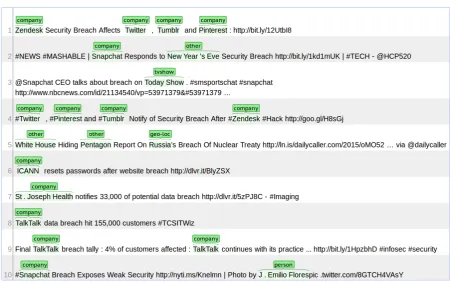
for reference (Ritter et al., 2011). The BRAT tool3 was used for annotation. Figure 1 is a screenshot of the interface presented to the annotators. To ensure that the new annotations were consistent with the earlier annotations, 100 tweets were annotated in both tasks to calculate agreement. The new annotator proved a high agreement with the old data set with a F1 score of 67.67.
Table 1 presents the count of each of the 10 named entity types labeled by the annotators in the training, development and test sets created for this shared task.
Train Dev Test company 171 39 621 facility 104 38 253 geo-loc 276 116 882
movie 34 15 34
musicartist 55 41 191
other 225 132 584
person 449 171 482
product 97 37 246
sportsteam 51 70 147
tvshow 34 2 33
Total 1496 661 3473
[image:3.595.73.524.405.688.2]Table 1: Named entity type counts in the train, development and test sets.
Figure 1: Annotation interface.
Team ID Affiliation
CambridgeLTL University of Cambridge Talos Viseo R&D
akora University of Manchester
NTNU Indian Institute of Technology Patna ASU Ain Shams University, Cairo, Egypt DeepNNNER Honda Research Institute Japan
DeepER University of Illinois at Urbana-Champaign hjpwhu Wuhan University
[image:4.595.182.419.62.183.2]UQAM-NTL Universit´e du Qu´ebec `a Montr´eal LIOX The Hong Kong Polytechnic University
Table 2: Team ID and affiliation of the named entity recognition shared task participants.
POS Orthographic Gazetteers Brown clustering Word embedding ML
BASELINE – X X – – CRFsuite
CambridgeLTL – – – – – LSTM
akora – – – – – LSTM
NTNU X X X – – CRF
Talos X X X X GloVe L2S
DeepNNNER – – – – Multiple LSTM-CNN
ASU – – X X – LSTM
UQAM-NTL X X X – – CRF
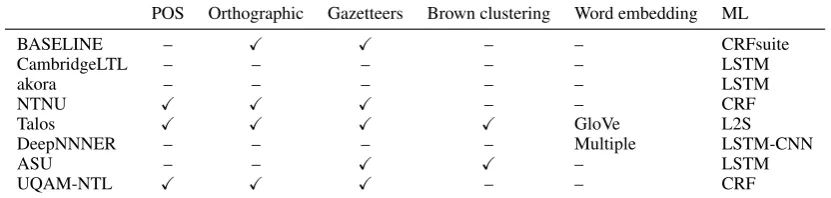
Table 3: Features and machine learning approach taken by each team.
2.3 System Descriptions
This section briefly describes the approach taken by each team. Overall we noticed different trends be-tween the types of systems submitted this year and last year. The most notable change is the use of LSTM-based systems. Four of the seven submissions were LSTM-based as opposed to zero submis-sions last year. The previous year Conditional Random Fields was the most popular ML technique for extracting named entities.
CambridgeLTL (Limsopatham and Collier, 2016) The system uses bidirectional LSTM to automati-cally induce and leverage orthographic features for performing Named Entity Recognition in Twitter messages.
akora (Kurt Junshean Espinosa and Ananiadou, 2016) This system uses bidirectional LSTM net-works and exploits weakly annotated data to bootstrap sparse entity types.
NTNU (Sikdar and Gamb¨ack, 2016) This system is based on classification using Conditional Random Fields, a supervised machine learning approach. The system utilizes a large feature set developed specifically for the task, with eight types of features based on actual characters and token internal data, five types of features built through context and chunk information, and five types of features based on lexicon-type information such as stop word matching, word frequencies, and entries in the shared task lexicon and Babelfy (Moro et al., 2014).
Talos (Ioannis Partalas and Kalitvianski, 2016) The system uses three types of features: lexical and morpho-syntactic features, contextual enrichment features using Linked Open Data, and features based on distributed representation of words. The system also exploits words clustering to enhance performance. The learning algorithm was solved by using Learning to search (L2S) that resembles a reinforcement learning algorithm.
[image:4.595.91.507.219.318.2]Precision Recall F1 CambridgeLTL 60.77 46.07 52.41
Talos 58.51 38.12 46.16
akora 51.70 39.48 44.77
NTNU 53.19 32.13 40.06
ASU 40.58 37.58 39.02
DeepNNNER 54.97 28.16 37.24
DeepER 45.40 31.15 36.95
hjpwhu 48.90 28.76 36.22
UQAM-NTL 40.73 23.52 29.82
[image:5.595.75.272.63.215.2]LIOX 40.15 12.69 19.26
Table 4: Results segmenting and categorizing enti-ties into 10 types.
Precision Recall F1 CambridgeLTL 73.49 59.72 65.89
NTNU 64.18 62.28 63.22
Talos 70.53 52.58 60.24
akora 64.75 54.28 59.05
ASU 57.55 52.98 55.17
DeepER 63.17 43.31 51.38
DeepNNNER 70.66 36.14 47.82
hjpwhu 63.00 37.06 46.66
UQAM-NTL 53.21 37.95 44.30
[image:5.595.305.505.69.220.2]LIOX 58.18 31.33 40.73
Table 5: Results on segmentation only (no types)
Acc P R F1
CambridgeLTL 90.57 69.75 51.24 59.08
Talos 89.36 60.49 41.13 48.96
akora 88.42 54.21 36.32 43.50
hjpwhu 88.21 59.79 28.86 38.93
ASU 87.76 42.22 32.84 36.94
NTNU 87.72 51.89 27.36 35.83
DeepNNNER 87.66 62.88 23.88 34.62
DeepER 84.32 40.23 22.89 29.18
UQAM-NTL 85.64 37.97 16.75 23.25
LIOX 84.41 30.08 6.63 10.87
Table 6: Results for the Cyber domain data on seg-menting and categorizing entities into 10 types.
Acc P R F1
CambridgeLTL 93.00 66.25 56.72 61.12
Talos 92.03 68.53 49.00 57.14
DeepER 91.96 64.01 51.40 57.02
akora 91.54 58.89 49.40 53.73
NTNU 91.14 61.36 42.08 49.92
DeepNNNER 91.22 59.88 41.15 48.78
hjpwhu 90.83 53.71 41.41 46.77
ASU 90.74 45.40 47.94 46.63
UQAM-NTL 89.38 45.80 33.42 38.65
LIOX 88.35 55.77 23.17 32.74
Table 7: Results for the Shooting domain on seg-menting and categorizing entities into 10 types.
ASU (Michel Naim Gerguis and Gerguis, 2016) The system shows an experimental study on using word embeddings, Brown clusters, part-of-speech tags, shape features, gazetteers, and local con-text to create a feature representation along with a set of experiments for the network design. A Wikipedia-based classifier framework was adopted to extract lists of fine-grained entities out of few input examples to be used as gazetteers. The model uses the LSTM algorithm to learn a NE classifier from the feature representation.
UQAM-NTL (Ngoc Tan LE and Sadat, 2016) The system is based on supervised machine learning and trained with a sequential labeling algorithm, using Conditional Random Fields to learn a clas-sifier for Twitter NE extraction. The model uses 6 different categories of features including (1) orthographic, (2) lexical and (3) syntactic features as well as (4) part-of-speech tags, (5) polysemy count and (6) longest n-gram length in order to create a feature representation.
3 Summary
[image:5.595.77.293.260.412.2] [image:5.595.309.518.261.412.2]Acknowledgments
This material is based upon work supported by the National Science Foundation under Grant No. IIS-1464128. Alan Ritter and Benjamin Strauss are supported by the Office of the Director of National Intelligence (ODNI) and the Intelligence Advanced Research Projects Activity (IARPA) via the Air Force Research Laboratory (AFRL) contract number FA8750-16-C-0114. The U.S. Government is authorized to reproduce and distribute reprints for Governmental purposes notwithstanding any copyright annotation thereon. Disclaimer: The views and conclusions contained herein are those of the authors and should not be interpreted as necessarily representing the official policies or endorsements, either expressed or implied, of ODNI, IARPA, AFRL, or the U.S. Government.
References
Timothy Baldwin, Young-Bum Kim, Marie Catherine de Marneffe, Alan Ritter, Bo Han, and Wei Xu. 2015. Shared tasks of the 2015 workshop on noisy user-generated text: Twitter lexical normalization and named entity
recognition. ACL-IJCNLP, 126:2015.
Doug Downey, Oren Etzioni, and Stephen Soderland. 2005. A probabilistic model of redundancy in information extraction. InProceedings of the 19th international joint conference on Artificial intelligence.
Mark Dredze, Tim Oates, and Christine Piatko. 2010. We’re not in kansas anymore: detecting domain changes in
streams. InProceedings of the 2010 Conference on Empirical Methods in Natural Language Processing, pages
585–595. Association for Computational Linguistics.
Fabrice Dugas and Eric Nichols. 2016. Deepnnner: Applying blstmcnns and extended lexicons to named entity recognition in tweets. Inproceedings of W-NUT 2016, Osaka, Japan.
Jenny Rose Finkel, Trond Grenager, and Christopher Manning. 2005. Incorporating non-local information into
information extraction systems by gibbs sampling. InProceedings of the 43rd Annual Meeting on Association
for Computational Linguistics, ACL ’05, pages 363–370, Stroudsburg, PA, USA. Association for Computational Linguistics.
Hege Fromreide, Dirk Hovy, and Anders Søgaard. 2014. Crowdsourcing and annotating ner for twitter# drift.
European language resources distribution agency.
Nadia Derbas Ioannis Partalas, C´edric Lopez and Ruslan Kalitvianski. 2016. Learning to search for recognizing named entities in twitter. Inproceedings of W-NUT 2016, Osaka, Japan.
Riza Theresa BatistaNavarro Kurt Junshean Espinosa and Sophia Ananiadou. 2016. Learning to recognise named entities in tweets by exploiting weakly labelled data. Inproceedings of W-NUT 2016, Osaka, Japan.
Nut Limsopatham and Nigel Collier. 2016. Bidirectional lstm for named entity recognition in twitter messages. Inproceedings of W-NUT 2016, Osaka, Japan.
M. Watheq El-Kharashi Michel Naim Gerguis, Cherif Salama and Michel Naim Gerguis. 2016. Asu: An
exper-imental study on applying deep learning in twitter named entity recognition. Inproceedings of W-NUT 2016,
Osaka, Japan.
Andrea Moro, Alessandro Raganato, and Roberto Navigli. 2014. Entity linking meets word sense disambiguation: a unified approach. Transactions of the Association for Computational Linguistics, 2:231–244.
Graham Neubig, Yuichiroh Matsubayashi, Masato Hagiwara, and Koji Murakami. 2011. Safety information mining-what can nlp do in a disaster-. InIJCNLP.
Fatma Mallek Ngoc Tan LE and Fatiha Sadat. 2016. Uqam-ntl: Named entity recognition in twitter messages. In
proceedings of W-NUT 2016, Osaka, Japan.
Michael J Paul and Mark Dredze. 2011. You are what you tweet: Analyzing twitter for public health. ICWSM.
Alan Ritter, Sam Clark, Oren Etzioni, et al. 2011. Named entity recognition in tweets: an experimental study. In Proceedings of the Conference on Empirical Methods in Natural Language Processing, pages 1524–1534. Association for Computational Linguistics.
Mausam Ritter, Alan, Oren Etzioni, and Sam Clark. 2012. Open domain event extraction from twitter. In
Alan Ritter, Evan Wright, William Casey, and Tom Mitchell. 2015. Weakly supervised extraction of computer security events from twitter. InProceedings of the 24th International Conference on World Wide Web.
Utpal Kumar Sikdar and Bj¨orn Gamb¨ack. 2016. Feature-rich twitter named entity recognition and classification. Inproceedings of W-NUT 2016, Osaka, Japan.
Erik F Tjong Kim Sang and Fien De Meulder. 2003. Introduction to the conll-2003 shared task:
Language-independent named entity recognition. InProceedings of the seventh conference on Natural language learning