German NER with a Multilingual Rule Based Information Extraction
System: Analysis and Issues
Anna Druzhkina National Research University Higher School of Economics;
ABBYY
Alexey Leontyev ABBYY
Maria Stepanova ABBYY
Abstract
This paper presents a rule-based approach to Named Entity Recognition for the Ger-man language. The approach rests upon deep linguistic parsing and has already been applied to English and Russian. In this paper we present the first results of our system, ABBYY InfoExtractor, on Ger-mEval 2014 Shared Task corpus. We focus on the main challenges of German NER that we have encountered when adapting our system to German and possible solu-tions for them.
1 Introduction
Named Entity Recognition (NER), which is a sub-task of information extraction (Grishman, 2003), is a well-studied, yet challenging task. Vari-ous competitions have been held to evaluate qual-ity of named entqual-ity recognition for different lan-guages (MUC, CONLL-2002, IREX). German is no exception: there have already been two eval-uation tracks for German, ConLL 2003 (Tjong Kim Sang and De Meulder, 2003) and GermEval 2014 (Benikova et al., 2014). The best results ported for the tracks are 72.41% and 76.38% re-spectively, which is still considerably below the results for English. One of the observed reasons is that noun capitalization in German differs con-siderably from that in English. Another reason is the smaller number of gazetteers and other linguis-tic resources available for German. In this paper we present an overview of our approach to Named Entity Recognition and discuss the issues that we have observed while adapting our information ex-traction system to German.
ABBYY InfoExtractor has already been applied to English and Russian. We evaluated our named entity recognition system for English on MUC-6 corpus and achieved the F-measure of approx-imately 83% with no prior adjustments. We per-formed this evaluation ourselves. As for the Rus-sian language, we took part in FactRuEval 2016 competition1 and showed the best results in the
Russian Named Entity Recognition Track with the F-measure of 86.7% (Stepanova et al., 2016; Starostin et al., 2016).
The paper is structured as follows. In Section 2 we review some of the previous works in the field of German NER. In Section 3 an outline of the sys-tem architecture is given. In Section 4 we discuss the issues that we have faced in German NER and comment on them. In Section 5 we present perfor-mance of our system on GermEval 2014 corpus. Section 6 provides conclusion and discussion of our future work.
2 Related Work
There have been two main approaches to named entity recognition: rule-based and classifier-based. Most of the systems that work with the German language are classifier-based: only four of the systems that took part in either GermEval 2014 or CONLL 2003 tracks used handcrafted rules for named entity recognition (Bobkova et al., 2014; Hermann et al., 2014; Weber and Pötzl, 2014; Watrin et al., 2014), three of these systems used rules in combination with classifier-based ap-proaches. Hatner (2014) reports that the combi-nation of rules and a classifier performed actually worse than the classifier alone. However,
Early-1http://www.dialog-21.ru/en/evaluation/
Tracks reported that the use of linguistic resources and rules improved the resulting F-measure con-siderably. NERU was the only system which re-lied mainly on handcrafted rules, the system was able to achieve the F-measure of 54.55% on the test set. Overall, the systems participating in Ger-mEval track showed F-measures from 37.23% to 76.38%.
3 System Architecture
Our approach rests upon deep linguistic parsing performed by ABBYY Compreno parser. The in-put of information extraction module is semantic and syntactic structures of text produced by the parser.
3.1 Language model
The language model we use can be described as projective dependency trees. Alternatively, it can be viewed as flat constituent structures where ev-ery constituent is built around a word. Depen-dency arcs have two types of labels, syntactic and semantic ones. Syntactically, our structures are very similar to universal dependency model (Nivre, 2015). Semantic labels include traditional semantic roles (Agent, Instrument, Object, Time etc.) as well as several ‘dummy’ labels (such as Specification) devoid of semantic content.
Leaves of dependency trees are mostly word forms annotated with lexeme and lexical meaning (similar in spirit to WordNet (Fellbaum, 1998) meanings). Quoted expressions, e.g. “‘War and Peace’ is a masterpiece”, have their own dummy nodes as well. The system is designed as mul-tilingual, which is manifested as follows. Lexi-cal meanings in a given language are leaves in a language-independent hierarchy of meanings. Se-mantic labels are universal for all languages as well. Syntactic structures across different lan-guages are aligned as much as possible.
The pipeline of the system consists of the fol-lowing steps. Input text undergoes lexical and morphological analysis, at which stage all pos-sible lexical classes for each word form with all possible grammatical values are suggested. At the next step the syntactic module builds a graph of all possible syntactic and semantic dependencies be-tween the lemmas. At the same time non-tree rela-tions, if any, are checked. Incompatible meanings are gradually filtered, and a set of valid syntactic-semantic trees remains. Then the tree with the best
score is selected. This final tree is passed to the on-tological rules, which yield an RDF graph. More on the parser is given in (Anisimovich et al., 2012; Goncharova et al., 2015).
Statistics is gathered on parallel texts, and lexi-cal ambiguity in one language is resolved with the help of other languages.
3.2 Rules
The information extraction system can be consid-ered a rule-based one. The input accepted by the information extraction mechanism is a sequence of syntactic-semantic trees described above (one tree per sentence), the output of the mechanism is an RDF graph. A detailed description of our information extraction module can be found in (Starostin et al., 2014). A rule is itself a condi-tion on parse tree or an object condicondi-tion (i.e. that an object of a certain type must be “linked” to a certain node in a parse tree). Consider an exam-ple:
Die AfD hat gesagt, dass sie über eine vollständige Alternative verhandeln will.
AfD said that it will carry on negotia-tions regarding a complete alternative.
Figure 1 shows a fragment of a parse tree gen-erated for the sentence.
Figure 1: Parse tree fragment
Figure 2 shows an example of a rule that would extract an organization on the fragment “AfD”.
Figure 2: Rule
English and Russian for German. However, Ger-man capitalization was a challenge: in English and Russian capitalization is a good marker to discrim-inate between abstract and named entities:
1. relationship between Church and State in the Middle Ages
2. He went to church on Sunday
In German this marker does not work because all nouns are capitalized. So far we have decided to create an extra rule, which checks if the noun has dependent adjectives that are capitalized. If such adjectives can be found, the entity is labelled as named, otherwise, the entity is labeled as ab-stract. The approach, however, works only for part of the cases and tends to miss out correct named entities (consider the example above).
As we evaluated our system on GermEval cor-pus, we wrote some additional rules to extract enti-ties which are specific to this corpus, i.e. OTHER, ENTITYderiv and ENTITYpart (Benikova et al., 2014). The rules for extraction entities of the type OTHER included conditions on currency names, bracketed names, urls and so on. To extract EN-TITYpart type we added a rule that marked the constituent that had the “Composite” grammeme.
Extracting of ENTITYderiv type of entities is challenging for us, because our system rests upon the hierarchy of semantic meanings and does not preserve information that some word was derived from another. For instance, the words “Deutscher” and “Deutsch” are not connected in the hierar-chy. We created a rule that added a “deriv” tag to the names of nationalities and to named entities, which were extracted on adjectives.
We did not extract any gazetteers from the cor-pus, although we plan to do it in the future.
4 Issues
Extending our system to German, we have faced a number of challenges. In this section we will discuss them and offer solutions where possible.
4.1 Organization names
Organization-denoting expressions can have dif-ferent syntactic structures.
Syntactic structures can be classified as follows. In the easiest case there is: generic word (Inc., Ltd., GmbH etc.) and the name of organization in quotes or italics/bold. See below a text example and our structure of its fragment:
“Deutsche Post” AG ist eine große Firma.
ist→AG→#BracketedProperName→
AG.
2. In the second case, there is only the name of organization in quotes or italics/bold without a generic word. Ex.:
“Deutsche Post” ist eine große Firma.
Deutsche Postist eine große Firma. ist→AG→#BracketedProperName→
Post.
3. The third case is similar to the first one, but the name of organization does not have quotes or formatting. Ex.:
Deutsche Post AG ist eine große Firma. Alpha Versicherung GmbH ist auch eine Firma.
Here we can easily identify only one of the two borders of the named entity, the one where the generic name is. The other border is harder to guess: in the examples above it can be either “Post AG” or “Deutsche Post AG” and “Versicherung GmbH” or “Alpha Versicherung GmbH”.
In such cases elements of organization name in English and Russian are normally capitalized, and a dummy node #CapitalizedProperName, an ana-logue of #BracketedProperName, can be identified on the basis of this capitalization. Ex.:
I shop at Healthy Soups.
shop → #CapitalizedProperName →
Soups→Healthy
In German this does not work. Thus we re-worked our system and introduced direct links be-tween the generic word and (the main word of) or-ganization title as such.
Organization name itself can belong to one of the several categories (ranked from easier to more difficult):
1. Proper name present in the dictionary. Ex.: “Raiffeisen Bank”.
2. Unknown word, i.e. not present in the dictio-nary. Ex.: “Gruffalo Bank”.
In the first case, the name helps building the correct structure because the model takes into ac-count correlation statistics between the semantic class of the child node and semantically labelled link, and the statistics for a proper organization name and the link between it and the generic com-pany name is normally good. In the third case the title is misleading because “Versicherung” (insur-ance) is a common verb noun, which is not a typ-ical child of aName link. Yet, as we cannot use a dummy node in this case in German, we have created a new semantically labelled link between generic company names and this type of organi-zation titles that would allow for such connection. (This work is now in progress.) In this way Ger-man has forced us to face this problem. With only English and Russian, such cases were infrequent and could be ignored.
4. In the most difficult case there is neither generic word nor quotes/formatting. Ex.:
Deutsche Post ist eine große Firma.
In this case identification of both borders and thus the very presence of organization name is troublesome. Yet, from our experience, this type is not less frequent.
4.2 Composites
When analyzing a word form, the parser can have several hypotheses about its lemma. If the word can in theory be split into several known word forms, the parser may try to analyze it as a com-posite word. While it is generally reasonable for a language so rich in composites as German, it may cause problems when analyzing unknown proper names (not present in the dictionary). The inner structure of proper names, particularly person or location names, can be rather complicated: “Tem-pelhof”, “Schimmelmann” etc., yet such words should be treated as single lemmas. But there are also common nouns that are actual compos-ites and that should be split into parts during the analysis: “Tempelarchitektur” (temple architec-ture), “Schimmelkultur” (fungus culture). In both cases the parser will have two hypotheses for these words: 1) an unknown word (Tempelhof, Tem-pelarchitektur); 2) a composite consisting of sev-eral known parts:Tempel+Architektur;Tempel+
Hof. Thus, choosing the correct hypothesis may be challenging.
4.3 Non-German fragments
We have also observed that sequences of for-eign words incorporated in German text can create problems for named entity recognition. If none of the foreign words in a sequence looks like a Ger-man word, they will all be interpreted as unknown words, which is the best variant in this situation. But if any of the foreign words in the sequence is homonymous to any known word form in German, the parser is more likely to interpret this word as a known German lexeme rather than an unknown one and build a syntactic structure based on this in-terpretation. This results in incorrect parsing, im-peding NE identification. Example: “Zimbabwe Conservation Task Force”. The word “Force” is present in the German dictionary as a town name, and the parser can recognize this word form as a location name instead of an element of a sequence of unknown words that together form the name of an organization. A possible solution here is to de-tect borders of a foreign language fragment and treat all words within it as one unknown item. Yet, this will not a complete solution because there are cases when a German word is incorporated into a foreign language string, which makes border de-tection more difficult:
Nutzung von Business-zu-Customer-Beziehungen
Here “zu” is a German word, but “customer” and probably “business” are English fragments.
4.4 Abbreviations
it into the dictionary, and is interpreted as an un-known acronym at the parsing stage.
4.5 Quotation marks
If a fragment of text has quotation marks around it, there is a high probability that it denotes a named entity such as an organization name. However, quotation marks can also be used in some other contexts such as quoting: “‘Excuse me’, the boy said”. For the languages we have previously dealt with we can look up for speech verbs in order to disambiguate between the two usages of quotation marks. However, for German the presence of a speech verb is not always obligatory since there exists a special verb form (Konjunktiv I) desig-nating reported speech. Thus for a fragment in a long sequence of Konjunktiv I sentences quota-tion marks can signify either reported speech or a named entity, even if there is not any speech verb nearby.
5 Evaluation
Precision (%) Recall (%) FB1 (%)
45.22 44.87 45.04
Table 1: Overall results. Strict metric
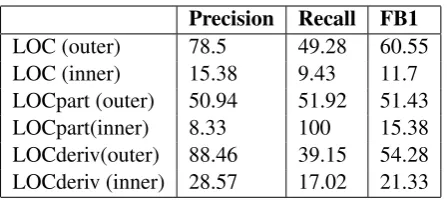
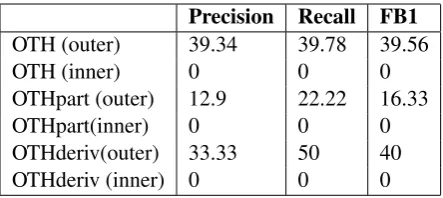
We have tested our system on GermEval 2014 corpus using the evaluation script provided by the organizers. Overall results of strict evaluation are presented in Table 1, results of strict evaluation by categories are given in Tables 2, 3, 4, 5. Predictably, extraction of organizations has turned out to be the most challenging task for us, due to the parsing problems mentioned above. We hope that the implementation of changes to the parser suggested in Section 4 will improve the quality of parse trees and entity extraction. Enrichment of Organization gazetteer is also likely to help.
Precision Recall FB1
[image:5.595.307.531.61.161.2]PER (outer) 63.02 65.68 64.33 PER (inner) 30.43 20.59 24.56 PERpart (outer) 0 0 0 PERpart(inner) 0 0 0 PERderiv(outer) 0 0 0 PERderiv (inner) 0 0 0
Table 2: Results for PER (in %)
Precision Recall FB1
LOC (outer) 78.5 49.28 60.55 LOC (inner) 15.38 9.43 11.7 LOCpart (outer) 50.94 51.92 51.43 LOCpart(inner) 8.33 100 15.38 LOCderiv(outer) 88.46 39.15 54.28 LOCderiv (inner) 28.57 17.02 21.33
Table 3: Results for LOC (in %)
Precision Recall FB1
ORG (outer) 18.7 32.46 23.73
ORG (inner) 0 0 0
[image:5.595.307.531.195.294.2]ORGpart (outer) 77.14 29.67 42.86 ORGpart(inner) 0 0 0 ORGderiv(outer) 0 0 0 ORGderiv (inner) 0 0 0
Table 4: Results for ORG (in %)
The results of “Person” type extraction are quite unexpected, first of all, because recall-better-than-precision pattern is not typical for us. These re-sults require further analysis, which is beyond the scope of this paper.
The precision of “Location” type extraction is relatively high and we believe that further Loca-tion gazetteer enrichment will improve the recall considerably.
6 Conclusions
In this paper we presented our rule-based approach to named entity recognition for the German lan-guage. The approach has previously been applied to Russian and English languages and has shown good results. However, we have found out that several changes should be made to the parser to obtain better results on German. We have eval-uated our system on GermEval 2014 corpus and presented the results as well as the analysis of problems we as a parser- and rule-based system have faced. In the nearest future we plan to imple-ment several changes to the parser as well as en-rich organizations and locations gazetteers in order to obtain better results for German.
References
K.V. Anisimovich, K.Ju. Druzhkin, F.R. Minlos, M.A. Petrova, V.P. Selegey, and K.A. Zuev. 2012. Syn-tactic and semantic parser based on ABBYY
[image:5.595.72.293.628.726.2]Precision Recall FB1
OTH (outer) 39.34 39.78 39.56
OTH (inner) 0 0 0
[image:6.595.72.294.62.161.2]OTHpart (outer) 12.9 22.22 16.33 OTHpart(inner) 0 0 0 OTHderiv(outer) 33.33 50 40 OTHderiv (inner) 0 0 0
Table 5: Results for OTH (in %)
Linguistics and Intellectual Technologies. Papers from the Annual International Conference «Dia-logue» (2012), number 11, pages 91–103.
Darina Benikova, Chris Biemann, Max Kisselew, and Sebastian Padó. 2014. GermEval 2014 Named En-tity Recognition Shared Task: Companion Paper. In
Proceedings of the KONVENS GermEval workshop, pages 104–112, Hildesheim, Germany.
Yulia Bobkova, Andreas Scholz, Tetiana Teplynska, and Desislava Zhekova. 2014. HATNER: Nested
Named Entitiy Recognition for German.
Proceed-ings of the KONVENS GermEval Shared Task on Named Entity Recognition, Hildesheim, Germany.
C. Fellbaum. 1998. WordNet: An Electronic Lexical
Database. Language, speech, and communication. MIT Press.
M.B. Goncharova, E.A. Kozlova, A.V. Pasyukov, R.V. Garashchuk, and V.P. Selegey. 2015. Model-based WSA as means of new language integration into a multilingual lexical-semantic database with
interlin-gua. InComputational Linguistics and Intellectual
Technologies. Papers from the Annual International Conference «Dialogue» (2015), volume 1, pages 169–182.
Ralph Grishman. 2003. Information Extraction. The
Handbook of Computational Linguistics and Natu-ral Language Processing, pages 515–530.
Martin Hermann, Michael Hochleitner, Sarah Kellner, Simon Preissner, and Desislava Zhekova. 2014. Nessy: A Hybrid Approach to Named Entity
Recog-nition for German. Proceedings of the KONVENS
GermEval Shared Task on Named Entity Recogni-tion, Hildesheim, Germany.
Joakim Nivre, 2015. Computational Linguistics and
Intelligent Text Processing: 16th International Con-ference, CICLing 2015, Cairo, Egypt, April 14-20, 2015, Proceedings, Part I, chapter Towards a Universal Grammar for Natural Language Process-ing, pages 3–16. Springer International PublishProcess-ing, Cham.
A.S. Starostin, I.M. Smurov, and M.E. Stepanova. 2014. A Production System for Information Extrac-tion Based on Complete Syntactic-semantic
Analy-sis. In Computational Linguistics and Intellectual
Technologies. Papers from the Annual International Conference «Dialogue» (2014), pages 659–667. A.S. Starostin, V.V. Bocharov, S.V. Alexeeva, A.A.
Bo-drova, A.S. Chuchunkov, S.S. Dzhumaev, I.V. Efi-menko, D.V. Granovsky, V.F. Khoroshevsky, I.V. Krylova, M.A. Nikolaeva, I.M. Smurov, and S.Y. Toldova. 2016. FactRuEval 2016: Evaluation of Named Entity Recognition and Fact Extraction
Sys-tems for Russian. InComputational Linguistics and
Intellectual Technologies. Proceedings of the An-nual International Conference «Dialogue» (2016), number 15, pages 702–720.
M.E. Stepanova, E.A Budnikov, A.N. Chelombeeva, P.V. Matavina, and D.A. Skorinkin. 2016. Informa-tion ExtracInforma-tion Based on Deep Syntactic-Semantic
Analysis. In Computational Linguistics and
In-tellectual Technologies. Proceedings of the Annual International Conference «Dialogue» (2016), num-ber 15, pages 721–732.
Erik F Tjong Kim Sang and Fien De Meulder. 2003. Introduction to the CoNLL-2003 shared task: Language-independent named entity recognition. In
Proceedings of the seventh conference on Natural language learning at HLT-NAACL 2003-Volume 4, pages 142–147. Association for Computational Lin-guistics.
Patrick Watrin, Louis de Viron, Denis Lebailly, Matthieu Constant, and Stephanie Weiser. 2014. Named Entity Recognition for German Using Con-ditional Random Fields and Linguistic Resources.
Proceedings of the KONVENS GermEval Shared Task on Named Entity Recognition, Hildesheim, Germany.
Daniel Weber and Josef Pötzl. 2014. NERU: Named
Entity Recognition for German. Proceedings of the