SnapToGrid: From Statistical to Interpretable Models for Biomedical
Information Extraction
Marco A. Valenzuela-Esc´arcega, Gus Hahn-Powell, Dane Bell, Mihai Surdeanu
University of Arizona Tucson, AZ 85721, USA
{marcov, hahnpowell, dane, msurdeanu}@email.arizona.edu
Abstract
We propose an approach for biomedical information extraction that marries the ad-vantages of machine learning models, e.g., learning directly from data, with the ben-efits of rule-based approaches, e.g., inter-pretability. Our approach starts by train-ing a feature-based statistical model, then converts this model to a rule-based vari-ant by converting its features to rules, and “snapping to grid” the feature weights to discrete votes. In doing so, our proposal takes advantage of the large body of work in machine learning, but it produces an in-terpretable model, which can be directly edited by experts. We evaluate our ap-proach on the BioNLP 2009 event extrac-tion task. Our results show that there is a small performance penalty when con-verting the statistical model to rules, but the gain in interpretability compensates for that: with minimal effort, human experts improve this model to have similar perfor-mance to the statistical model that served as starting point.
1 Introduction
Due to the deluge of unstructured data, informa-tion extracinforma-tion (IE) systems, which aim to trans-late this data to structured information, have be-come ubiquitous. For example, applications of IE range from parsing literature (Iyyer et al., 2016) to converting thousands of cancer research pub-lications into complex proteins signaling path-ways (Cohen, 2015).
By and large, in academia most of these ap-proaches are implemented using machine learning (ML). This choice is warranted: generally, ML ap-proaches, where the machine learns directly from
the data, perform better than approaches where hu-man domain experts encode the structure to be ex-tracted manually. For example, the top systems in the BioNLP event extraction shared tasks have consistently been ML-based approaches (Kim et al., 2009; Kim et al., 2013). However, this is only part of the story: most of these models cannot be easily understood by their users, and, by and large, cannot be modified without retraining. This “tech-nical debt” of ML (Sculley et al., 2014) is better understood in industry: Chiticariu et al. (2013) report that 67% of large commercial vendors of natural language processing (NLP) software focus on rule-based IE, and an additional 17% on hy-brid systems that combine rule-based and ML ap-proaches.
In this paper we focus oninterpretable models
for information extraction, i.e., models that: (a) can be understood by human users, and (b) can be directly edited and improved by these users. In particular, we focus on deterministic, rule-based models. Here, we introduce a novel approach to generate such models, which maintains both the advantages of ML such as learning from data, and the benefits of interpretability such as allowing hu-man domain experts to directly edit and improve these models. Specifically, our contributions are:
(1) We introduce a simple strategy that converts statistical models for IE to rule-based models. We call the proposed algorithm SnapToGrid. Our ap-proach works in three steps. First, we train a statistical model for the task at hand. Here we experiment with logistic regression, but the pro-posed method is, in principle, independent of the underlying statistical model. Further, our strat-egy can operate over multiple classifiers that are part of the same IE system (e.g., one classifier to identify event triggers, and another to identify event arguments). Second, we convert features
to rules implemented in Odin, a modern declar-ative rule language (Valenzuela-Escarcega et al., 2016; Valenzuela-Escarcega et al., 2015). We also discard most of the statistical information ac-quired previously, by converting feature weights to discrete votes, which guarantees interpretabil-ity (hence the SnapToGrid name). Third, human domain experts inspect and manually improve the generated model, under certain time constraints.
(1)We evaluate our approach on the BioNLP 2009 core event extraction task, and demonstrate that the resulting interpretable model has similar per-formance to the statistical model that served as starting point.
2 Approach
Our motivation for this work is to keep the human domain expert in the loop when building IE sys-tems. We show in Section 3 that this is beneficial, even when the domain experts have limited time to work on the task and no access to data other than the model itself. To achieve this “human in the loop” goal we propose the following three-step al-gorithm:
1. Train a statistical model for the IE task at hand (Section 2.1). The model may consist of several statistical classifiers. For exam-ple, for the BioNLP event extraction task, the most common approach involves two classi-fiers: one to identify event triggers, and a following classifier to identify event partici-pants. One restriction is that these classifiers be featubased classifiers, e.g., logistic re-gression, rather than the classifiers based on latent representations, e.g., neural networks.
2. Convert the statistical model into an inter-pretable, rule-based model (Section 2.2):
(a) First, we convert the features to rules in the Odin language.
(b) Then, we assign to each rules “votes” for a given class, by “snapping to grid”, i.e., converting to discrete values, the weights computed by the above statisti-cal model.
3. Domain experts edit the produced rule-based model directly, aiming to improve its quality with respect to both coverage and precision (Section 2.3).
We detail this process in the rest of this section, focusing on the BioNLP core event extraction task as the domain of interest.
2.1 Step 1: Build Statistical Model
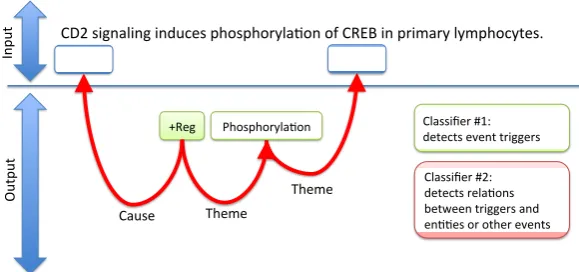
Our statistical model is inspired by the top per-forming approach at the 2009 evaluation (Bj¨orne et al., 2009). The approach is summarized in Fig-ure 1. Similar to (Bj¨orne et al., 2009), our ap-proach consists of two classifiers: the first clas-sifier detects and labels event trigger words in the input text; the second classifiers extracts and la-bels relations between event triggers and potential event participants, which can be either Protein en-tities or other event triggers. Both classifiers are implemented using multi-class logistic regression (LR), but our conversion process (Steps 2 and 3) is independent of the underlying statistical model, so, in principle, other feature-based classifiers that assign explicit weights to features could be used, e.g., perceptron, or linear support vector machines.
The Trigger Classifier
The first classifier sequentially labels each word in the input text as a trigger for a specific BioNLP event class, or asNilotherwise. We implemented the following features:
Surface features: These features include the original and lemmatized words, and the presence of the word in a gazetteer of known event triggers (constructed automati-cally from the training data). These features are generated for the word being classified, as well as the words surrounding it inside a win-dow ofn tokens. We used two windows in our experiments, withn= 1andn= 4. Fur-ther, bag-of-words features are generated for the windows and for the sentence as a whole.
CD2 signaling induces phosphoryla4on of CREB in primary lymphocytes.
In
pu
t
O
utp
ut
Protein
Phosphoryla4on
+Reg Classifier #1:
detects event triggers
Classifier #2: detects rela4ons between triggers and en44es or other events Protein
Theme Theme
[image:3.595.148.438.68.204.2]Cause
Figure 1: Architecture of the statistical model for the BioNLP core event extraction task.
Entity features: These features encode the num-ber of other entities surrounding the token, both inside a window and in the sentence as a whole.
The Event Participant Classifier
This classifier pairs all the triggers detected by the previous classifier with other named entities (Pro-teins in this case) or event triggers that occur in the same sentence. These pairs are then classi-fied into one of the possible participant relations, orNilindicating that there is no relation between the pair. This classifier uses the following features:
Syntactic features: These features are based on the shortest path connecting the two men-tions (trigger and candidate participant) in the Stanford syntactic dependency graph. Two versions of the shortest path are used: a lex-icalized one (capturing the words along the path), and an unlexicalized one.
Surface features: These features include: the or-der of the two mentions in text, their distance in terms of tokens, the number of entities and triggers in the sentence, the parts of speech and words of the mentions, and the number of triggers and entities between the mentions.
Consistency features: These features encode the labels of the two mentions jointly, as well as the labels of their superclasses. For example, the features<Regulation, Phosphorylation> and<Regulation, Event>are generated for a relation between a Regulation event trigger and a Phosphorylation trigger as its theme. These feature capture selectional preferences for arguments, e.g., the Theme of a regulation event should be another event.
Graph features: The parent, children, and sib-lings of the mentions in the syntactic depen-dency graph.
Limitations
Not all of the above features can be represented as rules in the current implementation of the cho-sen rule language. Currently1, Odin rules capture
paths (over sequences or directed graphs) that are anchored at both ends (e.g., from an event trig-ger to an event argument) (Valenzuela-Escarcega et al., 2015; Valenzuela-Escarcega et al., 2016). Because of this, Odin cannot represent the follow-ing information: bag-of-word features, syntactic paths that are not anchored at both ends (such as dependencies connected only to event trigger can-didates), and features that count occurrences of to-kens or entities in text. In Section 3 we analyze the performance drop when such features are removed from the model.
2.2 Step 2: Convert the Statistical Model to a Rule-based Model
Once the statistical model is constructed, we em-ploy the lossy process below to convert it to an interpretable one.
Converting Features to Rules
First, we convert the features encoded in the statistical model to rules in the Odin language (Valenzuela-Escarcega et al., 2015; Valenzuela-Escarcega et al., 2016). In general, the features previously introduced consist of con-junctions of information bits, each of which cor-responds to a different rule fragment. For ex-ample, for the classification of event participants, one such conjunction captures the type of the ex-pected trigger (e.g., Phosphorylation), combined
- name: phospho_event
[image:4.595.312.504.69.319.2]label: Phosphorylation
pattern: |
trigger:Phosphorylation
theme:Protein = >nsubjpass
1" Figure 2: Example of a rule for event participant classification that is built from a single feature. The feature captures the passive nominal subject (nsubjpass) outgoing (>) from a Phosphoryla-tion trigger and landing on a Protein. The bold font indicates the rule output, i.e., the nominal subject is thethemeof aPhosphorylationevent.
with the syntactic path that connects the trigger with the participant candidate (e.g., an outgoing passive nominal subject –nsubjpass), and a se-mantic constraint for the type of named entity of the participant (e.g., Protein). These are imme-diately translatable to Odin rules, as illustrated in Figure 2.
Importantly, the rules encode output informa-tion as well, e.g., the recognized event partic-ipant serves as a theme for a Phosphorylation event in Figure 2. At this stage, this information is exhaustively generated from all possible clas-sifier labels (e.g., for the classification of event participants these labels are the cartesian product of {theme, cause} and possible event labels
{Phosphorylation, Binding, . . .}). Of course, some of these outputs do not apply. For ex-ample, it is highly unlikely that the rule shown in Figure 2 produces the cause of a Regulation event. We quantify the confidence in these outputs in the next stage of the algorithm.
Converting Weights to Votes
Feature weights are unbounded continuous values that are difficult to interpret and manually mod-ify. For this reason, we would ideally prefer to exclude them completely from the interpretable model. Conceptually, this is simple: we could use the weights to choose the most likely output label for a rule (from the options generated pre-viously), and discard them afterwards. However, our early experiments demonstrated that this per-forms poorly, because it forces the algorithm to ig-nore the inherent ambiguity of language, which is captured by the statistical model through weights. For example, the trigger classifier learns that “re-cruits” serves as trigger for two different events, Binding and Localization, and, consequently, as-signs different weights to the two labels based on
Trigger features
Weights
Frequency
−5 0 5 10
0
200
600
1000
Relation features
Weights
Frequency
−6 −4 −2 0 2 4
0
200
400
600
800
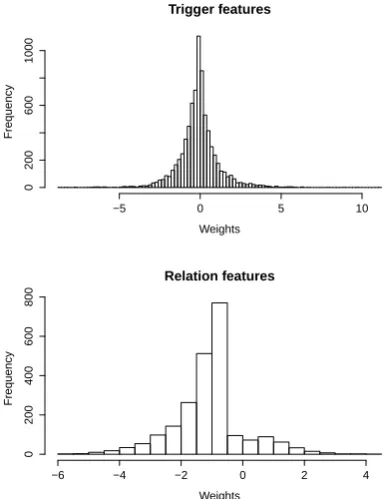
Figure 3: Weights of the two classifiers converted to votes (trigger classifier – top, participant clas-sifier – bottom). Each histogram bin receives a number of votes (positive or negative) equal to its offset from 0.
the amount of evidence seen in training. During inference, the most likely class is chosen by ag-gregating the weights of all features that apply.
Given this observation, we chose to preserve the weights, but convert them from the original unbounded continuous values to discrete “votes” (positive or negative) that are then used during in-ference to resolve conflicts. This achieves two things. First, we increase the interpretability of the model: humans can now interpret these dis-crete votes, which mimic a Likert scale (Likert, 1932). Second, by keeping and using these dis-cretized votes, we preserve some of the statistical power of the model. We show in Section 3 that some performance is indeed lost in this conver-sion, but the loss is small and the gain in inter-pretability compensates for that.
a histogram, for example (Sturges, 1926; Doane, 1976; Freedman and Diaconis, 1981). Here, we use the formula proposed by (Scott, 1979):
h= 3.5ˆσn−1/3 (1)
wherehis the estimated bin width,nis the sample size, andσˆis the estimated standard deviation. We chose this formula because it gives a good com-promise between retaining most of the informa-tion in the weights while minimizing the number of bins. The resulting binned weights for trigger and relation features (generated using the BioNLP 2009 training corpus) are shown in Figure 3.
2.3 Step 3: Edit the Rule-based Model
The output of the previous two steps is a model consisting of a set of rules. The association between rules and output classes is measured through votes that each matching rule gives to each output label. The last step in our proposed approach is to let human domain experts improve this model by directly editing it. The experts had complete freedom in the operations they were al-lowed to do. For example, they could improve the syntactic paths captured by the rules, or in-crease/decrease the number of votes assigned to a specific rule. The only constraints were: (a) they were not allowed to look only at the learned rules and not at the training data, and (b) they had to complete the process within one hour. This setting is of course artificial and unrealistic. We enforced it in this work to demonstrate the interpretability of the generated model.
3 Empirical Results
We analyze the performance of our approach on the core event extraction dataset from the BioNLP 2009 shared task (Kim et al., 2009). All the results reported in this section were measured on the de-velopmentpartition of the dataset, which was not used at all during training.2 To minimize
overfit-ting, we did not implement any feature selection or other hyper parameter tuning process.
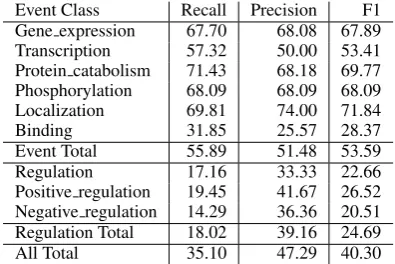
Table 2 lists the results of the complete statis-tical model, i.e., using all features introduced in Section 2.1, trained usingL2-regularized LR. This
configuration generated 1,190,029 features with non-zero weights. The table shows that this model
2The online scoring website, which would have allowed
us to also obtain scores on the official test partition, was down due to updates during the development of this work.
Event Class Recall Precision F1
Gene expression 67.70 68.08 67.89
Transcription 57.32 50.00 53.41
Protein catabolism 71.43 68.18 69.77 Phosphorylation 68.09 68.09 68.09
Localization 69.81 74.00 71.84
Binding 31.85 25.57 28.37
Event Total 55.89 51.48 53.59
Regulation 17.16 33.33 22.66
Positive regulation 19.45 41.67 26.52 Negative regulation 14.29 36.36 20.51 Regulation Total 18.02 39.16 24.69
[image:5.595.316.514.62.194.2]All Total 35.10 47.29 40.30
Table 1: Performance of the statistical model using L2-regularized LR, and all available features.
Event Class Recall Precision F1
Gene expression 57.58 74.28 64.87
Transcription 40.24 57.89 47.48
Protein catabolism 61.90 86.67 72.22 Phosphorylation 51.06 82.76 63.16
Localization 47.17 92.59 62.50
Binding 18.15 34.62 23.81
Event Total 42.75 64.61 51.45
Regulation 8.28 40.00 13.73
Positive regulation 17.18 42.74 24.51 Negative regulation 7.14 40.00 12.12 Regulation Total 13.65 42.14 20.62
[image:5.595.317.516.239.372.2]All Total 26.77 56.22 36.27
Table 2: Performance of the statistical model with L2-regularized LR, using only features that can be
converted to rules.
achieved an overall F1 score of over 40 points, which likely puts it in the top 5 or 6 (out of 24) sys-tems that participated in the actual challenge.3 The
performance of this system could be further im-proved by adding more features proposed in other event extraction approaches (Miwa et al., 2010), feature selection, hyper parameter tuning, etc.
For a fair comparison, we next trained the same model but using only features that can be con-verted to rules. As discussed, the features that were removed include bag-of-word features and features that count occurrences of tokens or enti-ties in text. These results, summarized in Table 2, show that the overall F1 score drops 4 points. This suggests that rule languages need to be extended if they are to have the same representational power as feature-based models. Given that the focus of
3(Kim et al., 2009) report results on the official test
Event Class Recall Precision F1 Gene expression 58.71 78.28 67.09
Transcription 37.80 55.36 44.93
Protein catabolism 61.90 86.67 72.22 Phosphorylation 46.81 84.62 60.27
Localization 56.60 88.24 68.97
Binding 16.13 33.33 21.74
Event Total 42.75 66.60 52.08
Regulation 8.88 65.22 15.62
Positive regulation 13.13 40.50 19.83 Negative regulation 8.16 55.17 14.22 Regulation Total 11.41 44.44 18.15
[image:6.595.317.515.61.195.2]All Total 25.54 59.35 35.72
Table 3: Performance of the statistical model with L1-regularized LR, using only features that can be
converted to rules.
this work is not on the design of rule-based lan-guages for IE, we will use this latter model as the starting point of our approach, ignoring (for now) the performance penalty observed above.
Importantly, a system with more than 1 million features is not interpretable. To address this, we trained the same system usingL1regularization as
a form of feature selection. This reduced the num-ber of features with non-zero weights by two or-ders of magnitude: from over 1 million to 10,926. The performance of this model is shown in Ta-ble 3. The results demonstrate that this drastic re-duction in the number of useful features came with a small performance cost, of less than 1 F1 point.
Given this successful compression of the fea-ture space, we next convert this L1-regularized
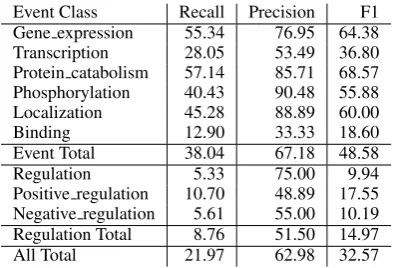
model to rules, using the approach discussed in Section 2.2. The performance of the rule-based model (before expert intervention!) is summa-rized in Table 4. The table shows that the over-all cost of “snapping to grid” the statistical model is approximately 3 F1 points, which come from a drop in recall. This happens because many fea-ture weights associated with specific labels (such as specific event triggers) have low values (due to sparsity), and, after the discretization process, the model can no longer prioritize these labels over the Nilclass. Interestingly, the same process yielded a small increase in precision from 59% to 62%.
All in all, we consider a drop of 3 F1 points for the gain of interpretability an acceptable trade-off. To empirically demonstrate the value of in-terpretability, we let two Linguistics PhD students edit the generated rule-based model for one hour, aiming to improve its generalization, robustness to syntactic errors, and readability. The students were familiar with the Odin language (Valenzuela-Escarcega et al., 2015) so they could “read” the
Event Class Recall Precision F1
Gene expression 55.34 76.95 64.38
Transcription 28.05 53.49 36.80
Protein catabolism 57.14 85.71 68.57 Phosphorylation 40.43 90.48 55.88
Localization 45.28 88.89 60.00
Binding 12.90 33.33 18.60
Event Total 38.04 67.18 48.58
Regulation 5.33 75.00 9.94
Positive regulation 10.70 48.89 17.55 Negative regulation 5.61 55.00 10.19 Regulation Total 8.76 51.50 14.97
All Total 21.97 62.98 32.57
Table 4: Performance of the rule-based model be-fore expert intervention.
model, and had a high-level understanding of the BioNLP shared task (although they did not par-ticipate in it). To guarantee that their recommen-dations came from understanding the model rather than other external factors, they were not given ac-cess to the BioNLP dataset. Given the large num-ber of rules at this point, the students tended to randomly sample the rules in the model attempt-ing to find repeated mistakes, rather than linearly inspect the list of rules. Table 5 summarizes the experts’ recommendations. As shown, several of the experts’ suggestions involved removing or col-lapsing rules, which reduced the number of rules from 10,926 to 8,868.
Table 6 lists the performance of the resulting model, after implementing the experts’ recom-mendations. The table shows that most of the F1 loss has been recovered: the overall F1 score for this system approaches 35 F1 points, and is less than 1 F1 point behind theL1-regularized LR sta-tistical model. In addition of reducing the number of rules in the model, the experts’ recommenda-tions increased recall by over 4%, which is more than what was lost during the conversion to rules. However, the precision of this configuration de-creased by 11%, which we blame on the experts’ limited familiarity with the BioNLP task, and the strict settings of the experiment (no access to data, limited time). However, all in all, this experiment demonstrates that the rule-based model produced by the proposed approach is interpretable: the ex-perts understood the model, and were able to im-prove it, both with respect to its generalization power and its readability.
[image:6.595.81.281.62.194.2]Suggested Change Description Generalization
Add
/conj_(and|or|nor)|dep|cc|nn|prep_of/{,2}
to the end of Theme paths.
This transformation adds an optional modifier depen-dency to capture event participants when they appear either as nominal heads or modifiers. For example, be-cause of this transformation, the model handles both these phrases similarly: “phosphorylation of MEK” and “phosphorylation of the MEK protein”
Ensure that all syntactic paths end inappos?. This change handles optional apposition to increase rule coverage. For example, in the sentence “we found that A20 binds to a novel protein, ABIN”, the word ABIN is an appositive for the word protein, so ABIN can serve as an argument in the binding event.
Replace all specific named entities with their label. For example, in rules such as
[word=phosphorylates] (?=MEK) that
reference a specific protein, this replaces the specific protein (MEK) with the labelProtein. This improves rule generalization and, at the same time, reduces the total number of rules.
Make the>nndependency optional in
Theme:Protein = >nsubjpass >nn. The output of this transformation is similar to the firstsuggested change, i.e., the same rule captures event par-ticipants when they appear either as nominal heads or modifiers.
Robustness
Replaceagentwith/ˆ(agent|prep_by)$/. This modification is designed to account for a common parsing error of passive sentences, whereagent de-pendencies are incorrectly parsed asprep_by. Change ccomp to /(c|x)comp/ and acomp to
/(a|x)comp/. Parsers often confuse clausal and adjectival comple-ments with open clausal complements. This transfor-mation allows the rules to be robust to these errors.
Readability
Merge rules when possible, e.g.
prep_of,prep_of nn,prep_of appos
becomeprep_of (nn? appos | nn appos? nn?)?.
This transformation collapses rules to improve readabil-ity.
Eliminate trigger rules that are not sufficiently discriminative
(e.g.,(?<=[lemma="be"]) [tag=/ˆ(V|N|J)/). Some uninformative rules survived feature regulariza-tion but should be removed, as with the example rule which looks for any verb, noun, or adjective preceded by any conjugation of the verb “be”. These rules inflate the grammar without adding discriminative power. Do not usewordconstraints. Only uselemmaandtag
fea-tures in trigger rules for simple events (other than transcription and binding).
This modification prefers lexical constraints on lemmas, because they generalize better than constraints on actual words.
Remove redundant constraints. For example, in patterns like
[incoming=nsubj & tag=/ˆN/] the POS
[image:7.595.67.532.59.525.2]tag is redundant because it is implicitly defined through the incoming dependency (nominal subject).
Table 5: Representative examples of the rule changes suggested by linguistic experts. the behavior of its statistical counterpart, with a
small penalty of 1-2 F1 points throughout. As dis-cussed before, this performance loss can be miti-gated through interventions by domain experts.
4 Related Work
Most of the biomedical IE systems in academia rely on supervised machine learning. This in-cludes the top performing system at the BioNLP 2009 shared task (Bj¨orne et al., 2009), as well as several following approaches that improve upon its performance (Miwa et al., 2010; McClosky et al., 2012; Miwa et al., 2012; Bui and Sloot, 2012; Venugopal et al., 2014).
However, rule-based approaches (Appelt et al.,
1993; Cunningham et al., 2002; Piskorski et al., 2004; Li et al., 2011; Chang and Manning, 2014) are preferable when the corresponding systems have to be deployed for long periods of time, during which they have to be maintained and improved. This has been recognized in indus-try (Chiticariu et al., 2013).
Event Class Recall Precision F1 Gene expression 60.39 70.49 65.05
Transcription 31.71 57.78 40.94
Protein catabolism 61.90 81.25 70.27 Phosphorylation 42.55 86.96 57.14
Localization 45.28 88.89 60.00
Binding 22.18 23.50 22.82
Event Total 43.74 54.31 48.46
Regulation 10.06 40.48 16.11
Positive regulation 12.80 44.89 19.92 Negative regulation 10.71 51.22 17.72 Regulation Total 11.91 45.17 18.86
[image:8.595.81.282.62.194.2]All Total 26.27 51.71 34.84
Table 6: Performance of the rule-based model, af-ter expert inaf-tervention.
0 10 20 30 40
200 400 600 800
Number of abstracts
F1 score
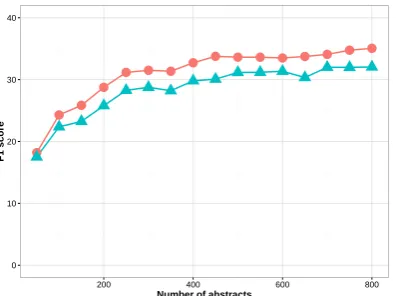
Figure 4: Learning curve showing the change in F1 performance as a function of the amount of training data. We compare the performance of theL1-regularized logistic regression (shown
us-ing circles) with the rule-based model prior to the expert intervention (shown using triangles).
presents the “human in the loop” with new ex-amples to annotate (Thompson et al., 1999). Al-though active learning may require less domain expertise than our proposal, it generally does not guarantee that the examples provided are actually propagated in the model (the learning algorithm may choose to override them with other data).
5 Conclusion and Future Work
We have proposed a simple approach that mar-ries the advantages of machine learning models for information extraction (such as learning di-rectly from data) with the benefits of rule-based approaches (interpretability, easier maintainabil-ity). Our approach starts by training a feature-based statistical model, then converts this model to a rule-based variant by converting its features to rules and its feature weights to discrete votes. In doing so, our proposal learns from data similar to
other machine learning approaches, but produces an interpretable rule-based model that can be di-rectly edited by experts. Using the BioNLP 2009 event extraction task as a test bed, we show that while there is a small performance penalty when converting the statistical model to rules, the gain in interpretability compensates for that.
In this work, we focused on building upon featubased classifiers, in particular logistic re-gression, due to their potential extensions to dis-tant supervision (DS), where training data is gen-erated automatically by aligning a knowledge base (KB) of known examples (e.g., known drug-gene interactions) with text (e.g., scientific publica-tions). Distant supervision has obvious applica-tions to bioinformatics (Craven et al., 1999), but it generally suffers from noise in the automatically-generated annotations (Riedel et al., 2010). In fu-ture work, we plan to combine our work with dis-tant supervision by adapting our proposal to logis-tic regression variants that are robust to the noise introduced in DS (Surdeanu et al., 2012). This ex-tension would make it possible to generate rules even when no annotated examples are available, as long as a suitable KB of known examples exists.
Another planned extension of this work focuses on reducing the number of generated rules by merging/collapsing similar paths into a single pat-tern. This can be achieved by constructing a min-imal deterministic acyclic finite-state automaton (DAFSA) (Daciuk et al., 2000) with the paths that are similar, and then converting the DAFSA into a single pattern (Neumann, 2005). For example, such approaches would collapse the two patterns: dobj and dobj nn, into a single one: dobj nn?. This is fundamental for the long-term main-tainability of the rule-based model, because the human experts would have to maintain consider-ably fewer rules.
[image:8.595.85.284.242.390.2]Acknowledgments
This work was funded by the Defense Advanced Research Projects Agency (DARPA) Big Mecha-nism program under ARO contract W911NF-14-1-0395.
References
Douglas E. Appelt, Jerry R. Hobbs, John Bear, David Israel, and Mabry Tyson. 1993. Fastus: A finite-state processor for information extraction from real-world text. InProceedings of the International Con-ferences on Artificial Intelligence (IJCAI).
Jari Bj¨orne, Juho Heimonen, Filip Ginter, Antti Airola, Tapio Pahikkala, and Tapio Salakoski. 2009. Ex-tracting complex biological events with rich graph-based feature sets. InProceedings of the Workshop on Current Trends in Biomedical Natural Language
Processing: Shared Task, pages 10–18. Association
for Computational Linguistics.
Quoc-Chinh Bui and Peter MA Sloot. 2012. A robust approach to extract biomedical events from litera-ture. Bioinformatics, 28(20):2654–2661.
Angel X. Chang and Christopher D. Manning. 2014. TokensRegex: Defining cascaded regular expres-sions over tokens. Technical Report CSTR 2014-02, Computer Science, Stanford.
Laura Chiticariu, Yunyao Li, and R. Reiss, Frederick. 2013. Rule-based Information Extraction is Dead! Long Live Rule-based Information Extraction Sys-tems! InProceedings of 2013 Conference on Em-pirical Methods in Natural Language Processing
(EMNLP).
Paul R. Cohen. 2015. DARPA’s Big Mechanism pro-gram. Physical Biology, 12(4):045008.
Mark Craven, Johan Kumlien, et al. 1999. Construct-ing biological knowledge bases by extractConstruct-ing infor-mation from text sources. In ISMB, volume 1999, pages 77–86.
Hamish Cunningham, Diana Maynard, Kalina Bontcheva, and Valentin Tablan. 2002. A frame-work and graphical development environment for robust nlp tools and applications. In ACL, pages 168–175.
Jan Daciuk, Stoyan Mihov, Bruce W Watson, and Richard E Watson. 2000. Incremental construction of minimal acyclic finite-state automata. Computa-tional linguistics, 26(1):3–16.
Marie-Catherine De Marneffe and Christopher D Man-ning. 2008. Stanford typed dependencies manual. Technical report, Stanford University.
David P Doane. 1976. Aesthetic frequency classifica-tions. The American Statistician, 30(4):181–183.
David Freedman and Persi Diaconis. 1981. On the his-togram as a density estimator:l2theory.Probability theory and related fields, 57(4):453–476.
Mohit Iyyer, Anupam Guha, and Jordan Boyd-Graber. 2016. Feuding Families and Former Friends: Unsu-pervised Learning for Dynamic Fictional Relation-ships. In Proceedings of the 15th Annual Confer-ence of the North American Chapter of the Associ-ation for ComputAssoci-ational Linguistics: Human
Lan-guage Technologies (NAACL-HLT).
Jin-Dong Kim, Tomoko Ohta, Sampo Pyysalo, Yoshi-nobu Kano, and Junichi Tsujii. 2009. Overview of BioNLP09 Shared Task on Event Extraction. In
Proceedings of the Workshop on BioNLP: Shared Task.
Jin-Dong Kim, Yue Wang, and Yamamoto Yasunori. 2013. The Genia Event Extraction Shared Task, 2013 Edition - Overview. In Proceedings of the
BioNLP Shared Task 2013 Workshop.
Yunyao Li, Frederick R Reiss, and Laura Chiticariu. 2011. Systemt: A declarative information extraction system. InProceedings of the 49th Annual Meeting of the Association for Computational Linguistics: Human Language Technologies: Systems
Demon-strations, pages 109–114. Association for
Compu-tational Linguistics.
Rensis Likert. 1932. A technique for the measurement of attitudes.Archives of psychology.
Christopher D Manning, Mihai Surdeanu, John Bauer, Jenny Rose Finkel, Steven Bethard, and David Mc-Closky. 2014. The stanford corenlp natural lan-guage processing toolkit. In ACL (System Demon-strations), pages 55–60.
David McClosky, Sebastian Riedel, Mihai Surdeanu, Andrew McCallum, and Christopher D. Manning. 2012. Combining joint models for biomedical event extraction. BMC Bioinformatics, 13(Suppl 11)(S9). Makoto Miwa, Rune Sætre, Jin-Dong Kim, and
Jun’ichi Tsujii. 2010. Event extraction with com-plex event classification using rich features.
Jour-nal of bioinformatics and computatioJour-nal biology,
8(01):131–146.
Makoto Miwa, Paul Thompson, and Sophia Ana-niadou. 2012. Boosting automatic event ex-traction from the literature using domain adapta-tion and coreference resoluadapta-tion. Bioinformatics, 28(13):1759–1765.
Christoph Neumann. 2005. Converting deter-ministic finite automata to regular expressions. http://neumannhaus.com/christoph/papers/2005-03-16.DFA to RegEx.pdf.
Sebastian Riedel, Limin Yao, and Andrew McCal-lum. 2010. Modeling relations and their men-tions without labeled text. InMachine Learning and
Knowledge Discovery in Databases, pages 148–163.
Springer.
David W Scott. 1979. On optimal and data-based his-tograms. Biometrika, 66(3):605–610.
D. Sculley, Gary Holt, Daniel Golovin, Eugene Davy-dov, Todd Phillips, Dietmar Ebner, Vinay Chaud-hary, Michael Young, Jean-Francois Crespo, and Dan Dennison. 2014. Hidden Technical Debt in Machine Learning Systems. In Proceedings of SE4ML: Software Engineering for Machine
Learn-ing (NIPS 2014 Workshop).
Herbert A Sturges. 1926. The choice of a class inter-val. Journal of the american statistical association, 21(153):65–66.
Mihai Surdeanu, Julie Tibshirani, Ramesh Nallapati, and Christopher D Manning. 2012. Multi-instance multi-label learning for relation extraction. In Pro-ceedings of the 2012 Joint Conference on Empirical Methods in Natural Language Processing and
Com-putational Natural Language Learning, pages 455–
465. Association for Computational Linguistics. Cynthia A Thompson, Mary Elaine Califf, and
Ray-mond J Mooney. 1999. Active learning for natu-ral language parsing and information extraction. In
ICML, pages 406–414. Citeseer.
Marco A. Valenzuela-Escarcega, Gustave Hahn-Powell, and Mihai Surdeanu. 2015. Description of the Odin Event Extraction Framework and Rule Language. InarXiv:1509.07513.
Marco A. Valenzuela-Escarcega, Gustave Hahn-Powell, and Mihai Surdeanu. 2016. Odin’s Runes: A Rule Language for Information Extraction. In
Proceedings of the 10th edition of the Language
Re-sources and Evaluation Conference (LREC).